CONDUCT OF
FLIGHT
OPERATION
Name : Nizarudin (Nizar)
Work Experience: Mandala Airlines (1999 – 2014)
Citilink Indonesia (2014 – present)
Sylabus (CASR 63 Appendix D)
1) Dispatcher and pilot briefing.
2) Preflight
a) Safety
b) Weather Analysis
c) NOTAMs and airport conditions
d) Crew
e) Aircraft
f) Flight Planning
g) Weight and Balance
h) Economic of flight overview
i) Decision to operate the flight
j) ATC Flight Plan
k) Flight Documentation
Sylabus (CASR 63 Appendix D)
3) Authorize flight departure with concurrence of PIC.
4) Inflight Operational Control
a) Current Situation Awareness
b) Information Exchange
c) Amend original flight release as required
5) Post-Flight
a) Arrival Verification
b) Weather Debrief
c) Flight Irregularity Report
CONDUCT OF
FLIGHT
OPERATION
DISPATCHER AND PILOT BRIEFING
OPERATION CONTROL SYSTEM
1) Crew Dispatcher.
2) Flight Dispatcher.
3) Load Control.
4) Ramp Dispatcher.
5) Operation Control Center.
1. CREW DISPATCHER
 Responsible for the implementation of the Crew
Rotation Plan (CROPA) in supporting of the
planned flight program.
 Provide crews with Aircraft Flight Schedule (AFL).
 Revise crews Flight Schedule, if any there are
changes to Crew Plan due to no show crew or other
reason.
 Monitoring crews duty and flight time (Crew
Tracking).
1. CREW DISPATCHER
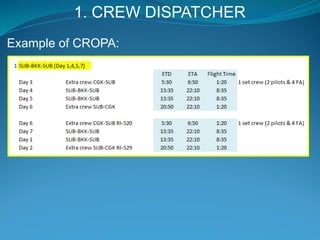
Example of CROPA:
1. CREW DISPATCHER
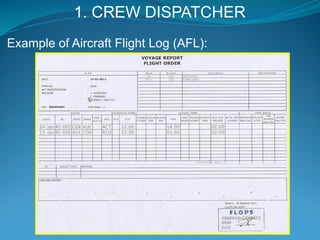
Example of Aircraft Flight Log (AFL):
1. CREW DISPATCHER
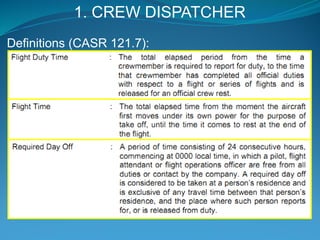
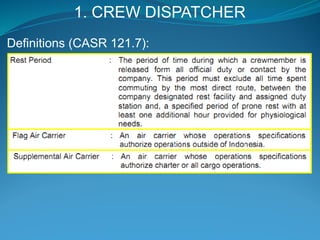
Definitions (CASR 121.7):
1. CREW DISPATCHER
Definitions (CASR 121.7):
1. CREW DISPATCHER
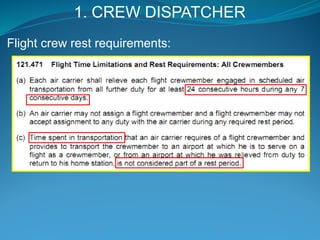
Flight crew rest requirements:
1. CREW DISPATCHER
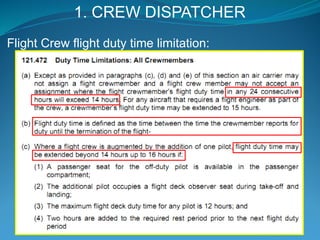
Flight Crew flight duty time limitation:
1. CREW DISPATCHER
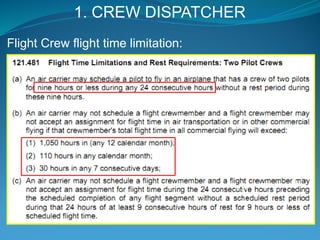
Flight Crew flight time limitation:
1. CREW DISPATCHER
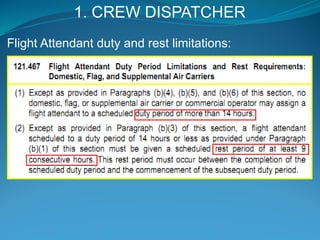
Flight Attendant duty and rest limitations:
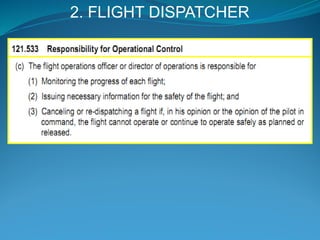
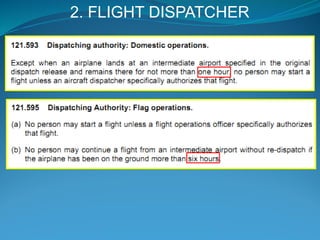
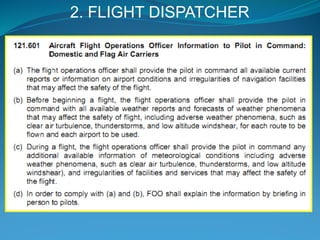
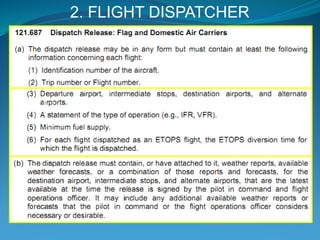
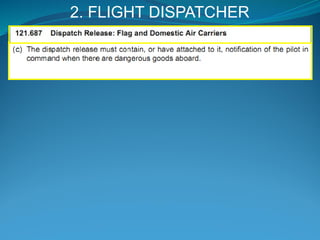
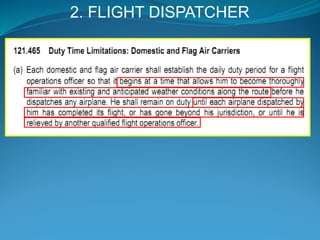
2. FLIGHT DISPATCHER
Example of Dispatch Release:
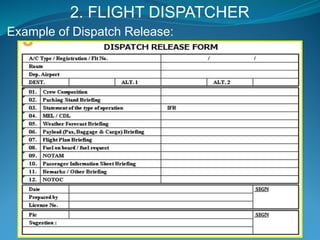
2. FLIGHT DISPATCHER
Example of Dispatch Release:
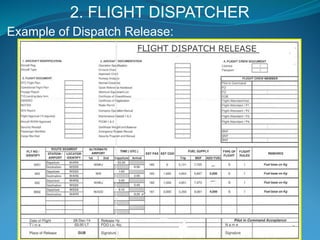
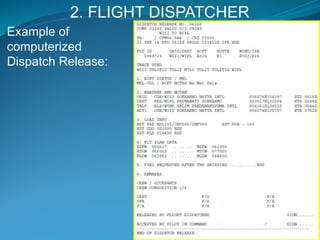
2. FLIGHT DISPATCHER
Example of
computerized
Dispatch Release:
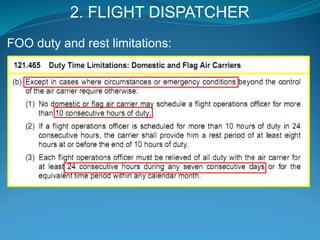
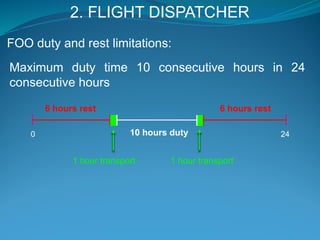
2. FLIGHT DISPATCHER
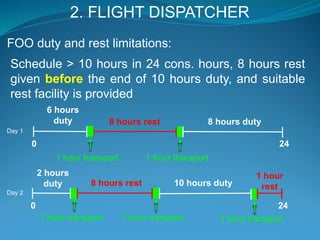
FOO duty and rest limitations:
Maximum duty time 10 consecutive hours in 24
consecutive hours
10 hours duty
0 24
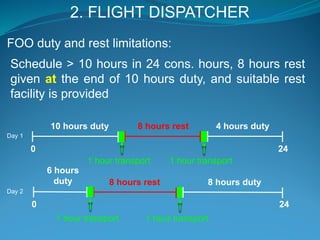
2. FLIGHT DISPATCHER
FOO duty and rest limitations:
6 hours rest 6 hours rest
1 hour transport 1 hour transport
0 24
4 hours duty
10 hours duty 8 hours rest
Schedule > 10 hours in 24 cons. hours, 8 hours rest
given at the end of 10 hours duty, and suitable rest
facility is provided
2. FLIGHT DISPATCHER
FOO duty and rest limitations:
0 24
6 hours
duty 8 hours rest
Day 1
Day 2
1 hour transport 1 hour transport
8 hours duty
0 24
10 hours duty
2 hours
duty 8 hours rest
Day 2
1 hour transport 1 hour transport
Schedule > 10 hours in 24 cons. hours, 8 hours rest
given before the end of 10 hours duty, and suitable
rest facility is provided
2. FLIGHT DISPATCHER
FOO duty and rest limitations:
0 24
6 hours
duty 8 hours rest
Day 1
1 hour transport 1 hour transport
8 hours duty
1 hour transport
1 hour
rest
2. FLIGHT DISPATCHER
3. LOAD CONTROL
 Responsible for supervising and directing loading
and unloading process of the flight he/she assigned
for.
 Provide aircraft Weight and Balance calculation
(Load Sheet).
 Ensure that the load positioning in cargo
compartments is done in accordance with given
loading instruction and/or planning.
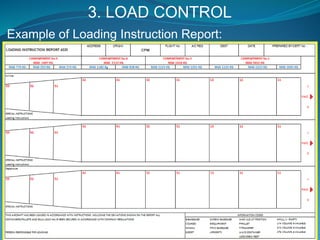
3. LOAD CONTROL
Example of Loading Instruction Report:
3. LOAD CONTROL
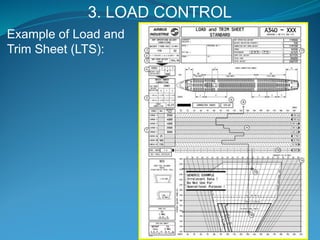
Example of Load and
Trim Sheet (LTS):
3. LOAD CONTROL
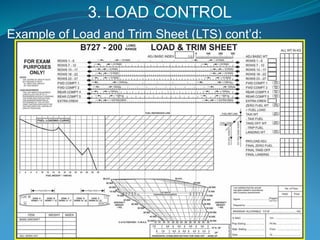
Example of Load and Trim Sheet (LTS) cont’d:
3. LOAD CONTROL
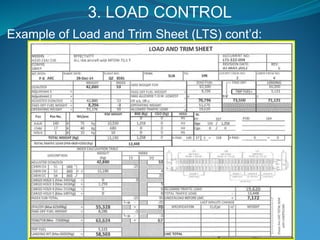
Example of Load and Trim Sheet (LTS) cont’d:
3. LOAD CONTROL
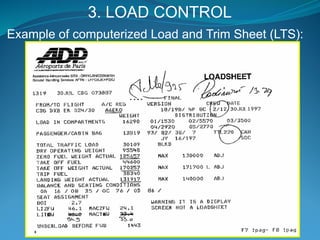
Example of computerized Load and Trim Sheet (LTS):
4. RAMP DISPATCHER
 Responsible for supervising the flight preparation
activities on the ramp / apron, concerning the
operation on a flight that he/she assigned for in
order to dispatch the flight on time.
4. RAMP DISPATCHER
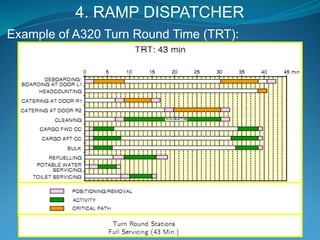
Example of A320 Turn Round Time (TRT):
4. RAMP DISPATCHER
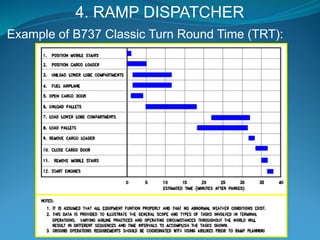
Example of B737 Classic Turn Round Time (TRT):
4. RAMP DISPATCHER
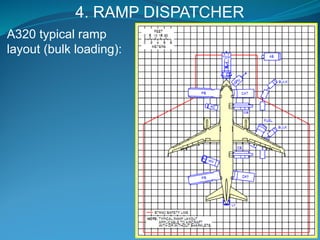
A320 typical ramp
layout (bulk loading):
4. RAMP DISPATCHER
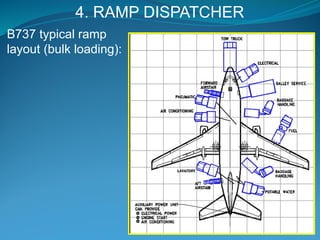
B737 typical ramp
layout (bulk loading):
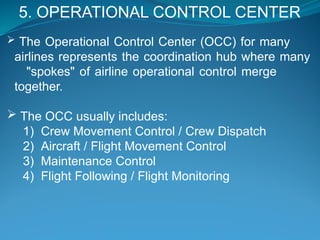
5. OPERATIONAL CONTROL CENTER
 The Operational Control Center (OCC) for many
airlines represents the coordination hub where many
"spokes" of airline operational control merge
together.
 The OCC usually includes:
1) Crew Movement Control / Crew Dispatch
2) Aircraft / Flight Movement Control
3) Maintenance Control
4) Flight Following / Flight Monitoring
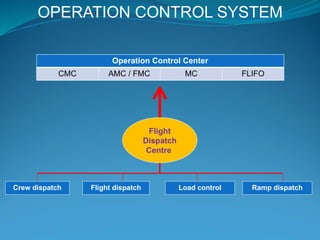
Operation Control Center
CMC AMC / FMC MC FLIFO
Ramp dispatch
Load control
Flight dispatch
Crew dispatch
Flight
Dispatch
Centre
OPERATION CONTROL SYSTEM
CONDUCT OF
FLIGHT
OPERATION
PREFLIGHT
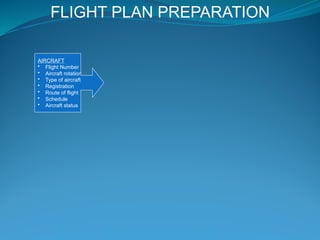
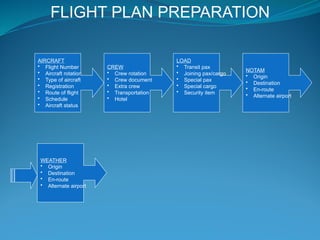
AIRCRAFT
• Flight Number
• Aircraft rotation
• Type of aircraft
• Registration
• Route of flight
• Schedule
• Aircraft status
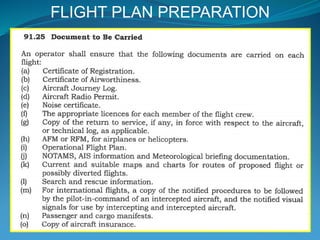
FLIGHT PLAN PREPARATION
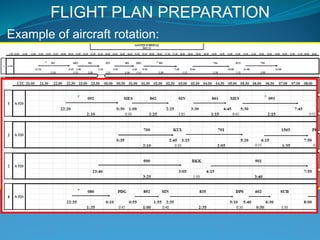
Example of aircraft rotation:
FLIGHT PLAN PREPARATION
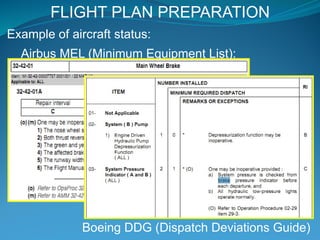
Example of aircraft status:
Airbus MEL (Minimum Equipment List):
Boeing DDG (Dispatch Deviations Guide)
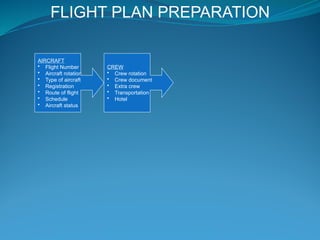
AIRCRAFT
• Flight Number
• Aircraft rotation
• Type of aircraft
• Registration
• Route of flight
• Schedule
• Aircraft status
CREW
• Crew rotation
• Crew document
• Extra crew
• Transportation
• Hotel
FLIGHT PLAN PREPARATION
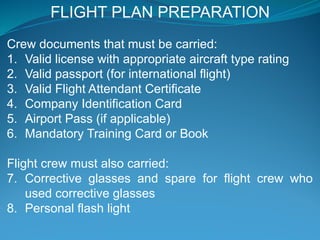
Crew documents that must be carried:
1. Valid license with appropriate aircraft type rating
2. Valid passport (for international flight)
3. Valid Flight Attendant Certificate
4. Company Identification Card
5. Airport Pass (if applicable)
6. Mandatory Training Card or Book
Flight crew must also carried:
7. Corrective glasses and spare for flight crew who
used corrective glasses
8. Personal flash light
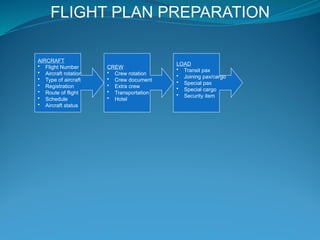
FLIGHT PLAN PREPARATION
AIRCRAFT
• Flight Number
• Aircraft rotation
• Type of aircraft
• Registration
• Route of flight
• Schedule
• Aircraft status
CREW
• Crew rotation
• Crew document
• Extra crew
• Transportation
• Hotel
LOAD
• Transit pax
• Joining pax/cargo
• Special pax
• Special cargo
• Security item
FLIGHT PLAN PREPARATION
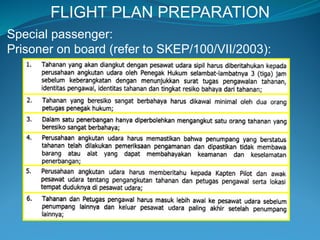
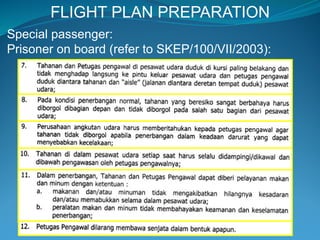
Special passenger:
Prisoner on board (refer to SKEP/100/VII/2003):
FLIGHT PLAN PREPARATION
Special passenger:
Prisoner on board (refer to SKEP/100/VII/2003):
FLIGHT PLAN PREPARATION
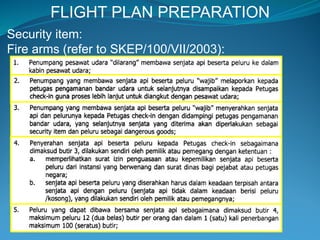
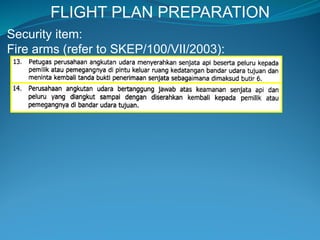
Security item:
Fire arms (refer to SKEP/100/VII/2003):
FLIGHT PLAN PREPARATION
Security item:
Fire arms (refer to SKEP/100/VII/2003):
FLIGHT PLAN PREPARATION
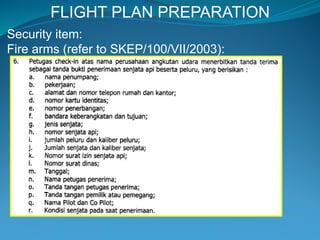
Security item:
Fire arms (refer to SKEP/100/VII/2003):
FLIGHT PLAN PREPARATION
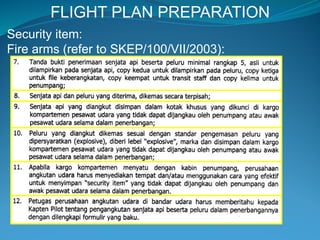
Security item:
Fire arms (refer to SKEP/100/VII/2003):
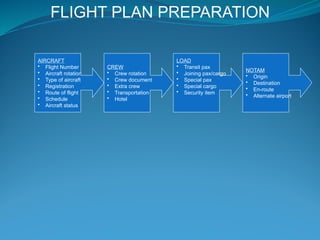
AIRCRAFT
• Flight Number
• Aircraft rotation
• Type of aircraft
• Registration
• Route of flight
• Schedule
• Aircraft status
CREW
• Crew rotation
• Crew document
• Extra crew
• Transportation
• Hotel
LOAD
• Transit pax
• Joining pax/cargo
• Special pax
• Special cargo
• Security item
NOTAM
• Origin
• Destination
• En-route
• Alternate airport
FLIGHT PLAN PREPARATION
 NOTAM are notices that containing information
concerning the establishment, condition or change
in any aeronautical facility, service, procedure or
hazard, the timely knowledge of which is essential to
personnel concerned with flight operation.
FLIGHT PLAN PREPARATION
 A NOTAM is divided into several parts:
1) The first line contains NOTAM identification (one
letter to indicate the Series, a 4 digit NOTAM
number followed by a stroke and 2 digits to indicate
the year), the type of operation (N for NEW, R for
REPLACE, or C for CANCEL), as well as a
reference to a previously-issued NOTAM for
NOTAMR and NOTAMC. Example:
A0307/06 NOTAMR
FLIGHT PLAN PREPARATION
 A NOTAM is divided into several parts:
1) The Series classified NOTAM as follows:
a. Series A. General rules, en-route navigation and
communication facilities, airspace restrictions and
activities taking place above FL 245 and information
concerning major international aerodromes.
b. Series B. Information on airspace restrictions, on
activities taking place below FL 245 and on other
international aerodromes at which IFR flights are
permitted.
c. Series C. Information on other international aerodromes
at which only VFR flights are permitted.
d. Series D. Information on national aerodromes.
e. Series E. Information on heliports.
FLIGHT PLAN PREPARATION
 A NOTAM is divided into several parts:
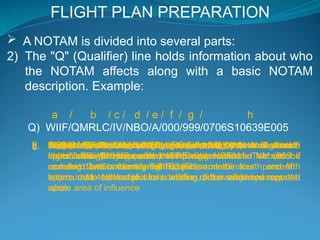
2) The "Q" (Qualifier) line holds information about who
the NOTAM affects along with a basic NOTAM
description. Example:
a / b / c / d / e / f / g / h
Q) WIIF/QMRLC/IV/NBO/A/000/999/0706S10639E005
a. FIR: ICAO FIR Location Indicator
c. Traffic: I for IFR, V for VFR, and IV for IFR & VFR
d. Purpose: N - Need immediate attention of flight crew members
B - Will be appear in a PIB
O - Concerning flight operation
M - Not subject for a briefing, but available on request
e. Scope: A for Aerodrome, E for En-route, and W for Navigation
Warning
f. Airspace lower limit (in Flight Level, 000 if doesn’t contain
specific height information). The values entered should be
rounded down to the nearest 100 ft increment
b. NOTAM Code: The first letter, Q, indicates that it is a code
abbreviation for use when composing NOTAM. The second
and third letters identify the subject, and the fourth and fifth
letters, denote the status or condition of the subjected reported
upon.
g. Airspace upper limit (in Flight Level). the values entered should
be rounded up to the nearest 100 ft increment.
h. Coordinates and Radius; 4 digits followed by N or S, then 5
digits followed by E or W, then 3 digits radius in NM (999 if
covering one or more FIR). The coordinates present
approximate center of circle whose radius encompasses the
whole area of influence
FLIGHT PLAN PREPARATION
 A NOTAM is divided into several parts:
3) Item A
ICAO Location indicator of the aerodrome or FIR in
which the facility, airspace, or condition being
reported on is located. If there is no available ICAO
location indicator, use the ICAO nationality plus XX
and followed up in Item E) by the name, in plain
language. Example:
A) WIII
FLIGHT PLAN PREPARATION
 A NOTAM is divided into several parts:
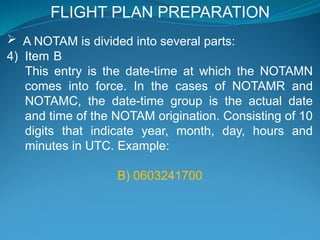
4) Item B
This entry is the date-time at which the NOTAMN
comes into force. In the cases of NOTAMR and
NOTAMC, the date-time group is the actual date
and time of the NOTAM origination. Consisting of 10
digits that indicate year, month, day, hours and
minutes in UTC. Example:
B) 0603241700
FLIGHT PLAN PREPARATION
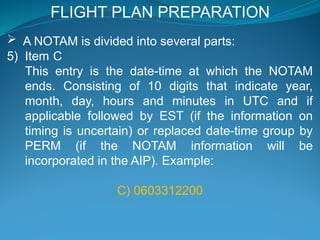
 A NOTAM is divided into several parts:
5) Item C
This entry is the date-time at which the NOTAM
ends. Consisting of 10 digits that indicate year,
month, day, hours and minutes in UTC and if
applicable followed by EST (if the information on
timing is uncertain) or replaced date-time group by
PERM (if the NOTAM information will be
incorporated in the AIP). Example:
C) 0603312200
FLIGHT PLAN PREPARATION
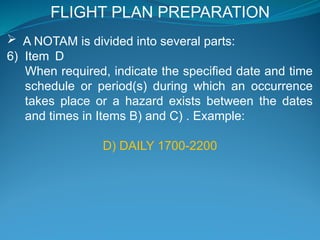
 A NOTAM is divided into several parts:
6) Item D
When required, indicate the specified date and time
schedule or period(s) during which an occurrence
takes place or a hazard exists between the dates
and times in Items B) and C) . Example:
D) DAILY 1700-2200
FLIGHT PLAN PREPARATION
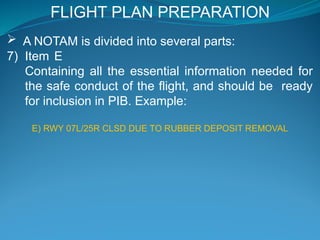
 A NOTAM is divided into several parts:
7) Item E
Containing all the essential information needed for
the safe conduct of the flight, and should be ready
for inclusion in PIB. Example:
E) RWY 07L/25R CLSD DUE TO RUBBER DEPOSIT REMOVAL
FLIGHT PLAN PREPARATION
 A NOTAM is divided into several parts:
8) Item F
The lower limit as SFC (surface), GND (ground
level), an altitude in meters or feet above mean sea
level, a height above ground or a flight level.
Example:
F) GND
FLIGHT PLAN PREPARATION
 A NOTAM is divided into several parts:
9) Item G
The upper limit as an altitude either in meters or
feet above mean sea level, a height above the
ground, a flight level or as UNL (unlimited) if
applicable. Example:
G) 10.000FT
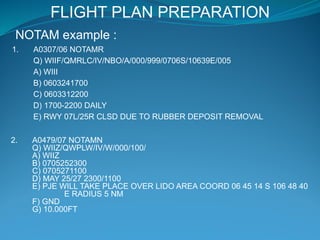
NOTAM example :
1. A0307/06 NOTAMR
Q) WIIF/QMRLC/IV/NBO/A/000/999/0706S/10639E/005
A) WIII
B) 0603241700
C) 0603312200
D) 1700-2200 DAILY
E) RWY 07L/25R CLSD DUE TO RUBBER DEPOSIT REMOVAL
2. A0479/07 NOTAMN
Q) WIIZ/QWPLW/IV/W/000/100/
A) WIIZ
B) 0705252300
C) 0705271100
D) MAY 25/27 2300/1100
E) PJE WILL TAKE PLACE OVER LIDO AREA COORD 06 45 14 S 106 48 40
E RADIUS 5 NM
F) GND
G) 10.000FT
FLIGHT PLAN PREPARATION
 Special NOTAM:
1) ASHTAM, used to notify an operationally
significant change in volcanic activity, the
location, date and time of volcanic eruptions
and/or horizontal and vertical extent of volcanic
ash cloud, including direction of movement, flight
levels and routes or portions of routes which
could be affected.
2) SNOWTAM, used to notify the presence or
removal of hazardous conditions on the
movement area due to snow, slush, ice or water
associated with these conditions.
FLIGHT PLAN PREPARATION
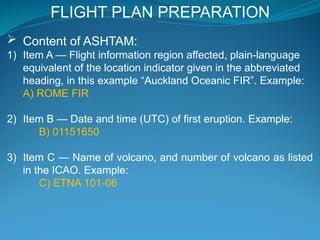
 Content of ASHTAM:
1) Item A — Flight information region affected, plain-language
equivalent of the location indicator given in the abbreviated
heading, in this example “Auckland Oceanic FIR”. Example:
A) ROME FIR
2) Item B — Date and time (UTC) of first eruption. Example:
B) 01151650
3) Item C — Name of volcano, and number of volcano as listed
in the ICAO. Example:
C) ETNA 101-06
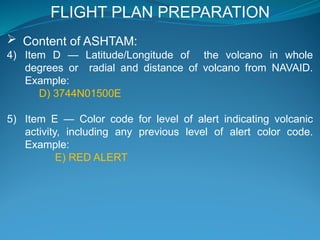
FLIGHT PLAN PREPARATION
 Content of ASHTAM:
4) Item D — Latitude/Longitude of the volcano in whole
degrees or radial and distance of volcano from NAVAID.
Example:
D) 3744N01500E
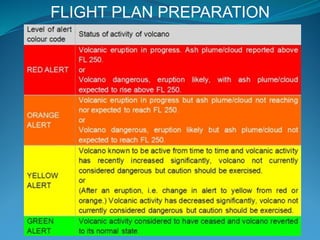
5) Item E — Color code for level of alert indicating volcanic
activity, including any previous level of alert color code.
Example:
E) RED ALERT
FLIGHT PLAN PREPARATION
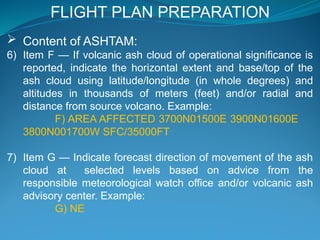
 Content of ASHTAM:
6) Item F — If volcanic ash cloud of operational significance is
reported, indicate the horizontal extent and base/top of the
ash cloud using latitude/longitude (in whole degrees) and
altitudes in thousands of meters (feet) and/or radial and
distance from source volcano. Example:
F) AREA AFFECTED 3700N01500E 3900N01600E
3800N001700W SFC/35000FT
7) Item G — Indicate forecast direction of movement of the ash
cloud at selected levels based on advice from the
responsible meteorological watch office and/or volcanic ash
advisory center. Example:
G) NE
FLIGHT PLAN PREPARATION
 Content of ASHTAM:
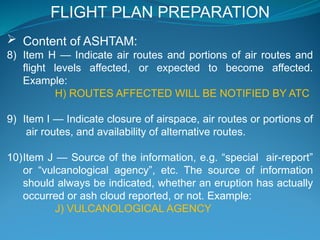
8) Item H — Indicate air routes and portions of air routes and
flight levels affected, or expected to become affected.
Example:
H) ROUTES AFFECTED WILL BE NOTIFIED BY ATC
9) Item I — Indicate closure of airspace, air routes or portions of
air routes, and availability of alternative routes.
10)Item J — Source of the information, e.g. “special air-report”
or “vulcanological agency”, etc. The source of information
should always be indicated, whether an eruption has actually
occurred or ash cloud reported, or not. Example:
J) VULCANOLOGICAL AGENCY
FLIGHT PLAN PREPARATION
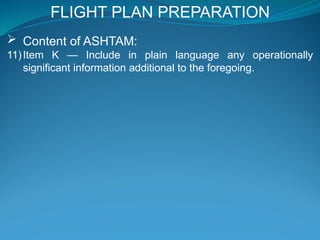
 Content of ASHTAM:
11)Item K — Include in plain language any operationally
significant information additional to the foregoing.
FLIGHT PLAN PREPARATION
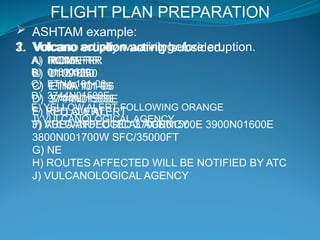
 ASHTAM example:
1. Volcano activity warning before eruption.
A) ROME FIR
B) 01091350
C) ETNA 101-06
D) 3744N01500E
E) YELLOW ALERT
J) VULCANOLOGICAL AGENCY
2. Volcano eruption warning.
A) ROMA FIR
B) 01151650
C) ETNA 101-06
D) 3744N01500E
E) RED ALERT
F) AREA AFFECTED 3700N01500E 3900N01600E
3800N001700W SFC/35000FT
G) NE
H) ROUTES AFFECTED WILL BE NOTIFIED BY ATC
J) VULCANOLOGICAL AGENCY
3. Volcano eruption activity subsided.
A) ROME FIR
B) 01300350
C) ETNA 101-06
D) 3744N01500E
E) YELLOW ALERT FOLLOWING ORANGE
J) VULCANOLOGICAL AGENCY
FLIGHT PLAN PREPARATION
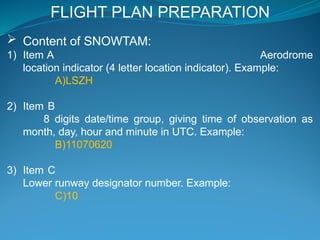
 Content of SNOWTAM:
1) Item A Aerodrome
location indicator (4 letter location indicator). Example:
A)LSZH
2) Item B
8 digits date/time group, giving time of observation as
month, day, hour and minute in UTC. Example:
B)11070620
3) Item C
Lower runway designator number. Example:
C)10
FLIGHT PLAN PREPARATION
 Content of SNOWTAM:
4) Item D
Cleared runway length in meters, if less than published
length (see Item T on reporting on part of runway not
cleared). Example:
D)2200
5) Item E
Cleared runway width in meters, if less than published width.
If offset left or right of center line, add “L” or “R”, as viewed
from the threshold having the lower runway designation
number. Example:
E)40L
FLIGHT PLAN PREPARATION
 Content of SNOWTAM:
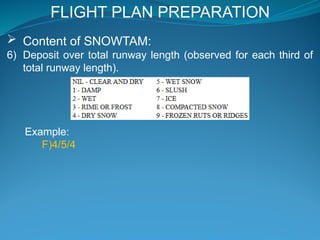
6) Deposit over total runway length (observed for each third of
total runway length).
Example:
F)4/5/4
FLIGHT PLAN PREPARATION
 Content of SNOWTAM:
7) Item G
Mean depth in millimeters deposit for each third of total
runway length, or “XX” if not measurable or operationally not
significant. Example:
G)20/10/10
8) Item H
Friction measurements on each third of the runway and
friction measuring device. Example:
H)30/35/30MUM
FLIGHT PLAN PREPARATION
 Content of SNOWTAM:
9) Item J
Critical snowbanks. If present insert height in centimeters
and distance from edge of runway in meters, followed by left
(“L”) or right (“R”) side or both sides (“LR”), as viewed from
the threshold having the lower runway designation number.
Example:
J)30/5L
10)Item K
If runway lights are obscured, insert “YES” followed by “L”,
“R” or both “LR”, as viewed from the threshold having the
lower runway designation number. Example:
K)YES L
FLIGHT PLAN PREPARATION
 Content of SNOWTAM:
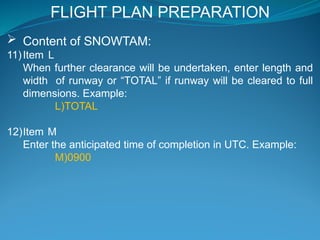
11)Item L
When further clearance will be undertaken, enter length and
width of runway or “TOTAL” if runway will be cleared to full
dimensions. Example:
L)TOTAL
12)Item M
Enter the anticipated time of completion in UTC. Example:
M)0900
FLIGHT PLAN PREPARATION
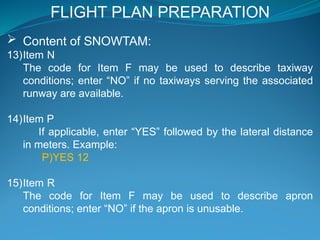
 Content of SNOWTAM:
13)Item N
The code for Item F may be used to describe taxiway
conditions; enter “NO” if no taxiways serving the associated
runway are available.
14)Item P
If applicable, enter “YES” followed by the lateral distance
in meters. Example:
P)YES 12
15)Item R
The code for Item F may be used to describe apron
conditions; enter “NO” if the apron is unusable.
FLIGHT PLAN PREPARATION
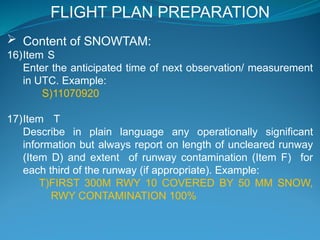
 Content of SNOWTAM:
16)Item S
Enter the anticipated time of next observation/ measurement
in UTC. Example:
S)11070920
17)Item T
Describe in plain language any operationally significant
information but always report on length of uncleared runway
(Item D) and extent of runway contamination (Item F) for
each third of the runway (if appropriate). Example:
T)FIRST 300M RWY 10 COVERED BY 50 MM SNOW,
RWY CONTAMINATION 100%
FLIGHT PLAN PREPARATION
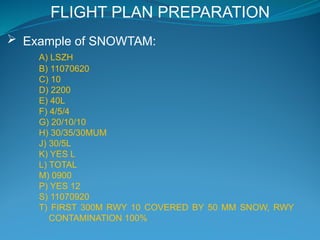
 Example of SNOWTAM:
A) LSZH
B) 11070620
C) 10
D) 2200
E) 40L
F) 4/5/4
G) 20/10/10
H) 30/35/30MUM
J) 30/5L
K) YES L
L) TOTAL
M) 0900
P) YES 12
S) 11070920
T) FIRST 300M RWY 10 COVERED BY 50 MM SNOW, RWY
CONTAMINATION 100%
AIRCRAFT
• Flight Number
• Aircraft rotation
• Type of aircraft
• Registration
• Route of flight
• Schedule
• Aircraft status
CREW
• Crew rotation
• Crew document
• Extra crew
• Transportation
• Hotel
LOAD
• Transit pax
• Joining pax/cargo
• Special pax
• Special cargo
• Security item
NOTAM
• Origin
• Destination
• En-route
• Alternate airport
WEATHER
• Origin
• Destination
• En-route
• Alternate airport
FLIGHT PLAN PREPARATION
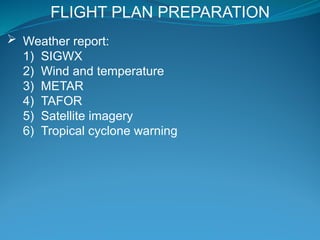
 Weather report:
1) SIGWX
2) Wind and temperature
3) METAR
4) TAFOR
5) Satellite imagery
6) Tropical cyclone warning
SIGWX
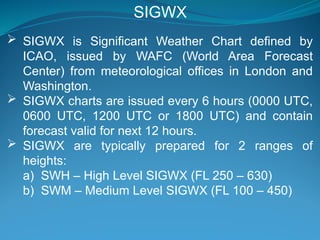
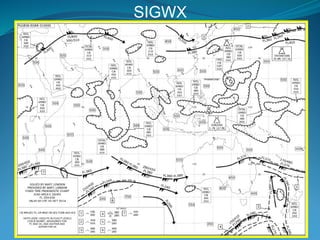
 SIGWX is Significant Weather Chart defined by
ICAO, issued by WAFC (World Area Forecast
Center) from meteorological offices in London and
Washington.
 SIGWX charts are issued every 6 hours (0000 UTC,
0600 UTC, 1200 UTC or 1800 UTC) and contain
forecast valid for next 12 hours.
 SIGWX are typically prepared for 2 ranges of
heights:
a) SWH – High Level SIGWX (FL 250 – 630)
b) SWM – Medium Level SIGWX (FL 100 – 450)
SIGWX
SIGWX
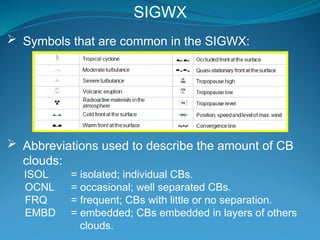
 Symbols that are common in the SIGWX:
 Abbreviations used to describe the amount of CB
clouds:
ISOL = isolated; individual CBs.
OCNL = occasional; well separated CBs.
FRQ = frequent; CBs with little or no separation.
EMBD = embedded; CBs embedded in layers of others
clouds.
SIGWX
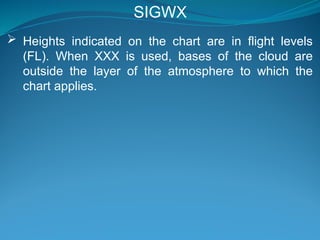
 Heights indicated on the chart are in flight levels
(FL). When XXX is used, bases of the cloud are
outside the layer of the atmosphere to which the
chart applies.
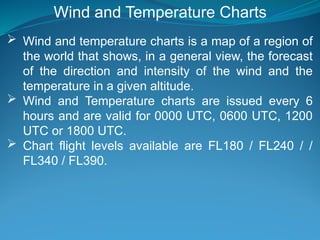
Wind and Temperature Charts
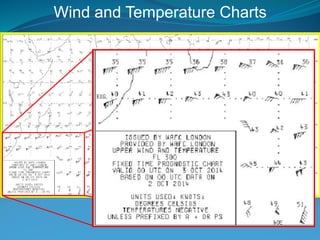
 Wind and temperature charts is a map of a region of
the world that shows, in a general view, the forecast
of the direction and intensity of the wind and the
temperature in a given altitude.
 Wind and Temperature charts are issued every 6
hours and are valid for 0000 UTC, 0600 UTC, 1200
UTC or 1800 UTC.
 Chart flight levels available are FL180 / FL240 / /
FL340 / FL390.
Wind and Temperature Charts
METAR
 METAR stands for METeorological Aerodrome
Report.
 METAR is a format for reporting weather
information, generated once an hour or half an hour.
 If weather condition change significantly, a report
known as a SPECI (SPECIal) may be issued.
METAR
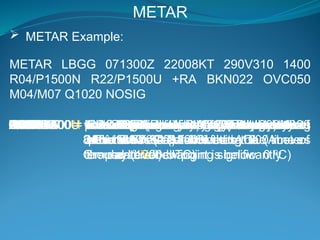
 METAR Example:
METAR LBGG 071300Z 22008KT 290V310 1400
R04/P1500N R22/P1500U +RA BKN022 OVC050
M04/M07 Q1020 NOSIG
LBGG = ICAO airport code
071300Z = time of the observation. It is the day of
the month (07) followed by the time of
the day (1300 UTC)
22008KT = wind direction is from 2200
at a speed of
8 knots
290V310 = wind direction is varying from 2900
to
3100
1400 = prevailing visibility is 1400 meters
R04/P1500N = RVR (Runway Visual Range) along
RWY 04 is more than 1500 meters
and Not changing significantly
R22/P1500U = RVR along RWY 22 is more than
1500 meters and rising
+SN = snow is falling at a heavy intensity
BKN022 = broken (over half the sky) cloud layer
with its base at 2200 feet AGL (Above
Ground Level)
OVC050 = unbroken (overcast) cloud layer with its
base at 5000 feet AGL
M04/M07 = the temperature is -4 0
C and the dew
point is -7 0
C (M indicates the
temperature/dew point is below 0 0
C)
Q1020 = current altimeter setting (QNH) is 1020
hPa
NOSIG = NO SIGnificant change is expected
within the next 2 hours
TAFOR
 TAFOR stands for Terminal Aerodrome FORcast.
 TAFOR are issued every 6 hours (0000, 0600, 1200,
and 1800 UTC), generally apply to a 24 or 30 hour
period, and in an area within approximately five
statute miles from the center of an airport runway
complex.
 TAFOR complement and use similar encoding to
METAR.
TAFOR
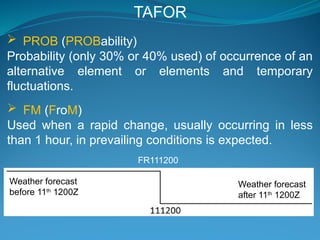
 PROB (PROBability)
Probability (only 30% or 40% used) of occurrence of an
alternative element or elements and temporary
fluctuations.
 FM (FroM)
Used when a rapid change, usually occurring in less
than 1 hour, in prevailing conditions is expected.
Weather forecast
after 11th
1200Z
Weather forecast
before 11th
1200Z
FR111200
METAR & TAFOR Code
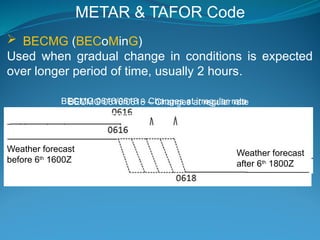
 BECMG (BECoMinG)
Used when gradual change in conditions is expected
over longer period of time, usually 2 hours.
Weather forecast
after 6th
1800Z
Weather forecast
before 6th
1600Z
BECMG 0616/0618 – Changes at regular rate
Weather forecast
after 6th
1800Z
Weather forecast
before 6th
1600Z
BECMG 0616/0618 – Changes at irregular rate
Weather forecast
after 6th
1800Z
Weather forecast
before 6th
1600Z
BECMG 0616/0618 – Changes at regular rate but in unspecified time
METAR & TAFOR Code
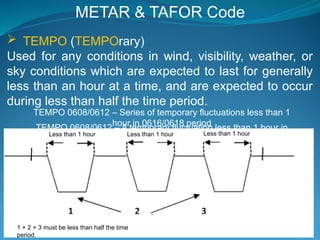
 TEMPO (TEMPOrary)
Used for any conditions in wind, visibility, weather, or
sky conditions which are expected to last for generally
less than an hour at a time, and are expected to occur
during less than half the time period.
TEMPO 0608/0612 – A temporary fluctuation less than 1 hour in
0616/0618 period
Less than 1 hour
TEMPO 0608/0612 – Series of temporary fluctuations less than 1
hour in 0616/0618 period
Less than 1 hour Less than 1 hour Less than 1 hour
1 + 2 + 3 must be less than half the time
period.