Dr.S.Silas Sargunam
Hub Coordinator
AURCT-IEDP Hub
Anna University Regional Campus Tirunelveli
DESIGN THINKING
 Philosophy and set of tools to help solve problems
creatively
 Difference Focus on Human centered approach
 Empathizing with the user
 Customer/User perceptive
 Design with the focus of human perspective
DESIGN THINKING PROCESS
 Empathize
 Define
 Ideate
 Prototype
 Test
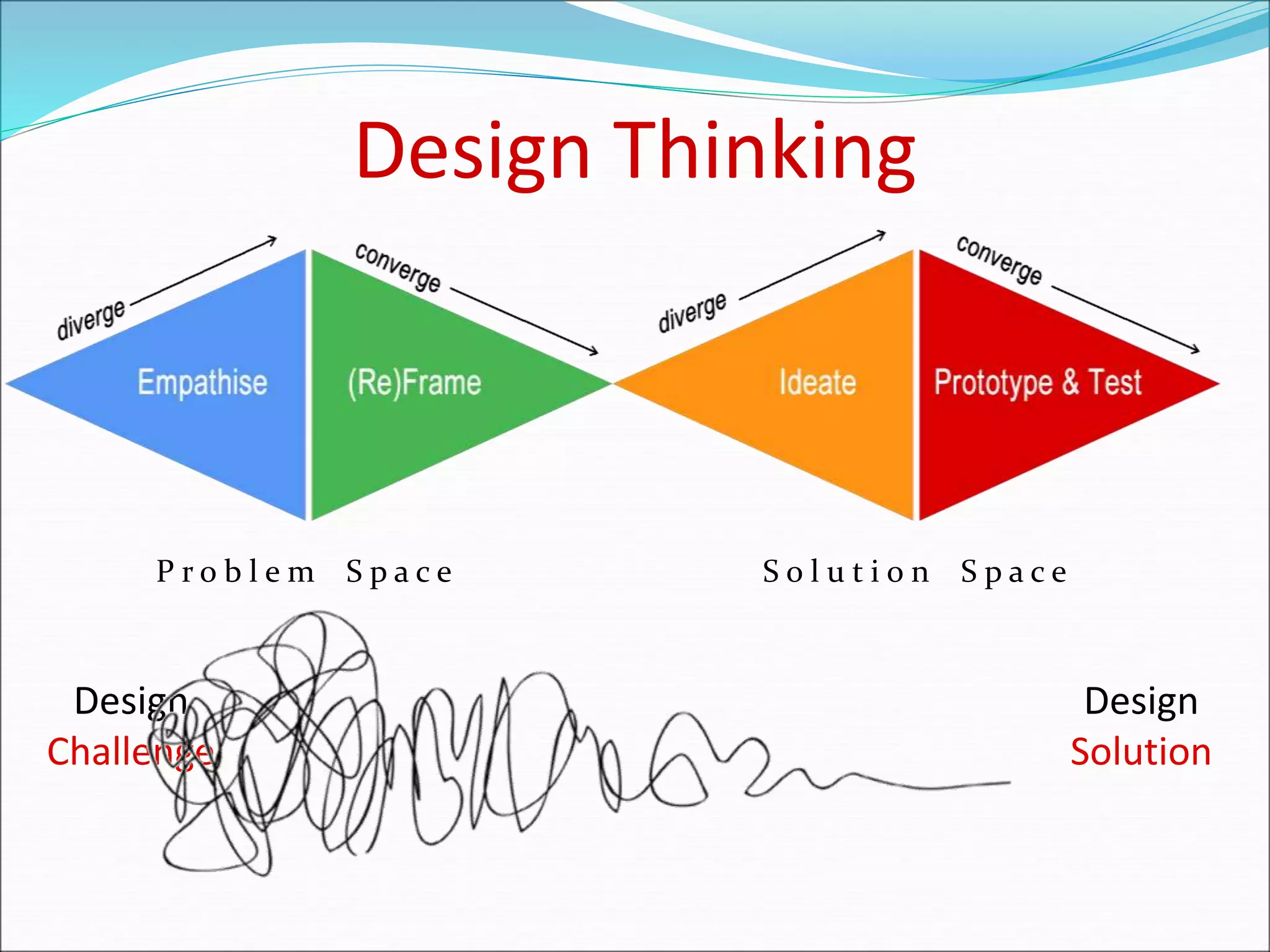
Design Thinking
P r o b l e m S p a c e S o l u t i o n S p a c e
Design
Challenge
Design
Solution
Empathy
• Viewing from the other person’s point of view
• Putting yourself into the shoes of the other person
• Intellectual identification with the emotions
thoughts, attitude and expectations of another
person
• Mirroring the other person’s feeling expectation,
expression etc
Empathy would lead to
• Understanding the problem from the other
person’s perspective
• The person who is facing the problem may have
different dimensions
• There may be more than one kind of stake holders
• Without Judgment
• With a beginners’ eyes
• With curiosity
• With a child like enthusiasm
• Interact /Survey
• Observe What they do and how they behave
• Intense Preparation
• Immersion
• Questions to be asked
• Points to be observed
• Interaction
• Focus on the problem
• No solution related talk
• Thorough understanding of the problem
• Survey – May not open up
• Observation – Behaviour may camaflouge
motives
• Asking leading questions
• Pain points
• May not open up easily
• Gaining confidence
• Multiple sitting may be needed
• Sometimes multiple stakeholders
Example
 Designing a wallet for your friend
 What you carry
 Why you carry
 Listen and Take notes
 Reasons-Logics and emotions
Define
 A problem well defined is half solved
 The objective is to get a clear cut understanding of the
problem.
 Precise understanding of the specific problem
 After empathizing, there may be general
understanding and broader perspective
 Lots of information
 Variety of insights into the problem
Define
 Accumulate
 Assort
 Analyze
 Synthesize
 This will give deeper and specific insight into the
problem
 Focus on needs not on solutions
Define
Problem Statements
 Who are the users?
 Who are the other stakeholders?
 What are their needs (common and individual)?
 What are their problems?
 What are the challenges they face?
Define
 Define  A child trying to reach the top of a book
shelf with chair
 Nouns all solutions ladder, Book location info
 Verbs  Needs to reach the top rung
 Focus on needs not on solutions
 This will give better insights and better drive for
solution
 Focus on Individuals (Extreme Users)
 User: Teenager
 Need: Healthy Food
 Insight: necessary for physical growth and mental
development
 Specified Extreme User: College first year students
 Deep needs: Acceptance
Define
Example
 Pre term babies in rural places
 Lack of incubator facilities
 Affordability and Accessibility
Example
 Users
 Desperate parents in remote villages without access in
the hospital
 Need
 Device to save the dying babies
Ideate
 Generating Ideas
 “The best way to get a good idea is to get a lot of ideas”
 Brainstorming
 Mind Mapping
Brainstorming - Points
 Encourage wild ideas
 Defer Judgement
 Go for volume
 One conversation at a time
 Build on the idea of others
 Stay focused on the topic
 Note down or Record
Mindmapping
 Use a central image
 One main topic on each branch
 Sub topics on sub branches
 One colour for each branch
 Involve everyone
Prototype
 A basic or preliminary version of a product
 Could be improved later
 Purpose is to expose to the users
 Physical reality of the concept
 Scope for improvement
Prototype
 Drawings in a Paper
 Paper prototype
 Working model
 Minimum viable product
Testing
 Only with users
 Performance compared with Expectations
 Improve and recreate
 Taken back to Ideation
Example
 Sleep bag for Pre-term babies
 Redesigned after testing.
 Expectations of Mothers, Doctors and Care takers.
 Hot water was replaced with Wax pouches
 Temperature readings changed to faces
 Indication added (Ready/ Not ready)
 Doctors – Needed visibility for monitoring
Example
 Hot water was replaced with Wax pouches
 Temperature readings changed to faces
 Indication added (Ready/ Not ready)
 Doctors – Needed visibility for monitoring
THANK YOU

Design Thinking - Ramco.ppt

  • 1.
    Dr.S.Silas Sargunam Hub Coordinator AURCT-IEDPHub Anna University Regional Campus Tirunelveli
  • 2.
    DESIGN THINKING  Philosophyand set of tools to help solve problems creatively  Difference Focus on Human centered approach  Empathizing with the user  Customer/User perceptive  Design with the focus of human perspective
  • 3.
    DESIGN THINKING PROCESS Empathize  Define  Ideate  Prototype  Test
  • 4.
    Design Thinking P ro b l e m S p a c e S o l u t i o n S p a c e Design Challenge Design Solution
  • 5.
    Empathy • Viewing fromthe other person’s point of view • Putting yourself into the shoes of the other person • Intellectual identification with the emotions thoughts, attitude and expectations of another person • Mirroring the other person’s feeling expectation, expression etc
  • 6.
    Empathy would leadto • Understanding the problem from the other person’s perspective • The person who is facing the problem may have different dimensions • There may be more than one kind of stake holders
  • 7.
    • Without Judgment •With a beginners’ eyes • With curiosity • With a child like enthusiasm • Interact /Survey • Observe What they do and how they behave
  • 8.
    • Intense Preparation •Immersion • Questions to be asked • Points to be observed • Interaction • Focus on the problem • No solution related talk • Thorough understanding of the problem
  • 9.
    • Survey –May not open up • Observation – Behaviour may camaflouge motives • Asking leading questions • Pain points • May not open up easily • Gaining confidence • Multiple sitting may be needed • Sometimes multiple stakeholders
  • 10.
    Example  Designing awallet for your friend  What you carry  Why you carry  Listen and Take notes  Reasons-Logics and emotions
  • 11.
    Define  A problemwell defined is half solved  The objective is to get a clear cut understanding of the problem.  Precise understanding of the specific problem  After empathizing, there may be general understanding and broader perspective  Lots of information  Variety of insights into the problem
  • 12.
    Define  Accumulate  Assort Analyze  Synthesize  This will give deeper and specific insight into the problem  Focus on needs not on solutions
  • 13.
    Define Problem Statements  Whoare the users?  Who are the other stakeholders?  What are their needs (common and individual)?  What are their problems?  What are the challenges they face?
  • 14.
    Define  Define A child trying to reach the top of a book shelf with chair  Nouns all solutions ladder, Book location info  Verbs  Needs to reach the top rung  Focus on needs not on solutions  This will give better insights and better drive for solution
  • 15.
     Focus onIndividuals (Extreme Users)  User: Teenager  Need: Healthy Food  Insight: necessary for physical growth and mental development  Specified Extreme User: College first year students  Deep needs: Acceptance Define
  • 16.
    Example  Pre termbabies in rural places  Lack of incubator facilities  Affordability and Accessibility
  • 17.
    Example  Users  Desperateparents in remote villages without access in the hospital  Need  Device to save the dying babies
  • 18.
    Ideate  Generating Ideas “The best way to get a good idea is to get a lot of ideas”  Brainstorming  Mind Mapping
  • 19.
    Brainstorming - Points Encourage wild ideas  Defer Judgement  Go for volume  One conversation at a time  Build on the idea of others  Stay focused on the topic  Note down or Record
  • 20.
    Mindmapping  Use acentral image  One main topic on each branch  Sub topics on sub branches  One colour for each branch  Involve everyone
  • 21.
    Prototype  A basicor preliminary version of a product  Could be improved later  Purpose is to expose to the users  Physical reality of the concept  Scope for improvement
  • 22.
    Prototype  Drawings ina Paper  Paper prototype  Working model  Minimum viable product
  • 23.
    Testing  Only withusers  Performance compared with Expectations  Improve and recreate  Taken back to Ideation
  • 24.
    Example  Sleep bagfor Pre-term babies  Redesigned after testing.  Expectations of Mothers, Doctors and Care takers.  Hot water was replaced with Wax pouches  Temperature readings changed to faces  Indication added (Ready/ Not ready)  Doctors – Needed visibility for monitoring
  • 25.
    Example  Hot waterwas replaced with Wax pouches  Temperature readings changed to faces  Indication added (Ready/ Not ready)  Doctors – Needed visibility for monitoring
  • 26.