© Copyright 2010 Alan S. Berger 1
Deviance
Crime, Deviance And
Social Control
© Copyright 2010 Alan S. Berger 2
What Do we want to Know
• How is deviance defined and who defines it
– Is it the person or the action?
• How is deviance distributed in society and how do we
know
• What causes deviance
• How is deviance controlled
© Copyright 2010 Alan S. Berger 3
Social Control
• Social control: techniques and strategies for
preventing deviant human behavior in any society
• Sanctions: penalties and rewards for conduct
concerning a social norm
• Society partly defined by people’s willingness to
accept shared beliefs and practices
– Society can limit individual freedom and advance
interests of some at expense of others
© Copyright 2010 Alan S. Berger 4
Conformity and Obedience
• Conformity: the act of going along with peers—
individuals of our own status who have no special
right to direct our behavior
• Obedience: compliance with higher authorities in a
hierarchical structure
© Copyright 2010 Alan S. Berger 5
Informal and
Formal Social Control
• Informal social control: used casually to enforce
norms
• Formal social control: carried out by authorized
agents
• Interplay between formal and informal social
control can be complicated because we have to
balance one source of control against another
© Copyright 2010 Alan S. Berger 6
Law and Society
• Some norms are so important to a society that they
are formalized into laws
• Law: governmental social control
• Control theory: our connection to other members of
society leads us to systematically conform to
society’s norms
© Copyright 2010 Alan S. Berger 7
Defining Deviance
• Deviance is the violation of Norms, especially widely held
norms
• Crime is an action declared illegal by some government or
agency
– Usually, by a legislative body
– Sometimes by administrative actions
• Is all deviance criminal ?
– Pushing children into fashion shows, sports ?
– Subcultures and deviance
© Copyright 2010 Alan S. Berger 8
Defining Deviance
• Not all crimes are deviant
– PETA
– Bullying
– Speeding
– Gambling
– White Collar crime
• Non Criminal Deviance
– Music preferences
– Body piercing
– Marrying someone
• Your parents disapprove of
• Your parents want you to
– Being a Geek or a Nerd
• Where do “rolling Stops” and other trivial driving violations
go?
© Copyright 2010 Alan S. Berger 9
Distribution of Deviance
• Crime Rates vs Crime Statistics
– Variance in Reporting Issues
• To Police
• To FBI
– By Type of Crime
• By nature of offender and victim
• Blaming the Victim
• Location
• Organized Crime
• White Collar Crime
• Non Criminal Deviance… What do we Know
– Not much
© Copyright 2010 Alan S. Berger 10
Explanations of Deviance
• Historical non Social-scientific explanations
– Patterns of Bumps on head
– The Devil made me do it
– Mental issues
– Bad Seed
• Sociological Explanations
– Functionalist:
• Deviance provides an example of what must be avoided because it
is wrong
• Some deviance can lead to positive social change
© Copyright 2010 Alan S. Berger 11
Controlling Deviance
• Is all deviance controlled?
– What choices does society have in controlling deviance?
• Internal
• External
• Who controls Deviance
– Under what circumstances some forms of deviance not controlled
– What is required to control deviant behavior?
• How about deviant thoughts?
– Presidential Candidate who admitted “Lusting in his thoughts”
• How does the nature of society impact the nature, extent and
control of deviance?
© Copyright 2010 Alan S. Berger 12
Explanations of Deviance
• Anomie The norms are weak or are in conflict. This is the
basis for Strain theory
– Social structure limits the abilities of certain groups to satisfy culturally
dictated goals and aspirations and means to achieve them.
• Cultural goals which are acceptable in our society
– Wealth
– Power
– Status
– Material Goods
• Acceptable means to achieve them
– Education
– Jobs
– Some talents
© Copyright 2010 Alan S. Berger 13
Explanations of Deviance
• Conflict or Strain between goals and means produce "anomie”
and possibly a high level of maladaptive behavior due to
cultural imbalance between goals and means.
• Social structure explains differences in upper and lower class
crime rates.
– Distribution of legitimate opportunities to achieve wealth through
legitimate means.
• Since goals are not always achieved, means become valuable in
themselves.
– Often times, means are placed under severe stress.
– Little reward in means alone.
• Strain falls on a wide variety of people:
– mostly concentrated in lower-classes.
– because of differential emphasis placed on ability to attain goals.
– Goals "open to all."
© Copyright 2010 Alan S. Berger 14
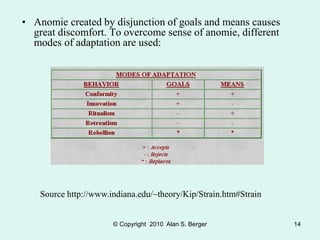
• Anomie created by disjunction of goals and means causes
great discomfort. To overcome sense of anomie, different
modes of adaptation are used:
Source http://www.indiana.edu/~theory/Kip/Strain.htm#Strain
© Copyright 2010 Alan S. Berger 15
Symbolic Interactionist Theories
• Social control or Social Bonding
– Doesn’t ask why people are deviant, but why they aren’t.
• http:faculty.ccc.eduabergerIt's Not A Crime If I Can't be Caught
.pdf
– Strong Interpersonal ties often lead to strong commitment to the norms
• Cultural Transmission, Differential association and subcultures
– Who you associate with
– Learned behaviors
– Interaction with other groups with other norms
© Copyright 2010 Alan S. Berger 16
White-Collar Crime
• White-collar crime: illegal acts committed in the
course of business activities, often by affluent,
“respectable” people
– Corporate crime: any act by a corporation that is
punishable by the government
– Computer crime: use of high technology to carry
out embezzlement or electronic fraud
© Copyright 2010 Alan S. Berger 17
Victimless Crimes
• Victimless crime: willing exchange among
adults of widely desired, but illegal, goods and
services
– Supporters of decriminalization are
troubled by attempts to legislate moral code
for adults
– Critics object to notion that these crimes
are “victimless”
© Copyright 2010 Alan S. Berger 18
Social Order, Deviance,
and Crime
• Durkheim’s Theory of Deviance
– Nothing inherently deviant or criminal in any act
– Society identifies criminals for the sake of social
order
– When societies experience anomie, social
integration is weak and people are free to pursue
deviant paths
© Copyright 2010 Alan S. Berger 19
Social Order, Deviance,
and Crime
• Merton’s Theory of Deviance
– Anomie theory of deviance: five basic forms of
adaptation to cultural expectations
• Conformist
• Innovator
• Ritualist
• Retreatist
• Rebel
© Copyright 2010 Alan S. Berger 20
Interpersonal Interaction
and Local Context
• Cultural transmission: individuals learn
criminal behavior by interacting with others
• Differential association: process through
which exposure to attitudes favorable to
criminal acts leads to the violation of rules
© Copyright 2010 Alan S. Berger 21
Interpersonal Interaction
and Local Context
• Social disorganization theory: attributes increases in
crime and deviance to the absence or breakdown of
communal relationships and social institutions
• Labeling theory: attempts to explain why certain
people are viewed as deviants while others engaged in
the same behavior are not
– Also known as the societal-reaction approach
© Copyright 2010 Alan S. Berger 22
Power and Inequality
• Criminal justice system serves the
interests of the powerful; protect their own
interests and define deviance to suit their
own needs
• Race and Class
– Suspects are treated differently based on their
race, ethnicity, and social class
– Differential justice: differences in the way
social control is exercised over different
groups
© Copyright 2010 Alan S. Berger 23
Power and Inequality
• Gender
– Existing approaches to deviance developed
with only men in mind
– Society tends to treat women in stereotypical
fashion
– Cultural views and attitudes toward women
influence how they are perceived and labeled
– As women take on more active and powerful
roles both in the household and in business,
gender differences in deviance and crime
have narrowed
© Copyright 2010 Alan S. Berger 24
The Criminal Justice System
• Based on Adversarial system, Conflict
• Only available for crimes, not for non criminal deviance
– Religious laws deal with some of the non criminal deviance
• Made up of
– Courts
– Police
– Corrections
• How else is deviance sanctioned?
– Hiring practices
– Public Opinion
– ?

201.08 Deviance.ppt

  • 1.
    © Copyright 2010Alan S. Berger 1 Deviance Crime, Deviance And Social Control
  • 2.
    © Copyright 2010Alan S. Berger 2 What Do we want to Know • How is deviance defined and who defines it – Is it the person or the action? • How is deviance distributed in society and how do we know • What causes deviance • How is deviance controlled
  • 3.
    © Copyright 2010Alan S. Berger 3 Social Control • Social control: techniques and strategies for preventing deviant human behavior in any society • Sanctions: penalties and rewards for conduct concerning a social norm • Society partly defined by people’s willingness to accept shared beliefs and practices – Society can limit individual freedom and advance interests of some at expense of others
  • 4.
    © Copyright 2010Alan S. Berger 4 Conformity and Obedience • Conformity: the act of going along with peers— individuals of our own status who have no special right to direct our behavior • Obedience: compliance with higher authorities in a hierarchical structure
  • 5.
    © Copyright 2010Alan S. Berger 5 Informal and Formal Social Control • Informal social control: used casually to enforce norms • Formal social control: carried out by authorized agents • Interplay between formal and informal social control can be complicated because we have to balance one source of control against another
  • 6.
    © Copyright 2010Alan S. Berger 6 Law and Society • Some norms are so important to a society that they are formalized into laws • Law: governmental social control • Control theory: our connection to other members of society leads us to systematically conform to society’s norms
  • 7.
    © Copyright 2010Alan S. Berger 7 Defining Deviance • Deviance is the violation of Norms, especially widely held norms • Crime is an action declared illegal by some government or agency – Usually, by a legislative body – Sometimes by administrative actions • Is all deviance criminal ? – Pushing children into fashion shows, sports ? – Subcultures and deviance
  • 8.
    © Copyright 2010Alan S. Berger 8 Defining Deviance • Not all crimes are deviant – PETA – Bullying – Speeding – Gambling – White Collar crime • Non Criminal Deviance – Music preferences – Body piercing – Marrying someone • Your parents disapprove of • Your parents want you to – Being a Geek or a Nerd • Where do “rolling Stops” and other trivial driving violations go?
  • 9.
    © Copyright 2010Alan S. Berger 9 Distribution of Deviance • Crime Rates vs Crime Statistics – Variance in Reporting Issues • To Police • To FBI – By Type of Crime • By nature of offender and victim • Blaming the Victim • Location • Organized Crime • White Collar Crime • Non Criminal Deviance… What do we Know – Not much
  • 10.
    © Copyright 2010Alan S. Berger 10 Explanations of Deviance • Historical non Social-scientific explanations – Patterns of Bumps on head – The Devil made me do it – Mental issues – Bad Seed • Sociological Explanations – Functionalist: • Deviance provides an example of what must be avoided because it is wrong • Some deviance can lead to positive social change
  • 11.
    © Copyright 2010Alan S. Berger 11 Controlling Deviance • Is all deviance controlled? – What choices does society have in controlling deviance? • Internal • External • Who controls Deviance – Under what circumstances some forms of deviance not controlled – What is required to control deviant behavior? • How about deviant thoughts? – Presidential Candidate who admitted “Lusting in his thoughts” • How does the nature of society impact the nature, extent and control of deviance?
  • 12.
    © Copyright 2010Alan S. Berger 12 Explanations of Deviance • Anomie The norms are weak or are in conflict. This is the basis for Strain theory – Social structure limits the abilities of certain groups to satisfy culturally dictated goals and aspirations and means to achieve them. • Cultural goals which are acceptable in our society – Wealth – Power – Status – Material Goods • Acceptable means to achieve them – Education – Jobs – Some talents
  • 13.
    © Copyright 2010Alan S. Berger 13 Explanations of Deviance • Conflict or Strain between goals and means produce "anomie” and possibly a high level of maladaptive behavior due to cultural imbalance between goals and means. • Social structure explains differences in upper and lower class crime rates. – Distribution of legitimate opportunities to achieve wealth through legitimate means. • Since goals are not always achieved, means become valuable in themselves. – Often times, means are placed under severe stress. – Little reward in means alone. • Strain falls on a wide variety of people: – mostly concentrated in lower-classes. – because of differential emphasis placed on ability to attain goals. – Goals "open to all."
  • 14.
    © Copyright 2010Alan S. Berger 14 • Anomie created by disjunction of goals and means causes great discomfort. To overcome sense of anomie, different modes of adaptation are used: Source http://www.indiana.edu/~theory/Kip/Strain.htm#Strain
  • 15.
    © Copyright 2010Alan S. Berger 15 Symbolic Interactionist Theories • Social control or Social Bonding – Doesn’t ask why people are deviant, but why they aren’t. • http:faculty.ccc.eduabergerIt's Not A Crime If I Can't be Caught .pdf – Strong Interpersonal ties often lead to strong commitment to the norms • Cultural Transmission, Differential association and subcultures – Who you associate with – Learned behaviors – Interaction with other groups with other norms
  • 16.
    © Copyright 2010Alan S. Berger 16 White-Collar Crime • White-collar crime: illegal acts committed in the course of business activities, often by affluent, “respectable” people – Corporate crime: any act by a corporation that is punishable by the government – Computer crime: use of high technology to carry out embezzlement or electronic fraud
  • 17.
    © Copyright 2010Alan S. Berger 17 Victimless Crimes • Victimless crime: willing exchange among adults of widely desired, but illegal, goods and services – Supporters of decriminalization are troubled by attempts to legislate moral code for adults – Critics object to notion that these crimes are “victimless”
  • 18.
    © Copyright 2010Alan S. Berger 18 Social Order, Deviance, and Crime • Durkheim’s Theory of Deviance – Nothing inherently deviant or criminal in any act – Society identifies criminals for the sake of social order – When societies experience anomie, social integration is weak and people are free to pursue deviant paths
  • 19.
    © Copyright 2010Alan S. Berger 19 Social Order, Deviance, and Crime • Merton’s Theory of Deviance – Anomie theory of deviance: five basic forms of adaptation to cultural expectations • Conformist • Innovator • Ritualist • Retreatist • Rebel
  • 20.
    © Copyright 2010Alan S. Berger 20 Interpersonal Interaction and Local Context • Cultural transmission: individuals learn criminal behavior by interacting with others • Differential association: process through which exposure to attitudes favorable to criminal acts leads to the violation of rules
  • 21.
    © Copyright 2010Alan S. Berger 21 Interpersonal Interaction and Local Context • Social disorganization theory: attributes increases in crime and deviance to the absence or breakdown of communal relationships and social institutions • Labeling theory: attempts to explain why certain people are viewed as deviants while others engaged in the same behavior are not – Also known as the societal-reaction approach
  • 22.
    © Copyright 2010Alan S. Berger 22 Power and Inequality • Criminal justice system serves the interests of the powerful; protect their own interests and define deviance to suit their own needs • Race and Class – Suspects are treated differently based on their race, ethnicity, and social class – Differential justice: differences in the way social control is exercised over different groups
  • 23.
    © Copyright 2010Alan S. Berger 23 Power and Inequality • Gender – Existing approaches to deviance developed with only men in mind – Society tends to treat women in stereotypical fashion – Cultural views and attitudes toward women influence how they are perceived and labeled – As women take on more active and powerful roles both in the household and in business, gender differences in deviance and crime have narrowed
  • 24.
    © Copyright 2010Alan S. Berger 24 The Criminal Justice System • Based on Adversarial system, Conflict • Only available for crimes, not for non criminal deviance – Religious laws deal with some of the non criminal deviance • Made up of – Courts – Police – Corrections • How else is deviance sanctioned? – Hiring practices – Public Opinion – ?