LILAC Information Literacy Conference
University of Nottingham
25 April 2019
Áine Carey
Teaching & Research Development Librarian
Twitter: @aine_carey
And
action…!
About me and my
role
 Manage Teaching and Research
Development team in MU Library
 Functional model based on Teaching
& Learning, Research Support, and
Academic Engagement
 Worked across a range of information
environments (larger / specialist
academic environments; private
sector consulting)
 ‘Client-facing’: getting to students’
point-of-need
Maynooth University
What I’ll cover
Why we chose a functional
model – and what it looks like
The impact on teaching
Our activity-based model of
teaching
What we have learned – and
where we are headed
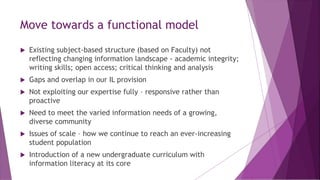
Move towards a functional model
 Existing subject-based structure (based on Faculty) not
reflecting changing information landscape - academic integrity;
writing skills; open access; critical thinking and analysis
 Gaps and overlap in our IL provision
 Not exploiting our expertise fully – responsive rather than
proactive
 Need to meet the varied information needs of a growing,
diverse community
 Issues of scale – how we continue to reach an ever-increasing
student population
 Introduction of a new undergraduate curriculum with
information literacy at its core
A new curriculum with a key focus on critical skills
‘…graduates are expected to be … capable of gathering
and critiquing information from a variety of sources’
(Maynooth University, 2015)
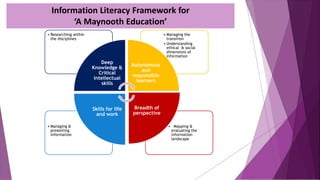
• Mapping &
evaluating the
information
landscape
• Managing &
presenting
information
• Managing the
transition
• Understanding
ethical & social
dimensions of
information
• Researching within
the disciplines
Deep
Knowledge &
Critical
intellectual
skills
Autonomous
and
responsible
learners
Breadth of
perspective
Skills for life
and work
Information Literacy Framework for
‘A Maynooth Education’
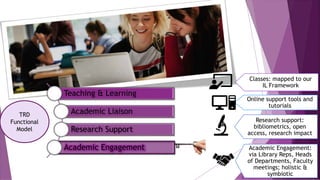
Research support:
bibliometrics, open
access, research impact
Classes: mapped to our
IL Framework
Online support tools and
tutorials
Teaching & Learning
Academic Liaison
Research Support
Academic Engagement
TRD
Functional
Model
Academic Engagement:
via Library Reps, Heads
of Departments, Faculty
meetings; holistic &
symbiotic
• Mapping &
evaluating the
information
landscape
• Managing &
presenting
information
• Managing the
transition
• Understanding ethical
& social dimensions
of information
• Researching within
the disciplines
Deep
Knowledge &
Critical
intellectual
skills
Autonomous
and
responsible
learners
Breadth of
perspective
Skills for life
and work
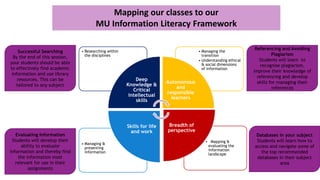
Mapping our classes to our
MU Information Literacy Framework
Successful Searching
By the end of this session,
your students should be able
to effectively find academic
information and use library
resources. This can be
tailored to any subject
Evaluating Information
Students will develop their
ability to evaluate
information and thereby find
the information most
relevant for use in their
assignments
Referencing and Avoiding
Plagiarism
Students will learn to
recognise plagiarism,
improve their knowledge of
referencing and develop
skills for managing their
references
Databases in your subject
Students will learn how to
access and navigate some of
the top recommended
databases in their subject
area
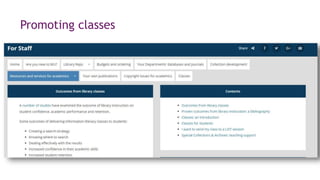
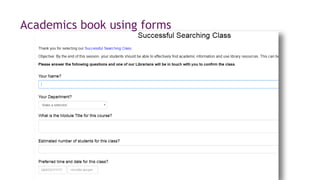
Promoting classes
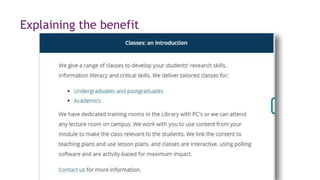
Explaining the benefit
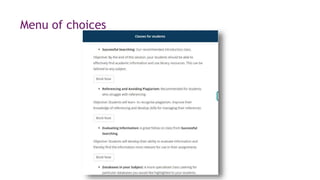
Menu of choices
Academics book using forms
Teaching approach
• Agreed learning
outcomes
• Standardised lesson
plans
• Establishing students’
prior learning
Initial outcomes  Some concern from academics –
especially departments who had
specific, intensive engagement with
Subject Librarians previously
 Within the team, uncertainty about
how we worked now as a team; fear of
losing touch with one another
 Were we losing specialism? Becoming
‘generic’?
 Worked really well for departments and
staff we were newly engaging with –
gave them a route map of support and
opportunities for collaboration
 Created an opportunity for the Library
to have a clear voice in Teaching &
Learning forum
 Enunciated our IL expertise clearly
During the pilot phase
 Initially resistant academics quickly endorsed
our new approach
 New opportunities for collaboration and co-
teaching
 Lecturers as partners in the classroom – the key
to success
 Each class retains the same learning outcomes
but is adapted to meet the specific module
requirements
 Based on identified point-of-need e.g. an
assignment, project or thesis
 Within the team, actively seeking areas of
collaboration – where do we need to meet and
work together? Identification of projects
 Weekly catch-up meetings
 Individual regular meetings with each team
member
 Away-days to build team-working and work
through concerns
Activity-based classes
Where we are now
 Collaboration with academics is vital – linking the class activity with what is
being covered in the module and their lectures
 Attendance of lecturer at classes ensures that the lecturer too is following IL
best practice!
 Learning outcomes and ensuring these are achieved is the key – this may
involve changing approach during the class
 Co-teaching approach now in place – essential for allowing responsive
approaches in class
 Pre-class tools and post-class follow up matter
 Focus on the student experience – did they respond? Interact? Participate? Did
they ask questions or admit they weren’t sure? Can you establish an enhanced
sense of engagement for each student by the end of the class? Was the
atmosphere warm, responsive and relaxed?
Next steps
 Continuing to examine what we do!
 Get more student feedback (academic feedback positive)
 Pre-class tools – partner with Critical Skills to develop an IL quiz that could be
credit-bearing if wanted
 What about more able students? How do we facilitate students who are doing well
and want to attain a higher grade?
 Where is the students’ point-of-need? E.g. for most it revolves around an
understanding (or lack of) the academic research and writing process. Tailor
classes to focus on assignments
 Scaffolded classes – how do we progress from one-shot classes?
 Co-teaching – a success for students and has positively impacted our team
 Supporting Teaching & Learning Librarians to feel confident in this fluid teaching
appraoch
 Embedding our online resources within module content – initial steps taken,
essential if we are to reach students more effectively
 Catering for out-of-hours students and classes - how to deliver parity of service
Áine Carey
Job Title
Maynooth University
Email: aine.carey@mu.ie
Telephone: 00353 1 474 7123
Twitter: @aine_carey
See what we do:
https://nuim.libguides.com/guides_tutorials

Creating a new teaching programme within a functional model - Carey

  • 1.
    LILAC Information LiteracyConference University of Nottingham 25 April 2019 Áine Carey Teaching & Research Development Librarian Twitter: @aine_carey And action…!
  • 2.
    About me andmy role  Manage Teaching and Research Development team in MU Library  Functional model based on Teaching & Learning, Research Support, and Academic Engagement  Worked across a range of information environments (larger / specialist academic environments; private sector consulting)  ‘Client-facing’: getting to students’ point-of-need
  • 3.
  • 4.
    What I’ll cover Whywe chose a functional model – and what it looks like The impact on teaching Our activity-based model of teaching What we have learned – and where we are headed
  • 5.
    Move towards afunctional model  Existing subject-based structure (based on Faculty) not reflecting changing information landscape - academic integrity; writing skills; open access; critical thinking and analysis  Gaps and overlap in our IL provision  Not exploiting our expertise fully – responsive rather than proactive  Need to meet the varied information needs of a growing, diverse community  Issues of scale – how we continue to reach an ever-increasing student population  Introduction of a new undergraduate curriculum with information literacy at its core
  • 6.
    A new curriculumwith a key focus on critical skills ‘…graduates are expected to be … capable of gathering and critiquing information from a variety of sources’ (Maynooth University, 2015)
  • 7.
    • Mapping & evaluatingthe information landscape • Managing & presenting information • Managing the transition • Understanding ethical & social dimensions of information • Researching within the disciplines Deep Knowledge & Critical intellectual skills Autonomous and responsible learners Breadth of perspective Skills for life and work Information Literacy Framework for ‘A Maynooth Education’
  • 8.
    Research support: bibliometrics, open access,research impact Classes: mapped to our IL Framework Online support tools and tutorials Teaching & Learning Academic Liaison Research Support Academic Engagement TRD Functional Model Academic Engagement: via Library Reps, Heads of Departments, Faculty meetings; holistic & symbiotic
  • 9.
    • Mapping & evaluatingthe information landscape • Managing & presenting information • Managing the transition • Understanding ethical & social dimensions of information • Researching within the disciplines Deep Knowledge & Critical intellectual skills Autonomous and responsible learners Breadth of perspective Skills for life and work Mapping our classes to our MU Information Literacy Framework Successful Searching By the end of this session, your students should be able to effectively find academic information and use library resources. This can be tailored to any subject Evaluating Information Students will develop their ability to evaluate information and thereby find the information most relevant for use in their assignments Referencing and Avoiding Plagiarism Students will learn to recognise plagiarism, improve their knowledge of referencing and develop skills for managing their references Databases in your subject Students will learn how to access and navigate some of the top recommended databases in their subject area
  • 10.
  • 11.
  • 12.
  • 13.
  • 14.
    Teaching approach • Agreedlearning outcomes • Standardised lesson plans • Establishing students’ prior learning
  • 16.
    Initial outcomes Some concern from academics – especially departments who had specific, intensive engagement with Subject Librarians previously  Within the team, uncertainty about how we worked now as a team; fear of losing touch with one another  Were we losing specialism? Becoming ‘generic’?  Worked really well for departments and staff we were newly engaging with – gave them a route map of support and opportunities for collaboration  Created an opportunity for the Library to have a clear voice in Teaching & Learning forum  Enunciated our IL expertise clearly
  • 17.
    During the pilotphase  Initially resistant academics quickly endorsed our new approach  New opportunities for collaboration and co- teaching  Lecturers as partners in the classroom – the key to success  Each class retains the same learning outcomes but is adapted to meet the specific module requirements  Based on identified point-of-need e.g. an assignment, project or thesis  Within the team, actively seeking areas of collaboration – where do we need to meet and work together? Identification of projects  Weekly catch-up meetings  Individual regular meetings with each team member  Away-days to build team-working and work through concerns
  • 18.
  • 19.
    Where we arenow  Collaboration with academics is vital – linking the class activity with what is being covered in the module and their lectures  Attendance of lecturer at classes ensures that the lecturer too is following IL best practice!  Learning outcomes and ensuring these are achieved is the key – this may involve changing approach during the class  Co-teaching approach now in place – essential for allowing responsive approaches in class  Pre-class tools and post-class follow up matter  Focus on the student experience – did they respond? Interact? Participate? Did they ask questions or admit they weren’t sure? Can you establish an enhanced sense of engagement for each student by the end of the class? Was the atmosphere warm, responsive and relaxed?
  • 20.
    Next steps  Continuingto examine what we do!  Get more student feedback (academic feedback positive)  Pre-class tools – partner with Critical Skills to develop an IL quiz that could be credit-bearing if wanted  What about more able students? How do we facilitate students who are doing well and want to attain a higher grade?  Where is the students’ point-of-need? E.g. for most it revolves around an understanding (or lack of) the academic research and writing process. Tailor classes to focus on assignments  Scaffolded classes – how do we progress from one-shot classes?  Co-teaching – a success for students and has positively impacted our team  Supporting Teaching & Learning Librarians to feel confident in this fluid teaching appraoch  Embedding our online resources within module content – initial steps taken, essential if we are to reach students more effectively  Catering for out-of-hours students and classes - how to deliver parity of service
  • 21.
    Áine Carey Job Title MaynoothUniversity Email: aine.carey@mu.ie Telephone: 00353 1 474 7123 Twitter: @aine_carey See what we do: https://nuim.libguides.com/guides_tutorials

Editor's Notes

  • #3 My current role and what that means – size of team; what TRD does My background – different work experience Why it’s relevant – I spent 10 years in a very specialist, and specific environment, and another decade in a variety of roles and contexts, where I think I have been ‘new’ a lot. Even in current role, I am slightly over 3 years in MU, but have had a number of role changes in that time. Newness means I am asking questions a lot and have a lot ot learn; but it also means I am able to ask questions and think ‘how can we do it better or differently’. In particular, I still bring the ‘client’ function along with me from my days working in a client driven environment
  • #4 Picture captures the essence of MU really – shows the front of the library building – which is a dramatic extension built about 6 years ago now and in the background you can see the historic buildings that comprise the original St Patrick’s College Maynooth campus, which has been in existence since the 18th century. On 16 June 2017, Maynooth University celebrated its 20th birthday, having been formally established as an autonomous university in 1997. Yet, it traces its origins to the foundation of the Royal College of St. Patrick in 1795, drawing inspiration from a heritage that includes over 200 years of education and scholarship. Located 25km outside Dublin, occupies quite a unique position – close enough to be considered a ‘Dublin’ university, in a way, and draws its catchment from there, but also has a significant commuter population especially from the midlands and more rural parts of the country. Again, we are geographically close to communities of new Irish, those who have made Ireland there home having immigrated in the last 20 years from all around the world including Africa and Eastern Europe etc. Fastest growing university in Ireland – 2010/2011, 2000 first year students; overall student population of 9,600. By 2016/17, 3000 first years students, overall population of just over 12,000. Challenges with this – resources – campus wide; library fared better – but managing the ‘friendly, personal environment’, while catering to the variety of needs a challenge. Most diverse – socio-economically, those with various access requirements, making up nearly ¼ of all our student intake.
  • #7 ‘Maynooth Education’ introduced 2015: a new curriculum: focus on critical thinking; key skills include – problem solving, independent learning, critical thinking, analysis, reflection, communication skills, understanding academic standards, ethical responsibility. Key role for library to support this work in all our teaching - development of online tutorials key to support this work.
  • #8 Unique opportunity for the Library. The graduate attributes essentially relate to core IL competencies that we had enunciated in our IL Framework. Mapped IL Framework to ‘A Maynooth Education’ Key partnership with Critical Skills – natural understanding of each other’s approach and areas of work. Embedding IL within these programmes meant that students receiving IL instruction without library The key thing here is that the functional model allows us to focus on the competencies we identify as important for the student – those competencies relate to all stages and disciplines and allow us to focus on the quality and purpose of our teaching
  • #9 A bit more about TRD – what are the functions? Note – the key to our functional model is the academic engagement role – connects us to our academic colleagues and also facilitates collaboration within the Library What kind of work do we do within these areas? Note: emphasis on symbiotic (mutually rewarding) aspect of academic engagement role
  • #10 Briefly as won’t have time to go into depth The key thing here is that the functional model allows us to focus on the competencies we identify as important for the student – those competencies relate to all stages and disciplines and allow us to focus on the quality and purpose of our teaching
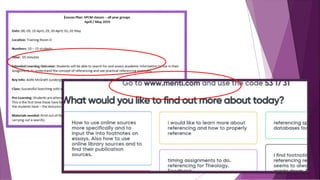
  • #19 Explain the difference in putting activity front and centre of each class. The role of Menti in discovering student’s understanding and where they are at. Where this leave the instructor.
  • #22 By Barry Mangham [CC BY-SA 3.0 (https://creativecommons.org/licenses/by-sa/3.0) or GFDL (http://www.gnu.org/copyleft/fdl.html)], from Wikimedia Commons