Teaching Research and Informational Writing in the Elementary Classroom A Presentation by Beverly Keegan and Melissa O’Neill
Today’s Agenda I.  Introductions and welcome II.  “CB Research Model” III. Practical ideas for teaching steps in model IV. Lunch V. Informational Writing Overview VI. Practical ideas for teaching  informational writing
Research: “Best Practices” Working in tandem with librarian Not best in isolation—goes both ways CB research model : bootleg copy Planning backward + PA State Standards Should be somewhat similar to current practice  “ Freestyling” by one   Reteaching for all Need vertical integration of research skills in buildings
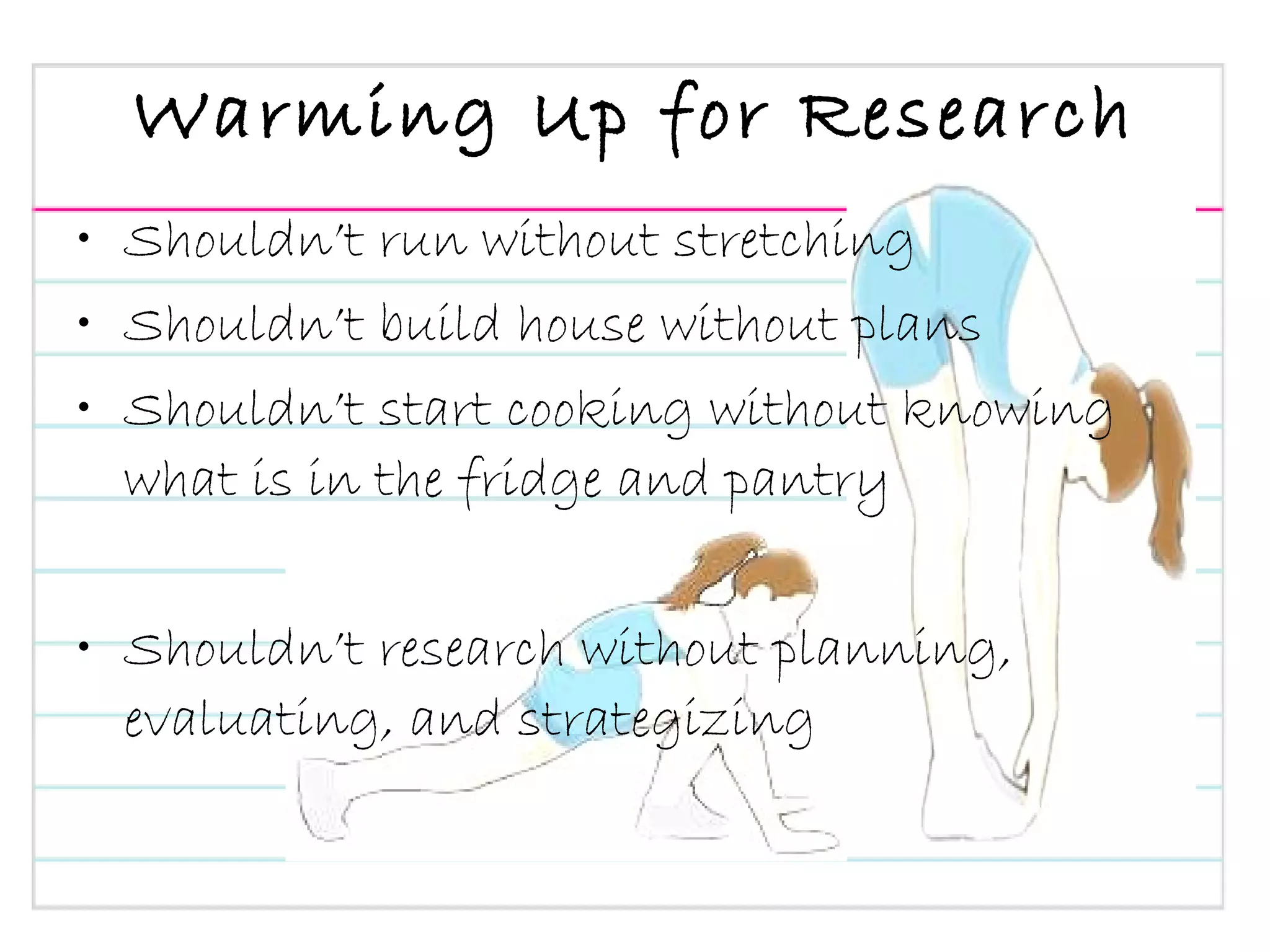
Warming Up for Research Shouldn’t run without stretching Shouldn’t build house without plans Shouldn’t start cooking without knowing what is in the fridge and pantry Shouldn’t research without planning, evaluating, and strategizing
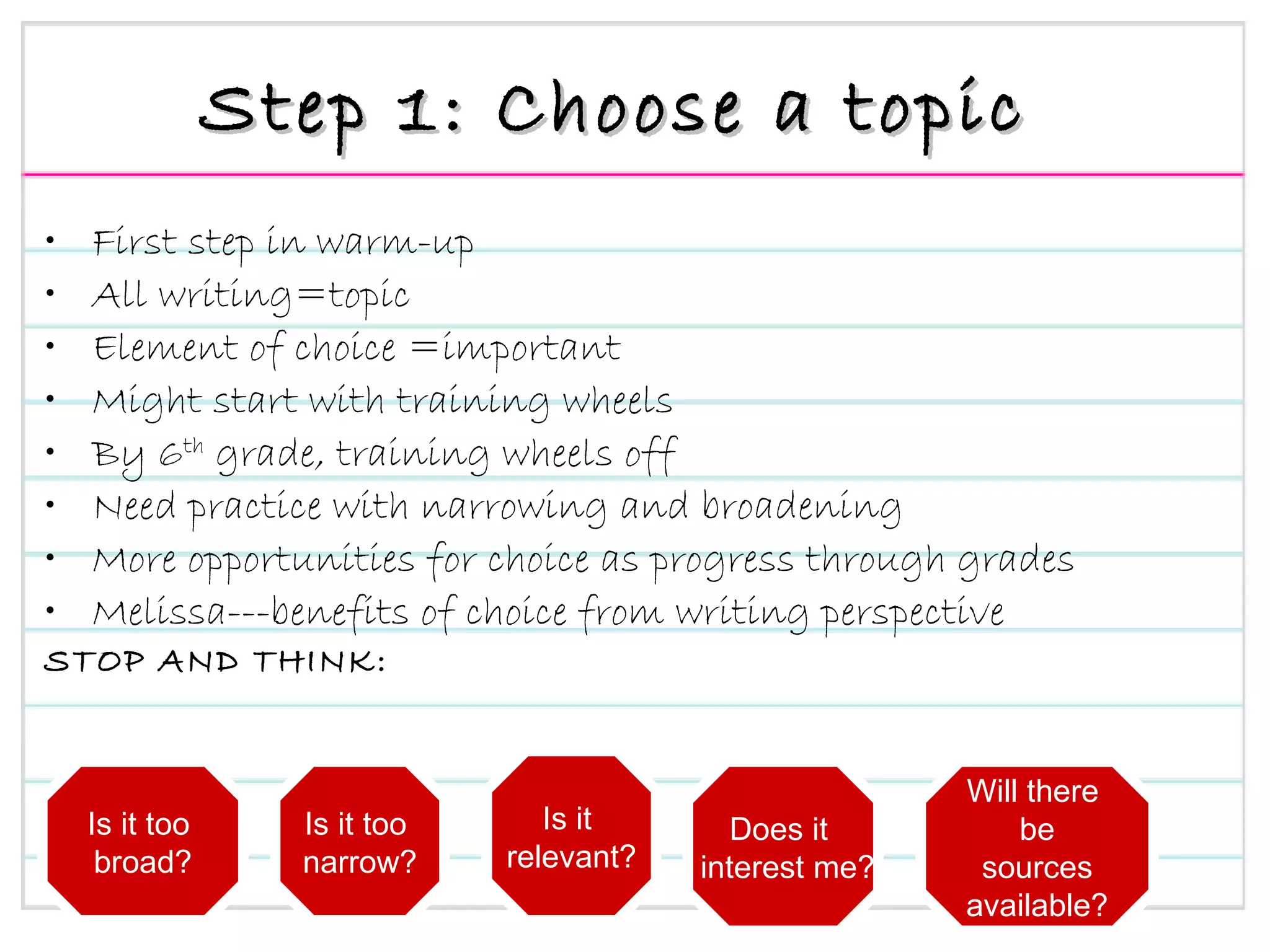
Step 1: Choose a topic First step in warm-up All writing=topic Element of choice =important Might start with training wheels By 6 th  grade, training wheels off Need practice with narrowing and broadening More opportunities for choice as progress through grades Melissa---benefits of choice from writing perspective STOP AND THINK: Is it too  broad? Is it too  narrow? Is it  relevant? Does it  interest me? Will there  be sources available?
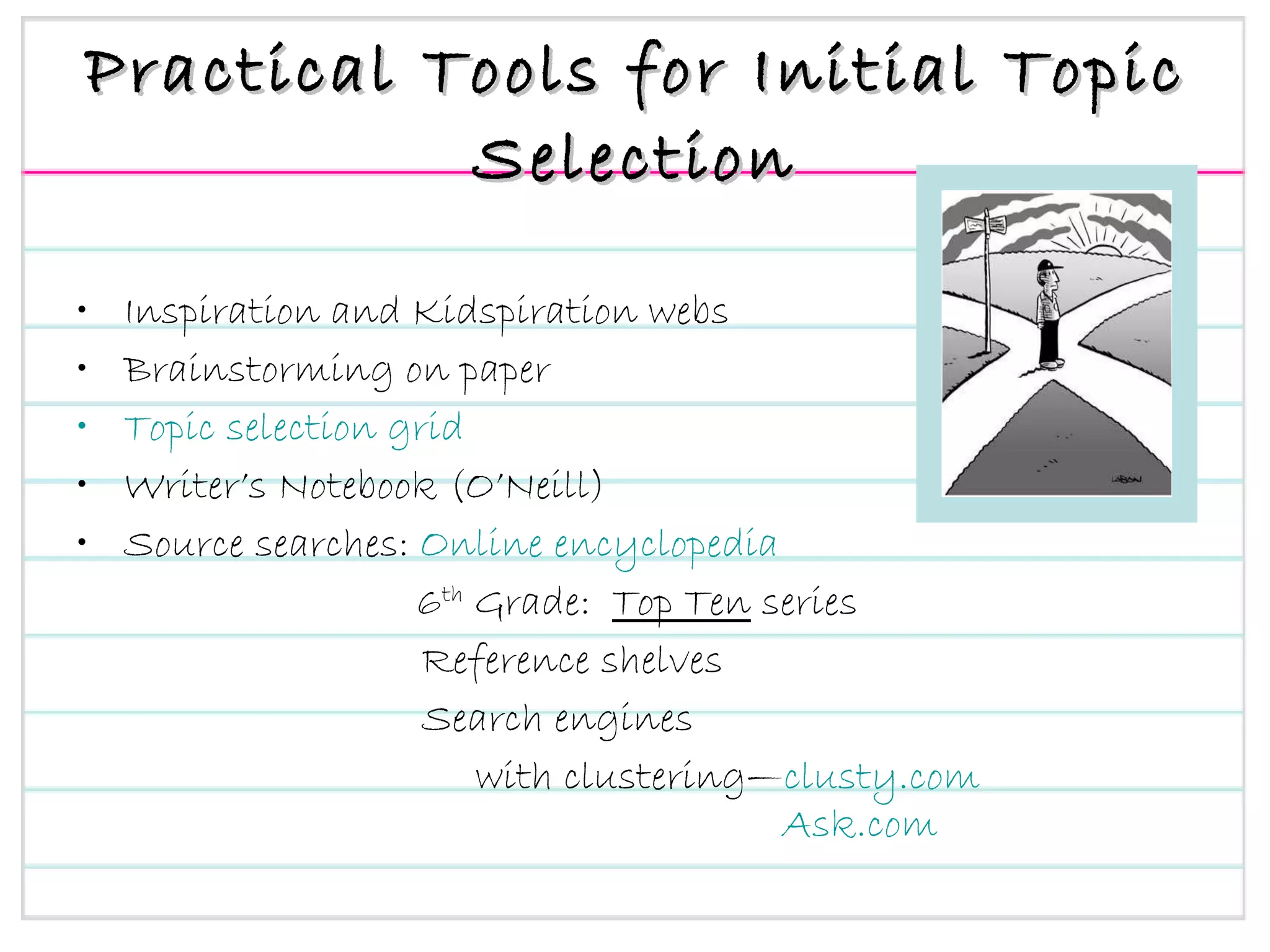
Practical Tools for Initial Topic Selection Inspiration and Kidspiration webs Brainstorming on paper Topic selection grid Writer’s Notebook (O’Neill) Source searches:  Online encyclopedia   6 th  Grade:  Top Ten  series Reference shelves Search engines  with clustering— clusty.com   Ask.com
Great Tools for Refining Topics Clusty and Ask World Book Online- Table of Contents in books Wikipedia
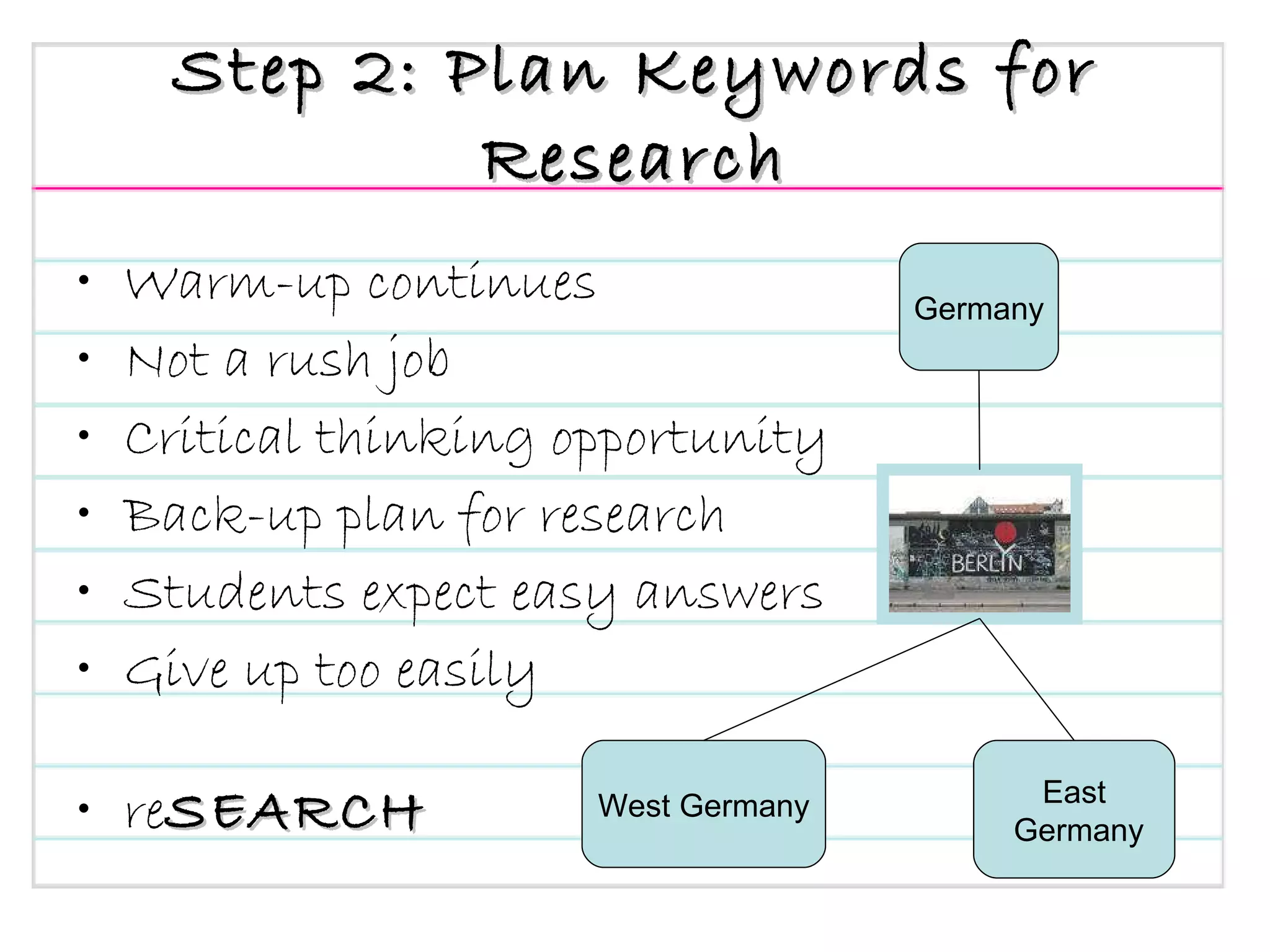
Step 2: Plan Keywords for Research Warm-up continues Not a rush job Critical thinking opportunity Back-up plan for research Students expect easy answers Give up too easily re SEARCH Germany West Germany East Germany
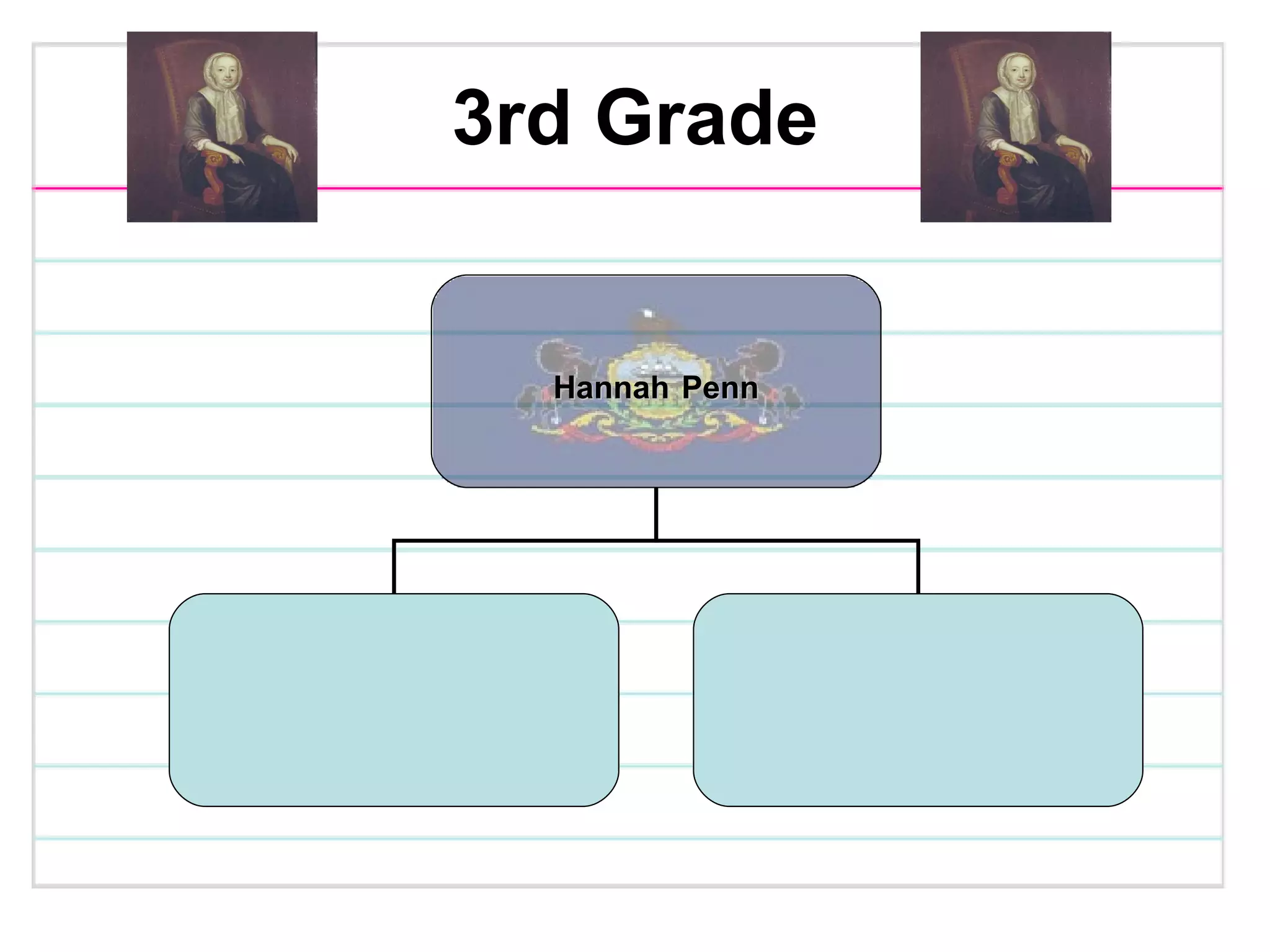
3rd Grade Hannah   Penn
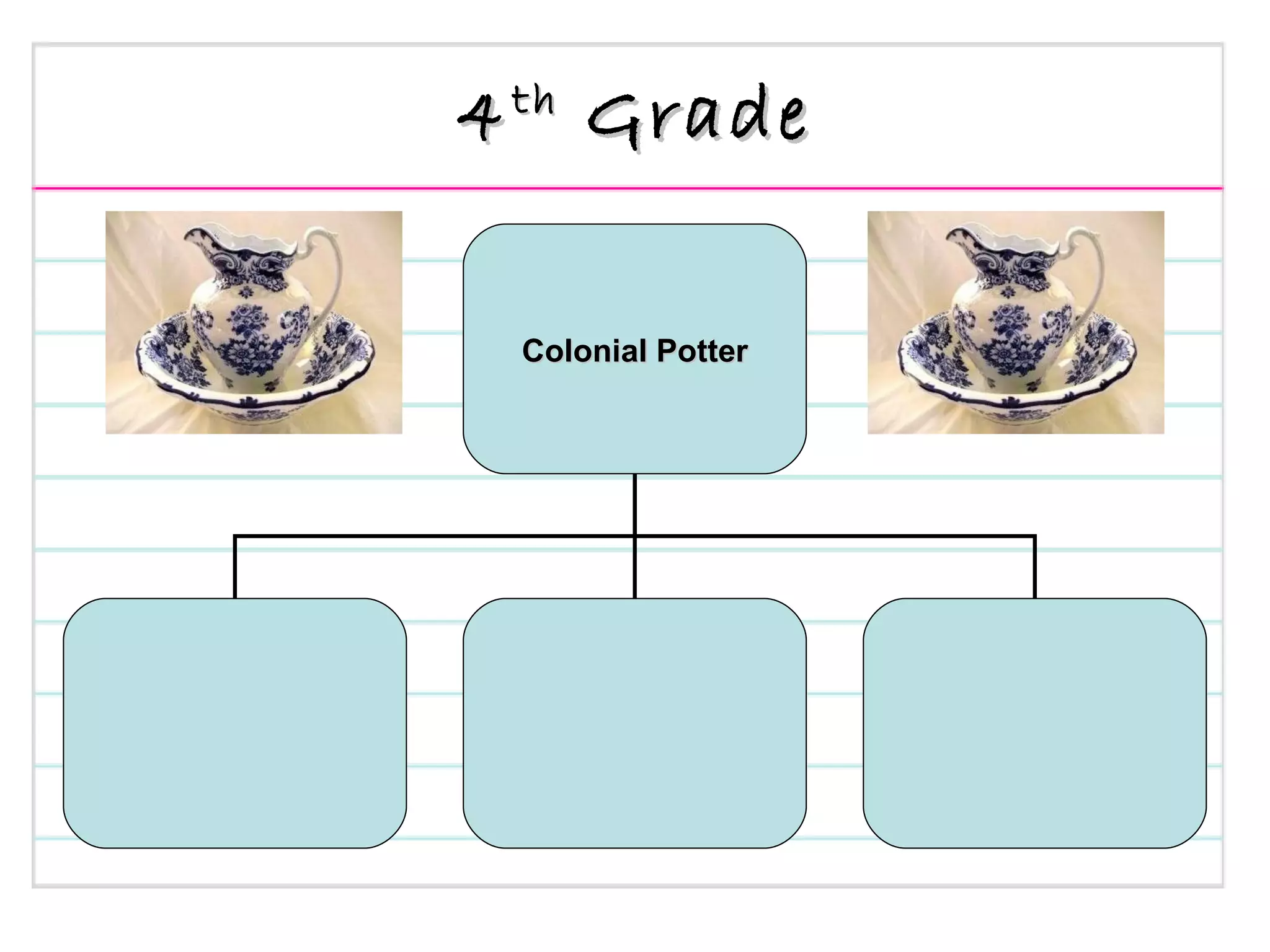
4 th  Grade Colonial Potter
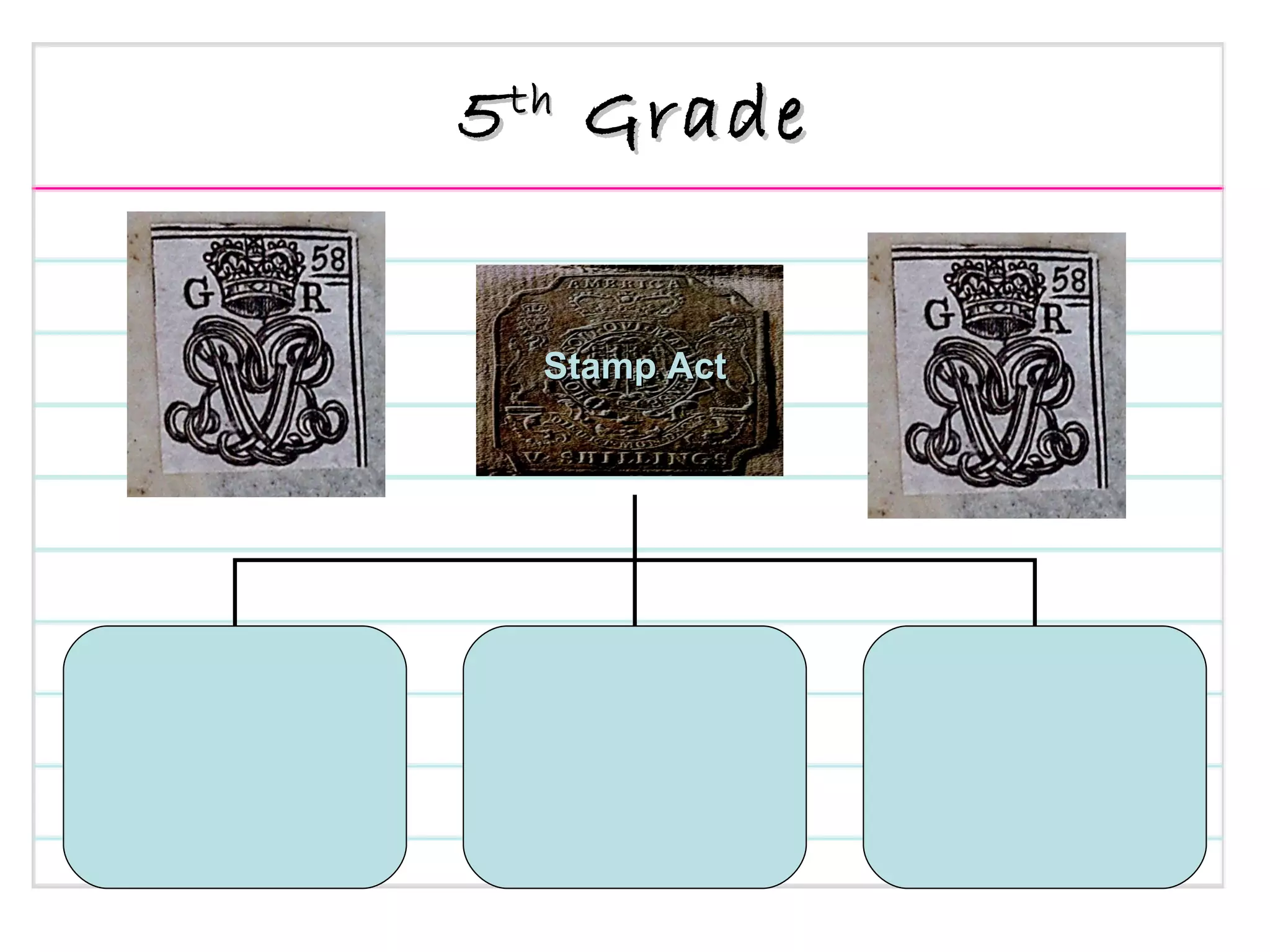
5 th  Grade Stamp Act
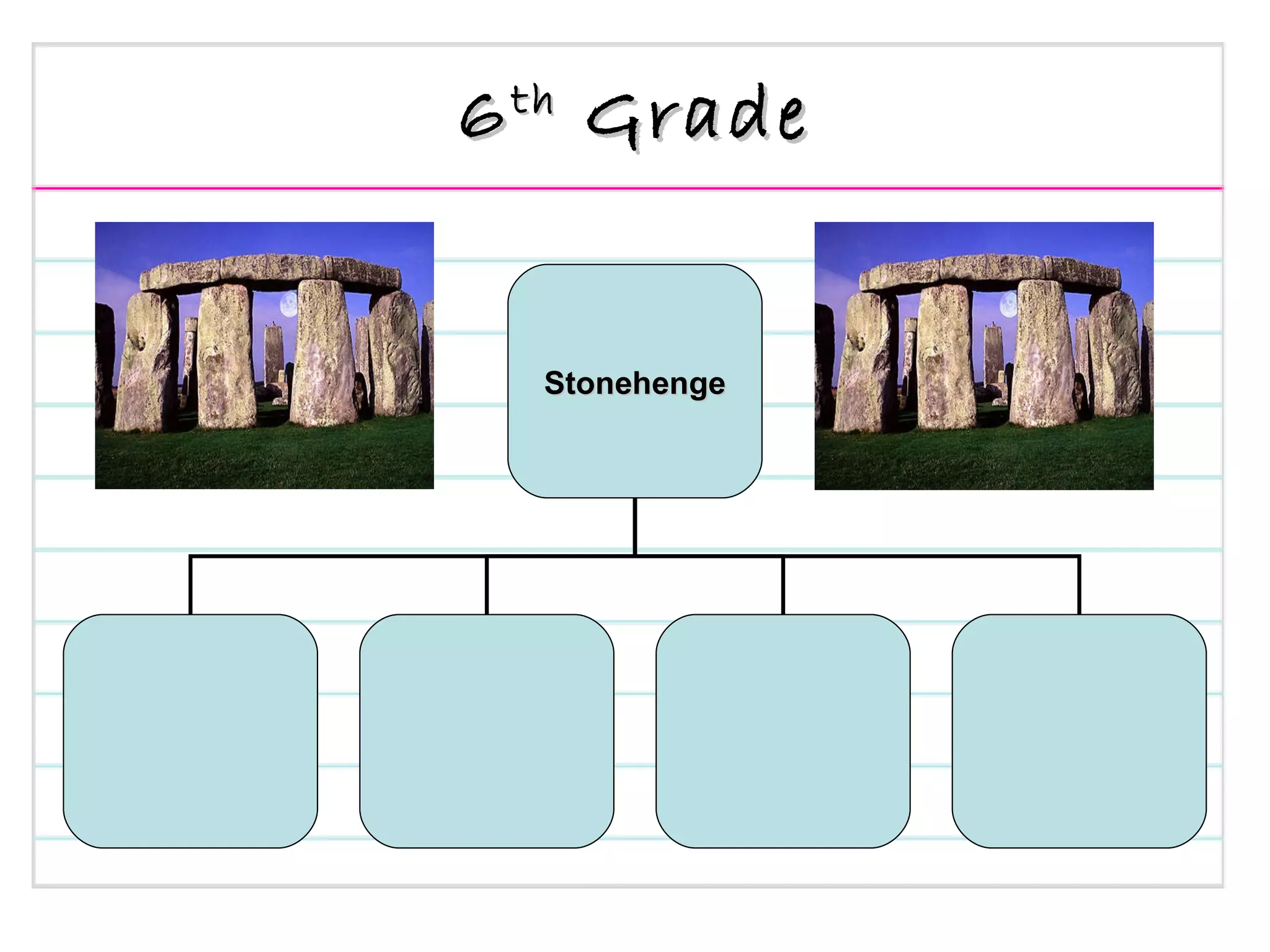
6 th  Grade Stonehenge
Step 3: Pre-search Part of warm-up “ Shopping time” “ Hunting and gathering” time Well chosen sources ≠ all websites Pre-searches needn’t be lengthy One of each 3 different kinds of sources Teacher must set  source expectations Reinforce Hierarchy of Research
Pop Quiz! Name the 5 main sources available to CB students. Next order them:  where should students research first, second, third, etc.
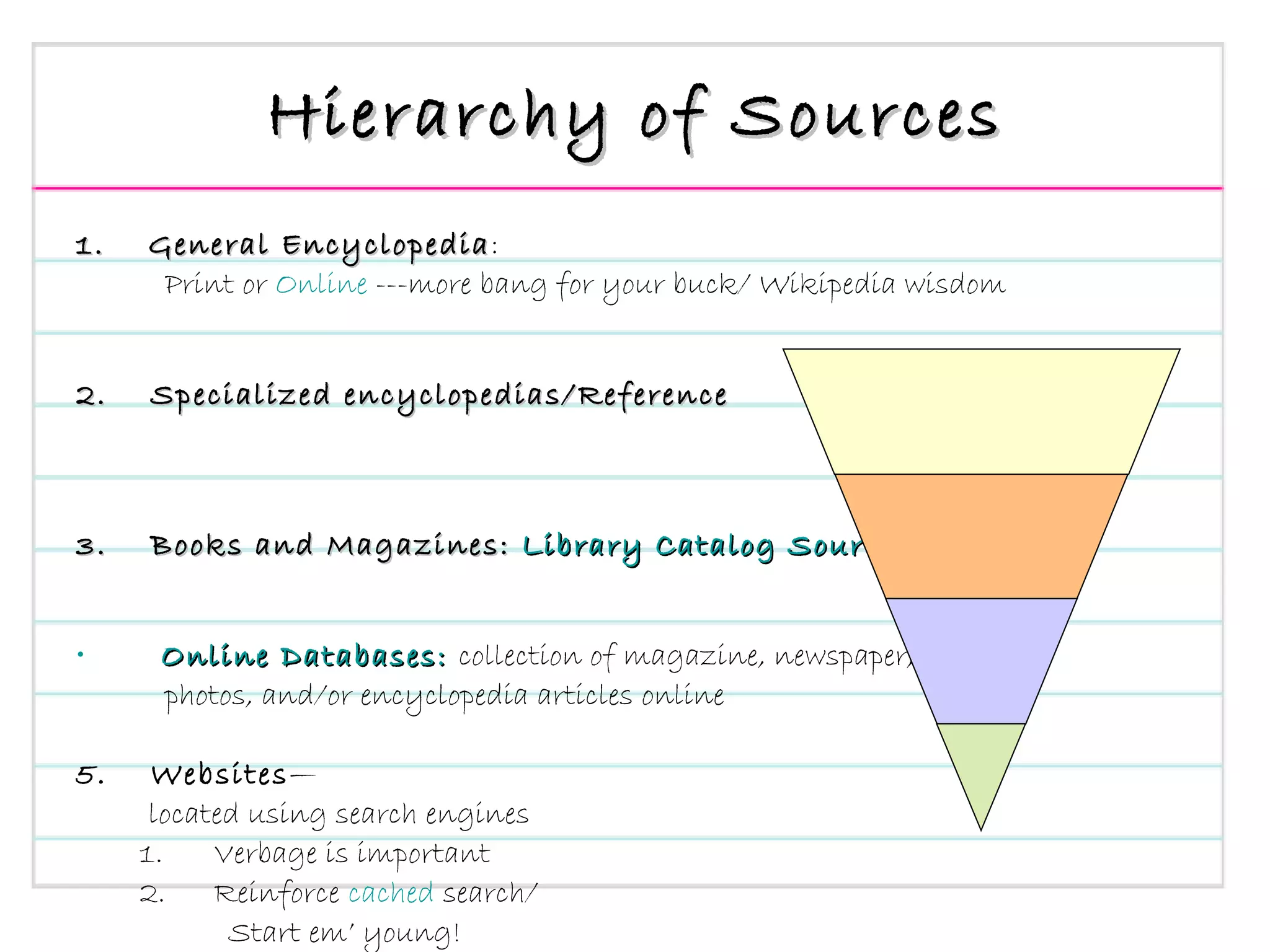
Hierarchy of Sources 1.  General Encyclopedia :  Print or  Online  ---more bang for your buck/ Wikipedia wisdom 2.  Specialized encyclopedias/Reference 3.  Books and Magazines:  Library Catalog Sources Online Databases:  collection of magazine, newspaper,  photos, and/or encyclopedia articles online 5.  Websites — located using search engines  Verbage is important Reinforce  cached  search/  Start em’ young!
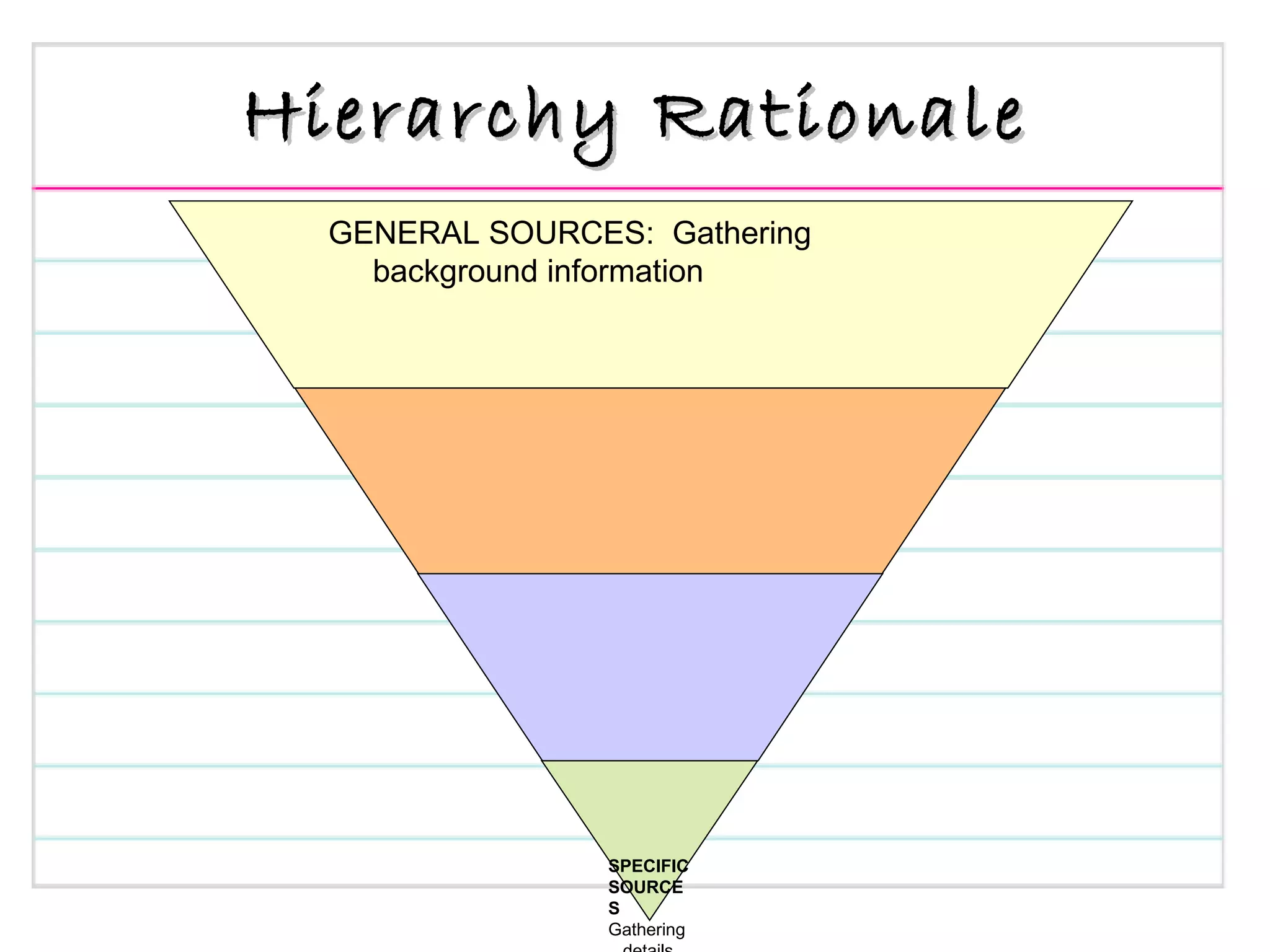
Hierarchy Rationale SPECIFIC SOURCES Gathering    details GENERAL SOURCES:  Gathering  background information
Hierarchy Manipulatives Envelopes with hierarchy components or Smart Notebook activity Game in packet Turkey game
Pre-search Document 6 th  Grade Assessment document Easily modified for various grade levels 5 th : should use 6 th  grade assessment document 4 th :  Colonial sample 3 rd : PA  Wax museum sample Can be as simple as “find one, print one”
Evaluating Sources Scenario for Discussion: Without guidance or parameters you tell your students to “go research.” What would their strategy most likely be?
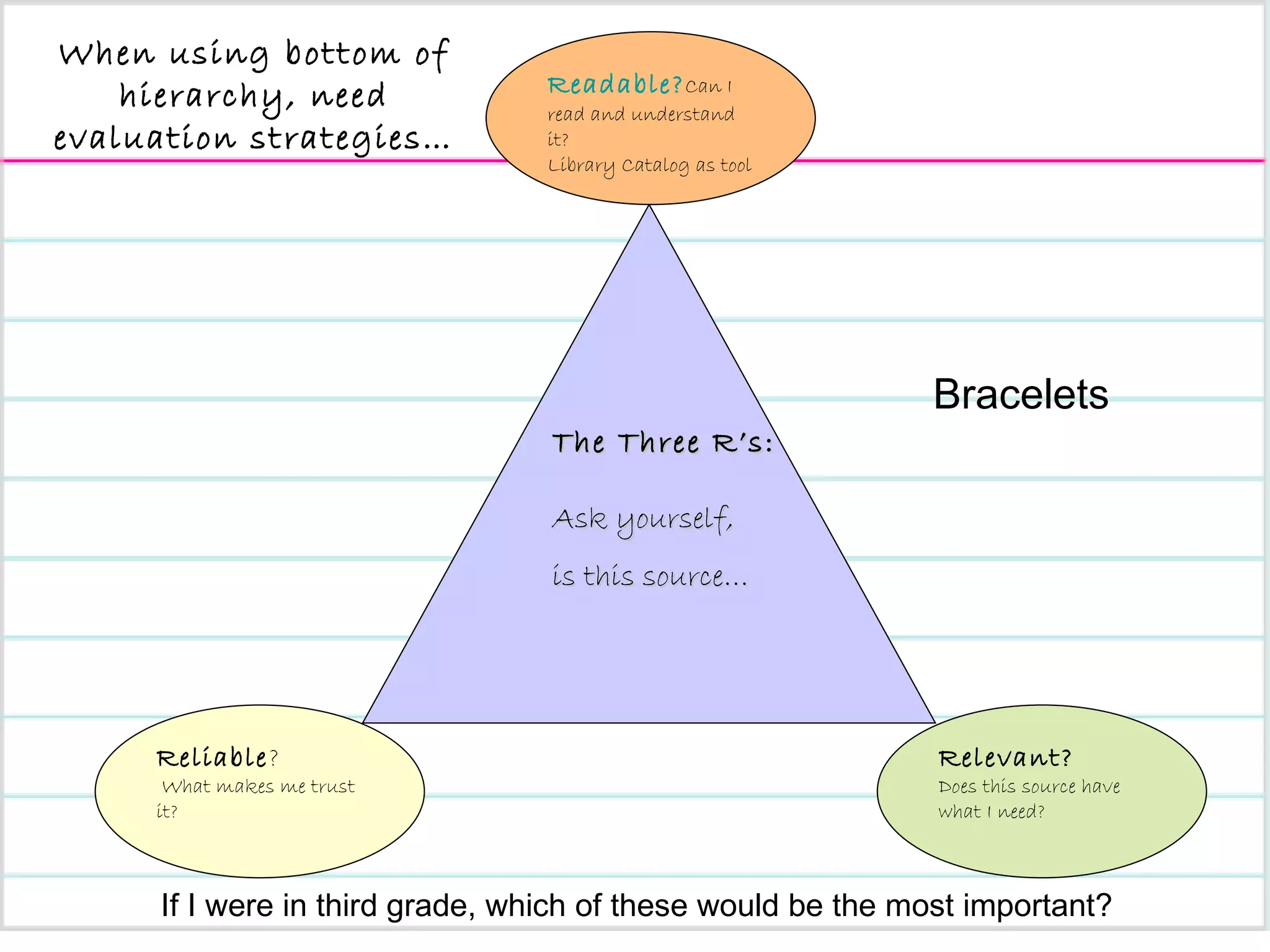
The Three R’s: Ask yourself,  is this source… If I were in third grade, which of these would be the most important? When using bottom of hierarchy, need evaluation strategies… Bracelets Reliable ? What makes me trust it? Readable ? Can I read and understand it? Library Catalog as tool Relevant? Does this source have what I need?
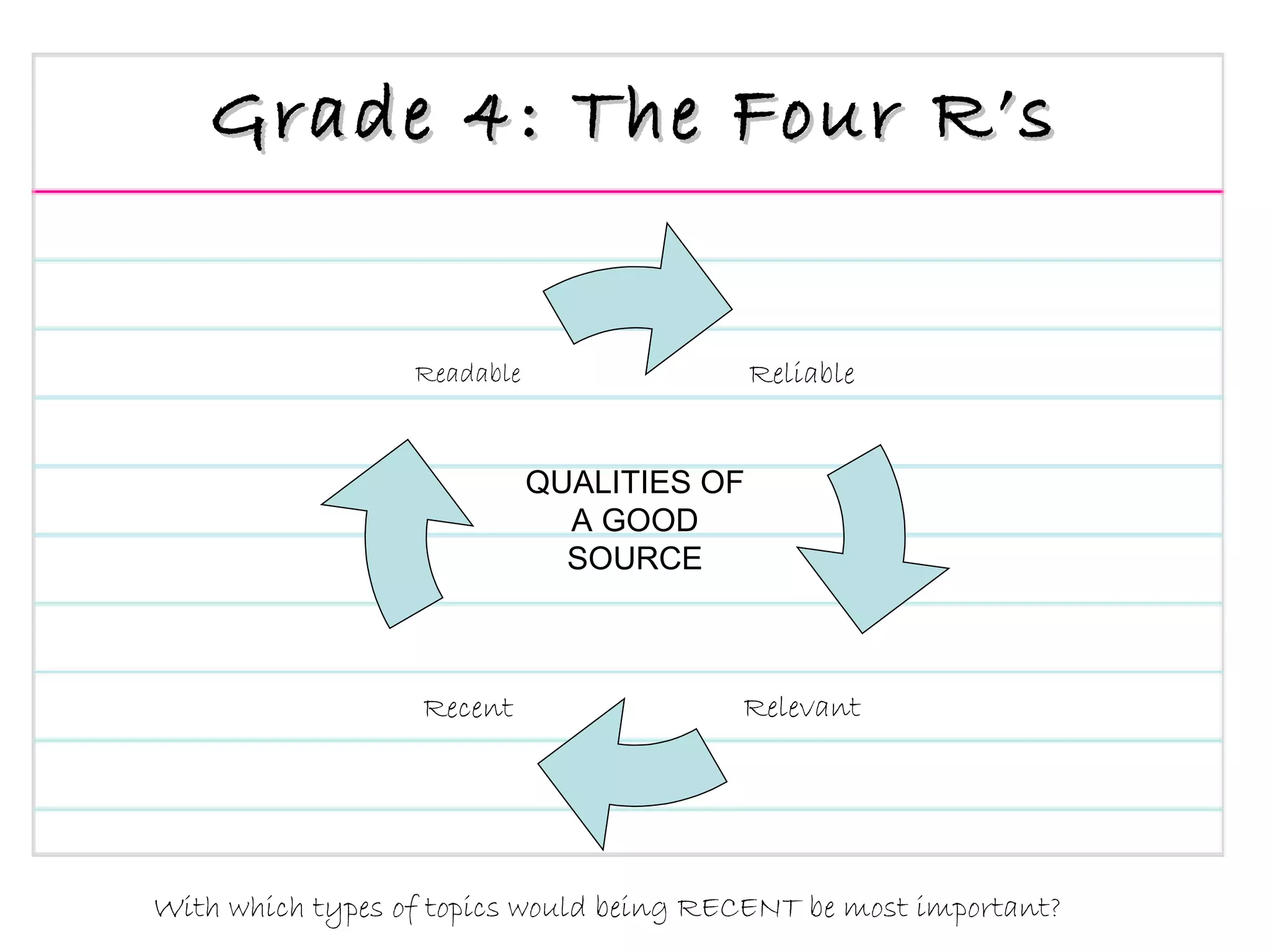
Grade 4: The Four R’s QUALITIES OF A GOOD SOURCE With which types of topics would being RECENT be most important? Reliable Recent Readable Relevant
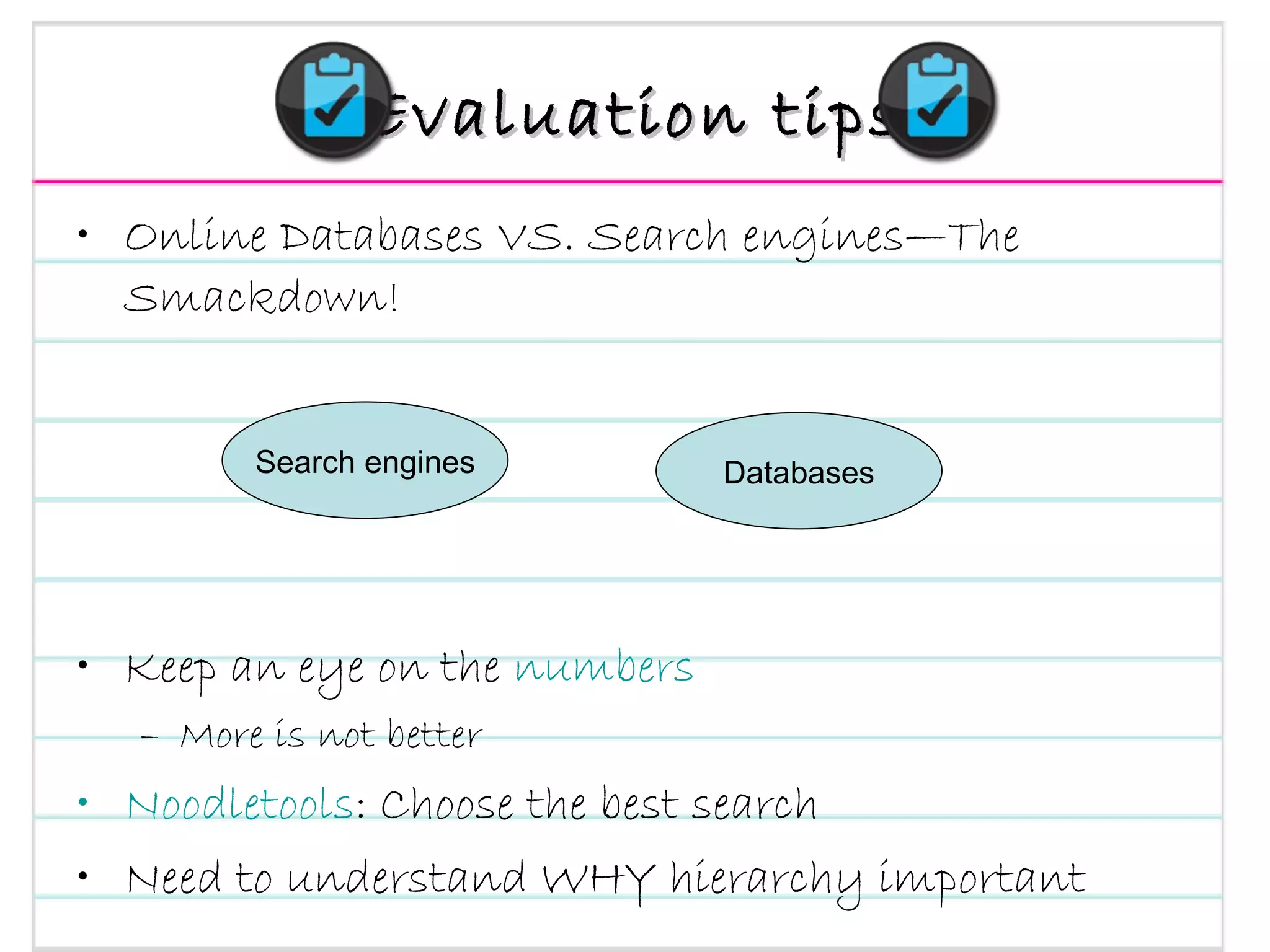
Evaluation tips Online Databases VS. Search engines—The Smackdown! Keep an eye on the  numbers More is not better Noodletools : Choose the best search Need to understand WHY hierarchy important Search engines Databases
This darned economy! Access to SIRS Discoverer No more Power Library No Nettrekker Try:  www.LII.org More direct teaching of   domain suffixes 1    domain 2  and authority Search strategy more important:  www.Iseek.com - More focused=more time to evaluate
Grade 6:  CARRDSS  Great video on Safari Montage http://safari.cbsd.org CARRDDS Websites only Taking evaluating to next level Students can discuss which are most important for current type of research Also  RATE  the source
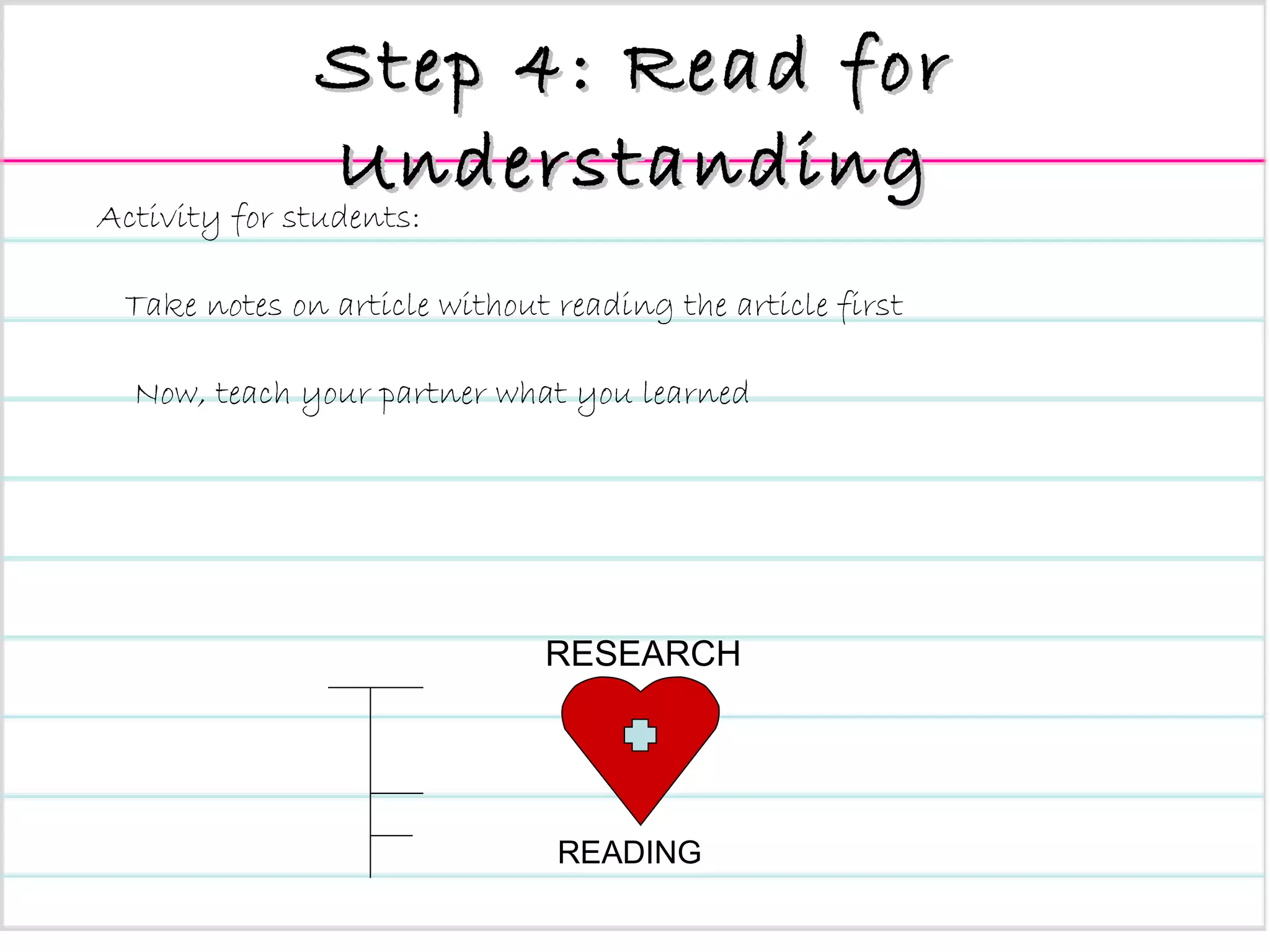
Step 4: Read for Understanding Activity for students:  Take notes on article without reading the article first Now, teach your partner what you learned RESEARCH  READING
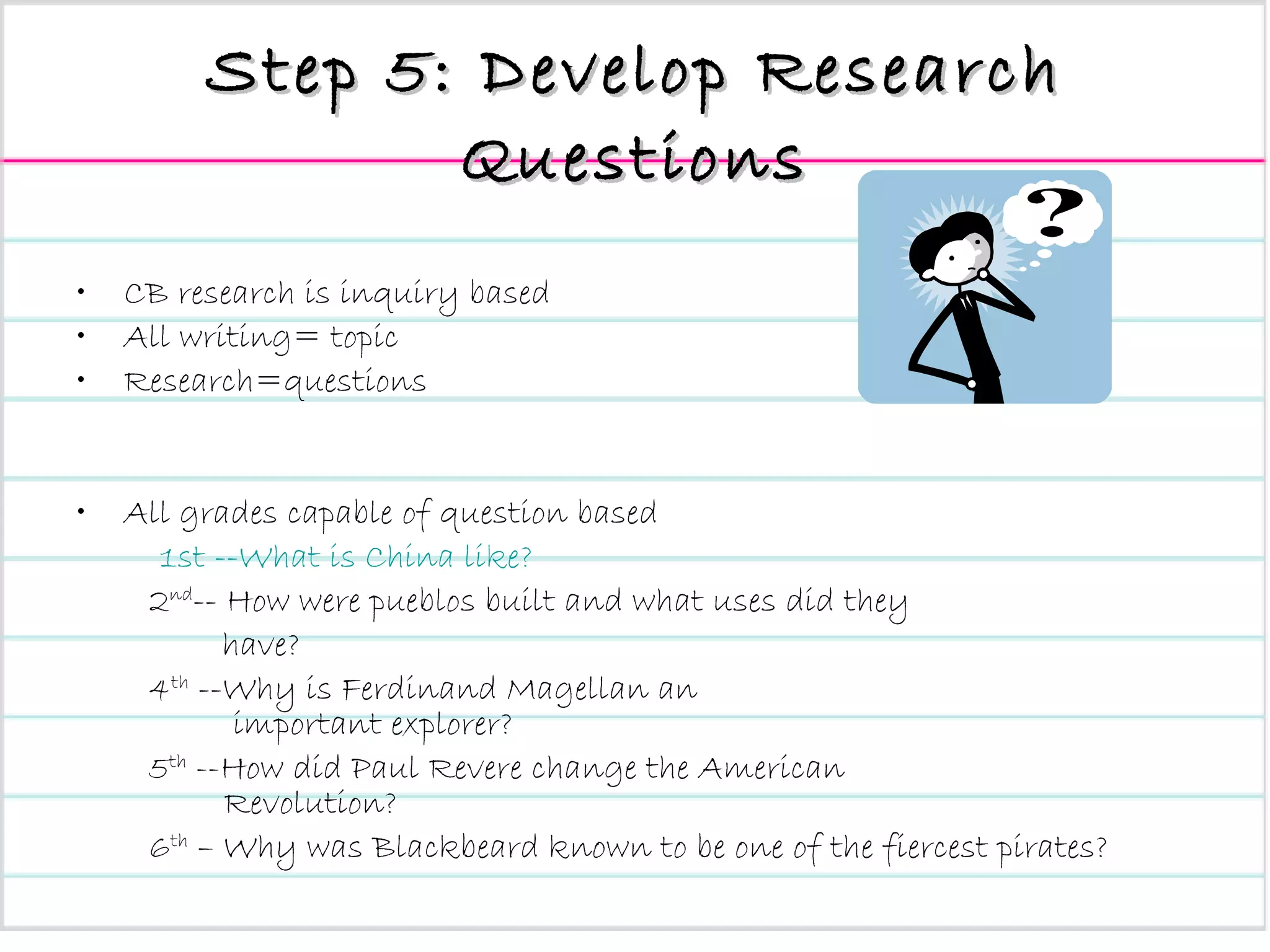
Step 5: Develop Research Questions CB research is inquiry based All writing= topic Research=questions  All grades capable of question based   1st --What is China like? 2 nd -- How were pueblos built and what uses did they  have? 4 th  --Why is Ferdinand Magellan an    important explorer? 5 th  --How did Paul Revere change the American   Revolution? 6 th  – Why was Blackbeard known to be one of the fiercest pirates?
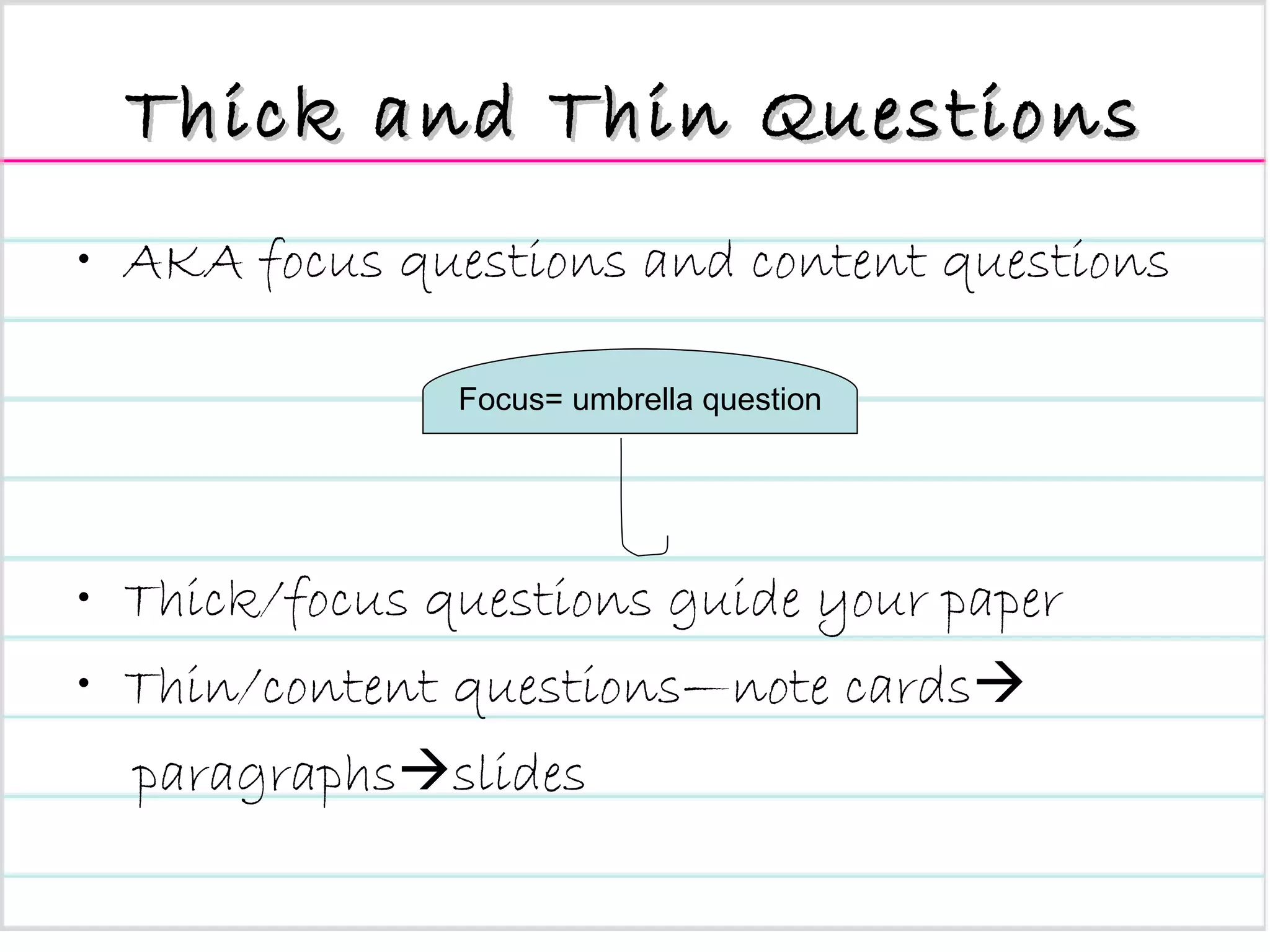
Thick and Thin Questions AKA focus questions and content questions Thick/focus questions guide your paper Thin/content questions—note cards  paragraphs  slides Focus= umbrella question
Don’t fear the questions Thick vs. Thin Questions Pizza theory for thin questions Which does not belong? Organizers in packet How Mrs. K teaches question development
Developing Questions (Developmentally) 2 nd  Grade:  Provide thick question and three thin questions; students produce one thin 3 rd :  Provide thick question and students choose from large list of thin questions to see which work best for their topic:  Egypt example 4 th :  Write thick question as a class; brainstorm thin questions in small groups and then choose from list 5 th :  Write thick and thin questions independently after guided lessons; revise with teacher and librarian 6 th :   Fine tune question writing skills
Editing and Revising Questions Questions not static—need revision Packet walk Question manipulatives Questioning Our Questions ppt.  with worksheet
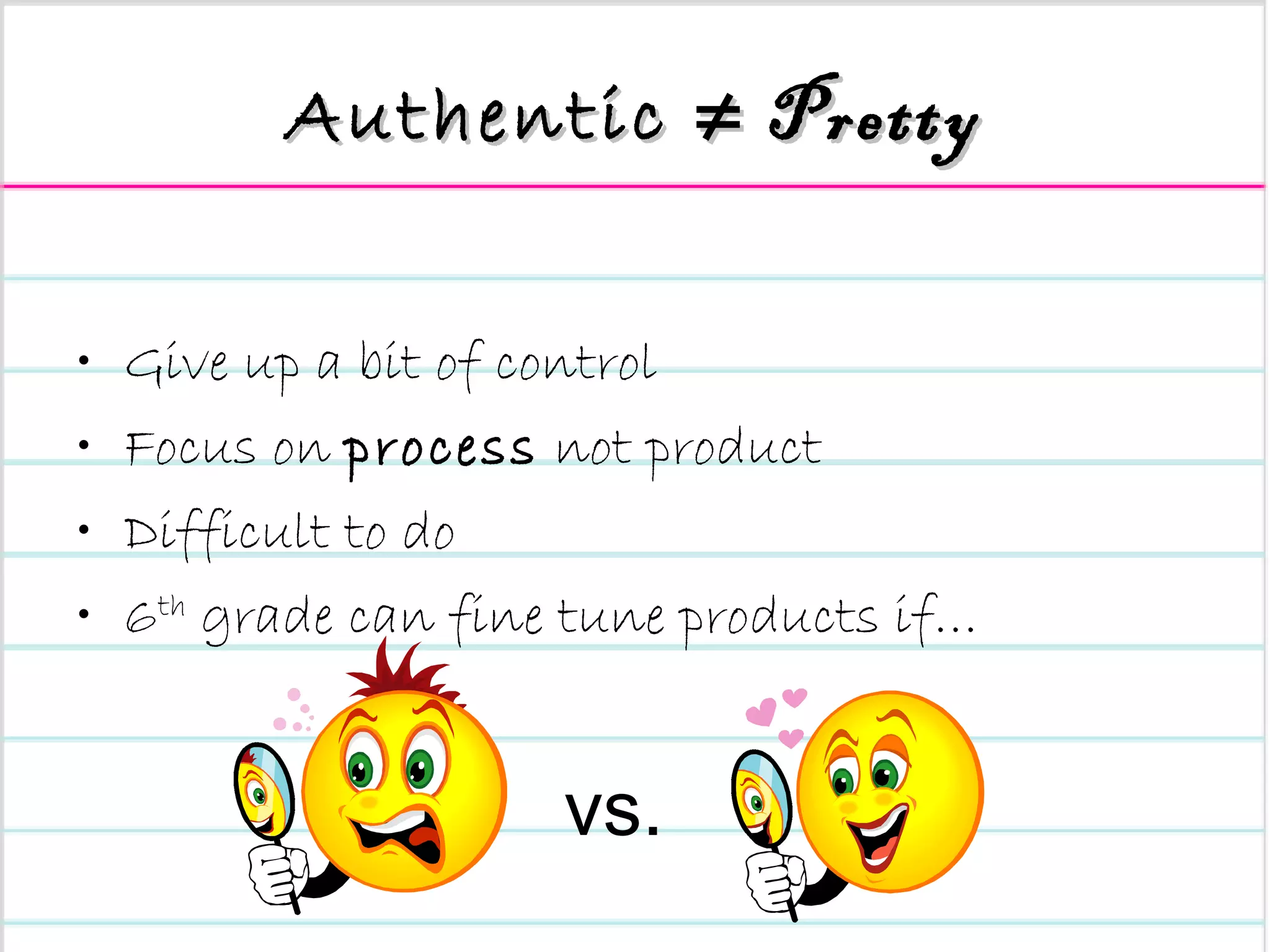
Authentic ≠   Pretty Give up a bit of control Focus on  process  not product Difficult to do 6 th  grade can fine tune products if… vs.
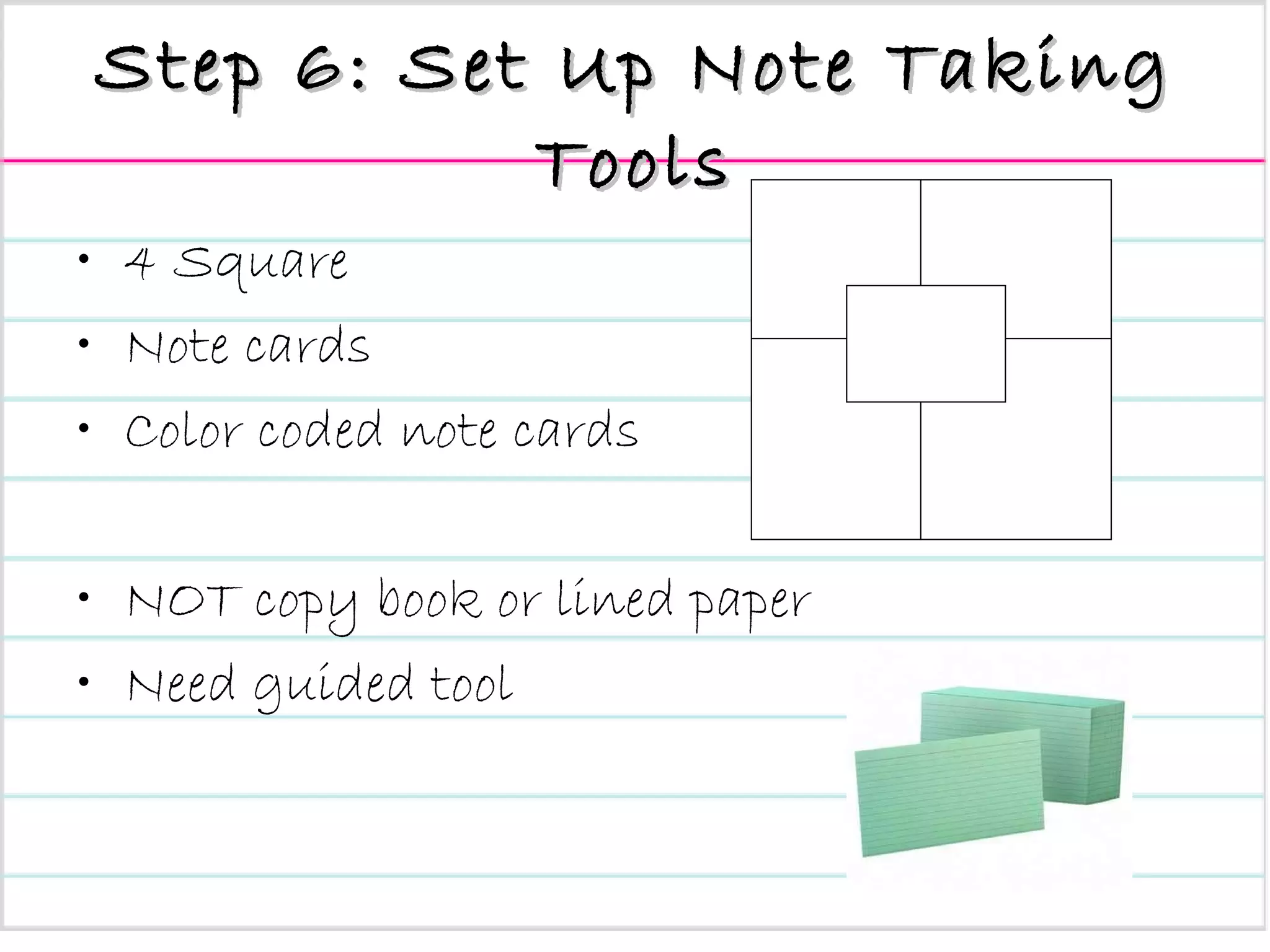
Step 6: Set Up Note Taking Tools 4 Square Note cards Color coded note cards NOT copy book or lined paper Need guided tool
Step 7: Take Notes “ It takes 15 years to develop experienced writing and note-taking skills.” (Scardamalia & Bereiter, 1991) 1 st - beginning of 3 rd :  Keyword Research In 3 rd ---begin paraphrasing and summarizing Brainpop -mill_es1/magic1-Study and Reading Skills
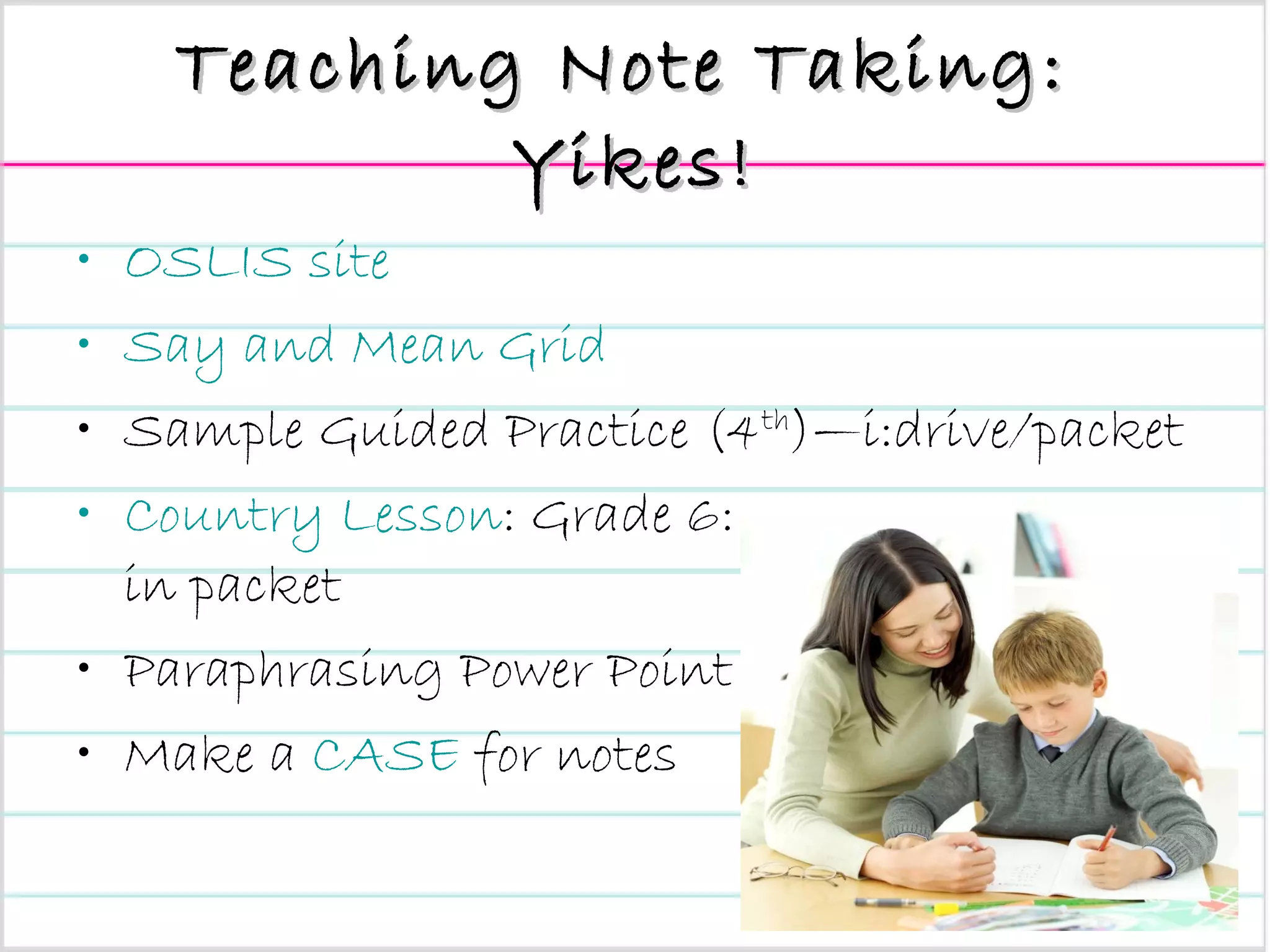
Teaching Note Taking:  Yikes! OSLIS site Say and Mean Grid Sample Guided Practice (4 th )—i:drive/packet Country Lesson : Grade 6: in packet Paraphrasing Power Point Make a  CASE  for notes
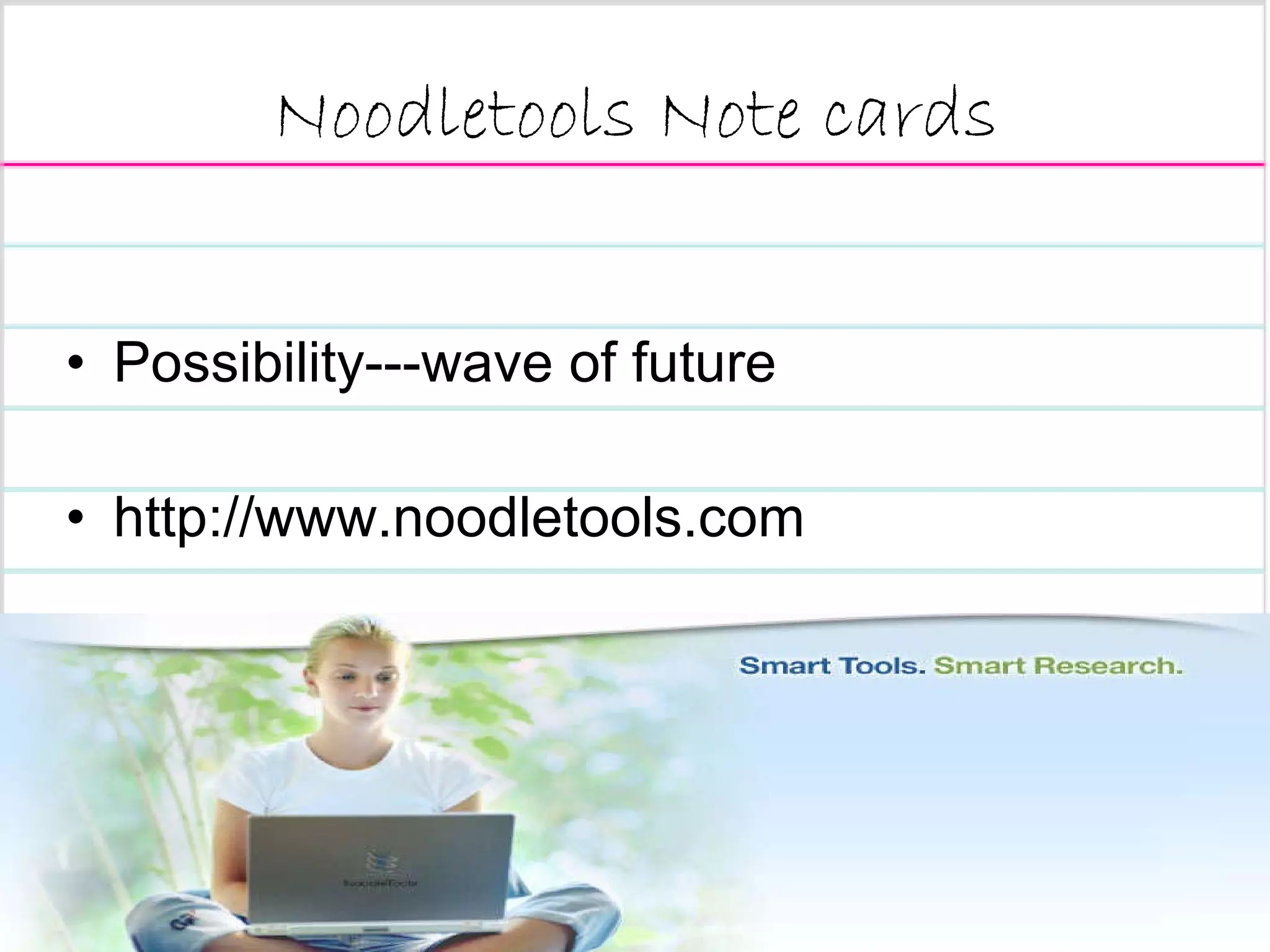
Noodletools Note cards Possibility---wave of future http://www.noodletools.com
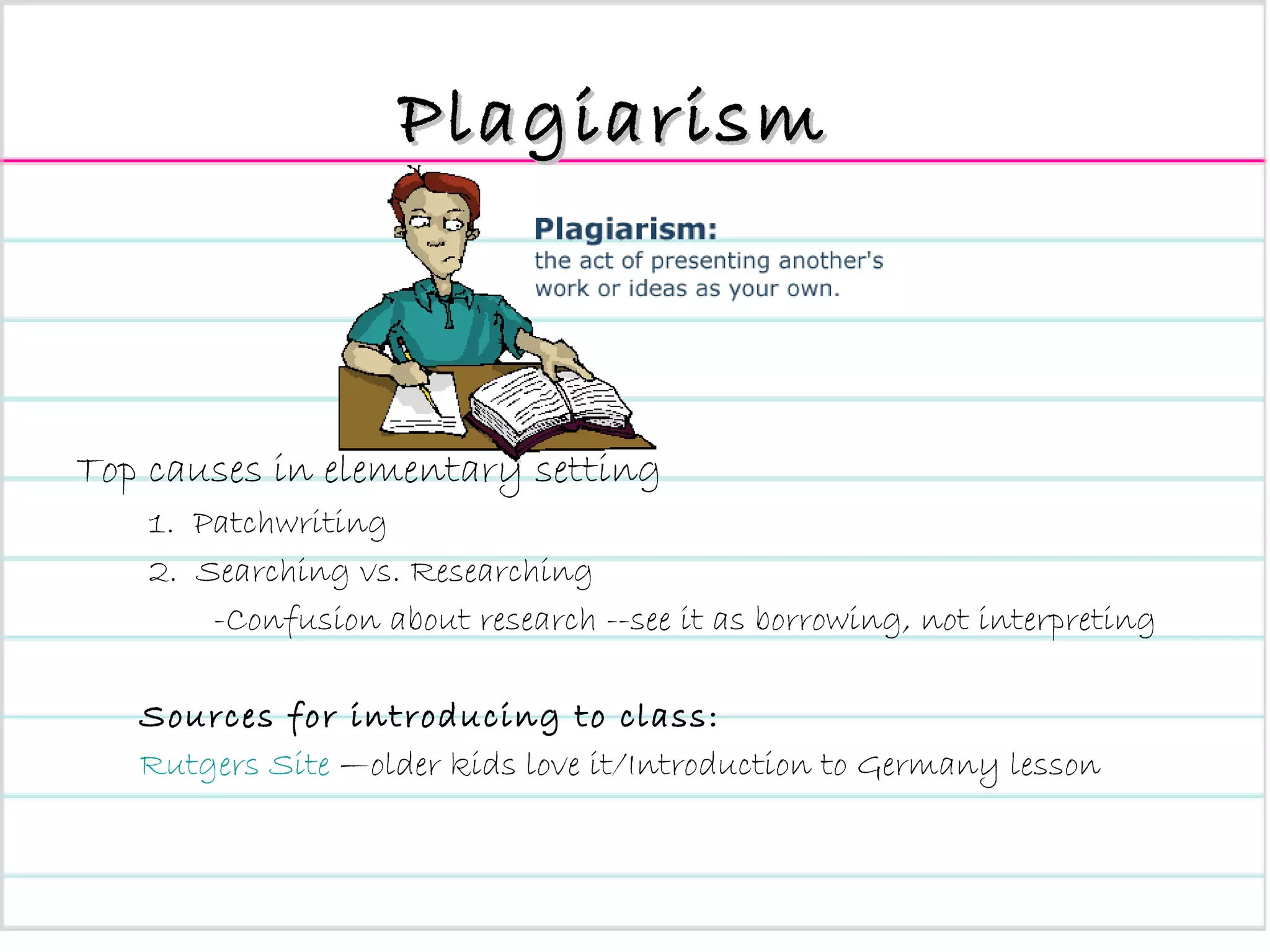
Plagiarism Top causes in elementary setting 1.  Patchwriting 2.  Searching vs. Researching -Confusion about research --see it as borrowing, not interpreting Sources for introducing to class: Rutgers Site  —older kids love it/Introduction to Germany lesson
Step 8: Credit Sources Librarian takes lead role Needs to be reinforced in classroom setting Cannot just say “Do a bibliography.” Cannot skip bibliography Main sources: Encyclopedia   Book Website Websites can be SCARY— ----let’s go for it!
2 Websites   Test me Google—Biography of Barack Obama for Kids:  2 nd  website
Noodletools God’s gift to librarians Librarian is leader  Practical and real world Sign up for account
Step 9: Organize Information Outlining— Brainpop - Inspiration-Outlining tool Melissa will add more more after break
Step 10: Continue with Writing Process After lunch…
Image Credits BlankNotecard:http://www.dovinci.net/site/Cassina/Entries/2008/3/13_Photo_of_the_Day_files/BlankNotecard.png Power Library Image:  www.delcolibraries.org/Databases_Full.htm   Pencil Image: Microsoft Office clip art gallery Highlighter:  http://www. catalystarts.wordpress.com   Stretches:  http://www.dailymail.co.uk/health/article-1053044/How-stay-flexible-stretching-mind---body.html Berlin Wall:  www.berlin101.com Stonehenge:  http://www.dailymail.co.uk/news/article-451539/Stonehenge-built-Romans-great-British-myths.html Stamp Act:  https://www.killeenisd.org/schools/Middle/ehms/MCD%208th%20webpages/chapter5/image.jpeg Hannah Penn:  http://explorepahistory.com Blue Notecards:  www.greenlightoffice.com Plagiarism Definition:  http://www.davisenglish.com/wp-content/uploads/2008/08/plagiarism.gif I Love Brainpop :  www.brainpop.com/eduacators/blog Topics bulletin board :  www.publicspeakingtip.org   Crossroads:   bigyellowtaxi.files.wordpress.com/2008/06/cro  Remainder of images: Microsoft Office Clipart Gallery

Teaching research in the elementary classroomfinak

  • 1.
    Teaching Research andInformational Writing in the Elementary Classroom A Presentation by Beverly Keegan and Melissa O’Neill
  • 2.
    Today’s Agenda I. Introductions and welcome II. “CB Research Model” III. Practical ideas for teaching steps in model IV. Lunch V. Informational Writing Overview VI. Practical ideas for teaching informational writing
  • 3.
    Research: “Best Practices”Working in tandem with librarian Not best in isolation—goes both ways CB research model : bootleg copy Planning backward + PA State Standards Should be somewhat similar to current practice “ Freestyling” by one  Reteaching for all Need vertical integration of research skills in buildings
  • 4.
    Warming Up forResearch Shouldn’t run without stretching Shouldn’t build house without plans Shouldn’t start cooking without knowing what is in the fridge and pantry Shouldn’t research without planning, evaluating, and strategizing
  • 5.
    Step 1: Choosea topic First step in warm-up All writing=topic Element of choice =important Might start with training wheels By 6 th grade, training wheels off Need practice with narrowing and broadening More opportunities for choice as progress through grades Melissa---benefits of choice from writing perspective STOP AND THINK: Is it too broad? Is it too narrow? Is it relevant? Does it interest me? Will there be sources available?
  • 6.
    Practical Tools forInitial Topic Selection Inspiration and Kidspiration webs Brainstorming on paper Topic selection grid Writer’s Notebook (O’Neill) Source searches: Online encyclopedia 6 th Grade: Top Ten series Reference shelves Search engines with clustering— clusty.com Ask.com
  • 7.
    Great Tools forRefining Topics Clusty and Ask World Book Online- Table of Contents in books Wikipedia
  • 8.
    Step 2: PlanKeywords for Research Warm-up continues Not a rush job Critical thinking opportunity Back-up plan for research Students expect easy answers Give up too easily re SEARCH Germany West Germany East Germany
  • 9.
  • 10.
    4 th Grade Colonial Potter
  • 11.
    5 th Grade Stamp Act
  • 12.
    6 th Grade Stonehenge
  • 13.
    Step 3: Pre-searchPart of warm-up “ Shopping time” “ Hunting and gathering” time Well chosen sources ≠ all websites Pre-searches needn’t be lengthy One of each 3 different kinds of sources Teacher must set source expectations Reinforce Hierarchy of Research
  • 14.
    Pop Quiz! Namethe 5 main sources available to CB students. Next order them: where should students research first, second, third, etc.
  • 15.
    Hierarchy of Sources1. General Encyclopedia : Print or Online ---more bang for your buck/ Wikipedia wisdom 2. Specialized encyclopedias/Reference 3. Books and Magazines: Library Catalog Sources Online Databases: collection of magazine, newspaper, photos, and/or encyclopedia articles online 5. Websites — located using search engines Verbage is important Reinforce cached search/ Start em’ young!
  • 16.
    Hierarchy Rationale SPECIFICSOURCES Gathering details GENERAL SOURCES: Gathering background information
  • 17.
    Hierarchy Manipulatives Envelopeswith hierarchy components or Smart Notebook activity Game in packet Turkey game
  • 18.
    Pre-search Document 6th Grade Assessment document Easily modified for various grade levels 5 th : should use 6 th grade assessment document 4 th : Colonial sample 3 rd : PA Wax museum sample Can be as simple as “find one, print one”
  • 19.
    Evaluating Sources Scenariofor Discussion: Without guidance or parameters you tell your students to “go research.” What would their strategy most likely be?
  • 20.
    The Three R’s:Ask yourself, is this source… If I were in third grade, which of these would be the most important? When using bottom of hierarchy, need evaluation strategies… Bracelets Reliable ? What makes me trust it? Readable ? Can I read and understand it? Library Catalog as tool Relevant? Does this source have what I need?
  • 21.
    Grade 4: TheFour R’s QUALITIES OF A GOOD SOURCE With which types of topics would being RECENT be most important? Reliable Recent Readable Relevant
  • 22.
    Evaluation tips OnlineDatabases VS. Search engines—The Smackdown! Keep an eye on the numbers More is not better Noodletools : Choose the best search Need to understand WHY hierarchy important Search engines Databases
  • 23.
    This darned economy!Access to SIRS Discoverer No more Power Library No Nettrekker Try: www.LII.org More direct teaching of domain suffixes 1 domain 2 and authority Search strategy more important: www.Iseek.com - More focused=more time to evaluate
  • 24.
    Grade 6: CARRDSS Great video on Safari Montage http://safari.cbsd.org CARRDDS Websites only Taking evaluating to next level Students can discuss which are most important for current type of research Also RATE the source
  • 25.
    Step 4: Readfor Understanding Activity for students: Take notes on article without reading the article first Now, teach your partner what you learned RESEARCH READING
  • 26.
    Step 5: DevelopResearch Questions CB research is inquiry based All writing= topic Research=questions All grades capable of question based 1st --What is China like? 2 nd -- How were pueblos built and what uses did they have? 4 th --Why is Ferdinand Magellan an important explorer? 5 th --How did Paul Revere change the American Revolution? 6 th – Why was Blackbeard known to be one of the fiercest pirates?
  • 27.
    Thick and ThinQuestions AKA focus questions and content questions Thick/focus questions guide your paper Thin/content questions—note cards  paragraphs  slides Focus= umbrella question
  • 28.
    Don’t fear thequestions Thick vs. Thin Questions Pizza theory for thin questions Which does not belong? Organizers in packet How Mrs. K teaches question development
  • 29.
    Developing Questions (Developmentally)2 nd Grade: Provide thick question and three thin questions; students produce one thin 3 rd : Provide thick question and students choose from large list of thin questions to see which work best for their topic: Egypt example 4 th : Write thick question as a class; brainstorm thin questions in small groups and then choose from list 5 th : Write thick and thin questions independently after guided lessons; revise with teacher and librarian 6 th : Fine tune question writing skills
  • 30.
    Editing and RevisingQuestions Questions not static—need revision Packet walk Question manipulatives Questioning Our Questions ppt. with worksheet
  • 31.
    Authentic ≠ Pretty Give up a bit of control Focus on process not product Difficult to do 6 th grade can fine tune products if… vs.
  • 32.
    Step 6: SetUp Note Taking Tools 4 Square Note cards Color coded note cards NOT copy book or lined paper Need guided tool
  • 33.
    Step 7: TakeNotes “ It takes 15 years to develop experienced writing and note-taking skills.” (Scardamalia & Bereiter, 1991) 1 st - beginning of 3 rd : Keyword Research In 3 rd ---begin paraphrasing and summarizing Brainpop -mill_es1/magic1-Study and Reading Skills
  • 34.
    Teaching Note Taking: Yikes! OSLIS site Say and Mean Grid Sample Guided Practice (4 th )—i:drive/packet Country Lesson : Grade 6: in packet Paraphrasing Power Point Make a CASE for notes
  • 35.
    Noodletools Note cardsPossibility---wave of future http://www.noodletools.com
  • 36.
    Plagiarism Top causesin elementary setting 1. Patchwriting 2. Searching vs. Researching -Confusion about research --see it as borrowing, not interpreting Sources for introducing to class: Rutgers Site —older kids love it/Introduction to Germany lesson
  • 37.
    Step 8: CreditSources Librarian takes lead role Needs to be reinforced in classroom setting Cannot just say “Do a bibliography.” Cannot skip bibliography Main sources: Encyclopedia Book Website Websites can be SCARY— ----let’s go for it!
  • 38.
    2 Websites Test me Google—Biography of Barack Obama for Kids: 2 nd website
  • 39.
    Noodletools God’s giftto librarians Librarian is leader Practical and real world Sign up for account
  • 40.
    Step 9: OrganizeInformation Outlining— Brainpop - Inspiration-Outlining tool Melissa will add more more after break
  • 41.
    Step 10: Continuewith Writing Process After lunch…
  • 42.
    Image Credits BlankNotecard:http://www.dovinci.net/site/Cassina/Entries/2008/3/13_Photo_of_the_Day_files/BlankNotecard.pngPower Library Image: www.delcolibraries.org/Databases_Full.htm Pencil Image: Microsoft Office clip art gallery Highlighter: http://www. catalystarts.wordpress.com Stretches: http://www.dailymail.co.uk/health/article-1053044/How-stay-flexible-stretching-mind---body.html Berlin Wall: www.berlin101.com Stonehenge: http://www.dailymail.co.uk/news/article-451539/Stonehenge-built-Romans-great-British-myths.html Stamp Act: https://www.killeenisd.org/schools/Middle/ehms/MCD%208th%20webpages/chapter5/image.jpeg Hannah Penn: http://explorepahistory.com Blue Notecards: www.greenlightoffice.com Plagiarism Definition: http://www.davisenglish.com/wp-content/uploads/2008/08/plagiarism.gif I Love Brainpop : www.brainpop.com/eduacators/blog Topics bulletin board : www.publicspeakingtip.org Crossroads: bigyellowtaxi.files.wordpress.com/2008/06/cro Remainder of images: Microsoft Office Clipart Gallery