How to write an A+ research paper
Start with the Library
Basic steps
STEP
STEP
STEP
STEP
STEP
STEP
STEP

1.
2.
3.
4.
5.
6.
7.

CHOOSE A TOPIC
FIND INFORMATION
STATE YOUR THESIS
MAKE A TENTATIVE OUTLINE
WRITE YOUR FIRST DRAFT
REVISE YOUR OUTLINE AND DRAFT
TYPE FINAL PAPER
STEP 1. CHOOSE A TOPIC
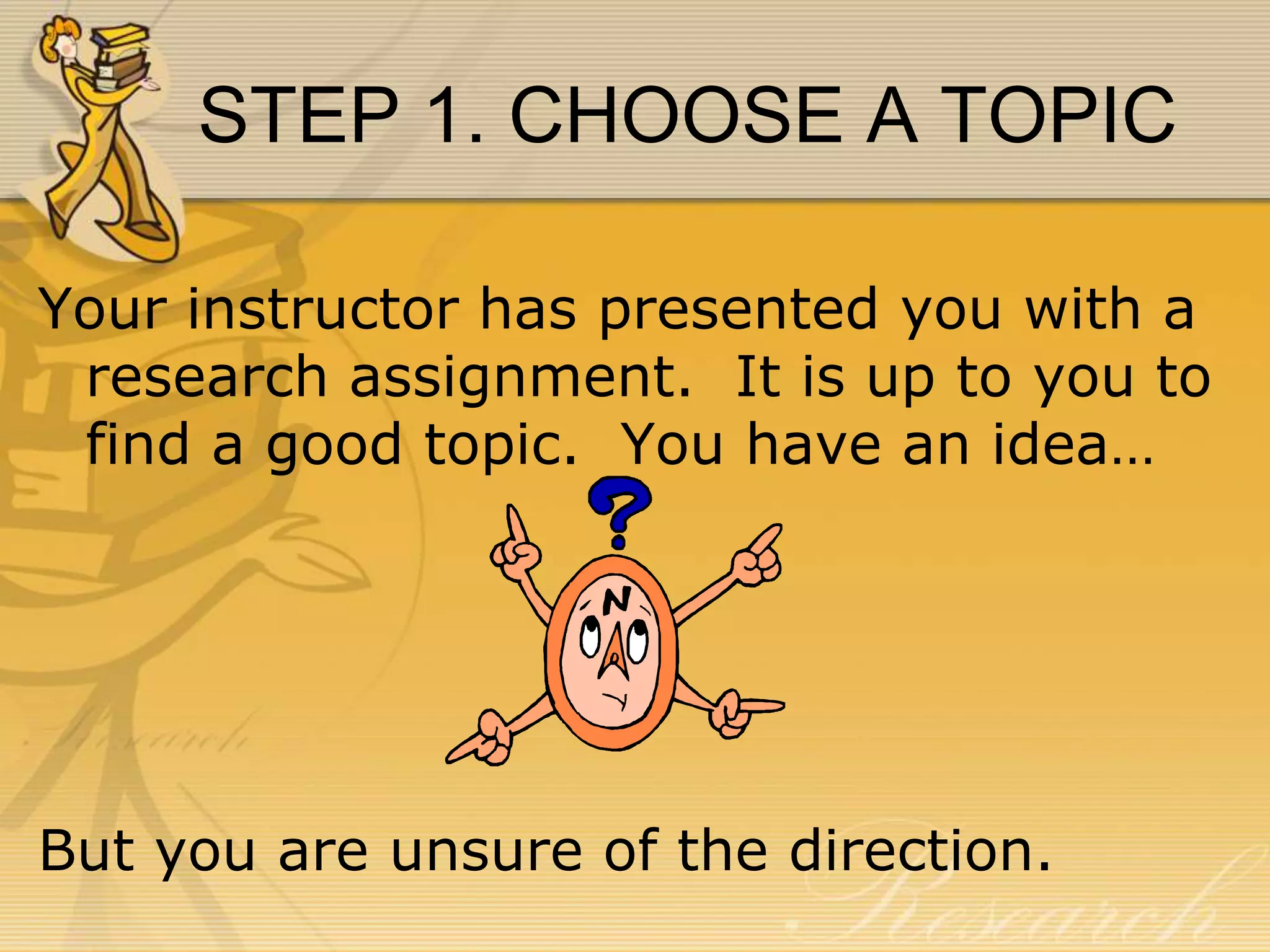
Your instructor has presented you with a
research assignment. It is up to you to
find a good topic. You have an idea…

But you are unsure of the direction.
STEP 1. CHOOSE A TOPIC
•
•
•
•

Keep a diary of your ideas and progress.
Talk it over with your instructor.
Talk it over with your peers.
The more you brainstorm or talk about
your topic you will have a broader
understanding of what you want to
research.
STEP 2. FIND INFORMATION
Come to the library and talk it over with
the librarian.
We will help you find information to
support your topic
STEP 2. FIND INFORMATION
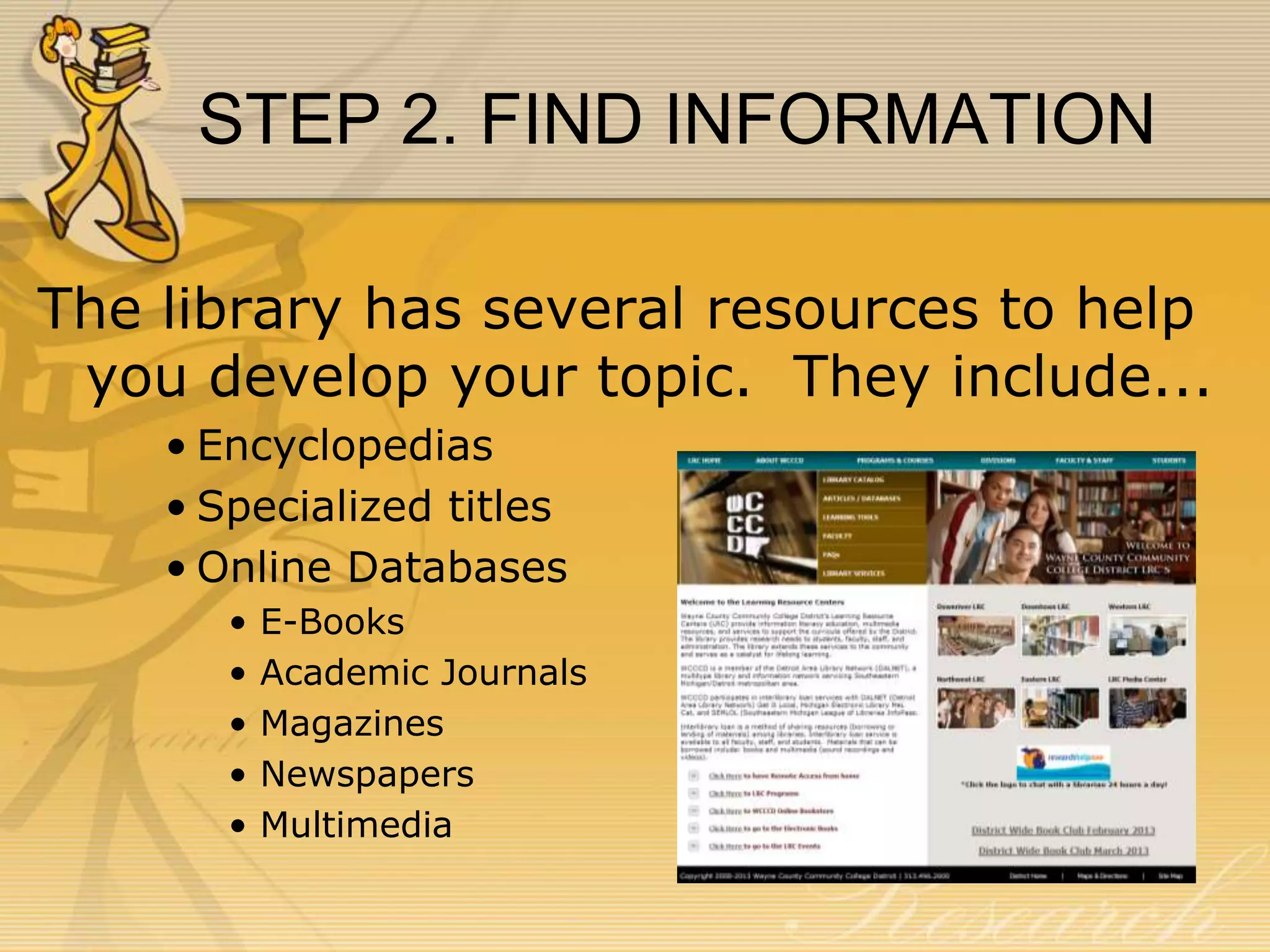
The library has several resources to help
you develop your topic. They include...
• Encyclopedias
• Specialized titles
• Online Databases
•
•
•
•
•

E-Books
Academic Journals
Magazines
Newspapers
Multimedia
The LRC Articles Database
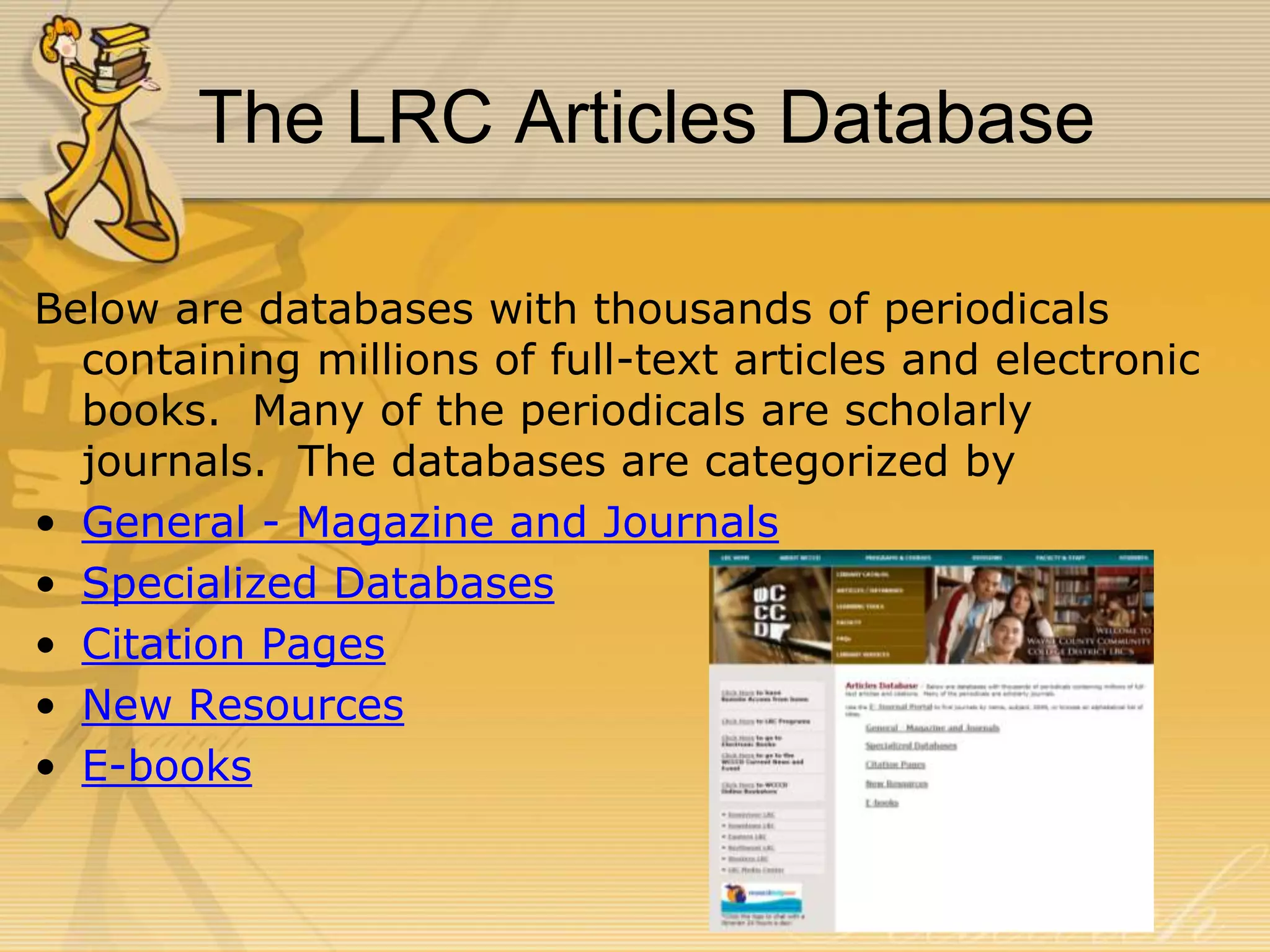
Below are databases with thousands of periodicals
containing millions of full-text articles and electronic
books. Many of the periodicals are scholarly
journals. The databases are categorized by
• General - Magazine and Journals
• Specialized Databases
• Citation Pages
• New Resources
• E-books
STEP 2. FIND INFORMATION
Great places to start when looking for information on
controversial issues are the following databases.
Each database will give you…
• An overall understanding on the issue
• Argumentative sides to the issue
• Statistics
• Additional resources
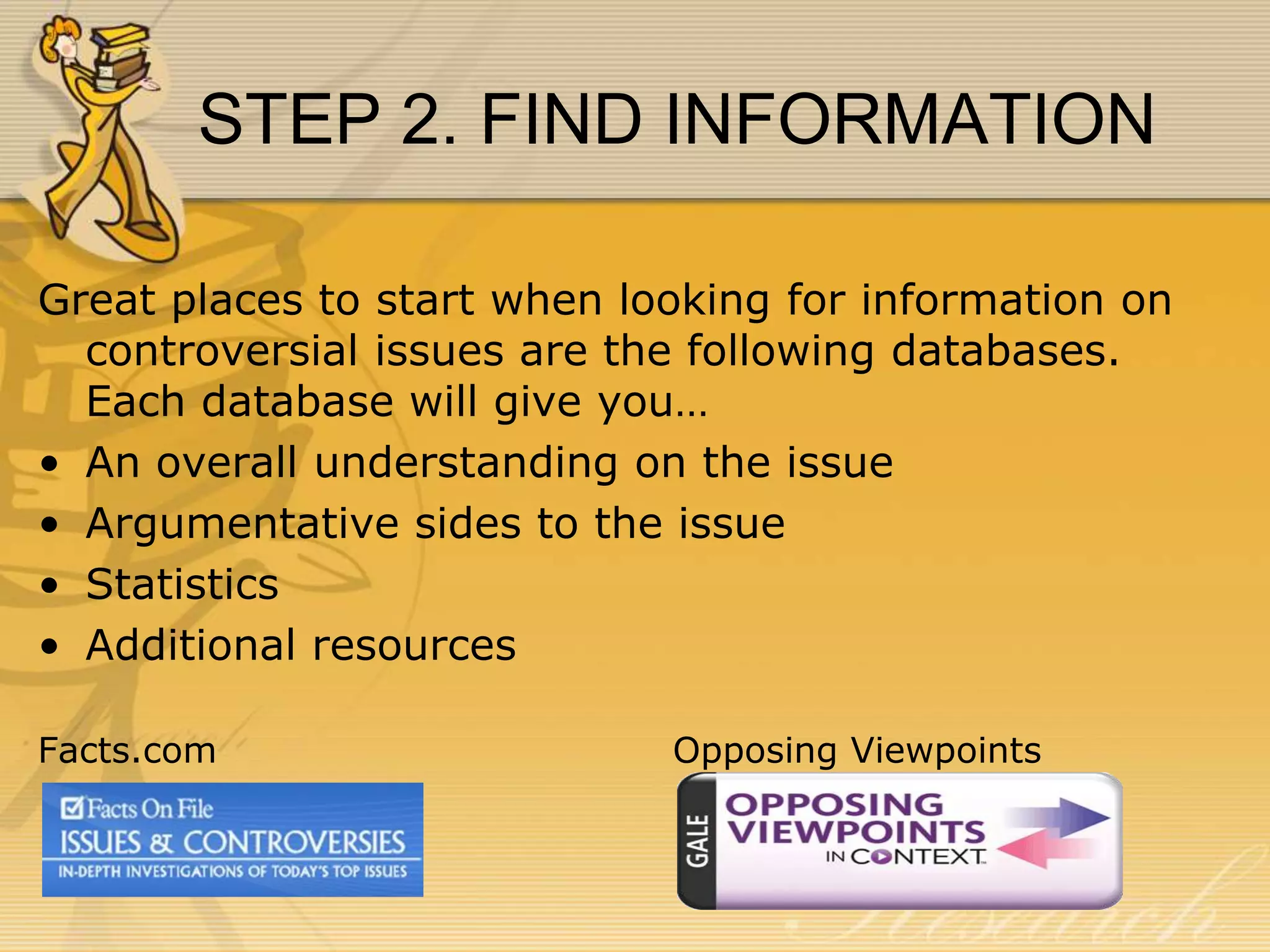
Facts.com

Opposing Viewpoints
STEP 2. FIND INFORMATION
Facts.com

Issues and Controversies helps
researchers understand the crucial issues we face
today, exploring more than 800 hot topics in
business, politics, government, education, and
popular culture. Updated weekly, with links to a 12year back-file, Issues and Controversies offers indepth articles made to inspire thought-provoking
debates. This database is great for research papers
and debate prep.

Found in “General” Articles and Databases
STEP 2. FIND INFORMATION
Opposing Viewpoints in Context

is the
premier online resource covering today’s hottest
social issues, from Offshore Drilling to Climate
Change, Health Care to Immigration. Opposing
Viewpoints in Context helps students research,
analyze and organize a broad variety of data for
conducting research, completing writing
assignments, preparing for debates, creating
presentations and more.

Found in “Specialized” Articles and Databases
Additional Resources
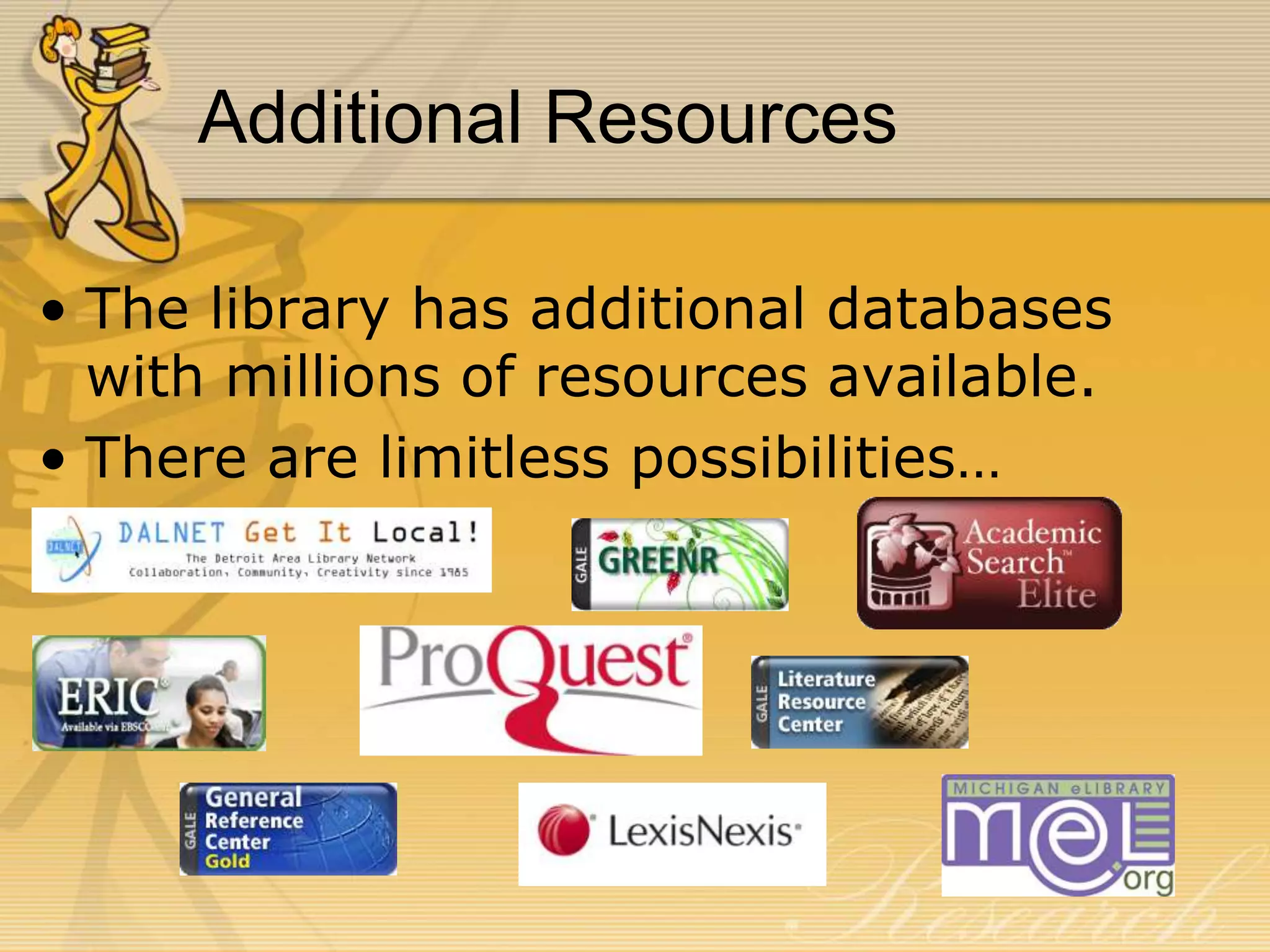
• The library has additional databases
with millions of resources available.
• There are limitless possibilities…
STEP 3. STATE YOUR THESIS
Now that you have an idea and you have
found supporting resources, it is time to
state you thesis.
Do some critical thinking and write your
thesis down in one sentence. A thesis
statement is like a declaration of your
opinion about a topic. The main portion of
your paper will consist of arguments to
support and defend this opinion.
STEP 4. MAKE A TENTATIVE OUTLINE
“An outline enables you to judge the
relevance of facts and opinions, to
organize your ideas in paragraphs and
to determine their most effective
order.”
Coyle, William and Joe Law. Research Papers. Boston:
Wadsworth, 2010. Print.
STEP 5. WRITE YOUR FIRST DRAFT
When writing your first draft, be sure to
include the resources you have found at
the library.
Refer to your…
• Notes
• Outline
• Scholarly resources

After writing your first draft, you may even find
that you need more information.
Plagiarism
IT IS UNETHICAL TO PLAGIARIZE
To avoid plagiarism, you must give credit whenever
you use:
• another person’s idea, concept or theory;
• any facts, statistics, graphs, drawings—any pieces of
information—that are not common knowledge;
• quotations of another person’s actual spoken or
written words; or
• paraphrase another person’s spoken or written
words.
http://www.indiana.edu/~wts/pamphlets/plagiarism.shtml
STEP 6. REVISE YOUR OUTLINE AND DRAFT
STEP 7. TYPE FINAL PAPER

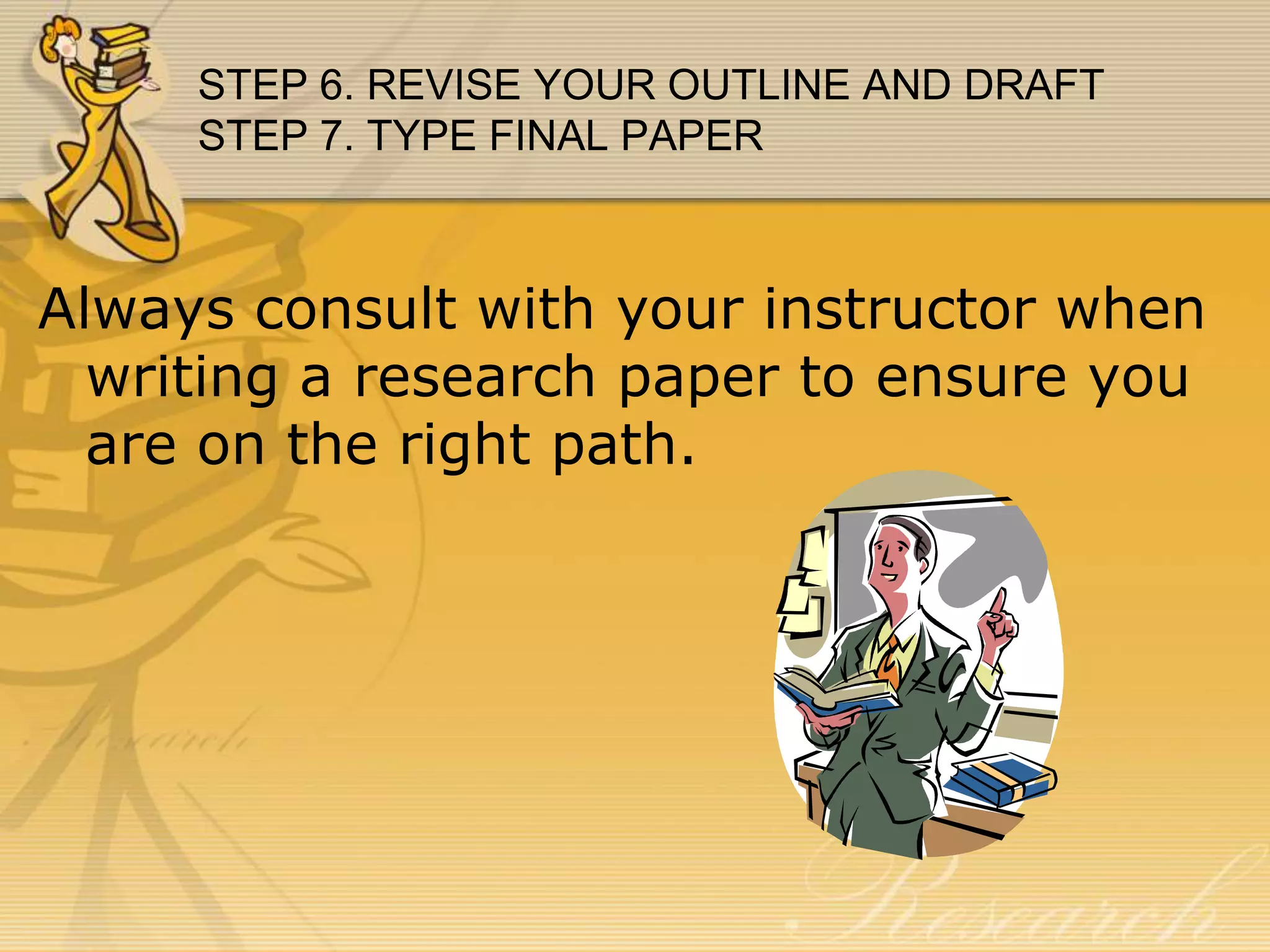
Always consult with your instructor when
writing a research paper to ensure you
are on the right path.
MLA & APA
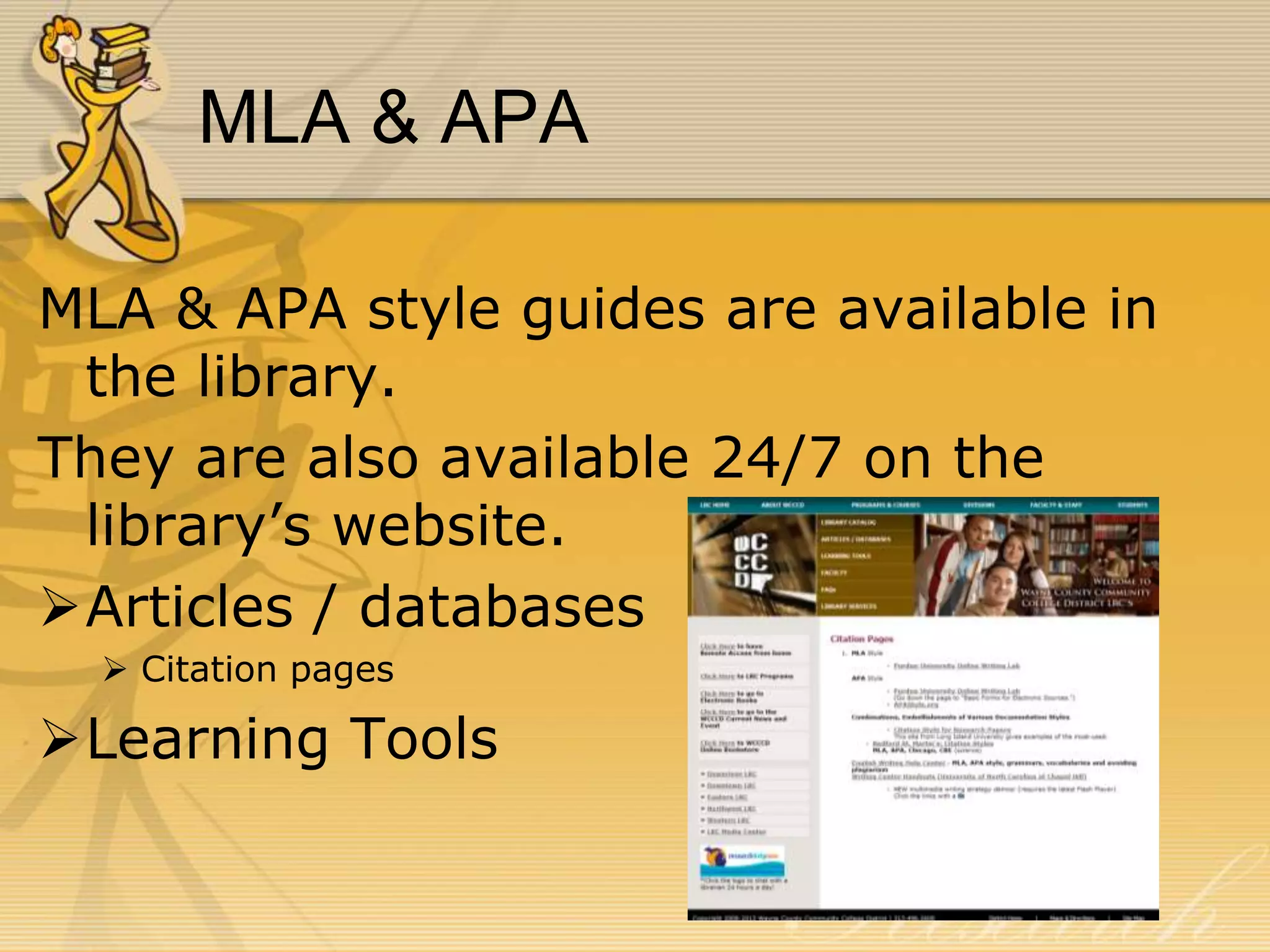
MLA & APA style guides are available in
the library.
They are also available 24/7 on the
library’s website.
Articles / databases
 Citation pages

Learning Tools
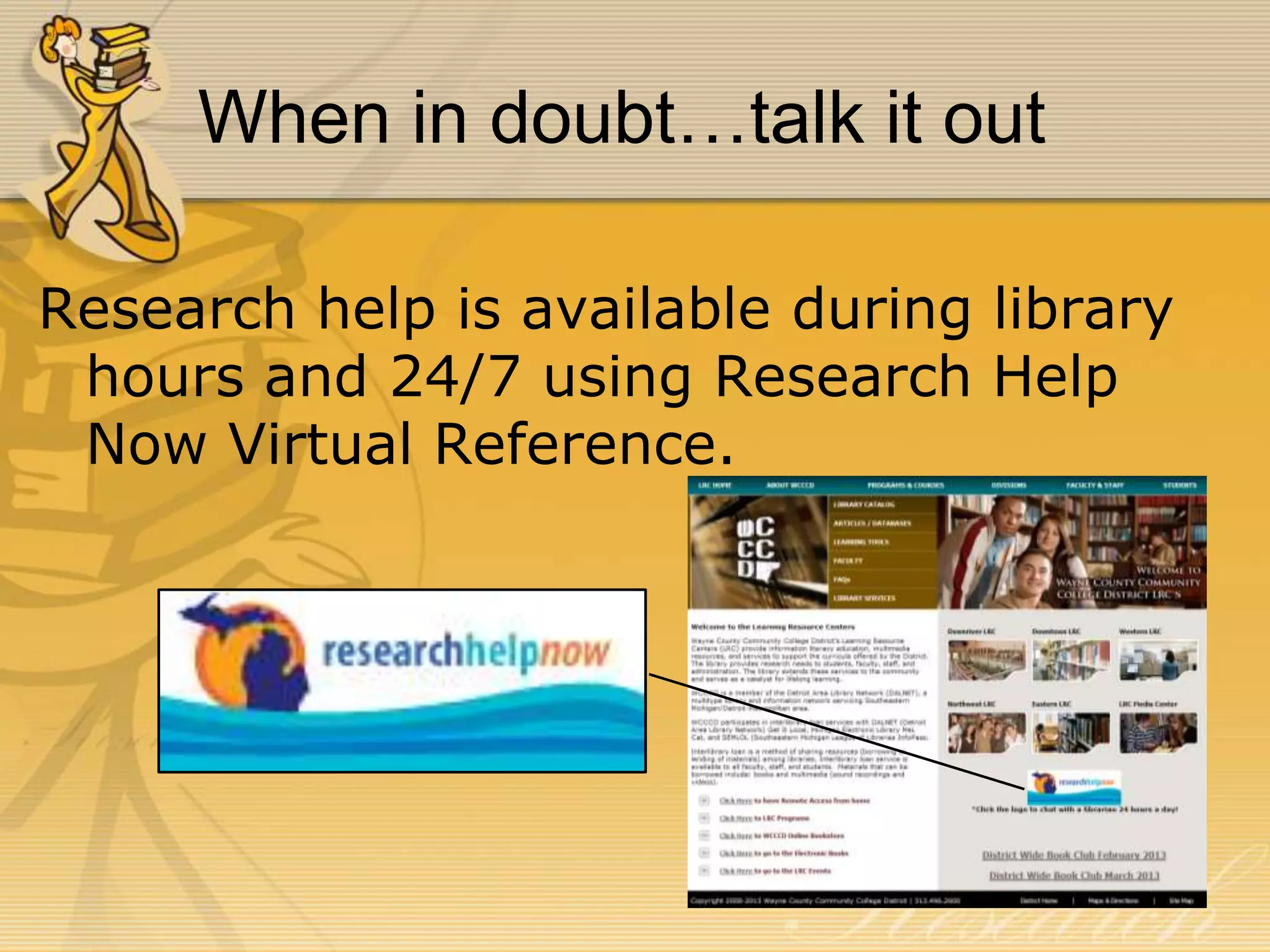
When in doubt…talk it out
Research help is available during library
hours and 24/7 using Research Help
Now Virtual Reference.
Thank You
Questions

How to Write an A+ Research Paper

  • 1.
    How to writean A+ research paper Start with the Library
  • 2.
    Basic steps STEP STEP STEP STEP STEP STEP STEP 1. 2. 3. 4. 5. 6. 7. CHOOSE ATOPIC FIND INFORMATION STATE YOUR THESIS MAKE A TENTATIVE OUTLINE WRITE YOUR FIRST DRAFT REVISE YOUR OUTLINE AND DRAFT TYPE FINAL PAPER
  • 3.
    STEP 1. CHOOSEA TOPIC Your instructor has presented you with a research assignment. It is up to you to find a good topic. You have an idea… But you are unsure of the direction.
  • 4.
    STEP 1. CHOOSEA TOPIC • • • • Keep a diary of your ideas and progress. Talk it over with your instructor. Talk it over with your peers. The more you brainstorm or talk about your topic you will have a broader understanding of what you want to research.
  • 5.
    STEP 2. FINDINFORMATION Come to the library and talk it over with the librarian. We will help you find information to support your topic
  • 6.
    STEP 2. FINDINFORMATION The library has several resources to help you develop your topic. They include... • Encyclopedias • Specialized titles • Online Databases • • • • • E-Books Academic Journals Magazines Newspapers Multimedia
  • 7.
    The LRC ArticlesDatabase Below are databases with thousands of periodicals containing millions of full-text articles and electronic books. Many of the periodicals are scholarly journals. The databases are categorized by • General - Magazine and Journals • Specialized Databases • Citation Pages • New Resources • E-books
  • 8.
    STEP 2. FINDINFORMATION Great places to start when looking for information on controversial issues are the following databases. Each database will give you… • An overall understanding on the issue • Argumentative sides to the issue • Statistics • Additional resources Facts.com Opposing Viewpoints
  • 9.
    STEP 2. FINDINFORMATION Facts.com Issues and Controversies helps researchers understand the crucial issues we face today, exploring more than 800 hot topics in business, politics, government, education, and popular culture. Updated weekly, with links to a 12year back-file, Issues and Controversies offers indepth articles made to inspire thought-provoking debates. This database is great for research papers and debate prep. Found in “General” Articles and Databases
  • 10.
    STEP 2. FINDINFORMATION Opposing Viewpoints in Context is the premier online resource covering today’s hottest social issues, from Offshore Drilling to Climate Change, Health Care to Immigration. Opposing Viewpoints in Context helps students research, analyze and organize a broad variety of data for conducting research, completing writing assignments, preparing for debates, creating presentations and more. Found in “Specialized” Articles and Databases
  • 11.
    Additional Resources • Thelibrary has additional databases with millions of resources available. • There are limitless possibilities…
  • 12.
    STEP 3. STATEYOUR THESIS Now that you have an idea and you have found supporting resources, it is time to state you thesis. Do some critical thinking and write your thesis down in one sentence. A thesis statement is like a declaration of your opinion about a topic. The main portion of your paper will consist of arguments to support and defend this opinion.
  • 13.
    STEP 4. MAKEA TENTATIVE OUTLINE “An outline enables you to judge the relevance of facts and opinions, to organize your ideas in paragraphs and to determine their most effective order.” Coyle, William and Joe Law. Research Papers. Boston: Wadsworth, 2010. Print.
  • 14.
    STEP 5. WRITEYOUR FIRST DRAFT When writing your first draft, be sure to include the resources you have found at the library. Refer to your… • Notes • Outline • Scholarly resources After writing your first draft, you may even find that you need more information.
  • 15.
    Plagiarism IT IS UNETHICALTO PLAGIARIZE To avoid plagiarism, you must give credit whenever you use: • another person’s idea, concept or theory; • any facts, statistics, graphs, drawings—any pieces of information—that are not common knowledge; • quotations of another person’s actual spoken or written words; or • paraphrase another person’s spoken or written words. http://www.indiana.edu/~wts/pamphlets/plagiarism.shtml
  • 16.
    STEP 6. REVISEYOUR OUTLINE AND DRAFT STEP 7. TYPE FINAL PAPER Always consult with your instructor when writing a research paper to ensure you are on the right path.
  • 17.
    MLA & APA MLA& APA style guides are available in the library. They are also available 24/7 on the library’s website. Articles / databases  Citation pages Learning Tools
  • 18.
    When in doubt…talkit out Research help is available during library hours and 24/7 using Research Help Now Virtual Reference.
  • 19.