By
Prof. Ibrahim Lameen
RESARCH METHODOLOGY
Sirt University
Faculty of Engineering
Electrical & Electronics Department
Msc. Program 2022-2023
CHAPTER 2
Formulating and Clarifying
Research Topics
OBJECTIVES
 Identify the attributes of a good research topic
 Generate ideas that will help in the choice of a suitable research
topic
 Turn research ideas into a research project with clear research
question(s) and objectives.
1- ATTRIBUTES OF A GOOD RESEARCH TOPIC
Capability: Is it feasible?
 Are you fascinated by the topic?
 Do you have the necessary research skills?
 Theoretical background, Academic writing skills
 Knowledge of English language
 Relevant tools (e.g. statistical software)
 Project management
 Can you complete the project in the time available?
 Will the research still be current when you finish?
 Do you have sufficient financial and other resources?
 Will you be able to gain access to data?
ATTRIBUTES OF A GOOD RESEARCH TOPIC
Appropriateness: Is it worthwhile?
 Will the examining institute's standards be met?
 Does the topic contain issues with clear links to theory?
 It may require further study in theory?
 Will the proposed research provide fresh insights into the topic?
 Does the research topic match your career goals?
 See it as an opportunity to advance your career
ATTRIBUTES OF A GOOD RESEARCH TOPIC
Relevance
 Personal interest /Passion/target/ direct related to your area.
 Does the topic relate clearly to an idea you were given
possibly by your organization ?
What is your topic (Area of interest)?
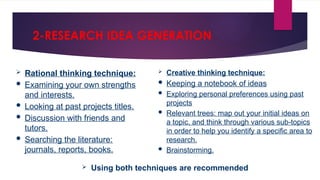
 Rational thinking technique:
 Examining your own strengths
and interests.
 Looking at past projects titles.
 Discussion with friends and
tutors.
 Searching the literature:
journals, reports, books.
2-RESEARCH IDEA GENERATION
 Creative thinking technique:
 Keeping a notebook of ideas
 Exploring personal preferences using past
projects
 Relevant trees: map out your initial ideas on
a topic, and think through various sub-topics
in order to help you identify a specific area to
research.
 Brainstorming.
 Using both techniques are recommended
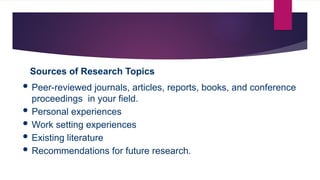
Sources of Research Topics
 Peer-reviewed journals, articles, reports, books, and conference
proceedings in your field.
 Personal experiences
 Work setting experiences
 Existing literature
 Recommendations for future research.
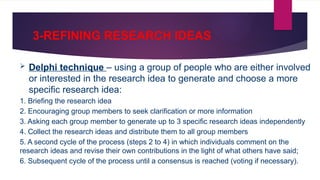
3-REFINING RESEARCH IDEAS
 Delphi technique – using a group of people who are either involved
or interested in the research idea to generate and choose a more
specific research idea:
1. Briefing the research idea
2. Encouraging group members to seek clarification or more information
3. Asking each group member to generate up to 3 specific research ideas independently
4. Collect the research ideas and distribute them to all group members
5. A second cycle of the process (steps 2 to 4) in which individuals comment on the
research ideas and revise their own contributions in the light of what others have said;
6. Subsequent cycle of the process until a consensus is reached (voting if necessary).
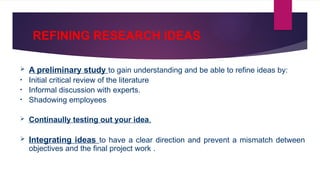
REFINING RESEARCH IDEAS
 A preliminary study to gain understanding and be able to refine ideas by:
• Initial critical review of the literature
• Informal discussion with experts.
• Shadowing employees
 Continaully testing out your idea.
 Integrating ideas to have a clear direction and prevent a mismatch detween
objectives and the final project work .
The process of generating and refining ideas is complete when you
are able to say
« I had like to do some research on ……… »
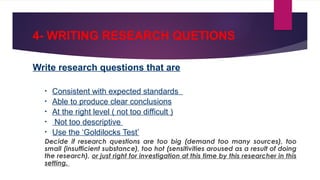
4- WRITING RESEARCH QUETIONS
Write research questions that are
• Consistent with expected standards
• Able to produce clear conclusions
• At the right level ( not too difficult )
• Not too descriptive
• Use the ‘Goldilocks Test’
Decide if research questions are too big (demand too many sources), too
small (insufficient substance), too hot (sensitivities aroused as a result of doing
the research), or just right for investigation at this time by this researcher in this
setting.
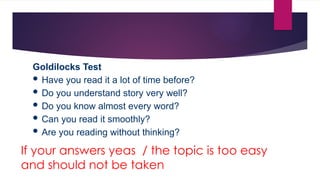
If your answers yeas / the topic is too easy
and should not be taken
Goldilocks Test
 Have you read it a lot of time before?
 Do you understand story very well?
 Do you know almost every word?
 Can you read it smoothly?
 Are you reading without thinking?
Goldilocks Test
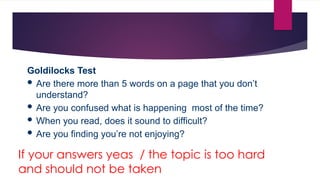
 Are there more than 5 words on a page that you don’t
understand?
 Are you confused what is happening most of the time?
 When you read, does it sound to difficult?
 Are you finding you’re not enjoying?
If your answers yeas / the topic is too hard
and should not be taken
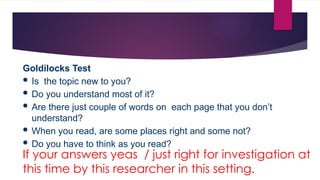
Goldilocks Test
 Is the topic new to you?
 Do you understand most of it?
 Are there just couple of words on each page that you don’t
understand?
 When you read, are some places right and some not?
 Do you have to think as you read?
If your answers yeas / just right for investigation at
this time by this researcher in this setting.
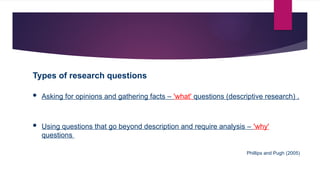
Types of research questions
 Asking for opinions and gathering facts – 'what' questions (descriptive research) .
 Using questions that go beyond description and require analysis – 'why'
questions
Phillips and Pugh (2005)
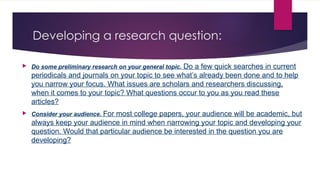
Developing a research question:
 Do some preliminary research on your general topic. Do a few quick searches in current
periodicals and journals on your topic to see what’s already been done and to help
you narrow your focus. What issues are scholars and researchers discussing,
when it comes to your topic? What questions occur to you as you read these
articles?
 Consider your audience. For most college papers, your audience will be academic, but
always keep your audience in mind when narrowing your topic and developing your
question. Would that particular audience be interested in the question you are
developing?
 Start asking questions. Taking into consideration all of the above, start asking
yourself open-ended “how” and “why” questions about your general topic.
 Evaluate your question. After you’ve put a question or even a couple of questions
down on paper, evaluate these questions to determine whether they would be
effective research questions or whether they need more revising and refining.
 Is your research question clear? With so much research available on any given topic,
research questions must be as clear as possible in order to be effective in helping
the writer direct his or her research.
 Is your research question focused? Research questions must be specific enough to be
well covered in the space available.
 Is your research question complex? Research questions should not be answerable
with a simple “yes” or “no” or by easily-found facts. They should, instead, require
both research and analysis on the part of the writer. They often begin with “How”
or “Why.”
 Begin your research. After you’ve come up with a question, think about the possible
paths your research could take. What sources should you consult as you seek
answers to your question? What research process will ensure that you find a
variety of perspectives and responses to your question?
Sample Research Questions
 Unclear: How should social networking sites address the harm they cause?
 Clear: What action should social networking sites like Facebook take to protect
users’ personal information and privacy?
The unclear version of this question doesn’t specify which social networking sites or suggest
what kind of harm the sites might be causing. It also assumes that this “harm” is proven and/or
accepted. The clearer version specifies sites (Facebook), the type of potential harm (privacy
issues), and who may be experiencing that harm (users). A strong research question should
never leave room for ambiguity or interpretation.
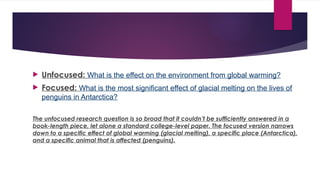
 Unfocused: What is the effect on the environment from global warming?
 Focused: What is the most significant effect of glacial melting on the lives of
penguins in Antarctica?
The unfocused research question is so broad that it couldn’t be sufficiently answered in a
book-length piece, let alone a standard college-level paper. The focused version narrows
down to a specific effect of global warming (glacial melting), a specific place (Antarctica),
and a specific animal that is affected (penguins).
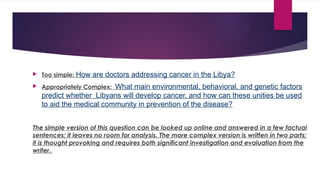
 Too simple: How are doctors addressing cancer in the Libya?
 Appropriately Complex: What main environmental, behavioral, and genetic factors
predict whether Libyans will develop cancer, and how can these unities be used
to aid the medical community in prevention of the disease?
The simple version of this question can be looked up online and answered in a few factual
sentences; it leaves no room for analysis. The more complex version is written in two parts;
it is thought provoking and requires both significant investigation and evaluation from the
writer.
Generally: if a quick Google search can answer a research
question, it’s likely not very effective.
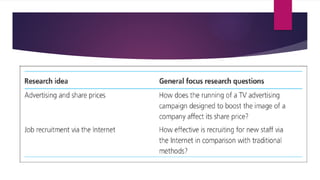
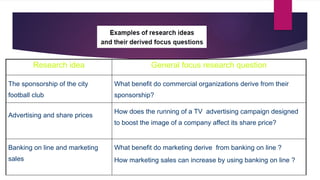
Research idea General focus research question
The sponsorship of the city
football club
What benefit do commercial organizations derive from their
sponsorship?
Advertising and share prices
How does the running of a TV advertising campaign designed
to boost the image of a company affect its share price?
Banking on line and marketing
sales
What benefit do marketing derive from banking on line ?
How marketing sales can increase by using banking on line ?
5- WRITING CLEAR RESEARCH OBJECTIVES
These are more specific and relate directly to research question. They may be
divided into two types:
 Primary objectives (guaranteed to be achieved)
 Secondary objectives (by the way)
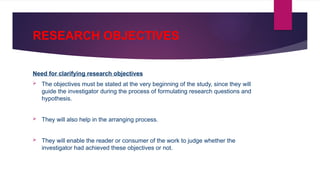
RESEARCH OBJECTIVES
Need for clarifying research objectives
 The objectives must be stated at the very beginning of the study, since they will
guide the investigator during the process of formulating research questions and
hypothesis.
 They will also help in the arranging process.
 They will enable the reader or consumer of the work to judge whether the
investigator had achieved these objectives or not.
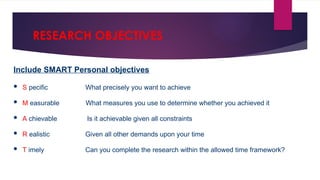
RESEARCH OBJECTIVES
Include SMART Personal objectives
 S pecific What precisely you want to achieve
 M easurable What measures you use to determine whether you achieved it
 A chievable Is it achievable given all constraints
 R ealistic Given all other demands upon your time
 T imely Can you complete the research within the allowed time framework?
Objective -examples
 Question1: What benefit do marketing derive from banking on line ?
 Objective1: To identify the benefit and the risk of using banking online
in marketing sales.
 Question 2: Is dietary intake of saturated fats over a period of 12
months is associated with risk of heart disease in Libya adult population
 Objective 2: To determine the association of dietary intake of saturated
fats and intimal thickness of coronary artery in Libyan adults


Research-Methodology-for-Msc-Chapter 2.pptx

  • 1.
    By Prof. Ibrahim Lameen RESARCHMETHODOLOGY Sirt University Faculty of Engineering Electrical & Electronics Department Msc. Program 2022-2023
  • 2.
    CHAPTER 2 Formulating andClarifying Research Topics
  • 3.
    OBJECTIVES  Identify theattributes of a good research topic  Generate ideas that will help in the choice of a suitable research topic  Turn research ideas into a research project with clear research question(s) and objectives.
  • 4.
    1- ATTRIBUTES OFA GOOD RESEARCH TOPIC Capability: Is it feasible?  Are you fascinated by the topic?  Do you have the necessary research skills?  Theoretical background, Academic writing skills  Knowledge of English language  Relevant tools (e.g. statistical software)  Project management  Can you complete the project in the time available?  Will the research still be current when you finish?  Do you have sufficient financial and other resources?  Will you be able to gain access to data?
  • 5.
    ATTRIBUTES OF AGOOD RESEARCH TOPIC Appropriateness: Is it worthwhile?  Will the examining institute's standards be met?  Does the topic contain issues with clear links to theory?  It may require further study in theory?  Will the proposed research provide fresh insights into the topic?  Does the research topic match your career goals?  See it as an opportunity to advance your career
  • 6.
    ATTRIBUTES OF AGOOD RESEARCH TOPIC Relevance  Personal interest /Passion/target/ direct related to your area.  Does the topic relate clearly to an idea you were given possibly by your organization ?
  • 7.
    What is yourtopic (Area of interest)?
  • 8.
     Rational thinkingtechnique:  Examining your own strengths and interests.  Looking at past projects titles.  Discussion with friends and tutors.  Searching the literature: journals, reports, books. 2-RESEARCH IDEA GENERATION  Creative thinking technique:  Keeping a notebook of ideas  Exploring personal preferences using past projects  Relevant trees: map out your initial ideas on a topic, and think through various sub-topics in order to help you identify a specific area to research.  Brainstorming.  Using both techniques are recommended
  • 9.
    Sources of ResearchTopics  Peer-reviewed journals, articles, reports, books, and conference proceedings in your field.  Personal experiences  Work setting experiences  Existing literature  Recommendations for future research.
  • 10.
    3-REFINING RESEARCH IDEAS Delphi technique – using a group of people who are either involved or interested in the research idea to generate and choose a more specific research idea: 1. Briefing the research idea 2. Encouraging group members to seek clarification or more information 3. Asking each group member to generate up to 3 specific research ideas independently 4. Collect the research ideas and distribute them to all group members 5. A second cycle of the process (steps 2 to 4) in which individuals comment on the research ideas and revise their own contributions in the light of what others have said; 6. Subsequent cycle of the process until a consensus is reached (voting if necessary).
  • 11.
    REFINING RESEARCH IDEAS A preliminary study to gain understanding and be able to refine ideas by: • Initial critical review of the literature • Informal discussion with experts. • Shadowing employees  Continaully testing out your idea.  Integrating ideas to have a clear direction and prevent a mismatch detween objectives and the final project work .
  • 12.
    The process ofgenerating and refining ideas is complete when you are able to say « I had like to do some research on ……… »
  • 13.
    4- WRITING RESEARCHQUETIONS Write research questions that are • Consistent with expected standards • Able to produce clear conclusions • At the right level ( not too difficult ) • Not too descriptive • Use the ‘Goldilocks Test’ Decide if research questions are too big (demand too many sources), too small (insufficient substance), too hot (sensitivities aroused as a result of doing the research), or just right for investigation at this time by this researcher in this setting.
  • 14.
    If your answersyeas / the topic is too easy and should not be taken Goldilocks Test  Have you read it a lot of time before?  Do you understand story very well?  Do you know almost every word?  Can you read it smoothly?  Are you reading without thinking?
  • 15.
    Goldilocks Test  Arethere more than 5 words on a page that you don’t understand?  Are you confused what is happening most of the time?  When you read, does it sound to difficult?  Are you finding you’re not enjoying? If your answers yeas / the topic is too hard and should not be taken
  • 16.
    Goldilocks Test  Isthe topic new to you?  Do you understand most of it?  Are there just couple of words on each page that you don’t understand?  When you read, are some places right and some not?  Do you have to think as you read? If your answers yeas / just right for investigation at this time by this researcher in this setting.
  • 17.
    Types of researchquestions  Asking for opinions and gathering facts – 'what' questions (descriptive research) .  Using questions that go beyond description and require analysis – 'why' questions Phillips and Pugh (2005)
  • 18.
    Developing a researchquestion:  Do some preliminary research on your general topic. Do a few quick searches in current periodicals and journals on your topic to see what’s already been done and to help you narrow your focus. What issues are scholars and researchers discussing, when it comes to your topic? What questions occur to you as you read these articles?  Consider your audience. For most college papers, your audience will be academic, but always keep your audience in mind when narrowing your topic and developing your question. Would that particular audience be interested in the question you are developing?
  • 19.
     Start askingquestions. Taking into consideration all of the above, start asking yourself open-ended “how” and “why” questions about your general topic.  Evaluate your question. After you’ve put a question or even a couple of questions down on paper, evaluate these questions to determine whether they would be effective research questions or whether they need more revising and refining.
  • 20.
     Is yourresearch question clear? With so much research available on any given topic, research questions must be as clear as possible in order to be effective in helping the writer direct his or her research.  Is your research question focused? Research questions must be specific enough to be well covered in the space available.
  • 21.
     Is yourresearch question complex? Research questions should not be answerable with a simple “yes” or “no” or by easily-found facts. They should, instead, require both research and analysis on the part of the writer. They often begin with “How” or “Why.”  Begin your research. After you’ve come up with a question, think about the possible paths your research could take. What sources should you consult as you seek answers to your question? What research process will ensure that you find a variety of perspectives and responses to your question?
  • 22.
    Sample Research Questions Unclear: How should social networking sites address the harm they cause?  Clear: What action should social networking sites like Facebook take to protect users’ personal information and privacy? The unclear version of this question doesn’t specify which social networking sites or suggest what kind of harm the sites might be causing. It also assumes that this “harm” is proven and/or accepted. The clearer version specifies sites (Facebook), the type of potential harm (privacy issues), and who may be experiencing that harm (users). A strong research question should never leave room for ambiguity or interpretation.
  • 23.
     Unfocused: Whatis the effect on the environment from global warming?  Focused: What is the most significant effect of glacial melting on the lives of penguins in Antarctica? The unfocused research question is so broad that it couldn’t be sufficiently answered in a book-length piece, let alone a standard college-level paper. The focused version narrows down to a specific effect of global warming (glacial melting), a specific place (Antarctica), and a specific animal that is affected (penguins).
  • 24.
     Too simple:How are doctors addressing cancer in the Libya?  Appropriately Complex: What main environmental, behavioral, and genetic factors predict whether Libyans will develop cancer, and how can these unities be used to aid the medical community in prevention of the disease? The simple version of this question can be looked up online and answered in a few factual sentences; it leaves no room for analysis. The more complex version is written in two parts; it is thought provoking and requires both significant investigation and evaluation from the writer.
  • 25.
    Generally: if aquick Google search can answer a research question, it’s likely not very effective.
  • 27.
    Research idea Generalfocus research question The sponsorship of the city football club What benefit do commercial organizations derive from their sponsorship? Advertising and share prices How does the running of a TV advertising campaign designed to boost the image of a company affect its share price? Banking on line and marketing sales What benefit do marketing derive from banking on line ? How marketing sales can increase by using banking on line ?
  • 28.
    5- WRITING CLEARRESEARCH OBJECTIVES These are more specific and relate directly to research question. They may be divided into two types:  Primary objectives (guaranteed to be achieved)  Secondary objectives (by the way)
  • 29.
    RESEARCH OBJECTIVES Need forclarifying research objectives  The objectives must be stated at the very beginning of the study, since they will guide the investigator during the process of formulating research questions and hypothesis.  They will also help in the arranging process.  They will enable the reader or consumer of the work to judge whether the investigator had achieved these objectives or not.
  • 30.
    RESEARCH OBJECTIVES Include SMARTPersonal objectives  S pecific What precisely you want to achieve  M easurable What measures you use to determine whether you achieved it  A chievable Is it achievable given all constraints  R ealistic Given all other demands upon your time  T imely Can you complete the research within the allowed time framework?
  • 31.
    Objective -examples  Question1:What benefit do marketing derive from banking on line ?  Objective1: To identify the benefit and the risk of using banking online in marketing sales.  Question 2: Is dietary intake of saturated fats over a period of 12 months is associated with risk of heart disease in Libya adult population  Objective 2: To determine the association of dietary intake of saturated fats and intimal thickness of coronary artery in Libyan adults

Editor's Notes

  • #11 Hypotheses: فرضيات hypotheses: فكري