IJRET: International Journal of Research in Engineering and Technology eISSN: 2319-1163 | pISSN: 2321-7308
_______________________________________________________________________________________
Volume: 03 Special Issue: 16 | ICPECDM-2014 | Dec-2014, Available @ http://www.ijret.org 141
DETECTION OF HAZARD PRONE AREAS IN THE UPPER
HIMALAYAN REGION IN GIS ENVIRONMENT
Esha Chakraborty1
, V.V. Govind Kumar2
, Dheeraj Kumar3
1
Geomatics Section, Department of Mining Engineering, Indian School of Mines, India
2
Assistant Professor, Department of Mining Engineering, Indian School of Mines, India
3
Associate Professor, Department of Mining Engineering, Indian School of Mines, India
Abstract
Himalayas are a great boon to India as they block the monsoon winds from the oceans, allowing the northern plain to receive
plenty of rainfall. The rivers Ganga and Brahmaputra are fed by the snow of the higher peaks, and these also protect from the
cold biting winds o North Asia. But it is this Himalayan range again, which is one of the biggest hotspots of natural disasters,
because they are still growing and young mountains and the changing climate of the globe has added to the frequency and extent
of such disasters. This paper involves the study of the Basin of Alakananda River, a tributary of the Ganges, so as to delineate the
flood prone zones of the area. Almost every year this region is affected by cloudbursts and consequent floods. The parameters
taken into consideration here are the slope, the river networks and the soil type of the area. River Tools has been used to extract
the stream networks of the river. Consequent analysis has been carried out in ArcGIS. The results of the analysis show that the
topology of the area is highly dangerous for any urbanization. Villages constructed on this region are very much vulnerable to
heavy floods due to the loose soil type present on the surface and the steep slope. The study identifies such highly vulnerable
regions in the Alakananda River Basin.
Keywords: Cloudbursts, ArcGIS, ASTERDEM and RiverTools.
--------------------------------------------------------------------***------------------------------------------------------------------
1. INTRODUCTION
According to United Nation’s International Strategy for
Disaster Reduction, Asia has the highest number of fatalities
from natural disasters of any region, and within Asia, the
countries of Himalayas have the greatest number of disasters
and casualties. There are several reasons for this
vulnerability, the mountains are young and dynamic and still
tectonically very active; the intense monsoon rainfall leads
to flooding and landslides, and the extreme relief contributes
to the instability of both the land itself and the infrastructure
built on it. The countries are particularly hard hit by
recurring annual flash floods (ICIMOD, 2010). Flash Floods
are generally the consequence of either cloudbursts, or may
be due to landslides, dam breaks or glacial lake outbursts.
Cloudburst is actually a situation when the intermolecular
forces between the water molecules get very high due to the
rapid decrease in temperature or excess of electrostatic
induction in the clouds causing lightning to remain inside
the cloud only, which causes hyperactive energy in the
cloud. The water concentration gets higher and higher and
the weight gets heavier, until water is no longer able to
maintain the force within the clouds and they fall. As the
water content is so high, the clouds seem to burst. Such
cloudburst activity in every monsoon occur in the Himachal
Pradesh (Kullu Valley) and the Western Uttaranchal
(Chamoli, Uttarkashi, Tehri, Rudraprayag and Pauri
Distrist). Sometimes it happens in Kumaun Mandal
(Pithoragarh, Almora, Bageshwar, Chapawat and Nainital
Districts) and Mussourie Hills of Dehradun district and
Lesser Himalayas and Siwaliks also (Asthana, A.K.L,
Asthana Harshita, 2014). Table 1 below lists the history of
cloudburst events in Uttarakhand since the year 2001.
Table 1: History of Cloudbursts in Uttarakhand
Place Date
1 Phata, Rudraprayag August 2001
2 Mussourie Hills, Dehradun August 2001
3 Gouna Tehri August 2001
4 Burhakedae-Agunda
(Balganga valley), Tehri
August 2002
5 Shilagarh Village, Shimla 16 July 2003
6 Tevla Village Kullu Valley August 2004
7 Dhanu Village Rudraprayag July 2005
8 Village near Shimla August 2007
9 Leh (Ladakh) August 2010
10 Assiganga Uttarkashi 5 July 2012
11 Dyara Bugyal Uttarkashi August 2012
12 Bageshwar, Kapkot near
Almora
19 Sept 2012
13 Kedarnath 16-17 June
2013
A major challenge associated with flash floods is
quantitative character of the forecast; the task is not just to
forecast the occurrence of an event, which is difficult
enough by itself, but to anticipate the magnitude of the
IJRET: International Journal of Research in Engineering and Technology eISSN: 2319-1163 | pISSN: 2321-7308
_______________________________________________________________________________________
Volume: 03 Special Issue: 16 | ICPECDM-2014 | Dec-2014, Available @ http://www.ijret.org 142
event. With the impact of climate change, the effects on the
intensity of the rainfall events, identifying the vulnerable
areas and assessing the degree of impact for a higher
magnitude flood risk event more clearly describes the
potential risk at which the current developmental or
infrastructural facilities are situated. Emphasizing the
significance of flood risk assessment studies
(Burby.R.J.,1998) states that the main components of such
studies should focus on hazard identification and
vulnerability assessment as the flood risk is considered as a
product of spatial identification and vu lnerability (Great
Britain Department of Communities and Local Government,
2006).
For producing flood hazard maps it is important to integrate
geospatial and temporal data in a same computational
environment that allows risk assessment, modeling and
decision support. The advancement in computer-aided
space-based technology such as Geographic Information
System (GIS) and Remote Sensing (RS) has proved very
useful in studying and mapping the flood-hazards and
developing measures that can be useful to the local
communities as well. The scope and scale of flood problems
makes the GIS software a powerful tool for its integrated
management process. GIS is ideally suited for various
floodplain management activities, such as base mapping,
topographic mapping, and post disaster verification of
mapped floodplain extents and depths.
In this Study, the watershed basin of one of the tributaries of
Ganga, namely Alakananda River has been taken for
studying the flood risk of the villages constructed along this
river. It lies in the Uttarakhand state, India, The main
objective of this paper is to study the river stream networks
of the Alakananda River and its reaches, and slope and soil
type, which determine whether a place has a tendency to get
damaged due to heavy floods. The results can be used for
further studies to identify vulnerable zones in Alakananda
River basin.
2. MATERIALS AND METHODS
Study Area: Uttarakhand is one amongst the Himalayan
states of India, often referred to as “Devbhumi” (Land of
Gods) due to many of the many Hindu temples and
pilgrimage centres found in this region (Kumar Govind V.
V, Jain Kamal, Gairola Ajay, 2013). The study area consists
of Badrinath, which is one of the famous “Char Dhams” and
since time immemorial has been the destination of countless
pilgrims. The Alakananda River Basin lies in the Chamoli
District of Uttarakhand, which extends upto an area of 7613
sq km. the watershed basin lies between 00' 43"N to
00' N and 12' to 10' 27"E. This area heavily
affected due to flashfloods in the year 2012. The Elevation
of the area varies from 604-7791 meters (ASTERDEM
analysis). In the year 2012, 7 cloudbursts hit Uttarakhand
state. The regions Badrinath, Hanuman Chatti,
Pandukeshwar, Joshimath, Gopeshwar, Karanprayag and
Rudraprayag were the worst affected villages, and have been
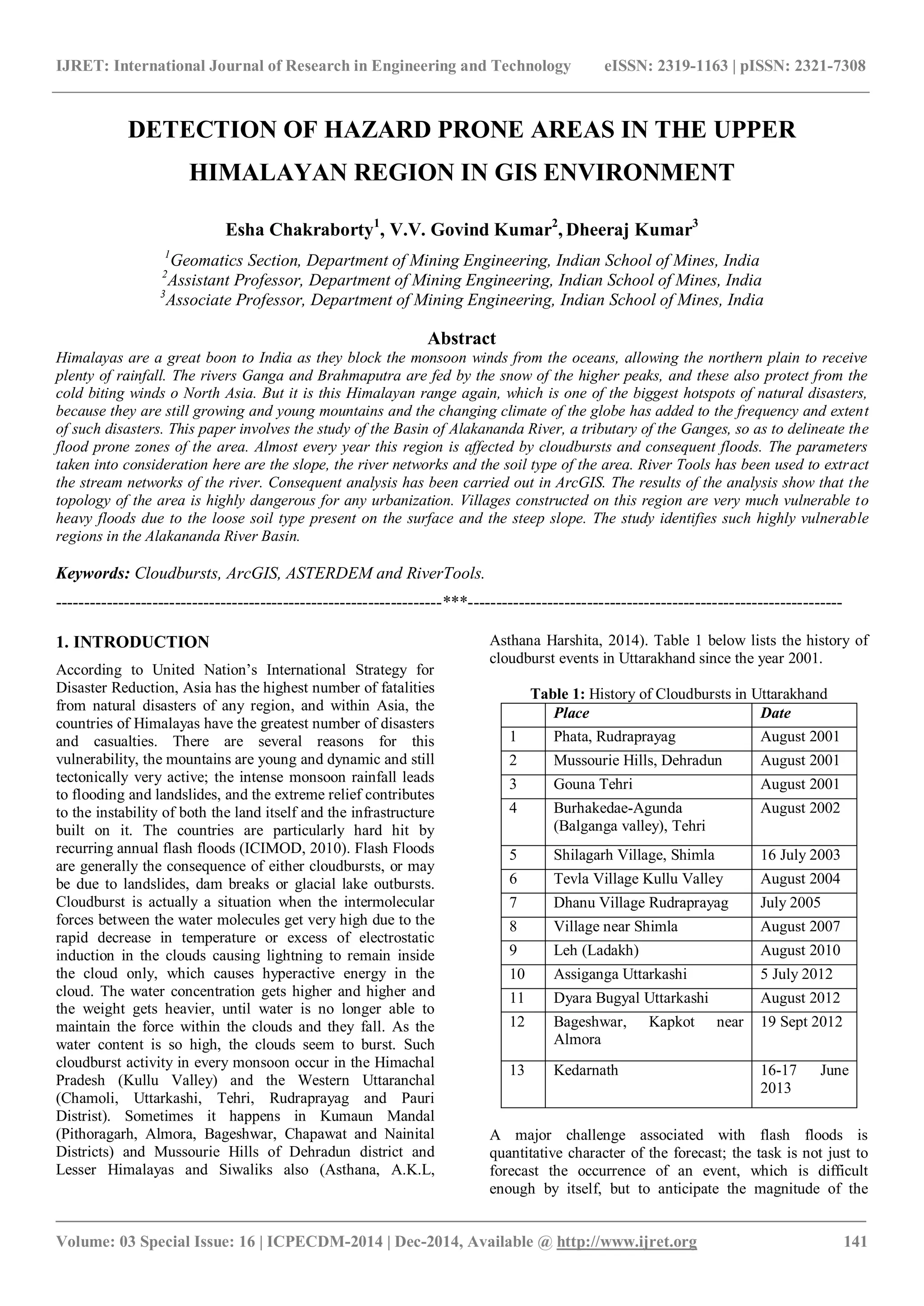
used in this study as the sub-watershed outlet point. Figure 1
shows the Alakananda River basin extracted from the
ASTERDEM, above mentioned places marked in green, and
the River in red.
Datasets: Digital Elevation Models are elevation data that
collect by remote sensing methods or by transforming the
contour maps to raster format by digitizing and surface
analyzing (Seyed Reza Hosseinzadeh, 2011). The analysis
of the watershed was done completely using the Digital
Elevation Model (DEM) downloaded from the ASTER
(Advanced Space-borne Thermal Emission and Reflection
Radiometer) GDEM (Global Digital Elevation Model). It
was used for delineation of the catchment area and also to
obtain the slope and drainage pattern. he AS D
covers land surfaces between N and S and is com osed
of by tiles. The ASTERGDEM has a resolution of 30m
and is in Geographic Latitude/ Longitude system. With the
help of Uttaranchal Administrative Atlas, prepared by the
Census of India, 2001 and Google Earth, locations were
observed and later mapped into ArcGIS.
Fig 1: Alakananda River Basin and the worst affected places
Google earth is a virtual globe, map and geographical
information program. It maps the Earth by the superposition
of images obtained satellite imagery, aerial photographs and
GIS.
The RiverTools software is a digital terrain analysis program
designed specifically for studying the drainage network
morphology and basin morphometry using DEMs. It also
can visualize the digital topography very well. The drainage
pattern was extracted for each of the sub-outlet points
namely Badrinath, Hanuman Chatti, Pandukeshwar,
Joshimath, Gopeshwar, Karanprayag, Rudraprayag.
IJRET: International Journal of Research in Engineering and Technology eISSN: 2319-1163 | pISSN: 2321-7308
_______________________________________________________________________________________
Volume: 03 Special Issue: 16 | ICPECDM-2014 | Dec-2014, Available @ http://www.ijret.org 143
Stream networks denote all the small tributaries of the main
river which contribute to the water in the river. The purpose
of extracting then for a particular basin outlet is to
understand the direction of water flow, and also to visualize
those villages which lie in the path of the free flow of the
streams, which has been done here.
Soil is another important factor in determining the
vulnerability of an area towards flooding. This is because
the structure of soil and soil type determines how much
water can infiltrate through such soil, or how much it can
hold back water, or else is water can easily carry away such
soils. Looking into these information, we can predict the
vulnerability of a region.
This study is focused on all the above mentioned factors,
using the mentioned tools to define the vulnerability of the
area.
3. RESULTS AND DISCUSSION
The district of Chamoli has been affected by a number of
cloudburst events in the last decade. Huge amount of
casualty along with loss of infrastructure and cattle has
taken place. As such there has been no effective flood
management practices undertaken for disaster prevention,
before it has already occurred.
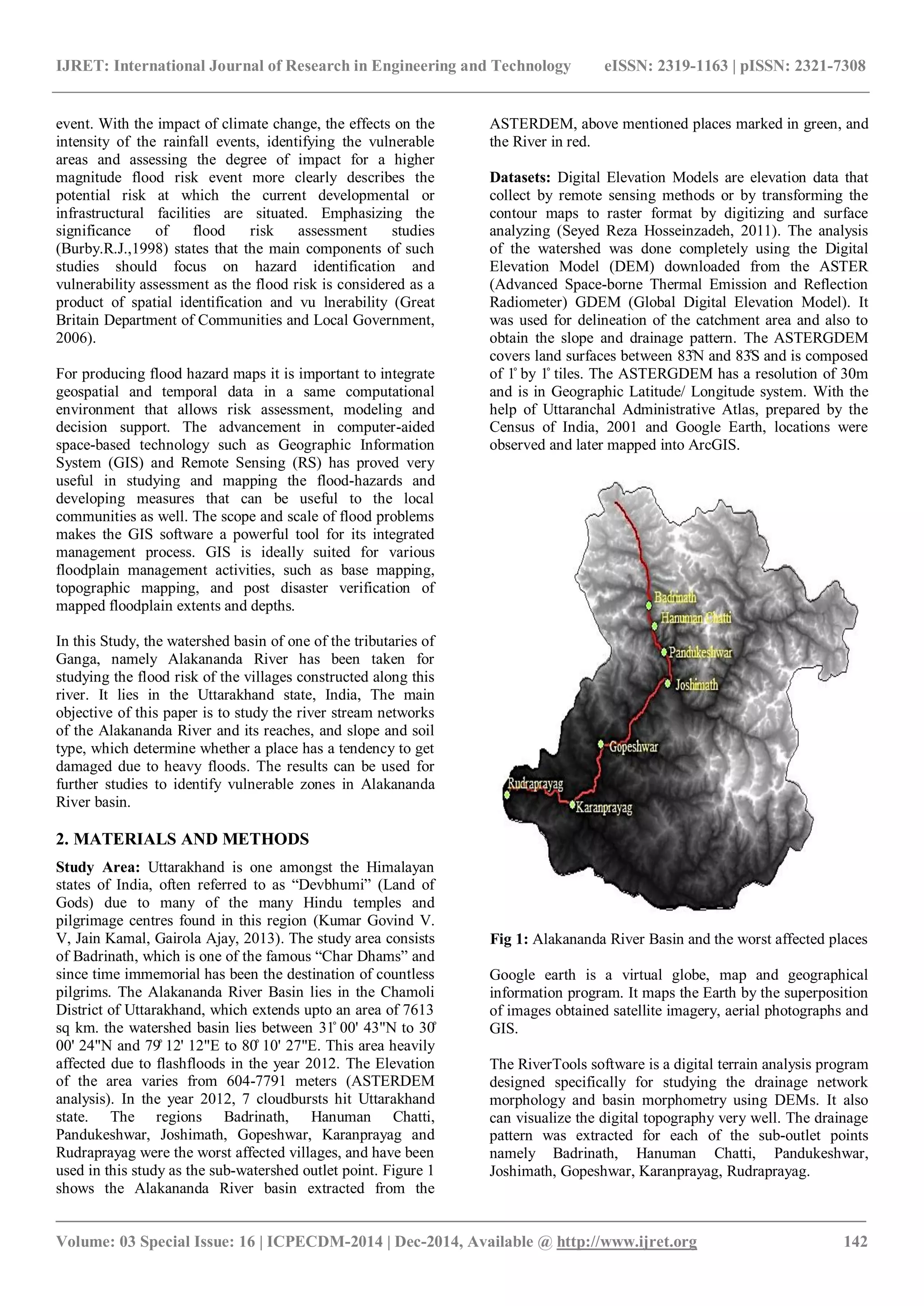
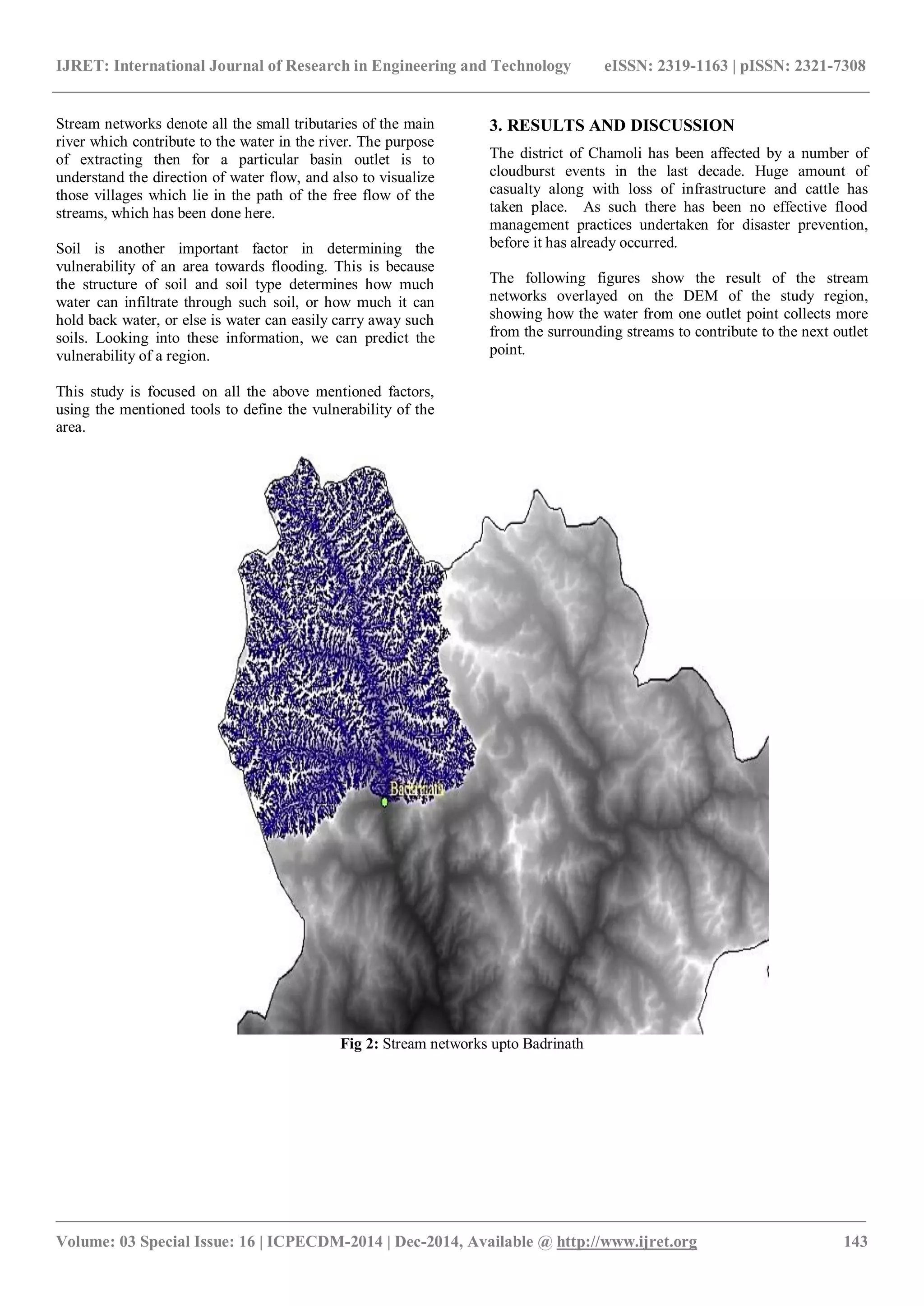
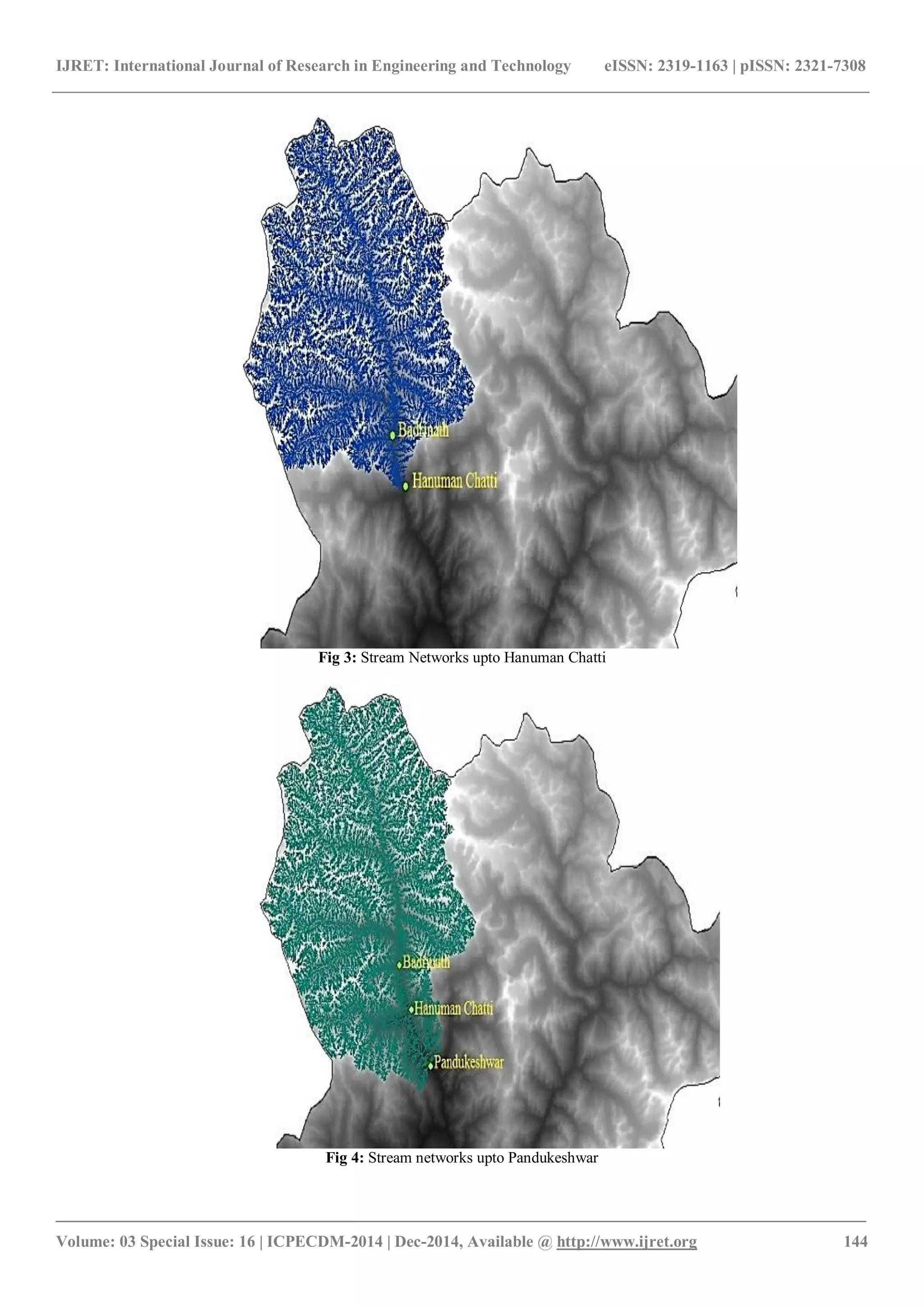
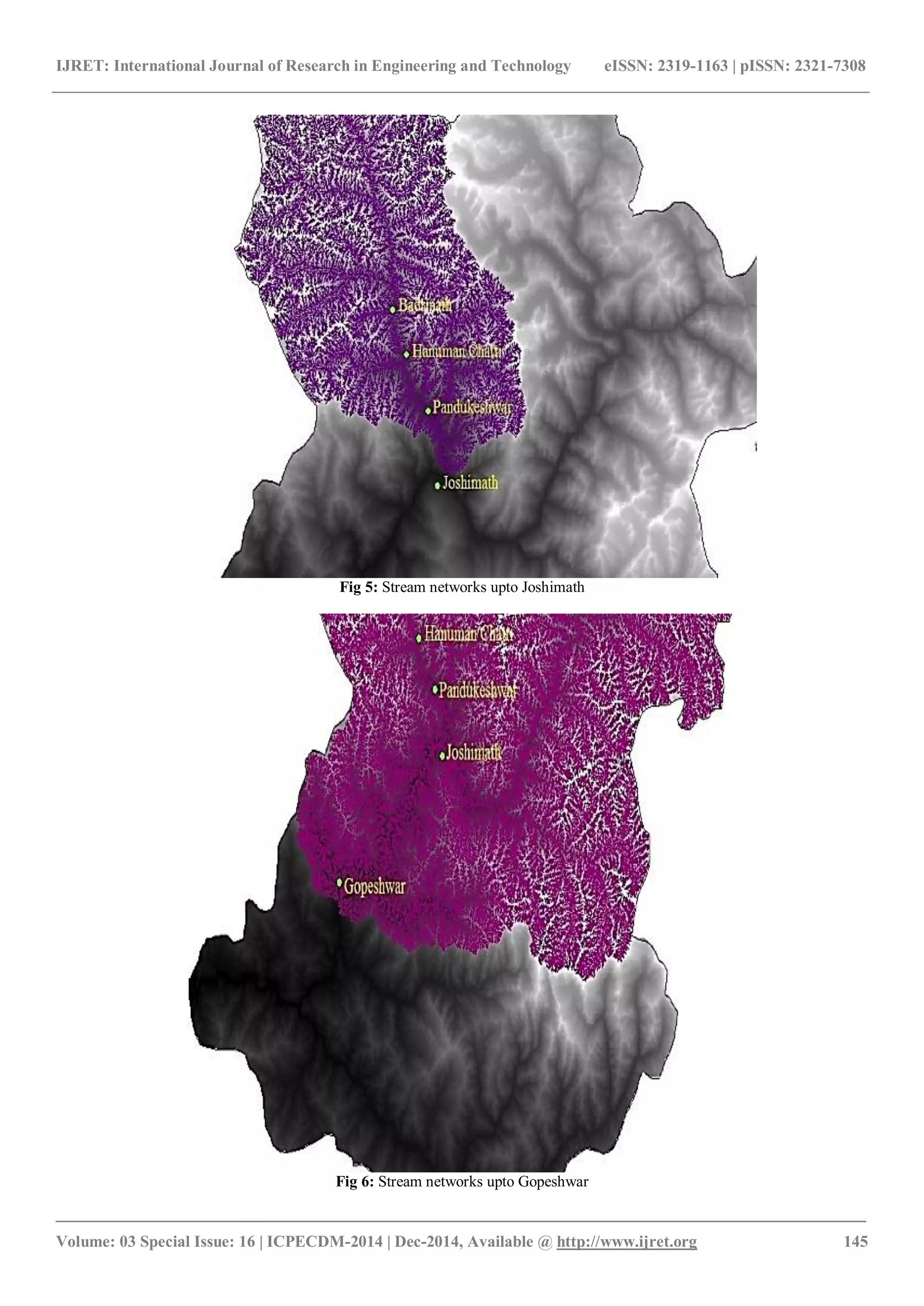
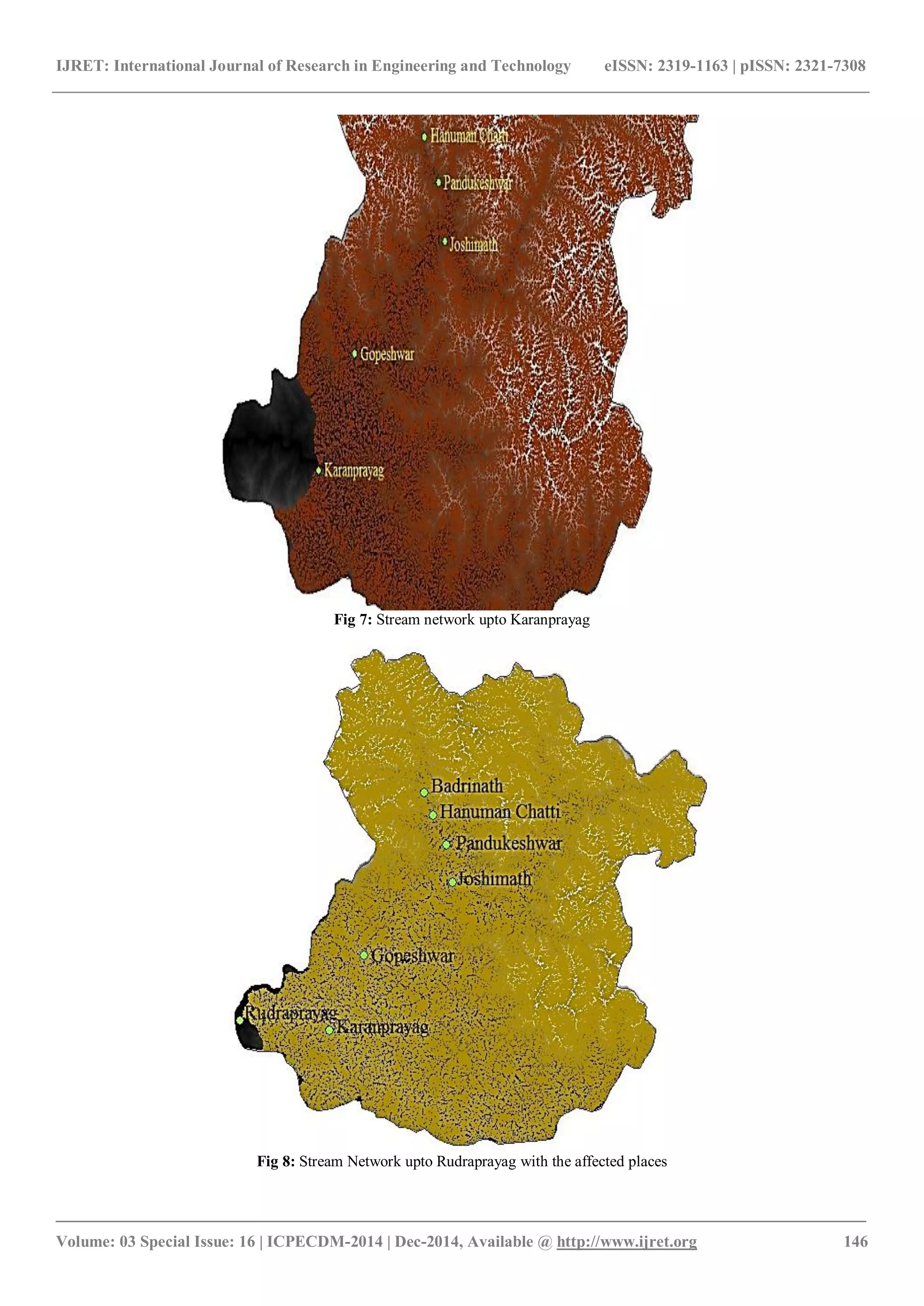
The following figures show the result of the stream
networks overlayed on the DEM of the study region,
showing how the water from one outlet point collects more
from the surrounding streams to contribute to the next outlet
point.
Fig 2: Stream networks upto Badrinath
IJRET: International Journal of Research in Engineering and Technology eISSN: 2319-1163 | pISSN: 2321-7308
_______________________________________________________________________________________
Volume: 03 Special Issue: 16 | ICPECDM-2014 | Dec-2014, Available @ http://www.ijret.org 144
Fig 3: Stream Networks upto Hanuman Chatti
Fig 4: Stream networks upto Pandukeshwar
IJRET: International Journal of Research in Engineering and Technology eISSN: 2319-1163 | pISSN: 2321-7308
_______________________________________________________________________________________
Volume: 03 Special Issue: 16 | ICPECDM-2014 | Dec-2014, Available @ http://www.ijret.org 145
Fig 5: Stream networks upto Joshimath
Fig 6: Stream networks upto Gopeshwar
IJRET: International Journal of Research in Engineering and Technology eISSN: 2319-1163 | pISSN: 2321-7308
_______________________________________________________________________________________
Volume: 03 Special Issue: 16 | ICPECDM-2014 | Dec-2014, Available @ http://www.ijret.org 146
Fig 7: Stream network upto Karanprayag
Fig 8: Stream Network upto Rudraprayag with the affected places
IJRET: International Journal of Research in Engineering and Technology eISSN: 2319-1163 | pISSN: 2321-7308
_______________________________________________________________________________________
Volume: 03 Special Issue: 16 | ICPECDM-2014 | Dec-2014, Available @ http://www.ijret.org 147
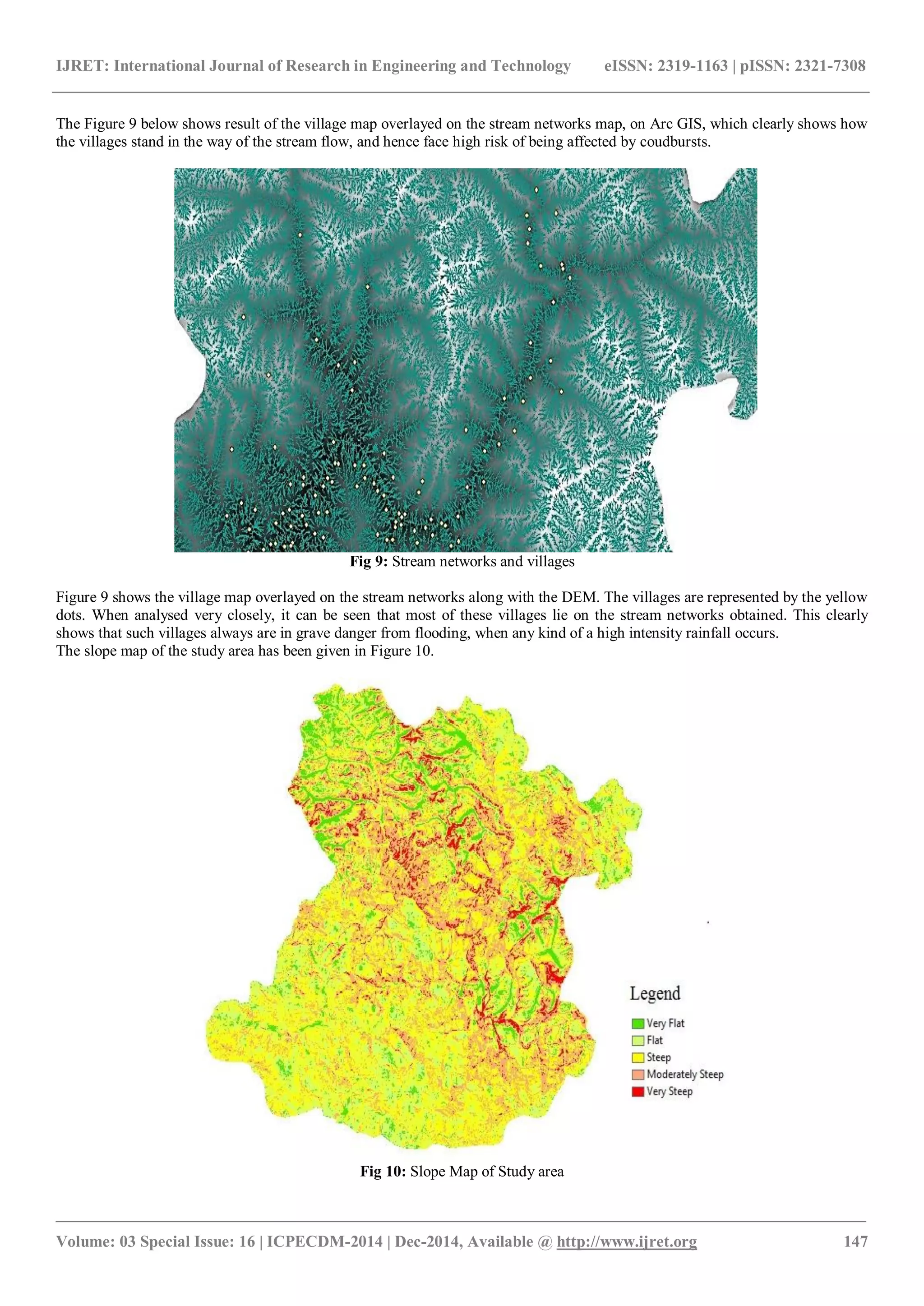
The Figure 9 below shows result of the village map overlayed on the stream networks map, on Arc GIS, which clearly shows how
the villages stand in the way of the stream flow, and hence face high risk of being affected by coudbursts.
Fig 9: Stream networks and villages
Figure 9 shows the village map overlayed on the stream networks along with the DEM. The villages are represented by the yellow
dots. When analysed very closely, it can be seen that most of these villages lie on the stream networks obtained. This clearly
shows that such villages always are in grave danger from flooding, when any kind of a high intensity rainfall occurs.
The slope map of the study area has been given in Figure 10.
Fig 10: Slope Map of Study area
IJRET: International Journal of Research in Engineering and Technology eISSN: 2319-1163 | pISSN: 2321-7308
_______________________________________________________________________________________
Volume: 03 Special Issue: 16 | ICPECDM-2014 | Dec-2014, Available @ http://www.ijret.org 148
The study area has been classified by colours into Very Flat Land, Flat Land, Steep Land, Moderately Steep Land and Very Steep
Land. As can be seen, nearly 50% of the region show a trend of moderate and steep slope. Also more than 90% of the region has a
steep to very steep slope. It indicates that such a high gradient region is very much unsuitable for construction of any kind, be it
settlement or infrastructure. As it is such high slopes tend to be very unstable themselves, and with an infrastructure built on it,
would surely collapse.
The soil map of the area was also studied (Figure 11).
Fig 11: Soil map of Uttarakhand
Soil map of the state shows that there are broadly three types
of soil in the region: first, the Glaciers with eternal snow,
second the Brown Hill Soils, and third, the Terai Soil. The
Glaciers and snow soil occur in the high altitudes of the
Himalaya. Here negligible rainfall occurs and main form of
precipitation is snow. The soil found here is very thin and
fragile. Since the texture of the soil is very course with high
gravel content, they are very much prone to displacements.
The Brown Hill soils are mixed with pebbles and gravels in
many regions. The texture varies from sandy to sandy loam,
therefore, coarse and are easily carried away by water. Most
of the region in the study area, namely Chamoli district is
covered by these two types of soils. The Terai Soil found in
other regions of the state is the soil found in the foothills of
the mountains, where it has been transported by hilly rivers
and streams and is made up of sandy material and raw
humus.
Thus when gathering all the information studies, we can say
that the villages located in such steeply sloping region and
with such coarse soil type, which is unable of withstanding
water flow, are always in a huge danger of flooding.
Application of GIS and RiverTools have helped to visualize
the proximity of the villages to the stream networks, and
hence point out the highly vulnerable villages.
4. CONCLUSION
From the river network study and the other parameters
studied, that is soil, slope and topographic position of
villages, the low-lying areas can be easily identified. Thus
the villages which are vulnerable to heavy floods along the
Alakananda River basin can be delineated. Further study of
the above work include the study of land use/cover pattern
of the area, which also highly affects the run-off from a
watershed. Also, hydraulic parameters of the river can be
evaluated using HEC-RAS and GIS. The study undertaken
here can help the government of Uttarakhand to locate the
regions which are highly unsuitable for construction of
infrastructure or residential areas, restrict the construction
permission at those places and thus minimize the risk of a
calamity happening from a disaster.
REFERENCES
[1]. Asthana A. K. L., Asthana Harshita, Geomorphic
Control of Cloud Bursts and Flash Floods in Himalaya with
Special Reference to Kedarnath Area of Uttarakhand, India
(2014)
[2]. Kumar Govind V. V, Jain Kamal, Gairola Ajay, A
Study and Simulation of Cloudburst event over Uttarkashi
Region using River Tool and Geomatic Techniques (2013)
IJRET: International Journal of Research in Engineering and Technology eISSN: 2319-1163 | pISSN: 2321-7308
_______________________________________________________________________________________
Volume: 03 Special Issue: 16 | ICPECDM-2014 | Dec-2014, Available @ http://www.ijret.org 149
[3]. Burby, R. J., Cooperating with Nature: Confronting
Natural Hazards with Land use planning for Sustainable
Communities. Washington DC: Joseph Henry/National
Academy Press (1998)
[4]. Great Britain Department of Communities and Local
Government, Planning Policy Statement 25: Development
and Flood Risk. London: Crown Copyright, PPS25 (2006)
[5]. Kumar Govind V. V, Jain Kamal, Gairola Ajay,
Analysis of Cloudburst in ungauged watersheds using HEC-
RAS model in GIS Environment.
[6]. ICIMOD, 2010, International Centre for Integrated
Mountain Development.
[7]. Seyed Reza Hosseinzadeh, International Journal of
Environmental Science and Development, Vol 2, No 3, June,
2011

Detection of hazard prone areas in the upper himalayan region in gis environment

  • 1.
    IJRET: International Journalof Research in Engineering and Technology eISSN: 2319-1163 | pISSN: 2321-7308 _______________________________________________________________________________________ Volume: 03 Special Issue: 16 | ICPECDM-2014 | Dec-2014, Available @ http://www.ijret.org 141 DETECTION OF HAZARD PRONE AREAS IN THE UPPER HIMALAYAN REGION IN GIS ENVIRONMENT Esha Chakraborty1 , V.V. Govind Kumar2 , Dheeraj Kumar3 1 Geomatics Section, Department of Mining Engineering, Indian School of Mines, India 2 Assistant Professor, Department of Mining Engineering, Indian School of Mines, India 3 Associate Professor, Department of Mining Engineering, Indian School of Mines, India Abstract Himalayas are a great boon to India as they block the monsoon winds from the oceans, allowing the northern plain to receive plenty of rainfall. The rivers Ganga and Brahmaputra are fed by the snow of the higher peaks, and these also protect from the cold biting winds o North Asia. But it is this Himalayan range again, which is one of the biggest hotspots of natural disasters, because they are still growing and young mountains and the changing climate of the globe has added to the frequency and extent of such disasters. This paper involves the study of the Basin of Alakananda River, a tributary of the Ganges, so as to delineate the flood prone zones of the area. Almost every year this region is affected by cloudbursts and consequent floods. The parameters taken into consideration here are the slope, the river networks and the soil type of the area. River Tools has been used to extract the stream networks of the river. Consequent analysis has been carried out in ArcGIS. The results of the analysis show that the topology of the area is highly dangerous for any urbanization. Villages constructed on this region are very much vulnerable to heavy floods due to the loose soil type present on the surface and the steep slope. The study identifies such highly vulnerable regions in the Alakananda River Basin. Keywords: Cloudbursts, ArcGIS, ASTERDEM and RiverTools. --------------------------------------------------------------------***------------------------------------------------------------------ 1. INTRODUCTION According to United Nation’s International Strategy for Disaster Reduction, Asia has the highest number of fatalities from natural disasters of any region, and within Asia, the countries of Himalayas have the greatest number of disasters and casualties. There are several reasons for this vulnerability, the mountains are young and dynamic and still tectonically very active; the intense monsoon rainfall leads to flooding and landslides, and the extreme relief contributes to the instability of both the land itself and the infrastructure built on it. The countries are particularly hard hit by recurring annual flash floods (ICIMOD, 2010). Flash Floods are generally the consequence of either cloudbursts, or may be due to landslides, dam breaks or glacial lake outbursts. Cloudburst is actually a situation when the intermolecular forces between the water molecules get very high due to the rapid decrease in temperature or excess of electrostatic induction in the clouds causing lightning to remain inside the cloud only, which causes hyperactive energy in the cloud. The water concentration gets higher and higher and the weight gets heavier, until water is no longer able to maintain the force within the clouds and they fall. As the water content is so high, the clouds seem to burst. Such cloudburst activity in every monsoon occur in the Himachal Pradesh (Kullu Valley) and the Western Uttaranchal (Chamoli, Uttarkashi, Tehri, Rudraprayag and Pauri Distrist). Sometimes it happens in Kumaun Mandal (Pithoragarh, Almora, Bageshwar, Chapawat and Nainital Districts) and Mussourie Hills of Dehradun district and Lesser Himalayas and Siwaliks also (Asthana, A.K.L, Asthana Harshita, 2014). Table 1 below lists the history of cloudburst events in Uttarakhand since the year 2001. Table 1: History of Cloudbursts in Uttarakhand Place Date 1 Phata, Rudraprayag August 2001 2 Mussourie Hills, Dehradun August 2001 3 Gouna Tehri August 2001 4 Burhakedae-Agunda (Balganga valley), Tehri August 2002 5 Shilagarh Village, Shimla 16 July 2003 6 Tevla Village Kullu Valley August 2004 7 Dhanu Village Rudraprayag July 2005 8 Village near Shimla August 2007 9 Leh (Ladakh) August 2010 10 Assiganga Uttarkashi 5 July 2012 11 Dyara Bugyal Uttarkashi August 2012 12 Bageshwar, Kapkot near Almora 19 Sept 2012 13 Kedarnath 16-17 June 2013 A major challenge associated with flash floods is quantitative character of the forecast; the task is not just to forecast the occurrence of an event, which is difficult enough by itself, but to anticipate the magnitude of the
  • 2.
    IJRET: International Journalof Research in Engineering and Technology eISSN: 2319-1163 | pISSN: 2321-7308 _______________________________________________________________________________________ Volume: 03 Special Issue: 16 | ICPECDM-2014 | Dec-2014, Available @ http://www.ijret.org 142 event. With the impact of climate change, the effects on the intensity of the rainfall events, identifying the vulnerable areas and assessing the degree of impact for a higher magnitude flood risk event more clearly describes the potential risk at which the current developmental or infrastructural facilities are situated. Emphasizing the significance of flood risk assessment studies (Burby.R.J.,1998) states that the main components of such studies should focus on hazard identification and vulnerability assessment as the flood risk is considered as a product of spatial identification and vu lnerability (Great Britain Department of Communities and Local Government, 2006). For producing flood hazard maps it is important to integrate geospatial and temporal data in a same computational environment that allows risk assessment, modeling and decision support. The advancement in computer-aided space-based technology such as Geographic Information System (GIS) and Remote Sensing (RS) has proved very useful in studying and mapping the flood-hazards and developing measures that can be useful to the local communities as well. The scope and scale of flood problems makes the GIS software a powerful tool for its integrated management process. GIS is ideally suited for various floodplain management activities, such as base mapping, topographic mapping, and post disaster verification of mapped floodplain extents and depths. In this Study, the watershed basin of one of the tributaries of Ganga, namely Alakananda River has been taken for studying the flood risk of the villages constructed along this river. It lies in the Uttarakhand state, India, The main objective of this paper is to study the river stream networks of the Alakananda River and its reaches, and slope and soil type, which determine whether a place has a tendency to get damaged due to heavy floods. The results can be used for further studies to identify vulnerable zones in Alakananda River basin. 2. MATERIALS AND METHODS Study Area: Uttarakhand is one amongst the Himalayan states of India, often referred to as “Devbhumi” (Land of Gods) due to many of the many Hindu temples and pilgrimage centres found in this region (Kumar Govind V. V, Jain Kamal, Gairola Ajay, 2013). The study area consists of Badrinath, which is one of the famous “Char Dhams” and since time immemorial has been the destination of countless pilgrims. The Alakananda River Basin lies in the Chamoli District of Uttarakhand, which extends upto an area of 7613 sq km. the watershed basin lies between 00' 43"N to 00' N and 12' to 10' 27"E. This area heavily affected due to flashfloods in the year 2012. The Elevation of the area varies from 604-7791 meters (ASTERDEM analysis). In the year 2012, 7 cloudbursts hit Uttarakhand state. The regions Badrinath, Hanuman Chatti, Pandukeshwar, Joshimath, Gopeshwar, Karanprayag and Rudraprayag were the worst affected villages, and have been used in this study as the sub-watershed outlet point. Figure 1 shows the Alakananda River basin extracted from the ASTERDEM, above mentioned places marked in green, and the River in red. Datasets: Digital Elevation Models are elevation data that collect by remote sensing methods or by transforming the contour maps to raster format by digitizing and surface analyzing (Seyed Reza Hosseinzadeh, 2011). The analysis of the watershed was done completely using the Digital Elevation Model (DEM) downloaded from the ASTER (Advanced Space-borne Thermal Emission and Reflection Radiometer) GDEM (Global Digital Elevation Model). It was used for delineation of the catchment area and also to obtain the slope and drainage pattern. he AS D covers land surfaces between N and S and is com osed of by tiles. The ASTERGDEM has a resolution of 30m and is in Geographic Latitude/ Longitude system. With the help of Uttaranchal Administrative Atlas, prepared by the Census of India, 2001 and Google Earth, locations were observed and later mapped into ArcGIS. Fig 1: Alakananda River Basin and the worst affected places Google earth is a virtual globe, map and geographical information program. It maps the Earth by the superposition of images obtained satellite imagery, aerial photographs and GIS. The RiverTools software is a digital terrain analysis program designed specifically for studying the drainage network morphology and basin morphometry using DEMs. It also can visualize the digital topography very well. The drainage pattern was extracted for each of the sub-outlet points namely Badrinath, Hanuman Chatti, Pandukeshwar, Joshimath, Gopeshwar, Karanprayag, Rudraprayag.
  • 3.
    IJRET: International Journalof Research in Engineering and Technology eISSN: 2319-1163 | pISSN: 2321-7308 _______________________________________________________________________________________ Volume: 03 Special Issue: 16 | ICPECDM-2014 | Dec-2014, Available @ http://www.ijret.org 143 Stream networks denote all the small tributaries of the main river which contribute to the water in the river. The purpose of extracting then for a particular basin outlet is to understand the direction of water flow, and also to visualize those villages which lie in the path of the free flow of the streams, which has been done here. Soil is another important factor in determining the vulnerability of an area towards flooding. This is because the structure of soil and soil type determines how much water can infiltrate through such soil, or how much it can hold back water, or else is water can easily carry away such soils. Looking into these information, we can predict the vulnerability of a region. This study is focused on all the above mentioned factors, using the mentioned tools to define the vulnerability of the area. 3. RESULTS AND DISCUSSION The district of Chamoli has been affected by a number of cloudburst events in the last decade. Huge amount of casualty along with loss of infrastructure and cattle has taken place. As such there has been no effective flood management practices undertaken for disaster prevention, before it has already occurred. The following figures show the result of the stream networks overlayed on the DEM of the study region, showing how the water from one outlet point collects more from the surrounding streams to contribute to the next outlet point. Fig 2: Stream networks upto Badrinath
  • 4.
    IJRET: International Journalof Research in Engineering and Technology eISSN: 2319-1163 | pISSN: 2321-7308 _______________________________________________________________________________________ Volume: 03 Special Issue: 16 | ICPECDM-2014 | Dec-2014, Available @ http://www.ijret.org 144 Fig 3: Stream Networks upto Hanuman Chatti Fig 4: Stream networks upto Pandukeshwar
  • 5.
    IJRET: International Journalof Research in Engineering and Technology eISSN: 2319-1163 | pISSN: 2321-7308 _______________________________________________________________________________________ Volume: 03 Special Issue: 16 | ICPECDM-2014 | Dec-2014, Available @ http://www.ijret.org 145 Fig 5: Stream networks upto Joshimath Fig 6: Stream networks upto Gopeshwar
  • 6.
    IJRET: International Journalof Research in Engineering and Technology eISSN: 2319-1163 | pISSN: 2321-7308 _______________________________________________________________________________________ Volume: 03 Special Issue: 16 | ICPECDM-2014 | Dec-2014, Available @ http://www.ijret.org 146 Fig 7: Stream network upto Karanprayag Fig 8: Stream Network upto Rudraprayag with the affected places
  • 7.
    IJRET: International Journalof Research in Engineering and Technology eISSN: 2319-1163 | pISSN: 2321-7308 _______________________________________________________________________________________ Volume: 03 Special Issue: 16 | ICPECDM-2014 | Dec-2014, Available @ http://www.ijret.org 147 The Figure 9 below shows result of the village map overlayed on the stream networks map, on Arc GIS, which clearly shows how the villages stand in the way of the stream flow, and hence face high risk of being affected by coudbursts. Fig 9: Stream networks and villages Figure 9 shows the village map overlayed on the stream networks along with the DEM. The villages are represented by the yellow dots. When analysed very closely, it can be seen that most of these villages lie on the stream networks obtained. This clearly shows that such villages always are in grave danger from flooding, when any kind of a high intensity rainfall occurs. The slope map of the study area has been given in Figure 10. Fig 10: Slope Map of Study area
  • 8.
    IJRET: International Journalof Research in Engineering and Technology eISSN: 2319-1163 | pISSN: 2321-7308 _______________________________________________________________________________________ Volume: 03 Special Issue: 16 | ICPECDM-2014 | Dec-2014, Available @ http://www.ijret.org 148 The study area has been classified by colours into Very Flat Land, Flat Land, Steep Land, Moderately Steep Land and Very Steep Land. As can be seen, nearly 50% of the region show a trend of moderate and steep slope. Also more than 90% of the region has a steep to very steep slope. It indicates that such a high gradient region is very much unsuitable for construction of any kind, be it settlement or infrastructure. As it is such high slopes tend to be very unstable themselves, and with an infrastructure built on it, would surely collapse. The soil map of the area was also studied (Figure 11). Fig 11: Soil map of Uttarakhand Soil map of the state shows that there are broadly three types of soil in the region: first, the Glaciers with eternal snow, second the Brown Hill Soils, and third, the Terai Soil. The Glaciers and snow soil occur in the high altitudes of the Himalaya. Here negligible rainfall occurs and main form of precipitation is snow. The soil found here is very thin and fragile. Since the texture of the soil is very course with high gravel content, they are very much prone to displacements. The Brown Hill soils are mixed with pebbles and gravels in many regions. The texture varies from sandy to sandy loam, therefore, coarse and are easily carried away by water. Most of the region in the study area, namely Chamoli district is covered by these two types of soils. The Terai Soil found in other regions of the state is the soil found in the foothills of the mountains, where it has been transported by hilly rivers and streams and is made up of sandy material and raw humus. Thus when gathering all the information studies, we can say that the villages located in such steeply sloping region and with such coarse soil type, which is unable of withstanding water flow, are always in a huge danger of flooding. Application of GIS and RiverTools have helped to visualize the proximity of the villages to the stream networks, and hence point out the highly vulnerable villages. 4. CONCLUSION From the river network study and the other parameters studied, that is soil, slope and topographic position of villages, the low-lying areas can be easily identified. Thus the villages which are vulnerable to heavy floods along the Alakananda River basin can be delineated. Further study of the above work include the study of land use/cover pattern of the area, which also highly affects the run-off from a watershed. Also, hydraulic parameters of the river can be evaluated using HEC-RAS and GIS. The study undertaken here can help the government of Uttarakhand to locate the regions which are highly unsuitable for construction of infrastructure or residential areas, restrict the construction permission at those places and thus minimize the risk of a calamity happening from a disaster. REFERENCES [1]. Asthana A. K. L., Asthana Harshita, Geomorphic Control of Cloud Bursts and Flash Floods in Himalaya with Special Reference to Kedarnath Area of Uttarakhand, India (2014) [2]. Kumar Govind V. V, Jain Kamal, Gairola Ajay, A Study and Simulation of Cloudburst event over Uttarkashi Region using River Tool and Geomatic Techniques (2013)
  • 9.
    IJRET: International Journalof Research in Engineering and Technology eISSN: 2319-1163 | pISSN: 2321-7308 _______________________________________________________________________________________ Volume: 03 Special Issue: 16 | ICPECDM-2014 | Dec-2014, Available @ http://www.ijret.org 149 [3]. Burby, R. J., Cooperating with Nature: Confronting Natural Hazards with Land use planning for Sustainable Communities. Washington DC: Joseph Henry/National Academy Press (1998) [4]. Great Britain Department of Communities and Local Government, Planning Policy Statement 25: Development and Flood Risk. London: Crown Copyright, PPS25 (2006) [5]. Kumar Govind V. V, Jain Kamal, Gairola Ajay, Analysis of Cloudburst in ungauged watersheds using HEC- RAS model in GIS Environment. [6]. ICIMOD, 2010, International Centre for Integrated Mountain Development. [7]. Seyed Reza Hosseinzadeh, International Journal of Environmental Science and Development, Vol 2, No 3, June, 2011