Detecting Interaction Coupling
from
Task Interaction Histories
Lijie Zou and Michael W. Godfrey
University of Waterloo
Ahmed E. Hassan
University of Victoria
Background
• Software maintenance is driven by tasks
– Tasks have a structure (predefined / emergent)
– Task structures implicitly include the set of program artifacts
involved plus a rich set of relationships
• A repository of task structure info can be mined for latent
knowledge about software development
– But how to populate it? How to mine it?
Background
• Related work:
– Logical coupling [Gall]
– Interaction history [Parnin, Schneider, Robillard/Murphy]
– Mylar [Kersten/Murphy]
– NavTracks [Singer/Storey]
Recovering relations in
task structure
• Murphy et al. [ECOOP-05]
– “A task structure consists of the parts of a software system and
relationships between those parts that were changed to complete
the task.”
• Dependencies between changed artifacts can be used to
infer relations that are relevant to a task … but …
– Change ; Relevance
• Some relations are unrelated to the task
– Relevance ; Change
• Some patterns involved “just looking”
e.g., viewing a function header before writing client code
Our approach: Interaction coupling
Definition
– Two artifacts that are “frequently” examined / changed “together”
are likely to have some latent relationship.
• We call this interaction coupling. [cf. Gall et al.]
– “frequently”
• The weight of an IC is the total number of times that two artifacts are
accessed together
• We use a threshold value to throw out low valued couplings
– “together”
• We track sequential accesses of entities, raised to the file level.
• Together means “A then B” or “B then A” where each of A and B may
be viewed or changed.
Interaction coupling
Intuition
– IC recovers relations within the context of a task execution
– Understanding of program structure leads to identifiable IC patterns
• … which can improve our understanding of task structure
– Temporal windowing increases accuracy
– Weight reflects the significance and effort of a relation in a
maintenance task
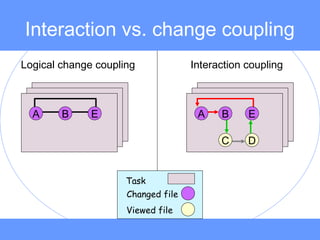
Interaction vs. change coupling
Changed file
Viewed file
A B
C D
E
Interaction coupling
Task
A B E
Logical change coupling
Interaction coupling patterns
Goal
– Use the info from ICs to improve understanding of
maint. tasks, process, history, + status of the system
Idea
– IC patterns ⇒ maintenance task structure patterns
Process
– Recover interaction couplings
– Check whether an IC matches an existing pattern
• Identify new patterns too
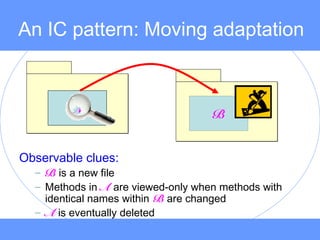
An IC pattern: Moving adaptation
Observable clues:
– B is a new file
– Methods in A are viewed-only when methods with
identical names within B are changed
– A is eventually deleted
A B
Case study
• A task interaction history repository built from our
previous work
– Same underlying data as reported in [WCRE-06]
• Three professional programmers working on two
projects: H (577 classes, 57 KLOC) and B (202 classes,
20 KLOC)
• One month of data collection, plus follow-up interviews
Research questions
Q1: Basic characteristics of interaction coupling
Q2: Interaction coupling patterns
Q3: Insights into the software system
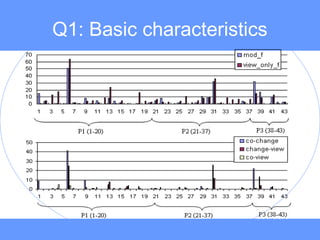
Q1: Basic characteristics
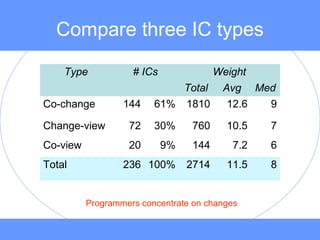
Compare three IC types
Type # ICs Weight
Total Avg Med
Co-change 144 61% 1810 12.6 9
Change-view 72 30% 760 10.5 7
Co-view 20 9% 144 7.2 6
Total 236 100% 2714 11.5 8
Programmers concentrate on changes
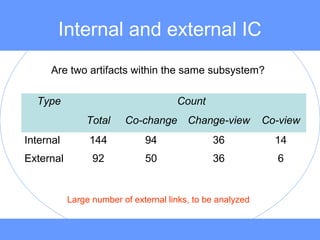
Internal and external IC
Type Count
Total Co-change Change-view Co-view
Internal 144 94 36 14
External 92 50 36 6
Are two artifacts within the same subsystem?
Large number of external links, to be analyzed
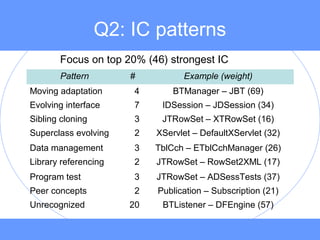
Q2: IC patterns
Focus on top 20% (46) strongest IC
Pattern # Example (weight)
Moving adaptation 4 BTManager – JBT (69)
Evolving interface 7 IDSession – JDSession (34)
Sibling cloning 3 JTRowSet – XTRowSet (16)
Superclass evolving 2 XServlet – DefaultXServlet (32)
Data management 3 TblCch – ETblCchManager (26)
Library referencing 2 JTRowSet – RowSet2XML (17)
Program test 3 JTRowSet – ADSessTests (37)
Peer concepts 2 Publication – Subscription (21)
Unrecognized 20 BTListener – DFEngine (57)
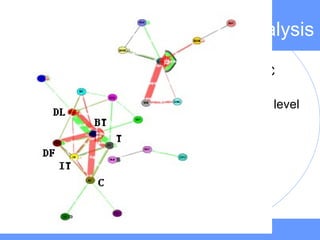
Q3: Insights from evolution analysis
• Analyze external IC
• Visualization at the
subsystem and file level
Case study: Summary
• IC patterns can aid in understanding developer
behaviour during maintenance
• ICs can aid in understanding emergent designs in
evolving systems
Concerns and threats to validity
• Is a time window of 2 events enough to be meaningful?
[Parnin]
• Is “file-level” the right level of granularity?
• Professional developers, experts in their system
• One study, two small systems, three programmers, …
• Did the required instrumentation affect developer behavior?
– Did the developers “keep the faith”? Were they “overly devout”?
Conclusions
• Interaction coupling (IC) is a useful concept in the
modelling of task structure
– Recovering relations in task structure
– Towards a better understanding of task structure
• IC patterns help to improve our understanding of
maintenance tasks
• IC can be used to recover latent knowledge about a
software system
Detecting Interaction Coupling
from
Task Interaction Histories
Lijie Zou and Michael W. Godfrey
University of Waterloo
Ahmed E. Hassan
University of Victoria

Detecting Interaction Coupling from Task Interaction Histories

  • 1.
    Detecting Interaction Coupling from TaskInteraction Histories Lijie Zou and Michael W. Godfrey University of Waterloo Ahmed E. Hassan University of Victoria
  • 2.
    Background • Software maintenanceis driven by tasks – Tasks have a structure (predefined / emergent) – Task structures implicitly include the set of program artifacts involved plus a rich set of relationships • A repository of task structure info can be mined for latent knowledge about software development – But how to populate it? How to mine it?
  • 3.
    Background • Related work: –Logical coupling [Gall] – Interaction history [Parnin, Schneider, Robillard/Murphy] – Mylar [Kersten/Murphy] – NavTracks [Singer/Storey]
  • 4.
    Recovering relations in taskstructure • Murphy et al. [ECOOP-05] – “A task structure consists of the parts of a software system and relationships between those parts that were changed to complete the task.” • Dependencies between changed artifacts can be used to infer relations that are relevant to a task … but … – Change ; Relevance • Some relations are unrelated to the task – Relevance ; Change • Some patterns involved “just looking” e.g., viewing a function header before writing client code
  • 5.
    Our approach: Interactioncoupling Definition – Two artifacts that are “frequently” examined / changed “together” are likely to have some latent relationship. • We call this interaction coupling. [cf. Gall et al.] – “frequently” • The weight of an IC is the total number of times that two artifacts are accessed together • We use a threshold value to throw out low valued couplings – “together” • We track sequential accesses of entities, raised to the file level. • Together means “A then B” or “B then A” where each of A and B may be viewed or changed.
  • 6.
    Interaction coupling Intuition – ICrecovers relations within the context of a task execution – Understanding of program structure leads to identifiable IC patterns • … which can improve our understanding of task structure – Temporal windowing increases accuracy – Weight reflects the significance and effort of a relation in a maintenance task
  • 7.
    Interaction vs. changecoupling Changed file Viewed file A B C D E Interaction coupling Task A B E Logical change coupling
  • 8.
    Interaction coupling patterns Goal –Use the info from ICs to improve understanding of maint. tasks, process, history, + status of the system Idea – IC patterns ⇒ maintenance task structure patterns Process – Recover interaction couplings – Check whether an IC matches an existing pattern • Identify new patterns too
  • 9.
    An IC pattern:Moving adaptation Observable clues: – B is a new file – Methods in A are viewed-only when methods with identical names within B are changed – A is eventually deleted A B
  • 10.
    Case study • Atask interaction history repository built from our previous work – Same underlying data as reported in [WCRE-06] • Three professional programmers working on two projects: H (577 classes, 57 KLOC) and B (202 classes, 20 KLOC) • One month of data collection, plus follow-up interviews
  • 11.
    Research questions Q1: Basiccharacteristics of interaction coupling Q2: Interaction coupling patterns Q3: Insights into the software system
  • 12.
  • 13.
    Compare three ICtypes Type # ICs Weight Total Avg Med Co-change 144 61% 1810 12.6 9 Change-view 72 30% 760 10.5 7 Co-view 20 9% 144 7.2 6 Total 236 100% 2714 11.5 8 Programmers concentrate on changes
  • 14.
    Internal and externalIC Type Count Total Co-change Change-view Co-view Internal 144 94 36 14 External 92 50 36 6 Are two artifacts within the same subsystem? Large number of external links, to be analyzed
  • 15.
    Q2: IC patterns Focuson top 20% (46) strongest IC Pattern # Example (weight) Moving adaptation 4 BTManager – JBT (69) Evolving interface 7 IDSession – JDSession (34) Sibling cloning 3 JTRowSet – XTRowSet (16) Superclass evolving 2 XServlet – DefaultXServlet (32) Data management 3 TblCch – ETblCchManager (26) Library referencing 2 JTRowSet – RowSet2XML (17) Program test 3 JTRowSet – ADSessTests (37) Peer concepts 2 Publication – Subscription (21) Unrecognized 20 BTListener – DFEngine (57)
  • 16.
    Q3: Insights fromevolution analysis • Analyze external IC • Visualization at the subsystem and file level
  • 17.
    Case study: Summary •IC patterns can aid in understanding developer behaviour during maintenance • ICs can aid in understanding emergent designs in evolving systems
  • 18.
    Concerns and threatsto validity • Is a time window of 2 events enough to be meaningful? [Parnin] • Is “file-level” the right level of granularity? • Professional developers, experts in their system • One study, two small systems, three programmers, … • Did the required instrumentation affect developer behavior? – Did the developers “keep the faith”? Were they “overly devout”?
  • 19.
    Conclusions • Interaction coupling(IC) is a useful concept in the modelling of task structure – Recovering relations in task structure – Towards a better understanding of task structure • IC patterns help to improve our understanding of maintenance tasks • IC can be used to recover latent knowledge about a software system
  • 20.
    Detecting Interaction Coupling from TaskInteraction Histories Lijie Zou and Michael W. Godfrey University of Waterloo Ahmed E. Hassan University of Victoria

Editor's Notes

  • #5 Not all the program dependencies between changed artifacts are relevant Some relevant dependencies occur between artifacts that are not changed
  • #7 Logical, retrospective, can be code dependencies or others ???
  • #8 Explain the difference between interaction coupling and change coupling, including source, source availability, relation between
  • #10 Want to move a file, A, to another location in the system A clone of A, call it B, is created in the new location, then heavily modified. As B is being adapted to the new location, A is referenced intensively.
  • #23 Explain the difference between interaction coupling and change coupling, including source, source availability, relation between