Towards Just-in-Time Suggestions
for
Log Changes
Journal-first Presentation | Empirical Software
Engineering
Heng Li Weiyi Shang Ying Zou Ahmed E.
Hassan
2
Log analytics
tools
System
issues
Log
collection
Release
Make
logging
decisions
Produce at run-time
RegE
x
[^…]
Logger.error()
3
Log analytics
tools
System
issues
Log
collection
Release
Make
logging
decisions
Produce at run-time
RegE
x
[^…]
Logger.error()
Logs are usually the only resource
for debugging field failures
4
Log analytics
tools
System
issues
Log
collection
Release
Make
logging
decisions
Produce at run-time
RegE
x
[^…]
Logger.error()
Making good logging decisions is critical for
failure diagnosis
Logs are usually the only resource
for debugging field failures
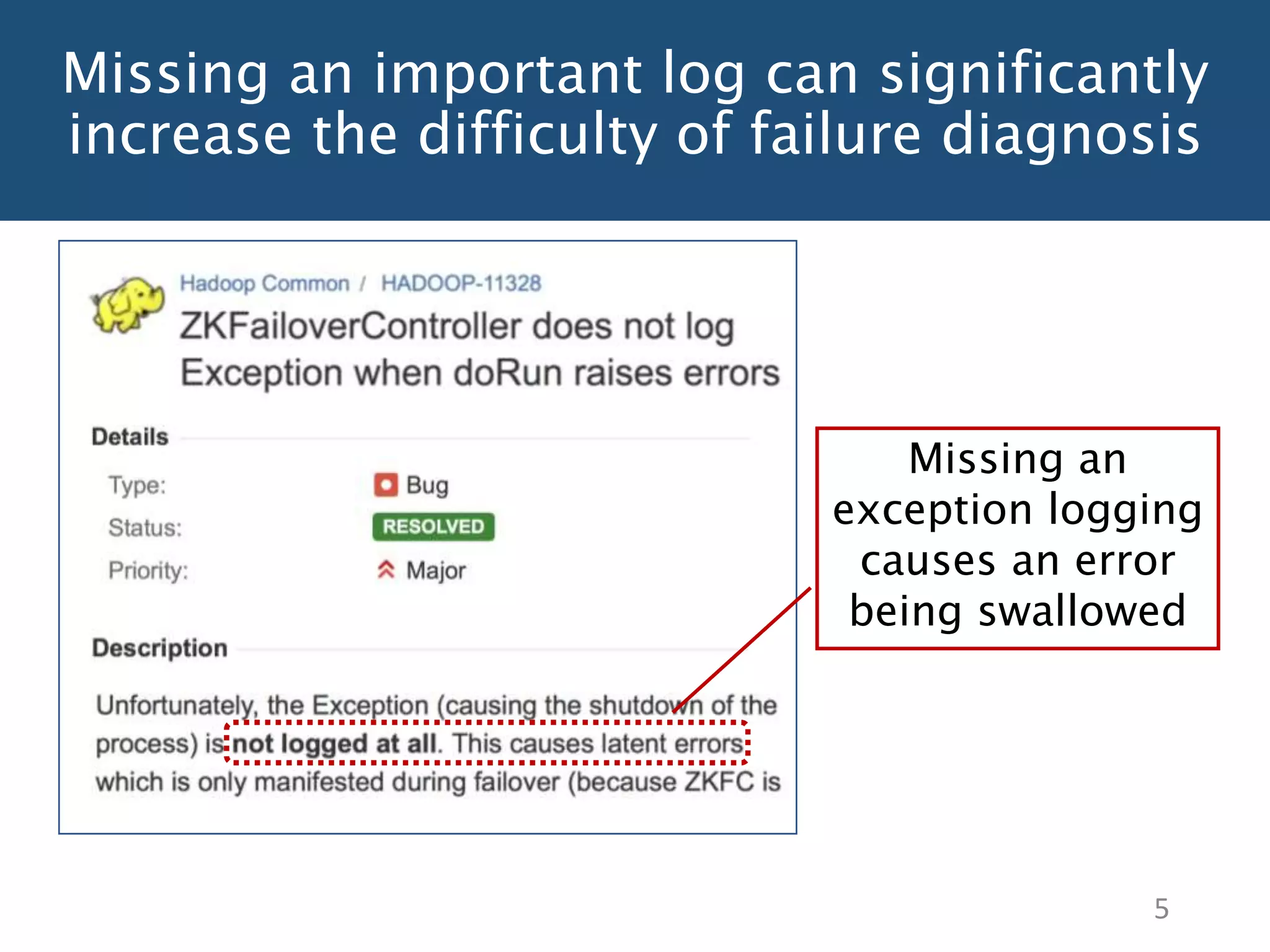
Missing an important log can significantly
increase the difficulty of failure diagnosis
5
Missing an
exception logging
causes an error
being swallowed
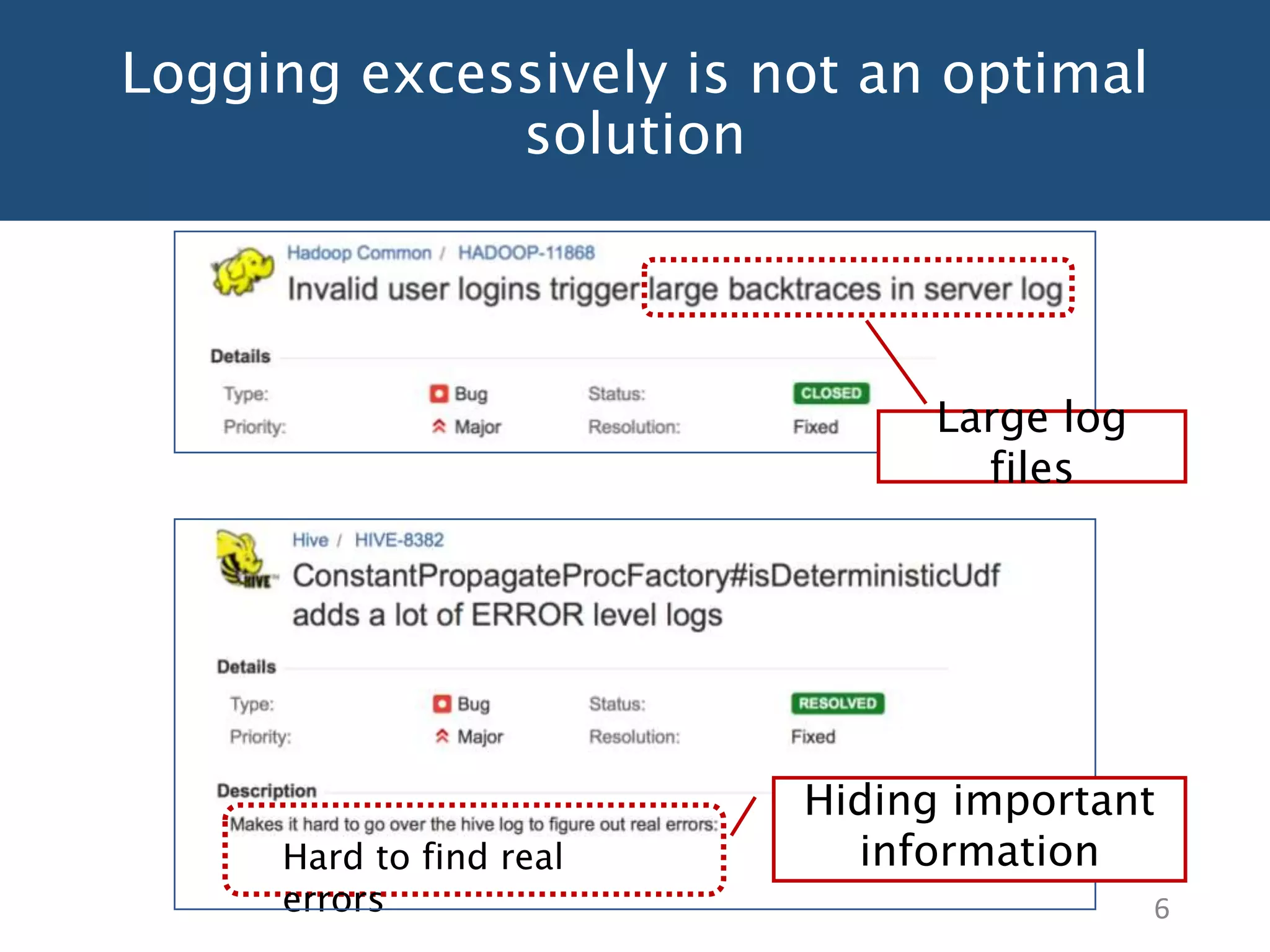
Logging excessively is not an optimal
solution
6
Large log
files
Hard to find real
errors
Hiding important
information
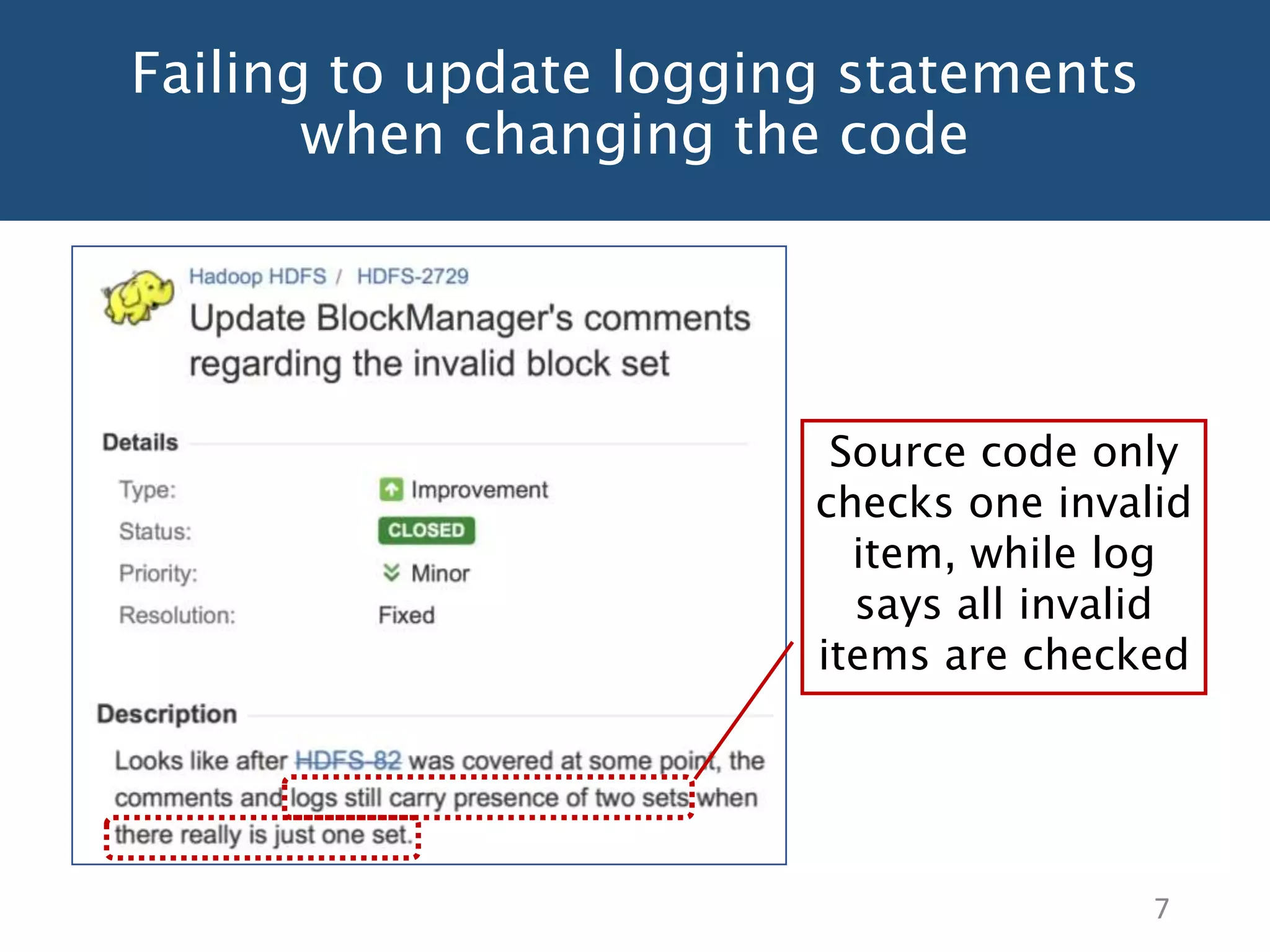
Failing to update logging statements
when changing the code
7
Source code only
checks one invalid
item, while log
says all invalid
items are checked
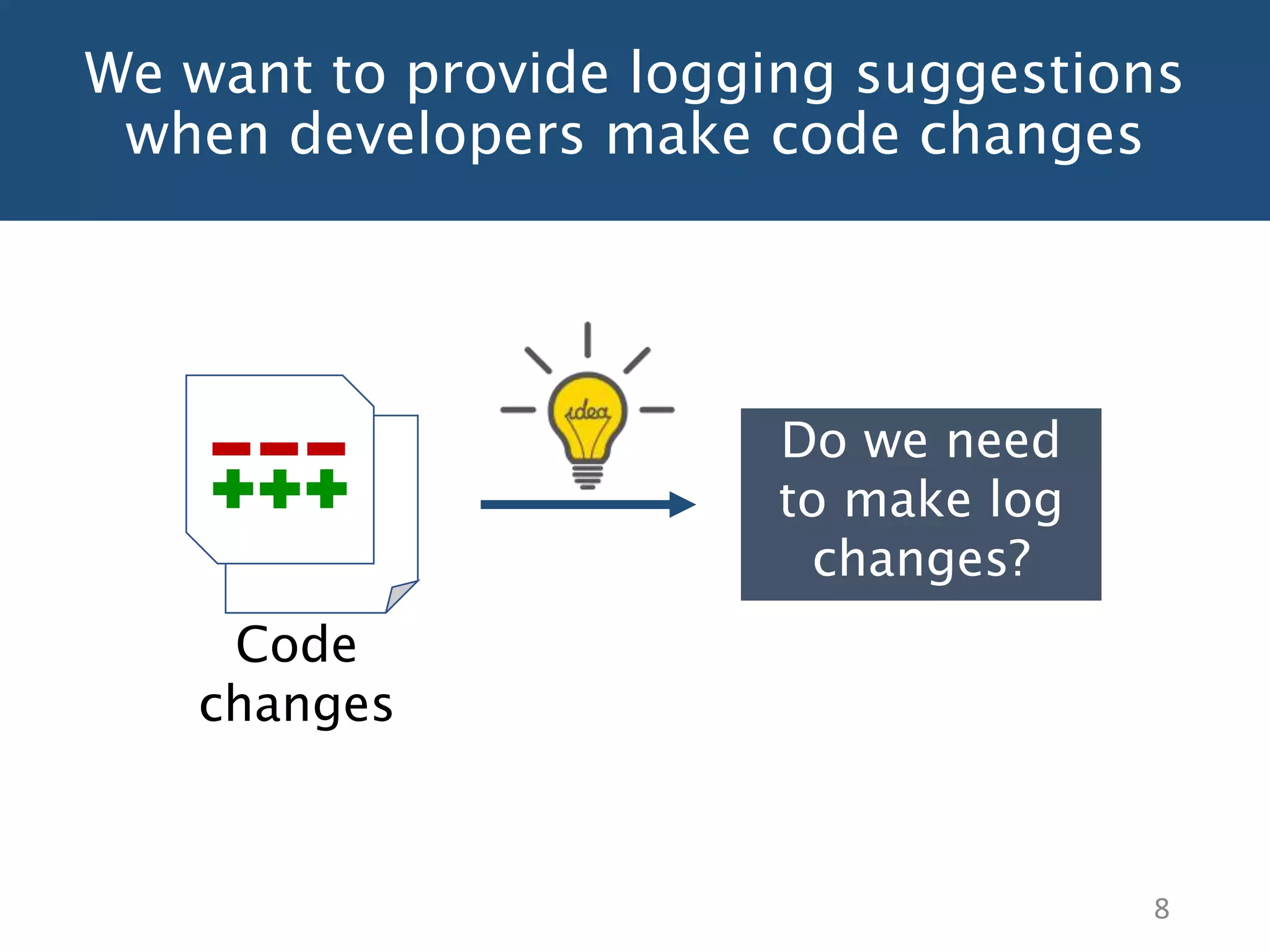
We want to provide logging suggestions
when developers make code changes
8
Code
changes
Do we need
to make log
changes?
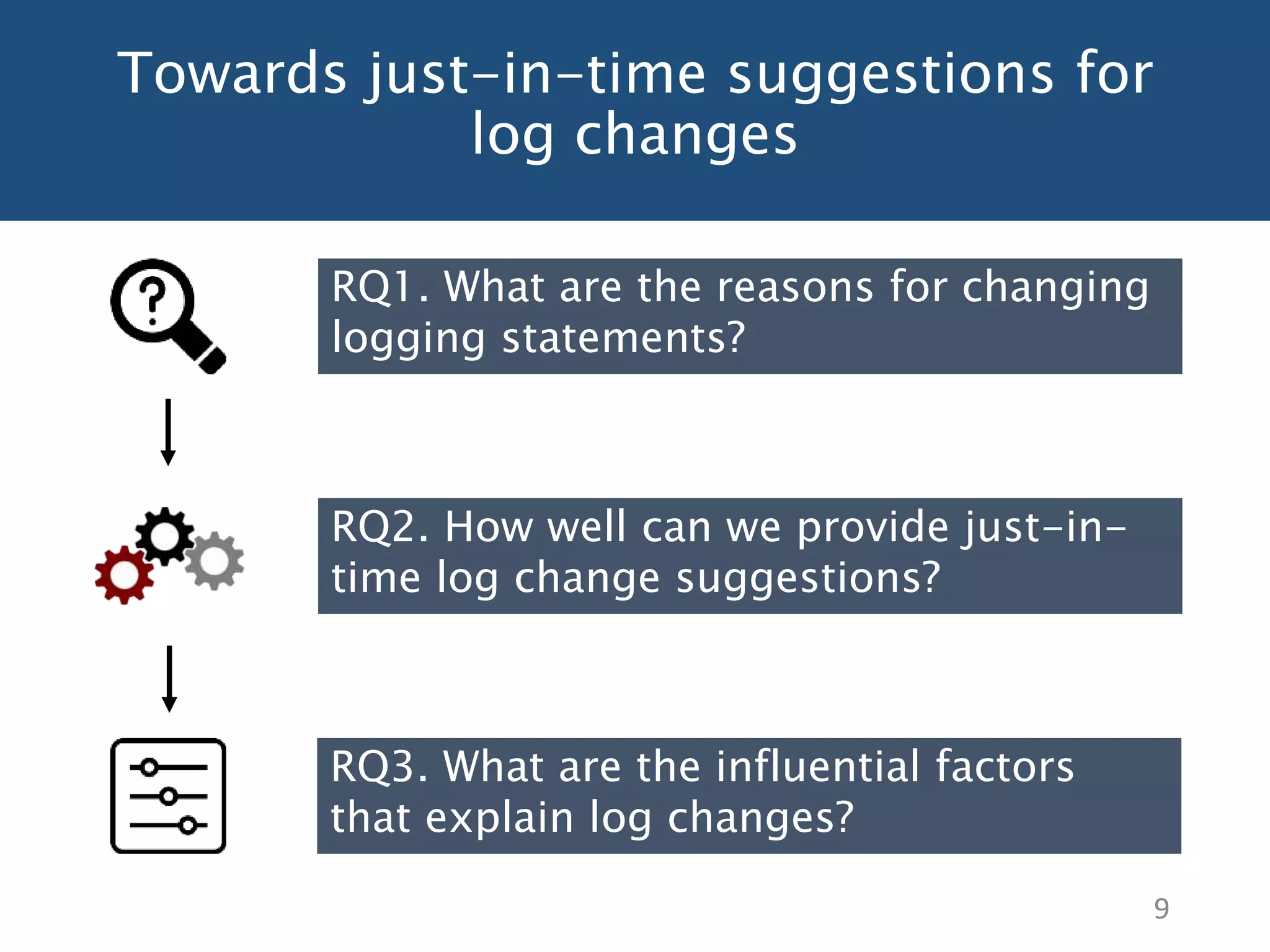
Towards just-in-time suggestions for
log changes
9
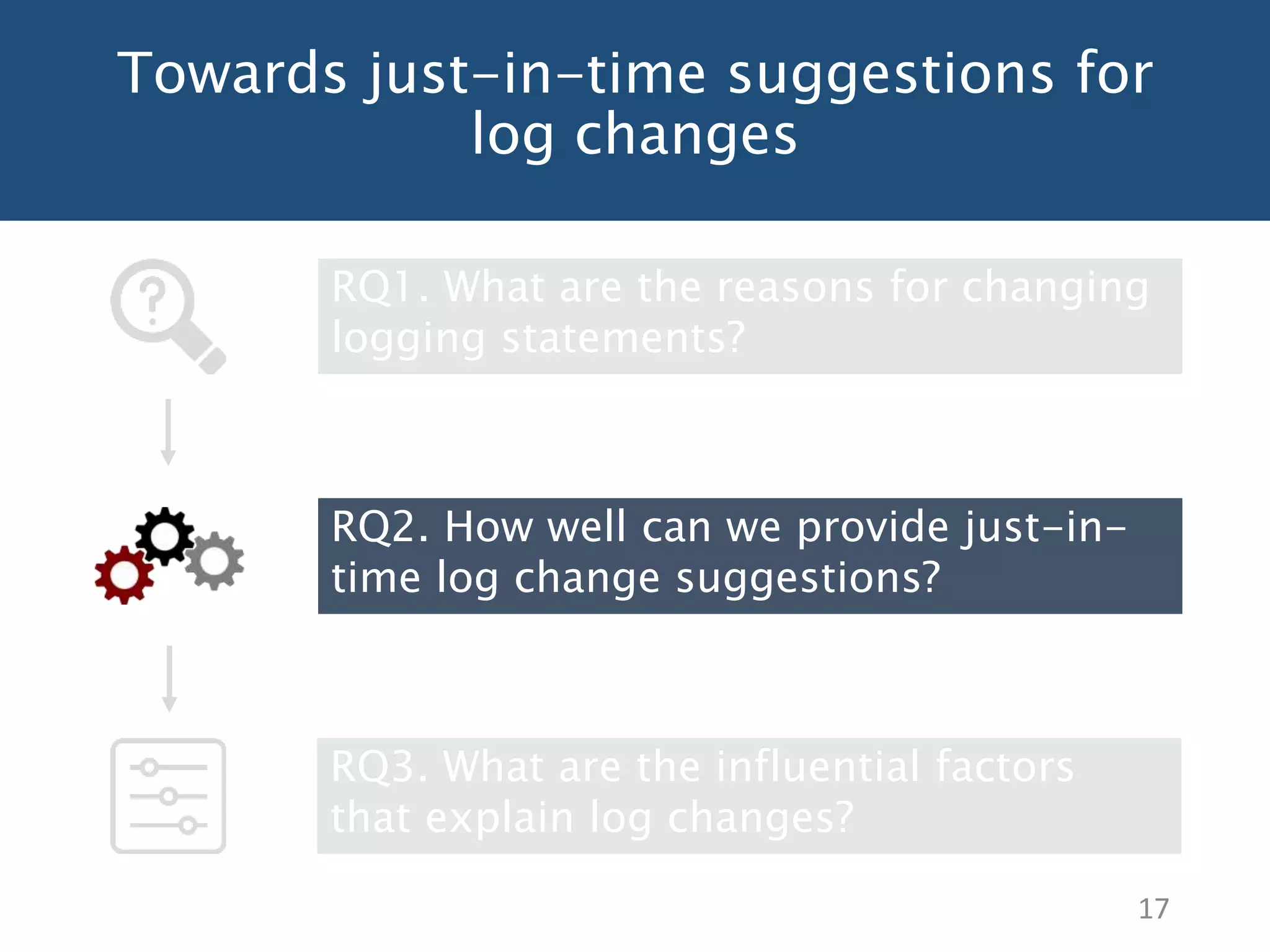
RQ1. What are the reasons for changing
logging statements?
RQ2. How well can we provide just-in-
time log change suggestions?
RQ3. What are the influential factors
that explain log changes?
Four case study systems
10
Over 2 M lines of code
Over 13 K logging statements
Over 40 K Commits
23% - 30% commits involve log
changes
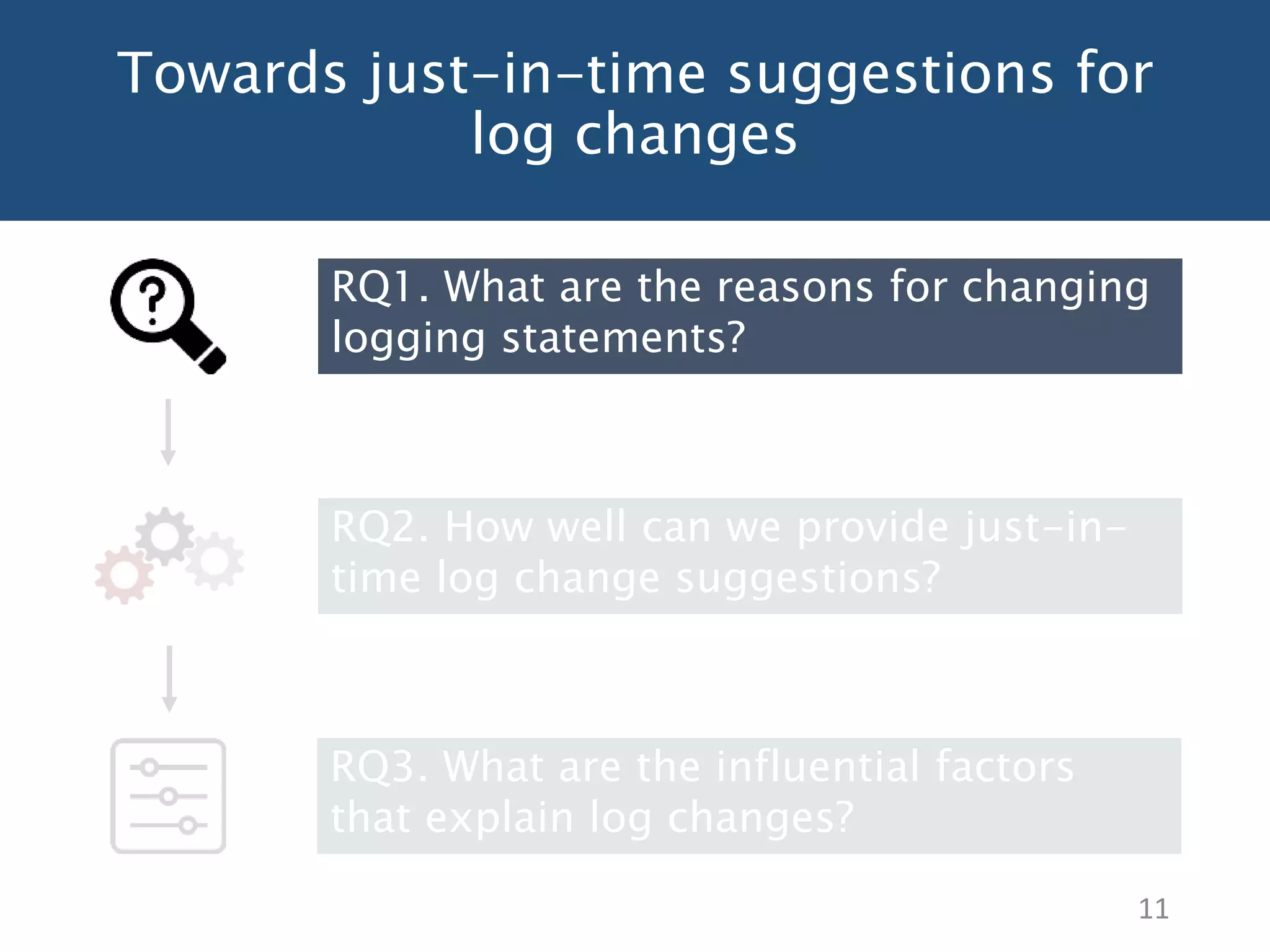
Towards just-in-time suggestions for
log changes
11
RQ1. What are the reasons for changing
logging statements?
RQ2. How well can we provide just-in-
time log change suggestions?
RQ3. What are the influential factors
that explain log changes?
We manually coded the reasons for
log changes
Random sampling of 380 log
changes out of 32K log changes
12
Manual examined code changes,
commit messages, and issue
reports
Open coding approach
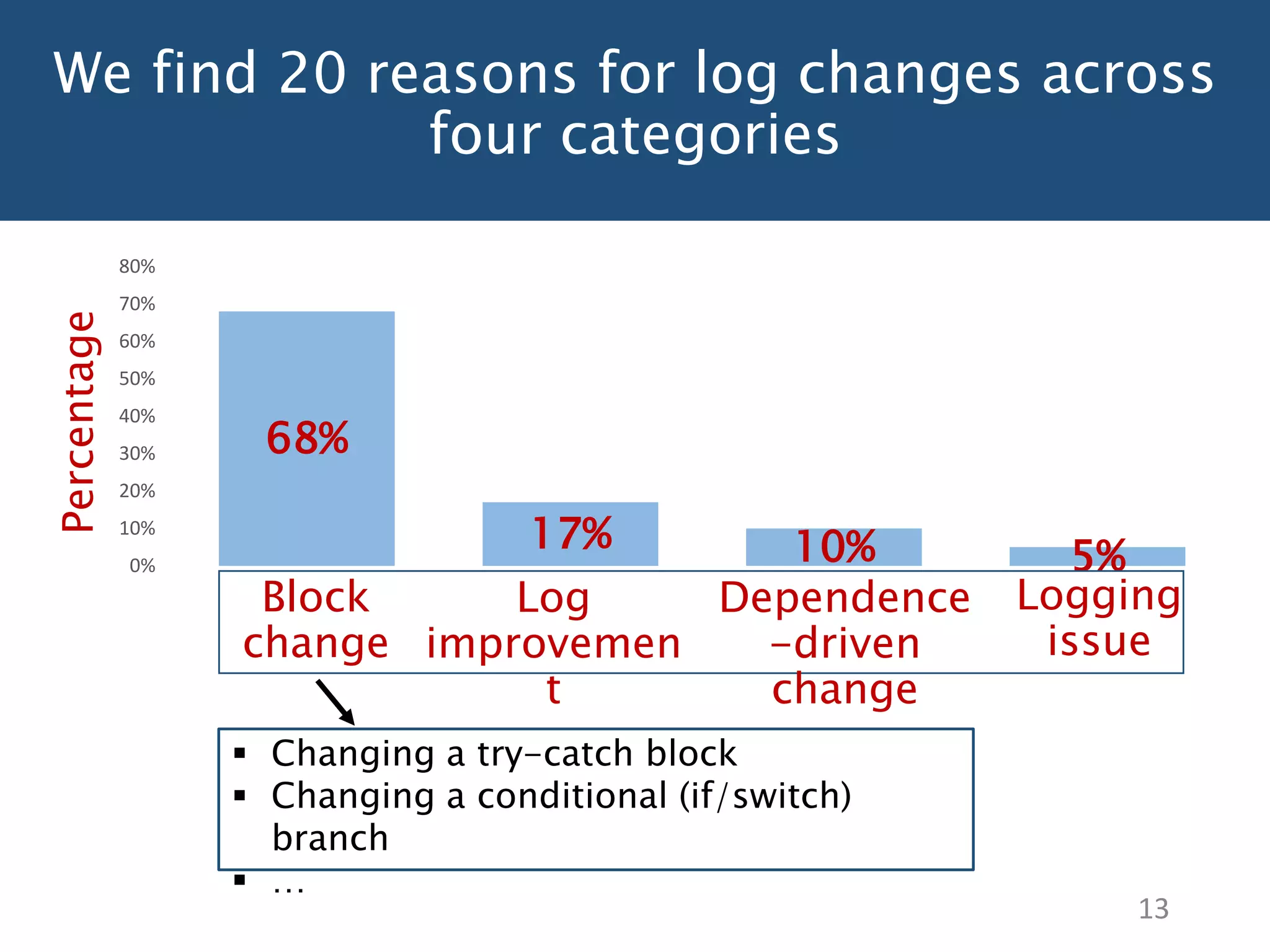
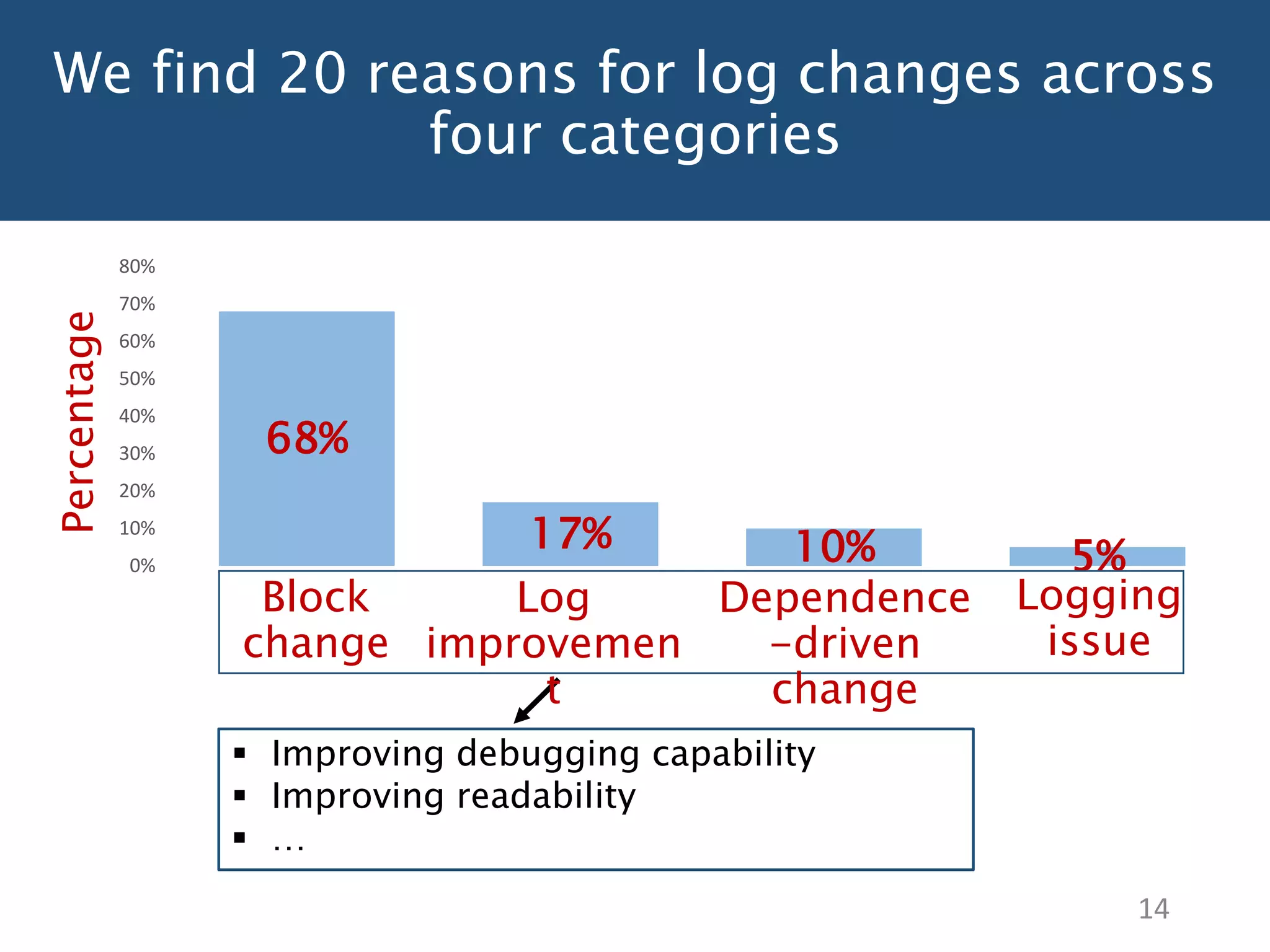
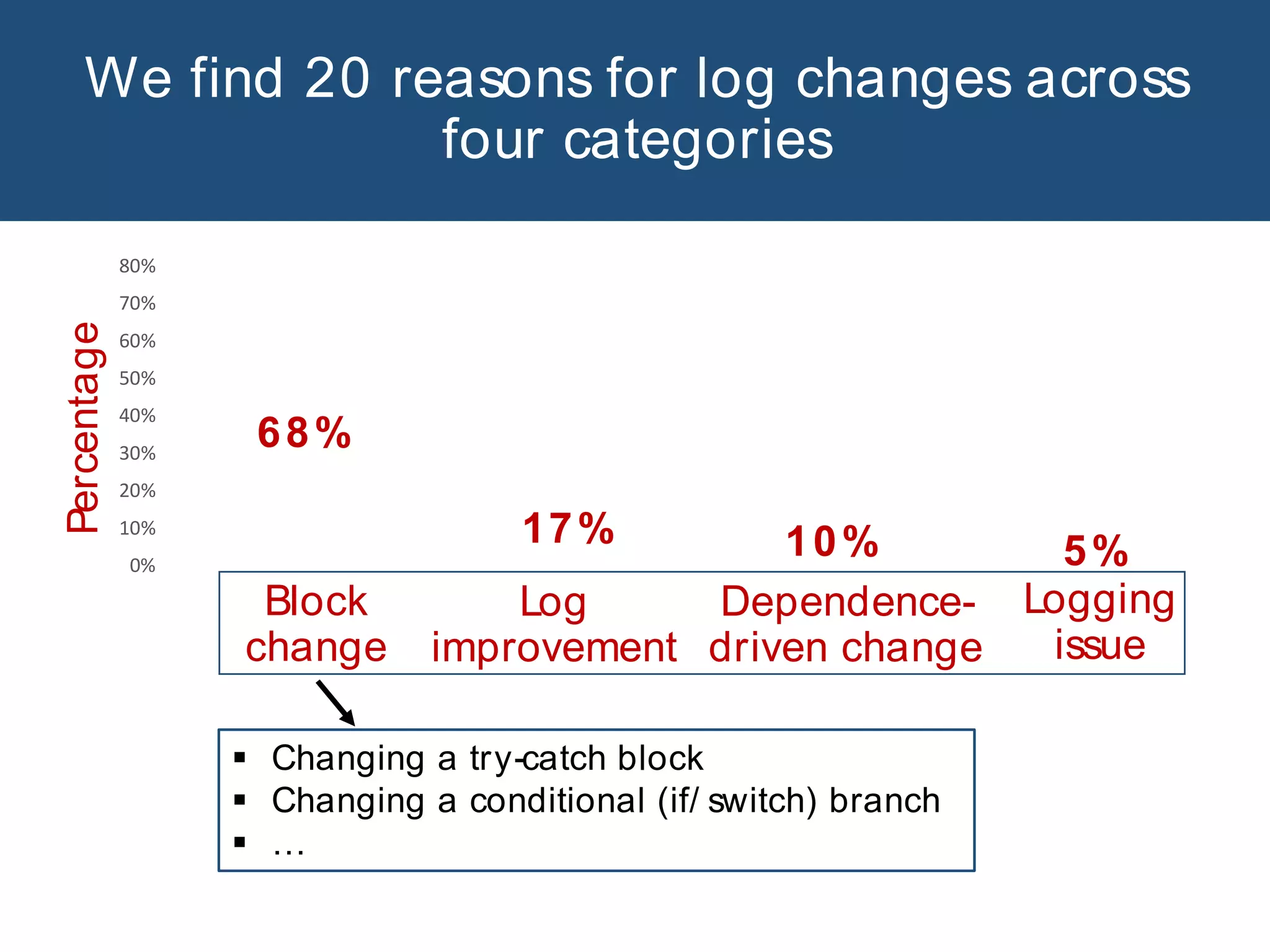
We find 20 reasons for log changes across
four categories
68%
17% 10% 5%0%
10%
20%
30%
40%
50%
60%
70%
80%
13
 Changing a try-catch block
 Changing a conditional (if/switch)
branch
 …
Percentage
Block
change
Log
improvemen
t
Dependence
-driven
change
Logging
issue
We find 20 reasons for log changes across
four categories
14
 Improving debugging capability
 Improving readability
 …
68%
17% 10% 5%0%
10%
20%
30%
40%
50%
60%
70%
80%
Percentage
Block
change
Log
improvemen
t
Dependence
-driven
change
Logging
issue
We find 20 reasons for log changes across
four categories
15
 Logger change
 Variable change
 …
68%
17% 10% 5%0%
10%
20%
30%
40%
50%
60%
70%
80%
Percentage
Block
change
Log
improvemen
t
Dependence
-driven
change
Logging
issue
We find 20 reasons for log changes across
four categories
16
 Inappropriate log level
 Inappropriate log text
 …
68%
17% 10% 5%0%
10%
20%
30%
40%
50%
60%
70%
80%
Percentage
Block
change
Log
improvemen
t
Dependence
-driven
change
Logging
issue
Towards just-in-time suggestions for
log changes
17
RQ1. What are the reasons for changing
logging statements?
RQ2. How well can we provide just-in-
time log change suggestions?
RQ3. What are the influential factors
that explain log changes?
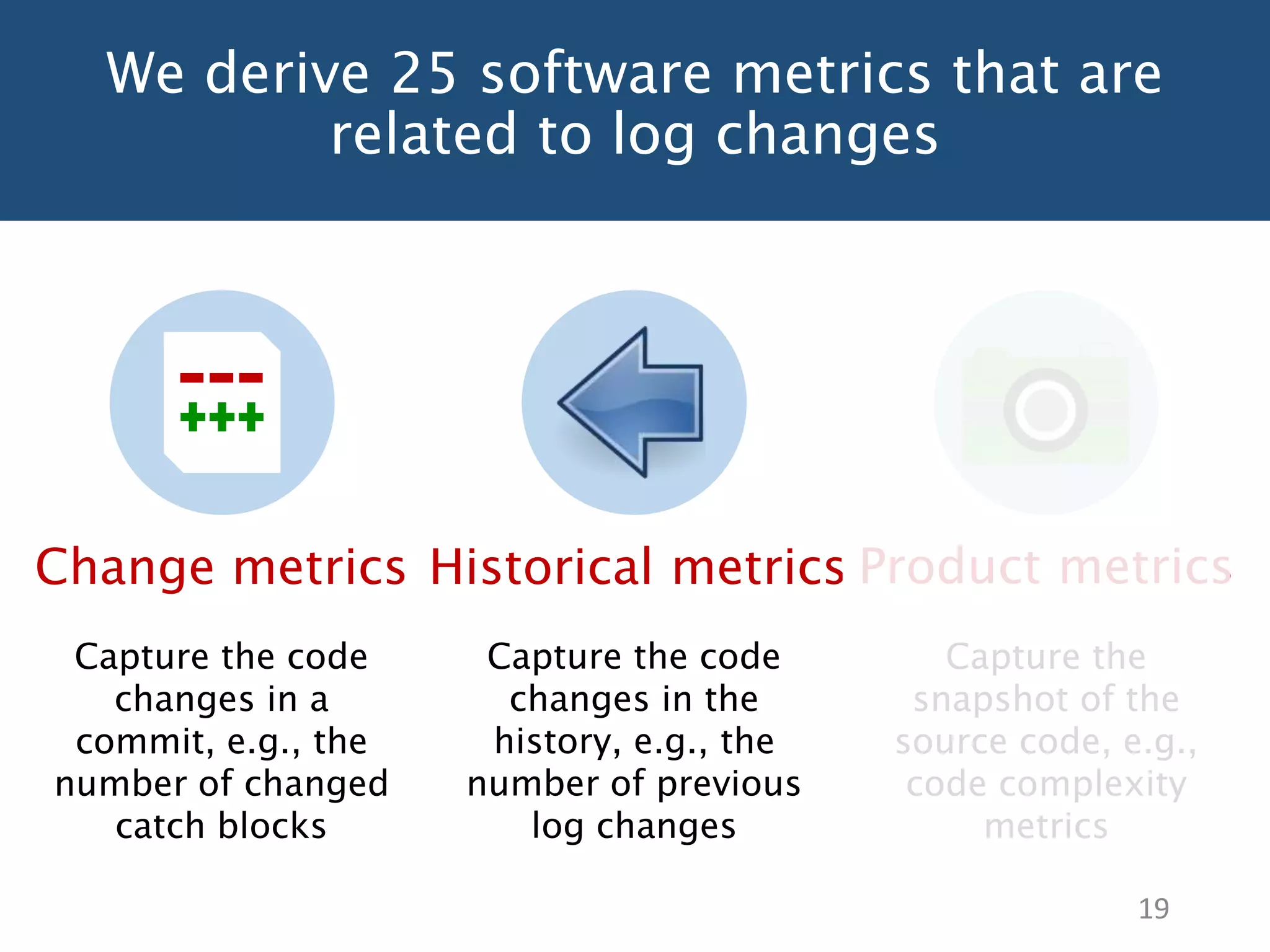
We derive 25 software metrics that are
related to log changes
18
Change metrics
Capture the code
changes in a
commit, e.g., the
number of changed
catch blocks
Historical metrics
Capture the code
changes in the
history, e.g., the
number of previous
log changes
Product metrics
Capture the
snapshot of the
source code, e.g.,
code complexity
metrics
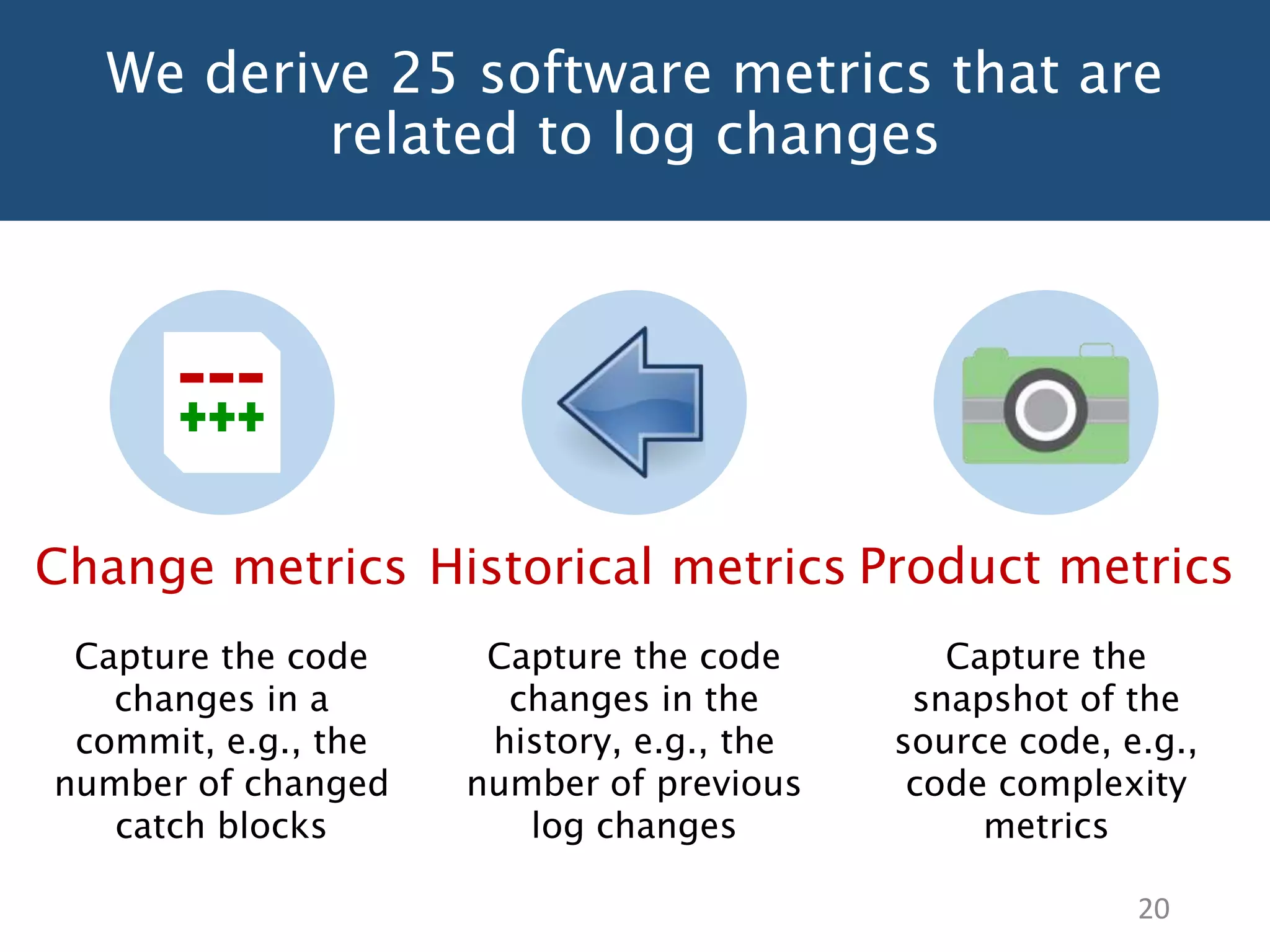
We derive 25 software metrics that are
related to log changes
19
Change metrics
Capture the code
changes in a
commit, e.g., the
number of changed
catch blocks
Historical metrics
Capture the code
changes in the
history, e.g., the
number of previous
log changes
Product metrics
Capture the
snapshot of the
source code, e.g.,
code complexity
metrics
We derive 25 software metrics that are
related to log changes
20
Change metrics
Capture the code
changes in a
commit, e.g., the
number of changed
catch blocks
Historical metrics
Capture the code
changes in the
history, e.g., the
number of previous
log changes
Product metrics
Capture the
snapshot of the
source code, e.g.,
code complexity
metrics
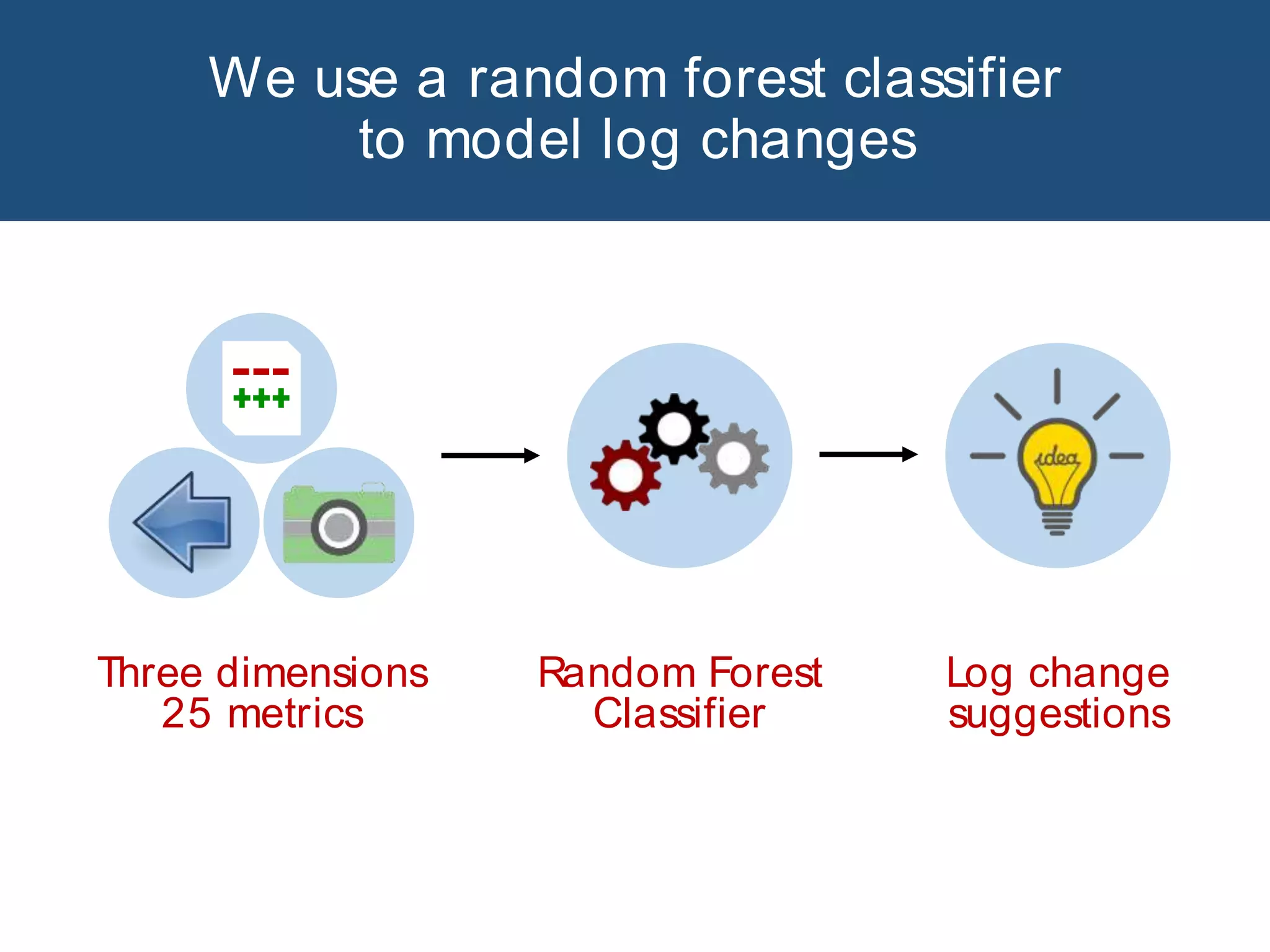
We use these software metrics as
explanatory variables for log changes
21
Three
dimensions
25 metrics
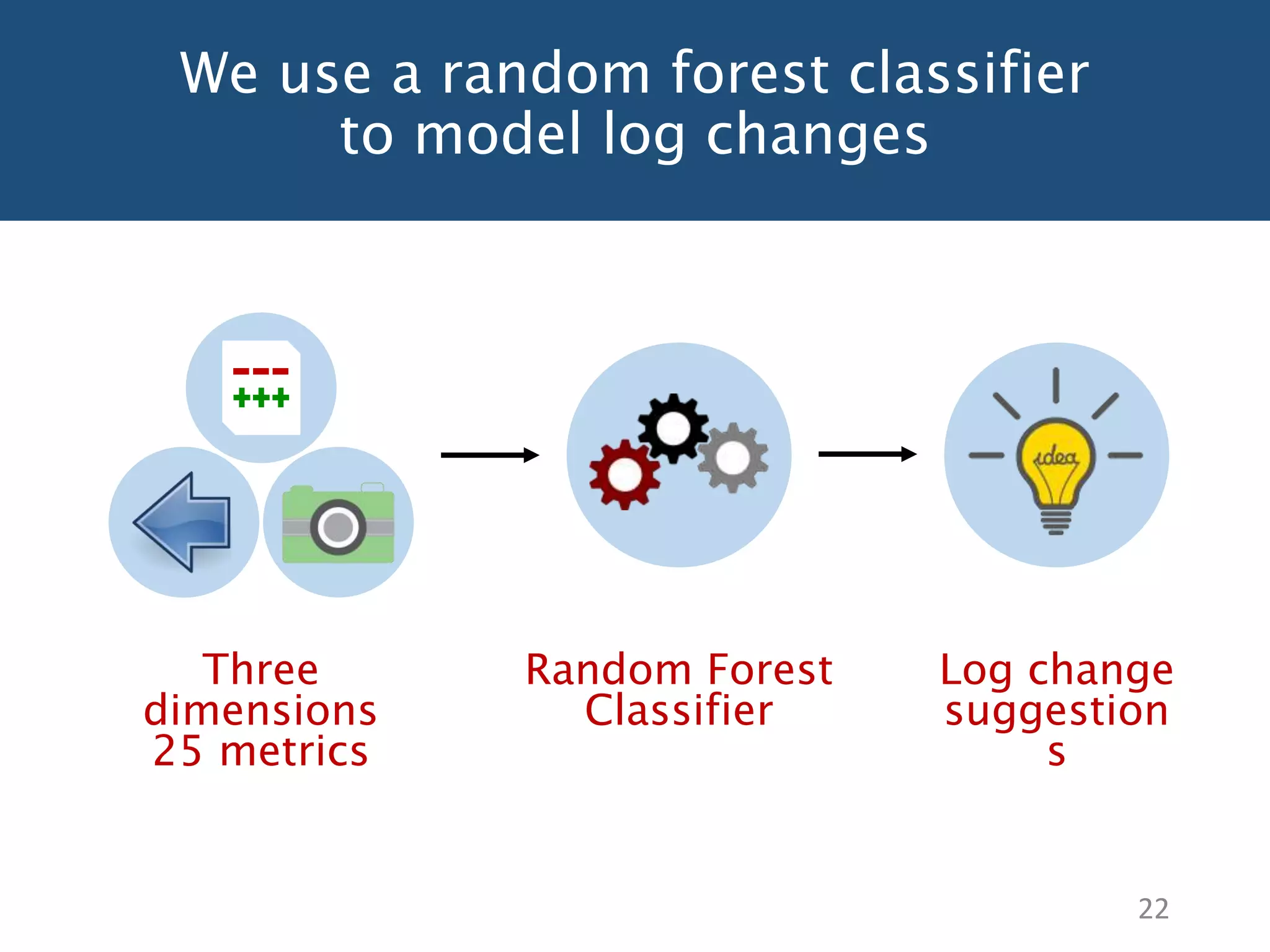
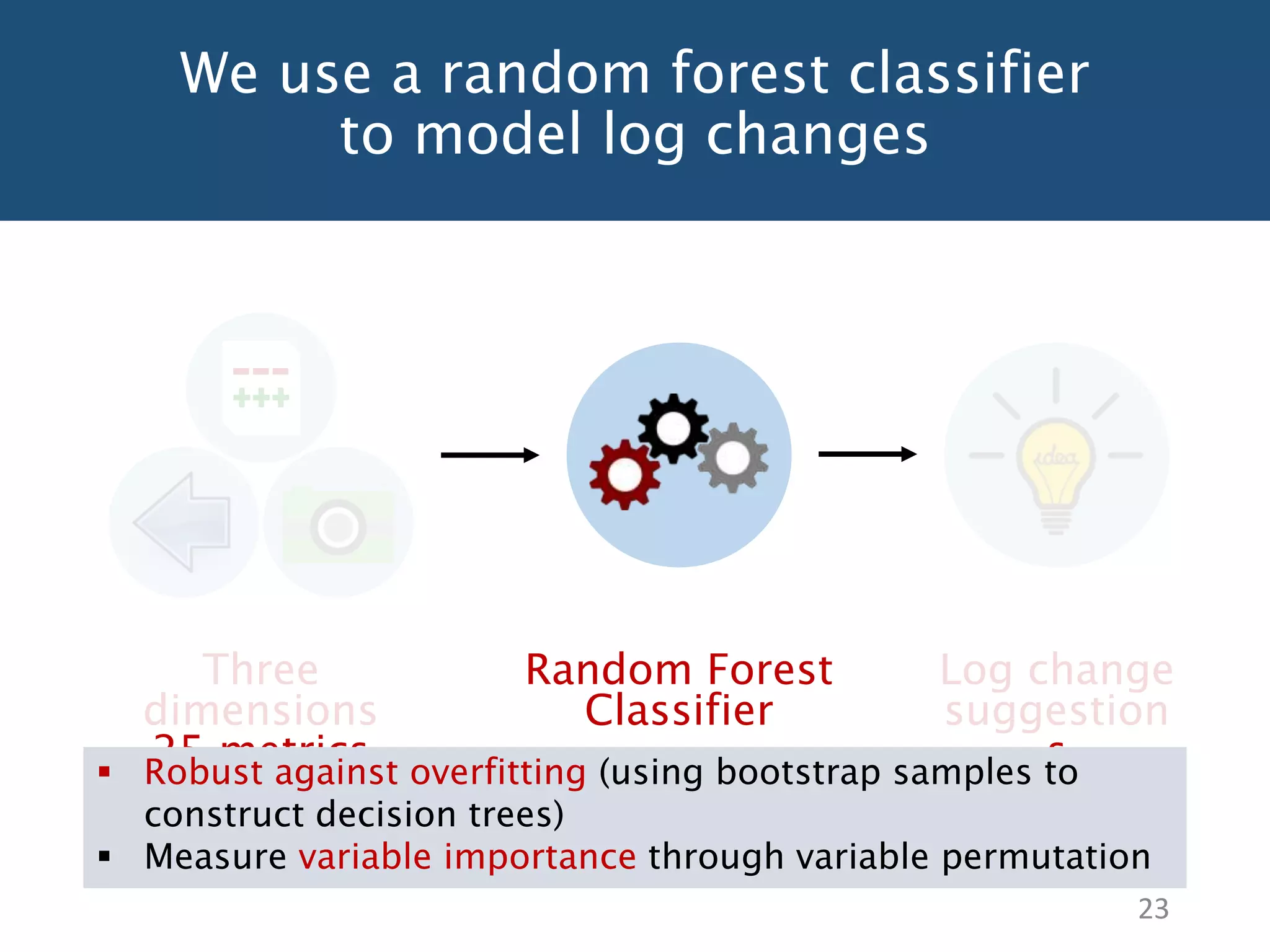
We use a random forest classifier
to model log changes
22
Random Forest
Classifier
Log change
suggestion
s
Three
dimensions
25 metrics
We use a random forest classifier
to model log changes
23
Random Forest
Classifier
Log change
suggestion
s
Three
dimensions
25 metrics Robust against overfitting (using bootstrap samples to
construct decision trees)
 Measure variable importance through variable permutation
Our models can effectively suggest
whether a log change is needed
24
0.84
0.91
0.86 0.88
0.4
0.5
0.6
0.7
0.8
0.9
1
Random
guess
AUC
The performance (AUC) of a within-project
evaluation
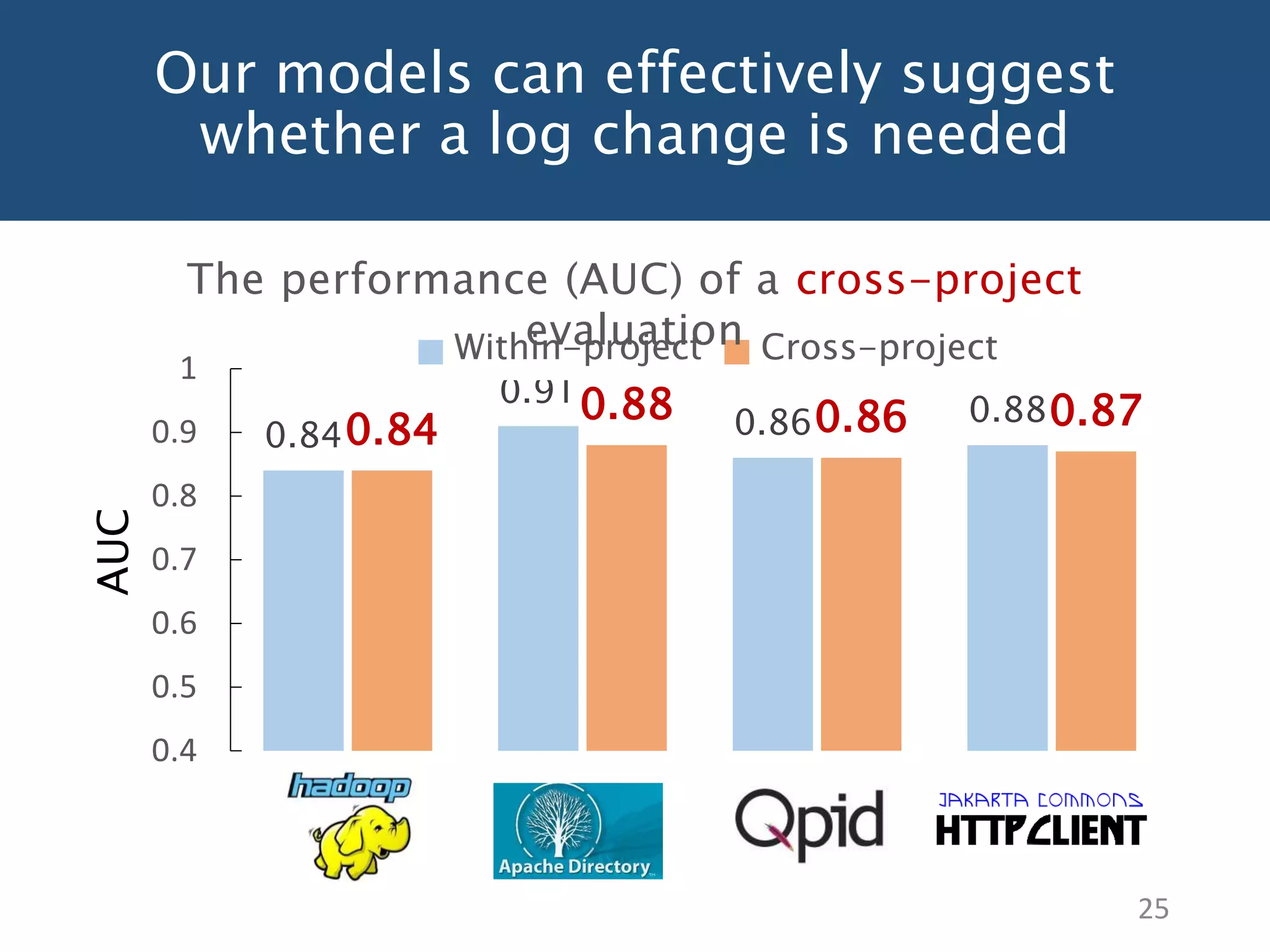
Our models can effectively suggest
whether a log change is needed
25
0.84
0.91
0.86 0.88
0.84
0.88 0.86 0.87
0.4
0.5
0.6
0.7
0.8
0.9
1
Within-project Cross-project
AUC
The performance (AUC) of a cross-project
evaluation
Towards just-in-time suggestions for
log changes
26
RQ1. What are the reasons for changing
logging statements?
RQ2. How well can we provide just-in-
time log change suggestions?
RQ3. What are the influential factors
that explain log changes?
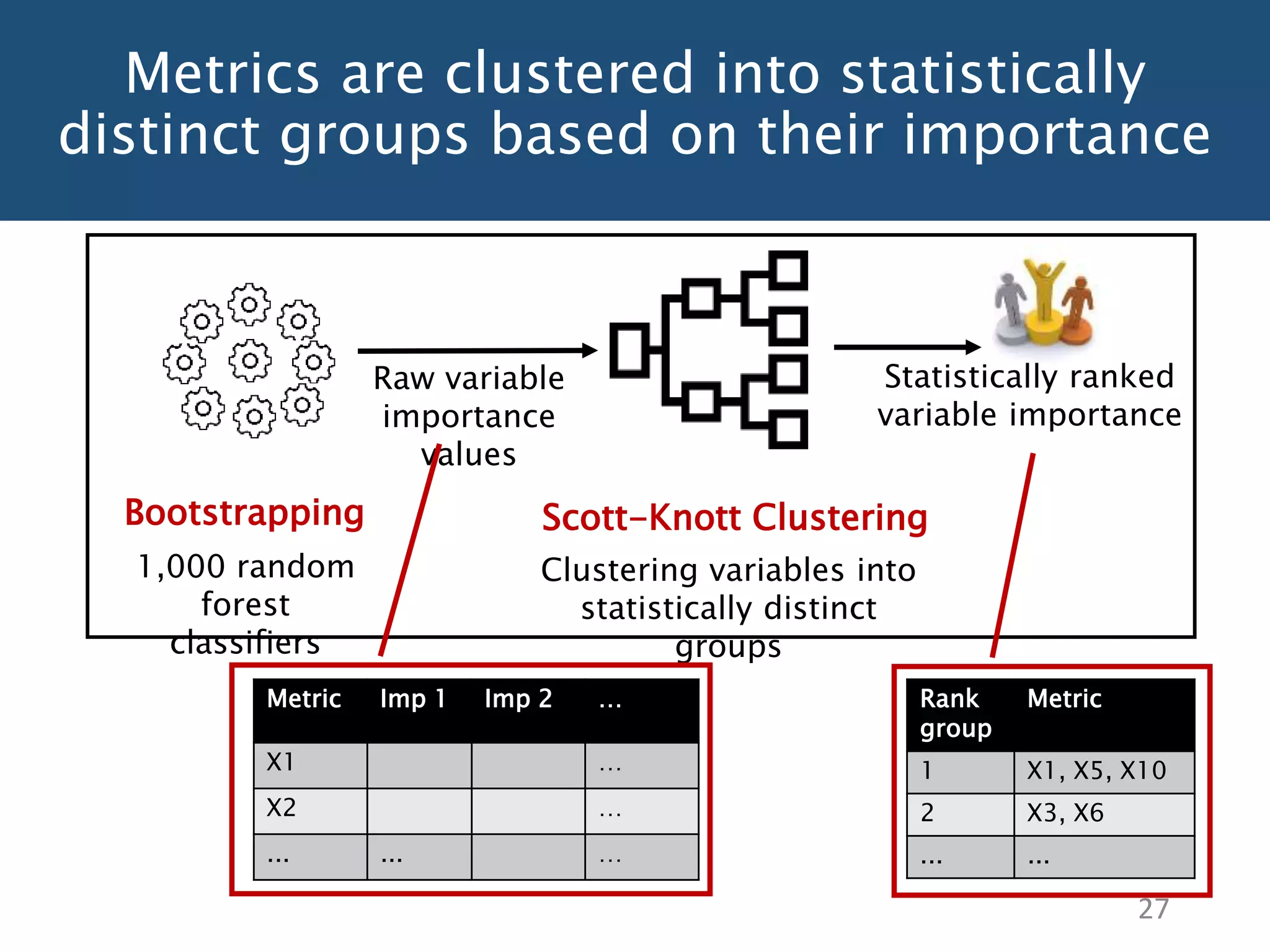
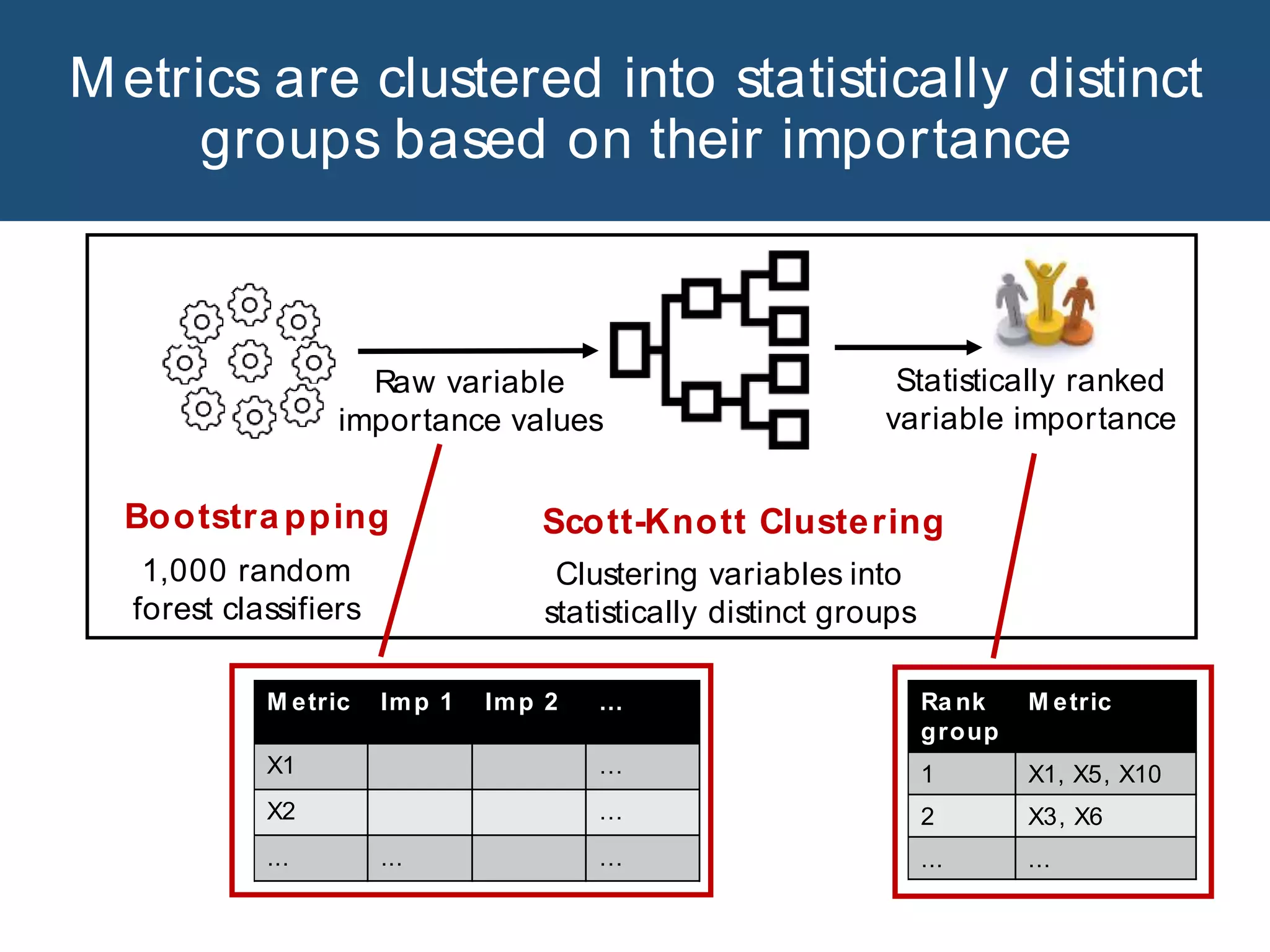
Metrics are clustered into statistically
distinct groups based on their importance
27
1,000 random
forest
classifiers
Scott-Knott ClusteringBootstrapping
Statistically ranked
variable importance
Raw variable
importance
values
Clustering variables into
statistically distinct
groups
Metric Imp 1 Imp 2 …
X1 …
X2 …
... ... …
Rank
group
Metric
1 X1, X5, X10
2 X3, X6
... ...
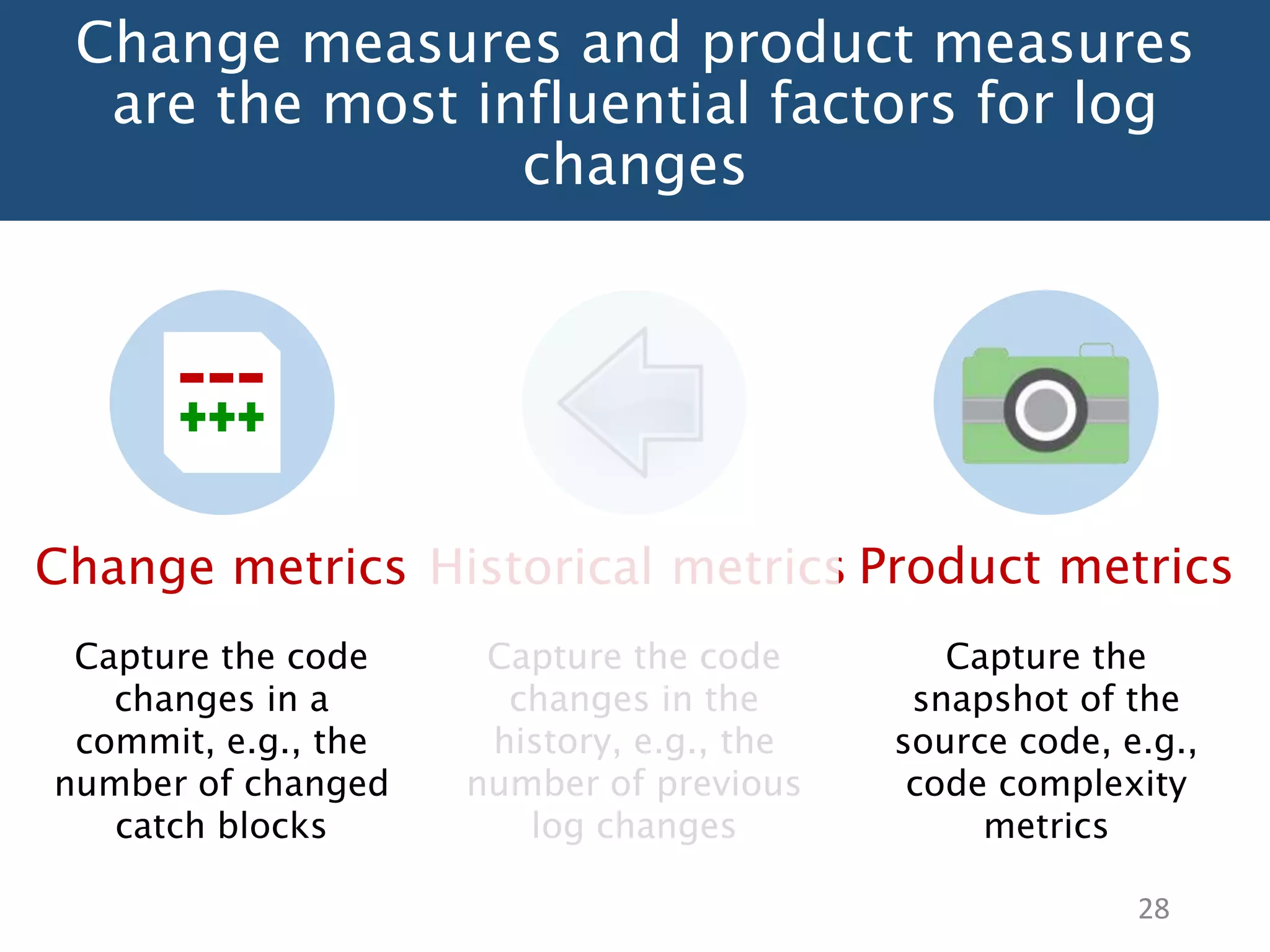
Change measures and product measures
are the most influential factors for log
changes
28
Change metrics
Capture the code
changes in a
commit, e.g., the
number of changed
catch blocks
Historical metrics
Capture the code
changes in the
history, e.g., the
number of previous
log changes
Product metrics
Capture the
snapshot of the
source code, e.g.,
code complexity
metrics
Log analytics
tools
System
issues
Log
collection
Release
Make
logging
decisions
Produce at run-time
RegEx
[^…]
Logger.error()
Making good logging decisions is critical for
failure diagnosis
Logs are usually the only resource
for debugging field failures
Log analytics
tools
System
issues
Log
collection
Release
Make
logging
decisions
Produce at run-time
RegEx
[^…]
Logger.error()
Making good logging decisions is critical for
failure diagnosis
Logs are usually the only resource
for debugging field failures
30
We find 20 reasons for log changes across
four categories
68%
17% 10% 5%0%
10%
20%
30%
40%
50%
60%
70%
80%
§ Changing a try-catch block
§ Changing a conditional (if/ switch) branch
§ …
Percentage
Block
change
Log
improvement
Dependence-
driven change
Logging
issue
Log analytics
tools
System
issues
Log
collection
Release
Make
logging
decisions
Produce at run-time
RegEx
[^…]
Logger.error()
Making good logging decisions is critical for
failure diagnosis
Logs are usually the only resource
for debugging field failures
32
We find 20 reasons for log changes across
four categories
68%
17% 10% 5%0%
10%
20%
30%
40%
50%
60%
70%
80%
§ Changing a try-catch block
§ Changing a conditional (if/ switch) branch
§ …
Percentage
Block
change
Log
improvement
Dependence-
driven change
Logging
issue
We use a random forest classifier
to model log changes
Random Forest
Classifier
Log change
suggestions
Three dimensions
25 metrics
Log analytics
tools
System
issues
Log
collection
Release
Make
logging
decisions
Produce at run-time
RegEx
[^…]
Logger.error()
Making good logging decisions is critical for
failure diagnosis
Logs are usually the only resource
for debugging field failures
34
We find 20 reasons for log changes across
four categories
68%
17% 10% 5%0%
10%
20%
30%
40%
50%
60%
70%
80%
§ Changing a try-catch block
§ Changing a conditional (if/ switch) branch
§ …
Percentage
Block
change
Log
improvement
Dependence-
driven change
Logging
issue
We use a random forest classifier
to model log changes
Random Forest
Classifier
Log change
suggestions
Three dimensions
25 metrics
Metrics are clustered into statistically distinct
groups based on their importance
1,000 random
forest classifiers
Scott-Knott ClusteringBootstrapping
Statistically ranked
variable importance
Raw variable
importance values
Clustering variables into
statistically distinct groups
M etric Imp 1 Imp 2 …
X1 …
X2 …
... ... …
Ra nk
group
M etric
1 X1, X5, X10
2 X3, X6
... ...
Log analytics
tools
System
issues
Log
collection
Release
Make
logging
decisions
Produce at run-time
RegEx
[^…]
Logger.error()
Making good logging decisions is critical for
failure diagnosis
Logs are usually the only resource
for debugging field failures
36
We find 20 reasons for log changes across
four categories
68%
17% 10% 5%0%
10%
20%
30%
40%
50%
60%
70%
80%
§ Changing a try-catch block
§ Changing a conditional (if/ switch) branch
§ …
Percentage
Block
change
Log
improvement
Dependence-
driven change
Logging
issue
We use a random forest classifier
to model log changes
Random Forest
Classifier
Log change
suggestions
Three dimensions
25 metrics
Metrics are clustered into statistically distinct
groups based on their importance
1,000 random
forest classifiers
Scott-Knott ClusteringBootstrapping
Statistically ranked
variable importance
Raw variable
importance values
Clustering variables into
statistically distinct groups
M etric Imp 1 Imp 2 …
X1 …
X2 …
... ... …
Ra nk
group
M etric
1 X1, X5, X10
2 X3, X6
... ...
Log analytics
tools
System
issues
Log
collection
Release
Make
logging
decisions
Produce at run-time
RegEx
[^…]
Logger.error()
Making good logging decisions is critical for
failure diagnosis
Logs are usually the only resource
for debugging field failures
37
We find 20 reasons for log changes across
four categories
68%
17% 10% 5%0%
10%
20%
30%
40%
50%
60%
70%
80%
§ Changing a try-catch block
§ Changing a conditional (if/ switch) branch
§ …
Percentage
Block
change
Log
improvement
Dependence-
driven change
Logging
issue
We use a random forest classifier
to model log changes
Random Forest
Classifier
Log change
suggestions
Three dimensions
25 metrics
Metrics are clustered into statistically distinct
groups based on their importance
1,000 random
forest classifiers
Scott-Knott ClusteringBootstrapping
Statistically ranked
variable importance
Raw variable
importance values
Clustering variables into
statistically distinct groups
M etric Imp 1 Imp 2 …
X1 …
X2 …
... ... …
Ra nk
group
M etric
1 X1, X5, X10
2 X3, X6
... ...
http://hengli.org
hengli@cs.queensu.ca

Towards Just-in-Time Suggestions for Log Changes

  • 1.
    Towards Just-in-Time Suggestions for LogChanges Journal-first Presentation | Empirical Software Engineering Heng Li Weiyi Shang Ying Zou Ahmed E. Hassan
  • 2.
  • 3.
    3 Log analytics tools System issues Log collection Release Make logging decisions Produce atrun-time RegE x [^…] Logger.error() Logs are usually the only resource for debugging field failures
  • 4.
    4 Log analytics tools System issues Log collection Release Make logging decisions Produce atrun-time RegE x [^…] Logger.error() Making good logging decisions is critical for failure diagnosis Logs are usually the only resource for debugging field failures
  • 5.
    Missing an importantlog can significantly increase the difficulty of failure diagnosis 5 Missing an exception logging causes an error being swallowed
  • 6.
    Logging excessively isnot an optimal solution 6 Large log files Hard to find real errors Hiding important information
  • 7.
    Failing to updatelogging statements when changing the code 7 Source code only checks one invalid item, while log says all invalid items are checked
  • 8.
    We want toprovide logging suggestions when developers make code changes 8 Code changes Do we need to make log changes?
  • 9.
    Towards just-in-time suggestionsfor log changes 9 RQ1. What are the reasons for changing logging statements? RQ2. How well can we provide just-in- time log change suggestions? RQ3. What are the influential factors that explain log changes?
  • 10.
    Four case studysystems 10 Over 2 M lines of code Over 13 K logging statements Over 40 K Commits 23% - 30% commits involve log changes
  • 11.
    Towards just-in-time suggestionsfor log changes 11 RQ1. What are the reasons for changing logging statements? RQ2. How well can we provide just-in- time log change suggestions? RQ3. What are the influential factors that explain log changes?
  • 12.
    We manually codedthe reasons for log changes Random sampling of 380 log changes out of 32K log changes 12 Manual examined code changes, commit messages, and issue reports Open coding approach
  • 13.
    We find 20reasons for log changes across four categories 68% 17% 10% 5%0% 10% 20% 30% 40% 50% 60% 70% 80% 13  Changing a try-catch block  Changing a conditional (if/switch) branch  … Percentage Block change Log improvemen t Dependence -driven change Logging issue
  • 14.
    We find 20reasons for log changes across four categories 14  Improving debugging capability  Improving readability  … 68% 17% 10% 5%0% 10% 20% 30% 40% 50% 60% 70% 80% Percentage Block change Log improvemen t Dependence -driven change Logging issue
  • 15.
    We find 20reasons for log changes across four categories 15  Logger change  Variable change  … 68% 17% 10% 5%0% 10% 20% 30% 40% 50% 60% 70% 80% Percentage Block change Log improvemen t Dependence -driven change Logging issue
  • 16.
    We find 20reasons for log changes across four categories 16  Inappropriate log level  Inappropriate log text  … 68% 17% 10% 5%0% 10% 20% 30% 40% 50% 60% 70% 80% Percentage Block change Log improvemen t Dependence -driven change Logging issue
  • 17.
    Towards just-in-time suggestionsfor log changes 17 RQ1. What are the reasons for changing logging statements? RQ2. How well can we provide just-in- time log change suggestions? RQ3. What are the influential factors that explain log changes?
  • 18.
    We derive 25software metrics that are related to log changes 18 Change metrics Capture the code changes in a commit, e.g., the number of changed catch blocks Historical metrics Capture the code changes in the history, e.g., the number of previous log changes Product metrics Capture the snapshot of the source code, e.g., code complexity metrics
  • 19.
    We derive 25software metrics that are related to log changes 19 Change metrics Capture the code changes in a commit, e.g., the number of changed catch blocks Historical metrics Capture the code changes in the history, e.g., the number of previous log changes Product metrics Capture the snapshot of the source code, e.g., code complexity metrics
  • 20.
    We derive 25software metrics that are related to log changes 20 Change metrics Capture the code changes in a commit, e.g., the number of changed catch blocks Historical metrics Capture the code changes in the history, e.g., the number of previous log changes Product metrics Capture the snapshot of the source code, e.g., code complexity metrics
  • 21.
    We use thesesoftware metrics as explanatory variables for log changes 21 Three dimensions 25 metrics
  • 22.
    We use arandom forest classifier to model log changes 22 Random Forest Classifier Log change suggestion s Three dimensions 25 metrics
  • 23.
    We use arandom forest classifier to model log changes 23 Random Forest Classifier Log change suggestion s Three dimensions 25 metrics Robust against overfitting (using bootstrap samples to construct decision trees)  Measure variable importance through variable permutation
  • 24.
    Our models caneffectively suggest whether a log change is needed 24 0.84 0.91 0.86 0.88 0.4 0.5 0.6 0.7 0.8 0.9 1 Random guess AUC The performance (AUC) of a within-project evaluation
  • 25.
    Our models caneffectively suggest whether a log change is needed 25 0.84 0.91 0.86 0.88 0.84 0.88 0.86 0.87 0.4 0.5 0.6 0.7 0.8 0.9 1 Within-project Cross-project AUC The performance (AUC) of a cross-project evaluation
  • 26.
    Towards just-in-time suggestionsfor log changes 26 RQ1. What are the reasons for changing logging statements? RQ2. How well can we provide just-in- time log change suggestions? RQ3. What are the influential factors that explain log changes?
  • 27.
    Metrics are clusteredinto statistically distinct groups based on their importance 27 1,000 random forest classifiers Scott-Knott ClusteringBootstrapping Statistically ranked variable importance Raw variable importance values Clustering variables into statistically distinct groups Metric Imp 1 Imp 2 … X1 … X2 … ... ... … Rank group Metric 1 X1, X5, X10 2 X3, X6 ... ...
  • 28.
    Change measures andproduct measures are the most influential factors for log changes 28 Change metrics Capture the code changes in a commit, e.g., the number of changed catch blocks Historical metrics Capture the code changes in the history, e.g., the number of previous log changes Product metrics Capture the snapshot of the source code, e.g., code complexity metrics
  • 29.
    Log analytics tools System issues Log collection Release Make logging decisions Produce atrun-time RegEx [^…] Logger.error() Making good logging decisions is critical for failure diagnosis Logs are usually the only resource for debugging field failures
  • 30.
    Log analytics tools System issues Log collection Release Make logging decisions Produce atrun-time RegEx [^…] Logger.error() Making good logging decisions is critical for failure diagnosis Logs are usually the only resource for debugging field failures 30
  • 31.
    We find 20reasons for log changes across four categories 68% 17% 10% 5%0% 10% 20% 30% 40% 50% 60% 70% 80% § Changing a try-catch block § Changing a conditional (if/ switch) branch § … Percentage Block change Log improvement Dependence- driven change Logging issue
  • 32.
    Log analytics tools System issues Log collection Release Make logging decisions Produce atrun-time RegEx [^…] Logger.error() Making good logging decisions is critical for failure diagnosis Logs are usually the only resource for debugging field failures 32 We find 20 reasons for log changes across four categories 68% 17% 10% 5%0% 10% 20% 30% 40% 50% 60% 70% 80% § Changing a try-catch block § Changing a conditional (if/ switch) branch § … Percentage Block change Log improvement Dependence- driven change Logging issue
  • 33.
    We use arandom forest classifier to model log changes Random Forest Classifier Log change suggestions Three dimensions 25 metrics
  • 34.
    Log analytics tools System issues Log collection Release Make logging decisions Produce atrun-time RegEx [^…] Logger.error() Making good logging decisions is critical for failure diagnosis Logs are usually the only resource for debugging field failures 34 We find 20 reasons for log changes across four categories 68% 17% 10% 5%0% 10% 20% 30% 40% 50% 60% 70% 80% § Changing a try-catch block § Changing a conditional (if/ switch) branch § … Percentage Block change Log improvement Dependence- driven change Logging issue We use a random forest classifier to model log changes Random Forest Classifier Log change suggestions Three dimensions 25 metrics
  • 35.
    Metrics are clusteredinto statistically distinct groups based on their importance 1,000 random forest classifiers Scott-Knott ClusteringBootstrapping Statistically ranked variable importance Raw variable importance values Clustering variables into statistically distinct groups M etric Imp 1 Imp 2 … X1 … X2 … ... ... … Ra nk group M etric 1 X1, X5, X10 2 X3, X6 ... ...
  • 36.
    Log analytics tools System issues Log collection Release Make logging decisions Produce atrun-time RegEx [^…] Logger.error() Making good logging decisions is critical for failure diagnosis Logs are usually the only resource for debugging field failures 36 We find 20 reasons for log changes across four categories 68% 17% 10% 5%0% 10% 20% 30% 40% 50% 60% 70% 80% § Changing a try-catch block § Changing a conditional (if/ switch) branch § … Percentage Block change Log improvement Dependence- driven change Logging issue We use a random forest classifier to model log changes Random Forest Classifier Log change suggestions Three dimensions 25 metrics Metrics are clustered into statistically distinct groups based on their importance 1,000 random forest classifiers Scott-Knott ClusteringBootstrapping Statistically ranked variable importance Raw variable importance values Clustering variables into statistically distinct groups M etric Imp 1 Imp 2 … X1 … X2 … ... ... … Ra nk group M etric 1 X1, X5, X10 2 X3, X6 ... ...
  • 37.
    Log analytics tools System issues Log collection Release Make logging decisions Produce atrun-time RegEx [^…] Logger.error() Making good logging decisions is critical for failure diagnosis Logs are usually the only resource for debugging field failures 37 We find 20 reasons for log changes across four categories 68% 17% 10% 5%0% 10% 20% 30% 40% 50% 60% 70% 80% § Changing a try-catch block § Changing a conditional (if/ switch) branch § … Percentage Block change Log improvement Dependence- driven change Logging issue We use a random forest classifier to model log changes Random Forest Classifier Log change suggestions Three dimensions 25 metrics Metrics are clustered into statistically distinct groups based on their importance 1,000 random forest classifiers Scott-Knott ClusteringBootstrapping Statistically ranked variable importance Raw variable importance values Clustering variables into statistically distinct groups M etric Imp 1 Imp 2 … X1 … X2 … ... ... … Ra nk group M etric 1 X1, X5, X10 2 X3, X6 ... ... http://hengli.org hengli@cs.queensu.ca