A computer to understand
learning and learning to
understand a computer
Xavier Prat-Resina
Center for Learning Innovation
ROCHESTER
Outline
• Learning to understand a computer.
Programming in a degree in Health Sciences
– Web design, gamification and Physical Chemistry
• A computer to (try to) understand learning.
BoSCO
– Browsing: Comparing assignments, semesters
and courses
– Is Homework useful? The story of a futile search.
Finding SLO/SDO in metagrades
– Assess flipping the class: Avoid a control group
Learning to understand a
computer
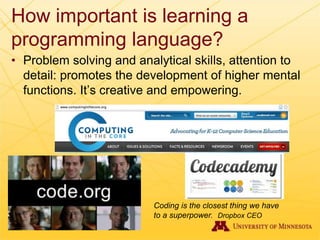
How important is learning a
programming language?
• Problem solving and analytical skills, attention to
detail: promotes the development of higher mental
functions. It’s creative and empowering.
Coding is the closest thing we have
to a superpower. Dropbox CEO
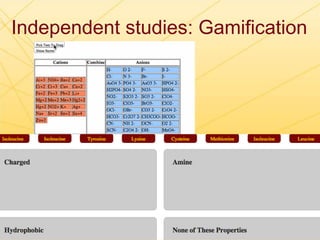
Independent studies: Gamification
How?
Weekly seminar of 2nd year students: A project-based course
Each students ends the semester with at least one
fully functional online activity
They take online tutorials at home. Bring questions to class
http://www.codecademy.com/
We only use basic action elements:
http://jqueryui.com/demos/
Click on buttons
Drag and drop
Brandon P. Eklund, Joseph W. Inhofer, Jason D. Greenwood, Omar
Mohamed, Peter L. Larsen, Xavier Prat-Resina
Students designing online games for active learning sessions in
chemistry courses. Proceedings of EDULEARN14 Conference. 7th-9th
July 2014, Barcelona, Spain
Independent studies: Gamification
The good:
A win-win situation:
An opportunity to include programming in any undergraduate major
We obtain game-like activities targeting specific needs for our courses
The bad:
It is hard to have students learn web design and develop in one
semester a platform that meets the quality to be used in class.
The ugly
Still, a very small portion of students are interested in programming
Independent studies:
Developing ChemEd X Data
http://chemdata.r.umn.edu
Brandon Eklund and Xavier Prat-Resina
ChemEd X Data: Exposing Students to Open Scientific Data for
Higher-Order Thinking and Self-Regulated Learning
J. Chem. Educ., 91(9), 1501-1504, 2014
Physical Chemistry with
“a touch” of python
• Physical Chemistry is a dreaded course for
any chemistry major because of its
mathematical and abstract approach.
• Thermodynamics is a fundamental science
applicable to many areas of science.
• Python helps us manipulate large amounts of
data
Xavier Prat-Resina
A new approach to a Physical Chemistry course: Using
simulations to learn thermodynamics.
In preparation
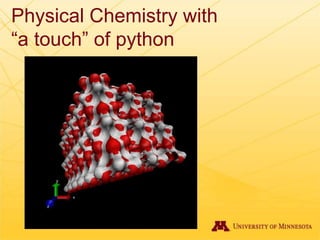
Physical Chemistry with
“a touch” of python
A computer to understand
learning
How can we measure learning?
• Understanding learning: What kind of
evidence do we need?
• Can we quantify the learning experience
– Validated tools? Control groups?
• Learning analytics: Stating the obvious,
spurious correlations or not enough evidence
How can we measure learning?
“We believe that the p < .05 bar is too easy
to pass and sometimes serves as an
excuse for lower quality research,”
BoSCO: A Browser of Student
and Course Objects
• BoSCO: hypothesis generator
– A radiography or the fingerprint of a curriculum
Robert L. Dunbar, Molly J. Dingel, Xavier Prat-Resina
Connecting Analytics and Curriculum Design: Process and Outcomes of
Building a Tool to Browse Data Relevant to Course Designers
J. of Learning Analytics. 3(1), 220-240, 2014
Histograms
• 2010-2014 General Chemistry I
• Filter: females vs males
Scatter plots
• Understanding student preparedness in
Chemistry
– ACT-math
– GPA
– Misconception chemistry and math survey
Correlation matrix
• Matrix: courses, semesters and assignments
– Wild search:
What tasks in the curriculum correlate?
SLICE: Showing Longitudinal Interactions of Course Events
• We use time as the criteria to bundle grades,
but in one assignment there may be different
questions that assess different skills.
• SLICE Chem Exams: qualitative (A),
quantitative(B) and transfer questions(C).
• Metagrades:
– Number of attempts in a quiz
– Grade in the first quiz attempt
– Time taken to take the quiz
– Chosen questions in a test
Does homework work?
• Is there any correlation between homework
performance and other assigments. Should
there be any?
X Y
Homework grade Final grade
# of attempts Exams grade
Grade at first attempt Type B questions
Time taken Type C questions
The fact that X and Y are not correlated does not mean that X is useless,
rather they address a different skill
A student report card?
• The final grade is a simplification of what the
course is about. A no correlation between
homework and final grade makes us think
that course performance should be a more
complete report rather than a number.
• Quantitative skills: % (Type B test questions)
• Follow through commitments: % (Homework and quizzes)
• Preparedness % (Grade at first attempt on quizzes)
• Commitment to one task and time efficient % (Time spent in quizzes)
• Transfer and critical thinking % (Type C and ambiguous questions)
SDO and SLO may be found in “sliced grades” or metagrades
rather than regular grades
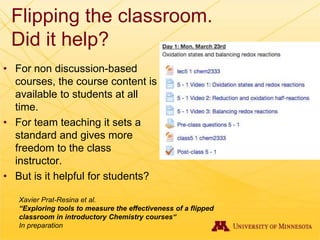
Flipping the classroom.
Did it help?
• For non discussion-based
courses, the course content is
available to students at all
time.
• For team teaching it sets a
standard and gives more
freedom to the class
instructor.
• But is it helpful for students?
Xavier Prat-Resina et al.
“Exploring tools to measure the effectiveness of a flipped
classroom in introductory Chemistry courses“
In preparation
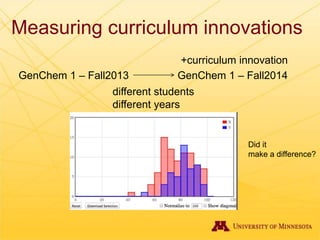
Measuring curriculum innovations
GenChem 1 – Fall2013 GenChem 1 – Fall2014
+curriculum innovation
different students
different years
Did it
make a difference?
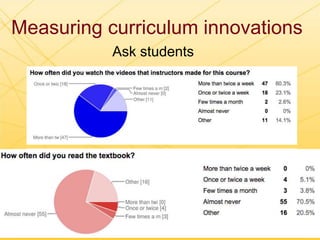
Measuring curriculum innovations
Ask students
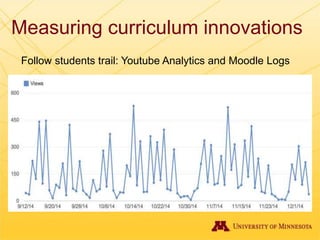
Measuring curriculum innovations
Follow students trail: Youtube Analytics and Moodle Logs
Measuring curriculum innovations
Follow students trail: Youtube Analytics and Moodle Logs
Student views vs student performance. (BoSCO)
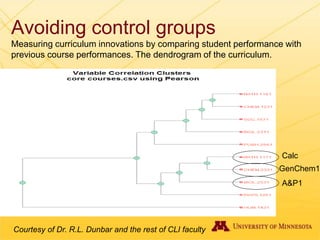
Avoiding control groups
Measuring curriculum innovations by comparing student performance with
previous course performances. The dendrogram of the curriculum.
Courtesy of Dr. R.L. Dunbar and the rest of CLI faculty
Calc
GenChem1
A&P1
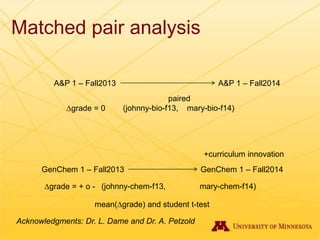
Matched pair analysis
GenChem 1 – Fall2013 GenChem 1 – Fall2014
+curriculum innovation
A&P 1 – Fall2013 A&P 1 – Fall2014
paired
(johnny-bio-f13, mary-bio-f14)Dgrade = 0
(johnny-chem-f13, mary-chem-f14)Dgrade = + o -
mean(Dgrade) and student t-test
Acknowledgments: Dr. L. Dame and Dr. A. Petzold
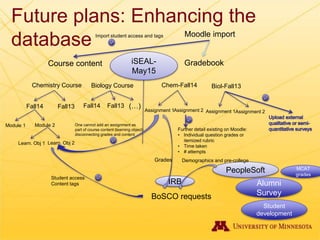
Future plans: Enhancing the
database
Course content
Chemistry Course Biology Course
Fall14 Fall13 Fall14 Fall13 (…)
Module 1 Module 2
Gradebook
Chem-Fall14 Biol-Fall13
Assignment 1Assignment 2 Assignment 1Assignment 2
Learn. Obj 1 Learn. Obj 2
Further detail existing on Moodle:
• Individual question grades or
itemized rubric
• Time taken
• # attempts
Moodle import
One cannot add an assignment as
part of course content (learning object)
disconnecting grades and content
IRB
BoSCO requests
Grades
PeopleSoft
iSEAL-
May15
Demographics and pre-college
Student access
Content tags
Import student access and tags
Alumni
Survey
Student
development
MCAT
grades
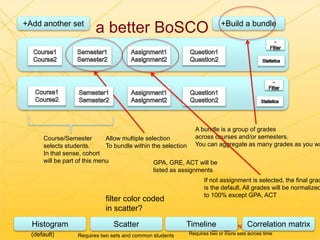
a better BoSCO+Add another set +Build a bundle
Histogram Timeline Correlation matrix
Allow multiple selection
To bundle within the selection
Scatter
A bundle is a group of grades
across courses and/or semesters.
You can aggregate as many grades as you wa
Course/Semester
selects students.
In that sense, cohort
will be part of this menu
filter color coded
in scatter?
GPA, GRE, ACT will be
listed as assignments
(default) Requires two sets and common students Requires two or more sets across time
If not assignment is selected, the final grad
is the default. All grades will be normalized
to 100% except GPA, ACT
Conclusions
• Learning to understand a computer:
Please, learn some programming
• A computer to understand learning
– BoSCO, an hypothesis generator.
– Some SDO and SLO may be found in
metagrades
– Using an integrated curriculum to measure
curriculum innovations.
Thank you

UMR - My ongoing projects with Technology - Rochester - 2015

  • 1.
    A computer tounderstand learning and learning to understand a computer Xavier Prat-Resina Center for Learning Innovation ROCHESTER
  • 2.
    Outline • Learning tounderstand a computer. Programming in a degree in Health Sciences – Web design, gamification and Physical Chemistry • A computer to (try to) understand learning. BoSCO – Browsing: Comparing assignments, semesters and courses – Is Homework useful? The story of a futile search. Finding SLO/SDO in metagrades – Assess flipping the class: Avoid a control group
  • 3.
  • 4.
    How important islearning a programming language? • Problem solving and analytical skills, attention to detail: promotes the development of higher mental functions. It’s creative and empowering. Coding is the closest thing we have to a superpower. Dropbox CEO
  • 5.
    Independent studies: Gamification How? Weeklyseminar of 2nd year students: A project-based course Each students ends the semester with at least one fully functional online activity They take online tutorials at home. Bring questions to class http://www.codecademy.com/ We only use basic action elements: http://jqueryui.com/demos/ Click on buttons Drag and drop Brandon P. Eklund, Joseph W. Inhofer, Jason D. Greenwood, Omar Mohamed, Peter L. Larsen, Xavier Prat-Resina Students designing online games for active learning sessions in chemistry courses. Proceedings of EDULEARN14 Conference. 7th-9th July 2014, Barcelona, Spain
  • 6.
  • 7.
    Independent studies: Gamification Thegood: A win-win situation: An opportunity to include programming in any undergraduate major We obtain game-like activities targeting specific needs for our courses The bad: It is hard to have students learn web design and develop in one semester a platform that meets the quality to be used in class. The ugly Still, a very small portion of students are interested in programming
  • 8.
    Independent studies: Developing ChemEdX Data http://chemdata.r.umn.edu Brandon Eklund and Xavier Prat-Resina ChemEd X Data: Exposing Students to Open Scientific Data for Higher-Order Thinking and Self-Regulated Learning J. Chem. Educ., 91(9), 1501-1504, 2014
  • 9.
    Physical Chemistry with “atouch” of python • Physical Chemistry is a dreaded course for any chemistry major because of its mathematical and abstract approach. • Thermodynamics is a fundamental science applicable to many areas of science. • Python helps us manipulate large amounts of data Xavier Prat-Resina A new approach to a Physical Chemistry course: Using simulations to learn thermodynamics. In preparation
  • 10.
    Physical Chemistry with “atouch” of python
  • 11.
    A computer tounderstand learning
  • 12.
    How can wemeasure learning? • Understanding learning: What kind of evidence do we need? • Can we quantify the learning experience – Validated tools? Control groups? • Learning analytics: Stating the obvious, spurious correlations or not enough evidence
  • 13.
    How can wemeasure learning? “We believe that the p < .05 bar is too easy to pass and sometimes serves as an excuse for lower quality research,”
  • 14.
    BoSCO: A Browserof Student and Course Objects • BoSCO: hypothesis generator – A radiography or the fingerprint of a curriculum Robert L. Dunbar, Molly J. Dingel, Xavier Prat-Resina Connecting Analytics and Curriculum Design: Process and Outcomes of Building a Tool to Browse Data Relevant to Course Designers J. of Learning Analytics. 3(1), 220-240, 2014
  • 15.
    Histograms • 2010-2014 GeneralChemistry I • Filter: females vs males
  • 16.
    Scatter plots • Understandingstudent preparedness in Chemistry – ACT-math – GPA – Misconception chemistry and math survey
  • 17.
    Correlation matrix • Matrix:courses, semesters and assignments – Wild search: What tasks in the curriculum correlate?
  • 18.
    SLICE: Showing LongitudinalInteractions of Course Events • We use time as the criteria to bundle grades, but in one assignment there may be different questions that assess different skills. • SLICE Chem Exams: qualitative (A), quantitative(B) and transfer questions(C). • Metagrades: – Number of attempts in a quiz – Grade in the first quiz attempt – Time taken to take the quiz – Chosen questions in a test
  • 19.
    Does homework work? •Is there any correlation between homework performance and other assigments. Should there be any? X Y Homework grade Final grade # of attempts Exams grade Grade at first attempt Type B questions Time taken Type C questions The fact that X and Y are not correlated does not mean that X is useless, rather they address a different skill
  • 20.
    A student reportcard? • The final grade is a simplification of what the course is about. A no correlation between homework and final grade makes us think that course performance should be a more complete report rather than a number. • Quantitative skills: % (Type B test questions) • Follow through commitments: % (Homework and quizzes) • Preparedness % (Grade at first attempt on quizzes) • Commitment to one task and time efficient % (Time spent in quizzes) • Transfer and critical thinking % (Type C and ambiguous questions) SDO and SLO may be found in “sliced grades” or metagrades rather than regular grades
  • 21.
    Flipping the classroom. Didit help? • For non discussion-based courses, the course content is available to students at all time. • For team teaching it sets a standard and gives more freedom to the class instructor. • But is it helpful for students? Xavier Prat-Resina et al. “Exploring tools to measure the effectiveness of a flipped classroom in introductory Chemistry courses“ In preparation
  • 22.
    Measuring curriculum innovations GenChem1 – Fall2013 GenChem 1 – Fall2014 +curriculum innovation different students different years Did it make a difference?
  • 23.
  • 24.
    Measuring curriculum innovations Followstudents trail: Youtube Analytics and Moodle Logs
  • 25.
    Measuring curriculum innovations Followstudents trail: Youtube Analytics and Moodle Logs Student views vs student performance. (BoSCO)
  • 26.
    Avoiding control groups Measuringcurriculum innovations by comparing student performance with previous course performances. The dendrogram of the curriculum. Courtesy of Dr. R.L. Dunbar and the rest of CLI faculty Calc GenChem1 A&P1
  • 27.
    Matched pair analysis GenChem1 – Fall2013 GenChem 1 – Fall2014 +curriculum innovation A&P 1 – Fall2013 A&P 1 – Fall2014 paired (johnny-bio-f13, mary-bio-f14)Dgrade = 0 (johnny-chem-f13, mary-chem-f14)Dgrade = + o - mean(Dgrade) and student t-test Acknowledgments: Dr. L. Dame and Dr. A. Petzold
  • 28.
    Future plans: Enhancingthe database Course content Chemistry Course Biology Course Fall14 Fall13 Fall14 Fall13 (…) Module 1 Module 2 Gradebook Chem-Fall14 Biol-Fall13 Assignment 1Assignment 2 Assignment 1Assignment 2 Learn. Obj 1 Learn. Obj 2 Further detail existing on Moodle: • Individual question grades or itemized rubric • Time taken • # attempts Moodle import One cannot add an assignment as part of course content (learning object) disconnecting grades and content IRB BoSCO requests Grades PeopleSoft iSEAL- May15 Demographics and pre-college Student access Content tags Import student access and tags Alumni Survey Student development MCAT grades
  • 29.
    a better BoSCO+Addanother set +Build a bundle Histogram Timeline Correlation matrix Allow multiple selection To bundle within the selection Scatter A bundle is a group of grades across courses and/or semesters. You can aggregate as many grades as you wa Course/Semester selects students. In that sense, cohort will be part of this menu filter color coded in scatter? GPA, GRE, ACT will be listed as assignments (default) Requires two sets and common students Requires two or more sets across time If not assignment is selected, the final grad is the default. All grades will be normalized to 100% except GPA, ACT
  • 30.
    Conclusions • Learning tounderstand a computer: Please, learn some programming • A computer to understand learning – BoSCO, an hypothesis generator. – Some SDO and SLO may be found in metagrades – Using an integrated curriculum to measure curriculum innovations.
  • 31.