Establishing Strategic Pay Plans Chapter 11 Part 4  |  Compensation
After studying this chapter, you should be able to: List the basic factors in determining pay rates. Explain in detail how to establish pay rates. Explain how to price managerial and professional jobs. Discuss competency-based pay and other current trends in compensation.
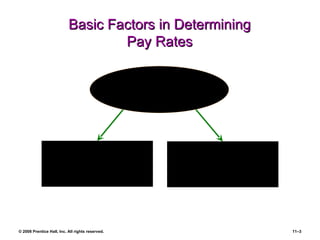
Basic Factors in Determining Pay Rates Direct Financial  Payments Indirect Financial  Payments Employee Compensation
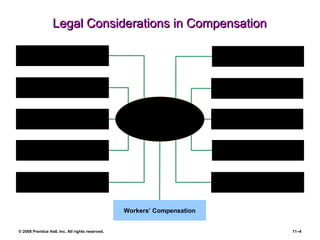
Legal Considerations in Compensation Employee  Compensation Equal Pay Act (1963) Employee Retirement Income Security Act (ERISA) Age Discrimination in Employment Act Americans with  Disabilities Act Davis-Bacon Act (1931) Walsh-Healey Public Contract Act (1936) Title VII of the 1964  Civil Rights Act Fair Labor Standards Act (1938) The Family and Medical Leave Act The Social Security Act of 1935 (as amended) Workers’ Compensation
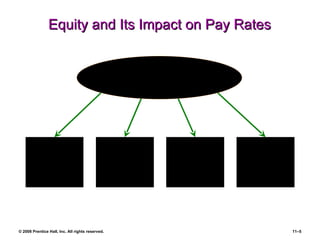
Equity and Its Impact on Pay Rates External Equity Procedural Equity Internal Equity Individual Equity Forms of Equity
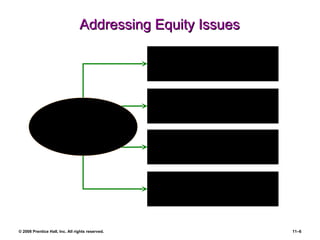
Addressing Equity Issues Salary Surveys Job Analysis and  Job Evaluation Performance Appraisal  and Incentive Pay Communications, Grievance Mechanisms, and Employees’ Participation  Methods to Address Equity Issues
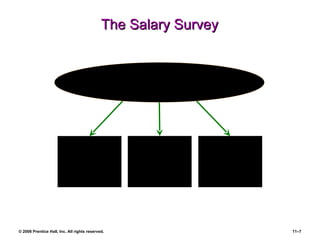
The Salary Survey To price benchmark jobs To make decisions about benefits Step 1. The Wage Survey: Uses for Salary Surveys To market-price wages for jobs
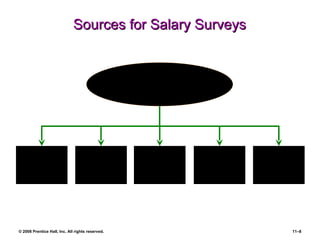
Sources for Salary Surveys Employer Self-Conducted Surveys Government Agencies Consulting Firms Sources of Wage and Salary Information Professional Associations The  Internet
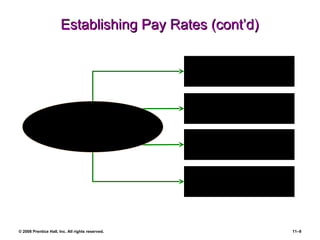
Establishing Pay Rates (cont’d) Skills Effort Responsibility Working Conditions Step 2. Job Evaluation: Identifying Compensable Factors
Establishing Pay Rates (cont’d) Ranking Factor Comparison Job Classification Methods for Evaluating Jobs Point  Method
Establishing Pay Rates (cont’d) Point Method Ranking Method Classification Methods Step 3. Group Similar Jobs into Pay Grades
Pricing Managerial and Professional Jobs Base  Pay Executive Benefits and Perks Short-term Incentives Long-Term Incentives Compensating Executives and Managers
Competency-Based Pay (cont’d) Support High-Performance Work Systems Support Performance Management Why Use Competency-Based Pay? Support Strategic Aims
Other Compensation Trends Broadbanding Consolidating salary grades and ranges into just a few wide levels or “bands,” each of which contains a relatively wide range of jobs and salary levels. Pro and Cons More flexibility in assigning workers to different job grades. Provides support for flatter hierarchies and teams. Promotes skills learning and mobility. Lack of permanence in job responsibilities can be unsettling to new employees.
K E Y  T E R M S employee compensation direct financial payments indirect financial payments Davis-Bacon Act (1931) Walsh-Healey Public Contract Act (1936) Title VII of the 1964 Civil Rights Act Fair Labor Standards Act (1938) Equal Pay Act (1963) Employee Retirement Income Security Act (ERISA) salary compression salary survey benchmark job job evaluation compensable factor ranking method job classification (or grading) method classes grades grade definition point method factor comparison method pay grade wage curve pay ranges competency-based pay competencies broadbanding comparable worth
Quantitative Job Evaluation Methods Appendix for Chapter 11 Part 4  |  Compensation
Quantitative Job Evaluation Methods Factor Comparison Job Evaluation Method Step 1. Obtain job information Step 2. Select key benchmark jobs Step 3. Rank key jobs by factor Step 4. Distribute wage rates by factors Step 5. Rank key jobs according to wages assigned to each factor Step 6. Compare the two sets of rankings to  screen out unusable key jobs Step 7. Construct the job-comparison scale Step 8. Use the job-comparison scale

Dessler 11

  • 1.
    Establishing Strategic PayPlans Chapter 11 Part 4 | Compensation
  • 2.
    After studying thischapter, you should be able to: List the basic factors in determining pay rates. Explain in detail how to establish pay rates. Explain how to price managerial and professional jobs. Discuss competency-based pay and other current trends in compensation.
  • 3.
    Basic Factors inDetermining Pay Rates Direct Financial Payments Indirect Financial Payments Employee Compensation
  • 4.
    Legal Considerations inCompensation Employee Compensation Equal Pay Act (1963) Employee Retirement Income Security Act (ERISA) Age Discrimination in Employment Act Americans with Disabilities Act Davis-Bacon Act (1931) Walsh-Healey Public Contract Act (1936) Title VII of the 1964 Civil Rights Act Fair Labor Standards Act (1938) The Family and Medical Leave Act The Social Security Act of 1935 (as amended) Workers’ Compensation
  • 5.
    Equity and ItsImpact on Pay Rates External Equity Procedural Equity Internal Equity Individual Equity Forms of Equity
  • 6.
    Addressing Equity IssuesSalary Surveys Job Analysis and Job Evaluation Performance Appraisal and Incentive Pay Communications, Grievance Mechanisms, and Employees’ Participation Methods to Address Equity Issues
  • 7.
    The Salary SurveyTo price benchmark jobs To make decisions about benefits Step 1. The Wage Survey: Uses for Salary Surveys To market-price wages for jobs
  • 8.
    Sources for SalarySurveys Employer Self-Conducted Surveys Government Agencies Consulting Firms Sources of Wage and Salary Information Professional Associations The Internet
  • 9.
    Establishing Pay Rates(cont’d) Skills Effort Responsibility Working Conditions Step 2. Job Evaluation: Identifying Compensable Factors
  • 10.
    Establishing Pay Rates(cont’d) Ranking Factor Comparison Job Classification Methods for Evaluating Jobs Point Method
  • 11.
    Establishing Pay Rates(cont’d) Point Method Ranking Method Classification Methods Step 3. Group Similar Jobs into Pay Grades
  • 12.
    Pricing Managerial andProfessional Jobs Base Pay Executive Benefits and Perks Short-term Incentives Long-Term Incentives Compensating Executives and Managers
  • 13.
    Competency-Based Pay (cont’d)Support High-Performance Work Systems Support Performance Management Why Use Competency-Based Pay? Support Strategic Aims
  • 14.
    Other Compensation TrendsBroadbanding Consolidating salary grades and ranges into just a few wide levels or “bands,” each of which contains a relatively wide range of jobs and salary levels. Pro and Cons More flexibility in assigning workers to different job grades. Provides support for flatter hierarchies and teams. Promotes skills learning and mobility. Lack of permanence in job responsibilities can be unsettling to new employees.
  • 15.
    K E Y T E R M S employee compensation direct financial payments indirect financial payments Davis-Bacon Act (1931) Walsh-Healey Public Contract Act (1936) Title VII of the 1964 Civil Rights Act Fair Labor Standards Act (1938) Equal Pay Act (1963) Employee Retirement Income Security Act (ERISA) salary compression salary survey benchmark job job evaluation compensable factor ranking method job classification (or grading) method classes grades grade definition point method factor comparison method pay grade wage curve pay ranges competency-based pay competencies broadbanding comparable worth
  • 16.
    Quantitative Job EvaluationMethods Appendix for Chapter 11 Part 4 | Compensation
  • 17.
    Quantitative Job EvaluationMethods Factor Comparison Job Evaluation Method Step 1. Obtain job information Step 2. Select key benchmark jobs Step 3. Rank key jobs by factor Step 4. Distribute wage rates by factors Step 5. Rank key jobs according to wages assigned to each factor Step 6. Compare the two sets of rankings to screen out unusable key jobs Step 7. Construct the job-comparison scale Step 8. Use the job-comparison scale