Content to be Covered -
ď‚— Introduction to Wages
ď‚— Concepts of Wages
ď‚— Theories of Wages
ď‚— Concept of Compensation
ď‚— Components of Compensation
ď‚— Factors affecting on Compensation
Introduction to Wages
 Wages – payment of compensation in return for work
done.
 Wages – Employer – perceives – as a cost of business
efforts.
 Wages – Employee – perceives – means for satisfying
their needs and maintain standard of living.
Definition of Wages
 According to Benham “Wages means the amount paid
to the labour for his services to the Employer”.
 According to P. M. Stohank “ Wages is that Labour’s
remuneration which creates the utility.”
Concepts of Wages
1) Money wages and Real wages
2) Minimum Wages
3) The Living Wages
4) Fair Wages
Wage Theories (Economic & Behavioural Theories)
Wage theories mainly divided into two parts:
A) Economic theory
B) Behavioral theory
Economic Theories of Wages
ď‚— SUBSISTENCE THEORY (Given by DAVID RICARDO in 1772-1823)
ď‚— THE SURPLUS VALUE THEORY (Given by KARL MARX in 1818-1883)
ď‚— THE WAGES FUND THEORY (Given by ADAM SMITH in 1723-1790)
ď‚— THE MARGINAL PRODUCTIVITY THEORY (Given by J.B.CLARCK)
ď‚— THE BARGAINING THEORY (Given by JOHN DAVIDESON)
ď‚— DEMAND AND SUPPLY THEORY (Given by MARSHALL)
ď‚— PURCHASING POWER THEORY (Given by PIGOUN)
ď‚— COMPARATIVE ADVANTAGE THEORY
Behavioural Theories of Wages
Behavioral theories are divided into three categories:-
ď‚— Content theories
ď‚— Process theories, and
ď‚— Contemporary theories
 A) CONTENT THEORIES –
ď‚— 1.HIERARCHY OF NEEDS
ď‚— 2.TWO FACTOR THEORY OF MOTIVATION
ď‚— 3.ERG THEORY
 B) PROCESS THEORIES –
ď‚— EXPECTANCY THEORY
 C) CONTEMPORARY THEORIES –
ď‚— 1. EQUITY THEORY
ď‚— 2. ATTRIBUTION THEORY
Introduction to Compensation
Compensation may be defined as money received
in the performance of work, plus the many kinds of
benefits and services that organizations provides to
their employees.
Compensation offered by an organization can
come both directly through base pay and variable pay
and, indirectly through benefits.
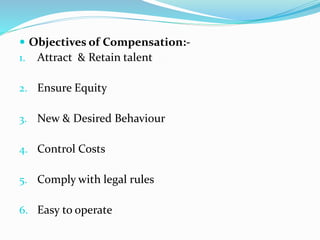
ď‚— Objectives of Compensation:-
1. Attract & Retain talent
2. Ensure Equity
3. New & Desired Behaviour
4. Control Costs
5. Comply with legal rules
6. Easy to operate
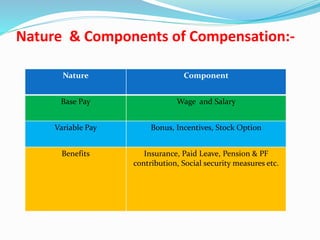
Nature & Components of Compensation:-
Nature Component
Base Pay Wage and Salary
Variable Pay Bonus, Incentives, Stock Option
Benefits Insurance, Paid Leave, Pension & PF
contribution, Social security measures etc.
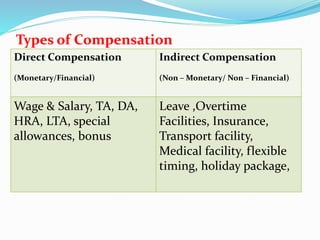
Types of Compensation
Direct Compensation
(Monetary/Financial)
Indirect Compensation
(Non – Monetary/ Non – Financial)
Wage & Salary, TA, DA,
HRA, LTA, special
allowances, bonus
Leave ,Overtime
Facilities, Insurance,
Transport facility,
Medical facility, flexible
timing, holiday package,
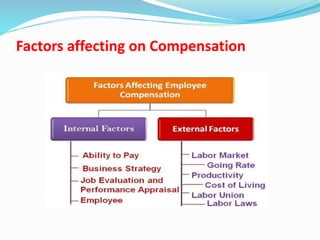
Factors affecting on Compensation
Reference Books
1) Personnel Management – Mamoria & Gankar
2) Modern HRM – Balyan & Balyan
3) Human Resource Management – K. Aswathappa
Compensation Management

Compensation Management

  • 2.
    Content to beCovered - ď‚— Introduction to Wages ď‚— Concepts of Wages ď‚— Theories of Wages ď‚— Concept of Compensation ď‚— Components of Compensation ď‚— Factors affecting on Compensation
  • 3.
    Introduction to Wages Wages – payment of compensation in return for work done.  Wages – Employer – perceives – as a cost of business efforts.  Wages – Employee – perceives – means for satisfying their needs and maintain standard of living.
  • 4.
    Definition of Wages According to Benham “Wages means the amount paid to the labour for his services to the Employer”.  According to P. M. Stohank “ Wages is that Labour’s remuneration which creates the utility.”
  • 5.
    Concepts of Wages 1)Money wages and Real wages 2) Minimum Wages 3) The Living Wages 4) Fair Wages
  • 6.
    Wage Theories (Economic& Behavioural Theories) Wage theories mainly divided into two parts: A) Economic theory B) Behavioral theory
  • 7.
    Economic Theories ofWages ď‚— SUBSISTENCE THEORY (Given by DAVID RICARDO in 1772-1823) ď‚— THE SURPLUS VALUE THEORY (Given by KARL MARX in 1818-1883) ď‚— THE WAGES FUND THEORY (Given by ADAM SMITH in 1723-1790) ď‚— THE MARGINAL PRODUCTIVITY THEORY (Given by J.B.CLARCK) ď‚— THE BARGAINING THEORY (Given by JOHN DAVIDESON) ď‚— DEMAND AND SUPPLY THEORY (Given by MARSHALL) ď‚— PURCHASING POWER THEORY (Given by PIGOUN) ď‚— COMPARATIVE ADVANTAGE THEORY
  • 8.
    Behavioural Theories ofWages Behavioral theories are divided into three categories:- ď‚— Content theories ď‚— Process theories, and ď‚— Contemporary theories
  • 9.
     A) CONTENTTHEORIES –  1.HIERARCHY OF NEEDS  2.TWO FACTOR THEORY OF MOTIVATION  3.ERG THEORY
  • 10.
     B) PROCESSTHEORIES –  EXPECTANCY THEORY  C) CONTEMPORARY THEORIES –  1. EQUITY THEORY  2. ATTRIBUTION THEORY
  • 11.
    Introduction to Compensation Compensationmay be defined as money received in the performance of work, plus the many kinds of benefits and services that organizations provides to their employees. Compensation offered by an organization can come both directly through base pay and variable pay and, indirectly through benefits.
  • 12.
    ď‚— Objectives ofCompensation:- 1. Attract & Retain talent 2. Ensure Equity 3. New & Desired Behaviour 4. Control Costs 5. Comply with legal rules 6. Easy to operate
  • 13.
    Nature & Componentsof Compensation:- Nature Component Base Pay Wage and Salary Variable Pay Bonus, Incentives, Stock Option Benefits Insurance, Paid Leave, Pension & PF contribution, Social security measures etc.
  • 14.
    Types of Compensation DirectCompensation (Monetary/Financial) Indirect Compensation (Non – Monetary/ Non – Financial) Wage & Salary, TA, DA, HRA, LTA, special allowances, bonus Leave ,Overtime Facilities, Insurance, Transport facility, Medical facility, flexible timing, holiday package,
  • 15.
  • 16.
    Reference Books 1) PersonnelManagement – Mamoria & Gankar 2) Modern HRM – Balyan & Balyan 3) Human Resource Management – K. Aswathappa