WASTE “ Elena Cuza”  School Iaşi  , Romania
STUDENTS sample:  208 subjects
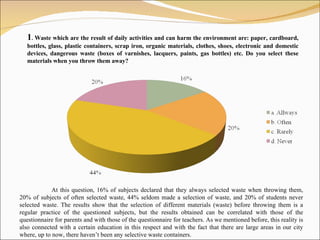
1 .  Waste which are the result of daily activities and can harm the environment are: paper, cardboard, bottles, glass, plastic containers, scrap iron, organic materials, clothes, shoes, electronic and domestic devices, dangerous waste (boxes of varnishes, lacquers, paints, gas bottles) etc. Do you select these materials when you throw them away? At this question,  16%  of subjects declared that they   always  select ed   waste when throwing  the m , 20%  of subjects of often selected waste , 44%  seldom made a selection of waste ,  and  20%  of students never selected waste .  The results show that the selection of different materials  ( waste )  before throwing them is a regular practice of the questioned subjects, but the results obtained can be correlated with those of the questionnaire for parents and with those of the questionnaire for teachers. As we mentioned before, this reality is also connected with a certain education in this respect and with the fact that there are large areas in our city where, up to now, there haven’t been any selective waste containers.
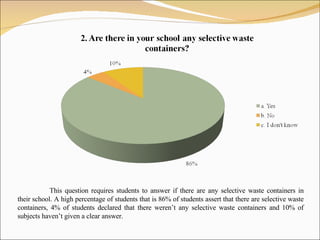
This question requires students to answer if there are any selective waste containers in their school.   A high percentage of students that is   86%  of students assert that there are selective waste containers,  4%  of students declared that there weren’t any selective waste containers and  10%  of subjects haven’t given a clear answer.
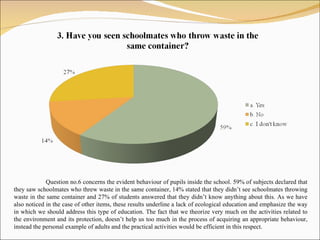
Question no. 6  concerns the evident behaviour of pupils inside the school.  59%  of subjects declared that they saw schoolmates who threw waste in the same container,  14%  stated that they didn’t see schoolmates throwing waste in the same container and  27%  of students answered that they didn’t know anything about this .  As we have also noticed in the case of other items, these results underline a lack of ecological education and emphasize the way in which we should address this type of education. The fact that we theorize very much on the activities related to the environment and its protection, doesn’t help us too much in the process of acquiring an appropriate behaviour, instead the personal example of adults and the practical activities would be efficient in this respect.
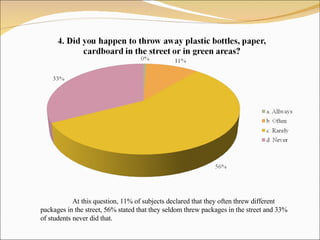
At this question,  11%  of subjects   declared that they often threw different packages in the street , 56%  stated that they seldom threw packages in the street and  33%  of students never  did  that .
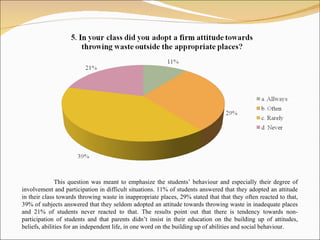
This question was meant to emphasize the   students’  behaviour and especially their  degree o f  involvement and participation in difficult situations.   11% of students answered that they adopted an attitude in their class towards throwing waste in inappropriate places, 29% stated that that they often reacted to that, 39% of subjects answered that they seldom adopted an attitude towards throwing waste in inadequate places and 21% of students never reacted to that. The results point out that there is tendency towards non-participation of students and that parents didn ’ t  insist  in their education  on  the  building up  of attitudes, beliefs, abilities for an independent life,  in one word on the building up of abilities and social behaviour.
TEACHERS sample:  34  subjects
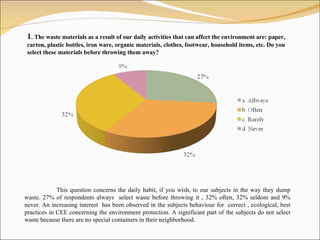
1 .  The waste materials as a result of our daily activities that can affect the environment are: paper, carton, plastic bottles, iron ware, organic materials, clothes, footwear, household items, etc. Do you select these materials before throwing them away? This question concerns the daily habit, if you wish, to our subjects in the way the y  dump  waste . 27% of respondents always  select   waste before throw ing it  , 32% often, 32%  seldom  and 9% never.  A n increasing interest  has been observed  in the subjects  behaviour for  correct , ecological,  best practices in CEE  concerning  the environment  protection . A significant  part of the  subjects  do  not select waste  because there are  no   special containers in their neighborhood.
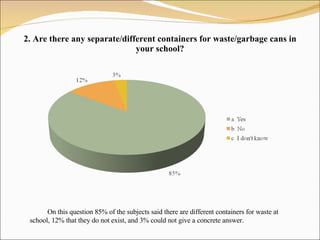
2 .  Are there any separate/different containers for waste/garbage cans in your school? On this question 85% of the subjects said the re  are different containers for waste  at school , 12% that  they  do not exist, and 3% could not give a concrete answer.
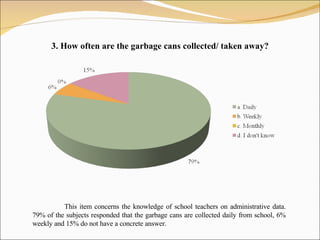
3 .  How often are the garbage cans collected/ taken away? This item concerns the knowledge of school teachers on administrative data. 79% of the subjects responded that the  garbage cans are collected  daily  from school , 6% weekly and 15% do not have a concrete answer.
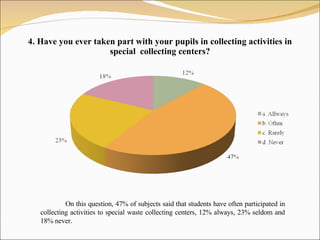
4 .  Have you ever taken part with your pupils in collecting activities in special  collecting centers? On this question, 47% of subjects said that students have  often  participated in  collecting  acti vities  to   special waste collecti ng  centers, 12% always, 23%  seldom  and 18% never.
PARENTS sample:  191  subjects
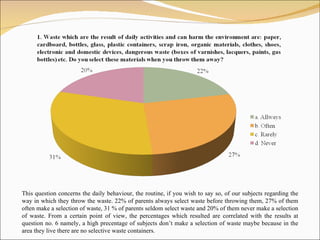
This question  concerns  the   daily behaviour, the routine, if you w ish  to say so, of our subjects regarding the way in which they throw the waste.  22%  of   parents always  select  waste before throwing  them ,  27%  of them often  make a selection of  waste , 31 %  of   parents seldom sel ec t waste and  20%  of them never  make a selection of waste. From a certain point of view, the percentages which resulted are correlated with the results  at  question no. 6 namely, a high precentage of subjects don ’t make a selection of waste maybe because in the area they live there are no selective waste containers.
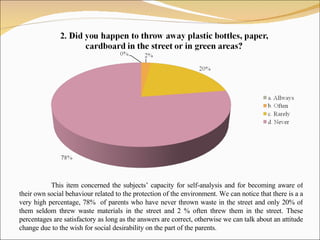
This item  concerned  the subjects’ capacity for self-analysis and for becoming aware of their own social behaviour related to the protection of the environment. We can notice that there is a a very high percentage,  78%  of parents  who  have never thrown waste in the street and only  20%  of them   seldom  threw waste materials  in the street and  2 %  often  threw them in the street .  These percentages are satisfactory as  long as  the answers  are  correct, otherwise we can talk about an attitude change due to the wish for social desirability on the part of the parents.
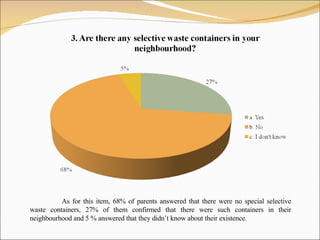
As for this item, 68% of parents answered that there were no special selective waste containers, 27% of them confirmed that there were such containers in their neighbourhood and 5 % answered that they didn ’t know about their existence.
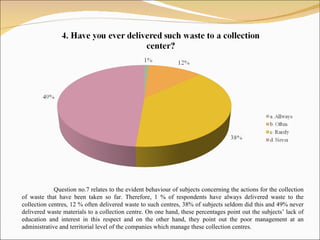
Question no.7 relates to the evident behaviour   of   subjects  concerning  the actions for the collection of waste that have been taken so far. Therefore,  1 % of res p ondents  have always delivered was te  to the collection centres,  12 %  often delivered  waste  to  such  centres,  38% of subjects seldom  did this and  49%  never delivered  waste materials  to a collection centre. On one hand, these percentages point out the  subjects ’ lack of education and interest   in this respect and on the other hand, they point out the poor management at an administrative and territorial level of the companies which manage these collection centres.
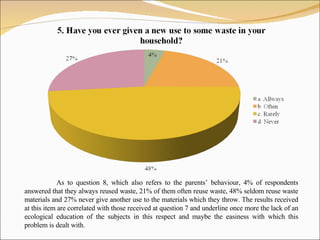
As to question 8, which also refers to the parents’ behaviour,  4%  of respondents answered that they always reused waste,  21%  of them often reuse waste , 48%  seldom reuse waste materials   and  27%  never give another use to the materials which they throw .  The results received at this item are correlated with those received at question 7 and underline once more the lack of an ecological education of the subjects in this respect and maybe the easiness with which this problem is dealt with.
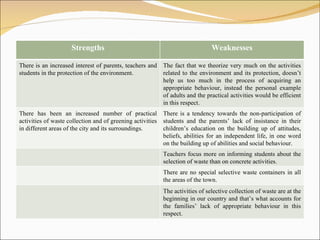
CONCLUSIONS Strengths Weaknesses There is an increased interest of parents, teachers and students in the protection of the environment. The fact that we theorize very much on the activities related to the environment and its protection, doesn’t help us too much in the process of acquiring an appropriate behaviour, instead the personal example of adults and the practical activities would be efficient in this respect.  There has been an increased number of practical activities of waste collection and of greening activities in different areas of the city and its surroundings. There is a tendency towards the non-participation of students and the parents’ lack of insistance in their children’s education on the building up of attitudes, beliefs, abilities for an independent life, in one word on the building up of abilities and social behaviour. Teachers focus more on informing students about the selection of waste than on concrete activities. There are no special selective waste containers in all the areas of the town. The activities of selective collection of waste are at the beginning in our country and that’s what accounts for the families’ lack of appropriate behaviour in this respect.
Action Plan Placing in all the school rooms (classrooms, laboratories, offices) of some special boxes for the collection of paper waste; The regular organization of activities for the selective waste collection in the neighbourhood with the involvement of the local community; The promotion in the neighbourhood, by means of posters, of the project’s ecological activities which are run in the school; The creation within workshops of some products made up of recyclable materials and their display at different exhibitions on the occasion of some events in the school life; The initiation and the running of some thematic contests;

Waste

  • 1.
    WASTE “ ElenaCuza” School Iaşi , Romania
  • 2.
    STUDENTS sample: 208 subjects
  • 3.
    1 . Waste which are the result of daily activities and can harm the environment are: paper, cardboard, bottles, glass, plastic containers, scrap iron, organic materials, clothes, shoes, electronic and domestic devices, dangerous waste (boxes of varnishes, lacquers, paints, gas bottles) etc. Do you select these materials when you throw them away? At this question, 16% of subjects declared that they always select ed waste when throwing the m , 20% of subjects of often selected waste , 44% seldom made a selection of waste , and 20% of students never selected waste . The results show that the selection of different materials ( waste ) before throwing them is a regular practice of the questioned subjects, but the results obtained can be correlated with those of the questionnaire for parents and with those of the questionnaire for teachers. As we mentioned before, this reality is also connected with a certain education in this respect and with the fact that there are large areas in our city where, up to now, there haven’t been any selective waste containers.
  • 4.
    This question requiresstudents to answer if there are any selective waste containers in their school. A high percentage of students that is 86% of students assert that there are selective waste containers, 4% of students declared that there weren’t any selective waste containers and 10% of subjects haven’t given a clear answer.
  • 5.
    Question no. 6 concerns the evident behaviour of pupils inside the school. 59% of subjects declared that they saw schoolmates who threw waste in the same container, 14% stated that they didn’t see schoolmates throwing waste in the same container and 27% of students answered that they didn’t know anything about this . As we have also noticed in the case of other items, these results underline a lack of ecological education and emphasize the way in which we should address this type of education. The fact that we theorize very much on the activities related to the environment and its protection, doesn’t help us too much in the process of acquiring an appropriate behaviour, instead the personal example of adults and the practical activities would be efficient in this respect.
  • 6.
    At this question, 11% of subjects declared that they often threw different packages in the street , 56% stated that they seldom threw packages in the street and 33% of students never did that .
  • 7.
    This question wasmeant to emphasize the students’ behaviour and especially their degree o f involvement and participation in difficult situations. 11% of students answered that they adopted an attitude in their class towards throwing waste in inappropriate places, 29% stated that that they often reacted to that, 39% of subjects answered that they seldom adopted an attitude towards throwing waste in inadequate places and 21% of students never reacted to that. The results point out that there is tendency towards non-participation of students and that parents didn ’ t insist in their education on the building up of attitudes, beliefs, abilities for an independent life, in one word on the building up of abilities and social behaviour.
  • 8.
    TEACHERS sample: 34 subjects
  • 9.
    1 . The waste materials as a result of our daily activities that can affect the environment are: paper, carton, plastic bottles, iron ware, organic materials, clothes, footwear, household items, etc. Do you select these materials before throwing them away? This question concerns the daily habit, if you wish, to our subjects in the way the y dump waste . 27% of respondents always select waste before throw ing it , 32% often, 32% seldom and 9% never. A n increasing interest has been observed in the subjects behaviour for correct , ecological, best practices in CEE concerning the environment protection . A significant part of the subjects do not select waste because there are no special containers in their neighborhood.
  • 10.
    2 . Are there any separate/different containers for waste/garbage cans in your school? On this question 85% of the subjects said the re are different containers for waste at school , 12% that they do not exist, and 3% could not give a concrete answer.
  • 11.
    3 . How often are the garbage cans collected/ taken away? This item concerns the knowledge of school teachers on administrative data. 79% of the subjects responded that the garbage cans are collected daily from school , 6% weekly and 15% do not have a concrete answer.
  • 12.
    4 . Have you ever taken part with your pupils in collecting activities in special collecting centers? On this question, 47% of subjects said that students have often participated in collecting acti vities to special waste collecti ng centers, 12% always, 23% seldom and 18% never.
  • 13.
    PARENTS sample: 191 subjects
  • 14.
    This question concerns the daily behaviour, the routine, if you w ish to say so, of our subjects regarding the way in which they throw the waste. 22% of parents always select waste before throwing them , 27% of them often make a selection of waste , 31 % of parents seldom sel ec t waste and 20% of them never make a selection of waste. From a certain point of view, the percentages which resulted are correlated with the results at question no. 6 namely, a high precentage of subjects don ’t make a selection of waste maybe because in the area they live there are no selective waste containers.
  • 15.
    This item concerned the subjects’ capacity for self-analysis and for becoming aware of their own social behaviour related to the protection of the environment. We can notice that there is a a very high percentage, 78% of parents who have never thrown waste in the street and only 20% of them seldom threw waste materials in the street and 2 % often threw them in the street . These percentages are satisfactory as long as the answers are correct, otherwise we can talk about an attitude change due to the wish for social desirability on the part of the parents.
  • 16.
    As for thisitem, 68% of parents answered that there were no special selective waste containers, 27% of them confirmed that there were such containers in their neighbourhood and 5 % answered that they didn ’t know about their existence.
  • 17.
    Question no.7 relatesto the evident behaviour of subjects concerning the actions for the collection of waste that have been taken so far. Therefore, 1 % of res p ondents have always delivered was te to the collection centres, 12 % often delivered waste to such centres, 38% of subjects seldom did this and 49% never delivered waste materials to a collection centre. On one hand, these percentages point out the subjects ’ lack of education and interest in this respect and on the other hand, they point out the poor management at an administrative and territorial level of the companies which manage these collection centres.
  • 18.
    As to question8, which also refers to the parents’ behaviour, 4% of respondents answered that they always reused waste, 21% of them often reuse waste , 48% seldom reuse waste materials and 27% never give another use to the materials which they throw . The results received at this item are correlated with those received at question 7 and underline once more the lack of an ecological education of the subjects in this respect and maybe the easiness with which this problem is dealt with.
  • 19.
    CONCLUSIONS Strengths WeaknessesThere is an increased interest of parents, teachers and students in the protection of the environment. The fact that we theorize very much on the activities related to the environment and its protection, doesn’t help us too much in the process of acquiring an appropriate behaviour, instead the personal example of adults and the practical activities would be efficient in this respect. There has been an increased number of practical activities of waste collection and of greening activities in different areas of the city and its surroundings. There is a tendency towards the non-participation of students and the parents’ lack of insistance in their children’s education on the building up of attitudes, beliefs, abilities for an independent life, in one word on the building up of abilities and social behaviour. Teachers focus more on informing students about the selection of waste than on concrete activities. There are no special selective waste containers in all the areas of the town. The activities of selective collection of waste are at the beginning in our country and that’s what accounts for the families’ lack of appropriate behaviour in this respect.
  • 20.
    Action Plan Placingin all the school rooms (classrooms, laboratories, offices) of some special boxes for the collection of paper waste; The regular organization of activities for the selective waste collection in the neighbourhood with the involvement of the local community; The promotion in the neighbourhood, by means of posters, of the project’s ecological activities which are run in the school; The creation within workshops of some products made up of recyclable materials and their display at different exhibitions on the occasion of some events in the school life; The initiation and the running of some thematic contests;