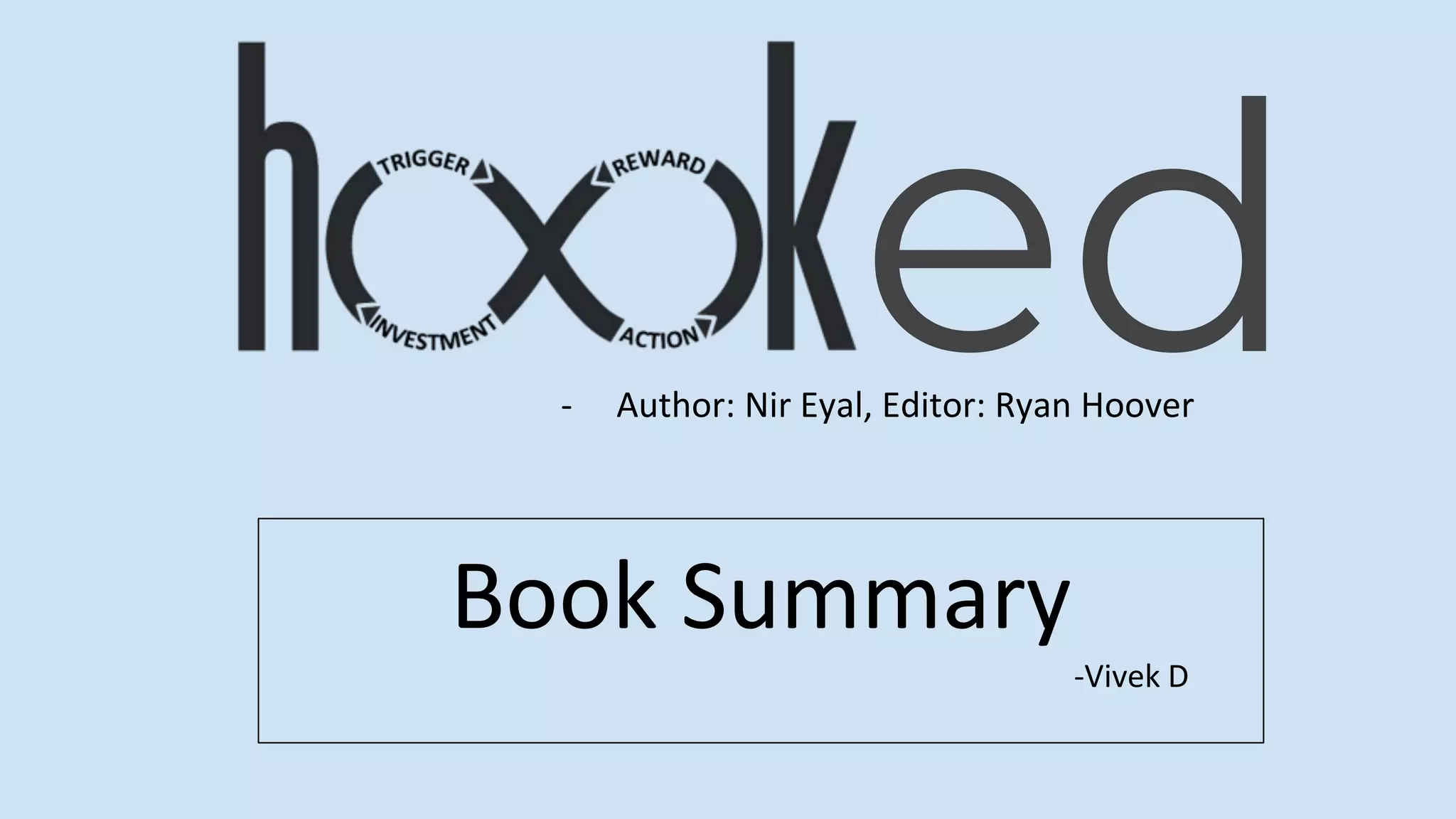
ed- Author: Nir Eyal, Editor: Ryan Hoover
Book Summary
-Vivek D
“
Habits= Repetitive Behaviors
(often voluntary & triggered internally)
Eg: Checking your Whatsapp without
notifications
“
If being away from an action
causes pain, it’s a habit.
Eg: Checking or waiting for likes on your
recent Linkedin Post
“
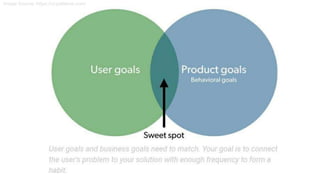
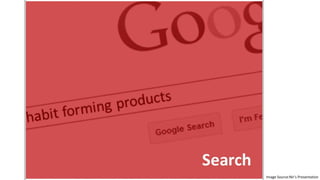
Access + Data + Speed = more
Habit-forming products
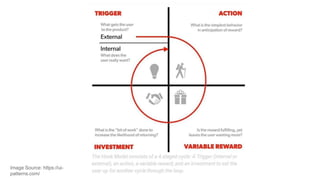
Image Source: https://ui-patterns.com/
“
The HOOK MODEL is a go-to tool for PMs.
See how it works:
User Problem → Frequent Solution →
Habit = Higher CLTV
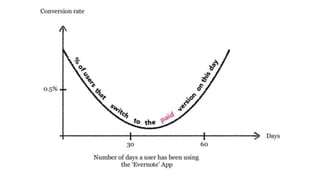
Smile Graph
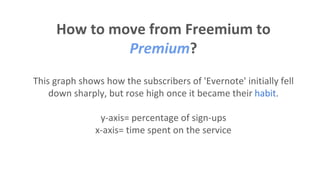
How to move from Freemium to
Premium?
This graph shows how the subscribers of 'Evernote' initially fell
down sharply, but rose high once it became their habit.
y-axis= percentage of sign-ups
x-axis= time spent on the service
9x Better
New products can mark their
presence only if they aren't just
better, but 9 times better.
Why such a high bar?
Because old habits die hard and new
products or services need to offer
dramatic improvements to change old
habits.
Better products don’t always win.
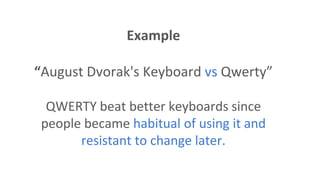
Example
“August Dvorak's Keyboard vs Qwerty”
QWERTY beat better keyboards since
people became habitual of using it and
resistant to change later.
“
Behaviors are LIFO — Last in, First out.
“
For new behaviours to convert into
habits, they must repeat.
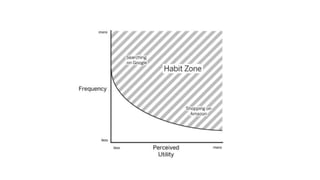
Habit Zone
Frequency = how often the behavior occurs
Perceived Utility = how useful and rewarding the
behavior is in the user’s mind over alternative
solutions
Other examples: WhatsApp, Cure.fit
Vitamins vs Painkillers
“
Vitamins
become
Painkillers
Flipkart, WhatsApp, Twitter, Linkedin,
Cure.fit, Udemy
were vitamins.
Now, they are painkillers.
Now, how to make a Habit-forming
Product?
or
Simply, how to Hook Users?
HOOKED Model
Hold on - Just 4 Steps
Image Source: https://ui-
patterns.com/
1
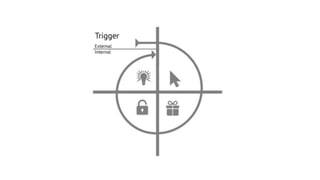
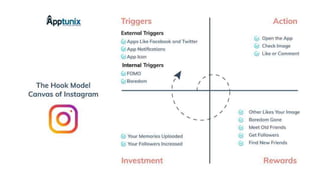
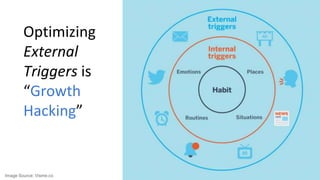
Triggers cue the user to take action and are the first
step in the Hook Model
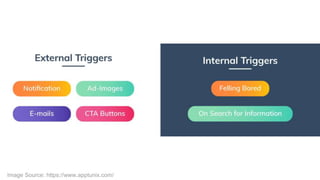
External Triggers: bits of information in users’ surroundings
that prompt them to perform an action. Eg: notifications, ads,
app updates
Internal Triggers: driven by users’ emotions and associations
stored in their memory. Eg: Negative emotions like
loneliness, FOMO
Image Source: https://www.apptunix.com/
Image Source: Visme.co
Optimizing
External
Triggers is
“Growth
Hacking”
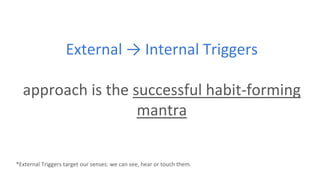
External → Internal Triggers
approach is the successful habit-forming
mantra
*External Triggers target our senses: we can see, hear or touch them.
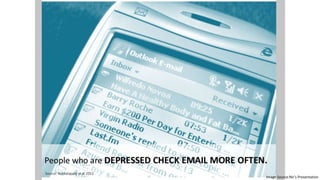
When we are unhappy with our
health or shape
Image Source:Nir’s Presentation
When we seek an opportunity
Image Source:Nir’s Presentation
2
“
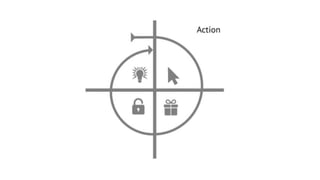
The action is the simplest behavior in
expectation of reward.
*A trigger is effective only if it forces an action and promises a reward
Image Source:Nir’s Presentation
Connect & Apply
Image Source:Nir’s Presentation
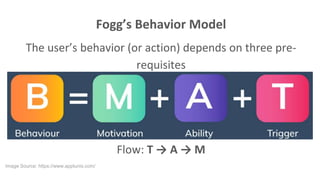
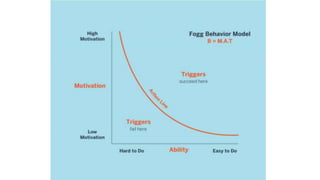
Fogg’s Behavior Model
The user’s behavior (or action) depends on three pre-
requisites
Flow: T → A → M
Image Source: https://www.apptunix.com/
Motivation = “the energy for action”
Three Core Motivators:
1. Desire for pleasure and/or avoidance of pain
2. Desire for hope and/or avoidance of fear
3. Desire for social acceptance and/or avoidance
of rejection
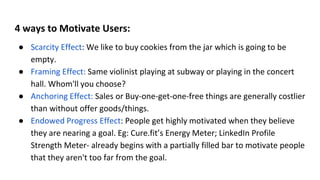
4 ways to Motivate Users:
● Scarcity Effect: We like to buy cookies from the jar which is going to be
empty.
● Framing Effect: Same violinist playing at subway or playing in the concert
hall. Whom'll you choose?
● Anchoring Effect: Sales or Buy-one-get-one-free things are generally costlier
than without offer goods/things.
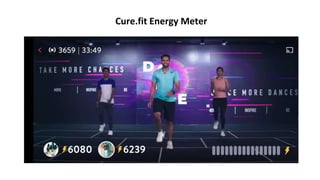
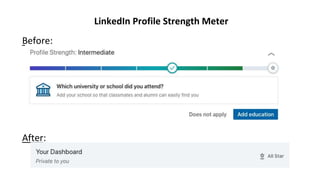
● Endowed Progress Effect: People get highly motivated when they believe
they are nearing a goal. Eg: Cure.fit’s Energy Meter; LinkedIn Profile
Strength Meter- already begins with a partially filled bar to motivate people
that they aren't too far from the goal.
Cure.fit Energy Meter
LinkedIn Profile Strength Meter
Before:
After:
How to improve Ability?
“Focus on ease of use”
Elements of focus to make easy-to-use products:
1.The Time it takes to use it ⬇
2. The Money it costs ⬇
3. The degree of Physical Effort involved ⬇
4. Brain Cycles (The level of Mental Labor & Focus needed) ⬇
5. The product’s Social Acceptability ⬇
6. Non-routine: The degree to which it matches or disrupts current
routines
Something Really New
“easier equals better”
For Creating Truly Innovative Products:
1. Understand the reason why people use a product or a
service
2. Note the steps customer must take to get the job done
3. Remove steps → Filter for the simplest process
Eg: Instahyre (simplest job board to apply for a job) vs messy job boards
which take hours to complete an application; Cluttered SuperApps vs Cure.fit
3
“
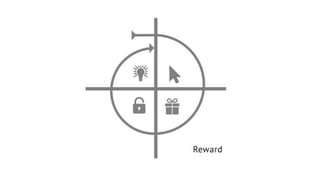
What draws us to act is not the sensation
we receive from the reward itself, but the
need to alleviate the craving for that
reward (Desire to get the reward).
Eg: Rewards fuel our desire to check Email, Check Application status on LinkedIn
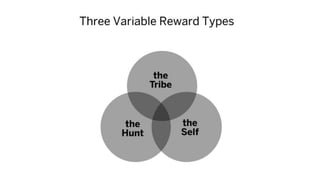
a) Rewards of the Tribe: gratification
from others make us feel accepted,
attractive, important and included.
(Social Rewards)
Eg: When we get 500+ likes on a post; 100 pending
connections/friend requests on LinkedIn/Facebook
b) Rewards of the hunt: material
goods, food, money, or information.
(Survival Rewards)
Eg: Getting next job through LinkedIn
c) Rewards of the self: mastery, completion,
competency or consistency.
(Intrinsic Value Rewards)
Eg: Energetic and healthy feeling after an online Yoga session (on
Cure.fit); In video games - earning power, new stages, new
weapons.
“
The unknown is fascinating.
Rewards must not be Constant
1. Vary with time & process
2. Satisfy users' needs
3. Create re-engagement opportunities (for
wanting more)
Infinite Variability: Linkedin gives us something new to
explore every time
“But you are free to accept or refuse”
Always give the BOSS-FEEL to your customer. Let
him choose.
Eg: Gmail gave option to choose between old and new
version
4
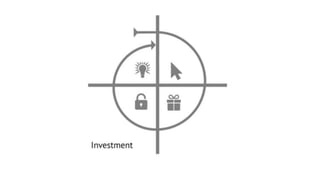
Investment phase leverages small
investments/inputs made by users for
future returns. It prompts users to do a bit
of work after they've received variable
rewards.
Eg.s: created content, inserted data, earned followers or
reputation (Social Capital), gained skill, money
In other words: Inviting friends, stating preferences, building
virtual assets and learning to use new features
“
Anything the user puts their
personal time & effort into, they
value it irrationally high (IKEA
EFFECT).
How does PUBG hook us?
Click here: https://www.linkedin.com/posts/vivek-
dangi_productpsychology-hookmodel-
productmanagement-activity-6668012835408371712-NEjD
End of HOOK Model
Let's crackdown to even simpler...
How to find your product’s hook?
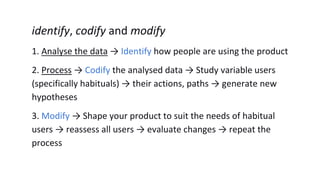
identify, codify and modify
1. Analyse the data → Identify how people are using the product
2. Process → Codify the analysed data → Study variable users
(specifically habituals) → their actions, paths → generate new
hypotheses
3. Modify → Shape your product to suit the needs of habitual
users → reassess all users → evaluate changes → repeat the
process
“
Observe the user in you. You might
inspire the next-habit forming
product or improve an existing one.
Thanks!

Hooked Summary - Vivek D

  • 1.
    ed- Author: NirEyal, Editor: Ryan Hoover Book Summary -Vivek D
  • 2.
    “ Habits= Repetitive Behaviors (oftenvoluntary & triggered internally) Eg: Checking your Whatsapp without notifications
  • 3.
    “ If being awayfrom an action causes pain, it’s a habit. Eg: Checking or waiting for likes on your recent Linkedin Post
  • 4.
    “ Access + Data+ Speed = more Habit-forming products
  • 5.
  • 6.
    “ The HOOK MODELis a go-to tool for PMs. See how it works: User Problem → Frequent Solution → Habit = Higher CLTV
  • 7.
  • 9.
    How to movefrom Freemium to Premium? This graph shows how the subscribers of 'Evernote' initially fell down sharply, but rose high once it became their habit. y-axis= percentage of sign-ups x-axis= time spent on the service
  • 10.
  • 11.
    New products canmark their presence only if they aren't just better, but 9 times better.
  • 12.
    Why such ahigh bar? Because old habits die hard and new products or services need to offer dramatic improvements to change old habits.
  • 13.
  • 14.
    Example “August Dvorak's Keyboardvs Qwerty” QWERTY beat better keyboards since people became habitual of using it and resistant to change later.
  • 15.
    “ Behaviors are LIFO— Last in, First out.
  • 16.
    “ For new behavioursto convert into habits, they must repeat.
  • 17.
  • 19.
    Frequency = howoften the behavior occurs Perceived Utility = how useful and rewarding the behavior is in the user’s mind over alternative solutions Other examples: WhatsApp, Cure.fit
  • 20.
  • 21.
  • 22.
    Flipkart, WhatsApp, Twitter,Linkedin, Cure.fit, Udemy were vitamins. Now, they are painkillers.
  • 23.
    Now, how tomake a Habit-forming Product? or Simply, how to Hook Users?
  • 24.
  • 25.
    Hold on -Just 4 Steps
  • 26.
  • 27.
  • 29.
    Triggers cue theuser to take action and are the first step in the Hook Model External Triggers: bits of information in users’ surroundings that prompt them to perform an action. Eg: notifications, ads, app updates Internal Triggers: driven by users’ emotions and associations stored in their memory. Eg: Negative emotions like loneliness, FOMO
  • 30.
  • 31.
  • 32.
    External → InternalTriggers approach is the successful habit-forming mantra *External Triggers target our senses: we can see, hear or touch them.
  • 33.
    When we areunhappy with our health or shape
  • 34.
  • 35.
    When we seekan opportunity
  • 36.
  • 37.
  • 39.
    “ The action isthe simplest behavior in expectation of reward. *A trigger is effective only if it forces an action and promises a reward
  • 40.
  • 41.
  • 42.
  • 43.
    Fogg’s Behavior Model Theuser’s behavior (or action) depends on three pre- requisites Flow: T → A → M Image Source: https://www.apptunix.com/
  • 45.
    Motivation = “theenergy for action” Three Core Motivators: 1. Desire for pleasure and/or avoidance of pain 2. Desire for hope and/or avoidance of fear 3. Desire for social acceptance and/or avoidance of rejection
  • 46.
    4 ways toMotivate Users: ● Scarcity Effect: We like to buy cookies from the jar which is going to be empty. ● Framing Effect: Same violinist playing at subway or playing in the concert hall. Whom'll you choose? ● Anchoring Effect: Sales or Buy-one-get-one-free things are generally costlier than without offer goods/things. ● Endowed Progress Effect: People get highly motivated when they believe they are nearing a goal. Eg: Cure.fit’s Energy Meter; LinkedIn Profile Strength Meter- already begins with a partially filled bar to motivate people that they aren't too far from the goal.
  • 47.
  • 48.
    LinkedIn Profile StrengthMeter Before: After:
  • 49.
    How to improveAbility? “Focus on ease of use” Elements of focus to make easy-to-use products: 1.The Time it takes to use it ⬇ 2. The Money it costs ⬇ 3. The degree of Physical Effort involved ⬇ 4. Brain Cycles (The level of Mental Labor & Focus needed) ⬇ 5. The product’s Social Acceptability ⬇ 6. Non-routine: The degree to which it matches or disrupts current routines
  • 50.
  • 51.
    “easier equals better” ForCreating Truly Innovative Products: 1. Understand the reason why people use a product or a service 2. Note the steps customer must take to get the job done 3. Remove steps → Filter for the simplest process Eg: Instahyre (simplest job board to apply for a job) vs messy job boards which take hours to complete an application; Cluttered SuperApps vs Cure.fit
  • 52.
  • 54.
    “ What draws usto act is not the sensation we receive from the reward itself, but the need to alleviate the craving for that reward (Desire to get the reward). Eg: Rewards fuel our desire to check Email, Check Application status on LinkedIn
  • 56.
    a) Rewards ofthe Tribe: gratification from others make us feel accepted, attractive, important and included. (Social Rewards) Eg: When we get 500+ likes on a post; 100 pending connections/friend requests on LinkedIn/Facebook
  • 57.
    b) Rewards ofthe hunt: material goods, food, money, or information. (Survival Rewards) Eg: Getting next job through LinkedIn
  • 58.
    c) Rewards ofthe self: mastery, completion, competency or consistency. (Intrinsic Value Rewards) Eg: Energetic and healthy feeling after an online Yoga session (on Cure.fit); In video games - earning power, new stages, new weapons.
  • 59.
    “ The unknown isfascinating.
  • 60.
    Rewards must notbe Constant 1. Vary with time & process 2. Satisfy users' needs 3. Create re-engagement opportunities (for wanting more) Infinite Variability: Linkedin gives us something new to explore every time
  • 61.
    “But you arefree to accept or refuse” Always give the BOSS-FEEL to your customer. Let him choose. Eg: Gmail gave option to choose between old and new version
  • 62.
  • 64.
    Investment phase leveragessmall investments/inputs made by users for future returns. It prompts users to do a bit of work after they've received variable rewards. Eg.s: created content, inserted data, earned followers or reputation (Social Capital), gained skill, money In other words: Inviting friends, stating preferences, building virtual assets and learning to use new features
  • 65.
    “ Anything the userputs their personal time & effort into, they value it irrationally high (IKEA EFFECT).
  • 66.
    How does PUBGhook us? Click here: https://www.linkedin.com/posts/vivek- dangi_productpsychology-hookmodel- productmanagement-activity-6668012835408371712-NEjD
  • 68.
  • 69.
    Let's crackdown toeven simpler...
  • 70.
    How to findyour product’s hook?
  • 71.
    identify, codify andmodify 1. Analyse the data → Identify how people are using the product 2. Process → Codify the analysed data → Study variable users (specifically habituals) → their actions, paths → generate new hypotheses 3. Modify → Shape your product to suit the needs of habitual users → reassess all users → evaluate changes → repeat the process
  • 72.
    “ Observe the userin you. You might inspire the next-habit forming product or improve an existing one.
  • 73.

Editor's Notes

  • #10 Cure.fit gives demo classes to make users experience first
  • #23 Cure.fit: Solving the challenge of instructor-based training at low cost, Nutritious food, Better diagnostic facilities Can Linkedin be an example here?