Tools of
Thought Translator
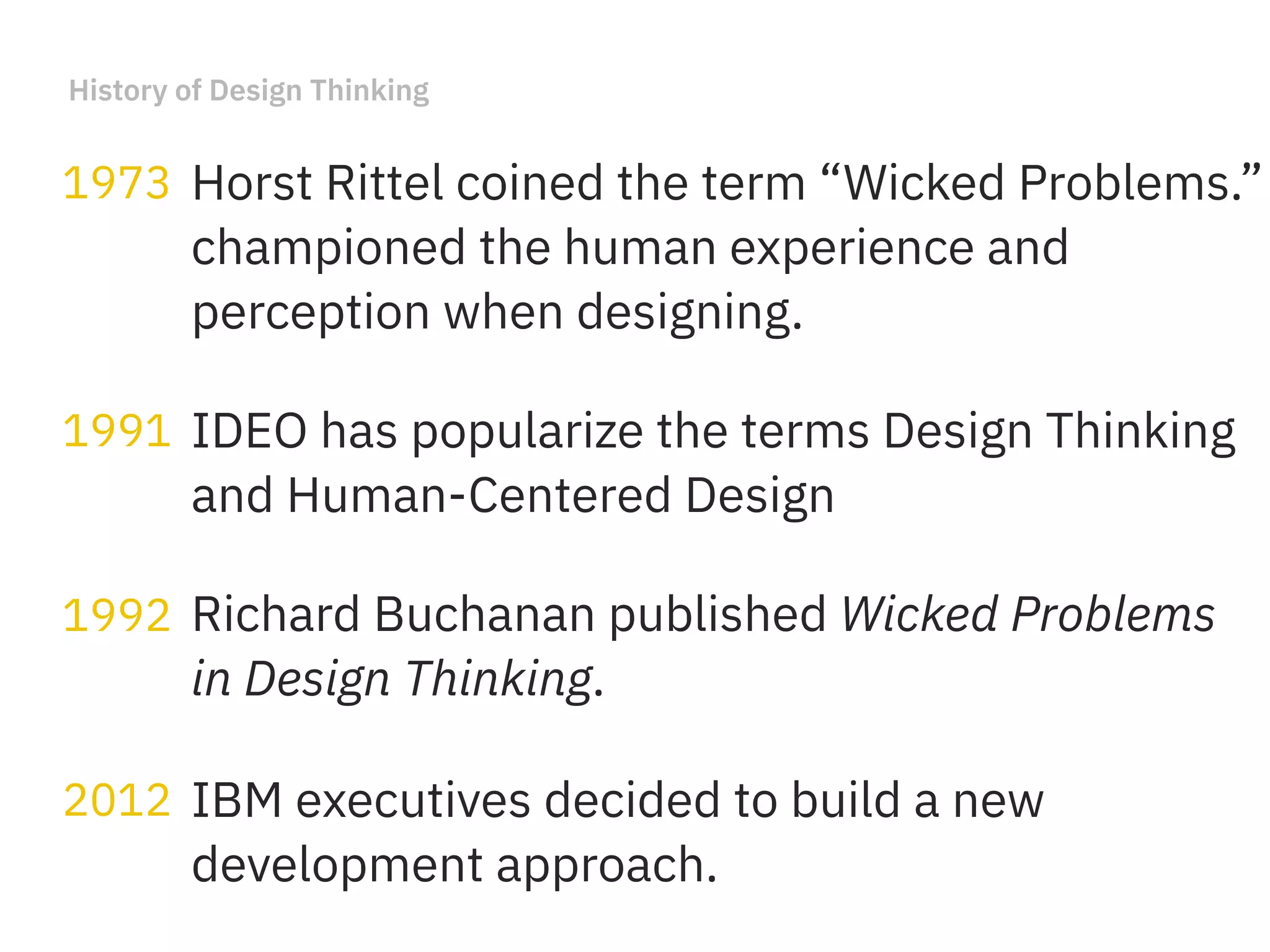
History of Design Thinking
Horst Rittel coined the term โ€œWicked Problems.โ€
championed the human experience and
perception when designing.
1973
Richard Buchanan published Wicked Problems
in Design Thinking.
1992
IDEO has popularize the terms Design Thinking
and Human-Centered Design
1991
IBM executives decided to build a new
development approach.
2012
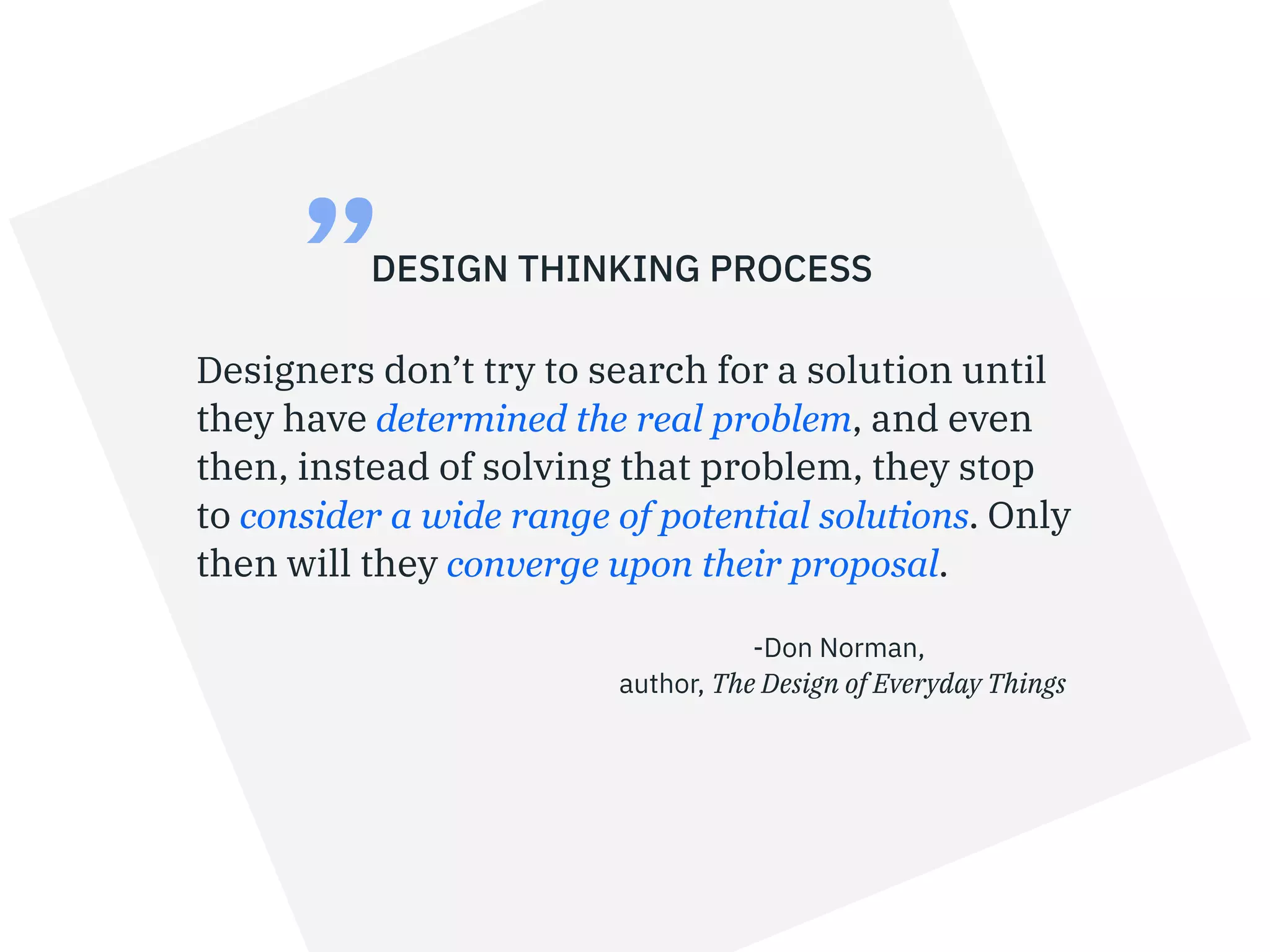
Designers donโ€™t try to search for a solution until
they have determined the real problem, and even
then, instead of solving that problem, they stop
to consider a wide range of potential solutions. Only
then will they converge upon their proposal.
DESIGN THINKING PROCESS
-Don Norman,
author, The Design of Everyday Things
โ€
Enterprise Design Thinking
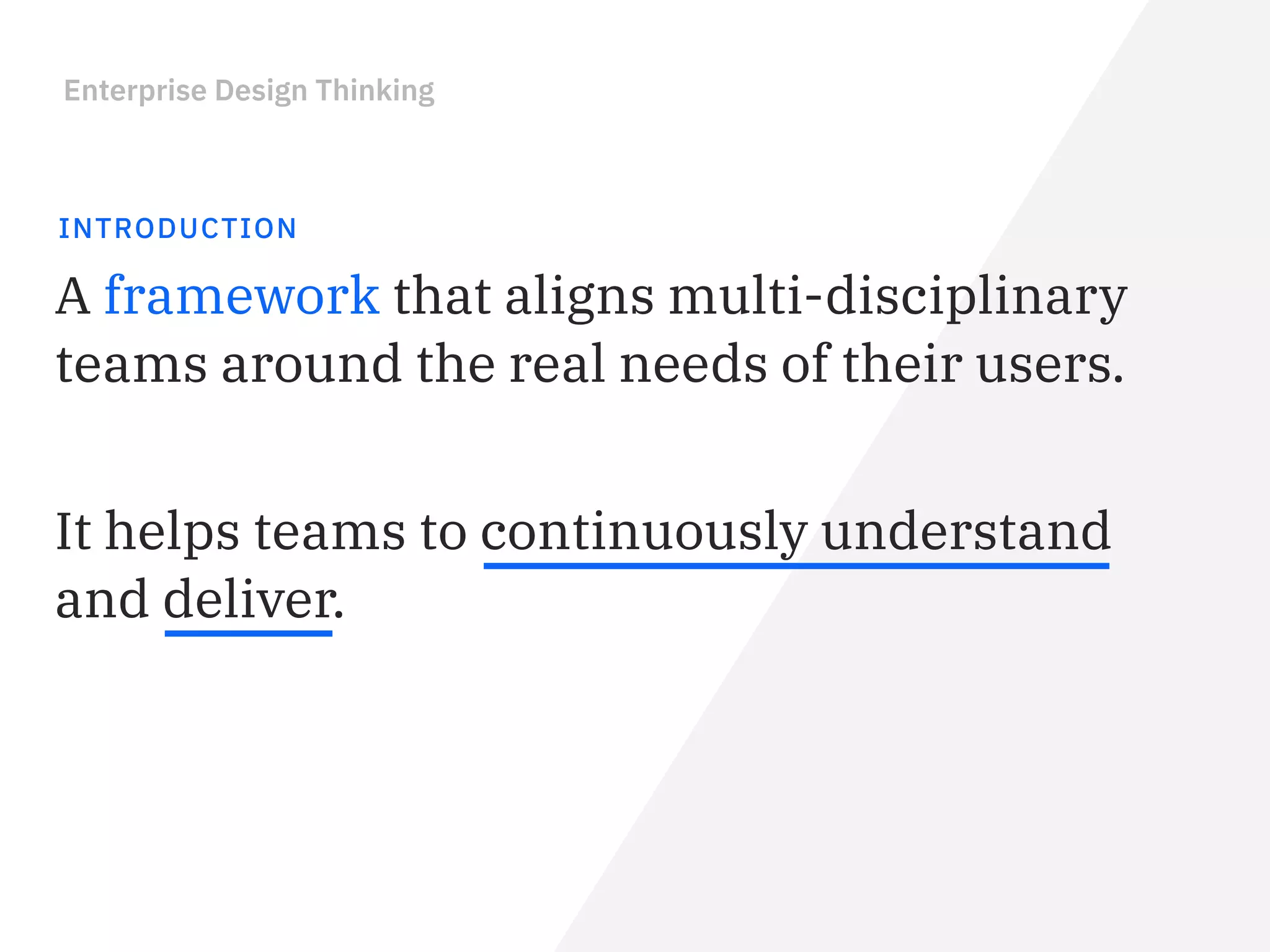
INTRODUCTION
It helps teams to continuously understand
and deliver.
Aย frameworkย that aligns multi-disciplinary
teams around the real needs of their users.
Enterprise Design Thinking
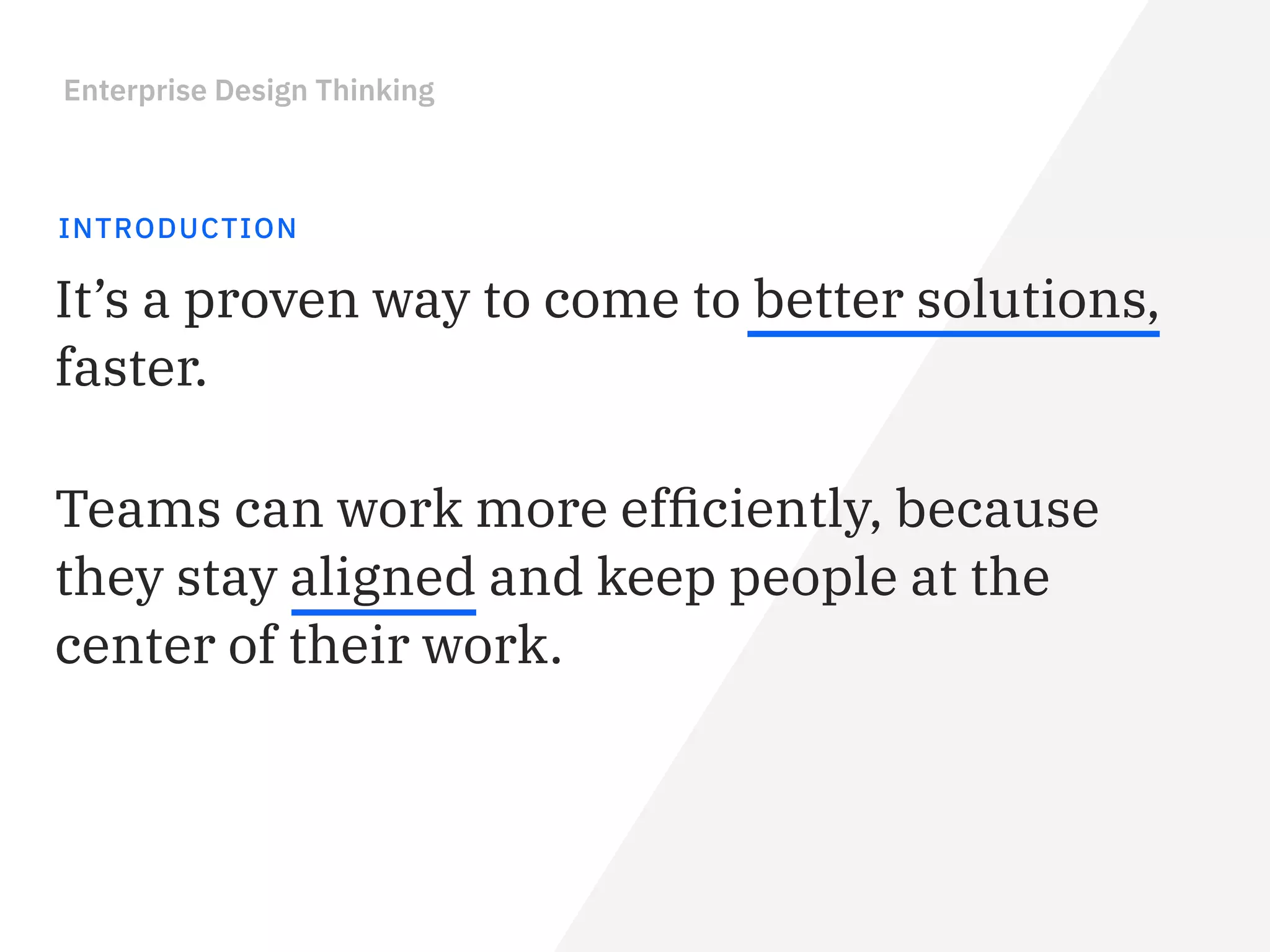
INTRODUCTION
Itโ€™s a proven way to come to better solutions,
faster.
Teams can work more ef๏ฌciently, because
they stay aligned and keep people at the
center of their work.
Fail Early &
Learn Well
Enterprise Design Thinking
MINDSETS
You have to know
whatย doesnโ€™tย work
in order to really
appreciate
whatย does!
Be Patient,
Be Explorer.
Enterprise Design Thinking
MINDSETS
The best designs
donโ€™t happen in a
single stroke.
Be able to better
appreciate, accomplish
the ideas of others
Be Wild Duck.
Enterprise Design Thinking
MINDSETS
A restless explorer
who are always
looking for a new
angle on a big
problem.ย 
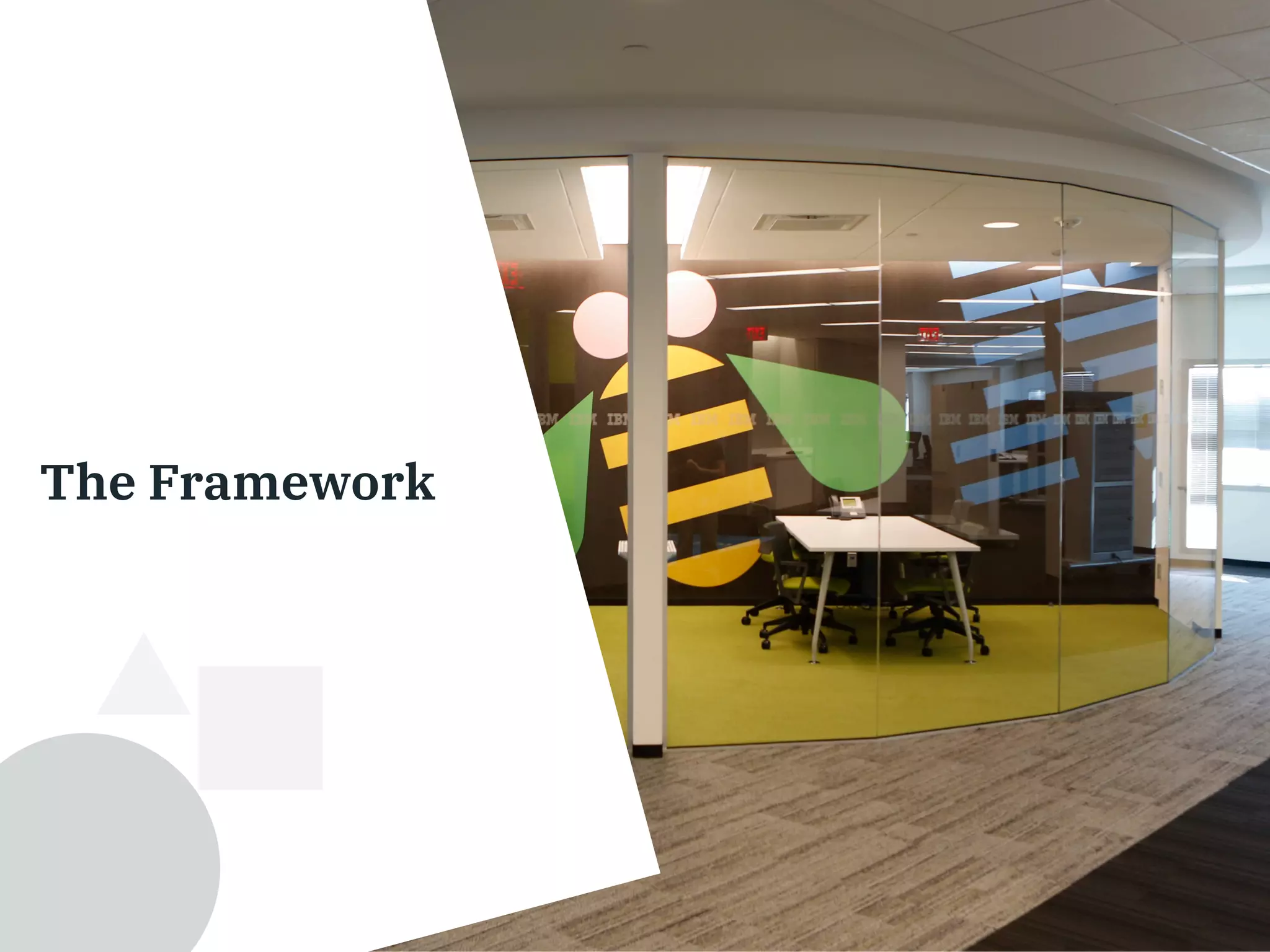
The Framework
Enterprise Design Thinking
THE FRAMEWORK
A human-centered mission to solve our
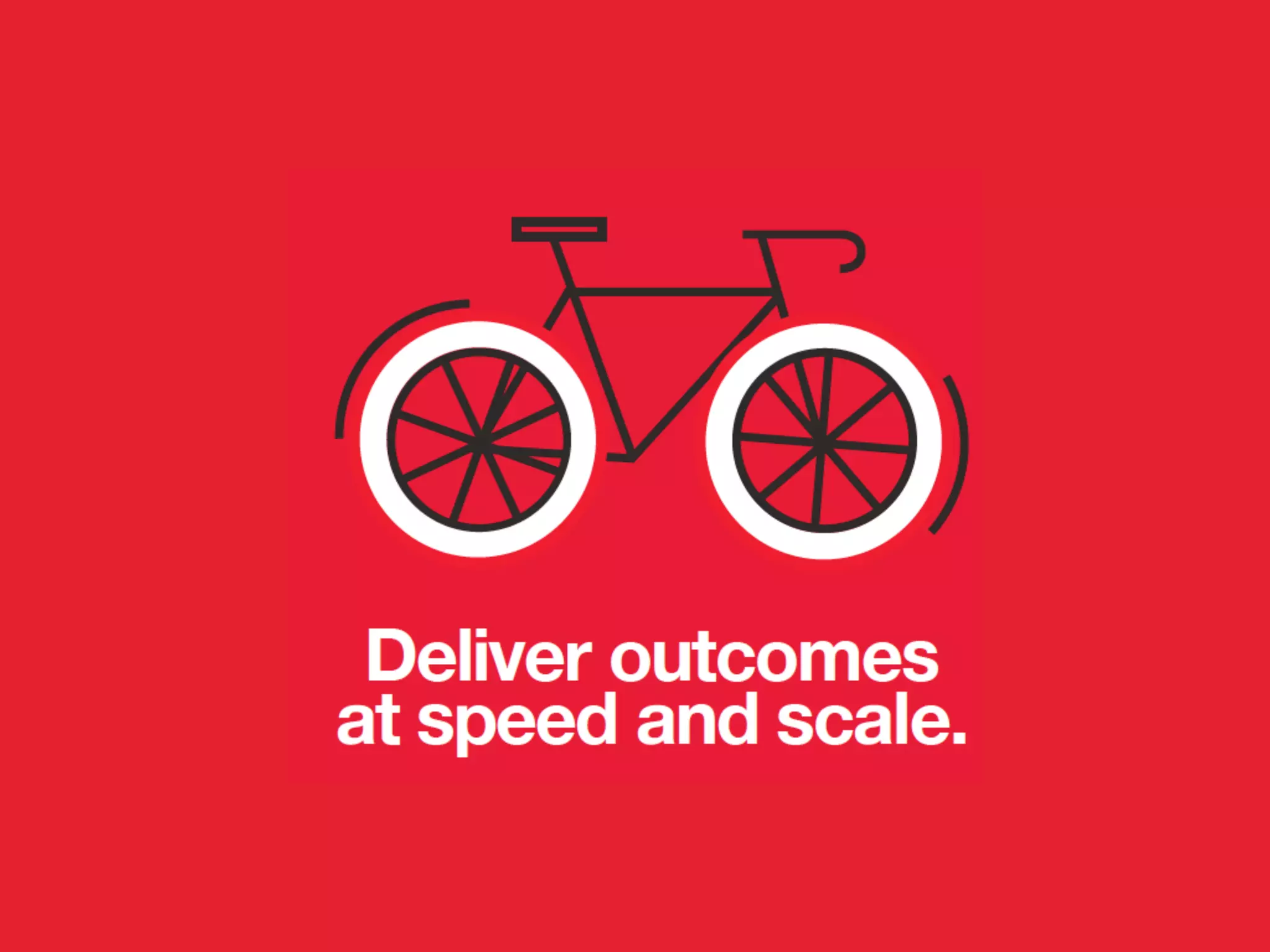
usersโ€™ problems at the speed and scale of the
complex enterprise.
Theย Principles Theย Loop Theย Keys
Enterprise Design Thinking
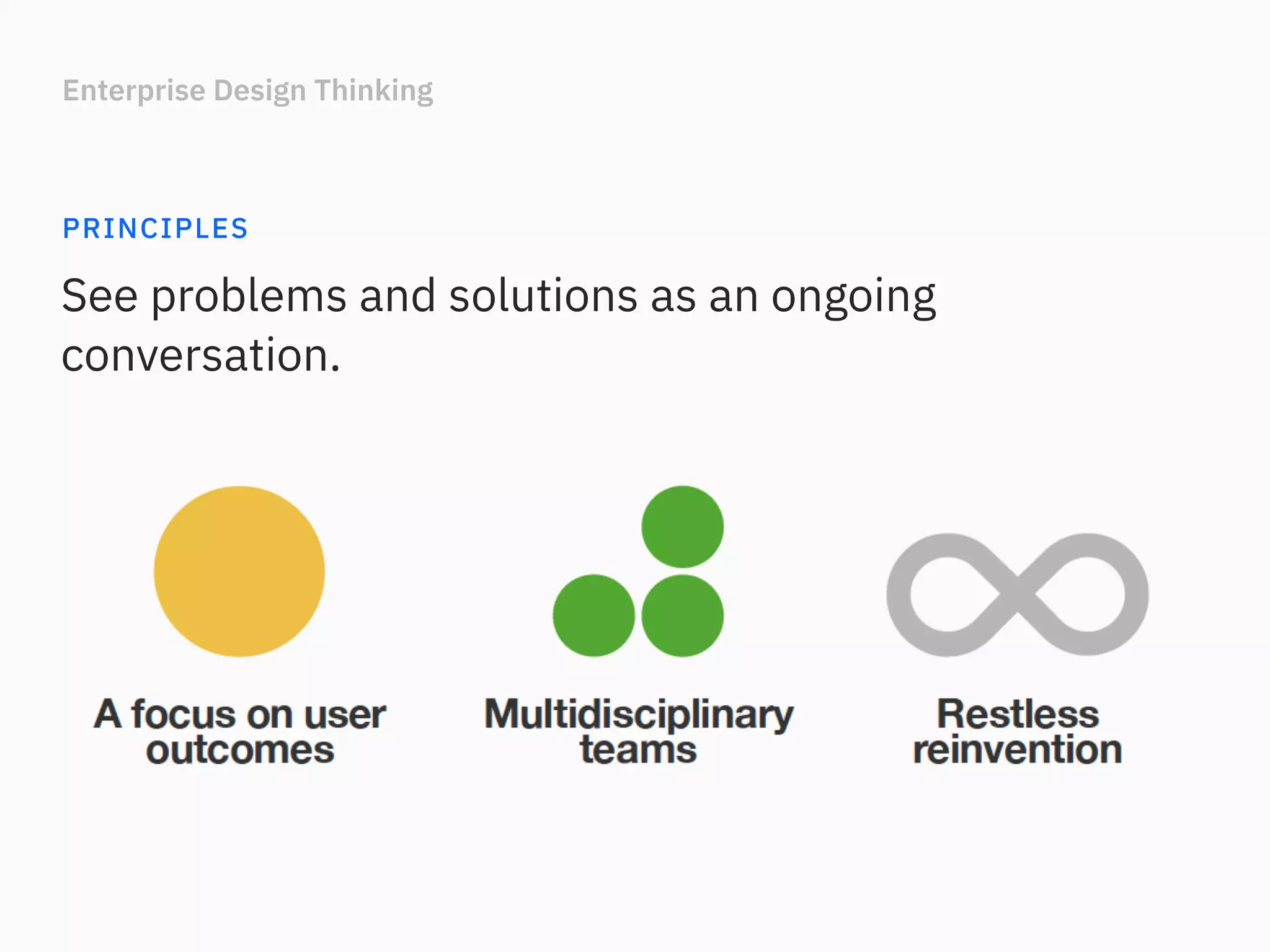
PRINCIPLES
See problems and solutions as an ongoing
conversation.
Enterprise Design Thinking
FOCUS ON USER OUTCOMES
Success isnโ€™t measured by the features we ship - its
measured by how well we ful๏ฌll our users` needs.
Shift the conversation from one about features and
functions to one about users and user outcomes.
help us deliver more useful, usable, and desirable
solutions.
Enterprise Design Thinking
FOCUS ON USER OUTCOMES
Differentiate between users and clients
Build empathy with users
Understand their role
Enterprise Design Thinking
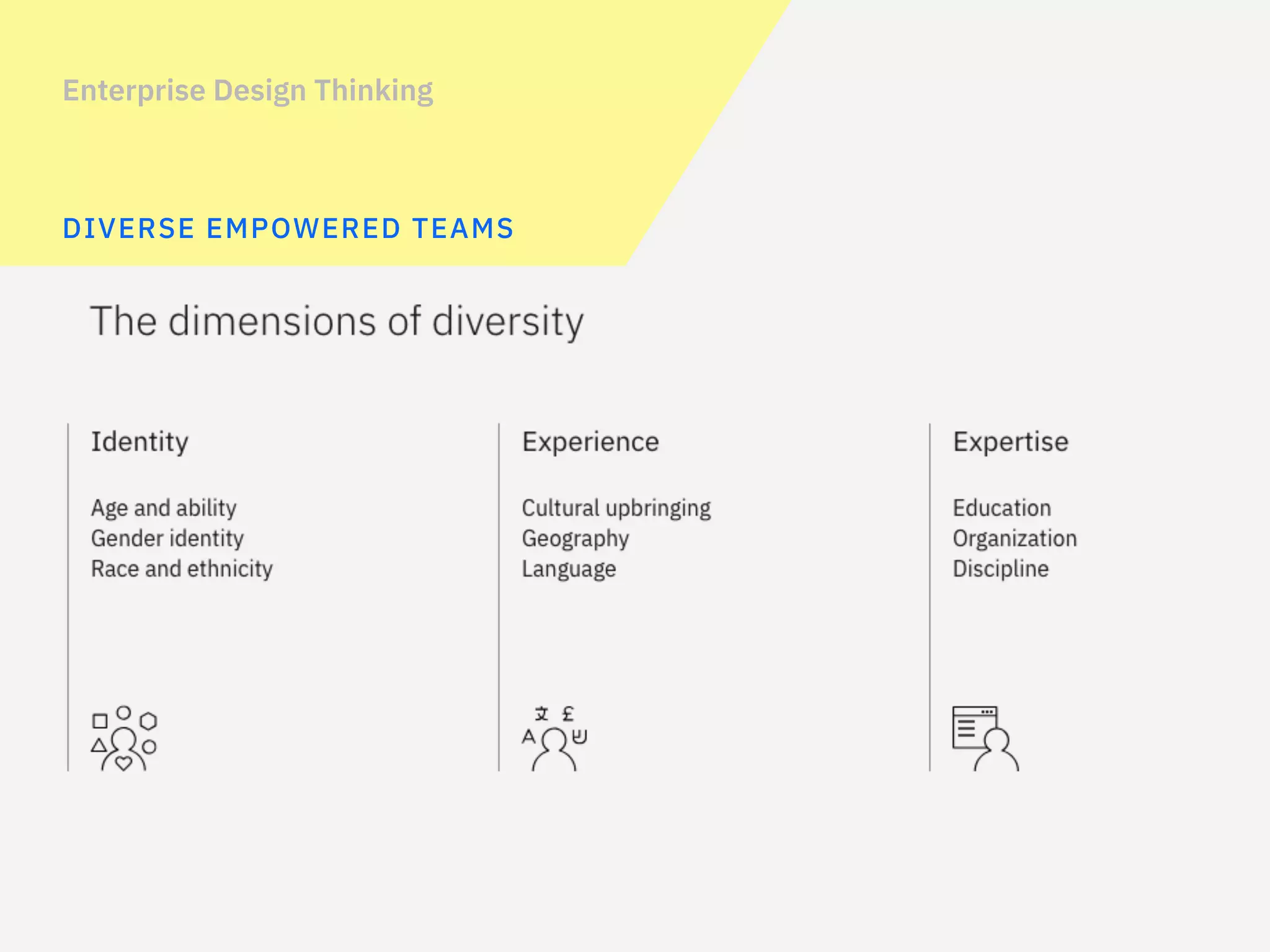
DIVERSE EMPOWERED TEAMS
Two team factors to generate better ideas and deliver
outcomes for users: diversity and empowerment
Diverse teams see the same problem from many
angles.
Empower them with the expertise and authority to
turn those ideas into outcomes.
Enterprise Design Thinking
DIVERSE EMPOWERED TEAMS
Differentiation through diversity
Speed through empowerment
Form self-contained teams
Enterprise Design Thinking
RESTLESS REINVENTION
Everything is a prototype. Everything; even in-market
solutions.
When you think of everything as just another iteration,
you are empowered to bring new thinking to the oldest
problems.
Enterprise Design Thinking
THE LOOP
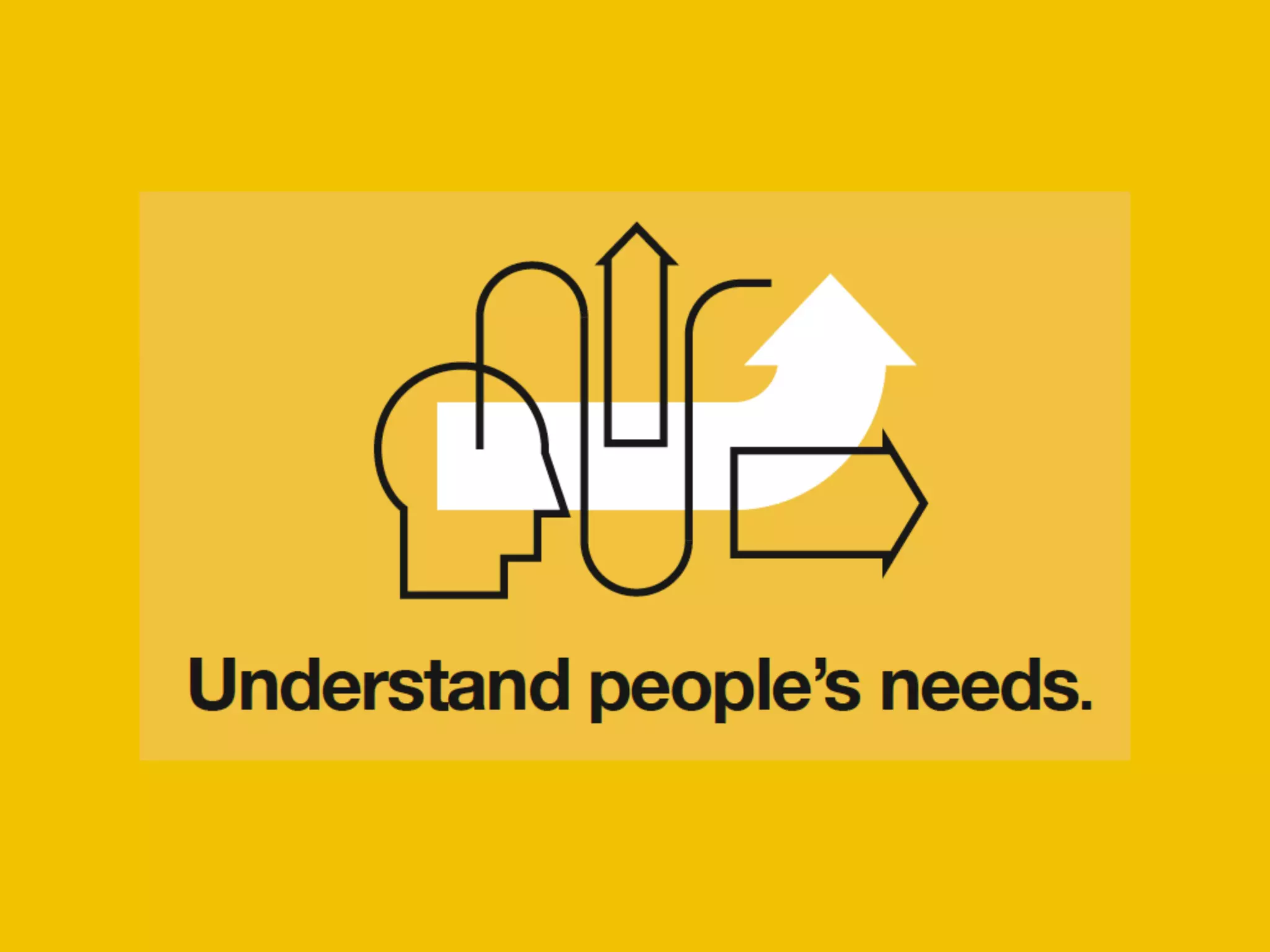
Understand usersโ€™ needs and deliver outcomes
continuously.
Enterprise Design Thinking
THE LOOP
Understand usersโ€™ needs and deliver outcomes
continuously.
Enterprise Design Thinking
OBSERVE
Everyone on your team should have chance to see
their usersโ€™ worldย 
Observing users in their world gives you the
opportunity to empathize with their experience,
understand their context, uncover hidden needs, and
hear their honest feedback.
Enterprise Design Thinking
OBSERVE
Enterprise Design Thinking
OBSERVE
Enterprise Design Thinking
OBSERVE
Enterprise Design Thinking
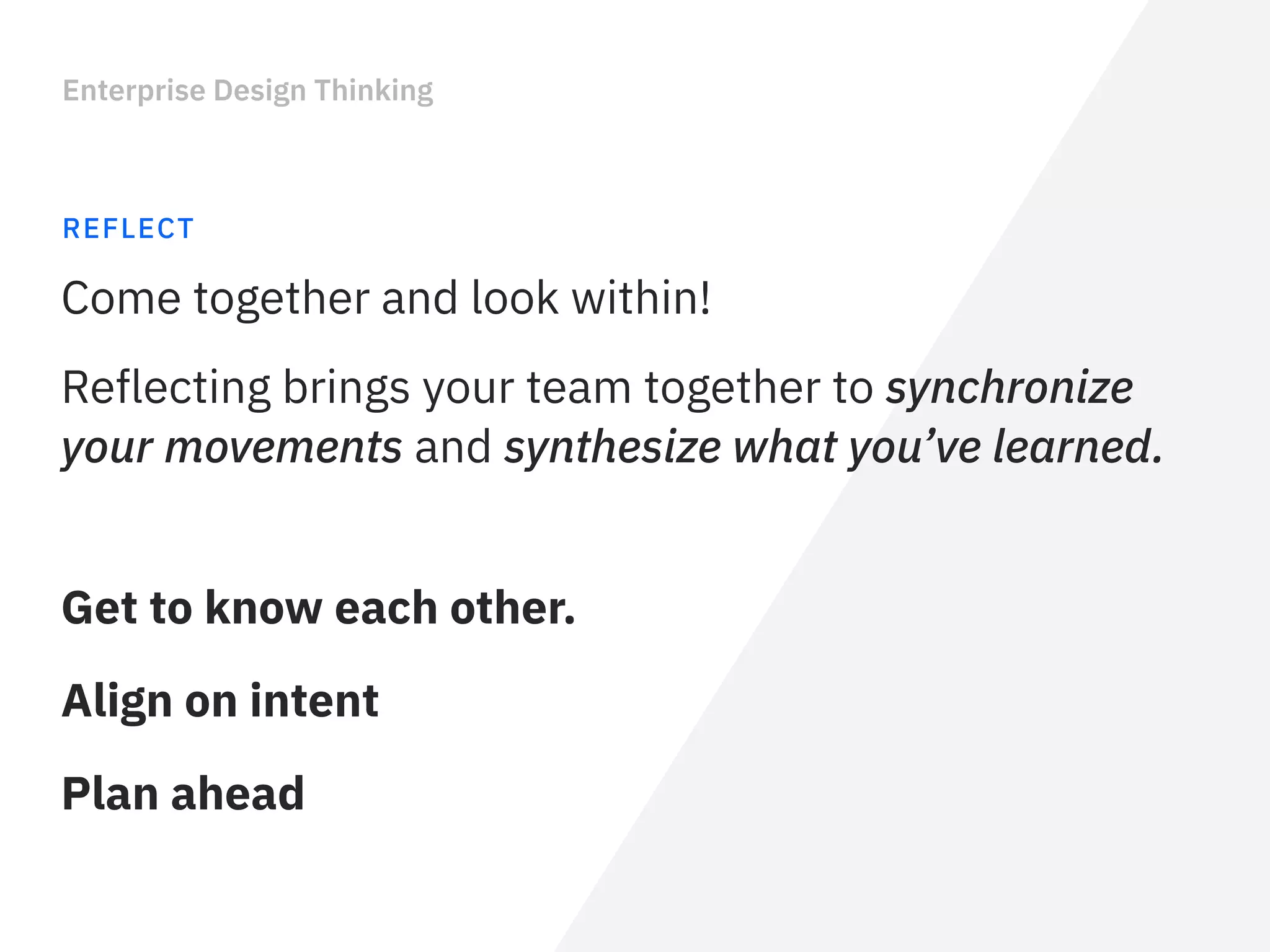
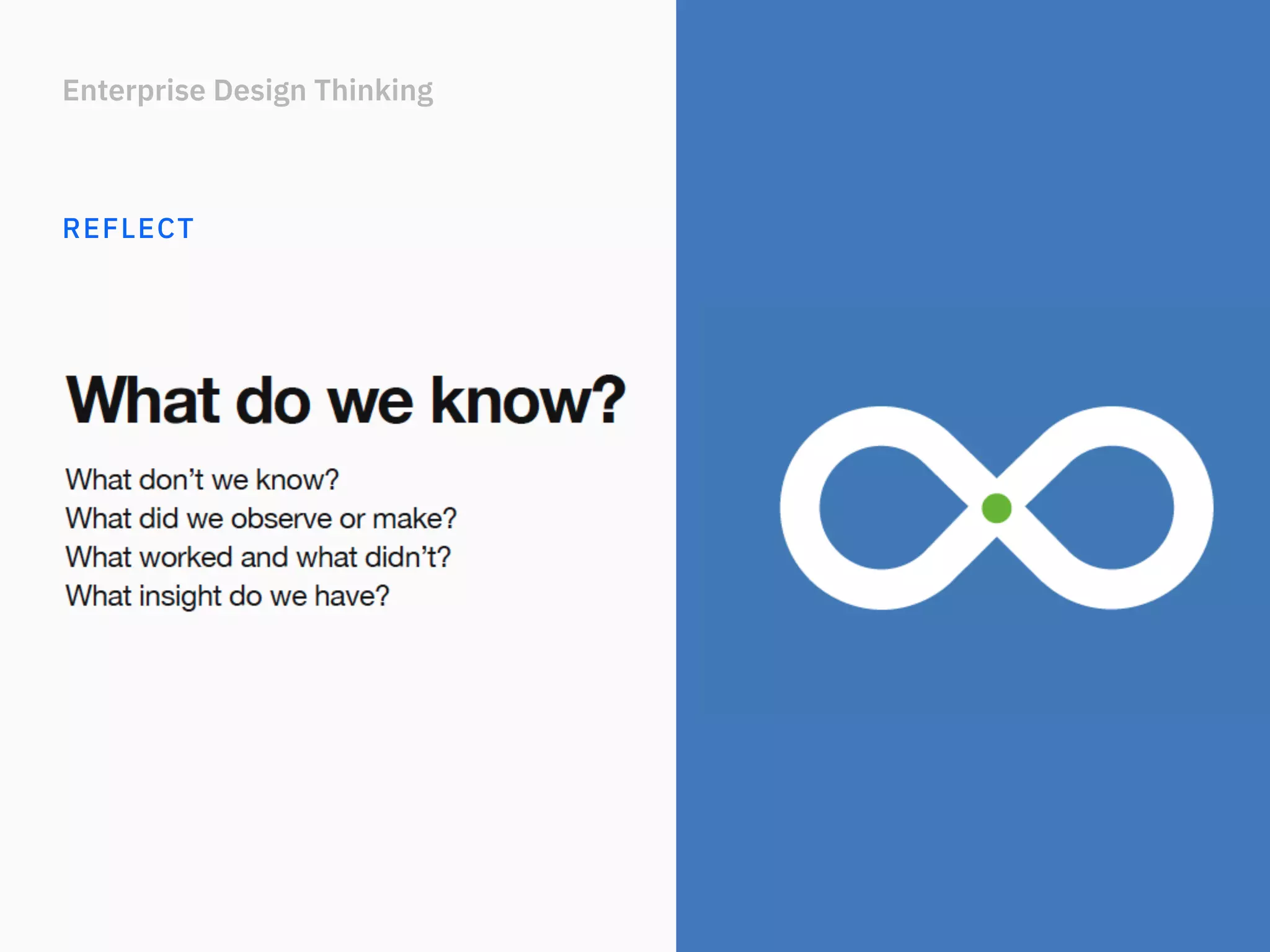
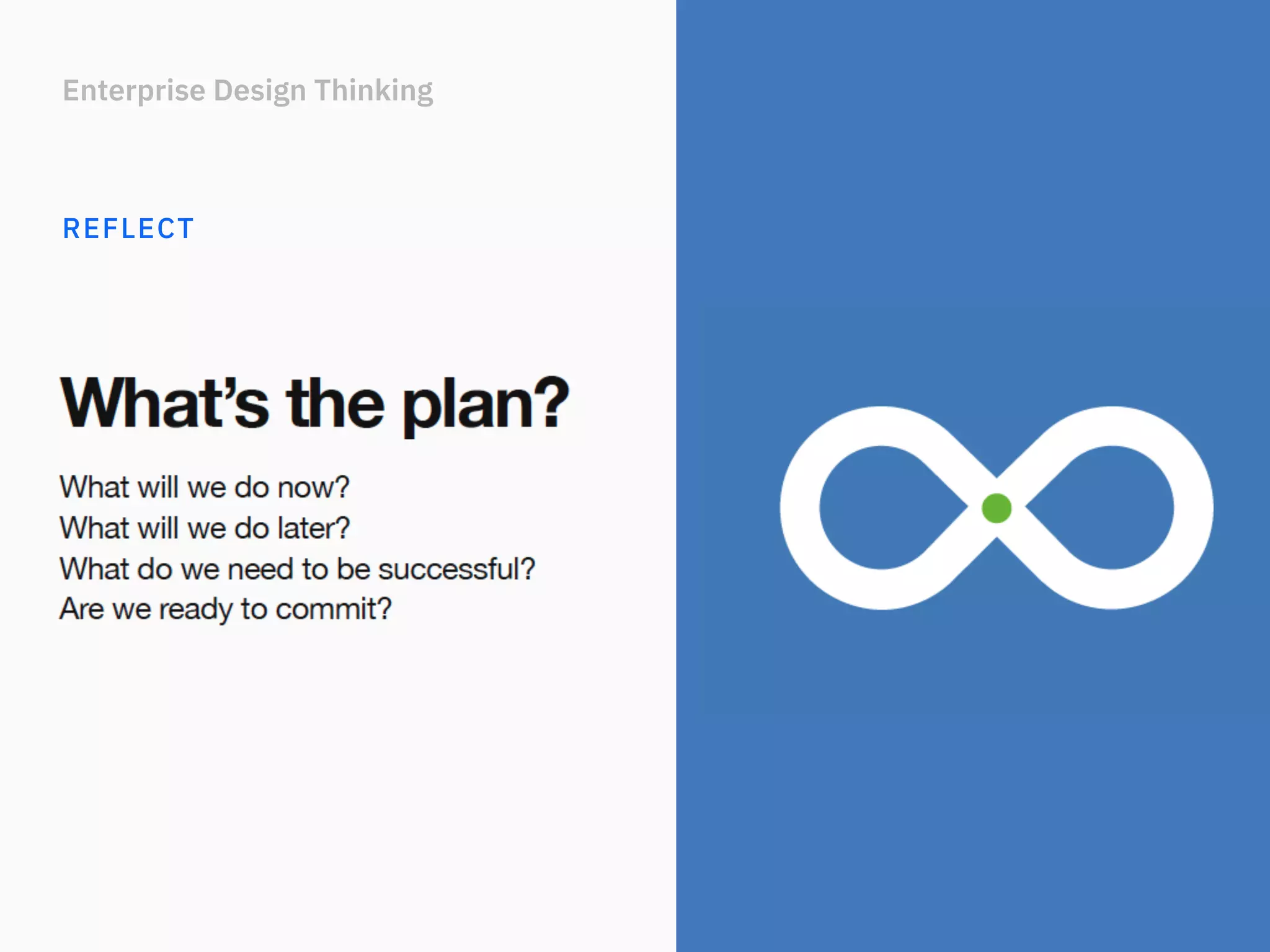
REFLECT
Reflecting brings your team together to synchronize
your movements and synthesize what youโ€™ve learned.
Come together and look within!
Get to know each other.
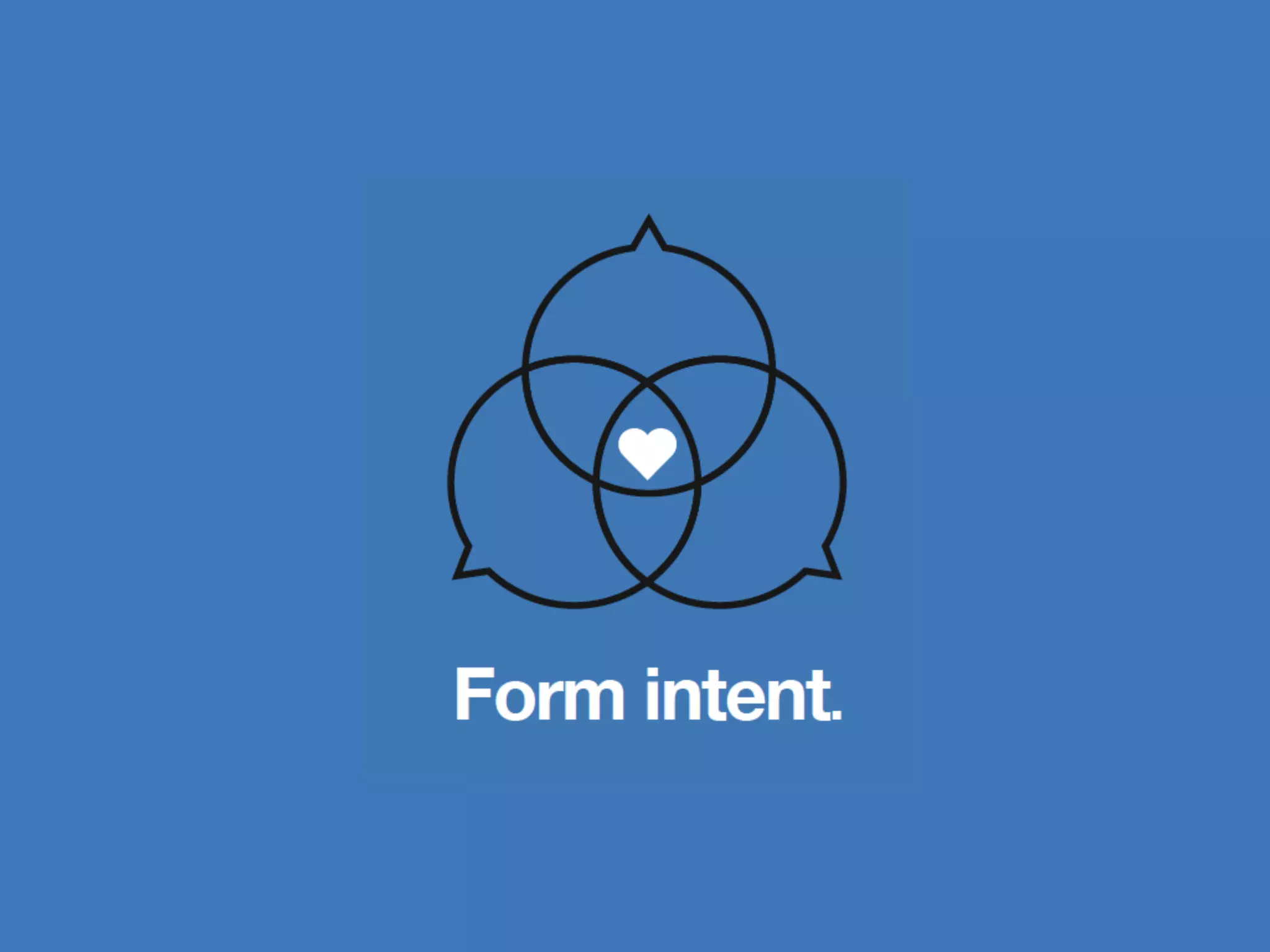
Align on intent
Plan ahead
Enterprise Design Thinking
REFLECT
Enterprise Design Thinking
REFLECT
Enterprise Design Thinking
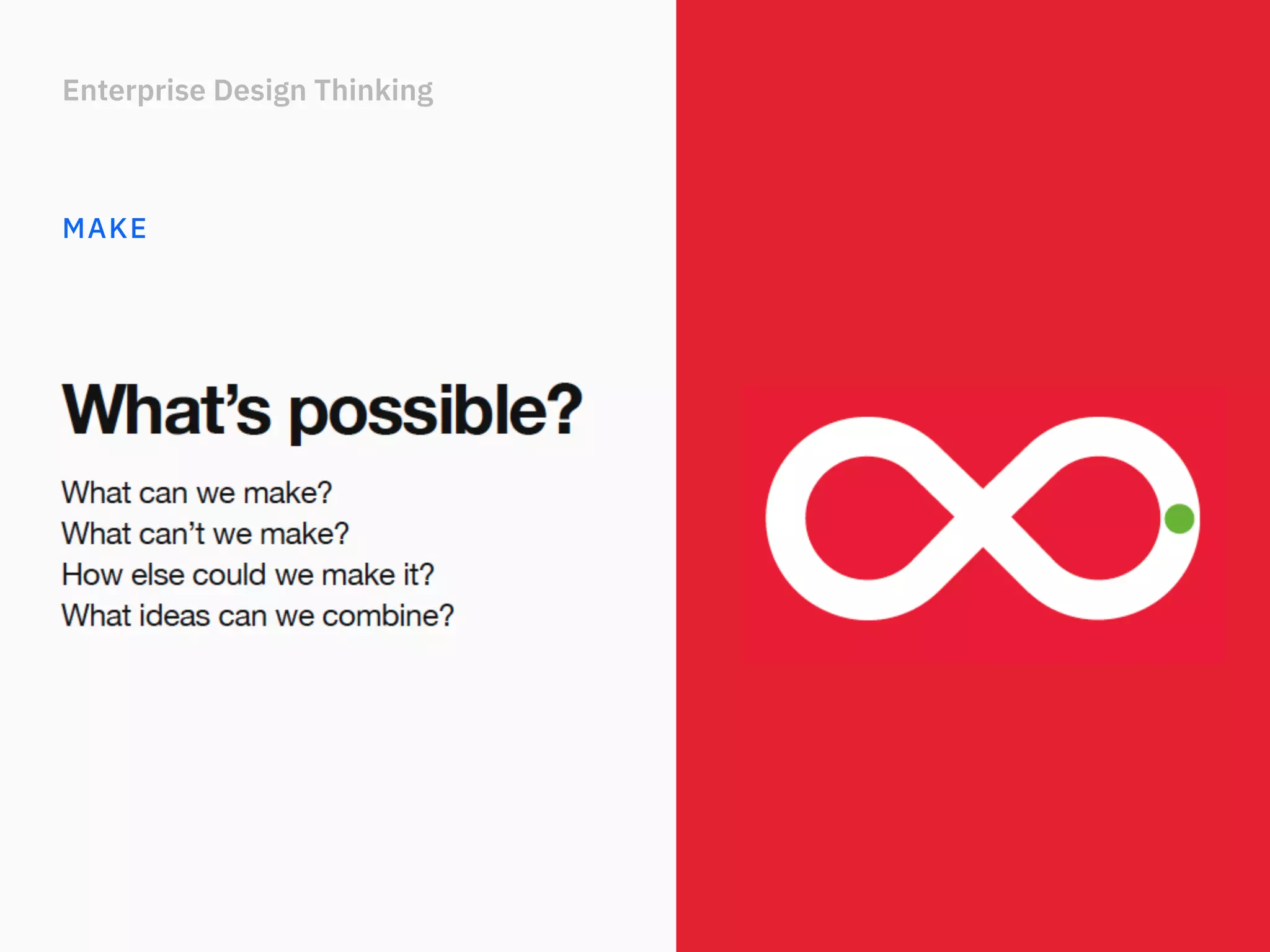
MAKE
Explore possibilities
The earlier you make, the faster you learn
Donโ€™t be afraid to share ideas even if they arenโ€™t fully
baked
Prototype concepts
Drive outcomes
Enterprise Design Thinking
MAKE
Enterprise Design Thinking
MAKE
Enterprise Design Thinking
THE KEYS
If every problem could be solved by a handful of
people, the Loop would be enough. But in the real
world, complex problems call for complex teams.
Enterprise Design Thinking
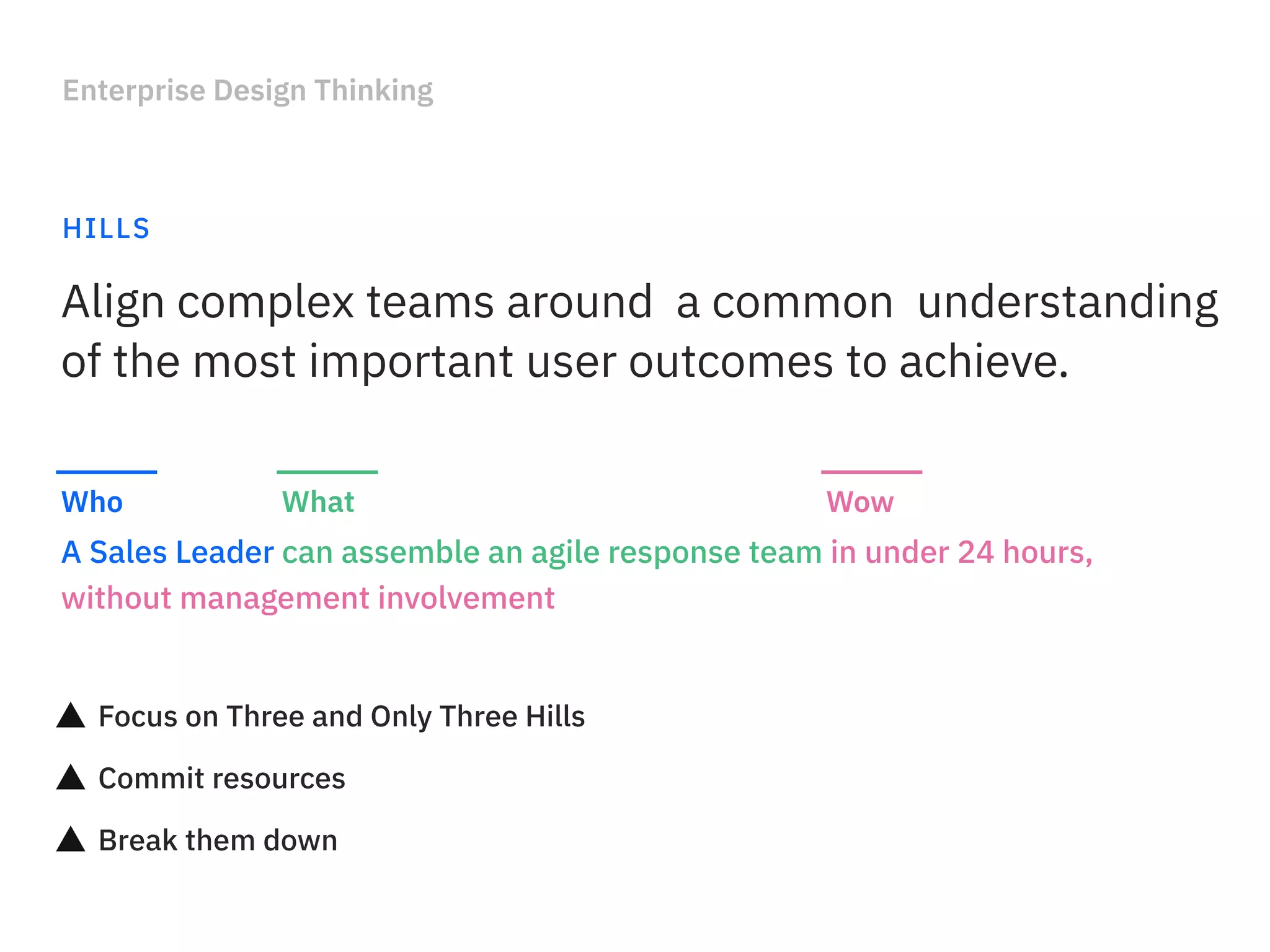
HILLS
Align complex teams around a common understanding
of the most important user outcomes to achieve.
A Sales Leader can assemble an agile response team in under 24 hours,
without management involvement
Who What Wow
Focus on Three and Only Three Hills
Commit resources
Break them down
Enterprise Design Thinking
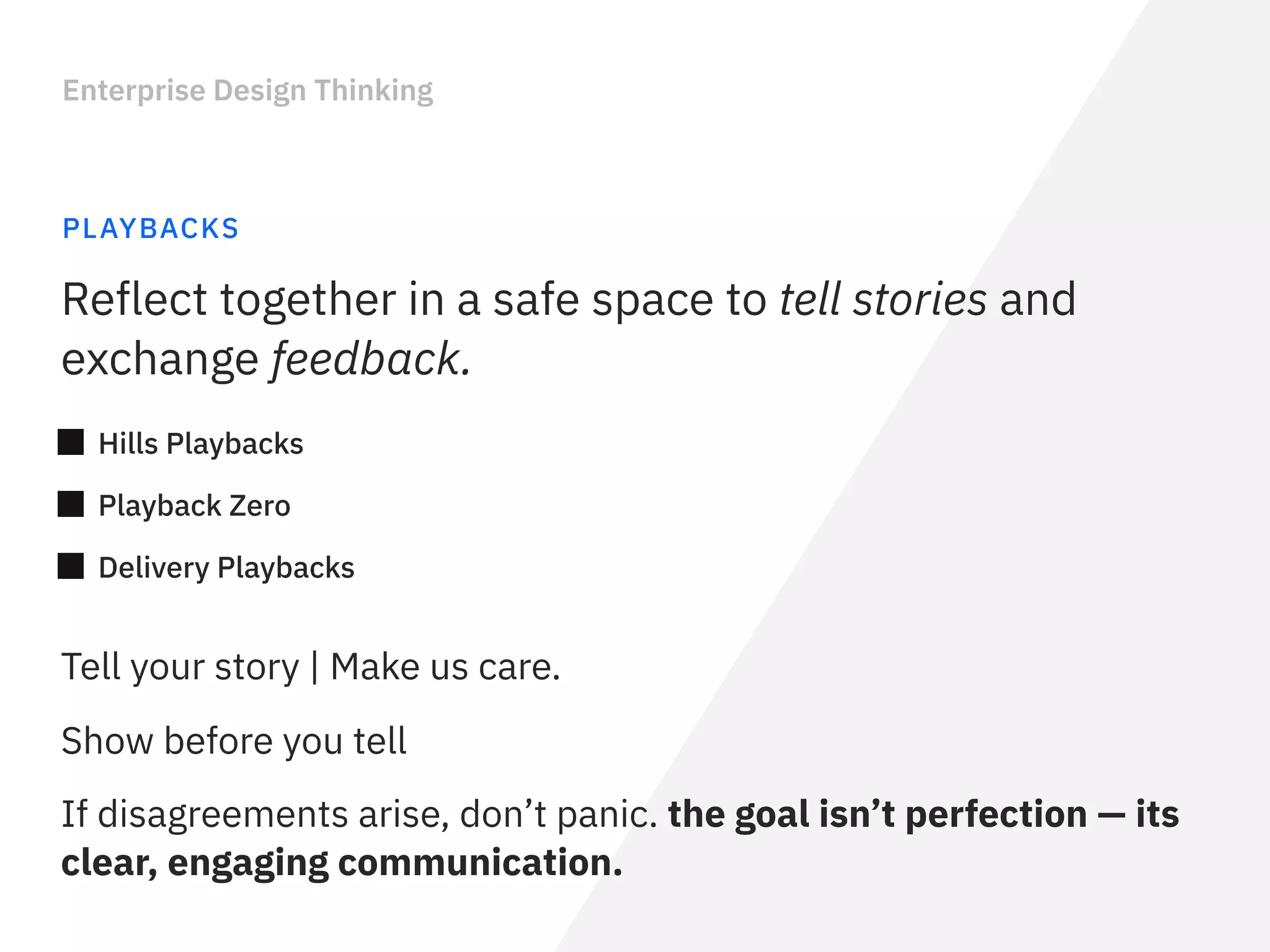
PLAYBACKS
Re๏ฌ‚ect together in a safe space to tell stories and
exchange feedback.
Hills Playbacks
Playback Zero
Delivery Playbacks
Tell your story | Make us care.
Show before you tell
If disagreements arise, donโ€™t panic. the goal isnโ€™t perfection โ€” its
clear, engaging communication.
Enterprise Design Thinking
SPONSOR USER
Give user a seat at the table. Invite them to observe,
reflect and make with you.
Design for real target users rather than imagined needs.
Sponsor User should attend Playbacks.
Potential users are all around us.
Users that bring lived experience and domain expertise to the team.
Active Participants that help you deliver outcomes meet their needs.
Interactions ensures that your product is valuable and effortless.
รง
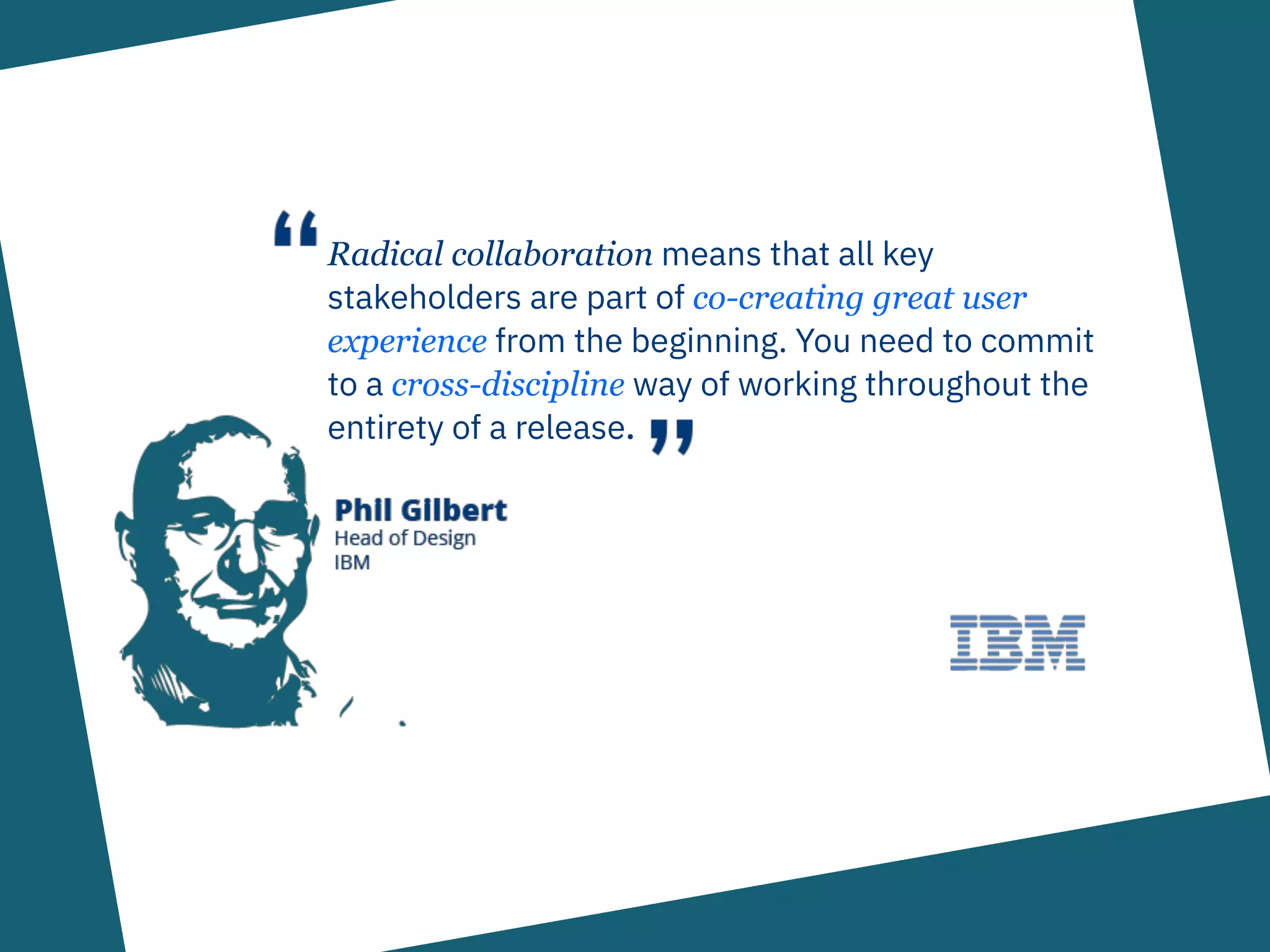
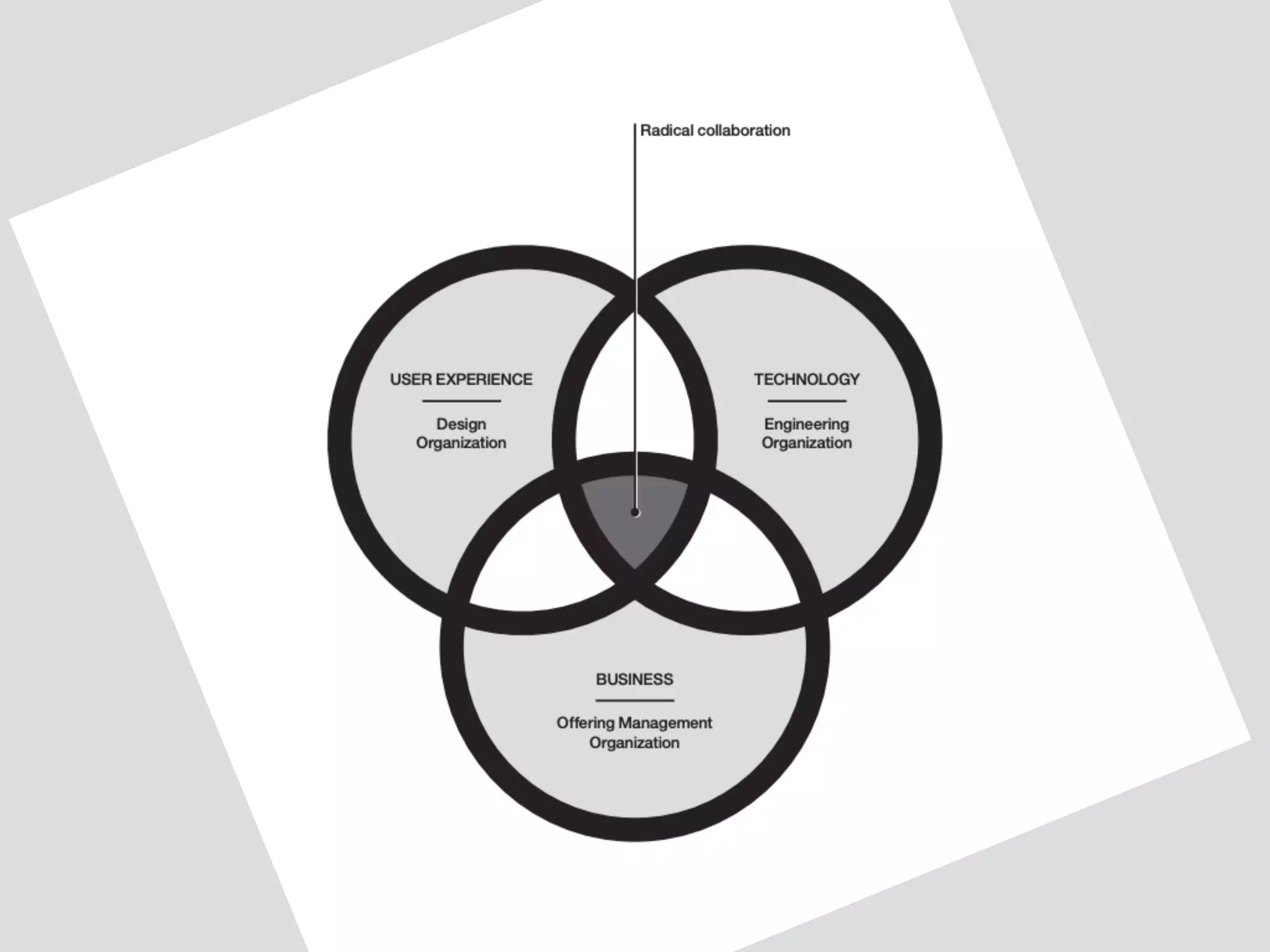
Radical collaboration means that all key
stakeholders are part of co-creating great user
experience from the beginning. You need to commit
to a cross-discipline way of working throughout the
entirety of a release.
Enterprise Design Thinking
TOOLKIT
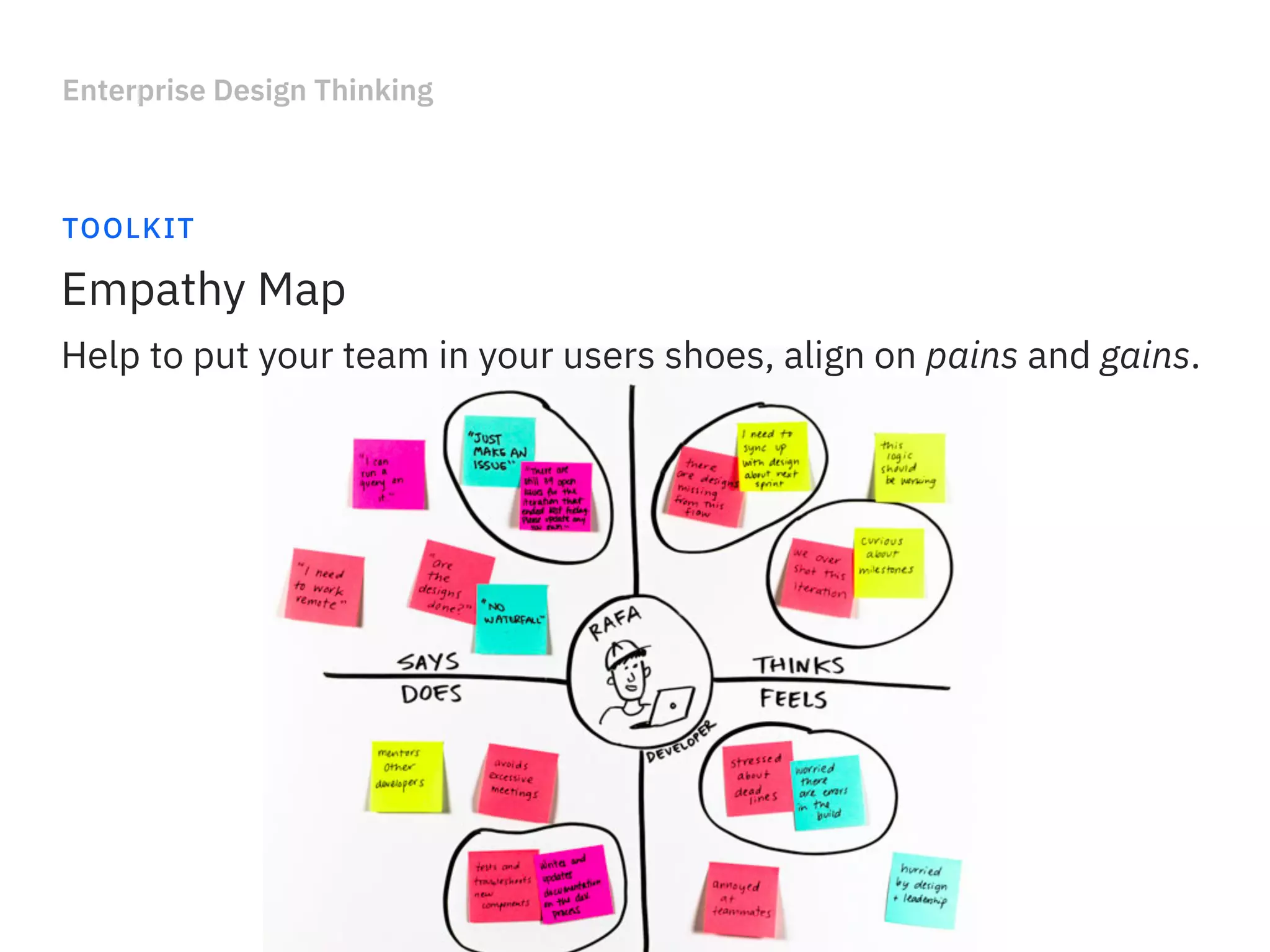
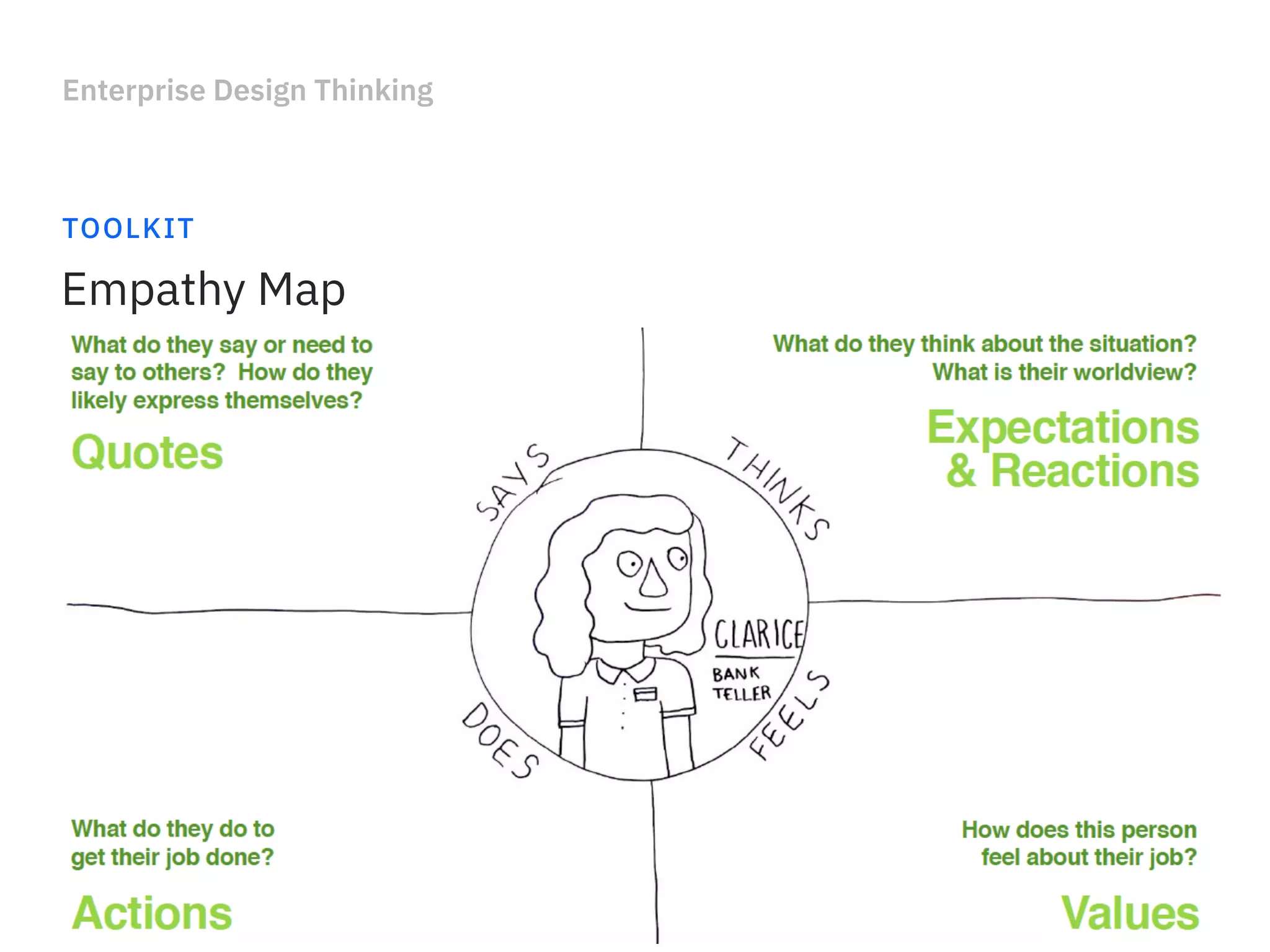
Empathy Map
Help to put your team in your users shoes, align on pains and gains.
Enterprise Design Thinking
TOOLKIT
Empathy Map
Enterprise Design Thinking
TOOLKIT
Empathy Map
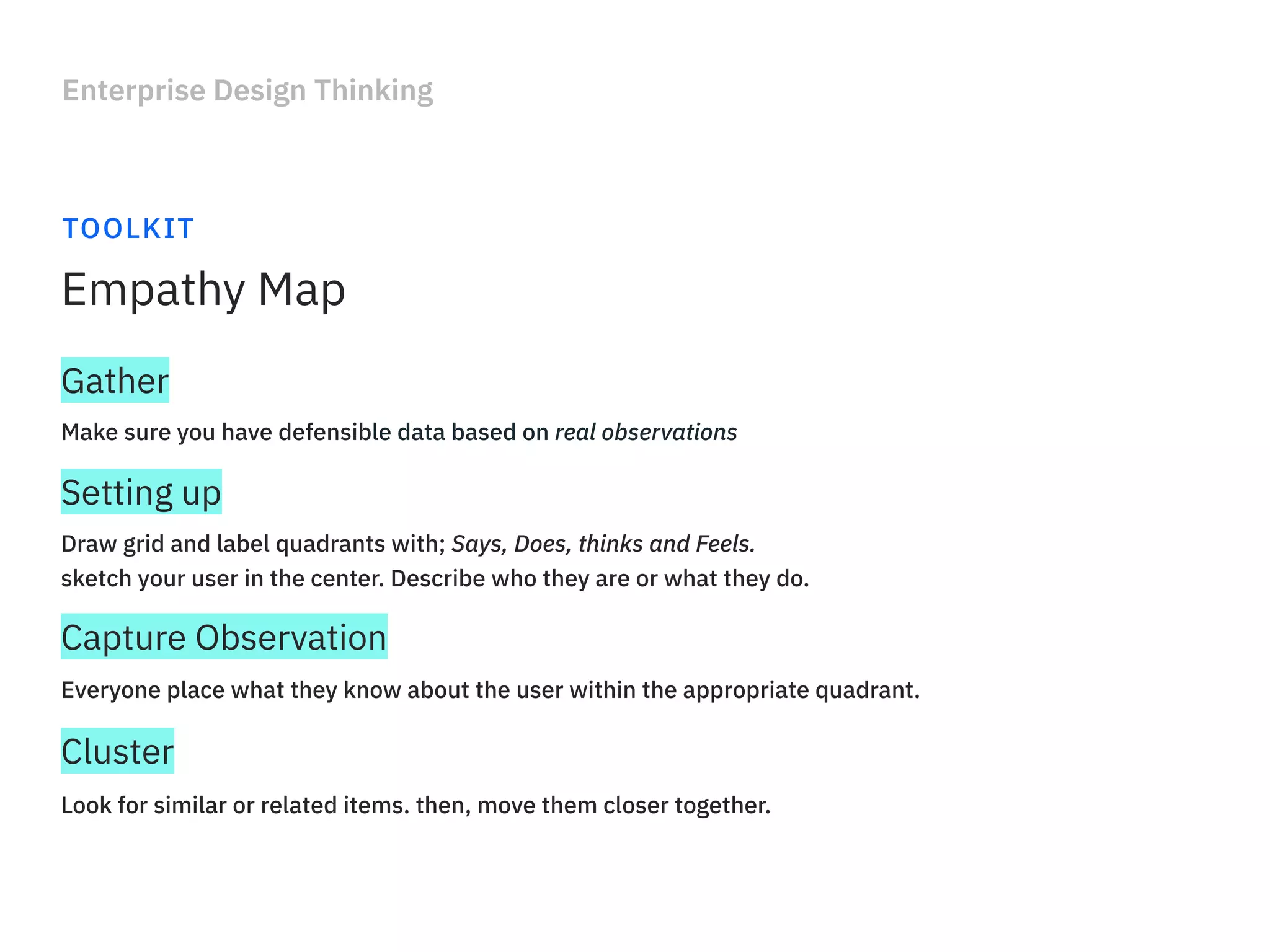
Make sure you have defensible data based on real observationsย 
Gather
Draw grid and label quadrants with; Says, Does, thinks and Feels.
sketch your user in the center. Describe who they are or what they do.
Setting up
Everyone place what they know about the user within the appropriate quadrant.
Capture Observation
Look for similar or related items. then, move them closer together.
Cluster
Enterprise Design Thinking
TOOLKIT
Empathy Map
Stay focused on your users.
Diverge to get everyoneโ€™s ideas. then, converge to determine the strongest ideas.
Everyone participates.
Yes, and โ€ฆ
keep them at the center of your attention.
there are no bad ideas.
stay engaged and avoid side conversations.
instead of dismissing an idea, push yourself to build on them.
Enterprise Design Thinking
TOOLKIT
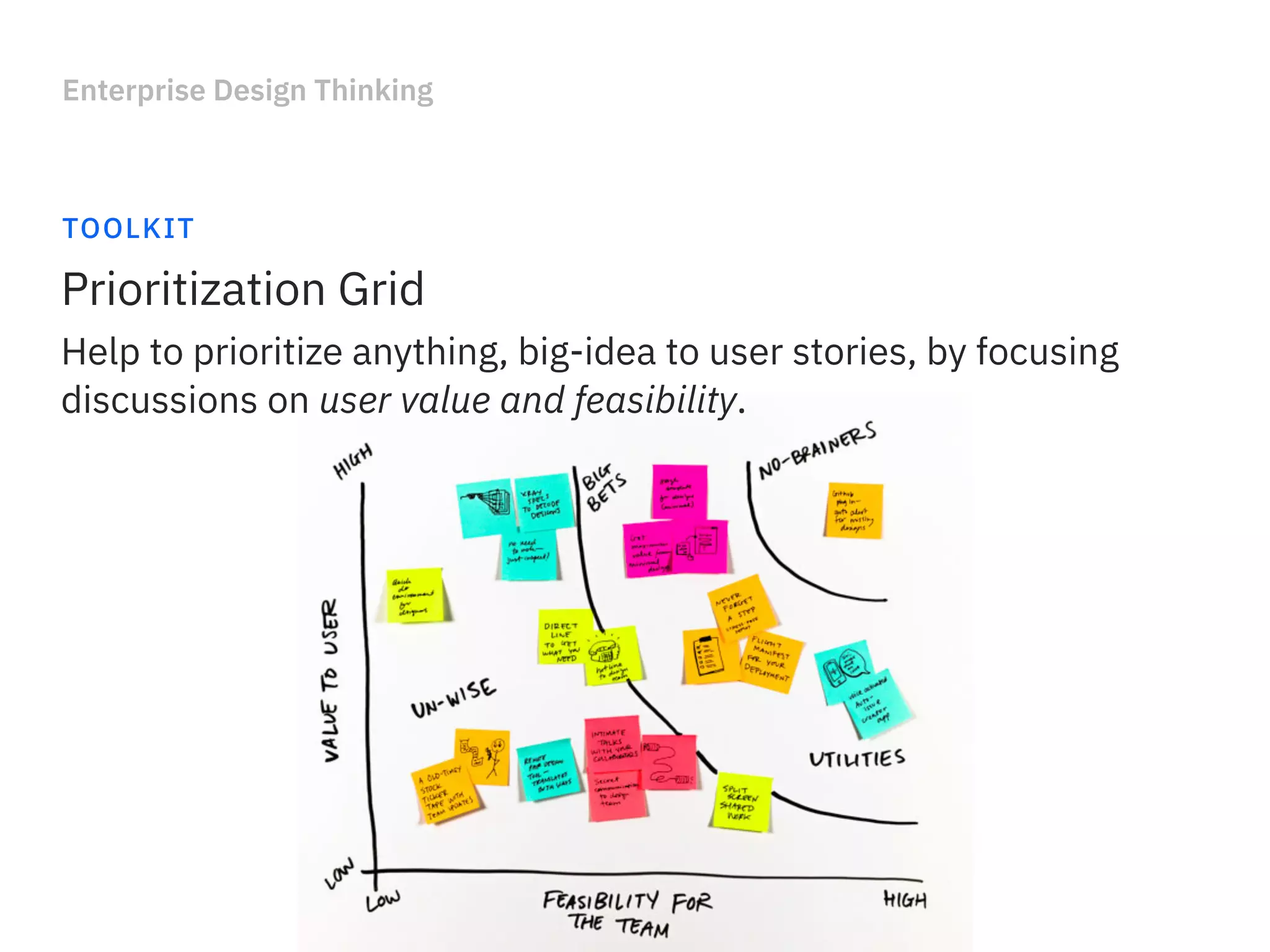
Prioritization Grid
Help to prioritize anything, big-idea to user stories, by focusing
discussions on user value and feasibility.
Enterprise Design Thinking
TOOLKIT
Prioritization Grid
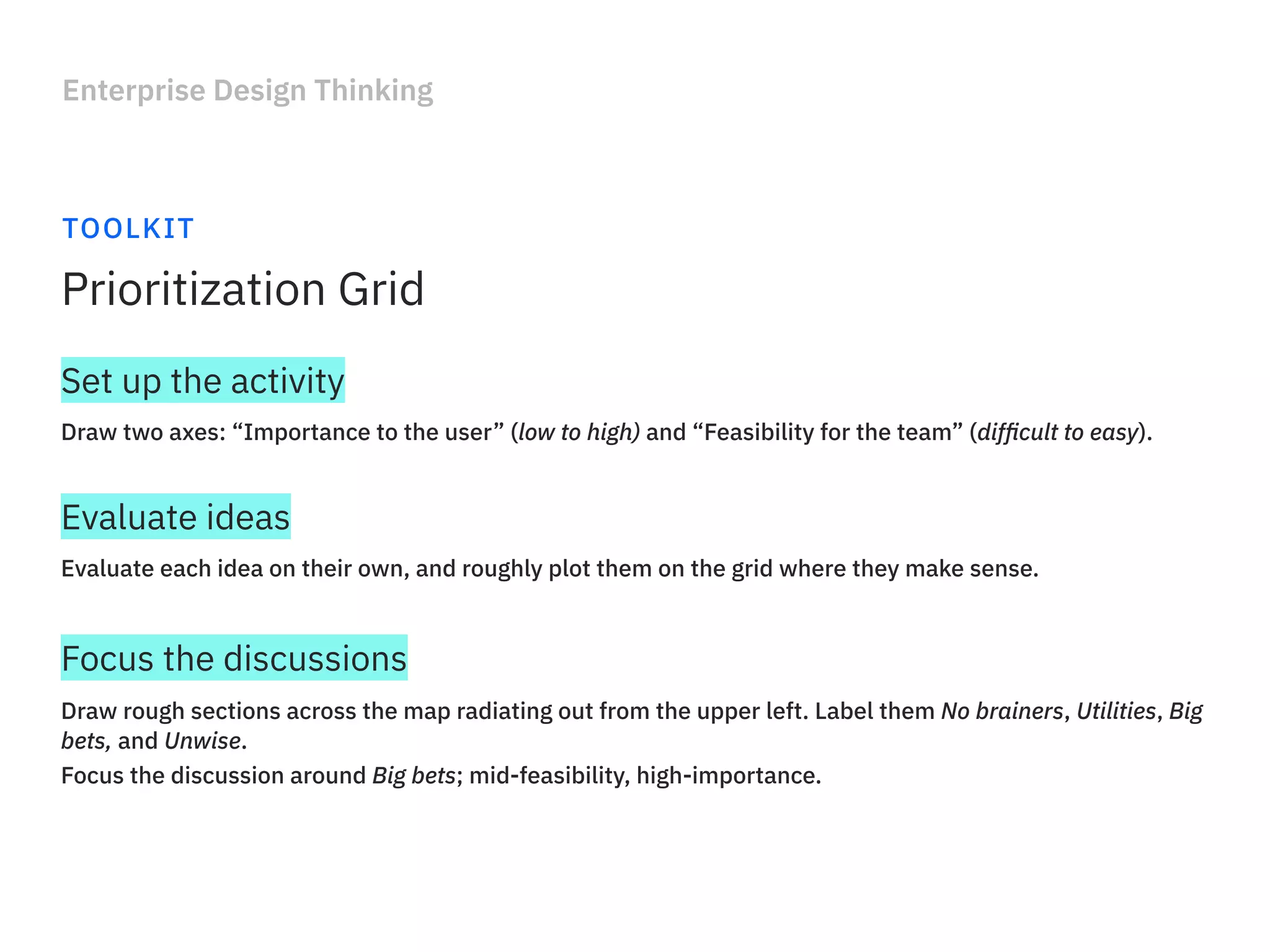
Draw two axes: โ€œImportance to the userโ€ (low to high) and โ€œFeasibility for the teamโ€ (dif๏ฌcult to easy).
Set up the activity
Evaluate each idea on their own, and roughly plot them on the grid where they make sense.
Evaluate ideas
Draw rough sections across the map radiating out from the upper left. Label them No brainers, Utilities, Big
bets, and Unwise.
Focus the discussion around Big bets; mid-feasibility, high-importance.
Focus the discussions
Enterprise Design Thinking
TOOLKIT
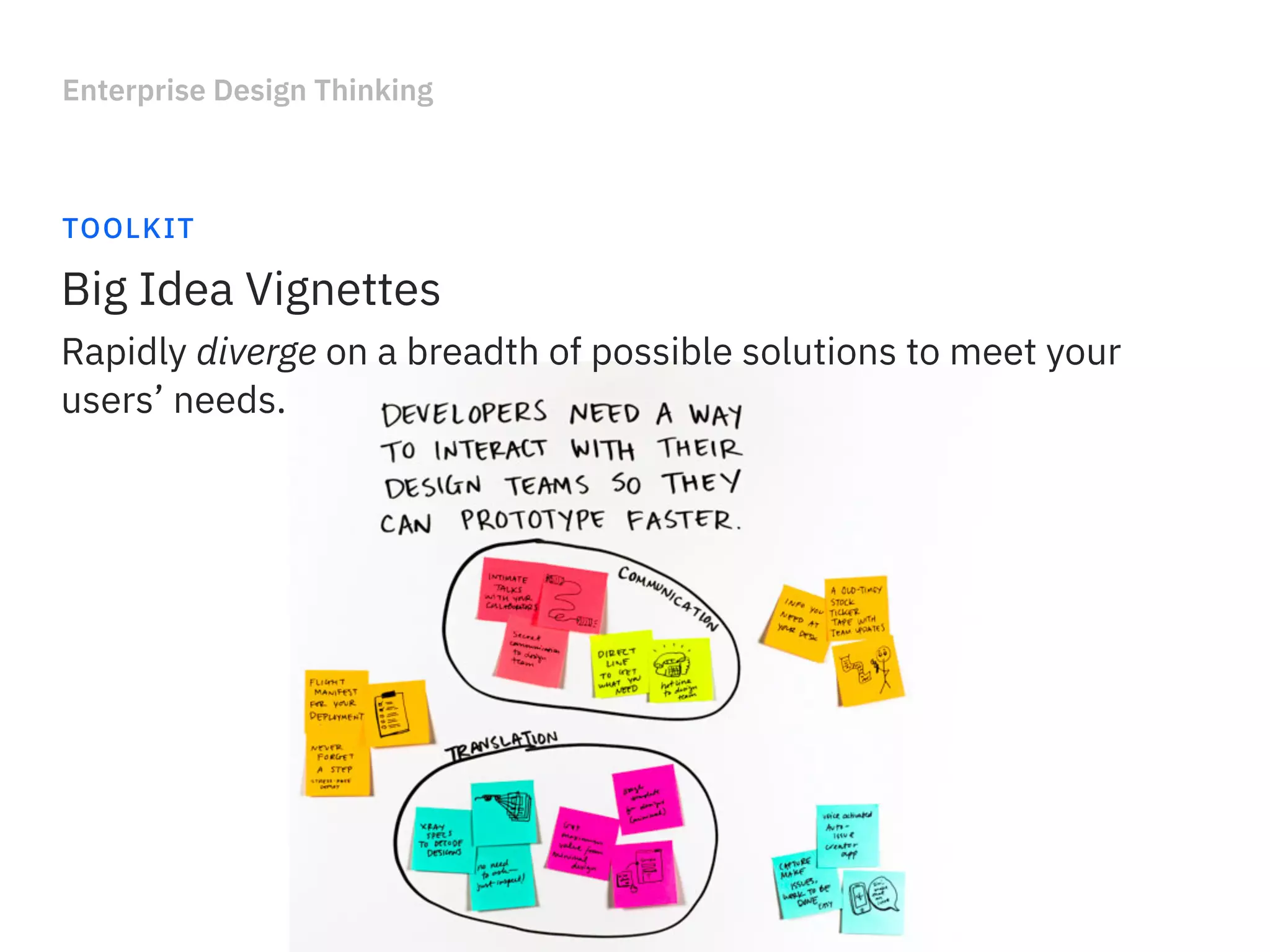
Big Idea Vignettes
Rapidly diverge on a breadth of possible solutions to meet your
usersโ€™ needs.
Enterprise Design Thinking
TOOLKIT
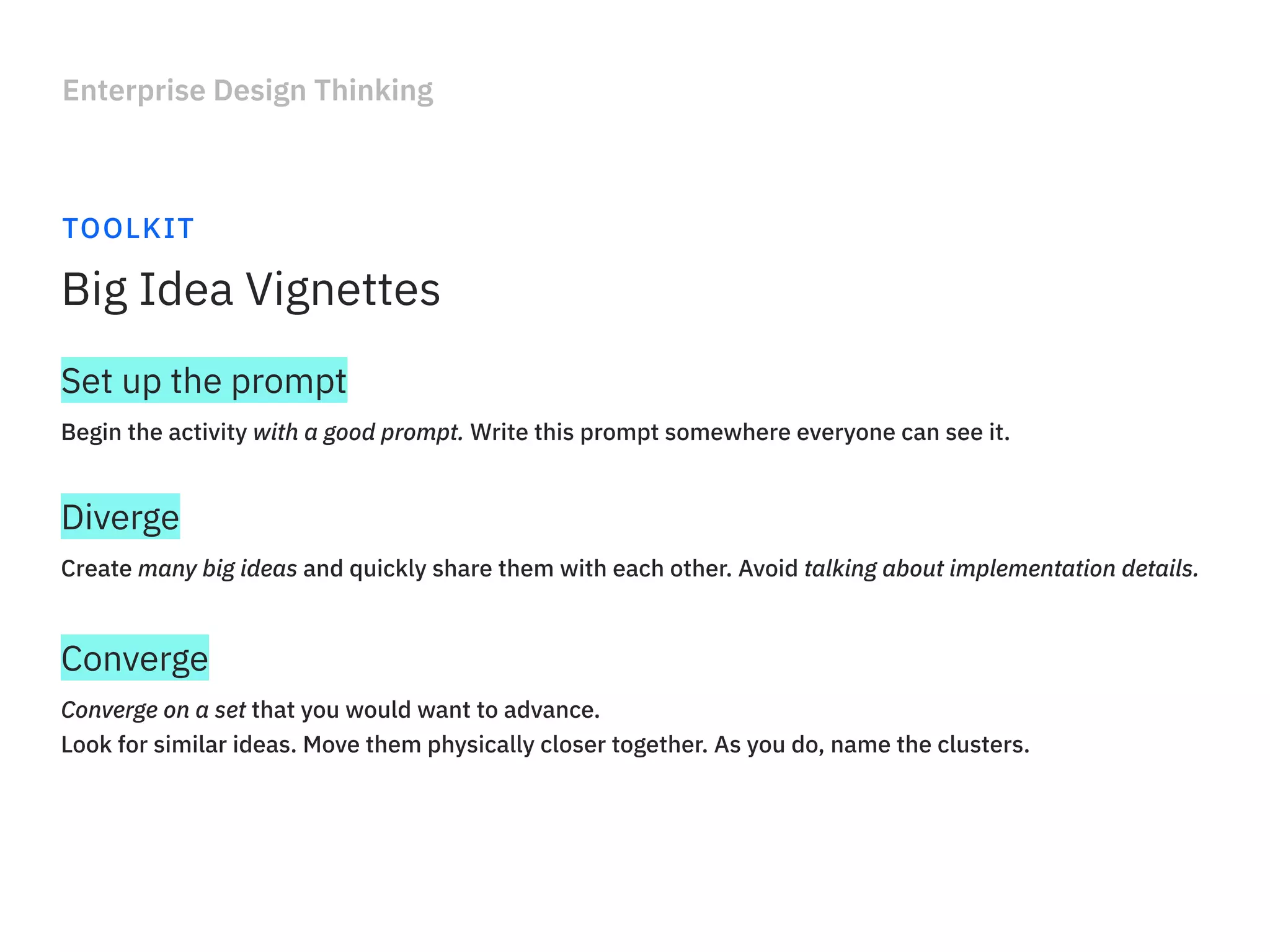
Big Idea Vignettes
Begin the activity with a good prompt. Write this prompt somewhere everyone can see it.
Set up the prompt
Create many big ideas and quickly share them with each other. Avoid talking about implementation details.
Diverge
Converge on a set that you would want to advance.
Look for similar ideas. Move them physically closer together. As you do, name the clusters.
Converge
Enterprise Design Thinking
TOOLKIT
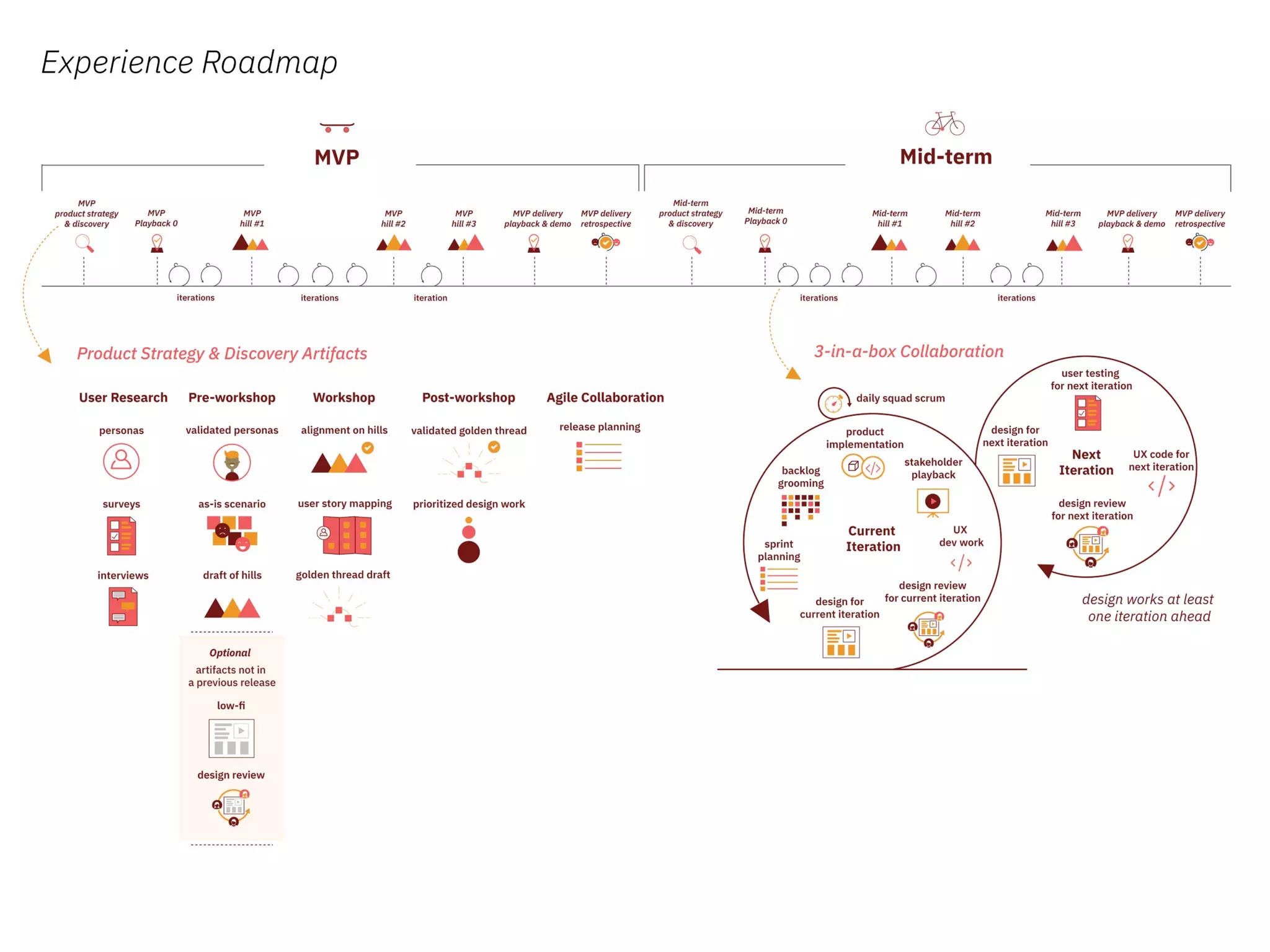
Experience-based Roadmap
Help to scope what youโ€™d like your users to be able to do, and when
youโ€™ll deliver those experiences.
Enterprise Design Thinking
TOOLKIT
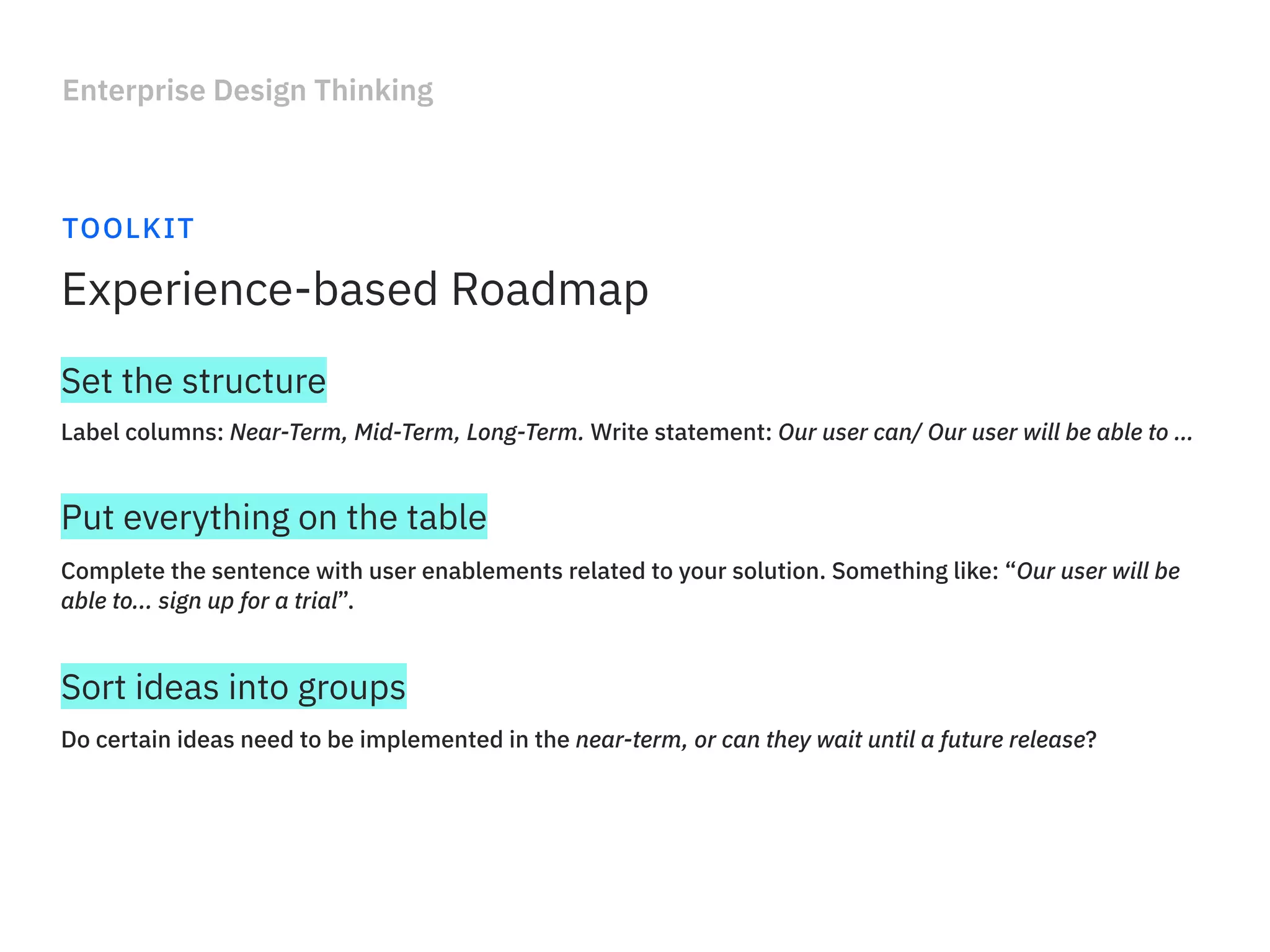
Experience-based Roadmap
Label columns: Near-Term, Mid-Term, Long-Term. Write statement: Our user can/ Our user will be able to โ€ฆ
Set the structure
Complete the sentence with user enablements related to your solution. Something like: โ€œOur user will be
able to... sign up for a trialโ€.
Put everything on the table
Do certain ideas need to be implemented in the near-term, or can they wait until a future release?
Sort ideas into groups
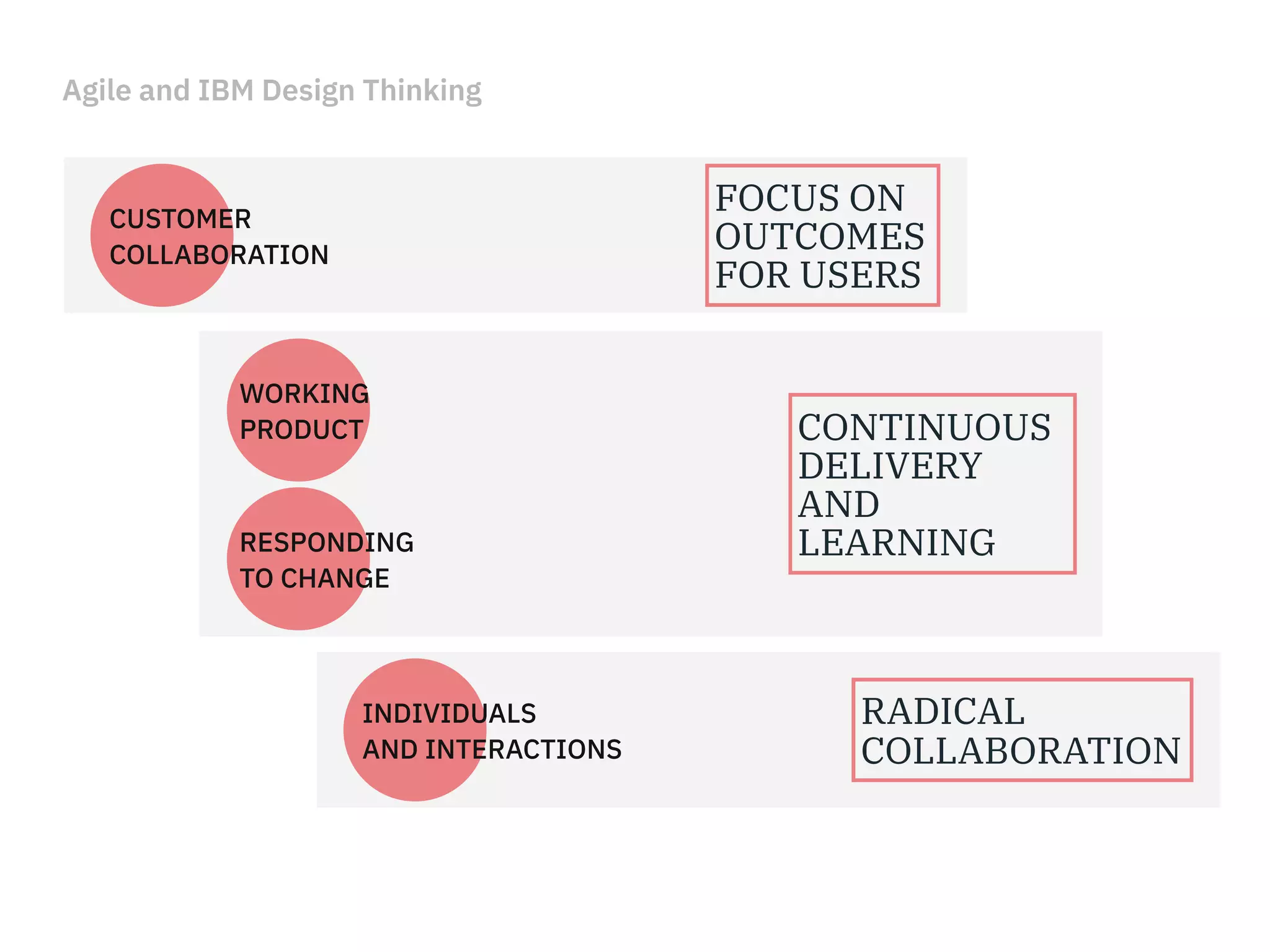
Agile and IBM Design Thinking
CUSTOMER
COLLABORATION
WORKING
PRODUCT
RESPONDING
TO CHANGE
INDIVIDUALS
AND INTERACTIONS
FOCUS ON
OUTCOMES
FOR USERS
CONTINUOUS
DELIVERY
AND
LEARNING
RADICAL
COLLABORATION
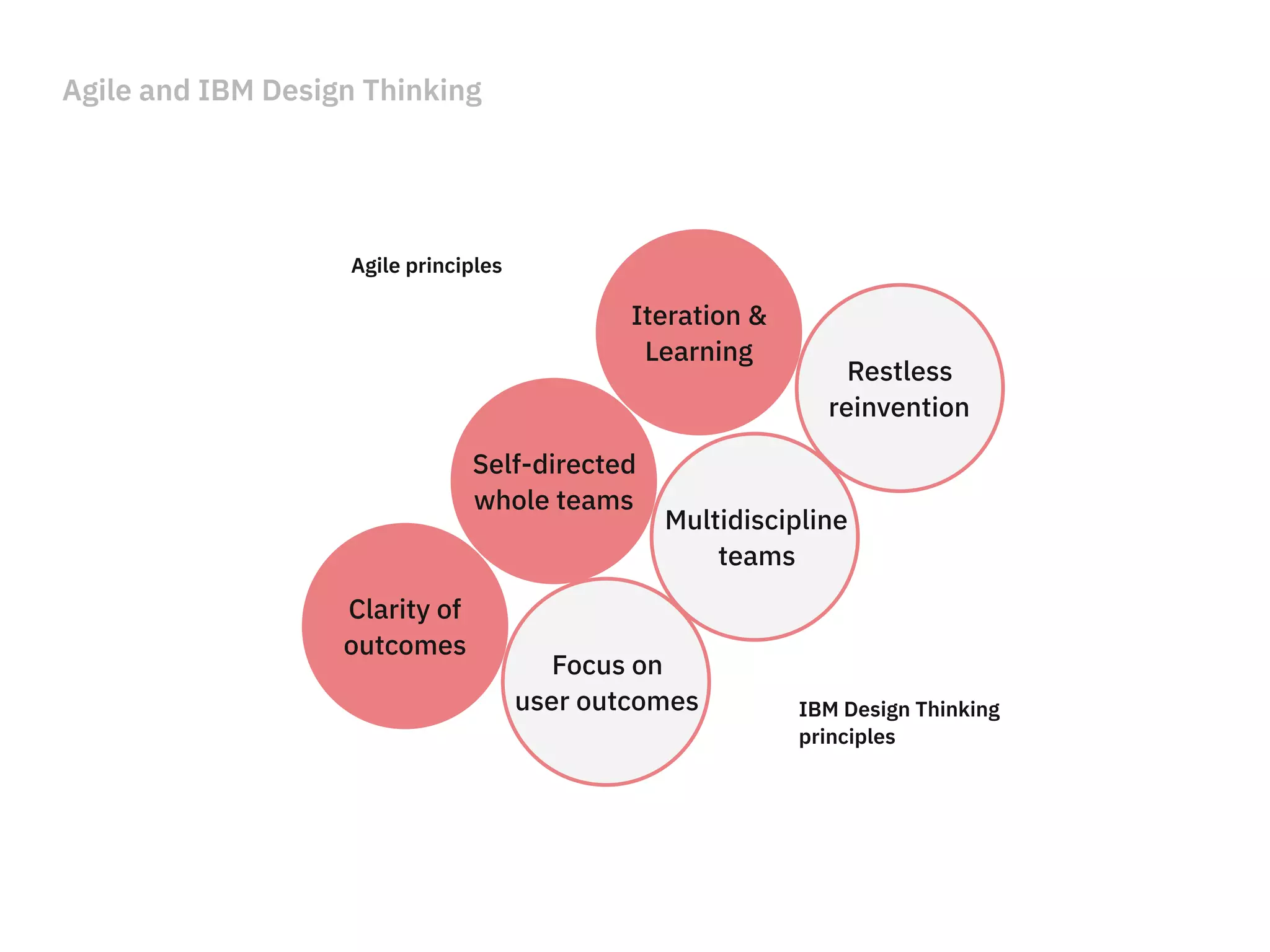
Agile and IBM Design Thinking
Clarity of
outcomes
Self-directed
whole teams
Iteration &
Learning
Focus on
user outcomes
Multidiscipline
teams
Restless
reinvention
IBM Design Thinking
principles
Agile principles
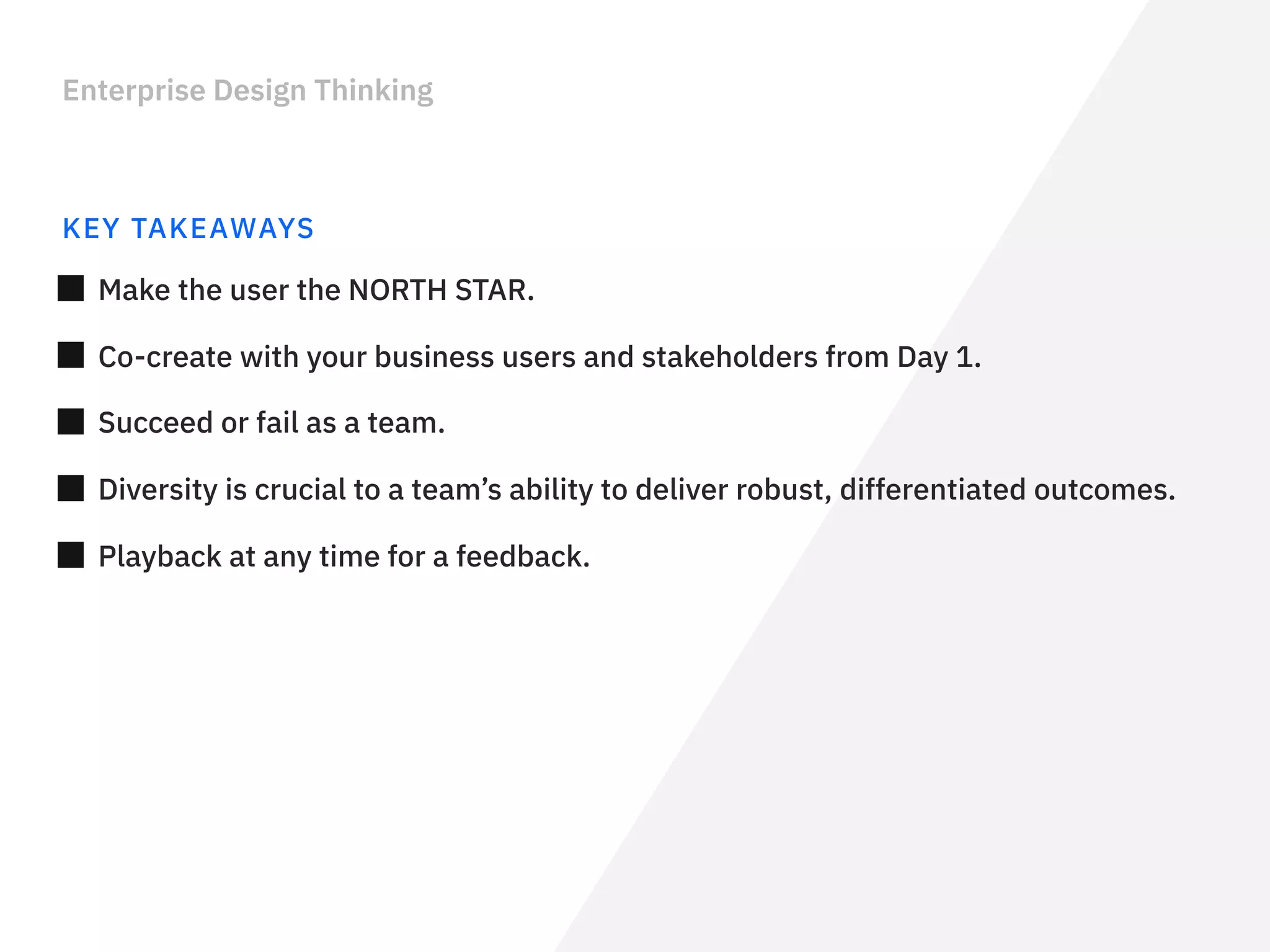
Enterprise Design Thinking
KEY TAKEAWAYS
Make the user the NORTH STAR.
Co-create with your business users and stakeholders from Day 1.
Diversity is crucial to a teamโ€™s ability to deliver robust, differentiated outcomes.
Playback at any time for a feedback.
Succeed or fail as a team.
IBMย Design Language
Enterprise Design Thinking
Practice Design Thinking
Empath Map: a complete Guide
Enterprise Design Thinking
KNOWING HOW
Thank you!
Ahmed Kraiz
Business Analyst
akraiz@live.com
0 5 9 0 0 6 5 1 6 2

IBM Enterprise Design Thinking

  • 1.
  • 3.
    History of DesignThinking Horst Rittel coined the term โ€œWicked Problems.โ€ championed the human experience and perception when designing. 1973 Richard Buchanan published Wicked Problems in Design Thinking. 1992 IDEO has popularize the terms Design Thinking and Human-Centered Design 1991 IBM executives decided to build a new development approach. 2012
  • 4.
    Designers donโ€™t tryto search for a solution until they have determined the real problem, and even then, instead of solving that problem, they stop to consider a wide range of potential solutions. Only then will they converge upon their proposal. DESIGN THINKING PROCESS -Don Norman, author, The Design of Everyday Things โ€
  • 7.
    Enterprise Design Thinking INTRODUCTION Ithelps teams to continuously understand and deliver. Aย frameworkย that aligns multi-disciplinary teams around the real needs of their users.
  • 8.
    Enterprise Design Thinking INTRODUCTION Itโ€™sa proven way to come to better solutions, faster. Teams can work more ef๏ฌciently, because they stay aligned and keep people at the center of their work.
  • 12.
    Fail Early & LearnWell Enterprise Design Thinking MINDSETS You have to know whatย doesnโ€™tย work in order to really appreciate whatย does!
  • 13.
    Be Patient, Be Explorer. EnterpriseDesign Thinking MINDSETS The best designs donโ€™t happen in a single stroke. Be able to better appreciate, accomplish the ideas of others
  • 14.
    Be Wild Duck. EnterpriseDesign Thinking MINDSETS A restless explorer who are always looking for a new angle on a big problem.ย 
  • 15.
  • 16.
    Enterprise Design Thinking THEFRAMEWORK A human-centered mission to solve our usersโ€™ problems at the speed and scale of the complex enterprise. Theย Principles Theย Loop Theย Keys
  • 17.
    Enterprise Design Thinking PRINCIPLES Seeproblems and solutions as an ongoing conversation.
  • 18.
    Enterprise Design Thinking FOCUSON USER OUTCOMES Success isnโ€™t measured by the features we ship - its measured by how well we ful๏ฌll our users` needs. Shift the conversation from one about features and functions to one about users and user outcomes. help us deliver more useful, usable, and desirable solutions.
  • 19.
    Enterprise Design Thinking FOCUSON USER OUTCOMES Differentiate between users and clients Build empathy with users Understand their role
  • 20.
    Enterprise Design Thinking DIVERSEEMPOWERED TEAMS Two team factors to generate better ideas and deliver outcomes for users: diversity and empowerment Diverse teams see the same problem from many angles. Empower them with the expertise and authority to turn those ideas into outcomes.
  • 21.
    Enterprise Design Thinking DIVERSEEMPOWERED TEAMS Differentiation through diversity Speed through empowerment Form self-contained teams
  • 22.
    Enterprise Design Thinking RESTLESSREINVENTION Everything is a prototype. Everything; even in-market solutions. When you think of everything as just another iteration, you are empowered to bring new thinking to the oldest problems.
  • 23.
    Enterprise Design Thinking THELOOP Understand usersโ€™ needs and deliver outcomes continuously.
  • 24.
    Enterprise Design Thinking THELOOP Understand usersโ€™ needs and deliver outcomes continuously.
  • 25.
    Enterprise Design Thinking OBSERVE Everyoneon your team should have chance to see their usersโ€™ worldย  Observing users in their world gives you the opportunity to empathize with their experience, understand their context, uncover hidden needs, and hear their honest feedback.
  • 26.
  • 27.
  • 28.
  • 29.
    Enterprise Design Thinking REFLECT Reflectingbrings your team together to synchronize your movements and synthesize what youโ€™ve learned. Come together and look within! Get to know each other. Align on intent Plan ahead
  • 30.
  • 31.
  • 32.
    Enterprise Design Thinking MAKE Explorepossibilities The earlier you make, the faster you learn Donโ€™t be afraid to share ideas even if they arenโ€™t fully baked Prototype concepts Drive outcomes
  • 33.
  • 34.
  • 35.
    Enterprise Design Thinking THEKEYS If every problem could be solved by a handful of people, the Loop would be enough. But in the real world, complex problems call for complex teams.
  • 36.
    Enterprise Design Thinking HILLS Aligncomplex teams around a common understanding of the most important user outcomes to achieve. A Sales Leader can assemble an agile response team in under 24 hours, without management involvement Who What Wow Focus on Three and Only Three Hills Commit resources Break them down
  • 37.
    Enterprise Design Thinking PLAYBACKS Re๏ฌ‚ecttogether in a safe space to tell stories and exchange feedback. Hills Playbacks Playback Zero Delivery Playbacks Tell your story | Make us care. Show before you tell If disagreements arise, donโ€™t panic. the goal isnโ€™t perfection โ€” its clear, engaging communication.
  • 38.
    Enterprise Design Thinking SPONSORUSER Give user a seat at the table. Invite them to observe, reflect and make with you. Design for real target users rather than imagined needs. Sponsor User should attend Playbacks. Potential users are all around us. Users that bring lived experience and domain expertise to the team. Active Participants that help you deliver outcomes meet their needs. Interactions ensures that your product is valuable and effortless.
  • 39.
  • 40.
    Radical collaboration meansthat all key stakeholders are part of co-creating great user experience from the beginning. You need to commit to a cross-discipline way of working throughout the entirety of a release.
  • 41.
    Enterprise Design Thinking TOOLKIT EmpathyMap Help to put your team in your users shoes, align on pains and gains.
  • 42.
  • 43.
    Enterprise Design Thinking TOOLKIT EmpathyMap Make sure you have defensible data based on real observationsย  Gather Draw grid and label quadrants with; Says, Does, thinks and Feels. sketch your user in the center. Describe who they are or what they do. Setting up Everyone place what they know about the user within the appropriate quadrant. Capture Observation Look for similar or related items. then, move them closer together. Cluster
  • 44.
    Enterprise Design Thinking TOOLKIT EmpathyMap Stay focused on your users. Diverge to get everyoneโ€™s ideas. then, converge to determine the strongest ideas. Everyone participates. Yes, and โ€ฆ keep them at the center of your attention. there are no bad ideas. stay engaged and avoid side conversations. instead of dismissing an idea, push yourself to build on them.
  • 45.
    Enterprise Design Thinking TOOLKIT PrioritizationGrid Help to prioritize anything, big-idea to user stories, by focusing discussions on user value and feasibility.
  • 46.
    Enterprise Design Thinking TOOLKIT PrioritizationGrid Draw two axes: โ€œImportance to the userโ€ (low to high) and โ€œFeasibility for the teamโ€ (dif๏ฌcult to easy). Set up the activity Evaluate each idea on their own, and roughly plot them on the grid where they make sense. Evaluate ideas Draw rough sections across the map radiating out from the upper left. Label them No brainers, Utilities, Big bets, and Unwise. Focus the discussion around Big bets; mid-feasibility, high-importance. Focus the discussions
  • 47.
    Enterprise Design Thinking TOOLKIT BigIdea Vignettes Rapidly diverge on a breadth of possible solutions to meet your usersโ€™ needs.
  • 48.
    Enterprise Design Thinking TOOLKIT BigIdea Vignettes Begin the activity with a good prompt. Write this prompt somewhere everyone can see it. Set up the prompt Create many big ideas and quickly share them with each other. Avoid talking about implementation details. Diverge Converge on a set that you would want to advance. Look for similar ideas. Move them physically closer together. As you do, name the clusters. Converge
  • 49.
    Enterprise Design Thinking TOOLKIT Experience-basedRoadmap Help to scope what youโ€™d like your users to be able to do, and when youโ€™ll deliver those experiences.
  • 50.
    Enterprise Design Thinking TOOLKIT Experience-basedRoadmap Label columns: Near-Term, Mid-Term, Long-Term. Write statement: Our user can/ Our user will be able to โ€ฆ Set the structure Complete the sentence with user enablements related to your solution. Something like: โ€œOur user will be able to... sign up for a trialโ€. Put everything on the table Do certain ideas need to be implemented in the near-term, or can they wait until a future release? Sort ideas into groups
  • 52.
    Agile and IBMDesign Thinking CUSTOMER COLLABORATION WORKING PRODUCT RESPONDING TO CHANGE INDIVIDUALS AND INTERACTIONS FOCUS ON OUTCOMES FOR USERS CONTINUOUS DELIVERY AND LEARNING RADICAL COLLABORATION
  • 53.
    Agile and IBMDesign Thinking Clarity of outcomes Self-directed whole teams Iteration & Learning Focus on user outcomes Multidiscipline teams Restless reinvention IBM Design Thinking principles Agile principles
  • 54.
    Enterprise Design Thinking KEYTAKEAWAYS Make the user the NORTH STAR. Co-create with your business users and stakeholders from Day 1. Diversity is crucial to a teamโ€™s ability to deliver robust, differentiated outcomes. Playback at any time for a feedback. Succeed or fail as a team.
  • 55.
    IBMย Design Language Enterprise DesignThinking Practice Design Thinking Empath Map: a complete Guide Enterprise Design Thinking KNOWING HOW
  • 56.
    Thank you! Ahmed Kraiz BusinessAnalyst akraiz@live.com 0 5 9 0 0 6 5 1 6 2