Don’t let
assumptions
kill good ideas
Hello!
I’m Lauren
You can find me at
@laurenteresa
2
Assistant Professor
Interactive Arts & Media Department
Columbia College Chicago
Some basics...
Let’s talk about the design
process.
3
HOLD UP
You do follow a design process, right?
4
Some basics...
Let’s talk about the design
process.
5
Some basics...
Let’s talk about the design
process.
6
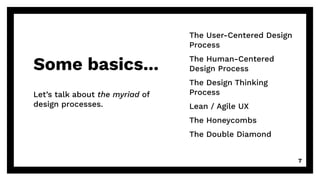
Some basics...
Let’s talk about the myriad of
design processes.
7
The User-Centered Design
Process
The Human-Centered
Design Process
The Design Thinking
Process
Lean / Agile UX
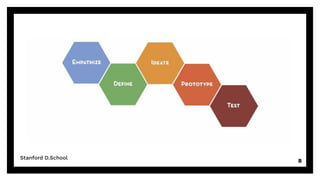
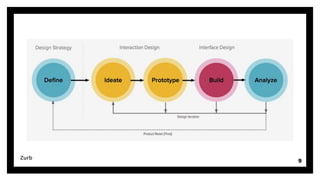
The Honeycombs
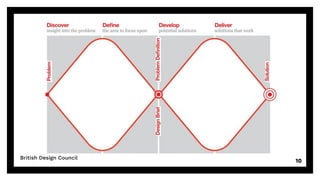
The Double Diamond
8
Stanford D.School
9
Zurb
10
British Design Council
11
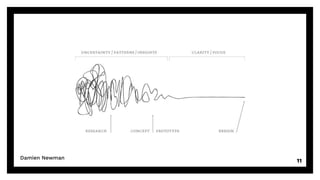
Damien Newman
LET’S
SIMPLIFY.
12
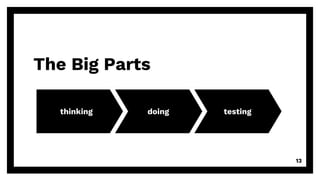
The Big Parts
thinking doing testing
13
Thinking
Ideation, Brainstorming, Discovery,
Definition, Research.
1.
Assumption
Brainstorming is easy and fun for everyone
15
Worst Idea Ever
Get ridiculous. Make terrible
suggestions. Relax. Laugh.
16
Worst Idea Ever
Get ridiculous. Make terrible
suggestions. Relax. Laugh.
17
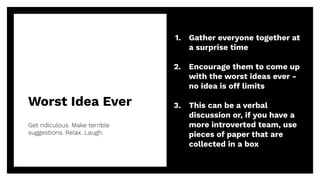
1. Gather everyone together at
a surprise time
2. Encourage them to come up
with the worst ideas ever -
no idea is off limits
3. This can be a verbal
discussion or, if you have a
more introverted team, use
pieces of paper that are
collected in a box
Worst Idea Ever
Get ridiculous. Make terrible
suggestions. Relax. Laugh.
18
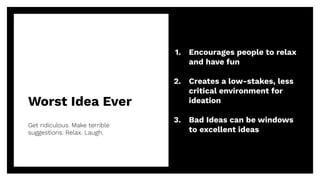
1. Encourages people to relax
and have fun
2. Creates a low-stakes, less
critical environment for
ideation
3. Bad Ideas can be windows
to excellent ideas
Assumption
Ideas have to be rooted in reality
19
The Disney Method
Live in a world of limitless
possibilities. Explore the boundaries
of questions. Wear ears if you want.
20
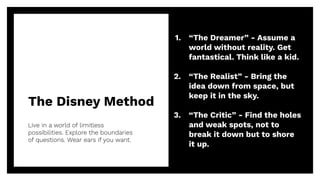
The Disney Method
Live in a world of limitless
possibilities. Explore the boundaries
of questions. Wear ears if you want.
21
1. “The Dreamer” - Assume a
world without reality. Get
fantastical. Think like a kid.
2. “The Realist” - Bring the
idea down from space, but
keep it in the sky.
3. “The Critic” - Find the holes
and weak spots, not to
break it down but to shore
it up.
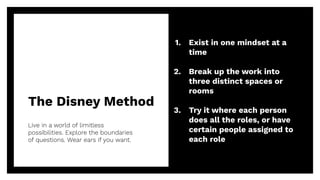
The Disney Method
Live in a world of limitless
possibilities. Explore the boundaries
of questions. Wear ears if you want.
22
1. Exist in one mindset at a
time
2. Break up the work into
three distinct spaces or
rooms
3. Try it where each person
does all the roles, or have
certain people assigned to
each role
Assumption
We are thinking about the right channel
23
Heuristic Ideation
Technique
An old technique updated for our
omnichannel world. Explore ideas
and concepts in different
applications.
24
Heuristic Ideation
Technique
An old technique updated for our
omnichannel world. Explore ideas
and concepts in different
applications.
25
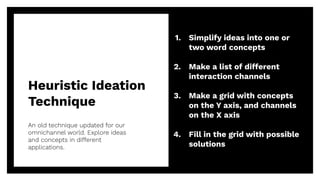
1. Simplify ideas into one or
two word concepts
2. Make a list of different
interaction channels
3. Make a grid with concepts
on the Y axis, and channels
on the X axis
4. Fill in the grid with possible
solutions
Heuristic Ideation
Technique
An old technique updated for our
omnichannel world. Explore ideas
and concepts in different
applications.
26
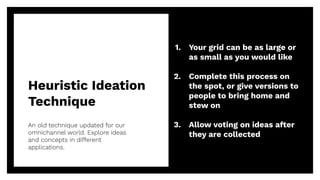
1. Your grid can be as large or
as small as you would like
2. Complete this process on
the spot, or give versions to
people to bring home and
stew on
3. Allow voting on ideas after
they are collected
Assumption
Ideas are best when they are owned
27
Pass the Baby
Sever attachment from your own
ideas, and give a different perspective
to other people’s ideas.
28
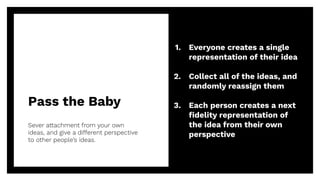
Pass the Baby
Sever attachment from your own
ideas, and give a different perspective
to other people’s ideas.
29
1. Everyone creates a single
representation of their idea
2. Collect all of the ideas, and
randomly reassign them
3. Each person creates a next
fidelity representation of
the idea from their own
perspective
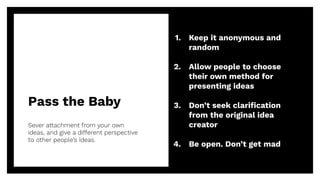
Pass the Baby
Sever attachment from your own
ideas, and give a different perspective
to other people’s ideas.
30
1. Keep it anonymous and
random
2. Allow people to choose
their own method for
presenting ideas
3. Don’t seek clarification
from the original idea
creator
4. Be open. Don’t get mad
Doing
Ideation, Brainstorming, Discovery,
Definition, Research.
2.
Assumption
We know our audience and what they want and need
32
POV Madlib
33
Explore different points of view,
context, and motivation in interaction
to reveal new paths
POV Madlib
34
Explore different points of view,
context, and motivation in interaction
to reveal new paths
1. Follow the format
“[Someone] needs to [verb]
because of [reason /
insight]”
2. Fill in the blanks with
various combinations
3. Have the team vote on
compelling / overlooked
concepts for further
exploration
POV Madlib
35
Explore different points of view,
context, and motivation in interaction
to reveal new paths
1. Be detailed in needs and
motivation to apply
empathy
2. Aim for problem
statements, and not just
logic
3. Think beyond your core
audience
Assumption
We are asking the right question(s)
36
The Toddler Game
37
Turn the annoying but classic pastime
into a results-oriented activity
The Toddler Game
38
Turn the annoying but classic pastime
into a results-oriented activity
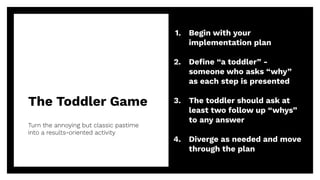
1. Begin with your
implementation plan
2. Define “a toddler” -
someone who asks “why”
as each step is presented
3. The toddler should ask at
least two follow up “whys”
to any answer
4. Diverge as needed and move
through the plan
The Toddler Game
39
Turn the annoying but classic pastime
into a results-oriented activity
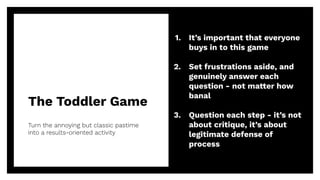
1. It’s important that everyone
buys in to this game
2. Set frustrations aside, and
genuinely answer each
question - not matter how
banal
3. Question each step - it’s not
about critique, it’s about
legitimate defense of
process
Testing
Ideation, Brainstorming, Discovery,
Definition, Research.
3.
Assumption
We are testing the right thing
41
Script Flip
Have your users build your prototypes
for you, part 1
42
Script Flip
Have your users build your prototypes
for you, part 1
43
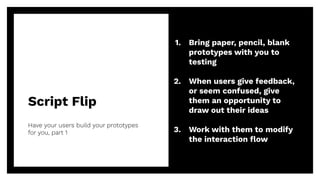
1. Bring paper, pencil, blank
prototypes with you to
testing
2. When users give feedback,
or seem confused, give
them an opportunity to
draw out their ideas
3. Work with them to modify
the interaction flow
Script Flip
Have your users build your prototypes
for you, part 1
44
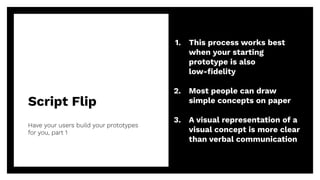
1. This process works best
when your starting
prototype is also
low-fidelity
2. Most people can draw
simple concepts on paper
3. A visual representation of a
visual concept is more clear
than verbal communication
Modular
Prototyping
Have your users build your prototypes
for you, part 2
45
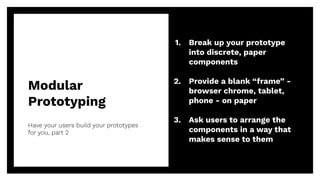
Modular
Prototyping
Have your users build your prototypes
for you, part 2
46
1. Break up your prototype
into discrete, paper
components
2. Provide a blank “frame” -
browser chrome, tablet,
phone - on paper
3. Ask users to arrange the
components in a way that
makes sense to them
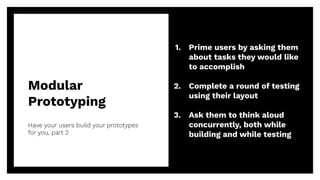
Modular
Prototyping
Have your users build your prototypes
for you, part 2
47
1. Prime users by asking them
about tasks they would like
to accomplish
2. Complete a round of testing
using their layout
3. Ask them to think aloud
concurrently, both while
building and while testing
Assumption
Building products is a linear process
48
Assumption
Starting over at this point is out of question
49
Thanks!
Any questions?
50
You can find me at
@laurenteresa
lliss@colum.edu
Download these slides at
goodspark.com/webcon2021

Don't let assumptions kill good ideas web con 2021

  • 1.
  • 2.
    Hello! I’m Lauren You canfind me at @laurenteresa 2 Assistant Professor Interactive Arts & Media Department Columbia College Chicago
  • 3.
    Some basics... Let’s talkabout the design process. 3
  • 4.
    HOLD UP You dofollow a design process, right? 4
  • 5.
    Some basics... Let’s talkabout the design process. 5
  • 6.
    Some basics... Let’s talkabout the design process. 6
  • 7.
    Some basics... Let’s talkabout the myriad of design processes. 7 The User-Centered Design Process The Human-Centered Design Process The Design Thinking Process Lean / Agile UX The Honeycombs The Double Diamond
  • 8.
  • 9.
  • 10.
  • 11.
  • 12.
  • 13.
    The Big Parts thinkingdoing testing 13
  • 14.
  • 15.
    Assumption Brainstorming is easyand fun for everyone 15
  • 16.
    Worst Idea Ever Getridiculous. Make terrible suggestions. Relax. Laugh. 16
  • 17.
    Worst Idea Ever Getridiculous. Make terrible suggestions. Relax. Laugh. 17 1. Gather everyone together at a surprise time 2. Encourage them to come up with the worst ideas ever - no idea is off limits 3. This can be a verbal discussion or, if you have a more introverted team, use pieces of paper that are collected in a box
  • 18.
    Worst Idea Ever Getridiculous. Make terrible suggestions. Relax. Laugh. 18 1. Encourages people to relax and have fun 2. Creates a low-stakes, less critical environment for ideation 3. Bad Ideas can be windows to excellent ideas
  • 19.
    Assumption Ideas have tobe rooted in reality 19
  • 20.
    The Disney Method Livein a world of limitless possibilities. Explore the boundaries of questions. Wear ears if you want. 20
  • 21.
    The Disney Method Livein a world of limitless possibilities. Explore the boundaries of questions. Wear ears if you want. 21 1. “The Dreamer” - Assume a world without reality. Get fantastical. Think like a kid. 2. “The Realist” - Bring the idea down from space, but keep it in the sky. 3. “The Critic” - Find the holes and weak spots, not to break it down but to shore it up.
  • 22.
    The Disney Method Livein a world of limitless possibilities. Explore the boundaries of questions. Wear ears if you want. 22 1. Exist in one mindset at a time 2. Break up the work into three distinct spaces or rooms 3. Try it where each person does all the roles, or have certain people assigned to each role
  • 23.
    Assumption We are thinkingabout the right channel 23
  • 24.
    Heuristic Ideation Technique An oldtechnique updated for our omnichannel world. Explore ideas and concepts in different applications. 24
  • 25.
    Heuristic Ideation Technique An oldtechnique updated for our omnichannel world. Explore ideas and concepts in different applications. 25 1. Simplify ideas into one or two word concepts 2. Make a list of different interaction channels 3. Make a grid with concepts on the Y axis, and channels on the X axis 4. Fill in the grid with possible solutions
  • 26.
    Heuristic Ideation Technique An oldtechnique updated for our omnichannel world. Explore ideas and concepts in different applications. 26 1. Your grid can be as large or as small as you would like 2. Complete this process on the spot, or give versions to people to bring home and stew on 3. Allow voting on ideas after they are collected
  • 27.
    Assumption Ideas are bestwhen they are owned 27
  • 28.
    Pass the Baby Severattachment from your own ideas, and give a different perspective to other people’s ideas. 28
  • 29.
    Pass the Baby Severattachment from your own ideas, and give a different perspective to other people’s ideas. 29 1. Everyone creates a single representation of their idea 2. Collect all of the ideas, and randomly reassign them 3. Each person creates a next fidelity representation of the idea from their own perspective
  • 30.
    Pass the Baby Severattachment from your own ideas, and give a different perspective to other people’s ideas. 30 1. Keep it anonymous and random 2. Allow people to choose their own method for presenting ideas 3. Don’t seek clarification from the original idea creator 4. Be open. Don’t get mad
  • 31.
  • 32.
    Assumption We know ouraudience and what they want and need 32
  • 33.
    POV Madlib 33 Explore differentpoints of view, context, and motivation in interaction to reveal new paths
  • 34.
    POV Madlib 34 Explore differentpoints of view, context, and motivation in interaction to reveal new paths 1. Follow the format “[Someone] needs to [verb] because of [reason / insight]” 2. Fill in the blanks with various combinations 3. Have the team vote on compelling / overlooked concepts for further exploration
  • 35.
    POV Madlib 35 Explore differentpoints of view, context, and motivation in interaction to reveal new paths 1. Be detailed in needs and motivation to apply empathy 2. Aim for problem statements, and not just logic 3. Think beyond your core audience
  • 36.
    Assumption We are askingthe right question(s) 36
  • 37.
    The Toddler Game 37 Turnthe annoying but classic pastime into a results-oriented activity
  • 38.
    The Toddler Game 38 Turnthe annoying but classic pastime into a results-oriented activity 1. Begin with your implementation plan 2. Define “a toddler” - someone who asks “why” as each step is presented 3. The toddler should ask at least two follow up “whys” to any answer 4. Diverge as needed and move through the plan
  • 39.
    The Toddler Game 39 Turnthe annoying but classic pastime into a results-oriented activity 1. It’s important that everyone buys in to this game 2. Set frustrations aside, and genuinely answer each question - not matter how banal 3. Question each step - it’s not about critique, it’s about legitimate defense of process
  • 40.
  • 41.
    Assumption We are testingthe right thing 41
  • 42.
    Script Flip Have yourusers build your prototypes for you, part 1 42
  • 43.
    Script Flip Have yourusers build your prototypes for you, part 1 43 1. Bring paper, pencil, blank prototypes with you to testing 2. When users give feedback, or seem confused, give them an opportunity to draw out their ideas 3. Work with them to modify the interaction flow
  • 44.
    Script Flip Have yourusers build your prototypes for you, part 1 44 1. This process works best when your starting prototype is also low-fidelity 2. Most people can draw simple concepts on paper 3. A visual representation of a visual concept is more clear than verbal communication
  • 45.
    Modular Prototyping Have your usersbuild your prototypes for you, part 2 45
  • 46.
    Modular Prototyping Have your usersbuild your prototypes for you, part 2 46 1. Break up your prototype into discrete, paper components 2. Provide a blank “frame” - browser chrome, tablet, phone - on paper 3. Ask users to arrange the components in a way that makes sense to them
  • 47.
    Modular Prototyping Have your usersbuild your prototypes for you, part 2 47 1. Prime users by asking them about tasks they would like to accomplish 2. Complete a round of testing using their layout 3. Ask them to think aloud concurrently, both while building and while testing
  • 48.
  • 49.
    Assumption Starting over atthis point is out of question 49
  • 50.
    Thanks! Any questions? 50 You canfind me at @laurenteresa lliss@colum.edu Download these slides at goodspark.com/webcon2021