ADDIE & Understanding by DesignEDU 643Dr. Kathryn Dirkin
Goals & ObjectivesIdentify the key elements in each phase of the ADDIE model.Identify the purpose of each phase of the ADDIE model.Identify each stage of the Backwards Design process and the necessary actions.
AnalysisNeeds AnalysisContent AnalysisTask Analysis
Needs AnalysisPurpose: to determine if there is a gap between desired outcomes and actual outcomes. The solution for addressing this gap would be instructional.Sources of Data for the AnalysisEvaluations of student workTest scoresSurveysObservations
Content AnalysisPurpose: To determine the instructional content and prerequisite knowledge necessary to support learning outcomes. It is also in this phase that learning goals are established based on the needs analysis. Questions to Ponder:What is it I want my students to know and be able to doWhat is the topic?What are the big ideas?
Task AnalysisPurpose: To determine the instructional tasks necessary to achieve the desired outcomesQuestions to Ponder:What are the prerequisite skills necessary?What is the difficulty level of the task?How should instruction be sequenced?How much time should be spent on each task and how much time is available?What limitations exist?
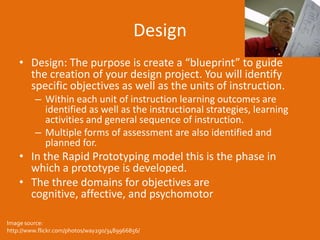
DesignDesign: The purpose is create a “blueprint” to guide the creation of your design project. You will identify specific objectives as well as the units of instruction. Within each unit of instruction learning outcomes are identified as well as the instructional strategies, learning activities and general sequence of instruction.Multiple forms of assessment are also identified and planned for.In the Rapid Prototyping model this is the phase in which a prototype is developed.The three domains for objectives are cognitive, affective, and psychomotorImage source: http://www.flickr.com/photos/way2go/3489966856/
DevelopPurpose: To prepare the materials or create the actual product. This also involves any preparation of the environment. Research Phase complete, production phase beginsFormative evaluations occur Focus on design and functionalityFocus on determining if students will learn from the productIf the rapid prototyping model is used then formative evaluations would have begun in the design phase.Existing content or learning objects are repurposed to fit instruction.
ImplementationPurpose: The delivery of instruction. Implementation can involve field testingEvaluations support the continual refinement of the product during this phase as well as earlier phases.Student feedback and evidence of learning also contribute to evaluation
EvaluationPurpose: To determine if students have met the desired learning outcomes and to determine what adjustments and/or changes need to be made to the design to better support the desired results. Sources of Evidence: Both formative (on-going) and summative evaluations are used. The process occurs throughout all phases. Types of Evaluation (Gagne et. al., 2005)Materials: Did the student understand the materials? Did the student learn  from the materials? Did the student enjoy the materials?Process: Evaluation of all phases of the ADDIE processLearner Reactions: What are the students’ perceptions of the instruction?Learner Achievement: How well did students achieve objectives?Instructional Consequence: Can students apply what they have learned? (Did transfer occur?)
Understanding by Design (UBD) / Backwards DesignFramework designed by McTighe&Wiggins (1998). Built on the work of others like Ralph Taylor (1949). Curriculum design model.Focuses on K-12 education rather than education and business training.
Backwards Design (UBD)Stage 1: Identify desired resultsGuiding Question: What should students know and or be able to do?Sources for analysis: Content standards & Curriculum expectationsActions: Unpack standards to determine key content and essential questions. Example:  Using historical thinking to understand the past. Michigan GLCE H3.0.8 Describe past and current threats to Michigan’s natural resources, describe how Michigan worked in the past and continues to work today to protect its natural resources. Essential Questions: Why is it important to protect our natural resources? What are some current and past examples of threats to Michigan’s natural resources? How has Michigan worked to protect its natural resources against these threats? (Tomlinson, & McTighe, 2006)
Backwards Design (UBD)Stage 2: Determine acceptable evidenceGuiding Questions: How will we know students have learned the necessary knowledge and skills? (*Note: in UBD there is an emphasis on learning for transfer). What is acceptable evidence for this determination?Action: Determine methods of assessment that will produce the acceptable evidence that learning has occurred and the desired results have been achieved.Examples: When determining what students know (declarative knowledge) you might use traditional test items such as multiple choice or fill in the blankWhen determining what students can do, whether it is a thinking skill, writing skill, or performance skill then you might want to use some sort of performance assessment. (Tomlinson, & McTighe, 2006)
Backwards Design (UBD)Stage 3: Plan learning experiences and instructionGuiding Questions:What “enabling knowledge and skills” will students need to  help them achieve the desired results? What activities, instructional sequence, and resources will best help them achieve the desired results?Action: Determine the instructional plan using the WHERETO framework. By following this framework you will help students by...W--- Letting students know Where the unit is going and What is expected (As well as Where students are coming from/their prior knowledge)H---Hooking and holding their interestE---Equipping students so that they can Explore and Experience key ideas and issuesR---Providing chances to Revise and RethinkE---Let students Evaluate their own work and thinkingT--- Tailoring instruction to student needsO---Being Organized(Tomlinson, & McTighe, 2006)
ConclusionQuestions to guide your knowledge building activityHow are these two processes similar?Think about the underlying assumptionsThink about the process itself.Think about their general audienceHow are they different?
References Peterson, C. (2003). Bringing ADDIE to Life: Instructional Design at Its Best. Journal of Educational Multimedia and Hypermedia. 12 (3), pp. 227-241. Norfolk, VA: AACE.Gagne, R., Wager, W., Golas, K., & Keller, J.(2005). Principles of Instructional Design (5th Ed.). Belmont, CA: Wadsworth. Tomlinson, C. A., & McTighe, J. (2006). Integrating Differentiated Instruction  and Understanding by Design. Alexandria, VA: ASCD

EDU 643:M2

  • 1.
    ADDIE & Understandingby DesignEDU 643Dr. Kathryn Dirkin
  • 2.
    Goals & ObjectivesIdentifythe key elements in each phase of the ADDIE model.Identify the purpose of each phase of the ADDIE model.Identify each stage of the Backwards Design process and the necessary actions.
  • 3.
  • 4.
    Needs AnalysisPurpose: todetermine if there is a gap between desired outcomes and actual outcomes. The solution for addressing this gap would be instructional.Sources of Data for the AnalysisEvaluations of student workTest scoresSurveysObservations
  • 5.
    Content AnalysisPurpose: Todetermine the instructional content and prerequisite knowledge necessary to support learning outcomes. It is also in this phase that learning goals are established based on the needs analysis. Questions to Ponder:What is it I want my students to know and be able to doWhat is the topic?What are the big ideas?
  • 6.
    Task AnalysisPurpose: Todetermine the instructional tasks necessary to achieve the desired outcomesQuestions to Ponder:What are the prerequisite skills necessary?What is the difficulty level of the task?How should instruction be sequenced?How much time should be spent on each task and how much time is available?What limitations exist?
  • 7.
    DesignDesign: The purposeis create a “blueprint” to guide the creation of your design project. You will identify specific objectives as well as the units of instruction. Within each unit of instruction learning outcomes are identified as well as the instructional strategies, learning activities and general sequence of instruction.Multiple forms of assessment are also identified and planned for.In the Rapid Prototyping model this is the phase in which a prototype is developed.The three domains for objectives are cognitive, affective, and psychomotorImage source: http://www.flickr.com/photos/way2go/3489966856/
  • 8.
    DevelopPurpose: To preparethe materials or create the actual product. This also involves any preparation of the environment. Research Phase complete, production phase beginsFormative evaluations occur Focus on design and functionalityFocus on determining if students will learn from the productIf the rapid prototyping model is used then formative evaluations would have begun in the design phase.Existing content or learning objects are repurposed to fit instruction.
  • 9.
    ImplementationPurpose: The deliveryof instruction. Implementation can involve field testingEvaluations support the continual refinement of the product during this phase as well as earlier phases.Student feedback and evidence of learning also contribute to evaluation
  • 10.
    EvaluationPurpose: To determineif students have met the desired learning outcomes and to determine what adjustments and/or changes need to be made to the design to better support the desired results. Sources of Evidence: Both formative (on-going) and summative evaluations are used. The process occurs throughout all phases. Types of Evaluation (Gagne et. al., 2005)Materials: Did the student understand the materials? Did the student learn from the materials? Did the student enjoy the materials?Process: Evaluation of all phases of the ADDIE processLearner Reactions: What are the students’ perceptions of the instruction?Learner Achievement: How well did students achieve objectives?Instructional Consequence: Can students apply what they have learned? (Did transfer occur?)
  • 11.
    Understanding by Design(UBD) / Backwards DesignFramework designed by McTighe&Wiggins (1998). Built on the work of others like Ralph Taylor (1949). Curriculum design model.Focuses on K-12 education rather than education and business training.
  • 12.
    Backwards Design (UBD)Stage1: Identify desired resultsGuiding Question: What should students know and or be able to do?Sources for analysis: Content standards & Curriculum expectationsActions: Unpack standards to determine key content and essential questions. Example: Using historical thinking to understand the past. Michigan GLCE H3.0.8 Describe past and current threats to Michigan’s natural resources, describe how Michigan worked in the past and continues to work today to protect its natural resources. Essential Questions: Why is it important to protect our natural resources? What are some current and past examples of threats to Michigan’s natural resources? How has Michigan worked to protect its natural resources against these threats? (Tomlinson, & McTighe, 2006)
  • 13.
    Backwards Design (UBD)Stage2: Determine acceptable evidenceGuiding Questions: How will we know students have learned the necessary knowledge and skills? (*Note: in UBD there is an emphasis on learning for transfer). What is acceptable evidence for this determination?Action: Determine methods of assessment that will produce the acceptable evidence that learning has occurred and the desired results have been achieved.Examples: When determining what students know (declarative knowledge) you might use traditional test items such as multiple choice or fill in the blankWhen determining what students can do, whether it is a thinking skill, writing skill, or performance skill then you might want to use some sort of performance assessment. (Tomlinson, & McTighe, 2006)
  • 14.
    Backwards Design (UBD)Stage3: Plan learning experiences and instructionGuiding Questions:What “enabling knowledge and skills” will students need to help them achieve the desired results? What activities, instructional sequence, and resources will best help them achieve the desired results?Action: Determine the instructional plan using the WHERETO framework. By following this framework you will help students by...W--- Letting students know Where the unit is going and What is expected (As well as Where students are coming from/their prior knowledge)H---Hooking and holding their interestE---Equipping students so that they can Explore and Experience key ideas and issuesR---Providing chances to Revise and RethinkE---Let students Evaluate their own work and thinkingT--- Tailoring instruction to student needsO---Being Organized(Tomlinson, & McTighe, 2006)
  • 15.
    ConclusionQuestions to guideyour knowledge building activityHow are these two processes similar?Think about the underlying assumptionsThink about the process itself.Think about their general audienceHow are they different?
  • 16.
    References Peterson, C.(2003). Bringing ADDIE to Life: Instructional Design at Its Best. Journal of Educational Multimedia and Hypermedia. 12 (3), pp. 227-241. Norfolk, VA: AACE.Gagne, R., Wager, W., Golas, K., & Keller, J.(2005). Principles of Instructional Design (5th Ed.). Belmont, CA: Wadsworth. Tomlinson, C. A., & McTighe, J. (2006). Integrating Differentiated Instruction  and Understanding by Design. Alexandria, VA: ASCD

Editor's Notes

  • #14 What students will know– declarative knowledge, Be able to do – procedural knowledge, What attitudes--Disposition- affective