Translating Scientific
Research into Effective
Classroom Use
  What makes a good
classroom activity and
  student experience?


                Karin Kirk
    Science Education Resource Center
             Carleton College
Warm-up question

Think-Pair-Share

In your experience what makes an
effective student activity?
Think 1:00


        Pair 2:00


        Share :20

In your experience what
makes an effective student
activity?
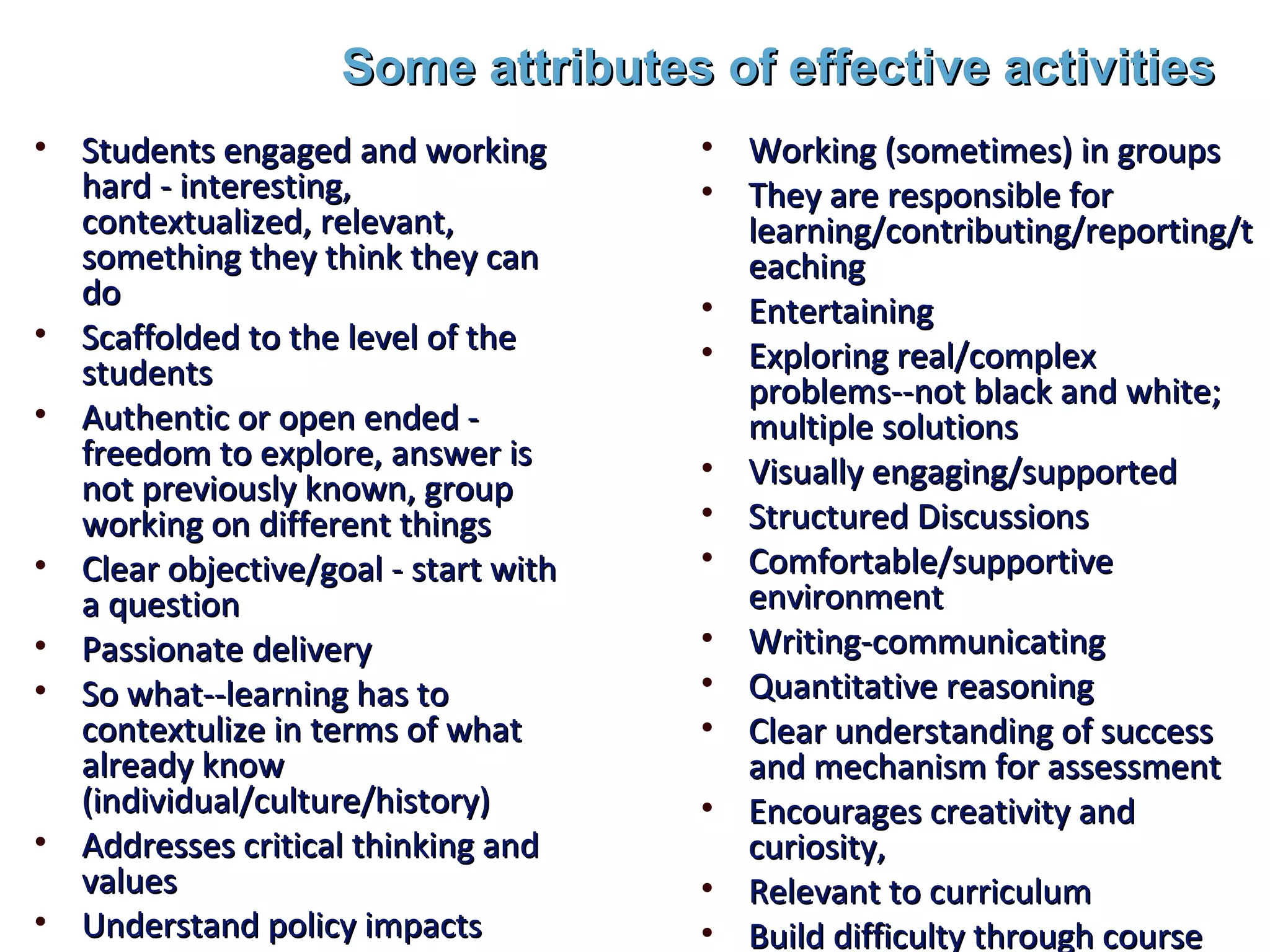
Some attributes of effective activities
• Students engaged and working        • Working (sometimes) in groups
  hard - interesting,                 • They are responsible for
  contextualized, relevant,             learning/contributing/reporting/t
  something they think they can         eaching
  do                                  • Entertaining
• Scaffolded to the level of the      • Exploring real/complex
  students                              problems--not black and white;
• Authentic or open ended -             multiple solutions
  freedom to explore, answer is       • Visually engaging/supported
  not previously known, group
  working on different things         • Structured Discussions
• Clear objective/goal - start with   • Comfortable/supportive
  a question                            environment
• Passionate delivery                 • Writing-communicating
• So what--learning has to            • Quantitative reasoning
  contextulize in terms of what       • Clear understanding of success
  already know                          and mechanism for assessment
  (individual/culture/history)        • Encourages creativity and
• Addresses critical thinking and       curiosity,
  values                              • Relevant to curriculum
• Understand policy impacts           • Build difficulty through course
Translating scientific research
  into classroom experiences

        Cool science


   Wisdom for students
(trickle-down pedagogy)
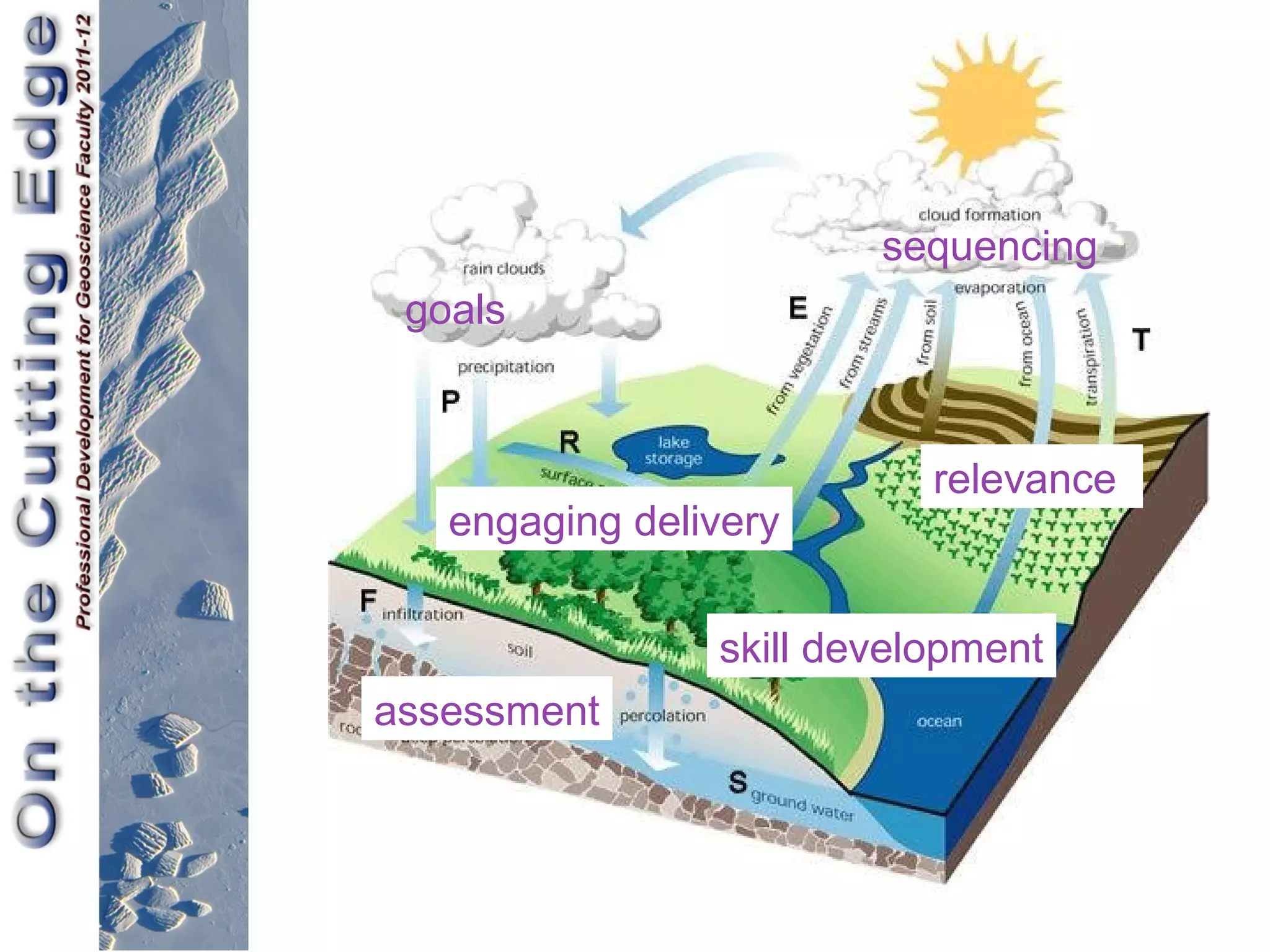
sequencing
 goals


                           relevance
   engaging delivery


                skill development
assessment
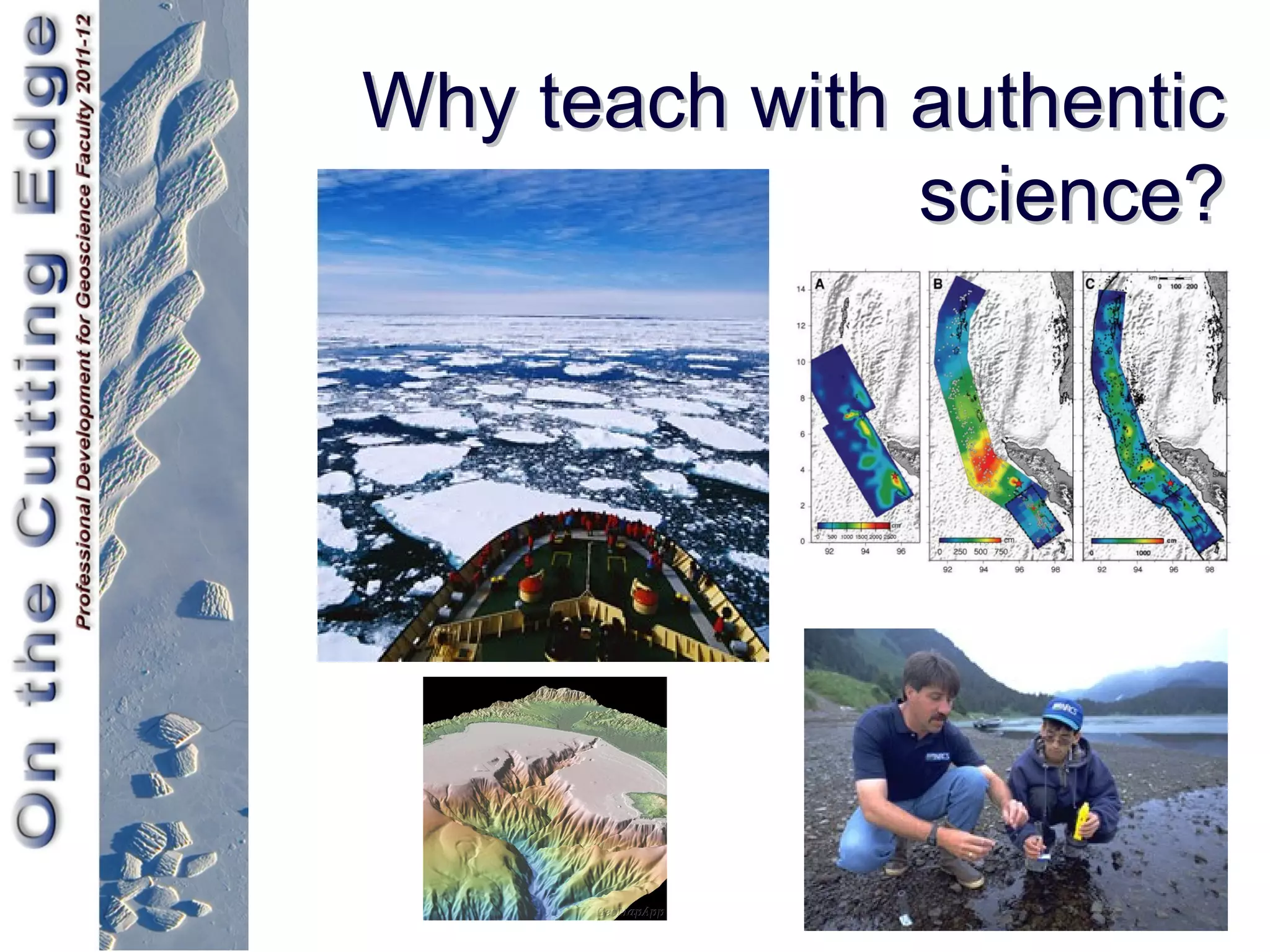
Why teach with authentic
               science?
What are some necessary
        translation steps?
Teaching the
          Process of Science
• Scientific thinking is widely
  misunderstood.
• Consider expert vs novice
  approach to problem solving.
• Scaffold problems so each
  assignment builds on skills
  developed in previous activities.
• Teach scientific thinking hand in
  hand with content.
A Design Strategy
• Setting Goals:
   What do I want them to be able to do?

• Measuring Success:
  How will I know that they can do this?

• Designing for Success:
  How will they gain the skills, knowledge and
  experience they need to succeed?

• Designing for Engagement:
   How will the activity draw them in and hold their
    attention?
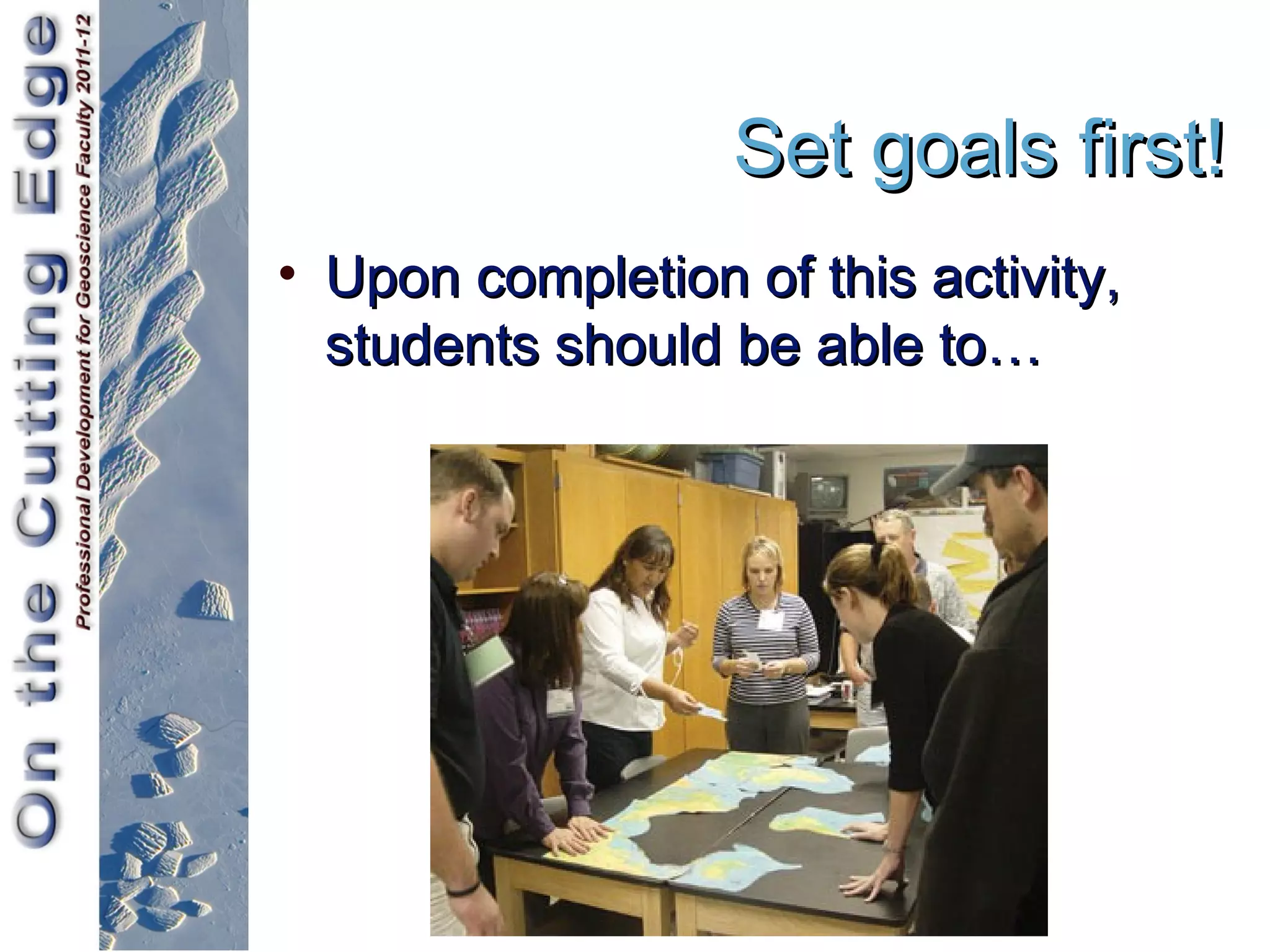
Set goals first!
• Upon completion of this activity,
  students should be able to…
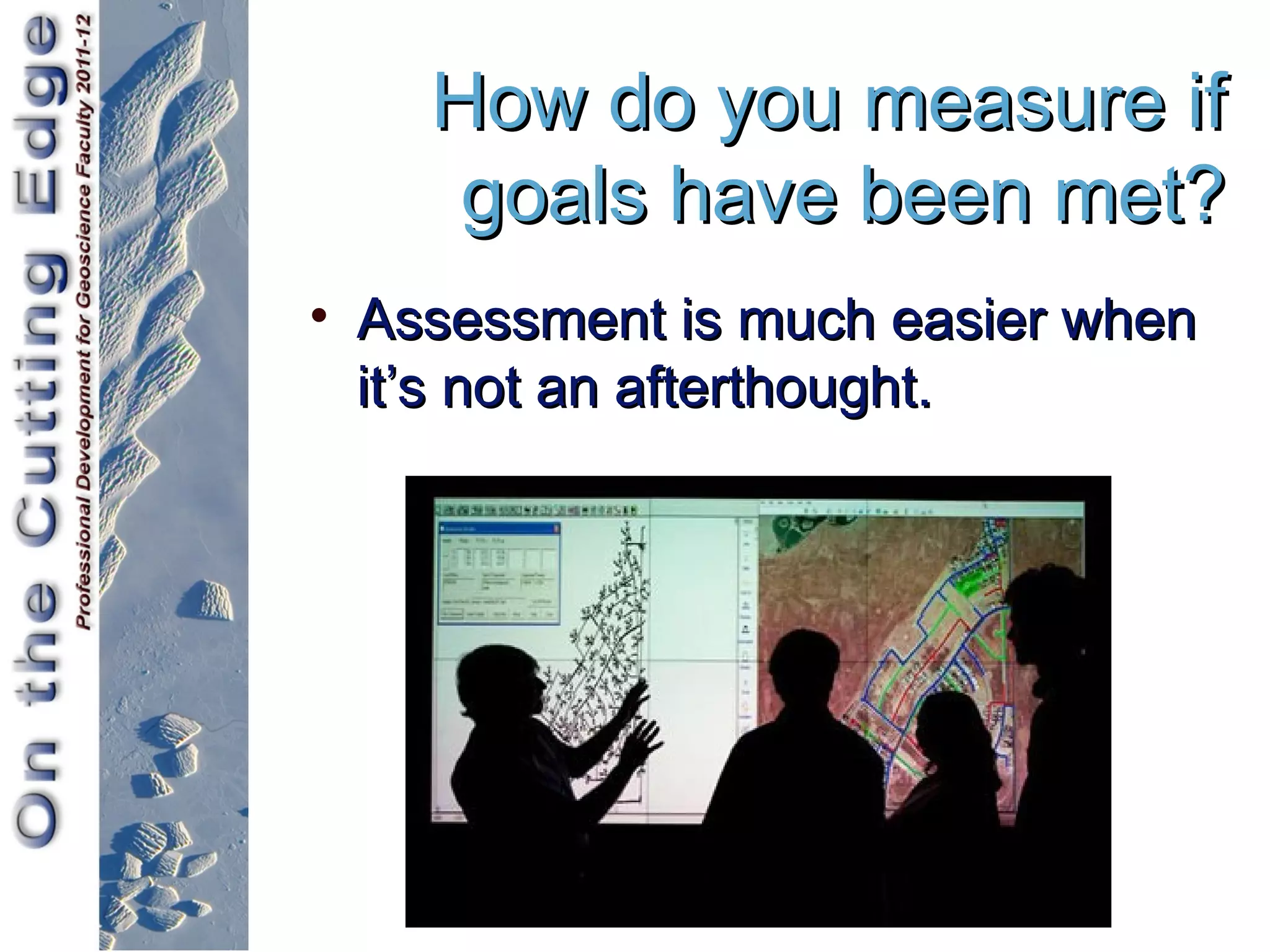
How do you measure if
     goals have been met?
• Assessment is much easier when
  it’s not an afterthought.
Design activities to meet
                       goals
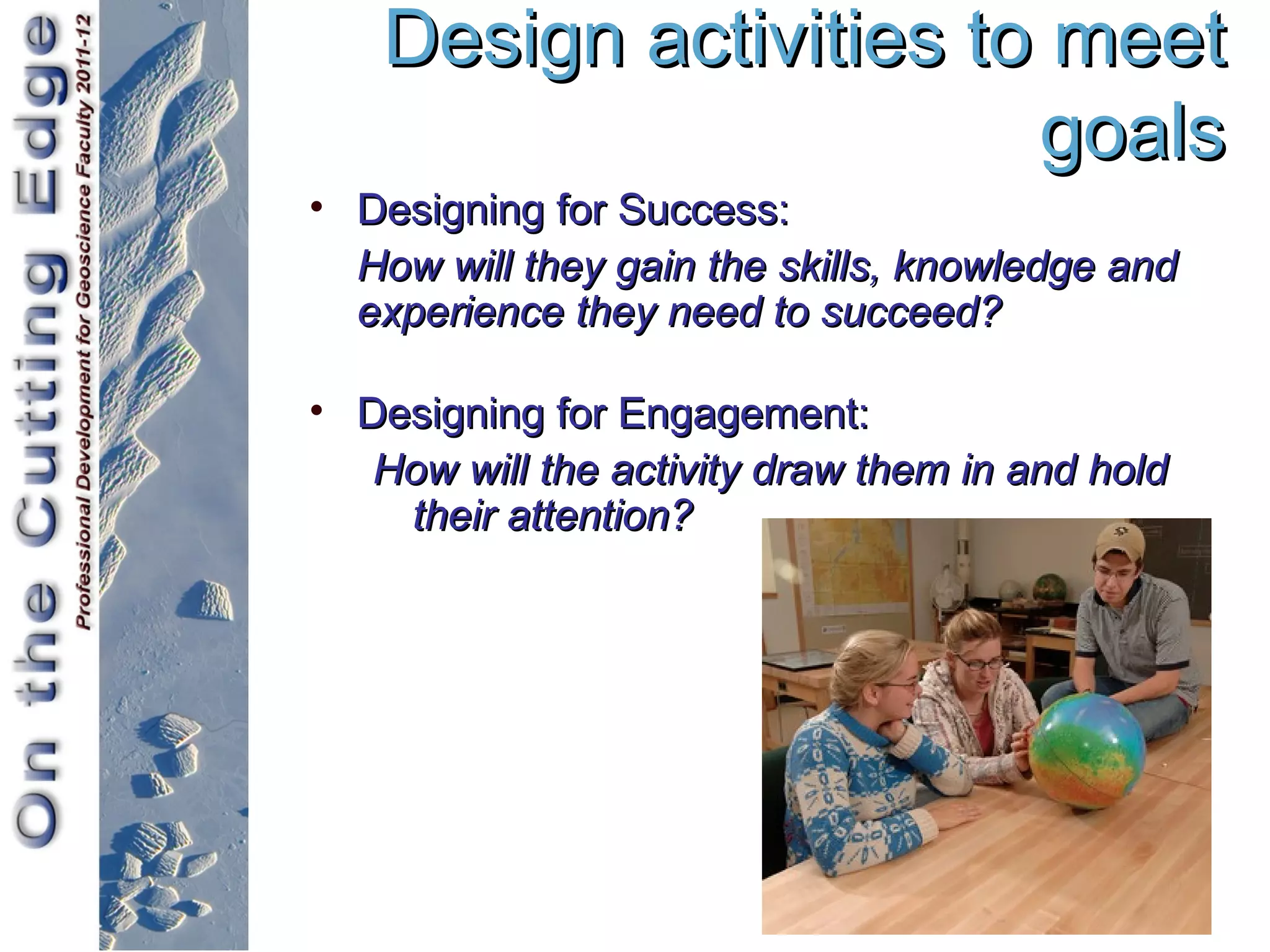
• Designing for Success:
  How will they gain the skills, knowledge and
  experience they need to succeed?

• Designing for Engagement:
   How will the activity draw them in and hold
    their attention?
Principles of Design
 1) Students must be engaged to learn
           How does the activity engage them?

 2) Students must construct new knowledge
    incrementally as a results of experience.
     What experiences will they have in this activity?
 3) Students must refine and connect their
    knowledge to be able to use it further

          How will the activity promote reflection on and
          application of the new knowledge?

Edelson, 2001, Learning for Use
A Framework for the Design of Technology-Supported Inquiry Activities: Journal of Research in Science
          Teaching, vol 38, no 3, p 355-385
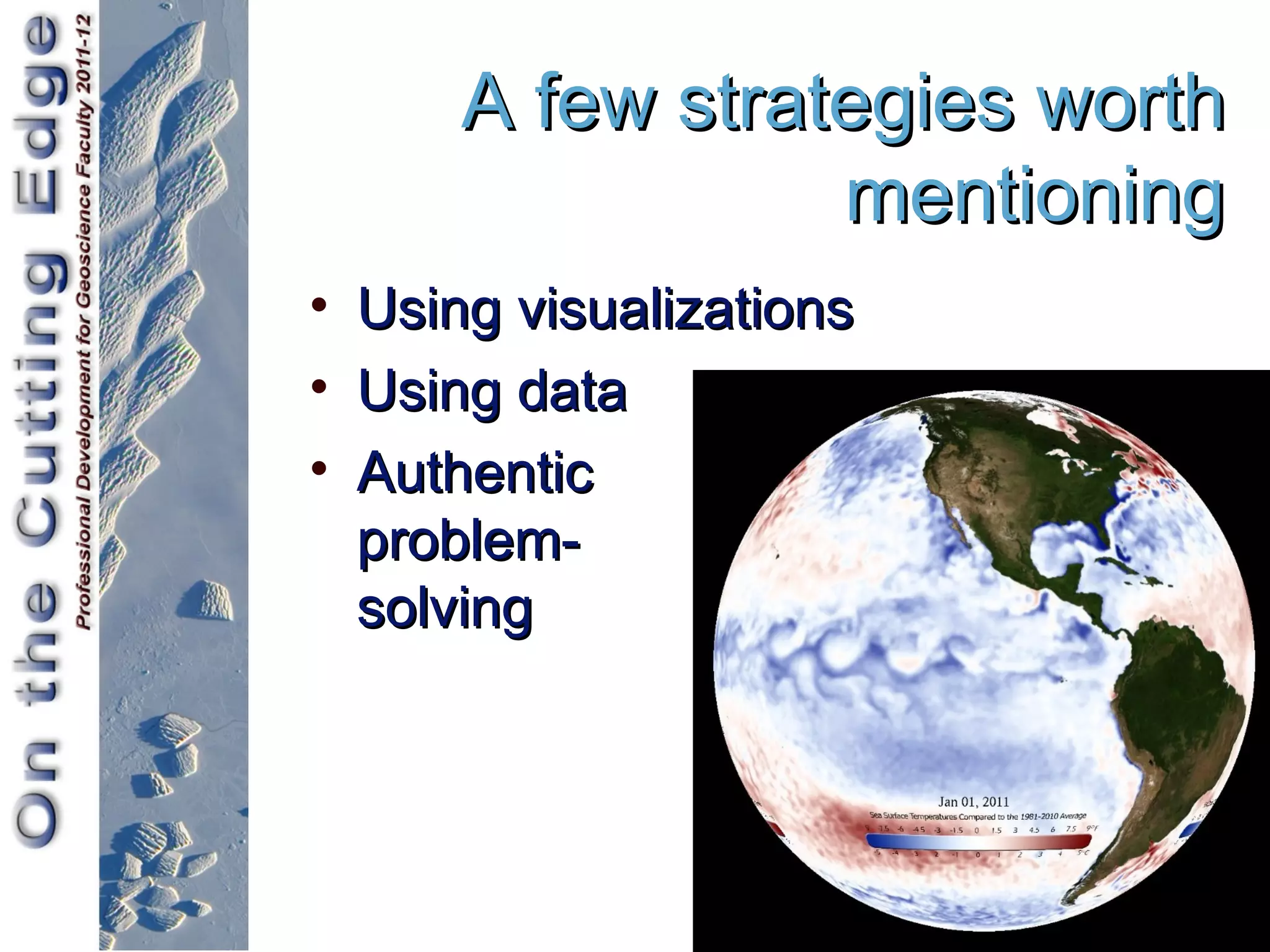
A few strategies worth
                 mentioning
• Using visualizations
• Using data
• Authentic
  problem-
  solving
Design Checklist:
 Does the activity…
• Encourage student interest and attention?
• Include opportunities for students to
  reflect, discuss, and synthesize?
• Engage students in data analysis and
  synthesis?
• Help students visualize data relationships,
  geologic processes, or other relationships?
• Provide opportunities for students to
  confirm their understanding?
• Require students to integrate
  ideas/information from different sources?
Instructions for working
                        groups
• Possible topics
  •   Interpreting sediment cores
  •   Reconstructing lake levels
  •   Great Lakes climate history
  •   Dune geomorphology
• Form groups of 2-3 people around
  similar topics or approaches
• Go to the workspace page for your
  group number
• Login to SERC account to access
  workspace page
• Work in the workspace page:
  • Add text, links, images, indefinitely
    editable
• 4:45 – show and tell of your
  activity page

What makes a good classroom activity and student experience?

  • 1.
    Translating Scientific Research intoEffective Classroom Use What makes a good classroom activity and student experience? Karin Kirk Science Education Resource Center Carleton College
  • 2.
    Warm-up question Think-Pair-Share In yourexperience what makes an effective student activity?
  • 3.
    Think 1:00 Pair 2:00 Share :20 In your experience what makes an effective student activity?
  • 4.
    Some attributes ofeffective activities • Students engaged and working • Working (sometimes) in groups hard - interesting, • They are responsible for contextualized, relevant, learning/contributing/reporting/t something they think they can eaching do • Entertaining • Scaffolded to the level of the • Exploring real/complex students problems--not black and white; • Authentic or open ended - multiple solutions freedom to explore, answer is • Visually engaging/supported not previously known, group working on different things • Structured Discussions • Clear objective/goal - start with • Comfortable/supportive a question environment • Passionate delivery • Writing-communicating • So what--learning has to • Quantitative reasoning contextulize in terms of what • Clear understanding of success already know and mechanism for assessment (individual/culture/history) • Encourages creativity and • Addresses critical thinking and curiosity, values • Relevant to curriculum • Understand policy impacts • Build difficulty through course
  • 5.
    Translating scientific research into classroom experiences Cool science Wisdom for students (trickle-down pedagogy)
  • 6.
    sequencing goals relevance engaging delivery skill development assessment
  • 7.
    Why teach withauthentic science?
  • 8.
    What are somenecessary translation steps?
  • 9.
    Teaching the Process of Science • Scientific thinking is widely misunderstood. • Consider expert vs novice approach to problem solving. • Scaffold problems so each assignment builds on skills developed in previous activities. • Teach scientific thinking hand in hand with content.
  • 10.
    A Design Strategy •Setting Goals: What do I want them to be able to do? • Measuring Success: How will I know that they can do this? • Designing for Success: How will they gain the skills, knowledge and experience they need to succeed? • Designing for Engagement: How will the activity draw them in and hold their attention?
  • 11.
    Set goals first! •Upon completion of this activity, students should be able to…
  • 12.
    How do youmeasure if goals have been met? • Assessment is much easier when it’s not an afterthought.
  • 13.
    Design activities tomeet goals • Designing for Success: How will they gain the skills, knowledge and experience they need to succeed? • Designing for Engagement: How will the activity draw them in and hold their attention?
  • 14.
    Principles of Design 1) Students must be engaged to learn How does the activity engage them? 2) Students must construct new knowledge incrementally as a results of experience. What experiences will they have in this activity? 3) Students must refine and connect their knowledge to be able to use it further How will the activity promote reflection on and application of the new knowledge? Edelson, 2001, Learning for Use A Framework for the Design of Technology-Supported Inquiry Activities: Journal of Research in Science Teaching, vol 38, no 3, p 355-385
  • 15.
    A few strategiesworth mentioning • Using visualizations • Using data • Authentic problem- solving
  • 16.
    Design Checklist: Doesthe activity… • Encourage student interest and attention? • Include opportunities for students to reflect, discuss, and synthesize? • Engage students in data analysis and synthesis? • Help students visualize data relationships, geologic processes, or other relationships? • Provide opportunities for students to confirm their understanding? • Require students to integrate ideas/information from different sources?
  • 17.
    Instructions for working groups • Possible topics • Interpreting sediment cores • Reconstructing lake levels • Great Lakes climate history • Dune geomorphology • Form groups of 2-3 people around similar topics or approaches
  • 18.
    • Go tothe workspace page for your group number • Login to SERC account to access workspace page • Work in the workspace page: • Add text, links, images, indefinitely editable • 4:45 – show and tell of your activity page