


Design Patterns
Optimizing OOPs Technology.
Aman Jain
Application Engineer,
Meritech Software Pvt. Ltd.
Gang of Four
o Pattern-based design was introduced
into architecture and engineering in
the 1950's
o It wasn't until a group of four
researchers combined forces that
pattern-based design became well-
known and commonplace
o This group was known as the gang of four (GoF)
Gang of Four
o The gang of four (GoF) is:
o Erich Gamma
o Richard Helm
o Ralph Johnson
o John Vlissides
o They are the authors of the famous
text "Design Patterns: Elements of
Reusable Object-Oriented Software"
Pattern??
o A pattern is a recurring solution to a
standard problem, in a context.
o A pattern is a three-part rule, which
expresses a relation between a
certain context, a problem, and a
solution.
Design Pattern Advantages
o Using patterns offers a few key
advantages:
o Facilitate a proven solution
o Provide a common vocabulary
Types of Patterns
o Creational patterns
o Deal with initializing and configuring classes and
objects.
o Structural patterns
o Deal with decoupling interface and
implementation of classes and objects
o Composition of classes or objects
o Behavioural patterns
o Deal with dynamic interactions among societies
of classes and objects.
o Distribute responsibility.
Creational Design Patterns
o Abstract Factory
o Factory for building related objects
o Builder
o Separates an object construction from its
representation.
o Factory Method
o Creates an instance of several derived classes.
o Prototype
o Factory for cloning new instances from a
prototype.
o Singleton
o A class of which a single object can exist.
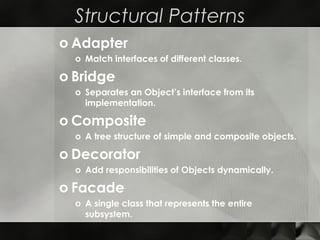
Structural Patterns
o Adapter
o Match interfaces of different classes.
o Bridge
o Separates an Object’s interface from its
implementation.
o Composite
o A tree structure of simple and composite objects.
o Decorator
o Add responsibilities of Objects dynamically.
o Facade
o A single class that represents the entire
subsystem.
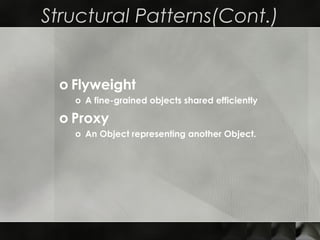
Structural Patterns(Cont.)
o Flyweight
o A fine-grained objects shared efficiently
o Proxy
o An Object representing another Object.
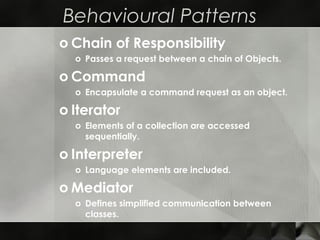
Behavioural Patterns
o Chain of Responsibility
o Passes a request between a chain of Objects.
o Command
o Encapsulate a command request as an object.
o Iterator
o Elements of a collection are accessed
sequentially.
o Interpreter
o Language elements are included.
o Mediator
o Defines simplified communication between
classes.
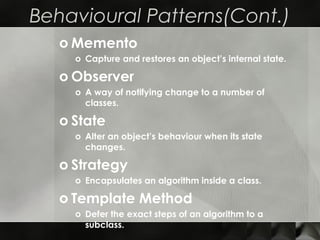
Behavioural Patterns(Cont.)
o Memento
o Capture and restores an object’s internal state.
o Observer
o A way of notifying change to a number of
classes.
o State
o Alter an object’s behaviour when its state
changes.
o Strategy
o Encapsulates an algorithm inside a class.
o Template Method
o Defer the exact steps of an algorithm to a
subclass.
Behavioural Patterns(Cont.)
o Visitor
o Defines a new operation to a class without
change.
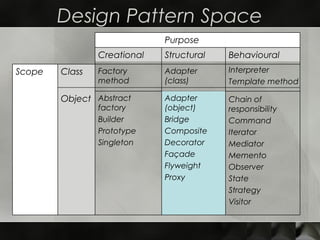
Design Pattern Space
Chain of
responsibility
Command
Iterator
Mediator
Memento
Observer
State
Strategy
Visitor
Adapter
(object)
Bridge
Composite
Decorator
Façade
Flyweight
Proxy
Abstract
factory
Builder
Prototype
Singleton
Object
Interpreter
Template method
Adapter
(class)
Factory
method
ClassScope
BehaviouralStructuralCreational
Purpose
Benefits of Design Patterns
o Design patterns enable large-
scale reuse of software
architectures and also help
document systems.
o Patterns help improve developer
communication.
o Pattern names form a common
vocabulary.
o Patterns help ease the transition
to Object Oriented technology.
Drawbacks of Design Patterns
o Patterns do not lead to direct
code reuse.
o Patterns are deceptively simple.
o Teams may suffer from pattern
overload.
o Patterns are validated by
experience and discussion rather
than by automated testing.
o Integrating patterns is a human-
intensive activity.
Suggestions for Effective Use
o Do not recast everything as a
pattern
o Instead, develop strategic domain patterns and
reuse existing tactical patterns.
o Clearly document when patterns
apply and do not apply.
o Directly involve pattern authors
with application developers and
domain experts.
References
o http://www.dofactory.com/
o B. Cheng – Michigan State
University.
o http://www.dotnetiq.com/
Thank You!

Design patterns ppt

  • 1.
    Design Patterns Optimizing OOPsTechnology. Aman Jain Application Engineer, Meritech Software Pvt. Ltd.
  • 2.
    Gang of Four oPattern-based design was introduced into architecture and engineering in the 1950's o It wasn't until a group of four researchers combined forces that pattern-based design became well- known and commonplace o This group was known as the gang of four (GoF)
  • 3.
    Gang of Four oThe gang of four (GoF) is: o Erich Gamma o Richard Helm o Ralph Johnson o John Vlissides o They are the authors of the famous text "Design Patterns: Elements of Reusable Object-Oriented Software"
  • 4.
    Pattern?? o A patternis a recurring solution to a standard problem, in a context. o A pattern is a three-part rule, which expresses a relation between a certain context, a problem, and a solution.
  • 5.
    Design Pattern Advantages oUsing patterns offers a few key advantages: o Facilitate a proven solution o Provide a common vocabulary
  • 6.
    Types of Patterns oCreational patterns o Deal with initializing and configuring classes and objects. o Structural patterns o Deal with decoupling interface and implementation of classes and objects o Composition of classes or objects o Behavioural patterns o Deal with dynamic interactions among societies of classes and objects. o Distribute responsibility.
  • 7.
    Creational Design Patterns oAbstract Factory o Factory for building related objects o Builder o Separates an object construction from its representation. o Factory Method o Creates an instance of several derived classes. o Prototype o Factory for cloning new instances from a prototype. o Singleton o A class of which a single object can exist.
  • 8.
    Structural Patterns o Adapter oMatch interfaces of different classes. o Bridge o Separates an Object’s interface from its implementation. o Composite o A tree structure of simple and composite objects. o Decorator o Add responsibilities of Objects dynamically. o Facade o A single class that represents the entire subsystem.
  • 9.
    Structural Patterns(Cont.) o Flyweight oA fine-grained objects shared efficiently o Proxy o An Object representing another Object.
  • 10.
    Behavioural Patterns o Chainof Responsibility o Passes a request between a chain of Objects. o Command o Encapsulate a command request as an object. o Iterator o Elements of a collection are accessed sequentially. o Interpreter o Language elements are included. o Mediator o Defines simplified communication between classes.
  • 11.
    Behavioural Patterns(Cont.) o Memento oCapture and restores an object’s internal state. o Observer o A way of notifying change to a number of classes. o State o Alter an object’s behaviour when its state changes. o Strategy o Encapsulates an algorithm inside a class. o Template Method o Defer the exact steps of an algorithm to a subclass.
  • 12.
    Behavioural Patterns(Cont.) o Visitor oDefines a new operation to a class without change.
  • 13.
    Design Pattern Space Chainof responsibility Command Iterator Mediator Memento Observer State Strategy Visitor Adapter (object) Bridge Composite Decorator Façade Flyweight Proxy Abstract factory Builder Prototype Singleton Object Interpreter Template method Adapter (class) Factory method ClassScope BehaviouralStructuralCreational Purpose
  • 14.
    Benefits of DesignPatterns o Design patterns enable large- scale reuse of software architectures and also help document systems. o Patterns help improve developer communication. o Pattern names form a common vocabulary. o Patterns help ease the transition to Object Oriented technology.
  • 15.
    Drawbacks of DesignPatterns o Patterns do not lead to direct code reuse. o Patterns are deceptively simple. o Teams may suffer from pattern overload. o Patterns are validated by experience and discussion rather than by automated testing. o Integrating patterns is a human- intensive activity.
  • 16.
    Suggestions for EffectiveUse o Do not recast everything as a pattern o Instead, develop strategic domain patterns and reuse existing tactical patterns. o Clearly document when patterns apply and do not apply. o Directly involve pattern authors with application developers and domain experts.
  • 17.
    References o http://www.dofactory.com/ o B.Cheng – Michigan State University. o http://www.dotnetiq.com/
  • 18.