A Study on HVAC Design, Installation and Troubleshooting of
Water- Cooled Chiller System, Cooling Tower and Air
Handling Unit
Under
Utility Professionals
Presented by
Md. Riazul Islam Mamun
ID-19207016
Department of BSME, IUBAT
Presentation Contents
• Introduction
• Objective of Internship
• Company Profile
• Basic Refrigeration Cycle
• Basic Component of Cooling Cycle
• Comparison between HVAC systems
• Dx System
• Window Unit
• Central Packaged Unit
• Chilled Water System
• Air Handling Unit (AHU)
• Fan Coil Unit (FCU)
• Water chillers Basic cycle
• HVAC Systems for Hospitals
• Food and Frozens and Hospitals
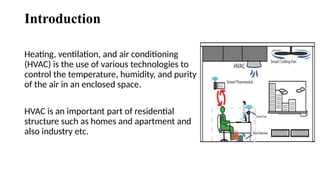
Heating, ventilation, and air conditioning
(HVAC) is the use of various technologies to
control the temperature, humidity, and purity
of the air in an enclosed space.
HVAC is an important part of residential
structure such as homes and apartment and
also industry etc.
Introduction
Objective of Internship:
• To gain practical experience in HVAC systems, including installation,
maintenance, and repair.
• Acquire knowledge of different HVAC systems, including their
components, functions, and how they interact within buildings.
• Develop troubleshooting skills by diagnosing issues in HVAC systems and
implementing effective solutions.
• Build professional relationships with mentors, colleagues, and industry
professionals for future career opportunities.
Company Details and Address:
Utility Professionals is an engineering organization
established in 2004 and embraced by a group of
professional engineers.
This organization is involved in MEP design and
consultancy. An MEP (Mechanical, Electrical, and
Plumbing) consultancy plays a crucial role in the
design, planning, and execution of building projects.
Company Location: House: 38 (Level 1 & 2), Block: B,
Road: 7 Banasree, Rampura, Dhaka-1219,
Bangladesh
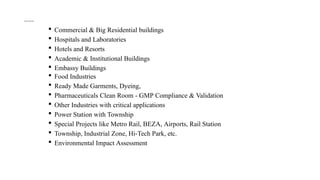
Sector of Services:
 Commercial & Big Residential buildings
 Hospitals and Laboratories
 Hotels and Resorts
 Academic & Institutional Buildings
 Embassy Buildings
 Food Industries
 Ready Made Garments, Dyeing,
 Pharmaceuticals Clean Room - GMP Compliance & Validation
 Other Industries with critical applications
 Power Station with Township
 Special Projects like Metro Rail, BEZA, Airports, Rail Station
 Township, Industrial Zone, Hi-Tech Park, etc.
 Environmental Impact Assessment
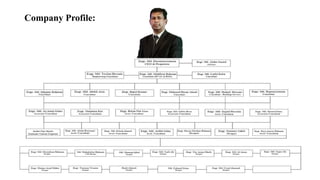
Company Profile:
Company Profile:
Mission:
• -To maintain an engineering professional team
• -To maintain professionalism with integrity and sincerity To build up long term relationship with
valued client
• To achieve this all of our staffs are continually trained up on Technology update and Professional practice.
Vision
• To become a global identity in MEP consulting services recognized for delivering unsurpassed value to customers by
providing innovative, intelligent, efficient, economical, effective, energy-efficient, environmentally friendly, and
aesthetic MEP infrastructure design and services.
Achievement:
• ISO 9001-2015 certification
• Enlisted as Number 1 Consultant under Fire Service and Civil Defence Enlisted Consultants of many
multinational companies
• Working experience with many foreign Consultants as their local associate
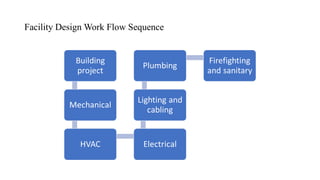
Facility Design Work Flow Sequence
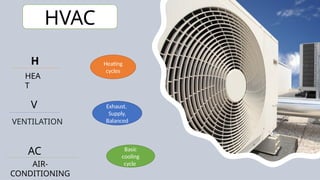
V
VENTILATION
AC
AIR-
CONDITIONING
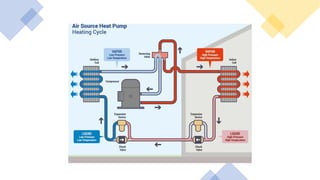
Heating
cycles
H
HEA
T
Exhaust,
Supply,
Balanced
Basic
cooling
cycle
HVAC
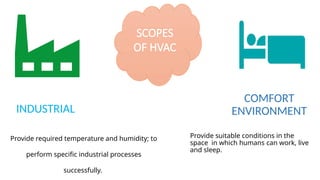
INDUSTRIAL
COMFORT
ENVIRONMENT
Provide required temperature and humidity; to
perform specific industrial processes
successfully.
Provide suitable conditions in the
space in which humans can work, live
and sleep.
SCOPES
OF HVAC
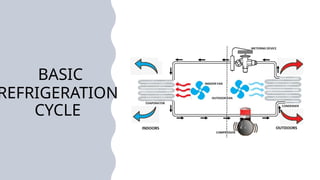
BASIC
REFRIGERATION
CYCLE
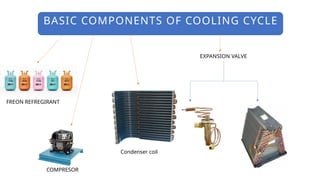
BASIC COMPONENTS OF COOLING CYCLE
FREON REFREGIRANT
COMPRESOR
Condenser coil
EXPANSION VALVE
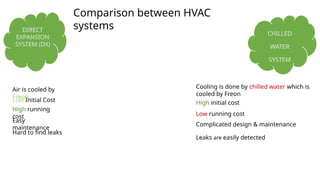
Comparison between HVAC
systems
DIRECT
EXPANSION
SYSTEM (DX)
CHILLED
WATER
SYSTEM
Air is cooled by
Freon
Low Initial Cost
High running
cost
Easy
maintenance
Hard to find leaks
Cooling is done by chilled water which is
cooled by Freon
High initial cost
Low running cost
Complicated design & maintenance
Leaks are easily detected
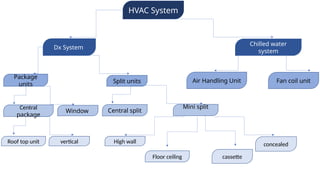
HVAC System
Dx System
Fan coil unit
Air Handling Unit
Chilled water
system
Central split
Mini split
Split units
Package
units
Floor ceiling
High wall
Central
package
Window
concealed
cassette
vertical
Roof top unit
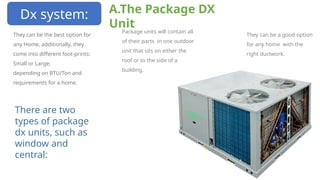
A.The Package DX
Unit
Dx system:
There are two
types of package
dx units, such as
window and
central:
They can be the best option for
any Home, additionally, they
come into different foot-prints:
Small or Large;
depending on BTU/Ton and
requirements for a home.
Package units will contain all
of their parts in one outdoor
unit that sits on either the
roof or to the side of a
building.
They can be a good option
for any home with the
right ductwork.
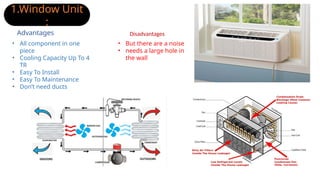
1.Window Unit
:
• All component in one
piece
• Cooling Capacity Up To 4
TR
• Easy To Install
• Easy To Maintenance
• Don’t need ducts
Advantages Disadvantages
• But there are a noise
• needs a large hole in
the wall
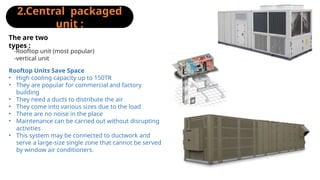
2.Central packaged
unit :
-Rooftop unit (most popular)
-vertical unit
The are two
types :
Rooftop Units Save Space
• High cooling capacity up to 150TR
• They are popular for commercial and factory
building
• They need a ducts to distribute the air
• They come into various sizes due to the load
• There are no noise in the place
• Maintenance can be carried out without disrupting
activities
• This system may be connected to ductwork and
serve a large-size single zone that cannot be served
by window air conditioners.
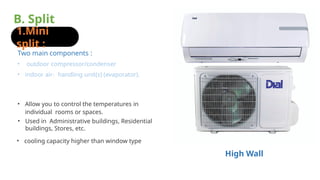
B. Split
units :
1.Mini
split :
• cooling capacity higher than window type
• Used in Administrative buildings, Residential
buildings, Stores, etc.
• Allow you to control the temperatures in
individual rooms or spaces.
• outdoor compressor/condenser
• indoor air- handling unit(s) (evaporator).
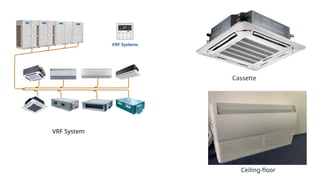
Two main components :
High Wall
Ceiling-floor
Cassette
VRF System
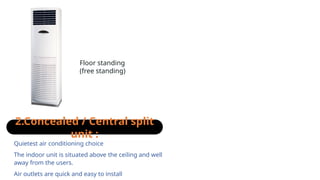
2.Concealed / Central split
unit :
Quietest air conditioning choice
The indoor unit is situated above the ceiling and well
away from the users.
Air outlets are quick and easy to install
Floor standing
(free standing)
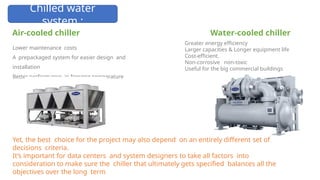
Chilled water
system :
Lower maintenance costs
A prepackaged system for easier design and
installation
Better performance in freezing temperature
Air-cooled chiller Water-cooled chiller
Greater energy efficiency
Larger capacities & Longer equipment life
Cost-efficient.
Non-corrosive non-toxic
Useful for the big commercial buildings
Yet, the best choice for the project may also depend on an entirely different set of
decisions criteria.
It’s important for data centers and system designers to take all factors into
consideration to make sure the chiller that ultimately gets specified balances all the
objectives over the long term
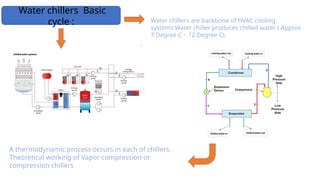
Water chillers are backbone of HVAC cooling
systems.Water chiller produces chilled water ( Approx
7 Degree C ~ 12 Degree C).
Water chillers Basic
cycle :
A thermodynamic process occurs in each of chillers.
Theoretical working of Vapor compression or
compression chillers
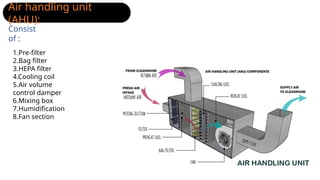
Air handling unit
(AHU):
1.Pre-filter
2.Bag filter
3.HEPA filter
4.Cooling coil
5.Air volume
control damper
6.Mixing box
7.Humidification
8.Fan section
Consist
of :
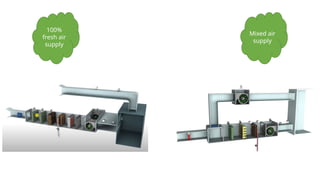
100%
fresh air
supply
Mixed air
supply
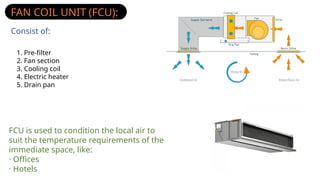
FAN COIL UNIT (FCU):
Consist of:
1. Pre-filter
2. Fan section
3. Cooling coil
4. Electric heater
5. Drain pan
FCU is used to condition the local air to
suit the temperature requirements of the
immediate space, like:
· Offices
· Hotels
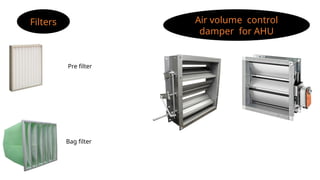
Filters
Pre filter
Bag filter
Air volume control
damper for AHU
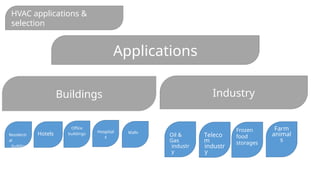
HVAC applications &
selection
Residenti
al
building
s
Hotels
Office
buildings Malls
Hospital
s Oil &
Gas
industr
y
Teleco
m
industr
y
Frozen
food
storages
Farm
animal
s
Applications
Buildings Industry
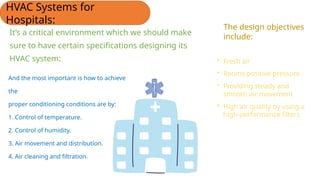
It’s a critical environment which we should make
sure to have certain specifications designing its
HVAC system:
The design objectives
include:
And the most important is how to achieve
the
proper conditioning conditions are by:
1. Control of temperature.
2. Control of humidity.
3. Air movement and distribution.
4. Air cleaning and filtration.
• Fresh air
• Rooms positive pressure
• Providing steady and
smooth air movement
• High air quality by using a
high-performance filters
HVAC Systems for
Hospitals:
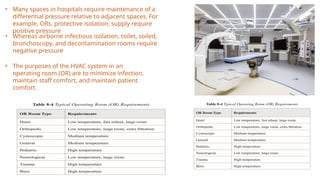
• Many spaces in hospitals require maintenance of a
differential pressure relative to adjacent spaces. For
example, ORs, protective isolation, supply require
positive pressure
• Whereas airborne infectious isolation, toilet, soiled,
bronchoscopy, and decontamination rooms require
negative pressure
• The purposes of the HVAC system in an
operating room (OR) are to minimize infection,
maintain staff comfort, and maintain patient
comfort.
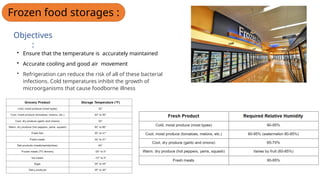
Frozen food storages :
Objectives
:
• Ensure that the temperature is accurately maintained
• Accurate cooling and good air movement
• Refrigeration can reduce the risk of all of these bacterial
infections. Cold temperatures inhibit the growth of
microorganisms that cause foodborne illness
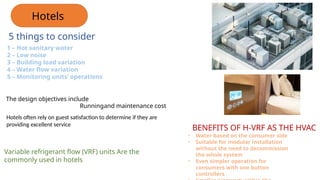
Hotels
Runningand maintenance cost
The design objectives include
Variable refrigerant flow (VRF) units Are the
commonly used in hotels
5 things to consider
1 – Hot sanitary water
2 – Low noise
3 – Building load variation
4 – Water flow variation
5 – Monitoring units’ operations
Hotels often rely on guest satisfaction to determine if they are
providing excellent service
BENEFITS OF H-VRF AS THE HVAC
• Water based on the consumer side
• Suitable for modular installation
without the need to decommission
the whole system
• Even simpler operation for
consumers with one button
controllers
Conclusion

final practicum Riazul Islam.pptxrttrrtff

  • 1.
    A Study onHVAC Design, Installation and Troubleshooting of Water- Cooled Chiller System, Cooling Tower and Air Handling Unit Under Utility Professionals Presented by Md. Riazul Islam Mamun ID-19207016 Department of BSME, IUBAT
  • 2.
    Presentation Contents • Introduction •Objective of Internship • Company Profile • Basic Refrigeration Cycle • Basic Component of Cooling Cycle • Comparison between HVAC systems • Dx System • Window Unit • Central Packaged Unit • Chilled Water System • Air Handling Unit (AHU) • Fan Coil Unit (FCU) • Water chillers Basic cycle • HVAC Systems for Hospitals • Food and Frozens and Hospitals
  • 3.
    Heating, ventilation, andair conditioning (HVAC) is the use of various technologies to control the temperature, humidity, and purity of the air in an enclosed space. HVAC is an important part of residential structure such as homes and apartment and also industry etc. Introduction
  • 4.
    Objective of Internship: •To gain practical experience in HVAC systems, including installation, maintenance, and repair. • Acquire knowledge of different HVAC systems, including their components, functions, and how they interact within buildings. • Develop troubleshooting skills by diagnosing issues in HVAC systems and implementing effective solutions. • Build professional relationships with mentors, colleagues, and industry professionals for future career opportunities.
  • 5.
    Company Details andAddress: Utility Professionals is an engineering organization established in 2004 and embraced by a group of professional engineers. This organization is involved in MEP design and consultancy. An MEP (Mechanical, Electrical, and Plumbing) consultancy plays a crucial role in the design, planning, and execution of building projects. Company Location: House: 38 (Level 1 & 2), Block: B, Road: 7 Banasree, Rampura, Dhaka-1219, Bangladesh
  • 6.
    Sector of Services: Commercial & Big Residential buildings  Hospitals and Laboratories  Hotels and Resorts  Academic & Institutional Buildings  Embassy Buildings  Food Industries  Ready Made Garments, Dyeing,  Pharmaceuticals Clean Room - GMP Compliance & Validation  Other Industries with critical applications  Power Station with Township  Special Projects like Metro Rail, BEZA, Airports, Rail Station  Township, Industrial Zone, Hi-Tech Park, etc.  Environmental Impact Assessment
  • 7.
  • 8.
    Company Profile: Mission: • -Tomaintain an engineering professional team • -To maintain professionalism with integrity and sincerity To build up long term relationship with valued client • To achieve this all of our staffs are continually trained up on Technology update and Professional practice. Vision • To become a global identity in MEP consulting services recognized for delivering unsurpassed value to customers by providing innovative, intelligent, efficient, economical, effective, energy-efficient, environmentally friendly, and aesthetic MEP infrastructure design and services. Achievement: • ISO 9001-2015 certification • Enlisted as Number 1 Consultant under Fire Service and Civil Defence Enlisted Consultants of many multinational companies • Working experience with many foreign Consultants as their local associate
  • 9.
    Facility Design WorkFlow Sequence
  • 10.
  • 11.
    INDUSTRIAL COMFORT ENVIRONMENT Provide required temperatureand humidity; to perform specific industrial processes successfully. Provide suitable conditions in the space in which humans can work, live and sleep. SCOPES OF HVAC
  • 12.
  • 13.
    BASIC COMPONENTS OFCOOLING CYCLE FREON REFREGIRANT COMPRESOR Condenser coil EXPANSION VALVE
  • 14.
    Comparison between HVAC systems DIRECT EXPANSION SYSTEM(DX) CHILLED WATER SYSTEM Air is cooled by Freon Low Initial Cost High running cost Easy maintenance Hard to find leaks Cooling is done by chilled water which is cooled by Freon High initial cost Low running cost Complicated design & maintenance Leaks are easily detected
  • 15.
    HVAC System Dx System Fancoil unit Air Handling Unit Chilled water system Central split Mini split Split units Package units Floor ceiling High wall Central package Window concealed cassette vertical Roof top unit
  • 16.
    A.The Package DX Unit Dxsystem: There are two types of package dx units, such as window and central: They can be the best option for any Home, additionally, they come into different foot-prints: Small or Large; depending on BTU/Ton and requirements for a home. Package units will contain all of their parts in one outdoor unit that sits on either the roof or to the side of a building. They can be a good option for any home with the right ductwork.
  • 17.
    1.Window Unit : • Allcomponent in one piece • Cooling Capacity Up To 4 TR • Easy To Install • Easy To Maintenance • Don’t need ducts Advantages Disadvantages • But there are a noise • needs a large hole in the wall
  • 19.
    2.Central packaged unit : -Rooftopunit (most popular) -vertical unit The are two types : Rooftop Units Save Space • High cooling capacity up to 150TR • They are popular for commercial and factory building • They need a ducts to distribute the air • They come into various sizes due to the load • There are no noise in the place • Maintenance can be carried out without disrupting activities • This system may be connected to ductwork and serve a large-size single zone that cannot be served by window air conditioners.
  • 20.
    B. Split units : 1.Mini split: • cooling capacity higher than window type • Used in Administrative buildings, Residential buildings, Stores, etc. • Allow you to control the temperatures in individual rooms or spaces. • outdoor compressor/condenser • indoor air- handling unit(s) (evaporator). Two main components : High Wall
  • 21.
  • 22.
    2.Concealed / Centralsplit unit : Quietest air conditioning choice The indoor unit is situated above the ceiling and well away from the users. Air outlets are quick and easy to install Floor standing (free standing)
  • 23.
    Chilled water system : Lowermaintenance costs A prepackaged system for easier design and installation Better performance in freezing temperature Air-cooled chiller Water-cooled chiller Greater energy efficiency Larger capacities & Longer equipment life Cost-efficient. Non-corrosive non-toxic Useful for the big commercial buildings Yet, the best choice for the project may also depend on an entirely different set of decisions criteria. It’s important for data centers and system designers to take all factors into consideration to make sure the chiller that ultimately gets specified balances all the objectives over the long term
  • 24.
    Water chillers arebackbone of HVAC cooling systems.Water chiller produces chilled water ( Approx 7 Degree C ~ 12 Degree C). Water chillers Basic cycle : A thermodynamic process occurs in each of chillers. Theoretical working of Vapor compression or compression chillers
  • 25.
    Air handling unit (AHU): 1.Pre-filter 2.Bagfilter 3.HEPA filter 4.Cooling coil 5.Air volume control damper 6.Mixing box 7.Humidification 8.Fan section Consist of :
  • 26.
  • 27.
    FAN COIL UNIT(FCU): Consist of: 1. Pre-filter 2. Fan section 3. Cooling coil 4. Electric heater 5. Drain pan FCU is used to condition the local air to suit the temperature requirements of the immediate space, like: · Offices · Hotels
  • 28.
    Filters Pre filter Bag filter Airvolume control damper for AHU
  • 29.
    HVAC applications & selection Residenti al building s Hotels Office buildingsMalls Hospital s Oil & Gas industr y Teleco m industr y Frozen food storages Farm animal s Applications Buildings Industry
  • 30.
    It’s a criticalenvironment which we should make sure to have certain specifications designing its HVAC system: The design objectives include: And the most important is how to achieve the proper conditioning conditions are by: 1. Control of temperature. 2. Control of humidity. 3. Air movement and distribution. 4. Air cleaning and filtration. • Fresh air • Rooms positive pressure • Providing steady and smooth air movement • High air quality by using a high-performance filters HVAC Systems for Hospitals:
  • 31.
    • Many spacesin hospitals require maintenance of a differential pressure relative to adjacent spaces. For example, ORs, protective isolation, supply require positive pressure • Whereas airborne infectious isolation, toilet, soiled, bronchoscopy, and decontamination rooms require negative pressure • The purposes of the HVAC system in an operating room (OR) are to minimize infection, maintain staff comfort, and maintain patient comfort.
  • 32.
    Frozen food storages: Objectives : • Ensure that the temperature is accurately maintained • Accurate cooling and good air movement • Refrigeration can reduce the risk of all of these bacterial infections. Cold temperatures inhibit the growth of microorganisms that cause foodborne illness
  • 33.
    Hotels Runningand maintenance cost Thedesign objectives include Variable refrigerant flow (VRF) units Are the commonly used in hotels 5 things to consider 1 – Hot sanitary water 2 – Low noise 3 – Building load variation 4 – Water flow variation 5 – Monitoring units’ operations Hotels often rely on guest satisfaction to determine if they are providing excellent service BENEFITS OF H-VRF AS THE HVAC • Water based on the consumer side • Suitable for modular installation without the need to decommission the whole system • Even simpler operation for consumers with one button controllers
  • 34.