DESIGN AND ANALYSIS OF COMPOSITE DRIVE SHAFT
USING FEA
Project report submitted to
MAHATMA GANDHI UNIVERSITY
KOTTAYAM
In partial fulfillment of the requirements
for the award of the degree of
BACHELOR OF TECHNOLOGY
IN
MECHANICAL ENGINEERING
Submitted By
Mr. ATHUL K NINAN (Reg. No.: 14024471)
Mr. BIPIN V NAIR (Reg. No.: 14024476)
Mr. BASIL BENNY (Reg. No.: 14024472)
Mr. GEORGE SHELTON (Reg. No.: 14024483)
DEPARTMENT OF MECHANICAL ENGINEERING
KOTTAYAM INSTITUTE OF TECHNOLOGY AND SCIENCE
CHENGALAM, KOTTAYAM
2014 – 2018
DEPARTMENT OF MECHANICAL ENGINEERING
KOTTAYAM INSTITUTE OF TECHNOLOGY AND SCIENCE
CHENGALAM, KOTTAYAM
CERTIFICATE
This is to certify that the report entitled “DESIGN AND ANALYSIS
OF COMPOSITE DRIVE SHAFT USING FEA” is the bonafide record
of the project by Mr. ATHUL K NINAN, Mr. BIPIN V NAIR, Mr. BASIL
BENNY, Mr. GEORGE SHELTON of MECHANICAL ENGINEERING
towards the partial fulfillment of the requirements for the award of the
degree of Bachelor of Technology in Mechanical Engineering by the
Mahatma Gandhi University.
PROJECT GUIDE HOD
I
ACKNOWLEDGEMENT
If the words are considered as symbols of approval and tokens of acknowledgement, first
and foremost, we praise the GOD ALMIGHTY for the grace he showered on us during
the project work.
We extend our sincere thanks to our Principal, Dr. N. Prabhu, for giving us this
opportunity to do the Project.
We would like to place our heartfelt thanks to Mr. Nandakumar S., Head of the
Department, Mechanical Engineering and our project guide Mr. Ashok K B Assistant
Professor, Department of Mechanical Engineering. It is a pleasure to be indebted to our
guide for his valuable support, advice and encouragement.
We also thank all the faculty and staff of the Department of Mechanical Engineering for
extending their helping hands to make this project work a great success.
We would also like to thank our parents and friends who have prayed and helped us
during the project.
II
ABSTRACT
The last few years have seen the increasing use of composite materials in many fields of
engineering applications. Polymer composites are today widely used to design the
automobile components in view of their outstanding specific stiffness and strength
properties. Composite shafts for automotive applications are among the most current
areas of investigation. Weight reduction can be primarily achieved by the introduction of
better material. The conventional system uses metallic shaft, has inherent limitations like
heavy weight, corrosion, flexibility problems, vibrations, bearing and manufacturing
problems, which magnifies with increase in shaft diameter. Advanced composite
materials offer the potential to improve propulsion shafting, by reducing weight, bearing
loads, alignment problems, life - cycle cost by using strategic materials, by increasing
allowable fatigue stress, flexibility, and vibration damping characteristics. This project
aims for the design and analysis of Carbon Fiber Reinforced plastics (CFRP) and Glass
Fiber Reinforced Plastics (GFRP) composite hollow shafts for automobiles.
III
TABLE OF CONTENTS
ACKNOWLEDGEMENT I
ABSTRACT II
LIST OF FIGURES VII
LIST OF TABLES VIII
CHAPTER 1
INTRODUCTION 1
CHAPTER 2
LIRERATURE SURVEY 3
CHAPTER 3
DESCRIPTION OF THE PROBLEM 6
3.1 AIM AND SCOPE OF THE WORK 6
3.2 ANALYSIS 6
3.3 DRIVE SHAFT 7
3.4 PURPOSE OF THE DRIVE SHAFT 7
CHAPTER 4
DRIVESHAFT 8
4.1 HISTORY 8
IV
4.2 AUTOMOTIVE DRIVE SHAFT 9
4.3 MOTORCYCLE DRIVE SHAFTS 12
4.4 MARINE DRIVE SHAFT 12
4.5 LOCOMOTIVE DRIVE SHAFT 13
CHAPTER 5
AUTOMOBILE DRIVE SHAFT 14
5.1 DEMERITS OF CONVENTIONAL DRIVE SHAFT 14
5.2 DRIVE SHAFT ARRANGEMENT IN AUTOMOBILE 15
5.3 FUNCTIONS OF DRIVE SHAFT 15
5.4 DIFFERENT TYPES OF SHAFTS 16
5.5 WORKING PRINCIPLE 16
CHAPTER 6
MODELLING 18
6.1 DIMENSIONS OF THE PROPELLER SHAFT 18
6.2 DETAILS ABOUT ABAQUS STUDENTS VERSION SOFTWARE 19
6.3 SOLUTION SEQUENCE 21
CHAPTER 7
DESIGN 22
V
CHAPTER 8
COMPOSITE AND PROPERTIES 24
8.1 COMPOSITE 24
8.2 PROPERTIES OF COMPOSITE 28
8.3 METHADOLOGY 29
CHAPTER 9
WEIGHT CALCULATION 30
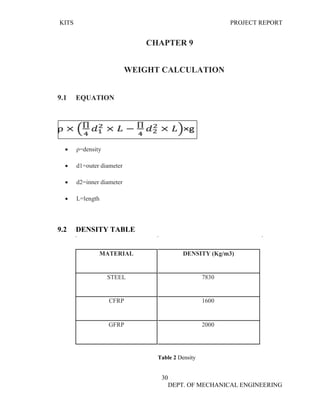
9.1 EQUATION 30
9.2 DENSITY TABLE 30
9.3 WEIGHT CALCULATED 31
CHAPTER 10
ANALYSIS 32
10.1 CONVENTIONAL STEEL [STRESS ANALYSIS] 32
10.2 CONVENTIONAL STEEL [STRAIN ANALYSIS] 33
10.3 CFRP [STRESS ANALYSIS] 33
10.4 CFRP [STRAIN ANALYSIS] 34
10.5 GFRP [STRESS ANALYSIS] 34
10.6 GFRP [STRAIN ANALYSIS] 35
10.7 HYBRID [STRESS ANALYSIS] 36
10.8 HYBRID [STRAIN ANALYSIS] 36
VI
CHAPTER 11
RESULTS 38
11.1 STRESS-STRAIN ANALYSIS RESULT OF STEEL 38
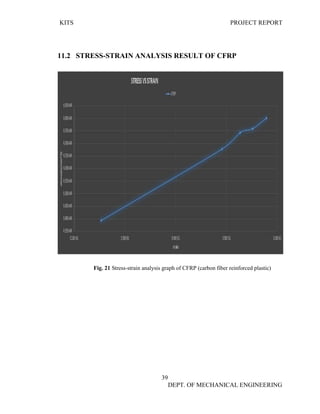
11.2 STRESS- STRAIN ANALYSIS RESULT OF CFRP 39
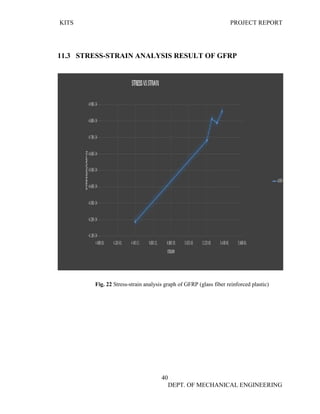
11.3 STRESS- STRAIN ANALYSIS RESULT OF GFRP 40
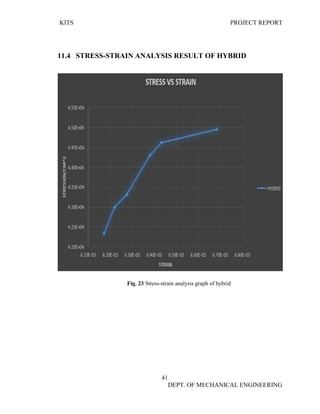
11.4 STRESS- STRAIN ANALYSIS RESULT OF HYBRID 41
CHAPTER 12
ADVANTAGES AND FUTURE SCOPE 42
12.1 ADVANTAGES OF COMPOSITE DRIVE SHAFT 42
12.2 FUTURE SCOPE 42
CHAPTER 13
13.1 CONCLUSION 43
REFERENCES 44
VII
LIST OF FIGURES
Fig 1: Schematic diagram of Propeller shaft arrangement 14
Fig 2: Two piece drive shaft arrangement in automobile 15
Fig 3: Drive shaft in automobile 16
Fig 4: FEA model of the composite propeller shaft 18
Fig 5: Solution sequence 21
Fig 6: Rough sketch of the composite drive shaft 22
Fig 7: Sample figure 23
Fig 8: Steps in design and analysis of the material 29
Fig 9: Stress analysis of conventional steel 32
Fig 10: Layer arrangement of conventional steel 32
Fig 11: Strain analysis of conventional steel 33
Fig 12: Stress analysis of CFRP(carbon fiber reinforced plastic) 33
Fig 13: Strain analysis of CFRP(carbon fiber reinforced plastic) 34
Fig 14: Stress analysis of GFRP(glass fiber reinforced plastic) 34
Fig 15: Strain analysis of GFRP(glass fiber reinforced plastic 35
Fig. 16 Layer arrangements in CFRP & GFRP 35
Fig 17: Hybrid stress analysis 36
Fig 18: Hybrid strain analysis 36
Fig 19: Layer arrangements in hybrid 37
Fig 20: Stress analysis graph of conventional steel 38
VIII
Fig 21: Stress analysis graph of CFRP(carbon fiber reinforced plastic) 39
Fig 22: Stress analysis graph of GFRP(glass fiber reinforced plastic) 40
Fig 23: Stress analysis graph of hybrid 41
LIST OF TABLES
Table 1: Properties of composite materials 28
Table 2: Density 30
Table 3: weight calculated 31
KITS PROJECT REPORT
1
DEPT. OF MECHANICAL ENGINEERING
CHAPTER 1
INTRODUCTION
Composite materials can be defined as a macroscopic combination of two or
more materials having a recognizable interface between them. Composite materials
typically have a fiber or particle phase that is stiffer and stronger than the continuous
phase. Now day’s people are using composite materials for many numbers of
applications in various fields, some of them are aerospace, automotive, construction etc.
In the case of automotive application people are using the composite materials for the
car door panels, bonnet construction, coming to the transmission system in the form of
FRP composite propeller shafts. The extensive application of the composite materials is
due to their superior properties over the conventional materials.
An automotive propeller shaft transmits power from the engine to the differential
gear of a rear wheel drive vehicle. The power is delivered to the shaft by torque (or say,
twisting moment) set up within the shaft, which permits the power to be transmitted to
various machines, linked to the shaft, depending on the applications. The conventional
materials used for ordinary shaft are steel, generally 35C8, 45C8, 55C8 etc. When high
strength is required alloy steel such as nickel, nickel-chromium or chrome-vanadium
steel is used. The fundamental natural frequency of the carbon fiber composite propeller
shaft can be twice as high as that of steel or aluminum because the carbon fiber
composite material has more than 4 times the specific stiffness of steel or aluminum
which makes it possible to manufacture the propeller shaft of passenger cars on one
piece. The composite propeller shaft has many other benefits such as reduced weight and
less noise and vibration.
KITS PROJECT REPORT
2
DEPT. OF MECHANICAL ENGINEERING
The static torque transmission capability of the composite shaft was defined in
this work as the torque value at which the first ply of the composite shaft failed. Since
long thin hollow shafts are vulnerable to torsional buckling.Nowadays, energy
conservation is most important objective in the design of automobile and the effective
measure is to reduce the weight of automobile. Actually, there is direct relation between
vehicle’s weight and fuel consumption.
KITS PROJECT REPORT
3
DEPT. OF MECHANICAL ENGINEERING
CHAPTER 2
LIRERATURE SURVEY
In today’s era, composite materials are widely used in various fields likes
Spacecraft’s equipment, automobiles, structural components etc. main purpose of using
composite material is to use their characteristics. By using this technology its application
is also enlarged. Generally drive shaft assemblies are made from pieces of shafts and u-
joints, which lead to increase in weight and complex mechanism. Firstly In 1988,
composite shaft was used in automobile. Bhirud Pankaj Prakash, Bimleshkumar Sinha
studied that by using of composite material in shaft leads to significant saving in
weight.in their workweight reduction carried out by using composite shaft to 2.7 kg from
10 kg of steel drive shaft. Study shows that when a steel shaft breaks, its components are
thrown in all direction and there is a possibilities that shaft makes a hole in ground and
damage or throw the car in air. But using of composite material in shaft, study shows
that when failure occur shaft divided into fine fibres and does not do any damage to the
driver. Zoricadordevic, Stevan Maksimovic and Ivana studied that by reduce the
thickness of aluminium tube wall, fundamental natural frequencies of shaft increases. B.
Prakash and B. Sinha studied that large amount of weight saving in the range of 24 –
29% is carried out by use of composite materials. And also studies shows that
Kevlar/epoxy composite has more promising properties over steel when deformation,
shear stress, resonant frequencies and weight saving are considered. Madhu K., Darshan
B., Manjunath K. studied that single piece steel drive shaft fails in shear while
Kevlar/epoxy and high modulus carbon/epoxy shafts are good in bending natural
frequency and shear strength. It have also good buckling strength and also good at shear
strength. Sagar D., Sachin M., Jayant G., Nilesh K. state that by replacing two piece
conventional steel shaft with single piece composite material shaft has an added
advantages because of weight reduction and more torsional stiffness. V. Bhajantri, S.
Bajantri, A. Shindolkar, S. Amarapure studied that optimum fibre orientation plays
KITS PROJECT REPORT
4
DEPT. OF MECHANICAL ENGINEERING
important role in the design of composite shaft. Orientations have great effect on the
static characteristics of the composites and added advantages like lower weight, higher
strength and lower power consumption. A. Ravi done a work on high strength carbon
composites with objectives of weight minimizations with constraints like torque, bending
frequency and torsional buckling capacities. He also worked on the composite drive
shafts and suggests hollow drive shaft with diameter (outer) between 50 – 100 for best
result.
A drive shaft is a pivoting part that transmits control from the motor to the
differential apparatus of a back wheel drive vehicles. The steel driveshaft is utilized as a
part of car, these days this steel drive shaft is supplanted by composite material drive
shaft. It has been demonstrated that composite drive shafts are successful in over-coming
the confinements, for example, weight, vibrational qualities and basic speed. Their
flexible properties can be tailored to increase the torque as well as the rotational speed at
which they operate. The drive shafts are used in automotive ,aircraft and aerospace
applications. The automotive industry is exploiting composite material technology for
structural components construction in order to obtain there reduction of the weight
without decrease in vehicle quality and reliability. The drive shafts are utilized as a part
of car, air ship and aviation applications. It is known that energy conservation is one of
the most important Indeed, the very way of the composite materials (fiber and resinous
fastener) permits drive-shafts to be intended to meet particular basic operational
characteristics, and accordingly custom fitted to coordinate the prerequisites of individual
applications. The consequence of this are utilized for demonstrating of carbon/epoxy
composite drive shaft and steel drive shaft utilizing CAD programming to perform static,
clasping and modular examination of both drive shaft utilizing ANSYS programming.In
this study, we evaluate several cylindrical composites shafts by carbon laminate in order
to ensure maximum strength and reliability with minimum material usage. Improvement
of laminate stacking sequence and sheet winding production process result the ultimate
strength goes twenty percent higher than conventional concept shaft. In future work, we
will try to prove numerically that anti-buckling effect by SMPW’s spiral laminate
structure. And also we will evaluate the effect on fatigue limit of this technology. This
KITS PROJECT REPORT
5
DEPT. OF MECHANICAL ENGINEERING
SMPW technology should be confirm greatly contribute to reduce weight ,strengthen and
save carbon fiber material to meat cost requirement for automotive parts; typically for
light-weight torque shaft like propeller or drive axle to achieve ultimate performance.
Chandrakant M. Panchani described that a drive shaft is a mechanical part that
exchanges the torque passed on by a vehicle's motor into usable commute vitality to help
the vehicle. This work did with the goal of supplanting of standard commute shafts with a
composite commute shaft for auto application. The auto business is making composite
material progression for associate parts change to get the decreasing of the weight
without diminishment in vehicle quality and consistency. It is identified that energy
conservation is one of the most vital objectives in vehicle design and saving of weight is
one of the most effective measures to obtain this result. Genuinely, there is basically a
brief proportionality between the hugeness of a vehicle and its fuel use, especially in city
driving. This try is examination done on drive shaft with composite material and
performs that the utilization of composite material for drive shaft would impact less
measure of uneasiness which also decreases the significance of the vehicle. CREO is
modeling software used to make the model of the drive shaft course of action and
ANSYS is the examination pack used to do examination.
KITS PROJECT REPORT
6
DEPT. OF MECHANICAL ENGINEERING
CHAPTER 3
DESCRIPTION OF THE PROBLEM
Almost all automobiles (at least those which correspond to design with rear wheel
drive and front engine installation) have transmission shafts. The weight reduction of the
drive shaft can have a certain role in the general weight reduction of the vehicle and is a
highly desirable goal, if it can be achieved without increase in cost and decrease in quality
and reliability. It is possible to achieve design of composite drive shaft with less weight to
increase the first natural frequency of the shaft.
3.1 AIM AND SCOPE OF THE WORK
This work deals with the replacement of a conventional steel drive shaft with
High Strength CFRP (carbon fiber reinforced plastic) and GFRP (glass fiber
reinforced plastic) composite drive shafts for an automobile application.
3.2 ANALYSIS
• Modeling of the high strength CFRP and GFRP composite drive shaft using
abacus software.
• Stress and strain analysis is to be carried out on high strength CFRP and GFRP
composite drive shaft using abacus software.
• To calculate;
➢ Mass reduction when using the high strength CFRP, GFRP and steel.
➢ The change in stress and strain values of composite drive shaft and
conventional steel drive shaft by varying thickness of shaft.
KITS PROJECT REPORT
7
DEPT. OF MECHANICAL ENGINEERING
3.3 DRIVE SHAFT
The term ‘Drive shaft’ is used to refer to a shaft, which is used for the transfer of
motion from one point to another. In automotive, driveshaft is the connection between
the transmission and the rear axle.
3.4 PURPOSE OF THE DRIVE SHAFT
The torque that is produced from the engine and transmission must be transferred
to the rear wheels to push the vehicle forward and reverse. The drive shaft must provide
a smooth, uninterrupted flow of power to the axles. The drive shaft and differential are
used to transfer this torque.
KITS PROJECT REPORT
8
DEPT. OF MECHANICAL ENGINEERING
CHAPTER 4
DRIVE SHAFT
A drive shaft, driveshaft, driving shaft, propeller shaft (prop shaft), or Cardan shaft is
a mechanical component for transmitting torque and rotation, usually used to connect other
components of a drive train that cannot be connected directly because of distance or the need
to allow for relative movement between them.As torque carriers, drive shafts are subject
to torsion and shear stress, equivalent to the difference between the input torque and the load.
They must therefore be strong enough to bear the stress, while avoiding too much additional
weight as that would in turn increase their inertia.To allow for variations in the alignment and
distance between the driving and driven components, drive shafts frequently incorporate one
or more universal joints, jaw couplings, or rag joints, and sometimes a splined
joint or prismatic joint.
4.1 HISTORY
The term drive shaft first appeared during the mid 19th century. In Stover's 1861
patent reissue for a planing and matching machine, the term is used to refer to the belt-
driven shaft by which the machine is driven. The term is not used in his original patent.
Another early use of the term occurs in the 1861 patent reissue for the Watkins and Bryson
horse-drawn mowing machine. Here, the term refers to the shaft transmitting power from the
machine's wheels to the gear train that works the cutting mechanism.
In the 1890s, the term began to be used in a manner closer to the modern sense. In
1891, for example, Battles referred to the shaft between the transmission and
driving trucks of his Climax locomotive as the drive shaft, and Stillman referred to the shaft
linking the crankshaft to the rear axle of his shaft-driven bicycle as a drive shaft. In 1899,
Bukey used the term to describe the shaft transmitting power from the wheel to the driven
KITS PROJECT REPORT
9
DEPT. OF MECHANICAL ENGINEERING
machinery by a universal joint in his Horse-Power. In the same year, Clark described his
Marine Velocipede using the term to refer to the gear-driven shaft transmitting power
through a universal joint to the propeller shaft. Crompton used the term to refer to the shaft
between the transmission of his steam-powered Motor Vehicle of 1903 and the driven axle.
The pioneering automobile industry company, Autocar, was the first to use a drive
shaft in a gasoline-powered car. Built in 1901, today this vehicle is in the collection of
the Smithsonian Institution.
4.2 AUTOMOTIVE DRIVE SHAFT
4.2.1 VEHICLE
An automobile may use a longitudinal shaft to deliver power from an
engine/transmission to the other end of the vehicle before it goes to the wheels. A pair of
short drive shafts is commonly used to send power from a central differential, transmission,
or transaxle to the wheels.
4.2.2 FRONT-ENGINE,REAR-WHEEL
In front-engined, rear-drive vehicles, a longer drive shaft is also required to send
power the length of the vehicle. Two forms dominate: The torque tube with a single universal
joint and the more common Hotchkiss drive with two or more joints. This system became
known as Système Panhard after the automobile company Panhard et Levassor patented it.
Most of these vehicles have a clutch and gearbox (or transmission) mounted directly
on the engine, with a drive shaft leading to a final drive in the rear axle. When the vehicle is
stationary, the drive shaft does not rotate. Some vehicles (generally sports cars, most
commonly Alfa Romeo or Porsche 924/944/928 models), seeking improved weight balance
between front and rear, use a rear-mounted transaxle. In some non-Porsche models, this
places the clutch and transmission at the rear of the car and the drive shaft between them and
the engine. In this case the drive shaft rotates continuously with the engine, even when the
KITS PROJECT REPORT
10
DEPT. OF MECHANICAL ENGINEERING
car is stationary and out of gear. However, the Porsche 924/944/928 models have the clutch
mounted to the back of the engine in a bell housing and the drive shaft from the clutch
output, located inside of a hollow protective torque tube, transfers power to the rear mounted
transaxle (transmission + differential).Thus the Porsche driveshaft only rotates when the rear
wheels are turning as the engine-mounted clutch can decouple engine crankshaft rotation
from the driveshaft. So for Porsche, when the driver is using the clutch while briskly shifting
up or down (manual transmission), the engine can rev freely with the driver's accelerator
pedal input, since with the clutch disengaged, the engine and flywheel inertia is relatively
low and is not burdened with the added rotational inertia of the driveshaft. The Porsche
torque tube is solidly fastened to both the engine's bell housing and to the transaxle case,
fixing the length and alignment between the bell housing and the transaxle and greatly
minimizing rear wheel drive reaction torque from twisting the transaxle in any plane.
A drive shaft connecting a rear differential to a rear wheel may be called a half-shaft.
The name derives from the fact that two such shafts are required to form one rear axle.Early
automobiles often used chain drive or belt drive mechanisms rather than a drive shaft. Some
used electrical generators and motors to transmit power to the wheels
4.2.3 FRONT-WHEEL DRIVE
In British English, the term "drive shaft" is restricted to a transverse shaft that
transmits power to the wheels, especially the front wheels. A drive shaft connecting the
gearbox to a rear differential is called a propeller shaft, or prop-shaft. A prop-shaft assembly
consists of a propeller shaft, a slip joint and one or more universal joints. Where the engine
and axles are separated from each other, as on four-wheel drive and rear-wheel
drive vehicles, it is the propeller shaft that serves to transmit the drive force generated by the
engine to the axles.
KITS PROJECT REPORT
11
DEPT. OF MECHANICAL ENGINEERING
Several different types of drive shaft are used in the automotive industry:
• One-piece drive shaft
• Two-piece drive shaft
• Slip-in-tube drive shaft
The slip-in-tube drive shaft is a new type that improves crash safety. It can be compressed to
absorb energy in the event of a crash, so is also known as a collapsible drive shaft
4.2.4 FOUR WHEEL AND ALL-WHEEL DRIVE
These evolved from the front-engine rear-wheel drive layout. A new form of
transmission called the transfer case was placed between transmission and final drives in
both axles. This split the drive to the two axles and may also have included reduction gears, a
dog clutch or differential. At least two drive shafts were used, one from the transfer case to
each axle. In some larger vehicles, the transfer box was centrally mounted and was itself
driven by a short drive shaft. In vehicles the size of a Land Rover, the drive shaft to the front
axle is noticeably shorter and more steeply articulated than the rear shaft, making it a more
difficult engineering problem to build a reliable drive shaft, and which may involve a more
sophisticated form of universal joint.
Modern light cars with all-wheel drive (notably Audi or the Fiat Panda may use a
system that more closely resembles a front-wheel drive layout. The transmission and final
drive for the front axle are combined into one housing alongside the engine, and
a single drive shaft runs the length of the car to the rear axle. This is a favored design where
the torque is biased to the front wheels to give car-like handling, or where the maker wishes
to produce both four-wheel drive and front-wheel drive cars with many shared components.
The automotive industry also uses drive shafts at testing plants. At an engine test
stand a drive shaft is used to transfer a certain speed or torque from the internal combustion
engine to a dynamometer. A "shaft guard" is used at a shaft connection to protect against
contact with the drive shaft and for detection of a shaft failure. At a transmission test stand a
drive shaft connects the prime mover with the transmission.
KITS PROJECT REPORT
12
DEPT. OF MECHANICAL ENGINEERING
4.3 MOTORCYCLE DRIVE SHAFTS
Drive shafts have been used on motorcycles since before WW1, such as the
Belgian FN motorcycle from 1903 and the Stuart Turner Stellar motorcycle of 1912. As an
alternative to chain and belt drives, drive shafts offer long-lived, clean, and relatively
maintenance-free operation. A disadvantage of shaft drive on a motorcycle is that helical
gearing, spiral bevel gearing or similar is needed to turn the power 90° from the shaft to the
rear wheel, losing some power in the process.
BMW has produced shaft drive motorcycles since 1923; and Moto Guzzi have built
shaft-drive V-twins since the 1960s. The British company, Triumph and the major Japanese
brands, Honda, Suzuki, Kawasaki and Yamaha, have produced shaft drive motorcycles.
Lambretta motorscooters type A up to type LD were shaft-driven the NSU Prima
scooter was also shaft-driven
Motorcycle engines positioned such that the crankshaft is longitudinal and parallel to
the frame are often used for shaft-driven motorcycles. This requires only one 90° turn in
power transmission, rather than two. Bikes from Moto Guzzi and BMW, plus the Triumph
Rocket III and Honda ST series all use this engine layout.
Motorcycles with shaft drive are subject to shaft effect where the chassis climbs
when power is applied. This effect, which is the opposite of that exhibited by chain-drive
motorcycles, is counteracted with systems such as BMW's Paralever, Moto
Guzzi's CARC and Kawasaki's Tetra Lever.
4.4 MARINE DRIVE SHAFT
On a power-driven ship, the drive shaft, or propeller shaft, usually connects the
transmission inside the vessel directly to the propeller, passing through a stuffing box or
other seal at the point it exits the hull. There is also a thrust block, a bearing to resist the axial
force of the propeller. As the rotating propeller pushes the vessel forward, any length of drive
shaft between propeller and thrust block is subject to compression, and when going astern
KITS PROJECT REPORT
13
DEPT. OF MECHANICAL ENGINEERING
to tension. Except for the very smallest of boats, this force isn't taken on the gearbox or
engine directly.
Cardan shafts are also often used in marine applications between the transmission
and either a propeller gearbox or waterjet.The portion of the prop shaft which connects
directly to the propeller is known as the tail shaft.
4.5 LOCOMOTIVE DRIVE SHAFT
The Shay, Climax and Heisler locomotives, all introduced in the late 19th century,
used quill drives to couple power from a centrally mounted multi-cylinder engine to each of
the trucks supporting the engine. On each of these geared steam locomotives, one end of each
drive shaft was coupled to the driven truck through a universal joint while the other end was
powered by the crankshaft, transmission or another truck through a second universal joint. A
quill drive also has the ability to slide lengthways, effectively varying its length. This is
required to allow the bogies to rotate when passing a curve.
Cardan shafts are used in some diesel locomotives (mainly diesel-hydraulics, such
as British Rail Class 52) and some electric locomotives (e.g. British Rail Class 91). They are
also widely used in diesel multiple units.
KITS PROJECT REPORT
14
DEPT. OF MECHANICAL ENGINEERING
CHAPTER 5
AUTOMOBILE DRIVE SHAFT
5.1 DEMERITS OF CONVENTIONAL DRIVE SHAFT
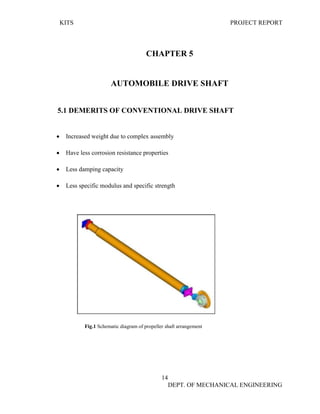
• Increased weight due to complex assembly
• Have less corrosion resistance properties
• Less damping capacity
• Less specific modulus and specific strength
Fig.1 Schematic diagram of propeller shaft arrangement
KITS PROJECT REPORT
15
DEPT. OF MECHANICAL ENGINEERING
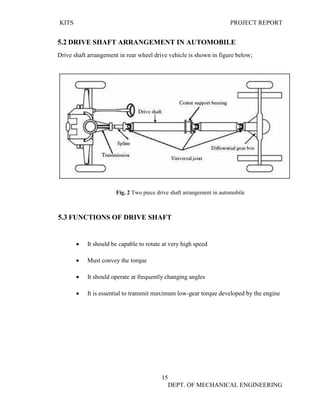
5.2 DRIVE SHAFT ARRANGEMENT IN AUTOMOBILE
Drive shaft arrangement in rear wheel drive vehicle is shown in figure below;
Fig. 2 Two piece drive shaft arrangement in automobile
5.3 FUNCTIONS OF DRIVE SHAFT
• It should be capable to rotate at very high speed
• Must convey the torque
• It should operate at frequently changing angles
• It is essential to transmit maximum low-gear torque developed by the engine
KITS PROJECT REPORT
16
DEPT. OF MECHANICAL ENGINEERING
5.4 DIFFERENT TYPES OF SHAFTS
• Transmission shaft: used for transmit the power between power sources
andmachines.
• Machine shaft: used as an integral part in machine itself.
• Axle: are used for transmitting a bending moment only.
• Spindle: is used as a short shaft that imparts motion either to a cutting tool or
to a work – piece.
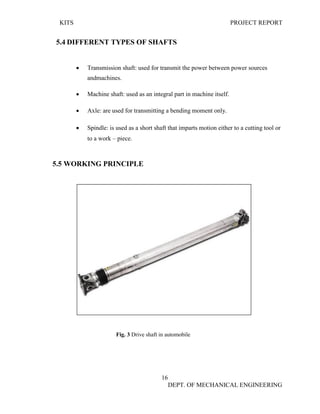
5.5 WORKING PRINCIPLE
Fig. 3 Drive shaft in automobile
KITS PROJECT REPORT
17
DEPT. OF MECHANICAL ENGINEERING
The torque that is produced from the engine and transmission must be
transferred to the rear wheels to pushthe vehicle forward and reverse. The drive shaft must
provide a smooth, uninterrupted flow of power to the axles. The drive shaft and differential
are used to transfer this torque. First, it must transmit torque from the transmission to the
differential gear box. During the operation, it is necessary to transmit maximum low-gear
torque developed by the engine. The drive shafts must also be capable of rotating at the very
fast speeds required by the vehicle. The drive shaft must also operate through constantly
changing angles between the transmission, the differential and the axles. As the rear wheels
roll over bumps in the road, the differential and axles move up and down. This movement
changes the angle between the transmission and the differential. The length of the drive shaft
must also be capable of changing while transmitting torque. Length changes are caused by
axle movement due to torque reaction, road deflections, braking loads and so on. Alsip joint
is used to compensate for this motion. The slip joint is usually made of an internal and
external spline. It is located on the front end of the drive shaft and is connected to the
transmission.
KITS PROJECT REPORT
18
DEPT. OF MECHANICAL ENGINEERING
CHAPTER 6
MODELING
In the design consideration solid or hollow circular shaft may be chosen. For this
problem hollow circular shaft is chosen. In the case of hollow circular cross section
stress variation is small.
6.1 DIMENSIONS OF THE PROPELLER SHAFT
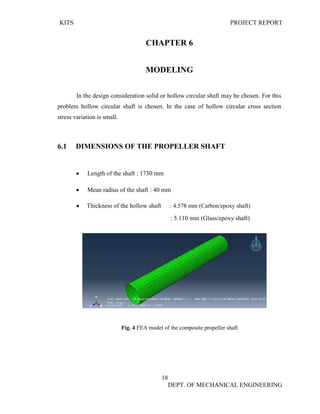
• Length of the shaft : 1730 mm
• Mean radius of the shaft : 40 mm
• Thickness of the hollow shaft : 4.578 mm (Carbon/epoxy shaft)
: 5.110 mm (Glass/epoxy shaft)
Fig. 4 FEA model of the composite propeller shaft
KITS PROJECT REPORT
19
DEPT. OF MECHANICAL ENGINEERING
Structural static analysis was carried out on the shaft. After doing the structural
static analysis for a torque of 2030 N-m, the optimized parameters were found with mean
radius, thickness of each layer as the design variables, and the maximum allowable shear
stress, maximum twist as the state variables and the total volume as the objective
function which is to be optimized (minimization).The results of static analysis i.e., the
maximum twist of the shaft and the maximum shear stress developed were checked and
those are found to be within the allowable values.
6.2 DETAILS ABOUT ABAQUS STUDENTS VERSION SOFTWARE
Abacus is used in the automotive, aerospace, and industrial products industries.
The product is popular with non-academic and research institutions in engineering due to
the wide material modeling capability, and the program's ability to be customized.
Abacus also provides a good collection of multiphysics capabilities, such as coupled
acoustic-structural, piezoelectric, and structural-pore capabilities, making it attractive for
production-level simulations where multiple fields need to be coupled. Abacus was
initially designed to address non-linear physical behavior; as a result, the package has an
extensive range of material models such as elastomeric (rubberlike) material capabilities.
Abaqus is a commercial software package for finite element analysis. The Abaqus
product suite consists of three core products: Abaqus/Standard, Abaqus/Explicit and
Abaqus/CAE. Abaqus/Standard is a general-purpose solver using a traditional implicit
integration scheme to solve finite element analyses. Abaqus/Explicit uses an explicit
integration scheme to solve highly nonlinear transient dynamic and quasi-static analyses.
Abaqus/CAE provides an integrated modelling (preprocessing) and visualization
(postprocessing) environment for the analysis products.
Abaqus is used in the automotive, aerospace, and industrial product industries. The
product is popular with academic and research institutions due to the wide material
modeling capability, and the program’s ability to be customized. Abaqus also provides a
KITS PROJECT REPORT
20
DEPT. OF MECHANICAL ENGINEERING
good collection of multiphysics capabilities, such as coupled acoustic-structural,
piezoelectric, and structural-pore capabilities, making it attractive for production-level
simulations where multiple fields need to be coupled.
Abaqus was initially designed to address non-linear physical behavior; as a result, the
package has an extensive range of material models. Its elastomeric (rubberlike) material
capabilities are particularly noteworthy.
Abaqus company was founded in 1978 by Dr. David Hibbitt, Dr. Bengt Karlsson, and
Dr. Paul Sorensen with the original name Hibbitt, Karlsson & Sorensen, Inc., (HKS). Later
on, the company name was changed to ABAQUS Inc. before the acquisition by Dassault
Systèmes in 2005. After that, it became part of Dassault Systèmes Simulia Corp. The
headquarters of the company was located in Providence, Rhode Island until 2014. Since
2014, the headquarters of the company are located in Johnston, Rhode Island, United States.
A wide range of linear and nonlinear engineering simulations to be carried out
efficiently, accurately, and reliably. The extensive analysis capabilities, superb performance,
thorough documentation, high quality, and best-in-class support make Abaqus/Standard an
effective tool for many engineering analysis. Abaqus/Standard is supported within the
Abaqus/CAE modeling environment for all common pre- and post processing needs. In
addition, Abaqus/Standard can be accessed from within many common modeling
environments that may be appropriate to your needs
KITS PROJECT REPORT
21
DEPT. OF MECHANICAL ENGINEERING
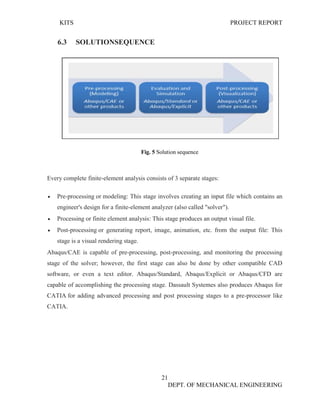
6.3 SOLUTIONSEQUENCE
Fig. 5 Solution sequence
Every complete finite-element analysis consists of 3 separate stages:
• Pre-processing or modeling: This stage involves creating an input file which contains an
engineer's design for a finite-element analyzer (also called "solver").
• Processing or finite element analysis: This stage produces an output visual file.
• Post-processing or generating report, image, animation, etc. from the output file: This
stage is a visual rendering stage.
Abaqus/CAE is capable of pre-processing, post-processing, and monitoring the processing
stage of the solver; however, the first stage can also be done by other compatible CAD
software, or even a text editor. Abaqus/Standard, Abaqus/Explicit or Abaqus/CFD are
capable of accomplishing the processing stage. Dassault Systemes also produces Abaqus for
CATIA for adding advanced processing and post processing stages to a pre-processor like
CATIA.
KITS PROJECT REPORT
22
DEPT. OF MECHANICAL ENGINEERING
CHAPTER 7
DESIGN
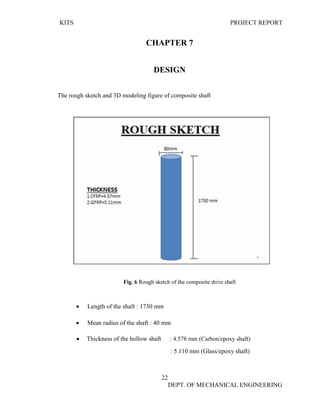
The rough sketch and 3D modeling figure of composite shaft
Fig. 6 Rough sketch of the composite drive shaft
• Length of the shaft : 1730 mm
• Mean radius of the shaft : 40 mm
• Thickness of the hollow shaft : 4.578 mm (Carbon/epoxy shaft)
: 5.110 mm (Glass/epoxy shaft)
KITS PROJECT REPORT
23
DEPT. OF MECHANICAL ENGINEERING
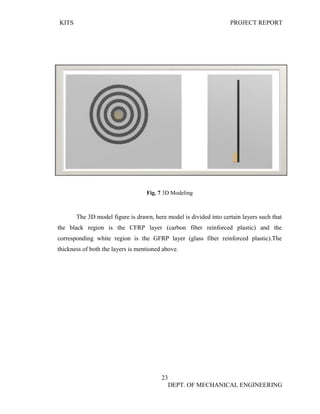
Fig. 7 3D Modeling
The 3D model figure is drawn, here model is divided into certain layers such that
the black region is the CFRP layer (carbon fiber reinforced plastic) and the
corresponding white region is the GFRP layer (glass fiber reinforced plastic).The
thickness of both the layers is mentioned above.
KITS PROJECT REPORT
24
DEPT. OF MECHANICAL ENGINEERING
CHAPTER 8
COMPOSITE AND PROPERTIES
8.1 COMPOSITE
A composite material is made by combining two or more materials – often ones
that have very different properties. The two materials work together to give the
composite unique properties. However, within the composite you can easily tell the
different materials apart as they do not dissolve or blend into each other.
8.1.1 NATURAL COMPOSITES
Natural composites exist in both animals and plants. Wood is a composite – it is
made from long cellulose fibres (a polymer) held together by a much weaker substance
called lignin. Cellulose is also found in cotton, but without the lignin to bind it together it
is much weaker. The two weak substances – lignin and cellulose – together form a much
stronger one. The bone in your body is also a composite. It is made from a hard but
brittle material called hydroxyapatite (which is mainly calcium phosphate) and a soft and
flexible material called collagen (which is a protein). Collagen is also found in hair and
finger nails. On its own it would not be much use in the skeleton but it can combine with
hydroxyapatite to give bone the properties that are needed to support the body.
8.1.2 EARLY COMPOSITES
People have been making composites for many thousands of years. One early
example is mud bricks. Mud can be dried out into a brick shape to give a building
material. It is strong if you try to squash it (it has good compressive strength) but it
breaks quite easily if you try to bend it (it has poor tensile strength). Straw seems very
KITS PROJECT REPORT
25
DEPT. OF MECHANICAL ENGINEERING
strong if you try to stretch it, but you can crumple it up easily. By mixing mud and straw
together it is possible to make bricks that are resistant to both squeezing and tearing and
make excellent building blocks. Another ancient composite is concrete. Concrete is a
mix of aggregate (small stones or gravel), cement and sand. It has good compressive
strength (it resists squashing). In more recent times it has been found that adding metal
rods or wires to the concrete can increase its tensile (bending) strength. Concrete
containing such rods or wires is called reinforced concrete.
8.1.3 MAKING COMPOSITES
Most composites are made of just two materials. One is the matrix or binder. It
surrounds and binds together fibres or fragments of the other material, which is called
the reinforcement.
8.1.4 MODERN EXAMPLES
The first modern composite material was fibreglass. It is still widely used today
for boat hulls, sports equipment, building panels and many car bodies. The matrix is a
plastic and the reinforcement is glass that has been made into fine threads and often
woven into a sort of cloth.The glass is very strong but brittle and it will break if bent
sharply. The plastic matrix holds the glass fibres together and also protects them from
damage by sharing out the forces acting on them. Some advanced composites are now
made using carbon fibres instead of glass. These materials are lighter and stronger than
fibre glass but more expensive to produce. They are used in aircraftstructures and
expensive sports equipment such as golf clubs. Carbon nanotubes have also been used
successfully to make new composites. These are even lighter and stronger than
composites made with ordinary carbon fibres but they are still extremely expensive.
They do, however, offer possibilities for making lighter cars and aircraft (which will use
less fuel than the heavier vehicles we have now). The new Airbus A380, the world’s
KITS PROJECT REPORT
26
DEPT. OF MECHANICAL ENGINEERING
largest passenger airliner, makes use of modern composites in its design. More than 20
% of the A380 is made of composite materials, mainly plastic reinforced with carbon
fibres. The design is the first large-scale use of glass-fibre-reinforced aluminium, a new
composite that is 25 % stronger than conventional airframe aluminium but 20 % lighter.
8.1.5 E-GLASS RESIN
A polymer is generally manufactured by Step-growth polymerization or addition
polymerization. When combined with various agents to enhance or in any way alter the
material properties of polymers the result is referred to as a plastic. Composite plastics
refer to those types of plastics that result from bonding two or more homogeneous
materials with different material properties to derive a final product with certain desired
material and mechanical properties. Fibre-reinforced plastics are a category of composite
plastics that specifically use fibre materials to mechanically enhance the strength and
elasticity of plastics. The original plastic material without fibre reinforcement is known
as the matrix. The matrix is a tough but relatively weak plastic that is reinforced by
stronger stiffer reinforcing filaments or fibres. The extent that strength and elasticity are
enhanced in a fibre-reinforced plastic depends on the mechanical properties of the fibre
and matrix, their volume relative to one another, and the fibre length and orientation with
in the matrix. Reinforcement of the matrix occurs by definition when the FRP material
exhibits increased strength or elasticity relative to the strength and elasticity of the
matrix alone. Low-E glass works by reflecting heat back to its source. All objects and
people give off varying forms of energy, affecting the temperature of a space. Long
wave radiation energy is heat, and short wave radiation energy is visible light from the
sun. The coating used to make low-E glass works to transmit short wave energy,
allowing light in, while reflecting long wave energy to keep heat in the desired location.
Low-E glass comes in high, moderate and low gain panels. In especially cold climates,
heat is preserved and reflected back into a house to keep it warm. This is accomplished
with high solar gain panels. In especially hot climates, low solar gain panels work to
reject excess heat by reflecting it back outside the space. Moderate solar gain panels are
KITS PROJECT REPORT
27
DEPT. OF MECHANICAL ENGINEERING
also available for areas with temperature fluctuations. Low-E glass is glazed with an
ultra-thin metallic coating. The manufacturing process applies this with either a hard coat
or soft coat process. Soft coated low-E glass is more delicate and easily damaged so it is
used in insulated windows where it can be in between two other pieces of glass. Hard
coated low-E glass is more durable and can be used in single paned windows. It can also
be used in retrofit projects. Generally low-E windows cost between 10% and 15% more
than standard. The reduction in energy loss can be 30% to 50%. Low-E windows are a
larger investment initially but will pay for themselves by reducing heating and cooling
costs.
Visibility was a problem with some of the first low-E glass available. Original
panes were said to have a brownish tint. Technology and manufacturing has continued to
improve its quality resulting in a spectrally selective low-E glass that allows the best
possible visibility while still filtering heat.
8.1.6 CARBON/EPOXY
Mechanical behaviour of Carbon fibre reinforced epoxy composites revealed that
the tensile strength is greatly influenced by the fibre content/ weight fraction of
reinforcement in matrix. A reinforced composite shows more tensile strength than
unreinforced epoxy. With increase in weight fraction of carbon glass fibres over pure
epoxy, the tensile strength increased. The maximum load observed is 14KN.
More elongation will be found in 15 ° orientation. The elongation is less in case
of 90° orientation. The external tensile load is equally distributed on all the fibres and
transmitted along the axis of the fibre.
KITS PROJECT REPORT
28
DEPT. OF MECHANICAL ENGINEERING
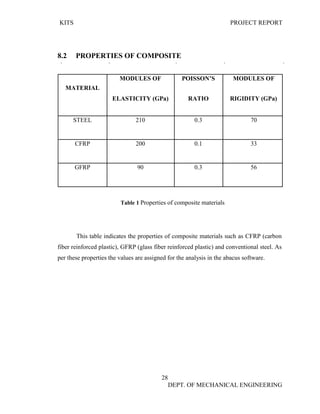
8.2 PROPERTIES OF COMPOSITE
This table indicates the properties of composite materials such as CFRP (carbon
fiber reinforced plastic), GFRP (glass fiber reinforced plastic) and conventional steel. As
per these properties the values are assigned for the analysis in the abacus software.
MATERIAL
MODULES OF POISSON’S MODULES OF
ELASTICITY (GPa) RATIO RIGIDITY (GPa)
STEEL 210 0.3 70
CFRP 200 0.1 33
GFRP 90 0.3 56
Table 1 Properties of composite materials
KITS PROJECT REPORT
29
DEPT. OF MECHANICAL ENGINEERING
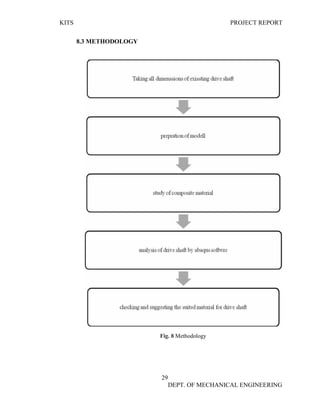
8.3 METHODOLOGY
Fig. 8 Methodology
KITS PROJECT REPORT
30
DEPT. OF MECHANICAL ENGINEERING
CHAPTER 9
WEIGHT CALCULATION
9.1 EQUATION
• ρ=density
• d1=outer diameter
• d2=inner diameter
• L=length
9.2 DENSITY TABLE
MATERIAL DENSITY (Kg/m3)
STEEL 7830
CFRP 1600
GFRP 2000
Table 2 Density
KITS PROJECT REPORT
31
DEPT. OF MECHANICAL ENGINEERING
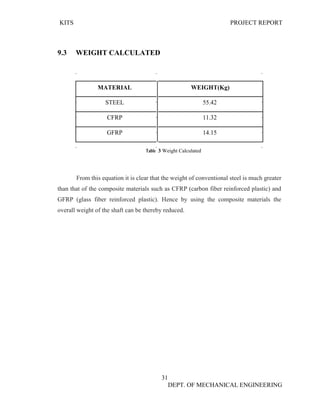
9.3 WEIGHT CALCULATED
MATERIAL WEIGHT(Kg)
STEEL 55.42
CFRP 11.32
GFRP 14.15
Table 3 Weight Calculated
From this equation it is clear that the weight of conventional steel is much greater
than that of the composite materials such as CFRP (carbon fiber reinforced plastic) and
GFRP (glass fiber reinforced plastic). Hence by using the composite materials the
overall weight of the shaft can be thereby reduced.
KITS PROJECT REPORT
32
DEPT. OF MECHANICAL ENGINEERING
CHAPTER 10
ANALYSIS
Analysis is done with the help of abacus software and the following are the analysis results;
10.1 CONVENTIONAL STEEL [STRESS ANALYSIS]
Fig. 9 Stress analysis of conventional steel
Fig. 10 Layer arrangement of conventional steel
KITS PROJECT REPORT
33
DEPT. OF MECHANICAL ENGINEERING
10.2 CONVENTIONAL STEEL [STRAIN ANALYSIS]
Fig. 11 Strain analysis of conventional steel
10.3 CFRP [STRESS ANALYSIS]
Fig. 12 Stress analysis of CFRP (carbon fiber reinforced plastic)
KITS PROJECT REPORT
34
DEPT. OF MECHANICAL ENGINEERING
10.4 CFRP [STRAIN ANALYSIS]
‘
Fig. 13 Strain analysis of CFRP (carbon fiber reinforced plastic)
10.5 GFRP [STRESS ANALYSIS]
Fig. 14 Stress analysis of GFRP (glass fiber reinforced plastic)
KITS PROJECT REPORT
35
DEPT. OF MECHANICAL ENGINEERING
10.6 GFRP [STRAIN ANALYSIS]
Fig. 15 Strain analysis of GFRP (glass fiber reinforced plastic)
Fig. 16 Layer arrangements in CFRP & GFRP
KITS PROJECT REPORT
36
DEPT. OF MECHANICAL ENGINEERING
10.7 HYBRID [STRESS ANALYSIS]
Fig. 17 Hybrid stress analysis
10.8 HYBRID [STRAIN ANALYSIS]
Fig. 18 Hybrid strain analysis
KITS PROJECT REPORT
37
DEPT. OF MECHANICAL ENGINEERING
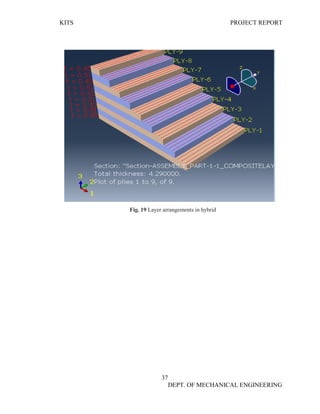
Fig. 19 Layer arrangements in hybrid
KITS PROJECT REPORT
38
DEPT. OF MECHANICAL ENGINEERING
CHAPTER 11
RESULTS
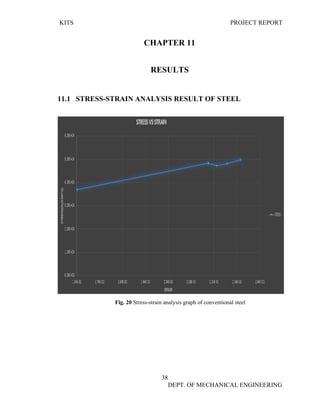
11.1 STRESS-STRAIN ANALYSIS RESULT OF STEEL
Fig. 20 Stress-strain analysis graph of conventional steel
KITS PROJECT REPORT
39
DEPT. OF MECHANICAL ENGINEERING
11.2 STRESS-STRAIN ANALYSIS RESULT OF CFRP
Fig. 21 Stress-strain analysis graph of CFRP (carbon fiber reinforced plastic)
KITS PROJECT REPORT
40
DEPT. OF MECHANICAL ENGINEERING
11.3 STRESS-STRAIN ANALYSIS RESULT OF GFRP
Fig. 22 Stress-strain analysis graph of GFRP (glass fiber reinforced plastic)
KITS PROJECT REPORT
41
DEPT. OF MECHANICAL ENGINEERING
11.4 STRESS-STRAIN ANALYSIS RESULT OF HYBRID
Fig. 23 Stress-strain analysis graph of hybrid
KITS PROJECT REPORT
42
DEPT. OF MECHANICAL ENGINEERING
CHAPTER 12
ADVANTAGES AND FUTURE SCOPE
12.1 ADVANTAGES OF COMPOSITE DRIVE SHAFT
• Reduced weight
• Good at corrosion resistance
• Higher fundamental natural frequency
• Due to reduction in weight, fuel consumption will be reduced.
• Longer fatigue life;
 FUTURE SCOPE
• Automotive industry: leaf springs, bumpers, body panels, frames, drive shaft.
• Aircraft: elevators, bearings, panels, floorings, drive shaft etc.
• Space: antenna, antenna ribs, antenna struts, remote manipulator arm etc.
• Marin: gear case, strainers, valve, propeller vanes etc.
• Chemical industries: storage tanks, composite vessels for fuel storage, ducts
• Electrical: insulators, fiber optics, lighting poles etc.
• Sports goods: golf club shafts, bicycle framework, helmets etc.
KITS PROJECT REPORT
43
DEPT. OF MECHANICAL ENGINEERING
CHAPTER 13
CONCLUSIONS
As the aim of this project is to reduce the weight and find strength of the drive
shaft. The major sources used for this purpose are composite materials. By using three
different kind of composite materials steel, carbon epoxy, E-glass epoxy the project has
been carried out. Shaft is analyzed using layer stacking method in Abacus software
which utilizes finite element method technologies. These layer stacking techniques are
employed for shafts with and without binder material. Static analysis is done for
observing the steady loading conditions. The results have shown that the shaft made of
composite material has high strength when compared steel material. On the basis of
stress calculation, report says that composite material shaft is advisable to replace
conventional material shaft.
Through this project it is concluded that;
• The weight of composite material shaft is lower than that of the conventional
steel shaft
• The stress induced by the composite material is also lower than that of the
conventional steel shaft
KITS PROJECT REPORT
44
DEPT. OF MECHANICAL ENGINEERING
REFERENCES
1. Beardmore P, “The Potential for Composites in Structural Automotive
Applications” Journal of Composites Science and Technology, 1986..
John W, “Engineers Guide to Composite Materials”, American Society for
Metals, 1986.
2. Pollard A, “Polymer Matrix Composites in Driveline Applications”, Gkn
Technology., UK, 1989.
3. . Rangaswamy, “Optimal Sizing And Stacking Sequence Of Composite Drive
Shafts” Materials Science. Vol.11 Issue 2, 2005.
4. Bhirud Pankaj Prakash, Bimlesh Kumar Sinha, “Analysis Of Drive Shaft”
IJMAPE, Volume- 2, Issue- 2, Feb.-2014.
5. Zorica Đorđević, Stevan Maksimović, Ivana Ilić, “Dynamic Analysis Of
Hybrid Aluminum/Composite Shafts” Scientific Technical Review, Vol. 8,
No.2, 2008.
6. Sagar Dharmadhikari, Sachin Mahakalkar, Jayant Giri, Nilesh Khutafale,
“Design And Analysis Of Composite Drive Shaft Using Ansys And Genetic
Algorithm”, IJMER, Vol.3, Issue.1, Jan-Feb. 2013.
7. Madhu K.S., Darshan B.H., Manjunath K, “Buckling Analysis Of Composite
Drive Shaft For Automotive Applications”, Journal Of Innovative Research
And Solutions (JIRAS) Volume No.1a, Issue No.2, Page No: 63 ‐70, Jan – Jun
2013.
8. V. Bhajantri, S. Bajantri, A. Shindolkar, S. Amarapure, “Design and Analysis
Of Composite Drive Shaft” International Journal Of Research In Engineering
And Technology, Volume: 03 Special Issue: 03 May-2014.
9. Arun Ravi, “Design, Comparison And Analysis Of A Composite Drive Shaft
For An Automobile” ,International Review Of Applied Engineering Research,
Volume 4, Number 1 (2014).
10. T. E. Alberts and Houchun Xia, ― Design and Analysis of Fibre Enhanced
Viscoelastic Damping Polymers‖, Journal of Vibration and Acoustics, Vol. 117,
October 1995.

DESIGN AND ANALYSIS OF COMPOSITE PROPELLER/DRIVEN SHAFT USING FEA

  • 1.
    DESIGN AND ANALYSISOF COMPOSITE DRIVE SHAFT USING FEA Project report submitted to MAHATMA GANDHI UNIVERSITY KOTTAYAM In partial fulfillment of the requirements for the award of the degree of BACHELOR OF TECHNOLOGY IN MECHANICAL ENGINEERING Submitted By Mr. ATHUL K NINAN (Reg. No.: 14024471) Mr. BIPIN V NAIR (Reg. No.: 14024476) Mr. BASIL BENNY (Reg. No.: 14024472) Mr. GEORGE SHELTON (Reg. No.: 14024483) DEPARTMENT OF MECHANICAL ENGINEERING KOTTAYAM INSTITUTE OF TECHNOLOGY AND SCIENCE CHENGALAM, KOTTAYAM 2014 – 2018
  • 2.
    DEPARTMENT OF MECHANICALENGINEERING KOTTAYAM INSTITUTE OF TECHNOLOGY AND SCIENCE CHENGALAM, KOTTAYAM CERTIFICATE This is to certify that the report entitled “DESIGN AND ANALYSIS OF COMPOSITE DRIVE SHAFT USING FEA” is the bonafide record of the project by Mr. ATHUL K NINAN, Mr. BIPIN V NAIR, Mr. BASIL BENNY, Mr. GEORGE SHELTON of MECHANICAL ENGINEERING towards the partial fulfillment of the requirements for the award of the degree of Bachelor of Technology in Mechanical Engineering by the Mahatma Gandhi University. PROJECT GUIDE HOD
  • 3.
    I ACKNOWLEDGEMENT If the wordsare considered as symbols of approval and tokens of acknowledgement, first and foremost, we praise the GOD ALMIGHTY for the grace he showered on us during the project work. We extend our sincere thanks to our Principal, Dr. N. Prabhu, for giving us this opportunity to do the Project. We would like to place our heartfelt thanks to Mr. Nandakumar S., Head of the Department, Mechanical Engineering and our project guide Mr. Ashok K B Assistant Professor, Department of Mechanical Engineering. It is a pleasure to be indebted to our guide for his valuable support, advice and encouragement. We also thank all the faculty and staff of the Department of Mechanical Engineering for extending their helping hands to make this project work a great success. We would also like to thank our parents and friends who have prayed and helped us during the project.
  • 4.
    II ABSTRACT The last fewyears have seen the increasing use of composite materials in many fields of engineering applications. Polymer composites are today widely used to design the automobile components in view of their outstanding specific stiffness and strength properties. Composite shafts for automotive applications are among the most current areas of investigation. Weight reduction can be primarily achieved by the introduction of better material. The conventional system uses metallic shaft, has inherent limitations like heavy weight, corrosion, flexibility problems, vibrations, bearing and manufacturing problems, which magnifies with increase in shaft diameter. Advanced composite materials offer the potential to improve propulsion shafting, by reducing weight, bearing loads, alignment problems, life - cycle cost by using strategic materials, by increasing allowable fatigue stress, flexibility, and vibration damping characteristics. This project aims for the design and analysis of Carbon Fiber Reinforced plastics (CFRP) and Glass Fiber Reinforced Plastics (GFRP) composite hollow shafts for automobiles.
  • 5.
    III TABLE OF CONTENTS ACKNOWLEDGEMENTI ABSTRACT II LIST OF FIGURES VII LIST OF TABLES VIII CHAPTER 1 INTRODUCTION 1 CHAPTER 2 LIRERATURE SURVEY 3 CHAPTER 3 DESCRIPTION OF THE PROBLEM 6 3.1 AIM AND SCOPE OF THE WORK 6 3.2 ANALYSIS 6 3.3 DRIVE SHAFT 7 3.4 PURPOSE OF THE DRIVE SHAFT 7 CHAPTER 4 DRIVESHAFT 8 4.1 HISTORY 8
  • 6.
    IV 4.2 AUTOMOTIVE DRIVESHAFT 9 4.3 MOTORCYCLE DRIVE SHAFTS 12 4.4 MARINE DRIVE SHAFT 12 4.5 LOCOMOTIVE DRIVE SHAFT 13 CHAPTER 5 AUTOMOBILE DRIVE SHAFT 14 5.1 DEMERITS OF CONVENTIONAL DRIVE SHAFT 14 5.2 DRIVE SHAFT ARRANGEMENT IN AUTOMOBILE 15 5.3 FUNCTIONS OF DRIVE SHAFT 15 5.4 DIFFERENT TYPES OF SHAFTS 16 5.5 WORKING PRINCIPLE 16 CHAPTER 6 MODELLING 18 6.1 DIMENSIONS OF THE PROPELLER SHAFT 18 6.2 DETAILS ABOUT ABAQUS STUDENTS VERSION SOFTWARE 19 6.3 SOLUTION SEQUENCE 21 CHAPTER 7 DESIGN 22
  • 7.
    V CHAPTER 8 COMPOSITE ANDPROPERTIES 24 8.1 COMPOSITE 24 8.2 PROPERTIES OF COMPOSITE 28 8.3 METHADOLOGY 29 CHAPTER 9 WEIGHT CALCULATION 30 9.1 EQUATION 30 9.2 DENSITY TABLE 30 9.3 WEIGHT CALCULATED 31 CHAPTER 10 ANALYSIS 32 10.1 CONVENTIONAL STEEL [STRESS ANALYSIS] 32 10.2 CONVENTIONAL STEEL [STRAIN ANALYSIS] 33 10.3 CFRP [STRESS ANALYSIS] 33 10.4 CFRP [STRAIN ANALYSIS] 34 10.5 GFRP [STRESS ANALYSIS] 34 10.6 GFRP [STRAIN ANALYSIS] 35 10.7 HYBRID [STRESS ANALYSIS] 36 10.8 HYBRID [STRAIN ANALYSIS] 36
  • 8.
    VI CHAPTER 11 RESULTS 38 11.1STRESS-STRAIN ANALYSIS RESULT OF STEEL 38 11.2 STRESS- STRAIN ANALYSIS RESULT OF CFRP 39 11.3 STRESS- STRAIN ANALYSIS RESULT OF GFRP 40 11.4 STRESS- STRAIN ANALYSIS RESULT OF HYBRID 41 CHAPTER 12 ADVANTAGES AND FUTURE SCOPE 42 12.1 ADVANTAGES OF COMPOSITE DRIVE SHAFT 42 12.2 FUTURE SCOPE 42 CHAPTER 13 13.1 CONCLUSION 43 REFERENCES 44
  • 9.
    VII LIST OF FIGURES Fig1: Schematic diagram of Propeller shaft arrangement 14 Fig 2: Two piece drive shaft arrangement in automobile 15 Fig 3: Drive shaft in automobile 16 Fig 4: FEA model of the composite propeller shaft 18 Fig 5: Solution sequence 21 Fig 6: Rough sketch of the composite drive shaft 22 Fig 7: Sample figure 23 Fig 8: Steps in design and analysis of the material 29 Fig 9: Stress analysis of conventional steel 32 Fig 10: Layer arrangement of conventional steel 32 Fig 11: Strain analysis of conventional steel 33 Fig 12: Stress analysis of CFRP(carbon fiber reinforced plastic) 33 Fig 13: Strain analysis of CFRP(carbon fiber reinforced plastic) 34 Fig 14: Stress analysis of GFRP(glass fiber reinforced plastic) 34 Fig 15: Strain analysis of GFRP(glass fiber reinforced plastic 35 Fig. 16 Layer arrangements in CFRP & GFRP 35 Fig 17: Hybrid stress analysis 36 Fig 18: Hybrid strain analysis 36 Fig 19: Layer arrangements in hybrid 37 Fig 20: Stress analysis graph of conventional steel 38
  • 10.
    VIII Fig 21: Stressanalysis graph of CFRP(carbon fiber reinforced plastic) 39 Fig 22: Stress analysis graph of GFRP(glass fiber reinforced plastic) 40 Fig 23: Stress analysis graph of hybrid 41 LIST OF TABLES Table 1: Properties of composite materials 28 Table 2: Density 30 Table 3: weight calculated 31
  • 11.
    KITS PROJECT REPORT 1 DEPT.OF MECHANICAL ENGINEERING CHAPTER 1 INTRODUCTION Composite materials can be defined as a macroscopic combination of two or more materials having a recognizable interface between them. Composite materials typically have a fiber or particle phase that is stiffer and stronger than the continuous phase. Now day’s people are using composite materials for many numbers of applications in various fields, some of them are aerospace, automotive, construction etc. In the case of automotive application people are using the composite materials for the car door panels, bonnet construction, coming to the transmission system in the form of FRP composite propeller shafts. The extensive application of the composite materials is due to their superior properties over the conventional materials. An automotive propeller shaft transmits power from the engine to the differential gear of a rear wheel drive vehicle. The power is delivered to the shaft by torque (or say, twisting moment) set up within the shaft, which permits the power to be transmitted to various machines, linked to the shaft, depending on the applications. The conventional materials used for ordinary shaft are steel, generally 35C8, 45C8, 55C8 etc. When high strength is required alloy steel such as nickel, nickel-chromium or chrome-vanadium steel is used. The fundamental natural frequency of the carbon fiber composite propeller shaft can be twice as high as that of steel or aluminum because the carbon fiber composite material has more than 4 times the specific stiffness of steel or aluminum which makes it possible to manufacture the propeller shaft of passenger cars on one piece. The composite propeller shaft has many other benefits such as reduced weight and less noise and vibration.
  • 12.
    KITS PROJECT REPORT 2 DEPT.OF MECHANICAL ENGINEERING The static torque transmission capability of the composite shaft was defined in this work as the torque value at which the first ply of the composite shaft failed. Since long thin hollow shafts are vulnerable to torsional buckling.Nowadays, energy conservation is most important objective in the design of automobile and the effective measure is to reduce the weight of automobile. Actually, there is direct relation between vehicle’s weight and fuel consumption.
  • 13.
    KITS PROJECT REPORT 3 DEPT.OF MECHANICAL ENGINEERING CHAPTER 2 LIRERATURE SURVEY In today’s era, composite materials are widely used in various fields likes Spacecraft’s equipment, automobiles, structural components etc. main purpose of using composite material is to use their characteristics. By using this technology its application is also enlarged. Generally drive shaft assemblies are made from pieces of shafts and u- joints, which lead to increase in weight and complex mechanism. Firstly In 1988, composite shaft was used in automobile. Bhirud Pankaj Prakash, Bimleshkumar Sinha studied that by using of composite material in shaft leads to significant saving in weight.in their workweight reduction carried out by using composite shaft to 2.7 kg from 10 kg of steel drive shaft. Study shows that when a steel shaft breaks, its components are thrown in all direction and there is a possibilities that shaft makes a hole in ground and damage or throw the car in air. But using of composite material in shaft, study shows that when failure occur shaft divided into fine fibres and does not do any damage to the driver. Zoricadordevic, Stevan Maksimovic and Ivana studied that by reduce the thickness of aluminium tube wall, fundamental natural frequencies of shaft increases. B. Prakash and B. Sinha studied that large amount of weight saving in the range of 24 – 29% is carried out by use of composite materials. And also studies shows that Kevlar/epoxy composite has more promising properties over steel when deformation, shear stress, resonant frequencies and weight saving are considered. Madhu K., Darshan B., Manjunath K. studied that single piece steel drive shaft fails in shear while Kevlar/epoxy and high modulus carbon/epoxy shafts are good in bending natural frequency and shear strength. It have also good buckling strength and also good at shear strength. Sagar D., Sachin M., Jayant G., Nilesh K. state that by replacing two piece conventional steel shaft with single piece composite material shaft has an added advantages because of weight reduction and more torsional stiffness. V. Bhajantri, S. Bajantri, A. Shindolkar, S. Amarapure studied that optimum fibre orientation plays
  • 14.
    KITS PROJECT REPORT 4 DEPT.OF MECHANICAL ENGINEERING important role in the design of composite shaft. Orientations have great effect on the static characteristics of the composites and added advantages like lower weight, higher strength and lower power consumption. A. Ravi done a work on high strength carbon composites with objectives of weight minimizations with constraints like torque, bending frequency and torsional buckling capacities. He also worked on the composite drive shafts and suggests hollow drive shaft with diameter (outer) between 50 – 100 for best result. A drive shaft is a pivoting part that transmits control from the motor to the differential apparatus of a back wheel drive vehicles. The steel driveshaft is utilized as a part of car, these days this steel drive shaft is supplanted by composite material drive shaft. It has been demonstrated that composite drive shafts are successful in over-coming the confinements, for example, weight, vibrational qualities and basic speed. Their flexible properties can be tailored to increase the torque as well as the rotational speed at which they operate. The drive shafts are used in automotive ,aircraft and aerospace applications. The automotive industry is exploiting composite material technology for structural components construction in order to obtain there reduction of the weight without decrease in vehicle quality and reliability. The drive shafts are utilized as a part of car, air ship and aviation applications. It is known that energy conservation is one of the most important Indeed, the very way of the composite materials (fiber and resinous fastener) permits drive-shafts to be intended to meet particular basic operational characteristics, and accordingly custom fitted to coordinate the prerequisites of individual applications. The consequence of this are utilized for demonstrating of carbon/epoxy composite drive shaft and steel drive shaft utilizing CAD programming to perform static, clasping and modular examination of both drive shaft utilizing ANSYS programming.In this study, we evaluate several cylindrical composites shafts by carbon laminate in order to ensure maximum strength and reliability with minimum material usage. Improvement of laminate stacking sequence and sheet winding production process result the ultimate strength goes twenty percent higher than conventional concept shaft. In future work, we will try to prove numerically that anti-buckling effect by SMPW’s spiral laminate structure. And also we will evaluate the effect on fatigue limit of this technology. This
  • 15.
    KITS PROJECT REPORT 5 DEPT.OF MECHANICAL ENGINEERING SMPW technology should be confirm greatly contribute to reduce weight ,strengthen and save carbon fiber material to meat cost requirement for automotive parts; typically for light-weight torque shaft like propeller or drive axle to achieve ultimate performance. Chandrakant M. Panchani described that a drive shaft is a mechanical part that exchanges the torque passed on by a vehicle's motor into usable commute vitality to help the vehicle. This work did with the goal of supplanting of standard commute shafts with a composite commute shaft for auto application. The auto business is making composite material progression for associate parts change to get the decreasing of the weight without diminishment in vehicle quality and consistency. It is identified that energy conservation is one of the most vital objectives in vehicle design and saving of weight is one of the most effective measures to obtain this result. Genuinely, there is basically a brief proportionality between the hugeness of a vehicle and its fuel use, especially in city driving. This try is examination done on drive shaft with composite material and performs that the utilization of composite material for drive shaft would impact less measure of uneasiness which also decreases the significance of the vehicle. CREO is modeling software used to make the model of the drive shaft course of action and ANSYS is the examination pack used to do examination.
  • 16.
    KITS PROJECT REPORT 6 DEPT.OF MECHANICAL ENGINEERING CHAPTER 3 DESCRIPTION OF THE PROBLEM Almost all automobiles (at least those which correspond to design with rear wheel drive and front engine installation) have transmission shafts. The weight reduction of the drive shaft can have a certain role in the general weight reduction of the vehicle and is a highly desirable goal, if it can be achieved without increase in cost and decrease in quality and reliability. It is possible to achieve design of composite drive shaft with less weight to increase the first natural frequency of the shaft. 3.1 AIM AND SCOPE OF THE WORK This work deals with the replacement of a conventional steel drive shaft with High Strength CFRP (carbon fiber reinforced plastic) and GFRP (glass fiber reinforced plastic) composite drive shafts for an automobile application. 3.2 ANALYSIS • Modeling of the high strength CFRP and GFRP composite drive shaft using abacus software. • Stress and strain analysis is to be carried out on high strength CFRP and GFRP composite drive shaft using abacus software. • To calculate; ➢ Mass reduction when using the high strength CFRP, GFRP and steel. ➢ The change in stress and strain values of composite drive shaft and conventional steel drive shaft by varying thickness of shaft.
  • 17.
    KITS PROJECT REPORT 7 DEPT.OF MECHANICAL ENGINEERING 3.3 DRIVE SHAFT The term ‘Drive shaft’ is used to refer to a shaft, which is used for the transfer of motion from one point to another. In automotive, driveshaft is the connection between the transmission and the rear axle. 3.4 PURPOSE OF THE DRIVE SHAFT The torque that is produced from the engine and transmission must be transferred to the rear wheels to push the vehicle forward and reverse. The drive shaft must provide a smooth, uninterrupted flow of power to the axles. The drive shaft and differential are used to transfer this torque.
  • 18.
    KITS PROJECT REPORT 8 DEPT.OF MECHANICAL ENGINEERING CHAPTER 4 DRIVE SHAFT A drive shaft, driveshaft, driving shaft, propeller shaft (prop shaft), or Cardan shaft is a mechanical component for transmitting torque and rotation, usually used to connect other components of a drive train that cannot be connected directly because of distance or the need to allow for relative movement between them.As torque carriers, drive shafts are subject to torsion and shear stress, equivalent to the difference between the input torque and the load. They must therefore be strong enough to bear the stress, while avoiding too much additional weight as that would in turn increase their inertia.To allow for variations in the alignment and distance between the driving and driven components, drive shafts frequently incorporate one or more universal joints, jaw couplings, or rag joints, and sometimes a splined joint or prismatic joint. 4.1 HISTORY The term drive shaft first appeared during the mid 19th century. In Stover's 1861 patent reissue for a planing and matching machine, the term is used to refer to the belt- driven shaft by which the machine is driven. The term is not used in his original patent. Another early use of the term occurs in the 1861 patent reissue for the Watkins and Bryson horse-drawn mowing machine. Here, the term refers to the shaft transmitting power from the machine's wheels to the gear train that works the cutting mechanism. In the 1890s, the term began to be used in a manner closer to the modern sense. In 1891, for example, Battles referred to the shaft between the transmission and driving trucks of his Climax locomotive as the drive shaft, and Stillman referred to the shaft linking the crankshaft to the rear axle of his shaft-driven bicycle as a drive shaft. In 1899, Bukey used the term to describe the shaft transmitting power from the wheel to the driven
  • 19.
    KITS PROJECT REPORT 9 DEPT.OF MECHANICAL ENGINEERING machinery by a universal joint in his Horse-Power. In the same year, Clark described his Marine Velocipede using the term to refer to the gear-driven shaft transmitting power through a universal joint to the propeller shaft. Crompton used the term to refer to the shaft between the transmission of his steam-powered Motor Vehicle of 1903 and the driven axle. The pioneering automobile industry company, Autocar, was the first to use a drive shaft in a gasoline-powered car. Built in 1901, today this vehicle is in the collection of the Smithsonian Institution. 4.2 AUTOMOTIVE DRIVE SHAFT 4.2.1 VEHICLE An automobile may use a longitudinal shaft to deliver power from an engine/transmission to the other end of the vehicle before it goes to the wheels. A pair of short drive shafts is commonly used to send power from a central differential, transmission, or transaxle to the wheels. 4.2.2 FRONT-ENGINE,REAR-WHEEL In front-engined, rear-drive vehicles, a longer drive shaft is also required to send power the length of the vehicle. Two forms dominate: The torque tube with a single universal joint and the more common Hotchkiss drive with two or more joints. This system became known as Système Panhard after the automobile company Panhard et Levassor patented it. Most of these vehicles have a clutch and gearbox (or transmission) mounted directly on the engine, with a drive shaft leading to a final drive in the rear axle. When the vehicle is stationary, the drive shaft does not rotate. Some vehicles (generally sports cars, most commonly Alfa Romeo or Porsche 924/944/928 models), seeking improved weight balance between front and rear, use a rear-mounted transaxle. In some non-Porsche models, this places the clutch and transmission at the rear of the car and the drive shaft between them and the engine. In this case the drive shaft rotates continuously with the engine, even when the
  • 20.
    KITS PROJECT REPORT 10 DEPT.OF MECHANICAL ENGINEERING car is stationary and out of gear. However, the Porsche 924/944/928 models have the clutch mounted to the back of the engine in a bell housing and the drive shaft from the clutch output, located inside of a hollow protective torque tube, transfers power to the rear mounted transaxle (transmission + differential).Thus the Porsche driveshaft only rotates when the rear wheels are turning as the engine-mounted clutch can decouple engine crankshaft rotation from the driveshaft. So for Porsche, when the driver is using the clutch while briskly shifting up or down (manual transmission), the engine can rev freely with the driver's accelerator pedal input, since with the clutch disengaged, the engine and flywheel inertia is relatively low and is not burdened with the added rotational inertia of the driveshaft. The Porsche torque tube is solidly fastened to both the engine's bell housing and to the transaxle case, fixing the length and alignment between the bell housing and the transaxle and greatly minimizing rear wheel drive reaction torque from twisting the transaxle in any plane. A drive shaft connecting a rear differential to a rear wheel may be called a half-shaft. The name derives from the fact that two such shafts are required to form one rear axle.Early automobiles often used chain drive or belt drive mechanisms rather than a drive shaft. Some used electrical generators and motors to transmit power to the wheels 4.2.3 FRONT-WHEEL DRIVE In British English, the term "drive shaft" is restricted to a transverse shaft that transmits power to the wheels, especially the front wheels. A drive shaft connecting the gearbox to a rear differential is called a propeller shaft, or prop-shaft. A prop-shaft assembly consists of a propeller shaft, a slip joint and one or more universal joints. Where the engine and axles are separated from each other, as on four-wheel drive and rear-wheel drive vehicles, it is the propeller shaft that serves to transmit the drive force generated by the engine to the axles.
  • 21.
    KITS PROJECT REPORT 11 DEPT.OF MECHANICAL ENGINEERING Several different types of drive shaft are used in the automotive industry: • One-piece drive shaft • Two-piece drive shaft • Slip-in-tube drive shaft The slip-in-tube drive shaft is a new type that improves crash safety. It can be compressed to absorb energy in the event of a crash, so is also known as a collapsible drive shaft 4.2.4 FOUR WHEEL AND ALL-WHEEL DRIVE These evolved from the front-engine rear-wheel drive layout. A new form of transmission called the transfer case was placed between transmission and final drives in both axles. This split the drive to the two axles and may also have included reduction gears, a dog clutch or differential. At least two drive shafts were used, one from the transfer case to each axle. In some larger vehicles, the transfer box was centrally mounted and was itself driven by a short drive shaft. In vehicles the size of a Land Rover, the drive shaft to the front axle is noticeably shorter and more steeply articulated than the rear shaft, making it a more difficult engineering problem to build a reliable drive shaft, and which may involve a more sophisticated form of universal joint. Modern light cars with all-wheel drive (notably Audi or the Fiat Panda may use a system that more closely resembles a front-wheel drive layout. The transmission and final drive for the front axle are combined into one housing alongside the engine, and a single drive shaft runs the length of the car to the rear axle. This is a favored design where the torque is biased to the front wheels to give car-like handling, or where the maker wishes to produce both four-wheel drive and front-wheel drive cars with many shared components. The automotive industry also uses drive shafts at testing plants. At an engine test stand a drive shaft is used to transfer a certain speed or torque from the internal combustion engine to a dynamometer. A "shaft guard" is used at a shaft connection to protect against contact with the drive shaft and for detection of a shaft failure. At a transmission test stand a drive shaft connects the prime mover with the transmission.
  • 22.
    KITS PROJECT REPORT 12 DEPT.OF MECHANICAL ENGINEERING 4.3 MOTORCYCLE DRIVE SHAFTS Drive shafts have been used on motorcycles since before WW1, such as the Belgian FN motorcycle from 1903 and the Stuart Turner Stellar motorcycle of 1912. As an alternative to chain and belt drives, drive shafts offer long-lived, clean, and relatively maintenance-free operation. A disadvantage of shaft drive on a motorcycle is that helical gearing, spiral bevel gearing or similar is needed to turn the power 90° from the shaft to the rear wheel, losing some power in the process. BMW has produced shaft drive motorcycles since 1923; and Moto Guzzi have built shaft-drive V-twins since the 1960s. The British company, Triumph and the major Japanese brands, Honda, Suzuki, Kawasaki and Yamaha, have produced shaft drive motorcycles. Lambretta motorscooters type A up to type LD were shaft-driven the NSU Prima scooter was also shaft-driven Motorcycle engines positioned such that the crankshaft is longitudinal and parallel to the frame are often used for shaft-driven motorcycles. This requires only one 90° turn in power transmission, rather than two. Bikes from Moto Guzzi and BMW, plus the Triumph Rocket III and Honda ST series all use this engine layout. Motorcycles with shaft drive are subject to shaft effect where the chassis climbs when power is applied. This effect, which is the opposite of that exhibited by chain-drive motorcycles, is counteracted with systems such as BMW's Paralever, Moto Guzzi's CARC and Kawasaki's Tetra Lever. 4.4 MARINE DRIVE SHAFT On a power-driven ship, the drive shaft, or propeller shaft, usually connects the transmission inside the vessel directly to the propeller, passing through a stuffing box or other seal at the point it exits the hull. There is also a thrust block, a bearing to resist the axial force of the propeller. As the rotating propeller pushes the vessel forward, any length of drive shaft between propeller and thrust block is subject to compression, and when going astern
  • 23.
    KITS PROJECT REPORT 13 DEPT.OF MECHANICAL ENGINEERING to tension. Except for the very smallest of boats, this force isn't taken on the gearbox or engine directly. Cardan shafts are also often used in marine applications between the transmission and either a propeller gearbox or waterjet.The portion of the prop shaft which connects directly to the propeller is known as the tail shaft. 4.5 LOCOMOTIVE DRIVE SHAFT The Shay, Climax and Heisler locomotives, all introduced in the late 19th century, used quill drives to couple power from a centrally mounted multi-cylinder engine to each of the trucks supporting the engine. On each of these geared steam locomotives, one end of each drive shaft was coupled to the driven truck through a universal joint while the other end was powered by the crankshaft, transmission or another truck through a second universal joint. A quill drive also has the ability to slide lengthways, effectively varying its length. This is required to allow the bogies to rotate when passing a curve. Cardan shafts are used in some diesel locomotives (mainly diesel-hydraulics, such as British Rail Class 52) and some electric locomotives (e.g. British Rail Class 91). They are also widely used in diesel multiple units.
  • 24.
    KITS PROJECT REPORT 14 DEPT.OF MECHANICAL ENGINEERING CHAPTER 5 AUTOMOBILE DRIVE SHAFT 5.1 DEMERITS OF CONVENTIONAL DRIVE SHAFT • Increased weight due to complex assembly • Have less corrosion resistance properties • Less damping capacity • Less specific modulus and specific strength Fig.1 Schematic diagram of propeller shaft arrangement
  • 25.
    KITS PROJECT REPORT 15 DEPT.OF MECHANICAL ENGINEERING 5.2 DRIVE SHAFT ARRANGEMENT IN AUTOMOBILE Drive shaft arrangement in rear wheel drive vehicle is shown in figure below; Fig. 2 Two piece drive shaft arrangement in automobile 5.3 FUNCTIONS OF DRIVE SHAFT • It should be capable to rotate at very high speed • Must convey the torque • It should operate at frequently changing angles • It is essential to transmit maximum low-gear torque developed by the engine
  • 26.
    KITS PROJECT REPORT 16 DEPT.OF MECHANICAL ENGINEERING 5.4 DIFFERENT TYPES OF SHAFTS • Transmission shaft: used for transmit the power between power sources andmachines. • Machine shaft: used as an integral part in machine itself. • Axle: are used for transmitting a bending moment only. • Spindle: is used as a short shaft that imparts motion either to a cutting tool or to a work – piece. 5.5 WORKING PRINCIPLE Fig. 3 Drive shaft in automobile
  • 27.
    KITS PROJECT REPORT 17 DEPT.OF MECHANICAL ENGINEERING The torque that is produced from the engine and transmission must be transferred to the rear wheels to pushthe vehicle forward and reverse. The drive shaft must provide a smooth, uninterrupted flow of power to the axles. The drive shaft and differential are used to transfer this torque. First, it must transmit torque from the transmission to the differential gear box. During the operation, it is necessary to transmit maximum low-gear torque developed by the engine. The drive shafts must also be capable of rotating at the very fast speeds required by the vehicle. The drive shaft must also operate through constantly changing angles between the transmission, the differential and the axles. As the rear wheels roll over bumps in the road, the differential and axles move up and down. This movement changes the angle between the transmission and the differential. The length of the drive shaft must also be capable of changing while transmitting torque. Length changes are caused by axle movement due to torque reaction, road deflections, braking loads and so on. Alsip joint is used to compensate for this motion. The slip joint is usually made of an internal and external spline. It is located on the front end of the drive shaft and is connected to the transmission.
  • 28.
    KITS PROJECT REPORT 18 DEPT.OF MECHANICAL ENGINEERING CHAPTER 6 MODELING In the design consideration solid or hollow circular shaft may be chosen. For this problem hollow circular shaft is chosen. In the case of hollow circular cross section stress variation is small. 6.1 DIMENSIONS OF THE PROPELLER SHAFT • Length of the shaft : 1730 mm • Mean radius of the shaft : 40 mm • Thickness of the hollow shaft : 4.578 mm (Carbon/epoxy shaft) : 5.110 mm (Glass/epoxy shaft) Fig. 4 FEA model of the composite propeller shaft
  • 29.
    KITS PROJECT REPORT 19 DEPT.OF MECHANICAL ENGINEERING Structural static analysis was carried out on the shaft. After doing the structural static analysis for a torque of 2030 N-m, the optimized parameters were found with mean radius, thickness of each layer as the design variables, and the maximum allowable shear stress, maximum twist as the state variables and the total volume as the objective function which is to be optimized (minimization).The results of static analysis i.e., the maximum twist of the shaft and the maximum shear stress developed were checked and those are found to be within the allowable values. 6.2 DETAILS ABOUT ABAQUS STUDENTS VERSION SOFTWARE Abacus is used in the automotive, aerospace, and industrial products industries. The product is popular with non-academic and research institutions in engineering due to the wide material modeling capability, and the program's ability to be customized. Abacus also provides a good collection of multiphysics capabilities, such as coupled acoustic-structural, piezoelectric, and structural-pore capabilities, making it attractive for production-level simulations where multiple fields need to be coupled. Abacus was initially designed to address non-linear physical behavior; as a result, the package has an extensive range of material models such as elastomeric (rubberlike) material capabilities. Abaqus is a commercial software package for finite element analysis. The Abaqus product suite consists of three core products: Abaqus/Standard, Abaqus/Explicit and Abaqus/CAE. Abaqus/Standard is a general-purpose solver using a traditional implicit integration scheme to solve finite element analyses. Abaqus/Explicit uses an explicit integration scheme to solve highly nonlinear transient dynamic and quasi-static analyses. Abaqus/CAE provides an integrated modelling (preprocessing) and visualization (postprocessing) environment for the analysis products. Abaqus is used in the automotive, aerospace, and industrial product industries. The product is popular with academic and research institutions due to the wide material modeling capability, and the program’s ability to be customized. Abaqus also provides a
  • 30.
    KITS PROJECT REPORT 20 DEPT.OF MECHANICAL ENGINEERING good collection of multiphysics capabilities, such as coupled acoustic-structural, piezoelectric, and structural-pore capabilities, making it attractive for production-level simulations where multiple fields need to be coupled. Abaqus was initially designed to address non-linear physical behavior; as a result, the package has an extensive range of material models. Its elastomeric (rubberlike) material capabilities are particularly noteworthy. Abaqus company was founded in 1978 by Dr. David Hibbitt, Dr. Bengt Karlsson, and Dr. Paul Sorensen with the original name Hibbitt, Karlsson & Sorensen, Inc., (HKS). Later on, the company name was changed to ABAQUS Inc. before the acquisition by Dassault Systèmes in 2005. After that, it became part of Dassault Systèmes Simulia Corp. The headquarters of the company was located in Providence, Rhode Island until 2014. Since 2014, the headquarters of the company are located in Johnston, Rhode Island, United States. A wide range of linear and nonlinear engineering simulations to be carried out efficiently, accurately, and reliably. The extensive analysis capabilities, superb performance, thorough documentation, high quality, and best-in-class support make Abaqus/Standard an effective tool for many engineering analysis. Abaqus/Standard is supported within the Abaqus/CAE modeling environment for all common pre- and post processing needs. In addition, Abaqus/Standard can be accessed from within many common modeling environments that may be appropriate to your needs
  • 31.
    KITS PROJECT REPORT 21 DEPT.OF MECHANICAL ENGINEERING 6.3 SOLUTIONSEQUENCE Fig. 5 Solution sequence Every complete finite-element analysis consists of 3 separate stages: • Pre-processing or modeling: This stage involves creating an input file which contains an engineer's design for a finite-element analyzer (also called "solver"). • Processing or finite element analysis: This stage produces an output visual file. • Post-processing or generating report, image, animation, etc. from the output file: This stage is a visual rendering stage. Abaqus/CAE is capable of pre-processing, post-processing, and monitoring the processing stage of the solver; however, the first stage can also be done by other compatible CAD software, or even a text editor. Abaqus/Standard, Abaqus/Explicit or Abaqus/CFD are capable of accomplishing the processing stage. Dassault Systemes also produces Abaqus for CATIA for adding advanced processing and post processing stages to a pre-processor like CATIA.
  • 32.
    KITS PROJECT REPORT 22 DEPT.OF MECHANICAL ENGINEERING CHAPTER 7 DESIGN The rough sketch and 3D modeling figure of composite shaft Fig. 6 Rough sketch of the composite drive shaft • Length of the shaft : 1730 mm • Mean radius of the shaft : 40 mm • Thickness of the hollow shaft : 4.578 mm (Carbon/epoxy shaft) : 5.110 mm (Glass/epoxy shaft)
  • 33.
    KITS PROJECT REPORT 23 DEPT.OF MECHANICAL ENGINEERING Fig. 7 3D Modeling The 3D model figure is drawn, here model is divided into certain layers such that the black region is the CFRP layer (carbon fiber reinforced plastic) and the corresponding white region is the GFRP layer (glass fiber reinforced plastic).The thickness of both the layers is mentioned above.
  • 34.
    KITS PROJECT REPORT 24 DEPT.OF MECHANICAL ENGINEERING CHAPTER 8 COMPOSITE AND PROPERTIES 8.1 COMPOSITE A composite material is made by combining two or more materials – often ones that have very different properties. The two materials work together to give the composite unique properties. However, within the composite you can easily tell the different materials apart as they do not dissolve or blend into each other. 8.1.1 NATURAL COMPOSITES Natural composites exist in both animals and plants. Wood is a composite – it is made from long cellulose fibres (a polymer) held together by a much weaker substance called lignin. Cellulose is also found in cotton, but without the lignin to bind it together it is much weaker. The two weak substances – lignin and cellulose – together form a much stronger one. The bone in your body is also a composite. It is made from a hard but brittle material called hydroxyapatite (which is mainly calcium phosphate) and a soft and flexible material called collagen (which is a protein). Collagen is also found in hair and finger nails. On its own it would not be much use in the skeleton but it can combine with hydroxyapatite to give bone the properties that are needed to support the body. 8.1.2 EARLY COMPOSITES People have been making composites for many thousands of years. One early example is mud bricks. Mud can be dried out into a brick shape to give a building material. It is strong if you try to squash it (it has good compressive strength) but it breaks quite easily if you try to bend it (it has poor tensile strength). Straw seems very
  • 35.
    KITS PROJECT REPORT 25 DEPT.OF MECHANICAL ENGINEERING strong if you try to stretch it, but you can crumple it up easily. By mixing mud and straw together it is possible to make bricks that are resistant to both squeezing and tearing and make excellent building blocks. Another ancient composite is concrete. Concrete is a mix of aggregate (small stones or gravel), cement and sand. It has good compressive strength (it resists squashing). In more recent times it has been found that adding metal rods or wires to the concrete can increase its tensile (bending) strength. Concrete containing such rods or wires is called reinforced concrete. 8.1.3 MAKING COMPOSITES Most composites are made of just two materials. One is the matrix or binder. It surrounds and binds together fibres or fragments of the other material, which is called the reinforcement. 8.1.4 MODERN EXAMPLES The first modern composite material was fibreglass. It is still widely used today for boat hulls, sports equipment, building panels and many car bodies. The matrix is a plastic and the reinforcement is glass that has been made into fine threads and often woven into a sort of cloth.The glass is very strong but brittle and it will break if bent sharply. The plastic matrix holds the glass fibres together and also protects them from damage by sharing out the forces acting on them. Some advanced composites are now made using carbon fibres instead of glass. These materials are lighter and stronger than fibre glass but more expensive to produce. They are used in aircraftstructures and expensive sports equipment such as golf clubs. Carbon nanotubes have also been used successfully to make new composites. These are even lighter and stronger than composites made with ordinary carbon fibres but they are still extremely expensive. They do, however, offer possibilities for making lighter cars and aircraft (which will use less fuel than the heavier vehicles we have now). The new Airbus A380, the world’s
  • 36.
    KITS PROJECT REPORT 26 DEPT.OF MECHANICAL ENGINEERING largest passenger airliner, makes use of modern composites in its design. More than 20 % of the A380 is made of composite materials, mainly plastic reinforced with carbon fibres. The design is the first large-scale use of glass-fibre-reinforced aluminium, a new composite that is 25 % stronger than conventional airframe aluminium but 20 % lighter. 8.1.5 E-GLASS RESIN A polymer is generally manufactured by Step-growth polymerization or addition polymerization. When combined with various agents to enhance or in any way alter the material properties of polymers the result is referred to as a plastic. Composite plastics refer to those types of plastics that result from bonding two or more homogeneous materials with different material properties to derive a final product with certain desired material and mechanical properties. Fibre-reinforced plastics are a category of composite plastics that specifically use fibre materials to mechanically enhance the strength and elasticity of plastics. The original plastic material without fibre reinforcement is known as the matrix. The matrix is a tough but relatively weak plastic that is reinforced by stronger stiffer reinforcing filaments or fibres. The extent that strength and elasticity are enhanced in a fibre-reinforced plastic depends on the mechanical properties of the fibre and matrix, their volume relative to one another, and the fibre length and orientation with in the matrix. Reinforcement of the matrix occurs by definition when the FRP material exhibits increased strength or elasticity relative to the strength and elasticity of the matrix alone. Low-E glass works by reflecting heat back to its source. All objects and people give off varying forms of energy, affecting the temperature of a space. Long wave radiation energy is heat, and short wave radiation energy is visible light from the sun. The coating used to make low-E glass works to transmit short wave energy, allowing light in, while reflecting long wave energy to keep heat in the desired location. Low-E glass comes in high, moderate and low gain panels. In especially cold climates, heat is preserved and reflected back into a house to keep it warm. This is accomplished with high solar gain panels. In especially hot climates, low solar gain panels work to reject excess heat by reflecting it back outside the space. Moderate solar gain panels are
  • 37.
    KITS PROJECT REPORT 27 DEPT.OF MECHANICAL ENGINEERING also available for areas with temperature fluctuations. Low-E glass is glazed with an ultra-thin metallic coating. The manufacturing process applies this with either a hard coat or soft coat process. Soft coated low-E glass is more delicate and easily damaged so it is used in insulated windows where it can be in between two other pieces of glass. Hard coated low-E glass is more durable and can be used in single paned windows. It can also be used in retrofit projects. Generally low-E windows cost between 10% and 15% more than standard. The reduction in energy loss can be 30% to 50%. Low-E windows are a larger investment initially but will pay for themselves by reducing heating and cooling costs. Visibility was a problem with some of the first low-E glass available. Original panes were said to have a brownish tint. Technology and manufacturing has continued to improve its quality resulting in a spectrally selective low-E glass that allows the best possible visibility while still filtering heat. 8.1.6 CARBON/EPOXY Mechanical behaviour of Carbon fibre reinforced epoxy composites revealed that the tensile strength is greatly influenced by the fibre content/ weight fraction of reinforcement in matrix. A reinforced composite shows more tensile strength than unreinforced epoxy. With increase in weight fraction of carbon glass fibres over pure epoxy, the tensile strength increased. The maximum load observed is 14KN. More elongation will be found in 15 ° orientation. The elongation is less in case of 90° orientation. The external tensile load is equally distributed on all the fibres and transmitted along the axis of the fibre.
  • 38.
    KITS PROJECT REPORT 28 DEPT.OF MECHANICAL ENGINEERING 8.2 PROPERTIES OF COMPOSITE This table indicates the properties of composite materials such as CFRP (carbon fiber reinforced plastic), GFRP (glass fiber reinforced plastic) and conventional steel. As per these properties the values are assigned for the analysis in the abacus software. MATERIAL MODULES OF POISSON’S MODULES OF ELASTICITY (GPa) RATIO RIGIDITY (GPa) STEEL 210 0.3 70 CFRP 200 0.1 33 GFRP 90 0.3 56 Table 1 Properties of composite materials
  • 39.
    KITS PROJECT REPORT 29 DEPT.OF MECHANICAL ENGINEERING 8.3 METHODOLOGY Fig. 8 Methodology
  • 40.
    KITS PROJECT REPORT 30 DEPT.OF MECHANICAL ENGINEERING CHAPTER 9 WEIGHT CALCULATION 9.1 EQUATION • ρ=density • d1=outer diameter • d2=inner diameter • L=length 9.2 DENSITY TABLE MATERIAL DENSITY (Kg/m3) STEEL 7830 CFRP 1600 GFRP 2000 Table 2 Density
  • 41.
    KITS PROJECT REPORT 31 DEPT.OF MECHANICAL ENGINEERING 9.3 WEIGHT CALCULATED MATERIAL WEIGHT(Kg) STEEL 55.42 CFRP 11.32 GFRP 14.15 Table 3 Weight Calculated From this equation it is clear that the weight of conventional steel is much greater than that of the composite materials such as CFRP (carbon fiber reinforced plastic) and GFRP (glass fiber reinforced plastic). Hence by using the composite materials the overall weight of the shaft can be thereby reduced.
  • 42.
    KITS PROJECT REPORT 32 DEPT.OF MECHANICAL ENGINEERING CHAPTER 10 ANALYSIS Analysis is done with the help of abacus software and the following are the analysis results; 10.1 CONVENTIONAL STEEL [STRESS ANALYSIS] Fig. 9 Stress analysis of conventional steel Fig. 10 Layer arrangement of conventional steel
  • 43.
    KITS PROJECT REPORT 33 DEPT.OF MECHANICAL ENGINEERING 10.2 CONVENTIONAL STEEL [STRAIN ANALYSIS] Fig. 11 Strain analysis of conventional steel 10.3 CFRP [STRESS ANALYSIS] Fig. 12 Stress analysis of CFRP (carbon fiber reinforced plastic)
  • 44.
    KITS PROJECT REPORT 34 DEPT.OF MECHANICAL ENGINEERING 10.4 CFRP [STRAIN ANALYSIS] ‘ Fig. 13 Strain analysis of CFRP (carbon fiber reinforced plastic) 10.5 GFRP [STRESS ANALYSIS] Fig. 14 Stress analysis of GFRP (glass fiber reinforced plastic)
  • 45.
    KITS PROJECT REPORT 35 DEPT.OF MECHANICAL ENGINEERING 10.6 GFRP [STRAIN ANALYSIS] Fig. 15 Strain analysis of GFRP (glass fiber reinforced plastic) Fig. 16 Layer arrangements in CFRP & GFRP
  • 46.
    KITS PROJECT REPORT 36 DEPT.OF MECHANICAL ENGINEERING 10.7 HYBRID [STRESS ANALYSIS] Fig. 17 Hybrid stress analysis 10.8 HYBRID [STRAIN ANALYSIS] Fig. 18 Hybrid strain analysis
  • 47.
    KITS PROJECT REPORT 37 DEPT.OF MECHANICAL ENGINEERING Fig. 19 Layer arrangements in hybrid
  • 48.
    KITS PROJECT REPORT 38 DEPT.OF MECHANICAL ENGINEERING CHAPTER 11 RESULTS 11.1 STRESS-STRAIN ANALYSIS RESULT OF STEEL Fig. 20 Stress-strain analysis graph of conventional steel
  • 49.
    KITS PROJECT REPORT 39 DEPT.OF MECHANICAL ENGINEERING 11.2 STRESS-STRAIN ANALYSIS RESULT OF CFRP Fig. 21 Stress-strain analysis graph of CFRP (carbon fiber reinforced plastic)
  • 50.
    KITS PROJECT REPORT 40 DEPT.OF MECHANICAL ENGINEERING 11.3 STRESS-STRAIN ANALYSIS RESULT OF GFRP Fig. 22 Stress-strain analysis graph of GFRP (glass fiber reinforced plastic)
  • 51.
    KITS PROJECT REPORT 41 DEPT.OF MECHANICAL ENGINEERING 11.4 STRESS-STRAIN ANALYSIS RESULT OF HYBRID Fig. 23 Stress-strain analysis graph of hybrid
  • 52.
    KITS PROJECT REPORT 42 DEPT.OF MECHANICAL ENGINEERING CHAPTER 12 ADVANTAGES AND FUTURE SCOPE 12.1 ADVANTAGES OF COMPOSITE DRIVE SHAFT • Reduced weight • Good at corrosion resistance • Higher fundamental natural frequency • Due to reduction in weight, fuel consumption will be reduced. • Longer fatigue life;  FUTURE SCOPE • Automotive industry: leaf springs, bumpers, body panels, frames, drive shaft. • Aircraft: elevators, bearings, panels, floorings, drive shaft etc. • Space: antenna, antenna ribs, antenna struts, remote manipulator arm etc. • Marin: gear case, strainers, valve, propeller vanes etc. • Chemical industries: storage tanks, composite vessels for fuel storage, ducts • Electrical: insulators, fiber optics, lighting poles etc. • Sports goods: golf club shafts, bicycle framework, helmets etc.
  • 53.
    KITS PROJECT REPORT 43 DEPT.OF MECHANICAL ENGINEERING CHAPTER 13 CONCLUSIONS As the aim of this project is to reduce the weight and find strength of the drive shaft. The major sources used for this purpose are composite materials. By using three different kind of composite materials steel, carbon epoxy, E-glass epoxy the project has been carried out. Shaft is analyzed using layer stacking method in Abacus software which utilizes finite element method technologies. These layer stacking techniques are employed for shafts with and without binder material. Static analysis is done for observing the steady loading conditions. The results have shown that the shaft made of composite material has high strength when compared steel material. On the basis of stress calculation, report says that composite material shaft is advisable to replace conventional material shaft. Through this project it is concluded that; • The weight of composite material shaft is lower than that of the conventional steel shaft • The stress induced by the composite material is also lower than that of the conventional steel shaft
  • 54.
    KITS PROJECT REPORT 44 DEPT.OF MECHANICAL ENGINEERING REFERENCES 1. Beardmore P, “The Potential for Composites in Structural Automotive Applications” Journal of Composites Science and Technology, 1986.. John W, “Engineers Guide to Composite Materials”, American Society for Metals, 1986. 2. Pollard A, “Polymer Matrix Composites in Driveline Applications”, Gkn Technology., UK, 1989. 3. . Rangaswamy, “Optimal Sizing And Stacking Sequence Of Composite Drive Shafts” Materials Science. Vol.11 Issue 2, 2005. 4. Bhirud Pankaj Prakash, Bimlesh Kumar Sinha, “Analysis Of Drive Shaft” IJMAPE, Volume- 2, Issue- 2, Feb.-2014. 5. Zorica Đorđević, Stevan Maksimović, Ivana Ilić, “Dynamic Analysis Of Hybrid Aluminum/Composite Shafts” Scientific Technical Review, Vol. 8, No.2, 2008. 6. Sagar Dharmadhikari, Sachin Mahakalkar, Jayant Giri, Nilesh Khutafale, “Design And Analysis Of Composite Drive Shaft Using Ansys And Genetic Algorithm”, IJMER, Vol.3, Issue.1, Jan-Feb. 2013. 7. Madhu K.S., Darshan B.H., Manjunath K, “Buckling Analysis Of Composite Drive Shaft For Automotive Applications”, Journal Of Innovative Research And Solutions (JIRAS) Volume No.1a, Issue No.2, Page No: 63 ‐70, Jan – Jun 2013. 8. V. Bhajantri, S. Bajantri, A. Shindolkar, S. Amarapure, “Design and Analysis Of Composite Drive Shaft” International Journal Of Research In Engineering And Technology, Volume: 03 Special Issue: 03 May-2014. 9. Arun Ravi, “Design, Comparison And Analysis Of A Composite Drive Shaft For An Automobile” ,International Review Of Applied Engineering Research, Volume 4, Number 1 (2014). 10. T. E. Alberts and Houchun Xia, ― Design and Analysis of Fibre Enhanced Viscoelastic Damping Polymers‖, Journal of Vibration and Acoustics, Vol. 117, October 1995.