“DESIGN AN HR ARCHITECTURE FOR THE
DIFFERENTIATED WORKFORCE”
1
INTRODUCTION
The most focus of the chapter is on workforce
diversity, differentiated workforce, undifferentiated
workforce, work design, HR architecture design and
some other related issues.
Requirement for differentiated workforce.
Strategic capabilities, information, technology, and
people to executed the strategy.
FORM STRATEGIC INTEND TO CORPORATE CULTURE
All firm have different culture so the manager
should be ensure to design the corporate culture by
having the answer of these questions
 What do we want our culture to look like?
 What we need to develop the culture?
 Who will be responsible for these changes?
 Where do we start?
 What mind-set and culture do we want?
WHAT MIND-SET & CULTURE DO WE WANT?
Firm X-employer of choice
we are employer of choice we try to hire the best
employees for all the position & than make sure
that each one is committed to our firm & never
leave them by providing best salaries, our all
employees know the values and mission of the
organization they feel scare they wont try for any
alternative
Firm Y- Employee of choice
We hire the very best employees for strategic
position, we do whatever is necessary to attract and
develop the employees we create the abilities to
retain the talent we are an employee equity firm
and proud of it.
FROM CORPORATE CULTURE TO WORKFORCE
PHILOSOPHY
Developing mindset and culture of accountabilities
involve two steps
 First-developing workforce philosophy which outline
the firm expectation & accountabilities
 Second- develop a unique & differentiated system
of HR architecture.
LOCKHEED MARTIN WORKFORCE PHILOSOPHY
In Martin the manager come to the conclusion and
get the element which is crucial for successful
strategy the factors are as flowing
challenging environment.
Clear understanding the environment is important
for successful strategy.
Requirement for that skill, talent, superiorly to
create customer focused solutions.
 Strategic focus
In this we must establish strategies that address the
changing environment. Requirement for this is
technical capabilities to deliver customer values .
 Delivering customer success
We must view all the business actions from customer
prospective should know the customer need, want, and
create for them certain values
 Workforce differentiation and diversity
We must have talent and skillful strategic
employees to provide unique customer focus
solution.
 leadership accountability
 Full spectrum leaders are accountable for their
workforce accountability, business strategy and
creating high performcance
 The role of HR
We all know that our business success is increasing more
depend on people and HR
FORM WORKFORCE PHILOSOPHY TO WORKFORCE
MANAGEMENT SYSTEM
There are certain strategies that must our workface know
Business strategy
how will we grow our business?
What is our completive advantages?
What strategies capabilities we need?
Strategic focus
How to accelerate our growth?
What are the indicator of our growth?
Performance focus
what is expected of me?
how well I am performance?
what should I do create wealth to the firm?
what work reduce the production cost?
Performance management
who has impact on my work?
how well am I doing?
how do I get specific feedback?
Performance consequence
What happen to me if I do a great job?
What happen if I do not perforce to the expected level?
Employee outcome
Everyone must know what the end game is what is likely
to happen to us if we are able to effectively execute our
strategy?
What will success look like in our organization from our
stakeholders perspective
ATTRIBUTES OF A DIFFERENTIATED WORKFORCE
Developing a differentiated workforce is much
easier if the firm has workforce philosophy and
workface management program
There are four key domains that distinguish a
differentiated approach with conventional approach
which will be explain in next slide
Equity, Not Equality
in undifferentiated firm all and every one treat the same
way, and vice versa in differentiate.
Engaging the right employees
in undifferentiated firm employees are aware that the firm
has a mission & values and asked for their lastly
In differentiated firm all employees specially strategic
position understand the firm strategy
hiring choice employees, Not becoming the
employer of choice
Undifferentiated firm workforce prompted itself as a great
place for all candidate, vice versa
Earning increase, Not entitlement
In undifferentiated firm employees feeling secure if
performance well or not they will get compensation & vice
versa in differentiated firm if u not add any values to the
firm you wont get any incentive
WORK SYSTEM ORGANIZING PRINCIPLE
Its all about the management of employee to deal
with the changes of environment, the HR
management system important because it create
the wealth for the stakeholder and directly control
the business. This system called as HR
architecture, implementing of an effective HR
architecture is the beginning of developing the
culture and workforce philosophy
 External v/s Internal
 HR management system
 HR architecture
19
HUMAN RESOURCE MANAGEMENT SYSTEM
• The policies and practices involved in carrying out the
“people” or human resource aspects of a management
position, including recruiting, screening, training,
rewarding, and appraising.
20
HR ARCHITECTURE
It is a system that consists of HR polices and
practices.
21
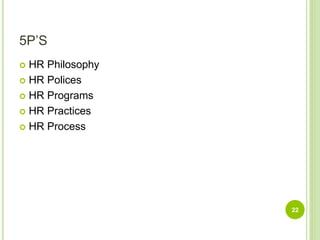
5P’S
 HR Philosophy
 HR Polices
 HR Programs
 HR Practices
 HR Process
22
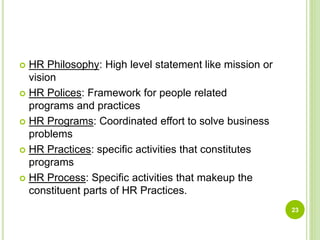
 HR Philosophy: High level statement like mission or
vision
 HR Polices: Framework for people related
programs and practices
 HR Programs: Coordinated effort to solve business
problems
 HR Practices: specific activities that constitutes
programs
 HR Process: Specific activities that makeup the
constituent parts of HR Practices.
23
EQUIFINAITY
 Same philosophy different practices
24
HUMAN RESOURCE PRACTICE MENU
 Planning choices
 Staffing choices
 Appraising choices
 Compensating choices
 Training and development
25
DESIGNING HR ARCHITECTURE
 Differentiation between employees
 Selection, training
 Undifferentiated approach
26
WORK DESIGN
 Structured work to give maximum output
27

Design an HR architecture for the differentiated workforce”

  • 1.
    “DESIGN AN HRARCHITECTURE FOR THE DIFFERENTIATED WORKFORCE” 1
  • 2.
    INTRODUCTION The most focusof the chapter is on workforce diversity, differentiated workforce, undifferentiated workforce, work design, HR architecture design and some other related issues. Requirement for differentiated workforce. Strategic capabilities, information, technology, and people to executed the strategy.
  • 3.
    FORM STRATEGIC INTENDTO CORPORATE CULTURE All firm have different culture so the manager should be ensure to design the corporate culture by having the answer of these questions  What do we want our culture to look like?  What we need to develop the culture?  Who will be responsible for these changes?  Where do we start?  What mind-set and culture do we want?
  • 4.
    WHAT MIND-SET &CULTURE DO WE WANT? Firm X-employer of choice we are employer of choice we try to hire the best employees for all the position & than make sure that each one is committed to our firm & never leave them by providing best salaries, our all employees know the values and mission of the organization they feel scare they wont try for any alternative
  • 5.
    Firm Y- Employeeof choice We hire the very best employees for strategic position, we do whatever is necessary to attract and develop the employees we create the abilities to retain the talent we are an employee equity firm and proud of it.
  • 6.
    FROM CORPORATE CULTURETO WORKFORCE PHILOSOPHY Developing mindset and culture of accountabilities involve two steps  First-developing workforce philosophy which outline the firm expectation & accountabilities  Second- develop a unique & differentiated system of HR architecture.
  • 7.
    LOCKHEED MARTIN WORKFORCEPHILOSOPHY In Martin the manager come to the conclusion and get the element which is crucial for successful strategy the factors are as flowing challenging environment. Clear understanding the environment is important for successful strategy. Requirement for that skill, talent, superiorly to create customer focused solutions.
  • 8.
     Strategic focus Inthis we must establish strategies that address the changing environment. Requirement for this is technical capabilities to deliver customer values .  Delivering customer success We must view all the business actions from customer prospective should know the customer need, want, and create for them certain values
  • 9.
     Workforce differentiationand diversity We must have talent and skillful strategic employees to provide unique customer focus solution.  leadership accountability  Full spectrum leaders are accountable for their workforce accountability, business strategy and creating high performcance
  • 10.
     The roleof HR We all know that our business success is increasing more depend on people and HR
  • 11.
    FORM WORKFORCE PHILOSOPHYTO WORKFORCE MANAGEMENT SYSTEM There are certain strategies that must our workface know Business strategy how will we grow our business? What is our completive advantages? What strategies capabilities we need?
  • 12.
    Strategic focus How toaccelerate our growth? What are the indicator of our growth? Performance focus what is expected of me? how well I am performance? what should I do create wealth to the firm? what work reduce the production cost?
  • 13.
    Performance management who hasimpact on my work? how well am I doing? how do I get specific feedback? Performance consequence What happen to me if I do a great job? What happen if I do not perforce to the expected level?
  • 14.
    Employee outcome Everyone mustknow what the end game is what is likely to happen to us if we are able to effectively execute our strategy? What will success look like in our organization from our stakeholders perspective
  • 15.
    ATTRIBUTES OF ADIFFERENTIATED WORKFORCE Developing a differentiated workforce is much easier if the firm has workforce philosophy and workface management program There are four key domains that distinguish a differentiated approach with conventional approach which will be explain in next slide
  • 16.
    Equity, Not Equality inundifferentiated firm all and every one treat the same way, and vice versa in differentiate. Engaging the right employees in undifferentiated firm employees are aware that the firm has a mission & values and asked for their lastly In differentiated firm all employees specially strategic position understand the firm strategy
  • 17.
    hiring choice employees,Not becoming the employer of choice Undifferentiated firm workforce prompted itself as a great place for all candidate, vice versa Earning increase, Not entitlement In undifferentiated firm employees feeling secure if performance well or not they will get compensation & vice versa in differentiated firm if u not add any values to the firm you wont get any incentive
  • 18.
    WORK SYSTEM ORGANIZINGPRINCIPLE Its all about the management of employee to deal with the changes of environment, the HR management system important because it create the wealth for the stakeholder and directly control the business. This system called as HR architecture, implementing of an effective HR architecture is the beginning of developing the culture and workforce philosophy
  • 19.
     External v/sInternal  HR management system  HR architecture 19
  • 20.
    HUMAN RESOURCE MANAGEMENTSYSTEM • The policies and practices involved in carrying out the “people” or human resource aspects of a management position, including recruiting, screening, training, rewarding, and appraising. 20
  • 21.
    HR ARCHITECTURE It isa system that consists of HR polices and practices. 21
  • 22.
    5P’S  HR Philosophy HR Polices  HR Programs  HR Practices  HR Process 22
  • 23.
     HR Philosophy:High level statement like mission or vision  HR Polices: Framework for people related programs and practices  HR Programs: Coordinated effort to solve business problems  HR Practices: specific activities that constitutes programs  HR Process: Specific activities that makeup the constituent parts of HR Practices. 23
  • 24.
    EQUIFINAITY  Same philosophydifferent practices 24
  • 25.
    HUMAN RESOURCE PRACTICEMENU  Planning choices  Staffing choices  Appraising choices  Compensating choices  Training and development 25
  • 26.
    DESIGNING HR ARCHITECTURE Differentiation between employees  Selection, training  Undifferentiated approach 26
  • 27.
    WORK DESIGN  Structuredwork to give maximum output 27