STRATEGIC HRM WORK
STRATEGIC HRM WORK
Comparison of conceptual frameworks, principal HR
processes/levers, their scopes and interactions
Resourcing
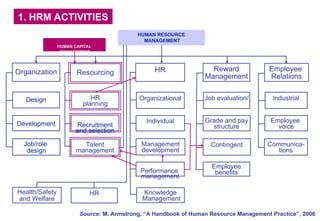
1. HRM ACTIVITIES
HUMAN CAPITAL
MANAGEMENT
Source: M. Armstrong, “A Handbook of Human Resource Management Practice”, 2006
Organization
Design
Development
Job/role
design
HUMAN RESOURCE
MANAGEMENT
HR Reward
Management
Employee
Relations
Individual
Performance
management
Knowledge
Management
Contingent
Grade and pay
structure
Job evaluation/
Employee
benefits
Management
development
Organizational
HR
Communica-
tions
Employee
voice
Industrial
Health/Safety
and Welfare
Recruitment
and selection
Talent
management
HR
planning
HR SYSTEMS
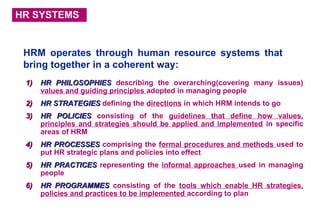
HRM operates through human resource systems that
bring together in a coherent way:
1)
1) HR PHILOSOPHIES
HR PHILOSOPHIES describing the overarching(covering many issues)
values and guiding principles adopted in managing people
2)
2) HR STRATEGIES
HR STRATEGIES defining the directions in which HRM intends to go
3)
3) HR POLICIES
HR POLICIES consisting of the guidelines that define how values,
principles and strategies should be applied and implemented in specific
areas of HRM
4)
4) HR PROCESSES
HR PROCESSES comprising the formal procedures and methods used to
put HR strategic plans and policies into effect
5)
5) HR PRACTICES
HR PRACTICES representing the informal approaches used in managing
people
6)
6) HR PROGRAMMES
HR PROGRAMMES consisting of the tools which enable HR strategies,
policies and practices to be implemented according to plan
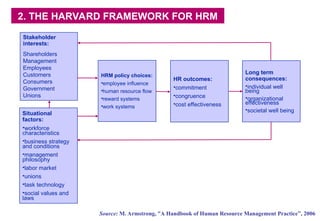
2. THE HARVARD FRAMEWORK FOR HRM
Stakeholder
interests:
Shareholders
Management
Employees
Customers
Consumers
Government
Unions
Source: M. Armstrong, “A Handbook of Human Resource Management Practice”, 2006
Situational
factors:
•workforce
characteristics
•business strategy
and conditions
•management
philosophy
•labor market
•unions
•task technology
•social values and
laws
HRM policy choices:
•employee influence
•human resource flow
•reward systems
•work systems
HR outcomes:
•commitment
•congruence
•cost effectiveness
Long term
consequences:
•individual well
being
•organizational
effectiveness
•societal well being
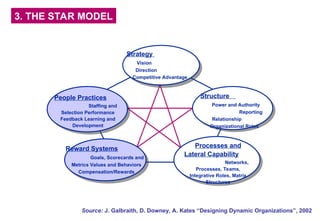
3. THE STAR MODEL
Strategy
Vision
Direction
Competitive Advantage
Structure
Power and Authority
Reporting
Relationship
Organizational Roles
People Practices
Staffing and
Selection Performance
Feedback Learning and
Development
Reward Systems
Goals, Scorecards and
Metrics Values and Behaviors
Compensation/Rewards
Processes and
Lateral Capability
Networks,
Processes, Teams,
Integrative Roles, Matrix
Structures
Source: J. Galbraith, D. Downey, A. Kates “Designing Dynamic Organizations”, 2002
4. THE HR VALUE PROPOSITION
Knowing external
business realities
(technology, economics,
globalization,
demographics)
Ensuring HR
professionalism
(HR roles, competencies,
and development)
Serving external and
internal stakeholders
(customers, investors,
managers, and employees)
Building HR resources
(HR strategy and
organization)
Crafting HR practices
(people, performance,
information and work)
HR value
proposition
Source: D. Ulrich, W. Brockbank “The HR value proposition”, 2002
PREMISES OF HR VALUE
Starting HR transformation with a value proposition
has six important implications(significance) for HR
professionals:
1) Human resource work doesn’t begin with HR, it begins with the
business
2) The ultimate receivers of business reside in market places that
companies serve
3) HR professionals must become a source of competitive advantage
4) HR professionals must align practice with the requirements of
internal and external shareholders
5) HR professionals must acquire the personal knowledge and skills
necessary to link HR activities to stakeholder value
6) HR professionals have to view company’s key stakeholders from a
unique and powerful perspective
HR PERSPECTIVE TO VIEW THE MARKET ENVIRONMENT
QUESTIONS TO ADDRESS:
What are the organizational capabilities that my company must have to
create products and services that meet customer expectations?
What employee abilities do our people need to respond to short-term
and long-term market demands?
How do we invest in the HR practices that deliver business results?
How do we organize HR activities to deliver maximum value?
How do we create an HR strategy that sets an agenda for how HR will
help our company succeed?
How do we ensure that HR professionals will know what to do and have
the skills to do it?
5. HUMAN RESOURCES MANAGEMENT PROCESSES
HR
Planning
Source: W.L. FRENCH “Human Resource Management”, 2007
Job &
Work Design
Training &
Development
Staffing
Performance
Appraisal
& Review
Protection &
Representation
Organization
Improvement
Compensation
& Reward
Mission
& Strategy
Resourcing
1. HRM ACTIVITIES
HUMAN CAPITAL
MANAGEMENT
Organization
Design
Development
Job/role
design
HUMAN RESOURCE
MANAGEMENT
HR Reward
Management
Employee
Relations
Individual
Performance
management
Knowledge
Management
Contingent
Grade and pay
structure
Job evaluation/
Employee
benefits
Management
development
Organizational
HR
Communica-
tions
Employee
voice
Industrial
Health/Safety
and Welfare
Recruitment
and selection
Talent
management
HR
planning
2. THE HARVARD FRAMEWORK FOR HRM
Stakeholder
interests:
Shareholders
Management
Employees
Customers
Consumers
Government
Unions
Situational
factors:
•workforce
characteristics
•business strategy
and conditions
•management
philosophy
•labor market
•unions
•task technology
•social values and
laws
HRM policy
choices:
•employee influence
•human resource
flow
•reward systems
•work systems
HR outcomes:
•commitment
•congruence
•cost effectiveness
Long term
consequences:
•individual well being
•organizational
effectiveness
•societal well being
3. THE STAR MODEL
Strategy
Vision Direction
Competitive Advantage
Structure
Power and Authority
Reporting
Relationship
Organizational Roles
People Practices
Staffing and Selection
Performance Feedback
Learning and Development
Reward Systems
Goals, Scorecards and Metrics
Values and Behaviors
Compensation/Rewards
Processes and Lateral
Capability
Networks, Processes, Teams,
Integrative Roles, Matrix
Structures
4. THE HR VALUE PROPOSITION
Knowing external
business realities
(technology, economics,
globalization, demographics)
Ensuring HR
professionalism (HR
roles, competencies, and
development)
Serving external and
internal stakeholders
(customers, investors,
managers, and employees)
Building HR resources
(HR strategy and
organization)
Crafting HR practices
(people, performance,
information and work)
HR value
proposition
5. HUMAN RESOURCES MANAGEMENT PROCESSES
HR
Planning
Job &
Work Design
Training &
Development
Staffing
Performance Appr.
& Review
Protection &
Representation
Organization
Improvement
Compensation
& Reward
Mission
& Strategy
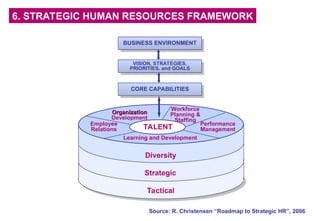
6. STRATEGIC HUMAN RESOURCES FRAMEWORK
Organization
Organization
Development
Performance
Management
Employee
Relations
Learning and Development
Workforce
Planning &
Staffing
TALENT
Tactical
Strategic
Diversity
CORE CAPABILITIES
VISION, STRATEGIES,
PRIORITIES, and GOALS
BUSINESS ENVIRONMENT
Source: R. Christensen “Roadmap to Strategic HR”, 2006
2. Incident
Too much diversity?
Too much diversity?
INCIDENT: “ Too much diversity?”
ANSWERS TO INCIDENT QUESTIONS
If you were Bill, what actions would you take in response to Tran’s request?
One of the major roles of a manager is that of problem solving (investigate,
determine the facts, think of solutions, choose the best and solve the problem)
First
First. He needs to meet with the Vietnamese assemblers, individually and/or in
a group, to find out why the are upset. Second
Second. He needs to determine what
specific behaviors others have engaged in that upset them. Third
Third. He needs to
meet with those who have been accused of misbehavior to hear their side of
the story. Fourth
Fourth.
. He needs to develop a solution to the problem
What actually happened in the real situation?
Bill asked the Operation Manager to meet with the entire group. During
several heated meetings it was determined that almost all the complaints were
directed to the sister of the supervisor team: she apparently was abusive and
too authoritarian. After the second meeting, she became very upset with the
charges leveled against her and decided to quit. Immediately, complaints
ceased and the workplace returned to normal. Several months later she was
rehired in a different department as an assembler and she is now an excellent
employee. So the problem emerged as the lack of proper supervision
The matter is not to hire less Latinos or Vietnamese workers but to focus on
hiring the best available employees
The major problem in this case is the behavior of one poor supervisor, not
the hiring of different nationalities: if the firm hired employees of a single
national origin or only native Californians, it would have no assurance that
they would work harmoniously together: the situation could also get worse.
And if the firm changed its hiring policy to only hire native Californians it
would be discriminating under the Civil Right Act!
INCIDENT: “ Too much diversity?”
ANSWERS TO INCIDENT QUESTIONS
What hiring policy should the firm follow?
Diversity produces many benefits but can also results in problems
There are benefits and disadvantages to almost any action a firm takes,
including creating a diverse workplace. So the matter is to find out the best
and most fruitful ways to manage diversity correctly and effectively,
suggesting in every different situation what specific actions managers and
employees need to take in order to positively embrace it
INCIDENT: “ Too much diversity?”
ANSWERS TO INCIDENT QUESTIONS
Does the firm have too diverse a workforce?
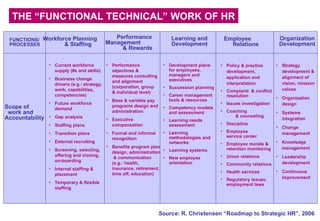
THE “FUNCTIONAL TECHNICAL” WORK OF HR
FUNCTIONS/
PROCESSES
Scope of
work and
Accountability
Workforce Planning
& Staffing
• Current workforce
supply (#s and skills)
• Business change
drivers (e.g.: strategy,
work, capabilities,
competencies)
• Future workforce
demand
• Gap analysis
• Staffing plans
• Transition plans
• External recruiting
• Screening, selecting,
offering and closing,
on-boarding
• Internal staffing &
placement
• Temporary & flexible
staffing
Performance
Management
& Rewards
• Performance
objectives &
measures consulting
and alignment
(corporation, group
& individual level)
• Base & variable pay
programs design and
administration
• Executive
compensation
• Formal and informal
recognition
• Benefits program plan
design, administration
& communication
(e.g.: health,
insurance, retirement,
time off, education)
Learning and
Development
• Development plans
for employees,
managers and
executives
• Succession planning
• Career management
tools & resources
• Competency models
and assessment
• Learning needs
assessment
• Learning
methodologies and
networks
• Learning systems
• New employee
orientation
Employee
Relations
• Policy & practice
development,
application and
interpretation
• Complaint & conflict
resolution
• Issues investigation
• Coaching
& counseling
• Discipline
• Employee
service center
• Employee morale &
retention monitoring
• Union relations
• Community relations
• Health services
• Regulatory issues,
employment laws
Organization
Development
• Strategy
development &
alignment of
vision, mission
values
• Organization
design
• Systems
integration
• Change
management
• Knowledge
management
• Leadership
development
• Continuous
improvement
Source: R. Christensen “Roadmap to Strategic HR”, 2006
Ford MADOX BROWN (English Pre-Raphaelite Painter) (1821- 1893)
“Work“, 1852, 1856-65 (Manchester City Art Gallery)

Lec-4 - Strategic human resource frameworks.ppt

  • 1.
    STRATEGIC HRM WORK STRATEGICHRM WORK Comparison of conceptual frameworks, principal HR processes/levers, their scopes and interactions
  • 2.
    Resourcing 1. HRM ACTIVITIES HUMANCAPITAL MANAGEMENT Source: M. Armstrong, “A Handbook of Human Resource Management Practice”, 2006 Organization Design Development Job/role design HUMAN RESOURCE MANAGEMENT HR Reward Management Employee Relations Individual Performance management Knowledge Management Contingent Grade and pay structure Job evaluation/ Employee benefits Management development Organizational HR Communica- tions Employee voice Industrial Health/Safety and Welfare Recruitment and selection Talent management HR planning
  • 3.
    HR SYSTEMS HRM operatesthrough human resource systems that bring together in a coherent way: 1) 1) HR PHILOSOPHIES HR PHILOSOPHIES describing the overarching(covering many issues) values and guiding principles adopted in managing people 2) 2) HR STRATEGIES HR STRATEGIES defining the directions in which HRM intends to go 3) 3) HR POLICIES HR POLICIES consisting of the guidelines that define how values, principles and strategies should be applied and implemented in specific areas of HRM 4) 4) HR PROCESSES HR PROCESSES comprising the formal procedures and methods used to put HR strategic plans and policies into effect 5) 5) HR PRACTICES HR PRACTICES representing the informal approaches used in managing people 6) 6) HR PROGRAMMES HR PROGRAMMES consisting of the tools which enable HR strategies, policies and practices to be implemented according to plan
  • 4.
    2. THE HARVARDFRAMEWORK FOR HRM Stakeholder interests: Shareholders Management Employees Customers Consumers Government Unions Source: M. Armstrong, “A Handbook of Human Resource Management Practice”, 2006 Situational factors: •workforce characteristics •business strategy and conditions •management philosophy •labor market •unions •task technology •social values and laws HRM policy choices: •employee influence •human resource flow •reward systems •work systems HR outcomes: •commitment •congruence •cost effectiveness Long term consequences: •individual well being •organizational effectiveness •societal well being
  • 5.
    3. THE STARMODEL Strategy Vision Direction Competitive Advantage Structure Power and Authority Reporting Relationship Organizational Roles People Practices Staffing and Selection Performance Feedback Learning and Development Reward Systems Goals, Scorecards and Metrics Values and Behaviors Compensation/Rewards Processes and Lateral Capability Networks, Processes, Teams, Integrative Roles, Matrix Structures Source: J. Galbraith, D. Downey, A. Kates “Designing Dynamic Organizations”, 2002
  • 6.
    4. THE HRVALUE PROPOSITION Knowing external business realities (technology, economics, globalization, demographics) Ensuring HR professionalism (HR roles, competencies, and development) Serving external and internal stakeholders (customers, investors, managers, and employees) Building HR resources (HR strategy and organization) Crafting HR practices (people, performance, information and work) HR value proposition Source: D. Ulrich, W. Brockbank “The HR value proposition”, 2002
  • 7.
    PREMISES OF HRVALUE Starting HR transformation with a value proposition has six important implications(significance) for HR professionals: 1) Human resource work doesn’t begin with HR, it begins with the business 2) The ultimate receivers of business reside in market places that companies serve 3) HR professionals must become a source of competitive advantage 4) HR professionals must align practice with the requirements of internal and external shareholders 5) HR professionals must acquire the personal knowledge and skills necessary to link HR activities to stakeholder value 6) HR professionals have to view company’s key stakeholders from a unique and powerful perspective
  • 8.
    HR PERSPECTIVE TOVIEW THE MARKET ENVIRONMENT QUESTIONS TO ADDRESS: What are the organizational capabilities that my company must have to create products and services that meet customer expectations? What employee abilities do our people need to respond to short-term and long-term market demands? How do we invest in the HR practices that deliver business results? How do we organize HR activities to deliver maximum value? How do we create an HR strategy that sets an agenda for how HR will help our company succeed? How do we ensure that HR professionals will know what to do and have the skills to do it?
  • 9.
    5. HUMAN RESOURCESMANAGEMENT PROCESSES HR Planning Source: W.L. FRENCH “Human Resource Management”, 2007 Job & Work Design Training & Development Staffing Performance Appraisal & Review Protection & Representation Organization Improvement Compensation & Reward Mission & Strategy
  • 10.
    Resourcing 1. HRM ACTIVITIES HUMANCAPITAL MANAGEMENT Organization Design Development Job/role design HUMAN RESOURCE MANAGEMENT HR Reward Management Employee Relations Individual Performance management Knowledge Management Contingent Grade and pay structure Job evaluation/ Employee benefits Management development Organizational HR Communica- tions Employee voice Industrial Health/Safety and Welfare Recruitment and selection Talent management HR planning 2. THE HARVARD FRAMEWORK FOR HRM Stakeholder interests: Shareholders Management Employees Customers Consumers Government Unions Situational factors: •workforce characteristics •business strategy and conditions •management philosophy •labor market •unions •task technology •social values and laws HRM policy choices: •employee influence •human resource flow •reward systems •work systems HR outcomes: •commitment •congruence •cost effectiveness Long term consequences: •individual well being •organizational effectiveness •societal well being 3. THE STAR MODEL Strategy Vision Direction Competitive Advantage Structure Power and Authority Reporting Relationship Organizational Roles People Practices Staffing and Selection Performance Feedback Learning and Development Reward Systems Goals, Scorecards and Metrics Values and Behaviors Compensation/Rewards Processes and Lateral Capability Networks, Processes, Teams, Integrative Roles, Matrix Structures 4. THE HR VALUE PROPOSITION Knowing external business realities (technology, economics, globalization, demographics) Ensuring HR professionalism (HR roles, competencies, and development) Serving external and internal stakeholders (customers, investors, managers, and employees) Building HR resources (HR strategy and organization) Crafting HR practices (people, performance, information and work) HR value proposition 5. HUMAN RESOURCES MANAGEMENT PROCESSES HR Planning Job & Work Design Training & Development Staffing Performance Appr. & Review Protection & Representation Organization Improvement Compensation & Reward Mission & Strategy
  • 11.
    6. STRATEGIC HUMANRESOURCES FRAMEWORK Organization Organization Development Performance Management Employee Relations Learning and Development Workforce Planning & Staffing TALENT Tactical Strategic Diversity CORE CAPABILITIES VISION, STRATEGIES, PRIORITIES, and GOALS BUSINESS ENVIRONMENT Source: R. Christensen “Roadmap to Strategic HR”, 2006
  • 12.
    2. Incident Too muchdiversity? Too much diversity?
  • 13.
    INCIDENT: “ Toomuch diversity?” ANSWERS TO INCIDENT QUESTIONS If you were Bill, what actions would you take in response to Tran’s request? One of the major roles of a manager is that of problem solving (investigate, determine the facts, think of solutions, choose the best and solve the problem) First First. He needs to meet with the Vietnamese assemblers, individually and/or in a group, to find out why the are upset. Second Second. He needs to determine what specific behaviors others have engaged in that upset them. Third Third. He needs to meet with those who have been accused of misbehavior to hear their side of the story. Fourth Fourth. . He needs to develop a solution to the problem What actually happened in the real situation? Bill asked the Operation Manager to meet with the entire group. During several heated meetings it was determined that almost all the complaints were directed to the sister of the supervisor team: she apparently was abusive and too authoritarian. After the second meeting, she became very upset with the charges leveled against her and decided to quit. Immediately, complaints ceased and the workplace returned to normal. Several months later she was rehired in a different department as an assembler and she is now an excellent employee. So the problem emerged as the lack of proper supervision
  • 14.
    The matter isnot to hire less Latinos or Vietnamese workers but to focus on hiring the best available employees The major problem in this case is the behavior of one poor supervisor, not the hiring of different nationalities: if the firm hired employees of a single national origin or only native Californians, it would have no assurance that they would work harmoniously together: the situation could also get worse. And if the firm changed its hiring policy to only hire native Californians it would be discriminating under the Civil Right Act! INCIDENT: “ Too much diversity?” ANSWERS TO INCIDENT QUESTIONS What hiring policy should the firm follow?
  • 15.
    Diversity produces manybenefits but can also results in problems There are benefits and disadvantages to almost any action a firm takes, including creating a diverse workplace. So the matter is to find out the best and most fruitful ways to manage diversity correctly and effectively, suggesting in every different situation what specific actions managers and employees need to take in order to positively embrace it INCIDENT: “ Too much diversity?” ANSWERS TO INCIDENT QUESTIONS Does the firm have too diverse a workforce?
  • 16.
    THE “FUNCTIONAL TECHNICAL”WORK OF HR FUNCTIONS/ PROCESSES Scope of work and Accountability Workforce Planning & Staffing • Current workforce supply (#s and skills) • Business change drivers (e.g.: strategy, work, capabilities, competencies) • Future workforce demand • Gap analysis • Staffing plans • Transition plans • External recruiting • Screening, selecting, offering and closing, on-boarding • Internal staffing & placement • Temporary & flexible staffing Performance Management & Rewards • Performance objectives & measures consulting and alignment (corporation, group & individual level) • Base & variable pay programs design and administration • Executive compensation • Formal and informal recognition • Benefits program plan design, administration & communication (e.g.: health, insurance, retirement, time off, education) Learning and Development • Development plans for employees, managers and executives • Succession planning • Career management tools & resources • Competency models and assessment • Learning needs assessment • Learning methodologies and networks • Learning systems • New employee orientation Employee Relations • Policy & practice development, application and interpretation • Complaint & conflict resolution • Issues investigation • Coaching & counseling • Discipline • Employee service center • Employee morale & retention monitoring • Union relations • Community relations • Health services • Regulatory issues, employment laws Organization Development • Strategy development & alignment of vision, mission values • Organization design • Systems integration • Change management • Knowledge management • Leadership development • Continuous improvement Source: R. Christensen “Roadmap to Strategic HR”, 2006
  • 17.
    Ford MADOX BROWN(English Pre-Raphaelite Painter) (1821- 1893) “Work“, 1852, 1856-65 (Manchester City Art Gallery)

Editor's Notes

  • #2 HRM-A strategic and coherent(logical,consistent) approach to the management of an organization’s most valued assets - the people working there - who individually and collectively contribute to the achievement of its objectives HCM-Human Capital represents the human factor in the organization: the combined intelligence, skills and expertise that give the organization the distinctive character
  • #4 Congruence-The quality of agreeing; being suitable and appropriate
  • #6 HR value proposition means that HR practices and professionals are able to produce positive outcomes for key stakeholders-employees, line managers, customers & investors
  • #7 Competitive advantage- a condition or circumstance that puts a company in a favourable or superior business position Premises- A statement that is assumed to be true and from which a conclusion can be drawn