WORK FORCE REDUCTION ,RETENTION
AND WORK FORCE DIVERSITY
HR PERFORMANCE
 HR performance encompasses a wide range of
activities, from talent acquisition and on boarding to
training and development, employee engagement, and
compliance with labour laws and regulations
WORK FORCE REDUCTION
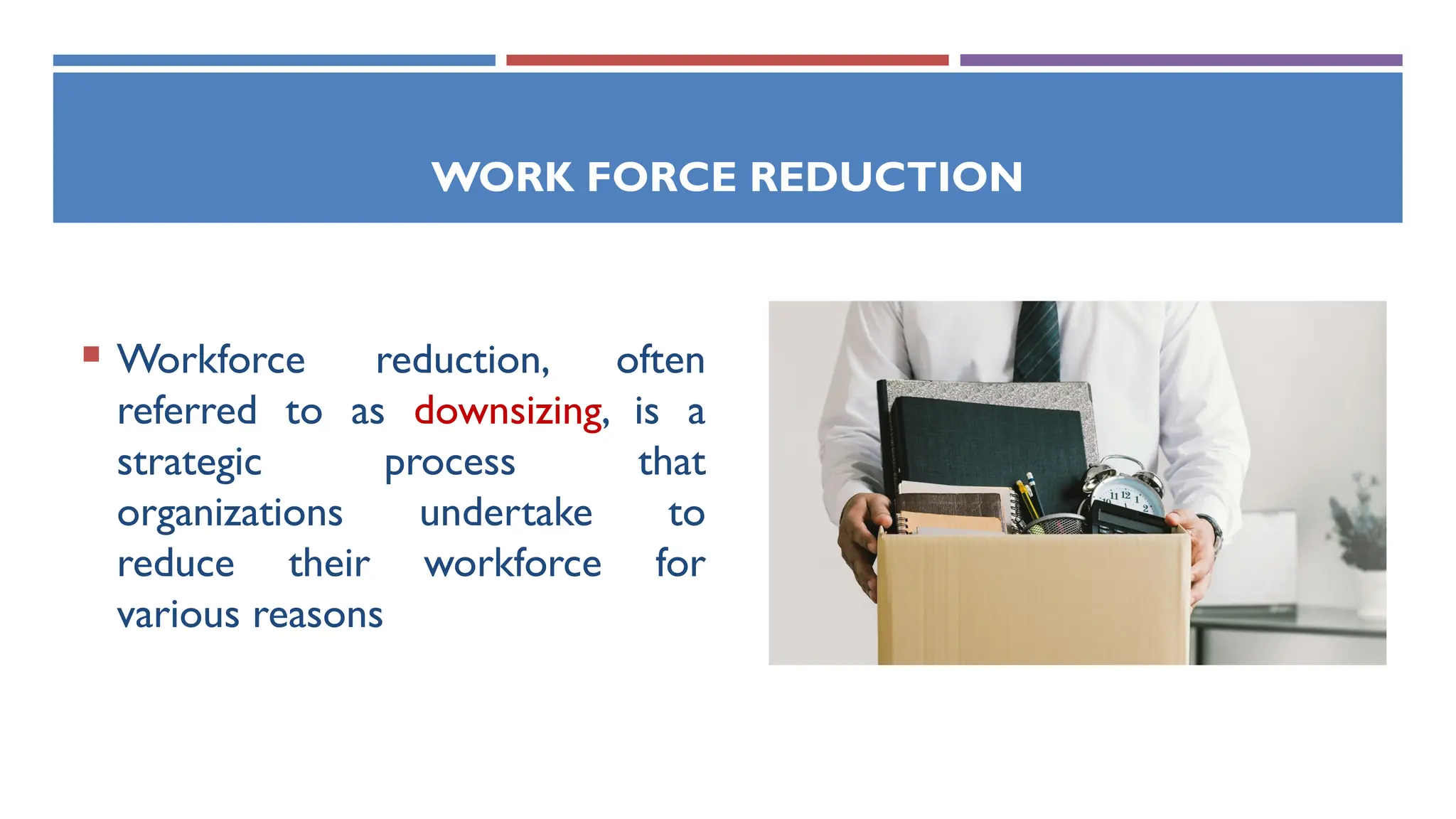
 Workforce reduction, often
referred to as downsizing, is a
strategic process that
organizations undertake to
reduce their workforce for
various reasons
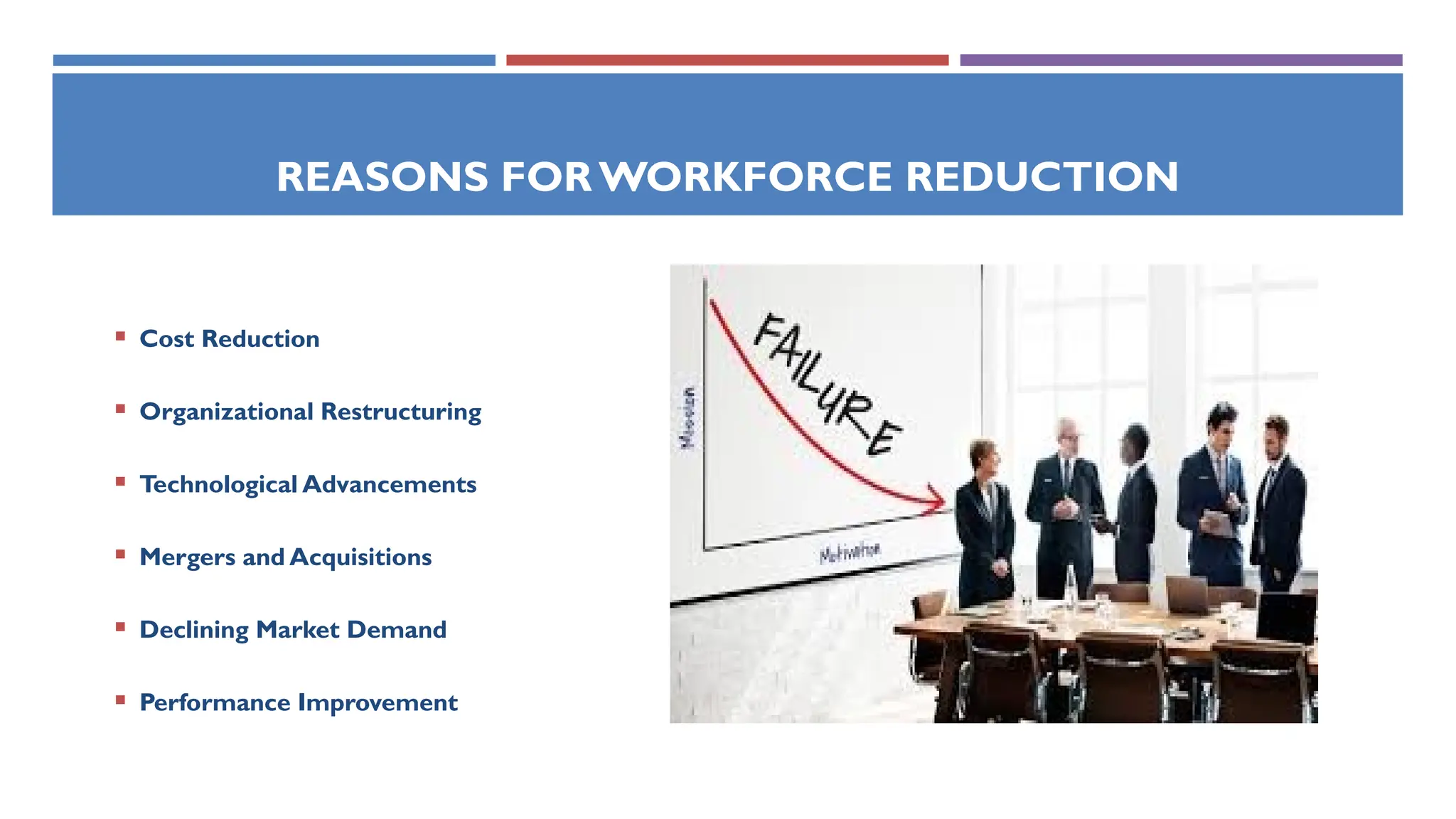
REASONS FORWORKFORCE REDUCTION
 Cost Reduction
 Organizational Restructuring
 Technological Advancements
 Mergers and Acquisitions
 Declining Market Demand
 Performance Improvement
WORK FORCE REDUCTION
 PhonePe has reduced customer support staff by 60% in five years, leveraging AI-driven chatbots to resolve over 90% of issues,
amidst a 40-fold transaction increase.
 Nokia has laid off nearly 2,000 employees in Greater China and plans to cut an additional 350 jobs in Europe to cut costs
 Airbus is set to cut up to 2,500 jobs in its struggling satellite division, signaling ongoing challenges in the European aerospace
sector
 Boeing layoffs: Aerospace giant prepares notices, to cut 17,000 jobs in coming weeks
 ByteDance cuts over 700 jobs in Malaysia in shift towards AI moderation
 Healthtech startup Dozee, despite its presence across India, laid off about 40 employees to cut losses, while WeTransfer,
recently acquired by Bending Spoons, saw 75% of its workforce cut as part of a profitability strategy.
 Tech layoffs cross 1 lakh mark as companies brace for more cuts ahead
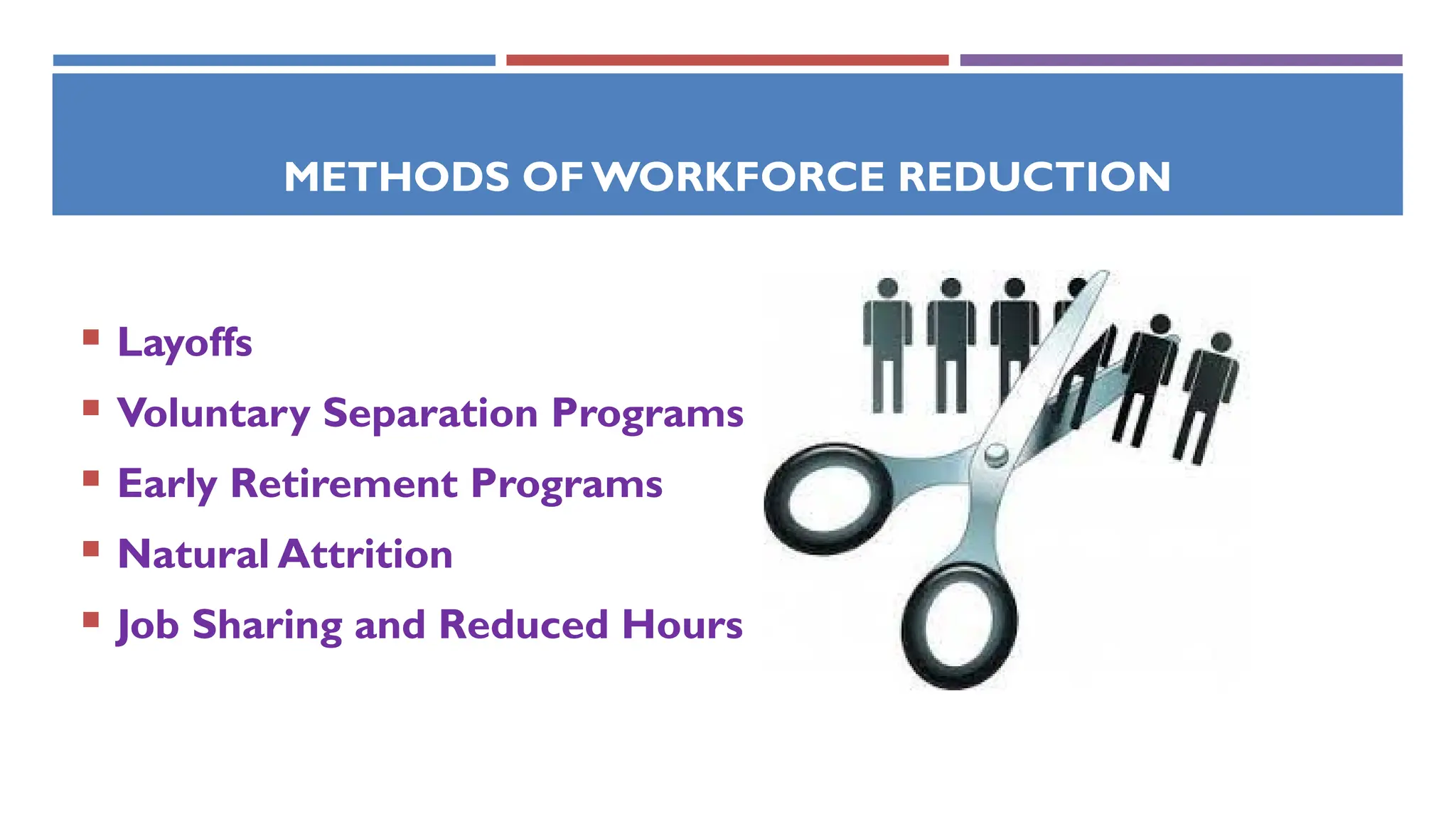
METHODS OFWORKFORCE REDUCTION
 Layoffs
 Voluntary Separation Programs
 Early Retirement Programs
 Natural Attrition
 Job Sharing and Reduced Hours
CONSIDERATIONS AND BEST PRACTICES
 Legal Compliance
 Communication
 Talent Retention
 Support for Affected Employees
 Rebuilding and Reengaging
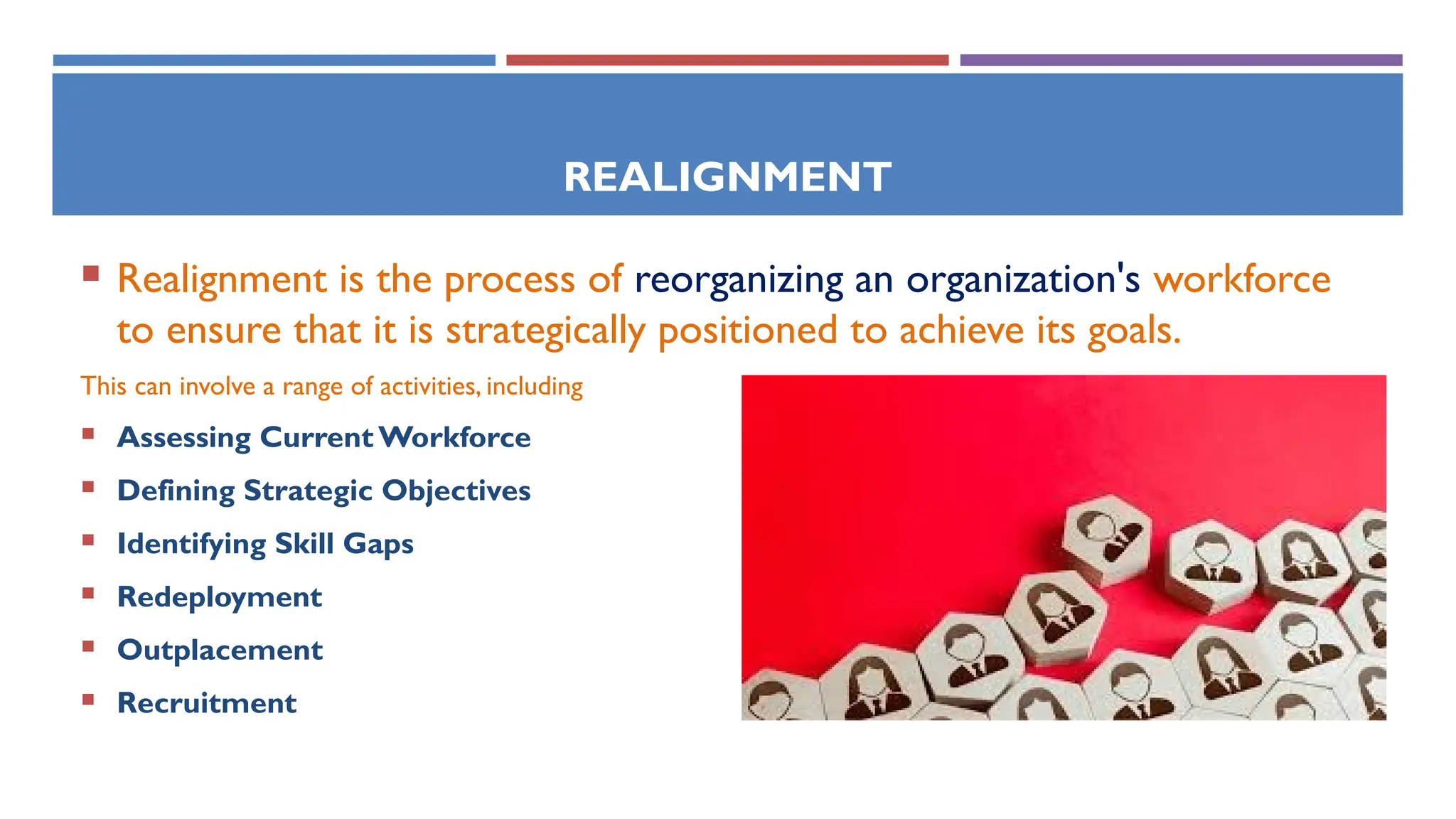
REALIGNMENT
 Realignment is the process of reorganizing an organization's workforce
to ensure that it is strategically positioned to achieve its goals.
This can involve a range of activities, including
 Assessing CurrentWorkforce
 Defining Strategic Objectives
 Identifying Skill Gaps
 Redeployment
 Outplacement
 Recruitment
RETENTION
 Employee retention is
defined as an organization's
ability to prevent employee
turnover, or the number of
people who leave their job
in a certain period, either
voluntarily or involuntarily.
KEY ASPECTS OF RETENTION
 Competitive Compensation and Benefits
 Career Development and Growth
 Recognition and Rewards
 Work-Life Balance
 Cultural Fit
 Feedback and Communication
 Tailored Retention Plans
 Exit Interviews
HR PERFORMANCE AND BENCH MARKING
 HR performance benchmarking is the systematic process of
comparing an organization's HR metrics and practices with those
of other organizations, industry best practices, or internal historical
data.
 The goal of benchmarking is to identify areas where HR can
improve its effectiveness, efficiency, and alignment with the
organization's strategic goals.
TYPES OF BENCHMARKING
 Internal Benchmarking
 External Benchmarking
 Functional Benchmarking-specific HR functions, such as recruitment, training, or compensation
 Strategic Benchmarking
HR METRICS FOR BENCHMARKING
Common HR metrics include
Employee turnover
Recruitment costs
Training investments
Employee engagement scores
Time-to-fill vacancies
BENEFITS OF HR PERFORMANCE BENCHMARKING
 Identifying Best Practices: Benchmarking helps organizations identify and adopt
best HR practices from other high-performing companies.
 Performance Improvement: By comparing metrics and practices, organizations can
identify areas for improvement and set targets for performance enhancement.
 Increased Efficiency: Benchmarking can lead to streamlining HR processes,
reducing costs, and enhancing HR's overall efficiency.
 Alignment with Strategic Goals: Benchmarking helps ensure that HR strategies and
practices align with the organization's strategic objectives.
CHALLENGES OF HR PERFORMANCE BENCHMARKING
 Data Accuracy and Consistency: Accurate and consistent data is essential
for meaningful benchmarking, but not all organizations maintain such
data.
 Context Matters: What works for one organization may not work for
another due to differences in culture, industry, and other contextual
factors.
 Resistance to Change: Benchmarking may identify the need for significant
changes in HR practices, which can be met with resistance from
employees and stakeholders
IMPLEMENTING HR PERFORMANCE BENCHMARKING
 Define clear objectives for benchmarking.
 Select the appropriate type of benchmarking based on your goals.
 Identify key metrics and data sources for comparison.
 Collect and analyze data, either internally or with the help of external benchmarking partners.
 Compare your organization's performance with benchmarks and industry standards.
 Develop an action plan to address areas for improvement and implement changes.
 Continuously monitor and adjust HR practices to maintain alignment with benchmarks and
strategic goals.
IMPACT OF GLOBALIZATION ON HRD
1. Diverse Workforce
Cultural Diversity
Language Skills
2.Talent Acquisition and Retention
GlobalTalent Pool
Retaining GlobalTalent: Policies and practices that retain and engage international employees
3. Cross-CulturalTraining -Avoid misunderstandings arising from cultural differences.
4.Training and Development
Global Skill Development- Intercultural communication, global leadership, and adaptability.
E-Learning
5. Mobility and Expatriate Management- managing expatriate assignments, which includes issues like international
tax, housing, and cultural adaptation.
6. Legal and Compliance Issues- multitude of international labor laws and regulations.
IMPACT OF GLOBALIZATION ON HRD
7. Performance Management- Diverse cultural contexts and international locations.
8. Leadership Development
9.VirtualTeams
10. Economic Factors- Including exchange rates, inflation, and labor costs for informed decisions about
compensation and benefits.
11. Ethical and Social Responsibility
12.Technological Advancements
13. Regulatory Compliance- International labor laws, privacy regulations, and data protection laws.
14. Geopolitical Factors- Impact global business operations and employee safety.
DIVERSITY OFWORK FORCE
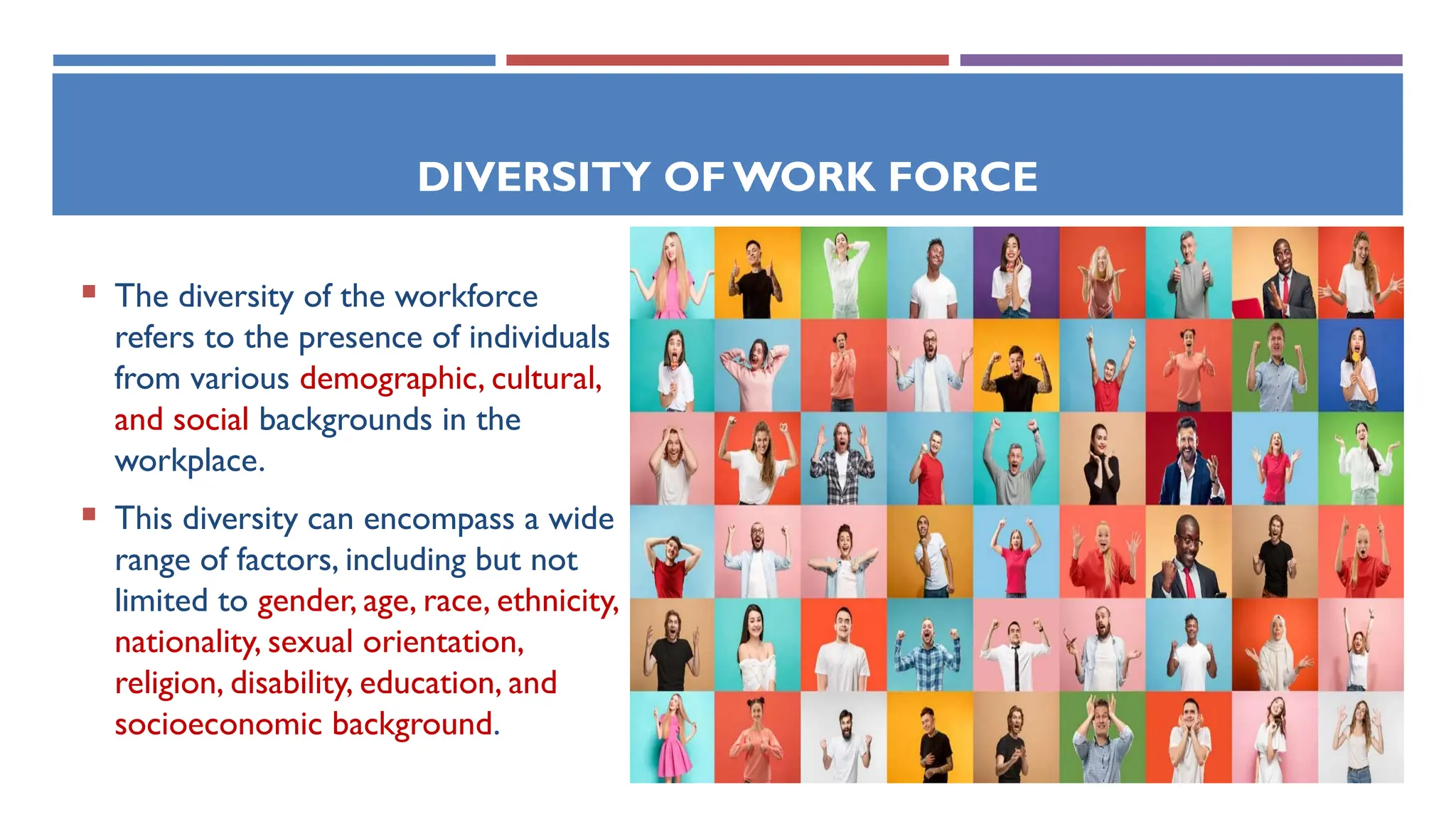
 The diversity of the workforce
refers to the presence of individuals
from various demographic, cultural,
and social backgrounds in the
workplace.
 This diversity can encompass a wide
range of factors, including but not
limited to gender, age, race, ethnicity,
nationality, sexual orientation,
religion, disability, education, and
socioeconomic background.
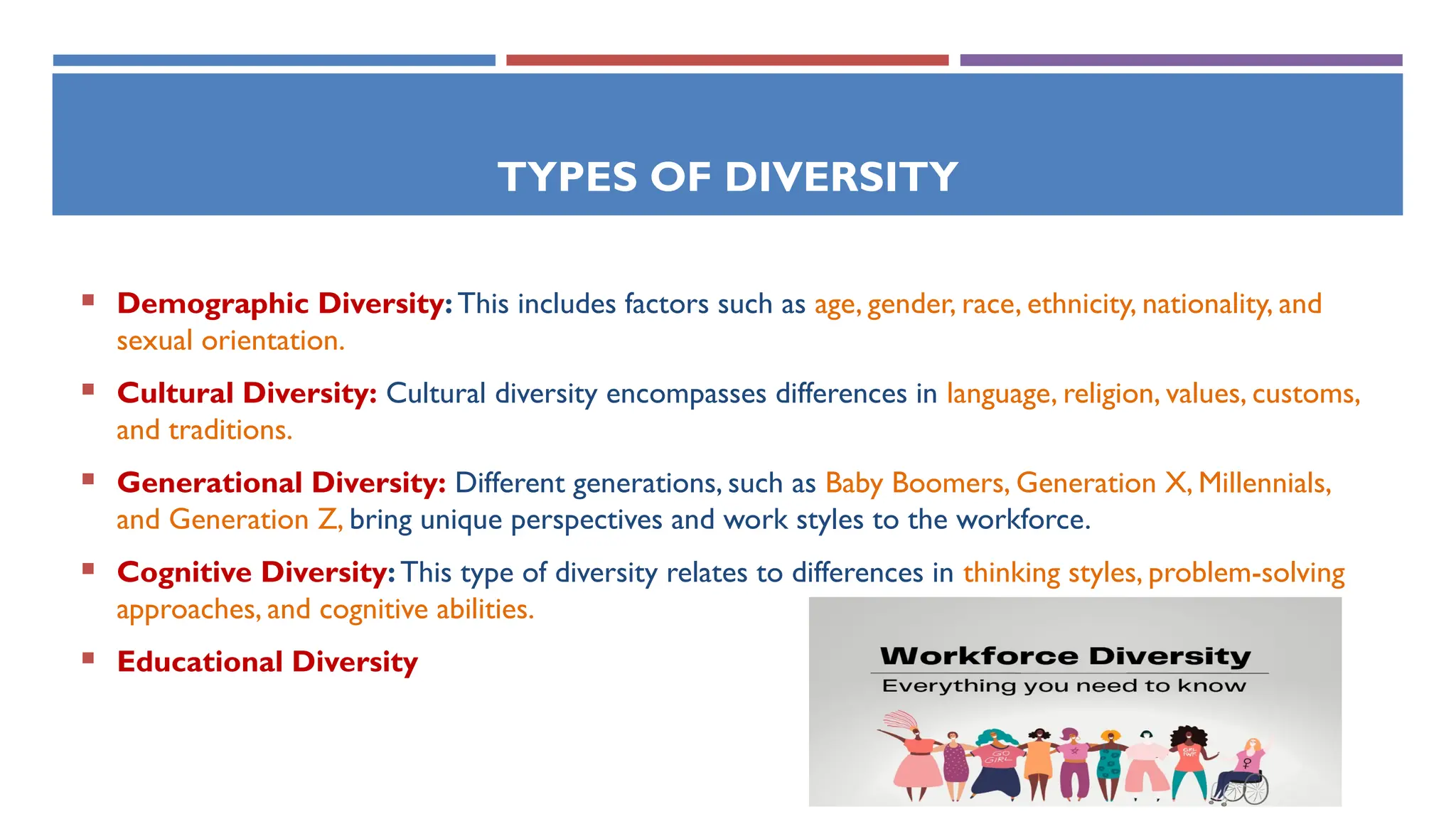
TYPES OF DIVERSITY
 Demographic Diversity: This includes factors such as age, gender, race, ethnicity, nationality, and
sexual orientation.
 Cultural Diversity: Cultural diversity encompasses differences in language, religion, values, customs,
and traditions.
 Generational Diversity: Different generations, such as Baby Boomers, Generation X, Millennials,
and Generation Z, bring unique perspectives and work styles to the workforce.
 Cognitive Diversity: This type of diversity relates to differences in thinking styles, problem-solving
approaches, and cognitive abilities.
 Educational Diversity
BENEFITS OF WORKFORCE DIVERSITY
 Innovation and Creativity
 Enhanced Decision-Making
 Improved Problem Solving
 Enhanced Customer Understanding
 Employee Engagement
 Global Competitiveness
CHALLENGES OFWORKFORCE DIVERSITY
 Bias and Discrimination: Prejudices, stereotypes, and discrimination can hinder the
success of diverse individuals within the organization.
 Communication Barriers: Language and communication styles can create
misunderstandings within diverse teams.
 Conflict Management: Differing viewpoints may lead to conflicts that need effective
resolution.
 Cultural Differences: Cultural norms and practices can lead to differences in work
styles and expectations.
 Resistance to Change: Some employees may resist the changes associated with a more
diverse workplace
MANAGINGWORKFORCE DIVERSITY
 Inclusive Culture: Promote an inclusive culture where every employee feels
valued, respected, and supported.
 DiversityTraining: To help employees understand and appreciate differences and
reduce bias.
 Diverse Leadership: Ensure diversity in leadership positions, as leadership sets the
tone for the rest of the organization.
 Mentoring and Sponsorship Programs: To support the development of
underrepresented employees.
 Diverse Recruitment and Promotion: Adopt diverse recruitment and
promotion practices to attract and advance employees from different backgrounds.
 Flexibility and Accommodations: Provide flexibility and accommodations to
support employees with different needs, such as remote work options or
accessibility adjustments for individuals with disabilities.
 Feedback and Inclusivity Surveys: Regularly seek feedback from employees and
conduct inclusivity surveys to assess and improve the workplace environment
OTHER FACTORS
Legal Considerations
Organizations must comply with anti-discrimination and equal opportunity laws to
ensure fair and equitable treatment of all employees.
Monitoring and Evaluation
Regularly monitor and evaluate diversity and inclusion initiatives to measure their
impact and identify areas for improvement.
HRD PROGRAMS FOR CULTURALLY DIVERSE EMPLOYEES
 Socialization and orientation
 Career development
 Mentoring women and minorities
 Sexual and racial harassment training

Work force reduction ,Retention and Diversity

  • 1.
    WORK FORCE REDUCTION,RETENTION AND WORK FORCE DIVERSITY
  • 2.
    HR PERFORMANCE  HRperformance encompasses a wide range of activities, from talent acquisition and on boarding to training and development, employee engagement, and compliance with labour laws and regulations
  • 3.
    WORK FORCE REDUCTION Workforce reduction, often referred to as downsizing, is a strategic process that organizations undertake to reduce their workforce for various reasons
  • 4.
    REASONS FORWORKFORCE REDUCTION Cost Reduction  Organizational Restructuring  Technological Advancements  Mergers and Acquisitions  Declining Market Demand  Performance Improvement
  • 5.
    WORK FORCE REDUCTION PhonePe has reduced customer support staff by 60% in five years, leveraging AI-driven chatbots to resolve over 90% of issues, amidst a 40-fold transaction increase.  Nokia has laid off nearly 2,000 employees in Greater China and plans to cut an additional 350 jobs in Europe to cut costs  Airbus is set to cut up to 2,500 jobs in its struggling satellite division, signaling ongoing challenges in the European aerospace sector  Boeing layoffs: Aerospace giant prepares notices, to cut 17,000 jobs in coming weeks  ByteDance cuts over 700 jobs in Malaysia in shift towards AI moderation  Healthtech startup Dozee, despite its presence across India, laid off about 40 employees to cut losses, while WeTransfer, recently acquired by Bending Spoons, saw 75% of its workforce cut as part of a profitability strategy.  Tech layoffs cross 1 lakh mark as companies brace for more cuts ahead
  • 6.
    METHODS OFWORKFORCE REDUCTION Layoffs  Voluntary Separation Programs  Early Retirement Programs  Natural Attrition  Job Sharing and Reduced Hours
  • 7.
    CONSIDERATIONS AND BESTPRACTICES  Legal Compliance  Communication  Talent Retention  Support for Affected Employees  Rebuilding and Reengaging
  • 8.
    REALIGNMENT  Realignment isthe process of reorganizing an organization's workforce to ensure that it is strategically positioned to achieve its goals. This can involve a range of activities, including  Assessing CurrentWorkforce  Defining Strategic Objectives  Identifying Skill Gaps  Redeployment  Outplacement  Recruitment
  • 9.
    RETENTION  Employee retentionis defined as an organization's ability to prevent employee turnover, or the number of people who leave their job in a certain period, either voluntarily or involuntarily.
  • 10.
    KEY ASPECTS OFRETENTION  Competitive Compensation and Benefits  Career Development and Growth  Recognition and Rewards  Work-Life Balance  Cultural Fit  Feedback and Communication  Tailored Retention Plans  Exit Interviews
  • 12.
    HR PERFORMANCE ANDBENCH MARKING  HR performance benchmarking is the systematic process of comparing an organization's HR metrics and practices with those of other organizations, industry best practices, or internal historical data.  The goal of benchmarking is to identify areas where HR can improve its effectiveness, efficiency, and alignment with the organization's strategic goals.
  • 13.
    TYPES OF BENCHMARKING Internal Benchmarking  External Benchmarking  Functional Benchmarking-specific HR functions, such as recruitment, training, or compensation  Strategic Benchmarking
  • 14.
    HR METRICS FORBENCHMARKING Common HR metrics include Employee turnover Recruitment costs Training investments Employee engagement scores Time-to-fill vacancies
  • 15.
    BENEFITS OF HRPERFORMANCE BENCHMARKING  Identifying Best Practices: Benchmarking helps organizations identify and adopt best HR practices from other high-performing companies.  Performance Improvement: By comparing metrics and practices, organizations can identify areas for improvement and set targets for performance enhancement.  Increased Efficiency: Benchmarking can lead to streamlining HR processes, reducing costs, and enhancing HR's overall efficiency.  Alignment with Strategic Goals: Benchmarking helps ensure that HR strategies and practices align with the organization's strategic objectives.
  • 16.
    CHALLENGES OF HRPERFORMANCE BENCHMARKING  Data Accuracy and Consistency: Accurate and consistent data is essential for meaningful benchmarking, but not all organizations maintain such data.  Context Matters: What works for one organization may not work for another due to differences in culture, industry, and other contextual factors.  Resistance to Change: Benchmarking may identify the need for significant changes in HR practices, which can be met with resistance from employees and stakeholders
  • 17.
    IMPLEMENTING HR PERFORMANCEBENCHMARKING  Define clear objectives for benchmarking.  Select the appropriate type of benchmarking based on your goals.  Identify key metrics and data sources for comparison.  Collect and analyze data, either internally or with the help of external benchmarking partners.  Compare your organization's performance with benchmarks and industry standards.  Develop an action plan to address areas for improvement and implement changes.  Continuously monitor and adjust HR practices to maintain alignment with benchmarks and strategic goals.
  • 18.
    IMPACT OF GLOBALIZATIONON HRD 1. Diverse Workforce Cultural Diversity Language Skills 2.Talent Acquisition and Retention GlobalTalent Pool Retaining GlobalTalent: Policies and practices that retain and engage international employees 3. Cross-CulturalTraining -Avoid misunderstandings arising from cultural differences. 4.Training and Development Global Skill Development- Intercultural communication, global leadership, and adaptability. E-Learning 5. Mobility and Expatriate Management- managing expatriate assignments, which includes issues like international tax, housing, and cultural adaptation. 6. Legal and Compliance Issues- multitude of international labor laws and regulations.
  • 19.
    IMPACT OF GLOBALIZATIONON HRD 7. Performance Management- Diverse cultural contexts and international locations. 8. Leadership Development 9.VirtualTeams 10. Economic Factors- Including exchange rates, inflation, and labor costs for informed decisions about compensation and benefits. 11. Ethical and Social Responsibility 12.Technological Advancements 13. Regulatory Compliance- International labor laws, privacy regulations, and data protection laws. 14. Geopolitical Factors- Impact global business operations and employee safety.
  • 20.
    DIVERSITY OFWORK FORCE The diversity of the workforce refers to the presence of individuals from various demographic, cultural, and social backgrounds in the workplace.  This diversity can encompass a wide range of factors, including but not limited to gender, age, race, ethnicity, nationality, sexual orientation, religion, disability, education, and socioeconomic background.
  • 21.
    TYPES OF DIVERSITY Demographic Diversity: This includes factors such as age, gender, race, ethnicity, nationality, and sexual orientation.  Cultural Diversity: Cultural diversity encompasses differences in language, religion, values, customs, and traditions.  Generational Diversity: Different generations, such as Baby Boomers, Generation X, Millennials, and Generation Z, bring unique perspectives and work styles to the workforce.  Cognitive Diversity: This type of diversity relates to differences in thinking styles, problem-solving approaches, and cognitive abilities.  Educational Diversity
  • 22.
    BENEFITS OF WORKFORCEDIVERSITY  Innovation and Creativity  Enhanced Decision-Making  Improved Problem Solving  Enhanced Customer Understanding  Employee Engagement  Global Competitiveness
  • 23.
    CHALLENGES OFWORKFORCE DIVERSITY Bias and Discrimination: Prejudices, stereotypes, and discrimination can hinder the success of diverse individuals within the organization.  Communication Barriers: Language and communication styles can create misunderstandings within diverse teams.  Conflict Management: Differing viewpoints may lead to conflicts that need effective resolution.  Cultural Differences: Cultural norms and practices can lead to differences in work styles and expectations.  Resistance to Change: Some employees may resist the changes associated with a more diverse workplace
  • 24.
    MANAGINGWORKFORCE DIVERSITY  InclusiveCulture: Promote an inclusive culture where every employee feels valued, respected, and supported.  DiversityTraining: To help employees understand and appreciate differences and reduce bias.  Diverse Leadership: Ensure diversity in leadership positions, as leadership sets the tone for the rest of the organization.  Mentoring and Sponsorship Programs: To support the development of underrepresented employees.
  • 25.
     Diverse Recruitmentand Promotion: Adopt diverse recruitment and promotion practices to attract and advance employees from different backgrounds.  Flexibility and Accommodations: Provide flexibility and accommodations to support employees with different needs, such as remote work options or accessibility adjustments for individuals with disabilities.  Feedback and Inclusivity Surveys: Regularly seek feedback from employees and conduct inclusivity surveys to assess and improve the workplace environment
  • 26.
    OTHER FACTORS Legal Considerations Organizationsmust comply with anti-discrimination and equal opportunity laws to ensure fair and equitable treatment of all employees. Monitoring and Evaluation Regularly monitor and evaluate diversity and inclusion initiatives to measure their impact and identify areas for improvement.
  • 27.
    HRD PROGRAMS FORCULTURALLY DIVERSE EMPLOYEES  Socialization and orientation  Career development  Mentoring women and minorities  Sexual and racial harassment training