TABLE OF CONTENTS
• The Evolution of HR
• Results from Internal Analysis
• Vision for the Future
• Strategic Plan for Creating the Vision
• Critical Outputs
• Executive Support & Approval
2
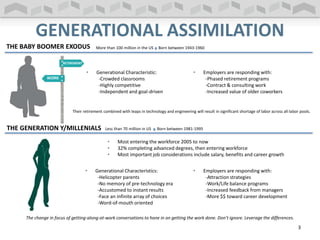
GENERATIONAL ASSIMILATION
The change in focus of getting-along-at-work conversations to hone in on getting the work done. Don’t ignore. Leverage the differences.
3
THE GENERATION Y/MILLENIALS
• Most entering the workforce 2005 to now
• 32% completing advanced degrees, then entering workforce
• Most important job considerations include salary, benefits and career growth
• Employers are responding with:
-Attraction strategies
-Work/Life balance programs
-Increased feedback from managers
-More $$ toward career development
• Generational Characteristics:
-Helicopter parents
-No memory of pre-technology era
-Accustomed to instant results
-Face an infinite array of choices
-Word-of-mouth oriented
THE BABY BOOMER EXODUS
RETIREMENT
WORK
More than 100 million in the US Born between 1943-1960
• Generational Characteristic:
-Crowded classrooms
-Highly competitive
-Independent and goal-driven
Their retirement combined with leaps in technology and engineering will result in significant shortage of labor across all labor pools.
• Employers are responding with:
-Phased retirement programs
-Contract & consulting work
-Increased value of older coworkers
Less than 70 million in US Born between 1981-1995
RESULTS FROM INTERNAL ANALYSIS
• Interviews completed:
– 8 Executive Leaders
– 18 Managers (to include VP’s)
– 79 Employees (Core, Data Factory, Infrastructure &
Sales)
– 1 Board Member/1 Board Observer
Offices visited include Harwich, Austin, Norwalk & Atlanta
4
MAJOR THEMES
• On balance, HR is mostly reactive.
• Overall, HR deliverables’ quality is the middle of the road.
• HR needs to lead long-term workforce planning.
• HR’s most visible function is recruiting, and in greatest need of
improvement.
• HR needs to enable the organization to better manage
performance.
• HR needs to take a leadership role in building better managers
and developing and retaining high performers.
• HR needs to take ownership of the succession planning
process.
5
MAJOR THEMES
• HR needs to listen to participants-Provide better
contracted benefit plans-with increased tier rates. Cost
effective plans with excellent customer service
• Compensation Model-(Earned Compensation) (EC)
• Need for blended compensation mix
• A company-wide performance management process
applied consistently is critical to our success
• Creating a goal-focused company where managers at
every level plan, set objectives, and align their work with
the broader organization
6
MAJOR THEMES
• Change from patriarchal, slow-moving,
change-resistant company to innovative,
creative, adaptable organization
• Communication needs to be effective-two way
with consistent messaging approaches over
different media sources
7
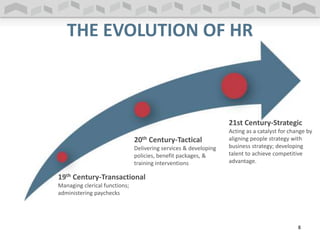
THE EVOLUTION OF HR
19th Century-Transactional
Managing clerical functions;
administering paychecks
20th Century-Tactical
Delivering services & developing
policies, benefit packages, &
training interventions
21st Century-Strategic
Acting as a catalyst for change by
aligning people strategy with
business strategy; developing
talent to achieve competitive
advantage.
8
STRATEGIC PLAN FOR CREATING THE
VISION
If you do what you’ve always done,
you get what you’ve always got.
Therefore the road to success
requires a new perspective and
change.
9
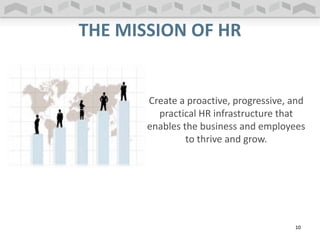
THE MISSION OF HR
10
Create a proactive, progressive, and
practical HR infrastructure that
enables the business and employees
to thrive and grow.
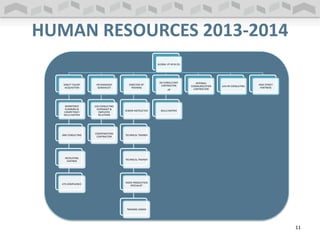
GLOBAL VP HR & OD
DIRECT TALENT
ACQUISITION
WORKFORCE
PLANNING &
COMPETENCY
SKILLS MATRIX
JRM CONSULTING
RECRUITING
PARTNER
ATS-COMPLIANCE
HR MANAGER
GENERALIST
JLM CONSULTING
OVERSIGHT &
EMPLOYEE
RELATIONS
COMPENSATION
CONTRACTOR
DIRECTOR OF
TRAINING
SENIOR INSTRUCTOR
TECHNICAL TRAINER
TECHNICAL TRAINER
VIDEO PRODUCTION
SPECIALIST
TRAINING ADMIN
OD CONSULTANT
CONTRACTOR
Jill
SKILLS MATRIX
INTERNAL
COMMUNICATION
CONTRACTOR
JLM HR CONSULTING
HIGH STREET
PARTNERS
HUMAN RESOURCES 2013-2014
11
STRATEGIC FRAMEWORK
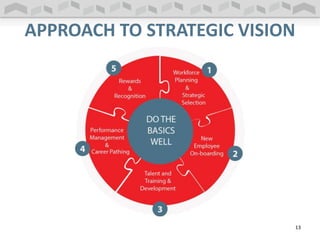
• Organized around the effective management of our talent
• Includes five major elements
• Weaves an analytical orientation into each element
• Depends on HR’s ability to do the basics well
• Implies structural changes to HR department
• Provides a framework through which we can understand,
discuss, and address our human assets
• Success depends on how all five elements work together, not
on the mere existence of multiple elements
12
APPROACH TO STRATEGIC VISION
13
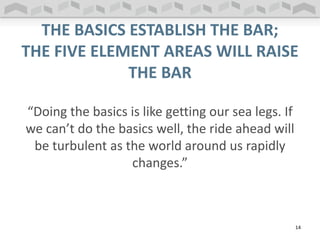
“Doing the basics is like getting our sea legs. If
we can’t do the basics well, the ride ahead will
be turbulent as the world around us rapidly
changes.”
THE BASICS ESTABLISH THE BAR;
THE FIVE ELEMENT AREAS WILL RAISE
THE BAR
14
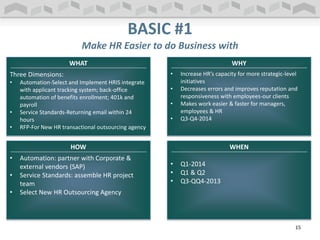
BASIC #1
Make HR Easier to do Business with
• Streamline the
application, hiring &
onboarding process once
a candidate is selected.
WHAT
Three Dimensions:
• Automation-Select and Implement HRIS integrate
with applicant tracking system; back-office
automation of benefits enrollment; 401k and
payroll
• Service Standards-Returning email within 24
hours
• RFP-For New HR transactional outsourcing agency
WHY
• Increase HR’s capacity for more strategic-level
initiatives
• Decreases errors and improves reputation and
responsiveness with employees-our clients
• Makes work easier & faster for managers,
employees & HR
• Q3-Q4-2014
HOW
• Automation: partner with Corporate &
external vendors (SAP)
• Service Standards: assemble HR project
team
• Select New HR Outsourcing Agency
WHEN
• Q1-2014
• Q1 & Q2
• Q3-QQ4-2013
15
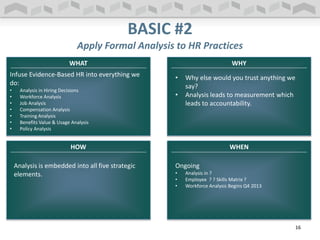
BASIC #2
Apply Formal Analysis to HR Practices
WHAT
Infuse Evidence-Based HR into everything we
do:
• Analysis in Hiring Decisions
• Workforce Analysis
• Job Analysis
• Compensation Analysis
• Training Analysis
• Benefits Value & Usage Analysis
• Policy Analysis
WHY
HOW WHEN
Ongoing
• Analysis in ?
• Employee ? ? Skills Matrix ?
• Workforce Analysis Begins Q4 2013
Analysis is embedded into all five strategic
elements.
• Why else would you trust anything we
say?
• Analysis leads to measurement which
leads to accountability.
16
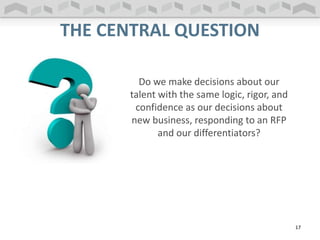
THE CENTRAL QUESTION
17
Do we make decisions about our
talent with the same logic, rigor, and
confidence as our decisions about
new business, responding to an RFP
and our differentiators?
WORKFORCE PLANNING &
STRATEGIC SELECTION
FORECAST WORKFORCE NEEDS
What Workforce Planning Is
Workforce Planning is taking the steps today to ensure we have
• The right people
• In the right place
• With the right skills
• At the right time
Done well, Workforce Planning reduces strategy execution risks associated with
workforce capacity, capability and flexibility.
19
FORECAST WORKFORCE NEEDS
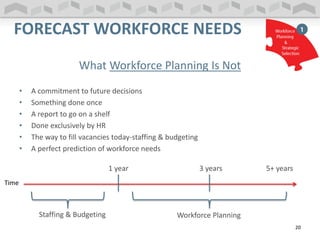
What Workforce Planning Is Not
• A commitment to future decisions
• Something done once
• A report to go on a shelf
• Done exclusively by HR
• The way to fill vacancies today-staffing & budgeting
• A perfect prediction of workforce needs
Time
Staffing & Budgeting
1 year 3 years 5+ years
Workforce Planning
20
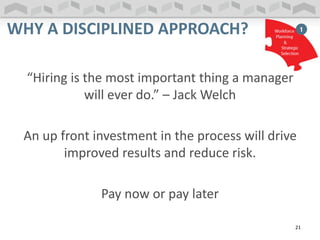
“Hiring is the most important thing a manager
will ever do.” – Jack Welch
An up front investment in the process will drive
improved results and reduce risk.
Pay now or pay later
WHY A DISCIPLINED APPROACH?
21
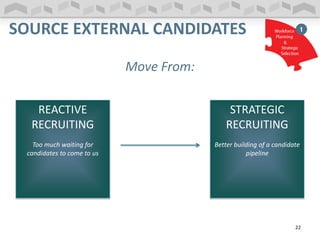
Move From:
SOURCE EXTERNAL CANDIDATES
REACTIVE
RECRUITING
Too much waiting for
candidates to come to us
STRATEGIC
RECRUITING
Better building of a candidate
pipeline
22
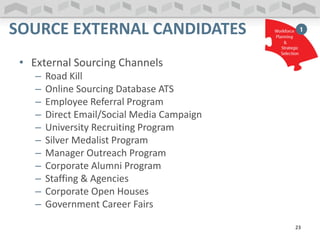
• External Sourcing Channels
– Road Kill
– Online Sourcing Database ATS
– Employee Referral Program
– Direct Email/Social Media Campaign
– University Recruiting Program
– Silver Medalist Program
– Manager Outreach Program
– Corporate Alumni Program
– Staffing & Agencies
– Corporate Open Houses
– Government Career Fairs
SOURCE EXTERNAL CANDIDATES
23
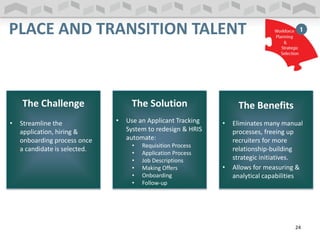
PLACE AND TRANSITION TALENT
The Challenge The Solution The Benefits
• Streamline the
application, hiring &
onboarding process once
a candidate is selected.
• Use an Applicant Tracking
System to redesign & HRIS
automate:
• Requisition Process
• Application Process
• Job Descriptions
• Making Offers
• Onboarding
• Follow-up
• Eliminates many manual
processes, freeing up
recruiters for more
relationship-building
strategic initiatives.
• Allows for measuring &
analytical capabilities
24
NEW EMPLOYEE
ON-BOARDING
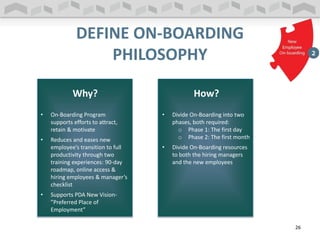
DEFINE ON-BOARDING
PHILOSOPHY
Why? How?
• On-Boarding Program
supports efforts to attract,
retain & motivate
• Reduces and eases new
employee’s transition to full
productivity through two
training experiences: 90-day
roadmap, online access &
hiring employees & manager’s
checklist
• Supports PDA New Vision-
”Preferred Place of
Employment”
• Divide On-Boarding into two
phases, both required:
o Phase 1: The first day
o Phase 2: The first month
• Divide On-Boarding resources
to both the hiring managers
and the new employees
26
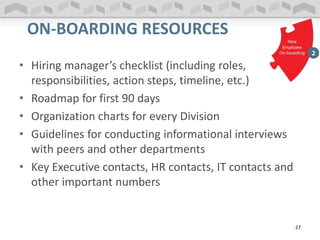
• Hiring manager’s checklist (including roles,
responsibilities, action steps, timeline, etc.)
• Roadmap for first 90 days
• Organization charts for every Division
• Guidelines for conducting informational interviews
with peers and other departments
• Key Executive contacts, HR contacts, IT contacts and
other important numbers
ON-BOARDING RESOURCES
27
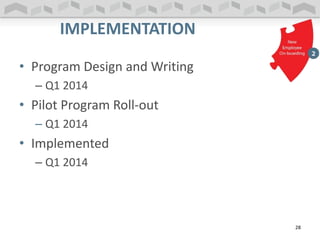
• Program Design and Writing
– Q1 2014
• Pilot Program Roll-out
– Q1 2014
• Implemented
– Q1 2014
IMPLEMENTATION
28
TALENT AND TRAINING &
DEVELOPMENT
“COMPETENCY” DEFINED
• Any combination of knowledge, skills, and abilities
(KSAs) that are essential for success in a given role
• Employee skills matrix with functional competency
and business competencies. Defined and
measurable. Competencies separate great
performance from mediocre performance
30
WHY A COMPETENCY MODEL?
• Integrates and standardizes virtually all HR practices
• Makes selection, performance, and coaching decisions
easier, faster, more accurate and more fair
• Creates a legally defensible basis for selection and
performance related decisions
• Focuses the organization’s resources and efforts on
developing competence in specific, strategic areas that
advance short- and long-term business goals
31
BUT MOST IMPORTANTLY:
• Competency models positively impact a company’s financial
performance:
Hewitt Associates
A study of 110 European
companies found that
organizations with above
average financial returns
are not only committed to
leadership development,
but have well-articulated
programs in place.
Corporate Executive
Board
Corporate Leadership
Council research reveals
that companies with strong
leadership bench strength
outperform companies with
weaker leadership.
32
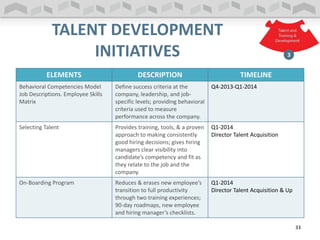
TALENT DEVELOPMENT
INITIATIVES
ELEMENTS DESCRIPTION TIMELINE
Behavioral Competencies Model
Job Descriptions. Employee Skills
Matrix
Define success criteria at the
company, leadership, and job-
specific levels; providing behavioral
criteria used to measure
performance across the company.
Q4-2013-Q1-2014
Selecting Talent Provides training, tools, & a proven
approach to making consistently
good hiring decisions; gives hiring
managers clear visibility into
candidate’s competency and fit as
they relate to the job and the
company.
Q1-2014
Director Talent Acquisition
On-Boarding Program Reduces & erases new employee’s
transition to full productivity
through two training experiences;
90-day roadmaps, new employee
and hiring manager’s checklists.
Q1-2014
Director Talent Acquisition & Up
33
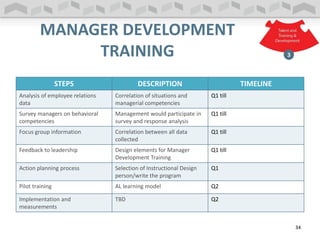
MANAGER DEVELOPMENT
TRAINING
STEPS DESCRIPTION TIMELINE
Analysis of employee relations
data
Correlation of situations and
managerial competencies
Q1 till
Survey managers on behavioral
competencies
Management would participate in
survey and response analysis
Q1 till
Focus group information Correlation between all data
collected
Q1 till
Feedback to leadership Design elements for Manager
Development Training
Q1 till
Action planning process Selection of Instructional Design
person/write the program
Q1
Pilot training AL learning model Q2
Implementation and
measurements
TBD Q2
34
PERFORMANCE MANAGEMENT
& CAREER DEVELOPMENT
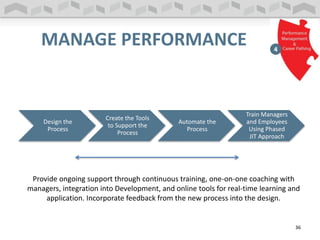
MANAGE PERFORMANCE
Design the
Process
Create the Tools
to Support the
Process
Automate the
Process
Train Managers
and Employees
Using Phased
JIT Approach
Provide ongoing support through continuous training, one-on-one coaching with
managers, integration into Development, and online tools for real-time learning and
application. Incorporate feedback from the new process into the design.
36
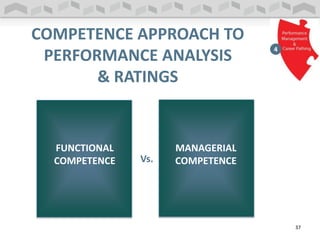
COMPETENCE APPROACH TO
PERFORMANCE ANALYSIS
& RATINGS
FUNCTIONAL
COMPETENCE
MANAGERIAL
COMPETENCEVs.
37
WHY A PERFORMANCE
MANAGEMENT PROCESS?
• A robust performance management process
builds:
– Stronger managers and leaders
– Stronger teams
– Stronger organizations
– Stronger bottom lines
Managing performance is not more work. It is the way to
work!
38
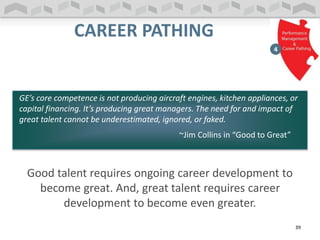
CAREER PATHING
GE’s core competence is not producing aircraft engines, kitchen appliances, or
capital financing. It’s producing great managers. The need for and impact of
great talent cannot be underestimated, ignored, or faked.
~Jim Collins in “Good to Great”
Good talent requires ongoing career development to
become great. And, great talent requires career
development to become even greater.
39
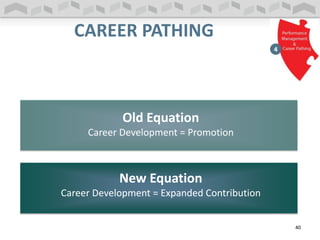
CAREER PATHING
Old Equation
Career Development = Promotion
New Equation
Career Development = Expanded Contribution
40
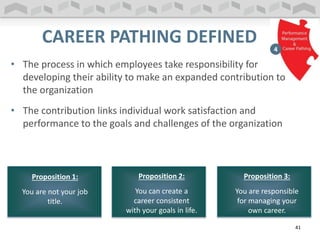
CAREER PATHING DEFINED
Proposition 1:
You are not your job
title.
Proposition 2:
You can create a
career consistent
with your goals in life.
Proposition 3:
You are responsible
for managing your
own career.
• The process in which employees take responsibility for
developing their ability to make an expanded contribution to
the organization
• The contribution links individual work satisfaction and
performance to the goals and challenges of the organization
41
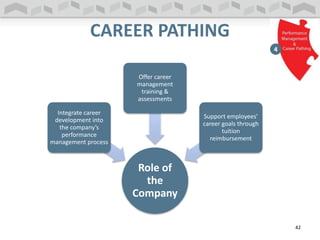
CAREER PATHING
Role of the
Company:
Role of
the
Company
Integrate career
development into
the company’s
performance
management process
Offer career
management
training &
assessments
Support employees’
career goals through
tuition
reimbursement
42
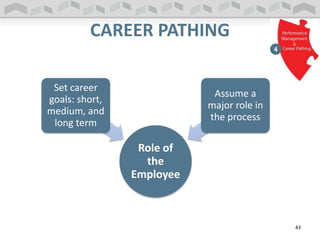
CAREER PATHING
Role of
the
Employee
Set career
goals: short,
medium, and
long term
Assume a
major role in
the process
43
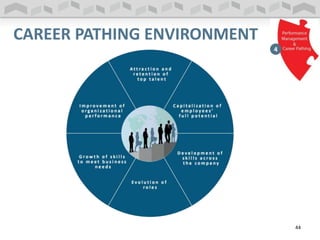
CAREER PATHING ENVIRONMENT
44
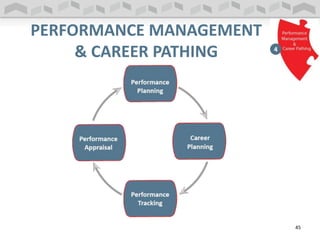
PERFORMANCE MANAGEMENT
& CAREER PATHING
45
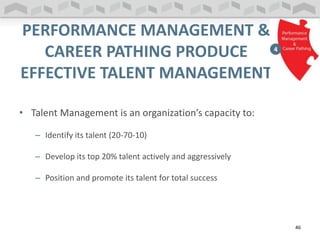
PERFORMANCE MANAGEMENT &
CAREER PATHING PRODUCE
EFFECTIVE TALENT MANAGEMENT
• Talent Management is an organization’s capacity to:
– Identify its talent (20-70-10)
– Develop its top 20% talent actively and aggressively
– Position and promote its talent for total success
46
EXECUTIVE COACHING
• Once managers reach Director level and above, they seldom
receive quality development because they are expected to
already “know it”
• Reality is that people of all levels aced ongoing development
to sharpen skills and increase capacity
• Executive coaching can bridge the gap
47
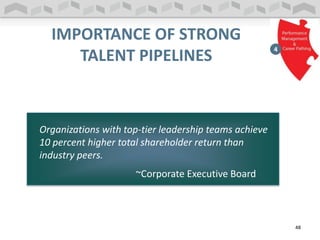
IMPORTANCE OF STRONG
TALENT PIPELINES
Organizations with top-tier leadership teams achieve
10 percent higher total shareholder return than
industry peers.
~Corporate Executive Board
48
REWARDS &
RECOGNITION
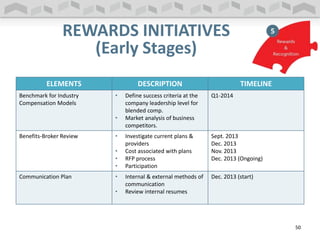
REWARDS INITIATIVES
(Early Stages)
ELEMENTS DESCRIPTION TIMELINE
Benchmark for Industry
Compensation Models
• Define success criteria at the
company leadership level for
blended comp.
• Market analysis of business
competitors.
Q1-2014
Benefits-Broker Review • Investigate current plans &
providers
• Cost associated with plans
• RFP process
• Participation
Sept. 2013
Dec. 2013
Nov. 2013
Dec. 2013 (Ongoing)
Communication Plan • Internal & external methods of
communication
• Review internal resumes
Dec. 2013 (start)
50
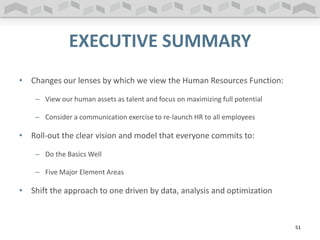
EXECUTIVE SUMMARY
• Changes our lenses by which we view the Human Resources Function:
– View our human assets as talent and focus on maximizing full potential
– Consider a communication exercise to re-launch HR to all employees
• Roll-out the clear vision and model that everyone commits to:
– Do the Basics Well
– Five Major Element Areas
• Shift the approach to one driven by data, analysis and optimization
51
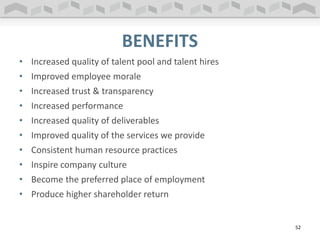
BENEFITS
• Increased quality of talent pool and talent hires
• Improved employee morale
• Increased trust & transparency
• Increased performance
• Increased quality of deliverables
• Improved quality of the services we provide
• Consistent human resource practices
• Inspire company culture
• Become the preferred place of employment
• Produce higher shareholder return
52
NEXT STEPS
• Senior leaders advise of potential strategy changes
• Senior leaders advise of costs associated with changes
• Senior leaders approve revised strategy
• Share strategy with all the managers
• Share strategy with Training Department
• Share strategy with all employees
• Begin implementation of strategy Elements One through Five
• Provide quarterly updates to senior leaders
53

PowerPoint Presentation Sample

  • 2.
    TABLE OF CONTENTS •The Evolution of HR • Results from Internal Analysis • Vision for the Future • Strategic Plan for Creating the Vision • Critical Outputs • Executive Support & Approval 2
  • 3.
    GENERATIONAL ASSIMILATION The changein focus of getting-along-at-work conversations to hone in on getting the work done. Don’t ignore. Leverage the differences. 3 THE GENERATION Y/MILLENIALS • Most entering the workforce 2005 to now • 32% completing advanced degrees, then entering workforce • Most important job considerations include salary, benefits and career growth • Employers are responding with: -Attraction strategies -Work/Life balance programs -Increased feedback from managers -More $$ toward career development • Generational Characteristics: -Helicopter parents -No memory of pre-technology era -Accustomed to instant results -Face an infinite array of choices -Word-of-mouth oriented THE BABY BOOMER EXODUS RETIREMENT WORK More than 100 million in the US Born between 1943-1960 • Generational Characteristic: -Crowded classrooms -Highly competitive -Independent and goal-driven Their retirement combined with leaps in technology and engineering will result in significant shortage of labor across all labor pools. • Employers are responding with: -Phased retirement programs -Contract & consulting work -Increased value of older coworkers Less than 70 million in US Born between 1981-1995
  • 4.
    RESULTS FROM INTERNALANALYSIS • Interviews completed: – 8 Executive Leaders – 18 Managers (to include VP’s) – 79 Employees (Core, Data Factory, Infrastructure & Sales) – 1 Board Member/1 Board Observer Offices visited include Harwich, Austin, Norwalk & Atlanta 4
  • 5.
    MAJOR THEMES • Onbalance, HR is mostly reactive. • Overall, HR deliverables’ quality is the middle of the road. • HR needs to lead long-term workforce planning. • HR’s most visible function is recruiting, and in greatest need of improvement. • HR needs to enable the organization to better manage performance. • HR needs to take a leadership role in building better managers and developing and retaining high performers. • HR needs to take ownership of the succession planning process. 5
  • 6.
    MAJOR THEMES • HRneeds to listen to participants-Provide better contracted benefit plans-with increased tier rates. Cost effective plans with excellent customer service • Compensation Model-(Earned Compensation) (EC) • Need for blended compensation mix • A company-wide performance management process applied consistently is critical to our success • Creating a goal-focused company where managers at every level plan, set objectives, and align their work with the broader organization 6
  • 7.
    MAJOR THEMES • Changefrom patriarchal, slow-moving, change-resistant company to innovative, creative, adaptable organization • Communication needs to be effective-two way with consistent messaging approaches over different media sources 7
  • 8.
    THE EVOLUTION OFHR 19th Century-Transactional Managing clerical functions; administering paychecks 20th Century-Tactical Delivering services & developing policies, benefit packages, & training interventions 21st Century-Strategic Acting as a catalyst for change by aligning people strategy with business strategy; developing talent to achieve competitive advantage. 8
  • 9.
    STRATEGIC PLAN FORCREATING THE VISION If you do what you’ve always done, you get what you’ve always got. Therefore the road to success requires a new perspective and change. 9
  • 10.
    THE MISSION OFHR 10 Create a proactive, progressive, and practical HR infrastructure that enables the business and employees to thrive and grow.
  • 11.
    GLOBAL VP HR& OD DIRECT TALENT ACQUISITION WORKFORCE PLANNING & COMPETENCY SKILLS MATRIX JRM CONSULTING RECRUITING PARTNER ATS-COMPLIANCE HR MANAGER GENERALIST JLM CONSULTING OVERSIGHT & EMPLOYEE RELATIONS COMPENSATION CONTRACTOR DIRECTOR OF TRAINING SENIOR INSTRUCTOR TECHNICAL TRAINER TECHNICAL TRAINER VIDEO PRODUCTION SPECIALIST TRAINING ADMIN OD CONSULTANT CONTRACTOR Jill SKILLS MATRIX INTERNAL COMMUNICATION CONTRACTOR JLM HR CONSULTING HIGH STREET PARTNERS HUMAN RESOURCES 2013-2014 11
  • 12.
    STRATEGIC FRAMEWORK • Organizedaround the effective management of our talent • Includes five major elements • Weaves an analytical orientation into each element • Depends on HR’s ability to do the basics well • Implies structural changes to HR department • Provides a framework through which we can understand, discuss, and address our human assets • Success depends on how all five elements work together, not on the mere existence of multiple elements 12
  • 13.
  • 14.
    “Doing the basicsis like getting our sea legs. If we can’t do the basics well, the ride ahead will be turbulent as the world around us rapidly changes.” THE BASICS ESTABLISH THE BAR; THE FIVE ELEMENT AREAS WILL RAISE THE BAR 14
  • 15.
    BASIC #1 Make HREasier to do Business with • Streamline the application, hiring & onboarding process once a candidate is selected. WHAT Three Dimensions: • Automation-Select and Implement HRIS integrate with applicant tracking system; back-office automation of benefits enrollment; 401k and payroll • Service Standards-Returning email within 24 hours • RFP-For New HR transactional outsourcing agency WHY • Increase HR’s capacity for more strategic-level initiatives • Decreases errors and improves reputation and responsiveness with employees-our clients • Makes work easier & faster for managers, employees & HR • Q3-Q4-2014 HOW • Automation: partner with Corporate & external vendors (SAP) • Service Standards: assemble HR project team • Select New HR Outsourcing Agency WHEN • Q1-2014 • Q1 & Q2 • Q3-QQ4-2013 15
  • 16.
    BASIC #2 Apply FormalAnalysis to HR Practices WHAT Infuse Evidence-Based HR into everything we do: • Analysis in Hiring Decisions • Workforce Analysis • Job Analysis • Compensation Analysis • Training Analysis • Benefits Value & Usage Analysis • Policy Analysis WHY HOW WHEN Ongoing • Analysis in ? • Employee ? ? Skills Matrix ? • Workforce Analysis Begins Q4 2013 Analysis is embedded into all five strategic elements. • Why else would you trust anything we say? • Analysis leads to measurement which leads to accountability. 16
  • 17.
    THE CENTRAL QUESTION 17 Dowe make decisions about our talent with the same logic, rigor, and confidence as our decisions about new business, responding to an RFP and our differentiators?
  • 18.
  • 19.
    FORECAST WORKFORCE NEEDS WhatWorkforce Planning Is Workforce Planning is taking the steps today to ensure we have • The right people • In the right place • With the right skills • At the right time Done well, Workforce Planning reduces strategy execution risks associated with workforce capacity, capability and flexibility. 19
  • 20.
    FORECAST WORKFORCE NEEDS WhatWorkforce Planning Is Not • A commitment to future decisions • Something done once • A report to go on a shelf • Done exclusively by HR • The way to fill vacancies today-staffing & budgeting • A perfect prediction of workforce needs Time Staffing & Budgeting 1 year 3 years 5+ years Workforce Planning 20
  • 21.
    “Hiring is themost important thing a manager will ever do.” – Jack Welch An up front investment in the process will drive improved results and reduce risk. Pay now or pay later WHY A DISCIPLINED APPROACH? 21
  • 22.
    Move From: SOURCE EXTERNALCANDIDATES REACTIVE RECRUITING Too much waiting for candidates to come to us STRATEGIC RECRUITING Better building of a candidate pipeline 22
  • 23.
    • External SourcingChannels – Road Kill – Online Sourcing Database ATS – Employee Referral Program – Direct Email/Social Media Campaign – University Recruiting Program – Silver Medalist Program – Manager Outreach Program – Corporate Alumni Program – Staffing & Agencies – Corporate Open Houses – Government Career Fairs SOURCE EXTERNAL CANDIDATES 23
  • 24.
    PLACE AND TRANSITIONTALENT The Challenge The Solution The Benefits • Streamline the application, hiring & onboarding process once a candidate is selected. • Use an Applicant Tracking System to redesign & HRIS automate: • Requisition Process • Application Process • Job Descriptions • Making Offers • Onboarding • Follow-up • Eliminates many manual processes, freeing up recruiters for more relationship-building strategic initiatives. • Allows for measuring & analytical capabilities 24
  • 25.
  • 26.
    DEFINE ON-BOARDING PHILOSOPHY Why? How? •On-Boarding Program supports efforts to attract, retain & motivate • Reduces and eases new employee’s transition to full productivity through two training experiences: 90-day roadmap, online access & hiring employees & manager’s checklist • Supports PDA New Vision- ”Preferred Place of Employment” • Divide On-Boarding into two phases, both required: o Phase 1: The first day o Phase 2: The first month • Divide On-Boarding resources to both the hiring managers and the new employees 26
  • 27.
    • Hiring manager’schecklist (including roles, responsibilities, action steps, timeline, etc.) • Roadmap for first 90 days • Organization charts for every Division • Guidelines for conducting informational interviews with peers and other departments • Key Executive contacts, HR contacts, IT contacts and other important numbers ON-BOARDING RESOURCES 27
  • 28.
    • Program Designand Writing – Q1 2014 • Pilot Program Roll-out – Q1 2014 • Implemented – Q1 2014 IMPLEMENTATION 28
  • 29.
    TALENT AND TRAINING& DEVELOPMENT
  • 30.
    “COMPETENCY” DEFINED • Anycombination of knowledge, skills, and abilities (KSAs) that are essential for success in a given role • Employee skills matrix with functional competency and business competencies. Defined and measurable. Competencies separate great performance from mediocre performance 30
  • 31.
    WHY A COMPETENCYMODEL? • Integrates and standardizes virtually all HR practices • Makes selection, performance, and coaching decisions easier, faster, more accurate and more fair • Creates a legally defensible basis for selection and performance related decisions • Focuses the organization’s resources and efforts on developing competence in specific, strategic areas that advance short- and long-term business goals 31
  • 32.
    BUT MOST IMPORTANTLY: •Competency models positively impact a company’s financial performance: Hewitt Associates A study of 110 European companies found that organizations with above average financial returns are not only committed to leadership development, but have well-articulated programs in place. Corporate Executive Board Corporate Leadership Council research reveals that companies with strong leadership bench strength outperform companies with weaker leadership. 32
  • 33.
    TALENT DEVELOPMENT INITIATIVES ELEMENTS DESCRIPTIONTIMELINE Behavioral Competencies Model Job Descriptions. Employee Skills Matrix Define success criteria at the company, leadership, and job- specific levels; providing behavioral criteria used to measure performance across the company. Q4-2013-Q1-2014 Selecting Talent Provides training, tools, & a proven approach to making consistently good hiring decisions; gives hiring managers clear visibility into candidate’s competency and fit as they relate to the job and the company. Q1-2014 Director Talent Acquisition On-Boarding Program Reduces & erases new employee’s transition to full productivity through two training experiences; 90-day roadmaps, new employee and hiring manager’s checklists. Q1-2014 Director Talent Acquisition & Up 33
  • 34.
    MANAGER DEVELOPMENT TRAINING STEPS DESCRIPTIONTIMELINE Analysis of employee relations data Correlation of situations and managerial competencies Q1 till Survey managers on behavioral competencies Management would participate in survey and response analysis Q1 till Focus group information Correlation between all data collected Q1 till Feedback to leadership Design elements for Manager Development Training Q1 till Action planning process Selection of Instructional Design person/write the program Q1 Pilot training AL learning model Q2 Implementation and measurements TBD Q2 34
  • 35.
  • 36.
    MANAGE PERFORMANCE Design the Process Createthe Tools to Support the Process Automate the Process Train Managers and Employees Using Phased JIT Approach Provide ongoing support through continuous training, one-on-one coaching with managers, integration into Development, and online tools for real-time learning and application. Incorporate feedback from the new process into the design. 36
  • 37.
    COMPETENCE APPROACH TO PERFORMANCEANALYSIS & RATINGS FUNCTIONAL COMPETENCE MANAGERIAL COMPETENCEVs. 37
  • 38.
    WHY A PERFORMANCE MANAGEMENTPROCESS? • A robust performance management process builds: – Stronger managers and leaders – Stronger teams – Stronger organizations – Stronger bottom lines Managing performance is not more work. It is the way to work! 38
  • 39.
    CAREER PATHING GE’s corecompetence is not producing aircraft engines, kitchen appliances, or capital financing. It’s producing great managers. The need for and impact of great talent cannot be underestimated, ignored, or faked. ~Jim Collins in “Good to Great” Good talent requires ongoing career development to become great. And, great talent requires career development to become even greater. 39
  • 40.
    CAREER PATHING Old Equation CareerDevelopment = Promotion New Equation Career Development = Expanded Contribution 40
  • 41.
    CAREER PATHING DEFINED Proposition1: You are not your job title. Proposition 2: You can create a career consistent with your goals in life. Proposition 3: You are responsible for managing your own career. • The process in which employees take responsibility for developing their ability to make an expanded contribution to the organization • The contribution links individual work satisfaction and performance to the goals and challenges of the organization 41
  • 42.
    CAREER PATHING Role ofthe Company: Role of the Company Integrate career development into the company’s performance management process Offer career management training & assessments Support employees’ career goals through tuition reimbursement 42
  • 43.
    CAREER PATHING Role of the Employee Setcareer goals: short, medium, and long term Assume a major role in the process 43
  • 44.
  • 45.
  • 46.
    PERFORMANCE MANAGEMENT & CAREERPATHING PRODUCE EFFECTIVE TALENT MANAGEMENT • Talent Management is an organization’s capacity to: – Identify its talent (20-70-10) – Develop its top 20% talent actively and aggressively – Position and promote its talent for total success 46
  • 47.
    EXECUTIVE COACHING • Oncemanagers reach Director level and above, they seldom receive quality development because they are expected to already “know it” • Reality is that people of all levels aced ongoing development to sharpen skills and increase capacity • Executive coaching can bridge the gap 47
  • 48.
    IMPORTANCE OF STRONG TALENTPIPELINES Organizations with top-tier leadership teams achieve 10 percent higher total shareholder return than industry peers. ~Corporate Executive Board 48
  • 49.
  • 50.
    REWARDS INITIATIVES (Early Stages) ELEMENTSDESCRIPTION TIMELINE Benchmark for Industry Compensation Models • Define success criteria at the company leadership level for blended comp. • Market analysis of business competitors. Q1-2014 Benefits-Broker Review • Investigate current plans & providers • Cost associated with plans • RFP process • Participation Sept. 2013 Dec. 2013 Nov. 2013 Dec. 2013 (Ongoing) Communication Plan • Internal & external methods of communication • Review internal resumes Dec. 2013 (start) 50
  • 51.
    EXECUTIVE SUMMARY • Changesour lenses by which we view the Human Resources Function: – View our human assets as talent and focus on maximizing full potential – Consider a communication exercise to re-launch HR to all employees • Roll-out the clear vision and model that everyone commits to: – Do the Basics Well – Five Major Element Areas • Shift the approach to one driven by data, analysis and optimization 51
  • 52.
    BENEFITS • Increased qualityof talent pool and talent hires • Improved employee morale • Increased trust & transparency • Increased performance • Increased quality of deliverables • Improved quality of the services we provide • Consistent human resource practices • Inspire company culture • Become the preferred place of employment • Produce higher shareholder return 52
  • 53.
    NEXT STEPS • Seniorleaders advise of potential strategy changes • Senior leaders advise of costs associated with changes • Senior leaders approve revised strategy • Share strategy with all the managers • Share strategy with Training Department • Share strategy with all employees • Begin implementation of strategy Elements One through Five • Provide quarterly updates to senior leaders 53