DESIGN & FABRICATION MODEL
OF 3D PRINTING MACHINE
UNDER THE GUIDANCE OF:
ANAND K J M.TECH
Assistant professor
PRESENTED BY:
RAKESH MALAGHAN
RAVIKUMAR D BARAKER
SUHAS S SAJJAN
VEERANAGOUDA
CONTENTS
 ABSTRACT
 HISTORY
 WHAT IS 3D PRINTING?
 STEPS INVOLVED IN MAKING OF 3D PRINTING
MODEL
 COMPONENTS USED FOR THE PROJECT
 APPLICATIONS
 ADVANTAGES
 LIMITATIONS
ABSTRACT
3D printing is a form of additive manufacturing
technology where a three dimensional object is created by
laying down successive layers of material.3D printers are
generally faster more affordable,& easier to use than other
additive manufacturing technologies.However,The term
3D printing is increasingly being used to describe all
additive manufacturing processes.
3D printers offer product developers the
ability to print parts & assemblies made of several
materials with different mechanical & physical
properties,often in a single build processes.Advanced 3D
Printing technology yield models that can serve as product
prototypes.
HISTORY
The inception of 3D printing can be traced back to 1976,
when the inkjet printer was invented.In 1984 adaptation
and advances on the inkjet concept morphed in the
technology from printing with ink to printing with
materials.
In 1984 charles hull,cofounder of 3D systems,invents
a method of printing process that enables a tangible 3d
object to be created from digital data.The technology is
used to create a 3d model from a picture &allows users to
test a design before investing in a larger manufacturing
program.
What is 3d printing
3D printing,also called additive manufacturing is a
process of making 3D solid objects using a digital file.
prior to coming up with the 3D objects,it has to go
through additive processes.
In the additive process,object is created by using
several layers of materials.Each of this layers is essential
in the formation of 3d object. The layers are the thinly
sliced horizontal cross section of the object. So,basically
its just piling up layer by layer.
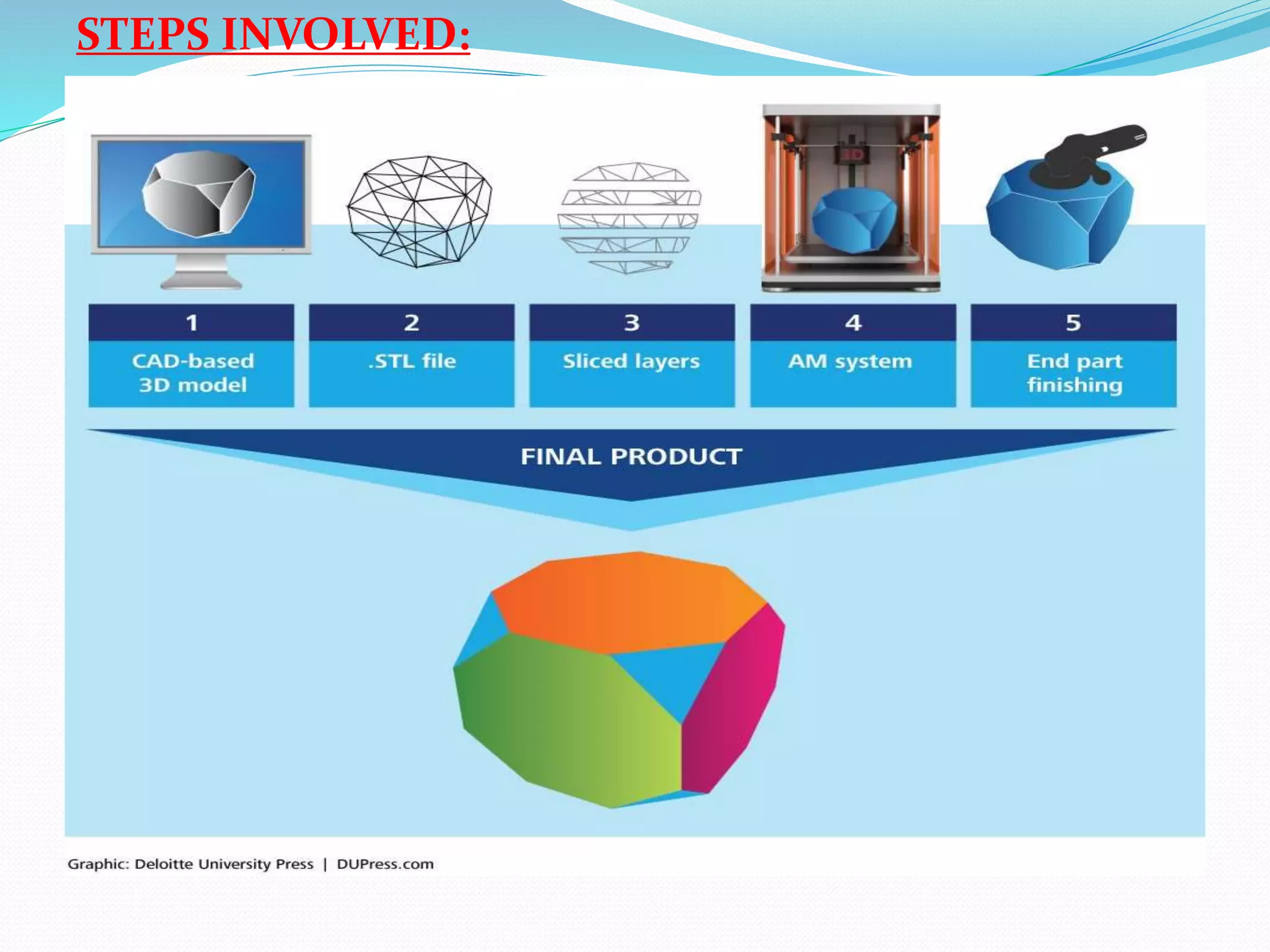
STEPS INVOLVED:
 CAD file development: We use cad software to design a
3d model with dimensions of the objects.
 Assembling of 3d printer parts: This requires electrical
components like arduino,stepper motors,ramps shield end
stops,power supply,Drivers & other components such as
Extruder,Hot end,Filaments,Print bed etc to assemble a 3d
printer.
 X,Y,&Z movement: After assembling , movement of
extruder will takes place in x,y direction whereas printbed
moves in Z direction.The movements & length of
movement will be controlled by ARDUINO software.
 Melting of filament:Filament is passed through extrusion
nozzle & nozzle tip is heated to melt the filament.
LAYER BY LAYER DEPOSITION:The melted
filament is placed on the printbed layer by layer till the
final shape of the object.
REMOVING OF THE MODEL: The model is removed
manually sometimes with knife after the completion of
the deposition process.
METHODS USED FOR 3D PRINTING
 Stereolithography(SLA)
 Fused deposition modeling(FDM)
 Selective laser sintering(SLS)
 Multi jet modeling(MJM)
WHY FDM:
FDM is the environmental friendly technologies.It
doesnot requires laser,explosive powders etc.
Other methods are costlier compared to FDM method.
There is wide range of materials such as filaments like
ABS,PLA can be used including resins.
Printed object can be easily be removed from the print
bed whereas in other method it is difficult to remove
the printed model.
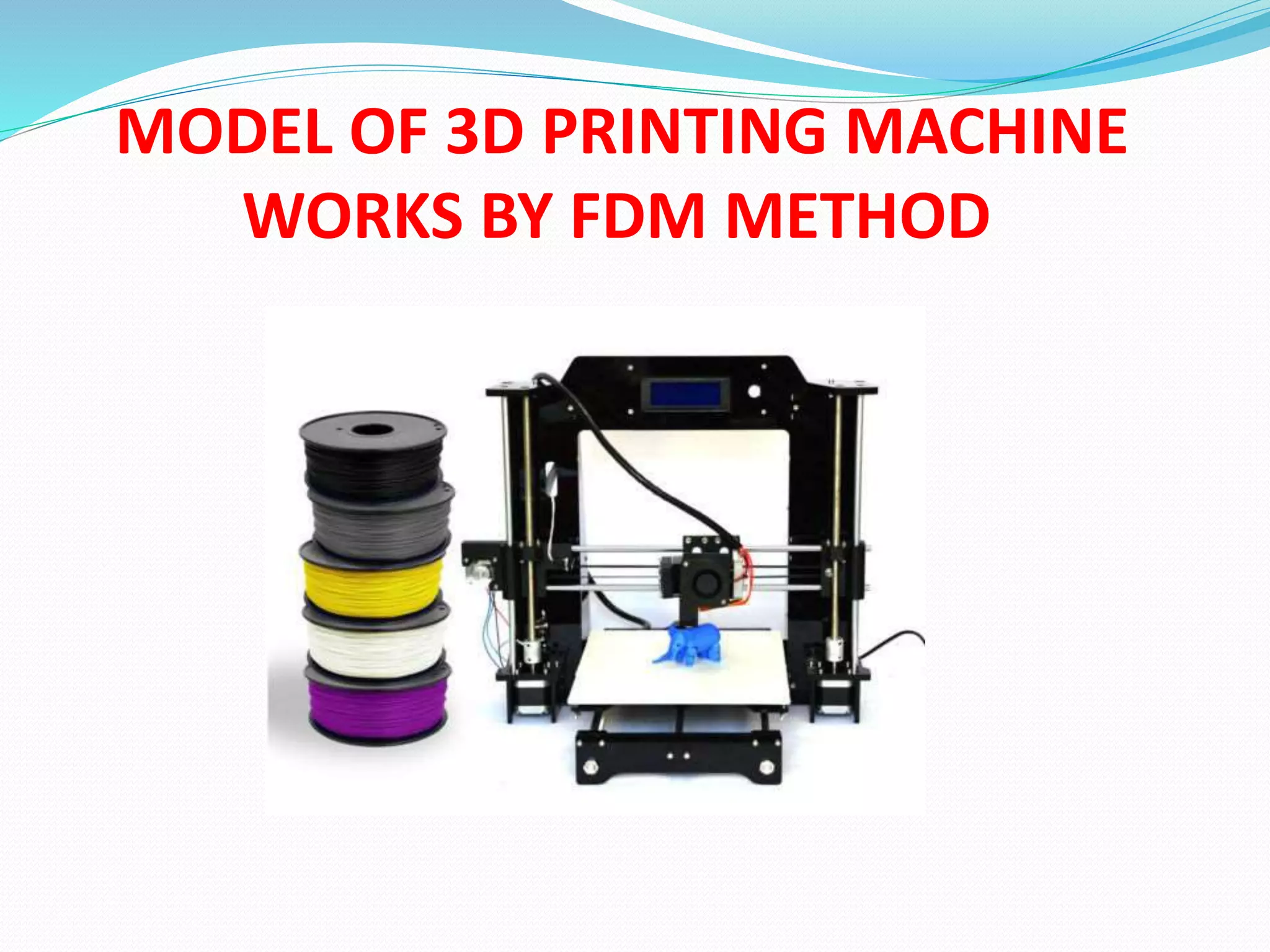
MODEL OF 3D PRINTING MACHINE
WORKS BY FDM METHOD
FUSED DEPOSITION MODELING
FDM technology builds a 3D object layer by layer
from the bottom to the top by heating thermoplastic
filament.This technology uses a special software to
create the cad model into layers & calculate the way the
printer extruder will build each layer.
The printer will heat the thermoplastic upto its
melting point & extrudes throught the nozzle onto the
base to build platform along the calculated path. A
computer will translate the dimension of the object into
X,Y&Z coordinates & control the nozzle & the base,so
that it follows the calculated path during printing.
Main components used:
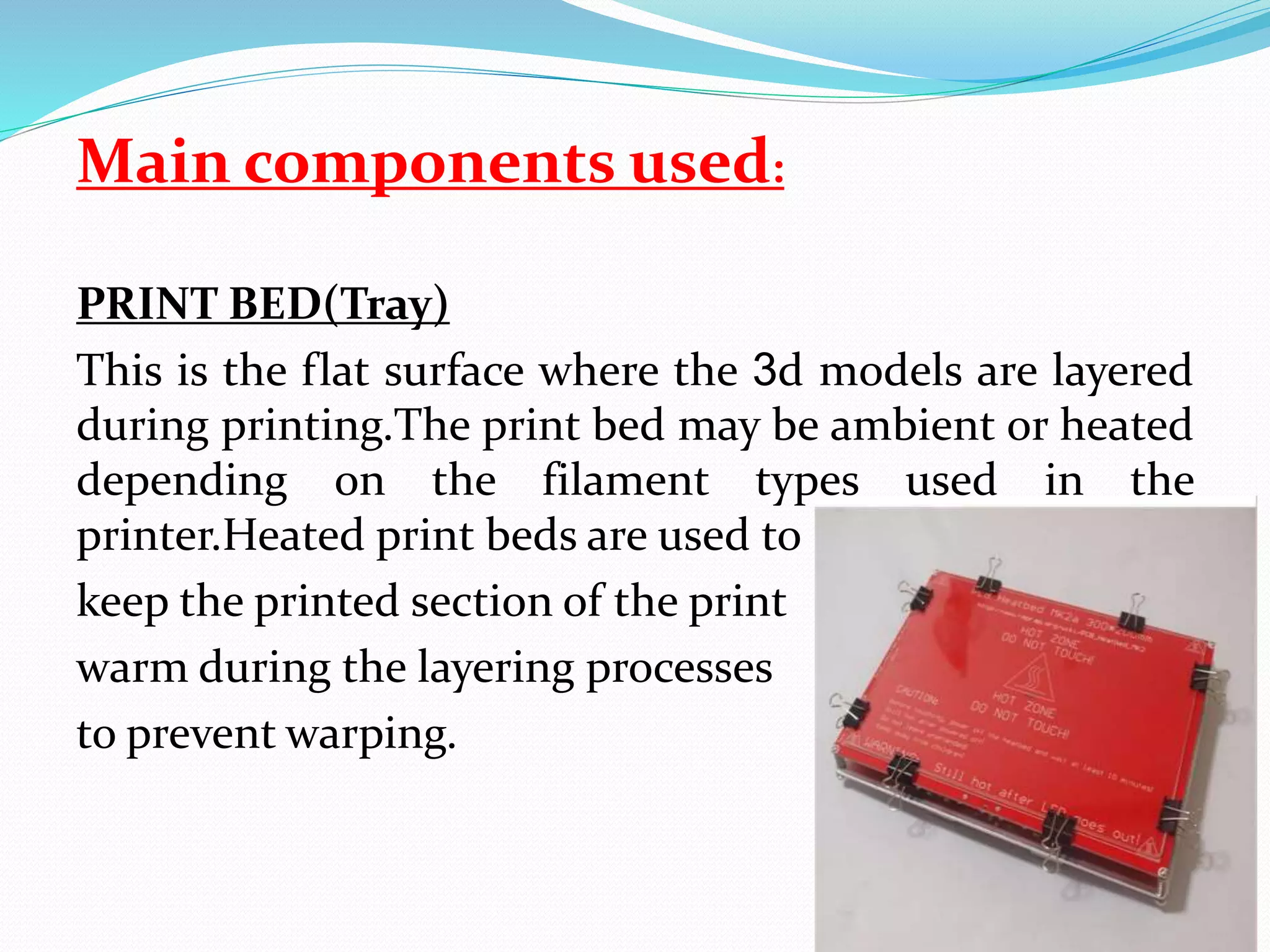
PRINT BED(Tray)
This is the flat surface where the 3d models are layered
during printing.The print bed may be ambient or heated
depending on the filament types used in the
printer.Heated print beds are used to
keep the printed section of the print
warm during the layering processes
to prevent warping.
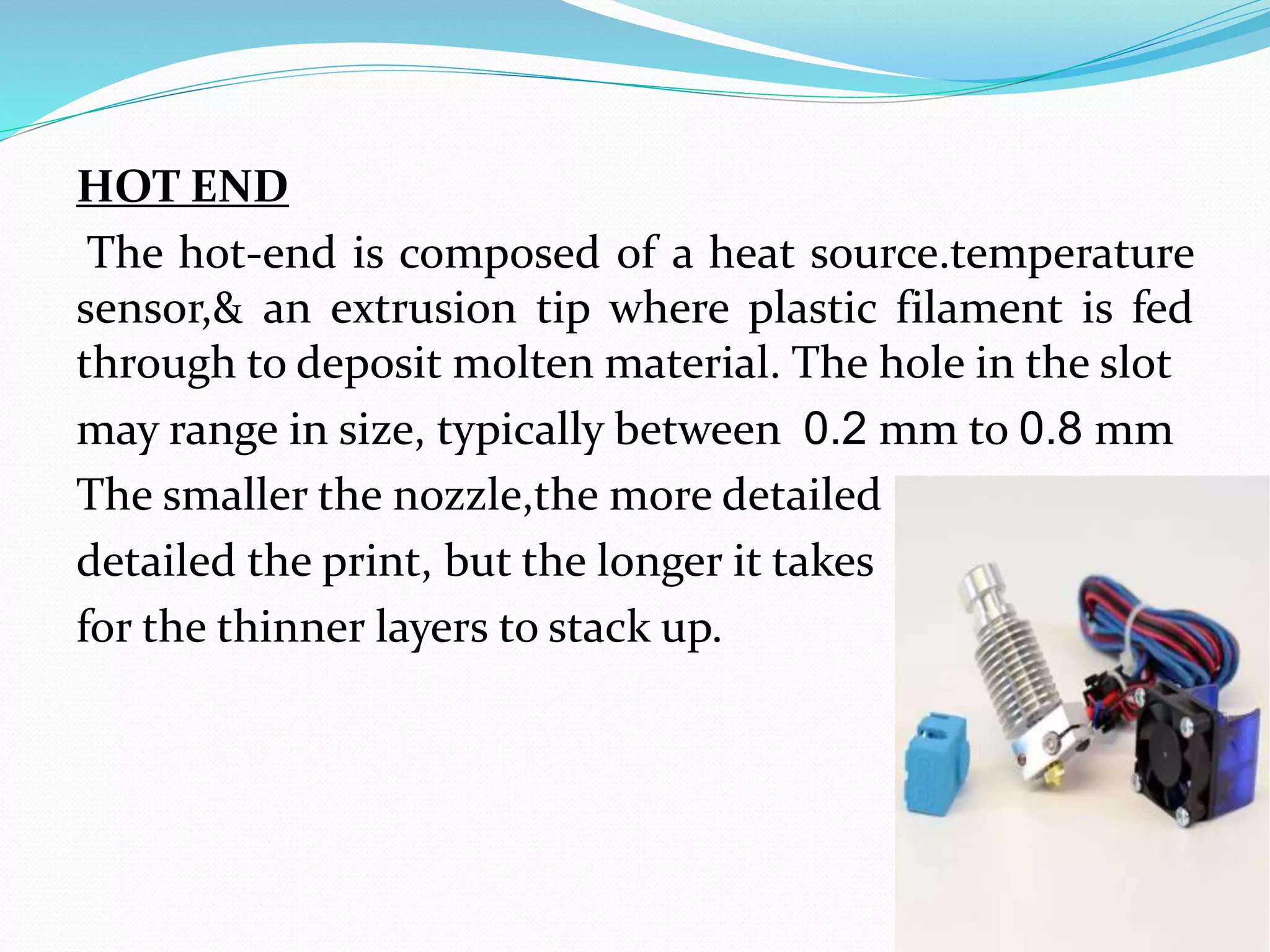
HOT END
The hot-end is composed of a heat source.temperature
sensor,& an extrusion tip where plastic filament is fed
through to deposit molten material. The hole in the slot
may range in size, typically between 0.2 mm to 0.8 mm
The smaller the nozzle,the more detailed
detailed the print, but the longer it takes
for the thinner layers to stack up.
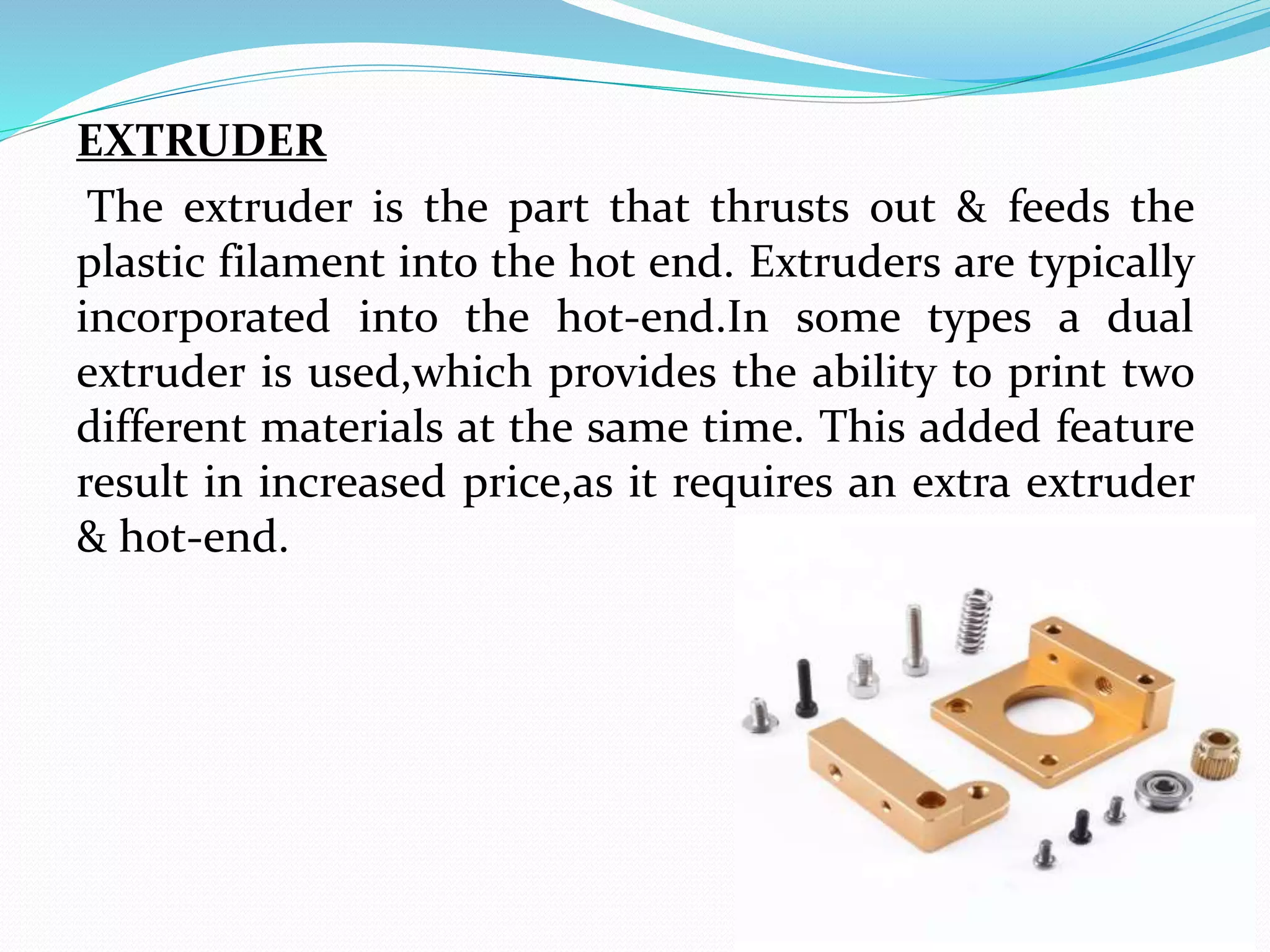
EXTRUDER
The extruder is the part that thrusts out & feeds the
plastic filament into the hot end. Extruders are typically
incorporated into the hot-end.In some types a dual
extruder is used,which provides the ability to print two
different materials at the same time. This added feature
result in increased price,as it requires an extra extruder
& hot-end.
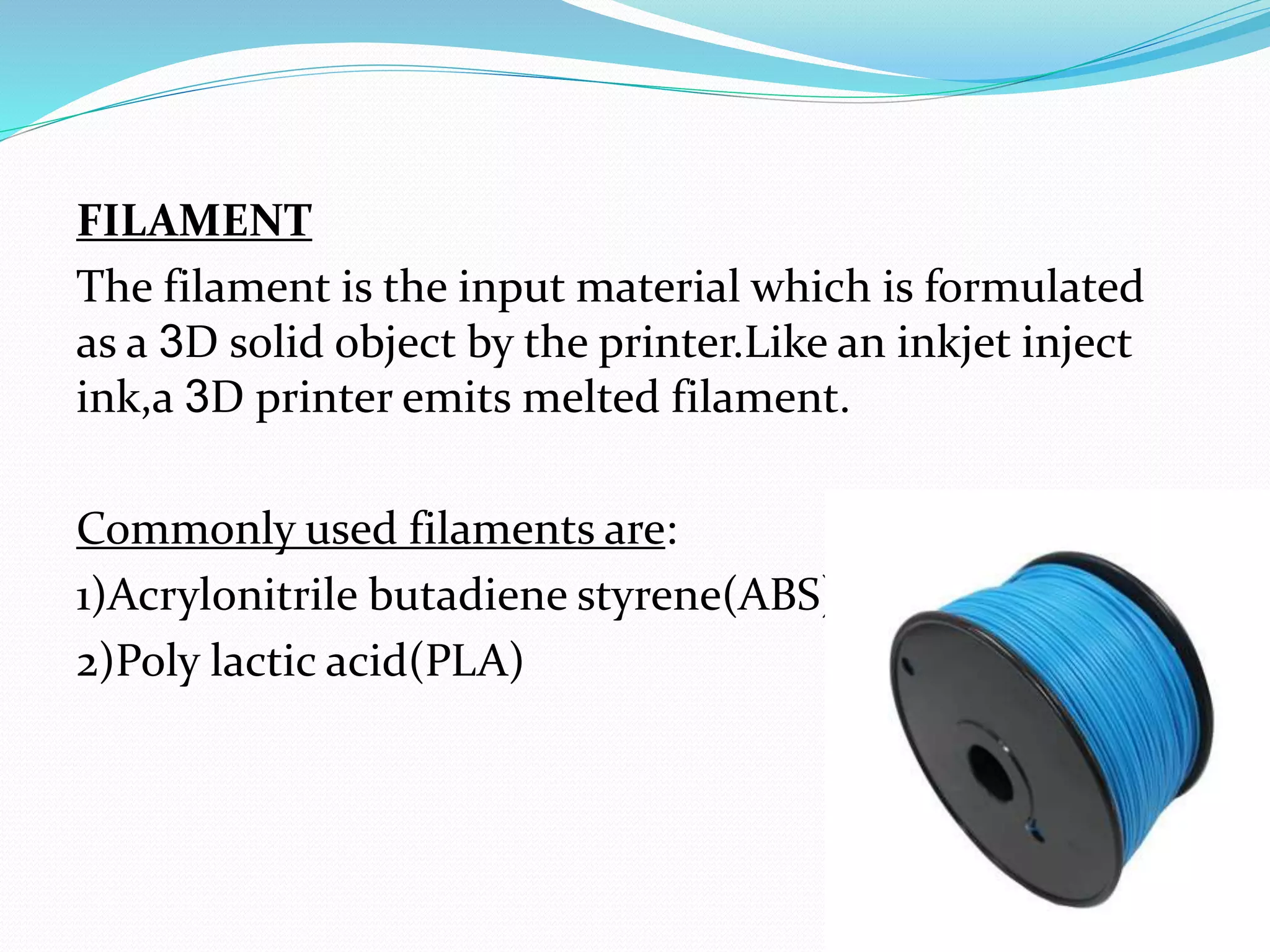
FILAMENT
The filament is the input material which is formulated
as a 3D solid object by the printer.Like an inkjet inject
ink,a 3D printer emits melted filament.
Commonly used filaments are:
1)Acrylonitrile butadiene styrene(ABS)
2)Poly lactic acid(PLA)
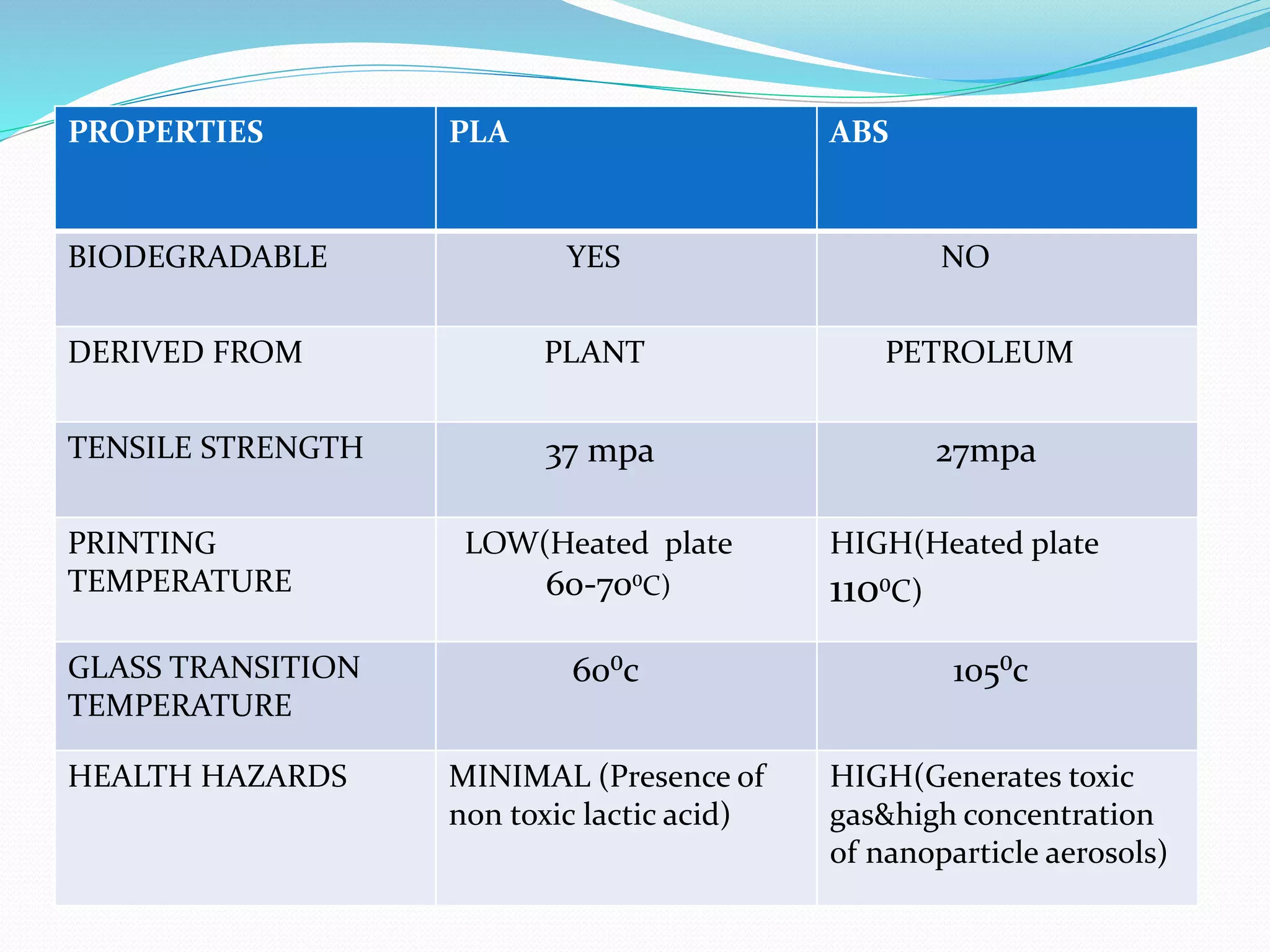
PROPERTIES PLA ABS
BIODEGRADABLE YES NO
DERIVED FROM PLANT PETROLEUM
TENSILE STRENGTH 37 mpa 27mpa
PRINTING
TEMPERATURE
LOW(Heated plate
60-70⁰C)
HIGH(Heated plate
110⁰C)
GLASS TRANSITION
TEMPERATURE
60⁰c 105⁰c
HEALTH HAZARDS MINIMAL (Presence of
non toxic lactic acid)
HIGH(Generates toxic
gas&high concentration
of nanoparticle aerosols)
Progress of the project:
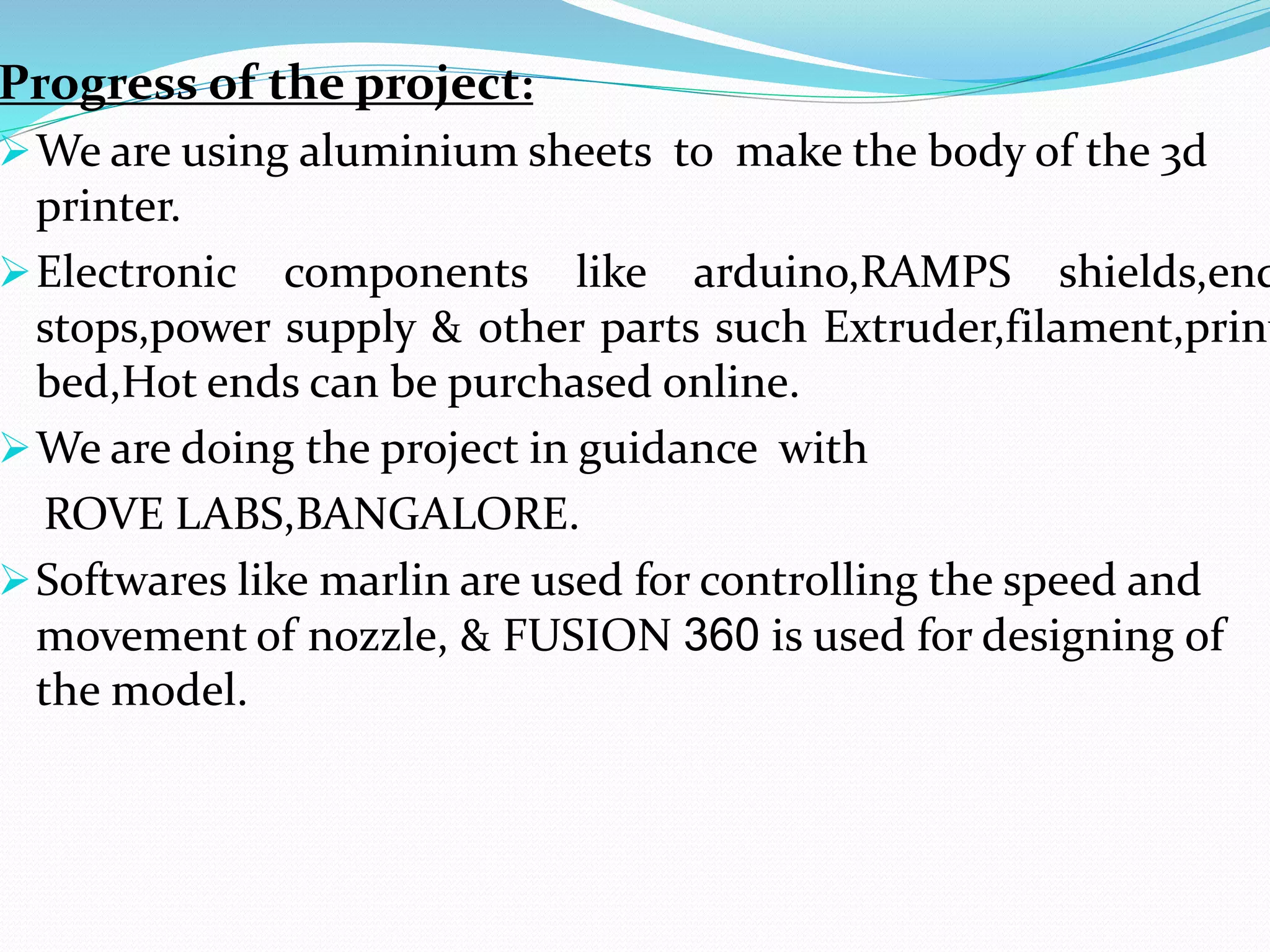
We are using aluminium sheets to make the body of the 3d
printer.
Electronic components like arduino,RAMPS shields,end
stops,power supply & other parts such Extruder,filament,print
bed,Hot ends can be purchased online.
We are doing the project in guidance with
ROVE LABS,BANGALORE.
Softwares like marlin are used for controlling the speed and
movement of nozzle, & FUSION 360 is used for designing of
the model.
ADVANTAGES :
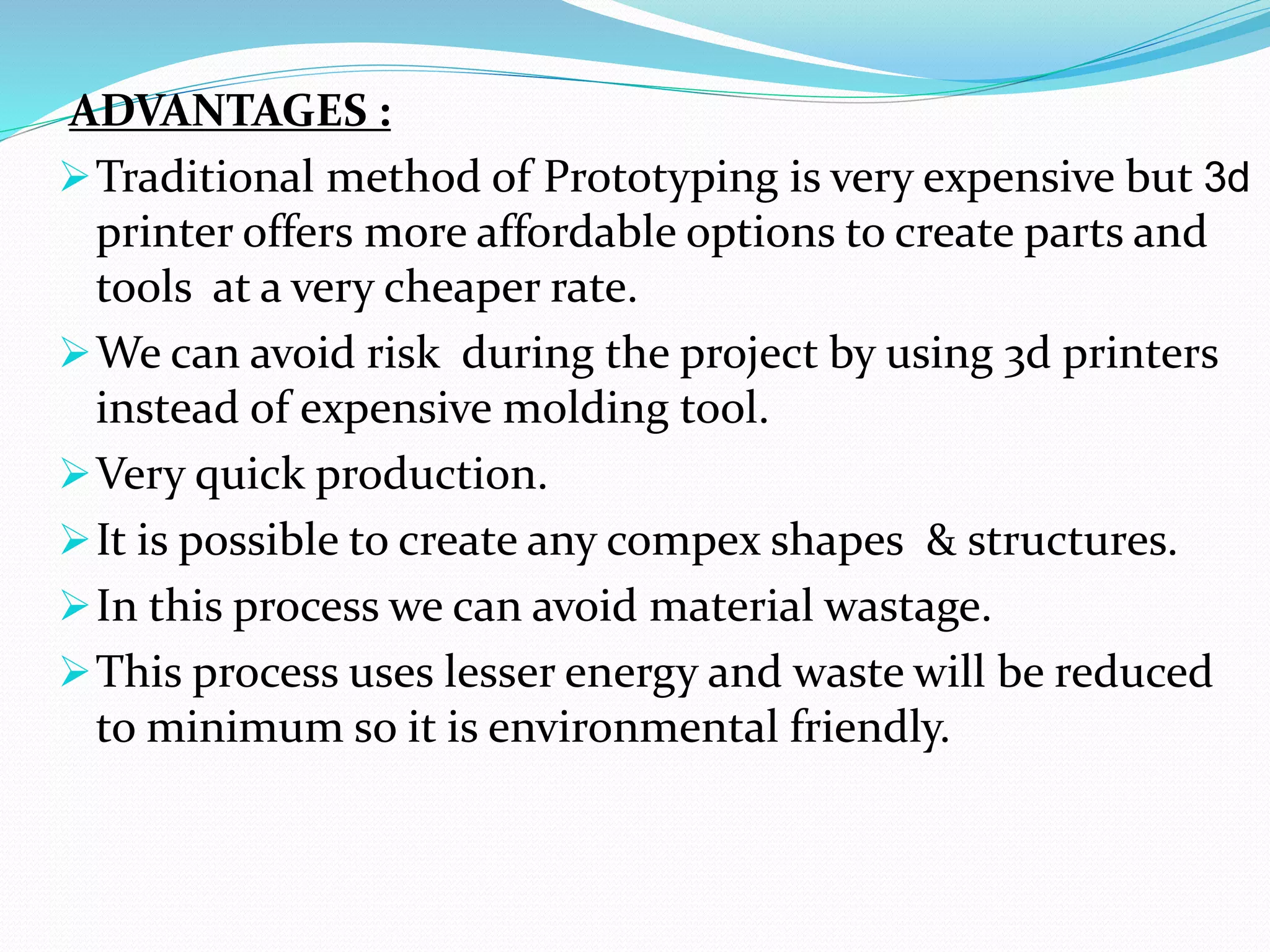
Traditional method of Prototyping is very expensive but 3d
printer offers more affordable options to create parts and
tools at a very cheaper rate.
We can avoid risk during the project by using 3d printers
instead of expensive molding tool.
Very quick production.
It is possible to create any compex shapes & structures.
In this process we can avoid material wastage.
This process uses lesser energy and waste will be reduced
to minimum so it is environmental friendly.
LIMITATIONS:
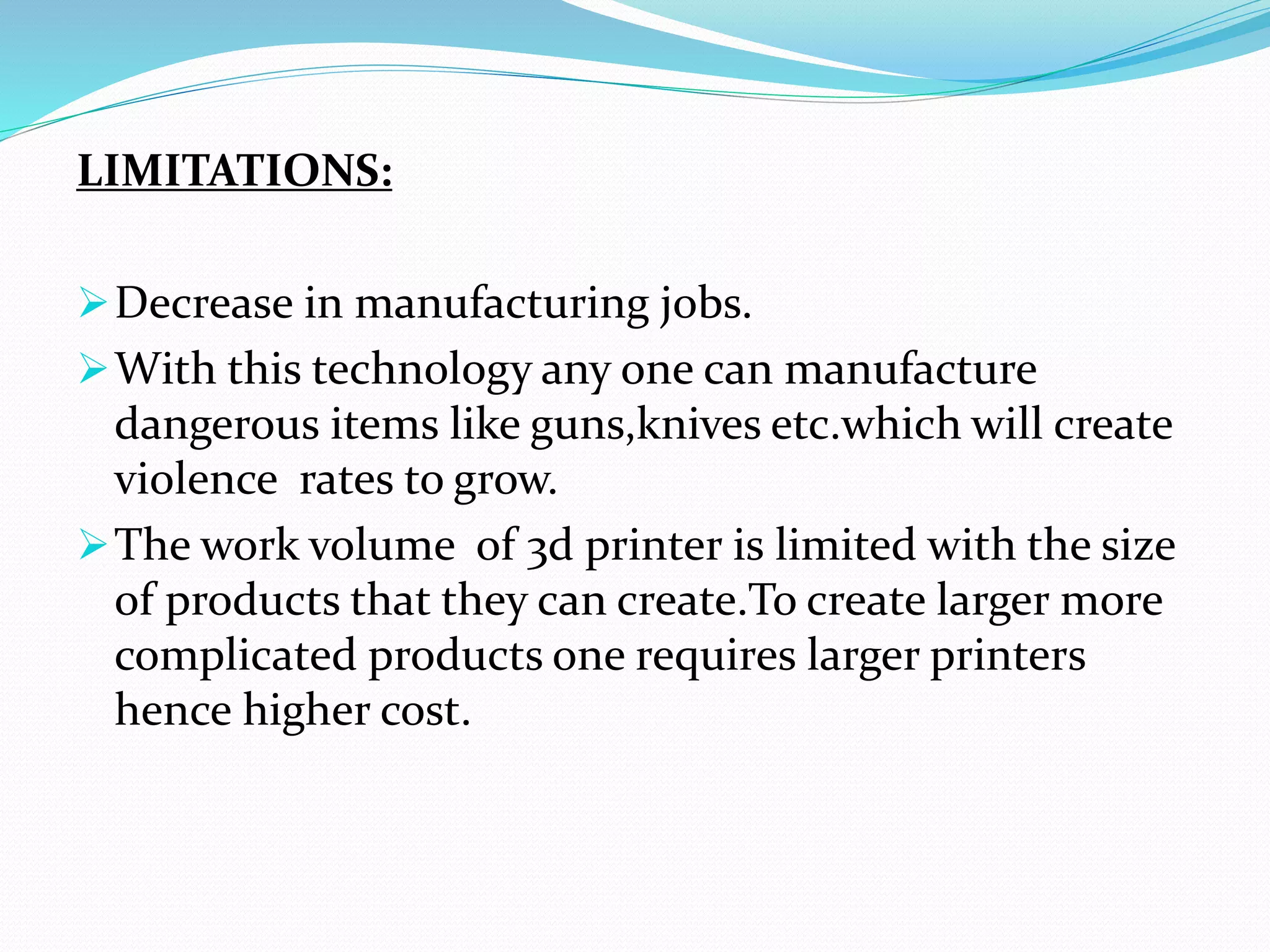
Decrease in manufacturing jobs.
With this technology any one can manufacture
dangerous items like guns,knives etc.which will create
violence rates to grow.
The work volume of 3d printer is limited with the size
of products that they can create.To create larger more
complicated products one requires larger printers
hence higher cost.
APPLICATIONS:
It is used in architecture & construction to build
beautiful & durable models for conception &
promotion of construction industry.
In medical field it is used in making of education
models,surgical guides & custom prosthetics.
In aeronautics and space it is used for building of
parts for planes,drones & satellites.
In optical field it is used for making of lens & wide
variety of frames.
CONCLUSION
With a 3d printer you can bring CAD files & design
ideas to life-right from your desktop.
Test form,fit & function-and as many design iterations
as you like-with functional parts.
REFERANCES:
 H. Lipson, M. Kurman, 1st Initial. , Fabricated: The
New World of 3D Printing, 1st edition, Indiana: John
Wiley & Sons, Inc., 2013, p.
 E. Canessa, C. Fonda, M. Zennaro, Low-cost 3D
Printing for Science, Education & Sustainable
Development, 1st edition, : ICTP—The Abdus Salam
International Centre for Theoretical Physics, 2013.
 K. France, Make: 3D Printing, 2nd ed., Gravenstein
Highway North, Sebastopol: Maker Media,, 2014, p.
 Volume 4,International journal of advances in
computer science & tehnology
THANK YOU…

Design & fabrication model of 3 d printing machine

  • 1.
    DESIGN & FABRICATIONMODEL OF 3D PRINTING MACHINE UNDER THE GUIDANCE OF: ANAND K J M.TECH Assistant professor PRESENTED BY: RAKESH MALAGHAN RAVIKUMAR D BARAKER SUHAS S SAJJAN VEERANAGOUDA
  • 2.
    CONTENTS  ABSTRACT  HISTORY WHAT IS 3D PRINTING?  STEPS INVOLVED IN MAKING OF 3D PRINTING MODEL  COMPONENTS USED FOR THE PROJECT  APPLICATIONS  ADVANTAGES  LIMITATIONS
  • 3.
    ABSTRACT 3D printing isa form of additive manufacturing technology where a three dimensional object is created by laying down successive layers of material.3D printers are generally faster more affordable,& easier to use than other additive manufacturing technologies.However,The term 3D printing is increasingly being used to describe all additive manufacturing processes. 3D printers offer product developers the ability to print parts & assemblies made of several materials with different mechanical & physical properties,often in a single build processes.Advanced 3D Printing technology yield models that can serve as product prototypes.
  • 4.
    HISTORY The inception of3D printing can be traced back to 1976, when the inkjet printer was invented.In 1984 adaptation and advances on the inkjet concept morphed in the technology from printing with ink to printing with materials. In 1984 charles hull,cofounder of 3D systems,invents a method of printing process that enables a tangible 3d object to be created from digital data.The technology is used to create a 3d model from a picture &allows users to test a design before investing in a larger manufacturing program.
  • 5.
    What is 3dprinting 3D printing,also called additive manufacturing is a process of making 3D solid objects using a digital file. prior to coming up with the 3D objects,it has to go through additive processes. In the additive process,object is created by using several layers of materials.Each of this layers is essential in the formation of 3d object. The layers are the thinly sliced horizontal cross section of the object. So,basically its just piling up layer by layer.
  • 6.
  • 7.
     CAD filedevelopment: We use cad software to design a 3d model with dimensions of the objects.  Assembling of 3d printer parts: This requires electrical components like arduino,stepper motors,ramps shield end stops,power supply,Drivers & other components such as Extruder,Hot end,Filaments,Print bed etc to assemble a 3d printer.  X,Y,&Z movement: After assembling , movement of extruder will takes place in x,y direction whereas printbed moves in Z direction.The movements & length of movement will be controlled by ARDUINO software.  Melting of filament:Filament is passed through extrusion nozzle & nozzle tip is heated to melt the filament.
  • 8.
    LAYER BY LAYERDEPOSITION:The melted filament is placed on the printbed layer by layer till the final shape of the object. REMOVING OF THE MODEL: The model is removed manually sometimes with knife after the completion of the deposition process.
  • 9.
    METHODS USED FOR3D PRINTING  Stereolithography(SLA)  Fused deposition modeling(FDM)  Selective laser sintering(SLS)  Multi jet modeling(MJM)
  • 10.
    WHY FDM: FDM isthe environmental friendly technologies.It doesnot requires laser,explosive powders etc. Other methods are costlier compared to FDM method. There is wide range of materials such as filaments like ABS,PLA can be used including resins. Printed object can be easily be removed from the print bed whereas in other method it is difficult to remove the printed model.
  • 11.
    MODEL OF 3DPRINTING MACHINE WORKS BY FDM METHOD
  • 12.
    FUSED DEPOSITION MODELING FDMtechnology builds a 3D object layer by layer from the bottom to the top by heating thermoplastic filament.This technology uses a special software to create the cad model into layers & calculate the way the printer extruder will build each layer. The printer will heat the thermoplastic upto its melting point & extrudes throught the nozzle onto the base to build platform along the calculated path. A computer will translate the dimension of the object into X,Y&Z coordinates & control the nozzle & the base,so that it follows the calculated path during printing.
  • 13.
    Main components used: PRINTBED(Tray) This is the flat surface where the 3d models are layered during printing.The print bed may be ambient or heated depending on the filament types used in the printer.Heated print beds are used to keep the printed section of the print warm during the layering processes to prevent warping.
  • 14.
    HOT END The hot-endis composed of a heat source.temperature sensor,& an extrusion tip where plastic filament is fed through to deposit molten material. The hole in the slot may range in size, typically between 0.2 mm to 0.8 mm The smaller the nozzle,the more detailed detailed the print, but the longer it takes for the thinner layers to stack up.
  • 15.
    EXTRUDER The extruder isthe part that thrusts out & feeds the plastic filament into the hot end. Extruders are typically incorporated into the hot-end.In some types a dual extruder is used,which provides the ability to print two different materials at the same time. This added feature result in increased price,as it requires an extra extruder & hot-end.
  • 16.
    FILAMENT The filament isthe input material which is formulated as a 3D solid object by the printer.Like an inkjet inject ink,a 3D printer emits melted filament. Commonly used filaments are: 1)Acrylonitrile butadiene styrene(ABS) 2)Poly lactic acid(PLA)
  • 17.
    PROPERTIES PLA ABS BIODEGRADABLEYES NO DERIVED FROM PLANT PETROLEUM TENSILE STRENGTH 37 mpa 27mpa PRINTING TEMPERATURE LOW(Heated plate 60-70⁰C) HIGH(Heated plate 110⁰C) GLASS TRANSITION TEMPERATURE 60⁰c 105⁰c HEALTH HAZARDS MINIMAL (Presence of non toxic lactic acid) HIGH(Generates toxic gas&high concentration of nanoparticle aerosols)
  • 18.
    Progress of theproject: We are using aluminium sheets to make the body of the 3d printer. Electronic components like arduino,RAMPS shields,end stops,power supply & other parts such Extruder,filament,print bed,Hot ends can be purchased online. We are doing the project in guidance with ROVE LABS,BANGALORE. Softwares like marlin are used for controlling the speed and movement of nozzle, & FUSION 360 is used for designing of the model.
  • 19.
    ADVANTAGES : Traditional methodof Prototyping is very expensive but 3d printer offers more affordable options to create parts and tools at a very cheaper rate. We can avoid risk during the project by using 3d printers instead of expensive molding tool. Very quick production. It is possible to create any compex shapes & structures. In this process we can avoid material wastage. This process uses lesser energy and waste will be reduced to minimum so it is environmental friendly.
  • 20.
    LIMITATIONS: Decrease in manufacturingjobs. With this technology any one can manufacture dangerous items like guns,knives etc.which will create violence rates to grow. The work volume of 3d printer is limited with the size of products that they can create.To create larger more complicated products one requires larger printers hence higher cost.
  • 21.
    APPLICATIONS: It is usedin architecture & construction to build beautiful & durable models for conception & promotion of construction industry. In medical field it is used in making of education models,surgical guides & custom prosthetics. In aeronautics and space it is used for building of parts for planes,drones & satellites. In optical field it is used for making of lens & wide variety of frames.
  • 22.
    CONCLUSION With a 3dprinter you can bring CAD files & design ideas to life-right from your desktop. Test form,fit & function-and as many design iterations as you like-with functional parts.
  • 23.
    REFERANCES:  H. Lipson,M. Kurman, 1st Initial. , Fabricated: The New World of 3D Printing, 1st edition, Indiana: John Wiley & Sons, Inc., 2013, p.  E. Canessa, C. Fonda, M. Zennaro, Low-cost 3D Printing for Science, Education & Sustainable Development, 1st edition, : ICTP—The Abdus Salam International Centre for Theoretical Physics, 2013.  K. France, Make: 3D Printing, 2nd ed., Gravenstein Highway North, Sebastopol: Maker Media,, 2014, p.  Volume 4,International journal of advances in computer science & tehnology
  • 24.