The succeeding differentiation rules involve the trigonometric functions and exponential
functions. Using the definition of derivative, the following rules can be derived.
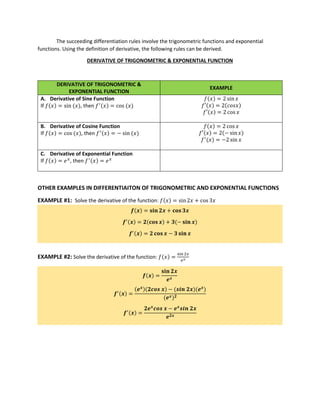
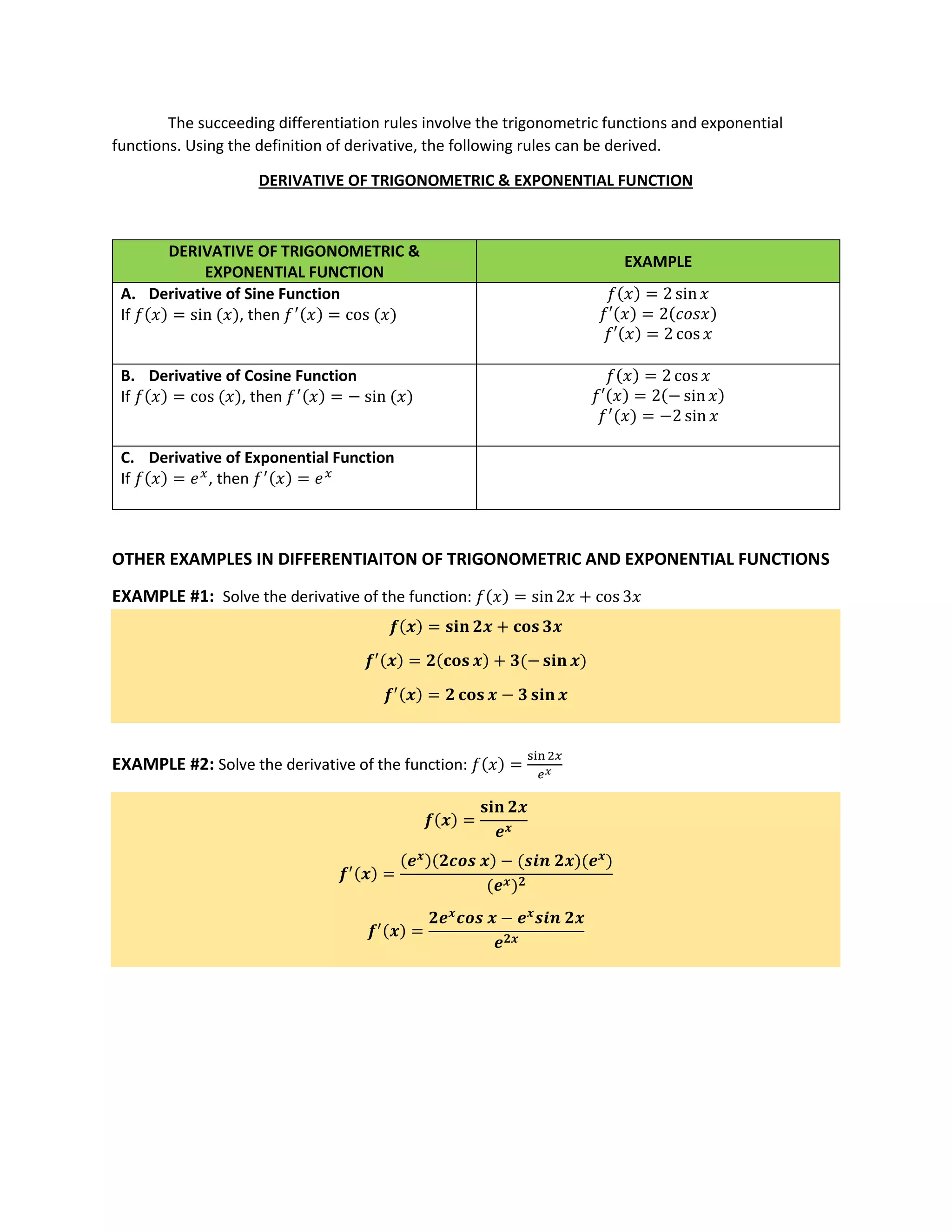
DERIVATIVE OF TRIGONOMETRIC & EXPONENTIAL FUNCTION
DERIVATIVE OF TRIGONOMETRIC &
EXPONENTIAL FUNCTION
EXAMPLE
A. Derivative of Sine Function
If 𝑓(𝑥) = sin⁡(𝑥), then 𝑓′(𝑥) = cos⁡(𝑥)
𝑓(𝑥) = 2 sin 𝑥
𝑓′(𝑥) = 2(𝑐𝑜𝑠𝑥)
𝑓′(𝑥) = 2 cos 𝑥
B. Derivative of Cosine Function
If 𝑓(𝑥) = cos⁡(𝑥), then 𝑓′(𝑥) = −⁡sin⁡(𝑥)
𝑓(𝑥) = 2 cos 𝑥
𝑓′(𝑥) = 2(− sin 𝑥)
𝑓′
(𝑥) = −2 sin 𝑥
C. Derivative of Exponential Function
If 𝑓(𝑥) = 𝑒𝑥
, then 𝑓′(𝑥) = 𝑒𝑥
OTHER EXAMPLES IN DIFFERENTIAITON OF TRIGONOMETRIC AND EXPONENTIAL FUNCTIONS
EXAMPLE #1: Solve the derivative of the function: 𝑓(𝑥) = sin2𝑥 + cos 3𝑥
EXAMPLE #2: Solve the derivative of the function: 𝑓(𝑥) =
sin 2𝑥
𝑒𝑥
𝒇(𝒙) = 𝐬𝐢𝐧 𝟐𝒙 + 𝐜𝐨𝐬 𝟑𝒙
𝒇′(𝒙) = 𝟐(𝐜𝐨𝐬 𝒙) + 𝟑(− 𝐬𝐢𝐧 𝒙)
𝒇′(𝒙) = 𝟐 𝐜𝐨𝐬 𝒙 − 𝟑 𝐬𝐢𝐧 𝒙
𝒇(𝒙) =
𝐬𝐢𝐧 𝟐𝒙
𝒆𝒙
𝒇′(𝒙) =
(𝒆𝒙)(𝟐𝒄𝒐𝒔⁡𝒙) − (𝒔𝒊𝒏⁡𝟐𝒙)(𝒆𝒙
)
(𝒆𝒙)𝟐
𝒇′(𝒙) =
𝟐𝒆𝒙
𝒄𝒐𝒔⁡𝒙 − 𝒆𝒙
𝒔𝒊𝒏⁡𝟐𝒙
𝒆𝟐𝒙

Derivatives of trigo and exponential functions module5

  • 1.
    The succeeding differentiationrules involve the trigonometric functions and exponential functions. Using the definition of derivative, the following rules can be derived. DERIVATIVE OF TRIGONOMETRIC & EXPONENTIAL FUNCTION DERIVATIVE OF TRIGONOMETRIC & EXPONENTIAL FUNCTION EXAMPLE A. Derivative of Sine Function If 𝑓(𝑥) = sin⁡(𝑥), then 𝑓′(𝑥) = cos⁡(𝑥) 𝑓(𝑥) = 2 sin 𝑥 𝑓′(𝑥) = 2(𝑐𝑜𝑠𝑥) 𝑓′(𝑥) = 2 cos 𝑥 B. Derivative of Cosine Function If 𝑓(𝑥) = cos⁡(𝑥), then 𝑓′(𝑥) = −⁡sin⁡(𝑥) 𝑓(𝑥) = 2 cos 𝑥 𝑓′(𝑥) = 2(− sin 𝑥) 𝑓′ (𝑥) = −2 sin 𝑥 C. Derivative of Exponential Function If 𝑓(𝑥) = 𝑒𝑥 , then 𝑓′(𝑥) = 𝑒𝑥 OTHER EXAMPLES IN DIFFERENTIAITON OF TRIGONOMETRIC AND EXPONENTIAL FUNCTIONS EXAMPLE #1: Solve the derivative of the function: 𝑓(𝑥) = sin2𝑥 + cos 3𝑥 EXAMPLE #2: Solve the derivative of the function: 𝑓(𝑥) = sin 2𝑥 𝑒𝑥 𝒇(𝒙) = 𝐬𝐢𝐧 𝟐𝒙 + 𝐜𝐨𝐬 𝟑𝒙 𝒇′(𝒙) = 𝟐(𝐜𝐨𝐬 𝒙) + 𝟑(− 𝐬𝐢𝐧 𝒙) 𝒇′(𝒙) = 𝟐 𝐜𝐨𝐬 𝒙 − 𝟑 𝐬𝐢𝐧 𝒙 𝒇(𝒙) = 𝐬𝐢𝐧 𝟐𝒙 𝒆𝒙 𝒇′(𝒙) = (𝒆𝒙)(𝟐𝒄𝒐𝒔⁡𝒙) − (𝒔𝒊𝒏⁡𝟐𝒙)(𝒆𝒙 ) (𝒆𝒙)𝟐 𝒇′(𝒙) = 𝟐𝒆𝒙 𝒄𝒐𝒔⁡𝒙 − 𝒆𝒙 𝒔𝒊𝒏⁡𝟐𝒙 𝒆𝟐𝒙