Introduction
This presentation delvesinto option strategies, highlighting their
significance in finance. We will explore the definition of options,
examine their different types, and discuss popular option strategies that
can help investors manage risk and maximize returns. By understanding
these concepts, you can make informed decisions in financial markets.
Definition of Options
Optionsare financial instruments that grant the buyer the right, but not
the obligation, to buy or sell an underlying asset at a predetermined
price before a specified expiration date. They are used for hedging,
speculation, or increasing leverage in trading. Understanding options is
crucial for effective risk management and investment strategies.
5.
Types of Options
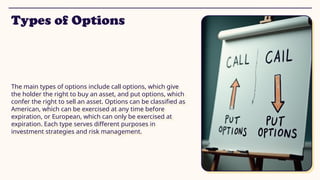
Themain types of options include call options, which give
the holder the right to buy an asset, and put options, which
confer the right to sell an asset. Options can be classified as
American, which can be exercised at any time before
expiration, or European, which can only be exercised at
expiration. Each type serves different purposes in
investment strategies and risk management.
6.
Importance in Finance
Optionsplay a vital role in financial markets, providing investors with
tools to hedge against risk, enhance portfolio returns, and facilitate
market predictions. By using options, investors can leverage their
positions with relatively small capital commitments. They also enable
strategies to minimize losses during market downturns and capitalize
on volatility, making them an essential component in modern trading
methodologies.
Covered Call
A coveredcall strategy involves holding a long position in
an asset while selling call options on the same asset. This
approach generates additional income through the option
premium, providing a cushion against potential downturns.
However, it also caps the upside potential if the asset's
price surges beyond the strike price of the sold calls.
9.
Protective Put
A protectiveput involves buying a put option for an asset already
owned. This strategy acts as an insurance policy, limiting potential
losses by allowing the investor to sell the asset at the strike price of the
put option if the market declines. It provides peace of mind while
maintaining ownership of the underlying asset, effectively balancing risk
and reward.
10.
Straddles and Strangles
Straddlesand strangles are strategies utilized when investors anticipate
significant market movement but are uncertain about the direction. A
straddle involves purchasing both a call and a put option at the same
strike price, while a strangle utilizes different strike prices. Both
strategies allow for potential profits from volatility, but they require
careful consideration of timing and market conditions to be effective.
11.
Conclusions
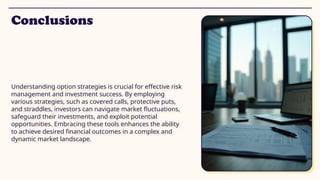
Understanding option strategiesis crucial for effective risk
management and investment success. By employing
various strategies, such as covered calls, protective puts,
and straddles, investors can navigate market fluctuations,
safeguard their investments, and exploit potential
opportunities. Embracing these tools enhances the ability
to achieve desired financial outcomes in a complex and
dynamic market landscape.
12.
CREDITS: This presentationtemplate
was created by Slidesgo, and includes
icons, infographics & images by
Freepik
Do you have any questions?
Thank you!
Thank you!