4th International Summer School
Achievements and Applications of Contemporary
Informatics, Mathematics and Physics
National University of Technology of the Ukraine
Kiev, Ukraine, August 5-16, 2009


                        Nonsmooth Optimization
    Derivative Free Optimization and Robust Optimization


             Gerhard-Wilhelm Weber * and Başak Akteke-Öztürk
             Gerhard-                          Akteke-
                               Institute of Applied Mathematics
                       Middle East Technical University, Ankara, Turkey

            * Faculty of Economics, Management and Law,   University of Siegen, Germany
             Center for Research on Optimization and Control, University of Aveiro, Portugal
Introduction

                                      Mathematical Models
 • Experimental Data Analysis
     • Classification problems
      • Identification problems              treated by:
          • Pattern Recognition       SVM, Cluster Analysis,
  • Assignment and Allocation
                                       Neural Systems etc.


• When these methods were born, the most developed and popular
      optimization tools were Linear and Quadratic Programming.

• Optimization parts of these methods are reduced to LP and QP
                                       Linear Discriminant Analysis
Introduction

• progress in Optimization         • new advanced tools,
• Nonsmooth Analysis and           • construct a mathematical model
  Nondifferentiable Opt.             better suited for the problem
                                     under consideration

• Most cases clustering problems are reduced
  to solving nonsmooth optimization problems.

• We are interested in new methods for solving related nonsmooth
   problems
  (e.g.,
  Semidefinite Programming, Semi-Infinite Programming,
   discrete gradient method and cutting angle method).
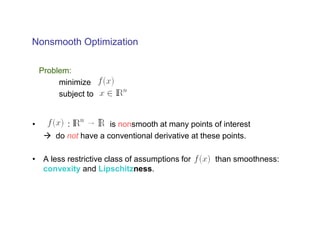
Nonsmooth Optimization

    Problem:
         minimize
         subject to


•          :           is nonsmooth at many points of interest
        do not have a conventional derivative at these points.

• A less restrictive class of assumptions for       than smoothness:
  convexity and Lipschitzness.
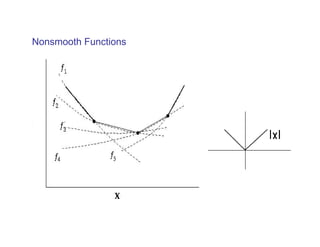
Nonsmooth Functions
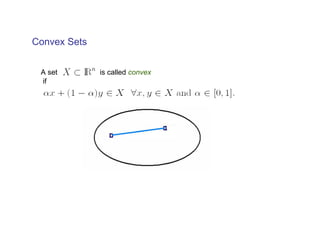
Convex Sets


 A set        is called convex
 if
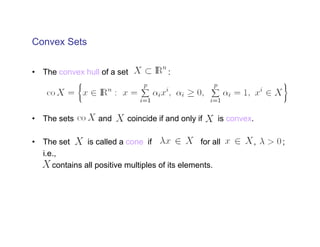
Convex Sets


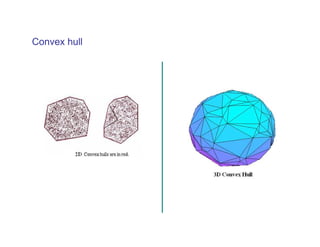
• The convex hull of a set              :


• The sets         and      coincide if and only if    is convex.

• The set      is called a cone if               for all        ,   ;
  i.e.,
     contains all positive multiples of its elements.
Convex hull
Convex Functions


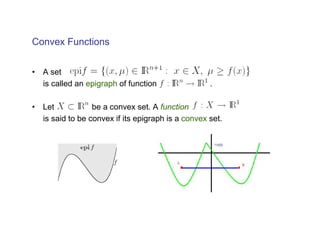
• A set
  is called an epigraph of function                .

• Let            be a convex set. A function
  is said to be convex if its epigraph is a convex set.
Convex Functions


• are differentiable (smooth) almost everywhere,
• their minimizers are points where the function need not be
  differentiable,
• standard numerical methods do not work


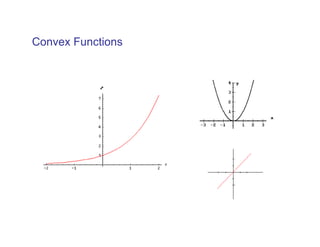
• Examples of convex functions:

    – affinely linear:
    – quadratic:                   (c>0)
    – exponential:
Convex Functions
Convex Optimization

• minimizing a convex function      over a convex feasible set

• Many applications.

• Important, because:

      a strong duality theory
      any local minimum is a global minimum
      includes least-squares problems and linear programs as special cases


      can be solved efficiently and reliably
Lipschitz Continuous


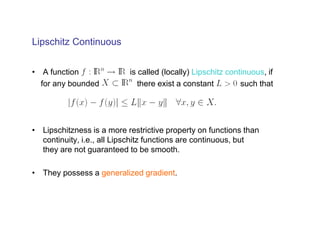
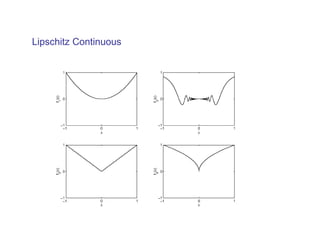
• A function               is called (locally) Lipschitz continuous, if
  for any bounded             there exist a constant         such that


• Lipschitzness is a more restrictive property on functions than
  continuity, i.e., all Lipschitz functions are continuous, but
  they are not guaranteed to be smooth.

• They possess a generalized gradient.
Lipschitz Continuous
Nonsmooth Optimization


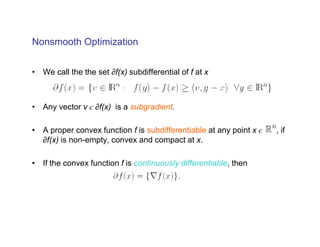
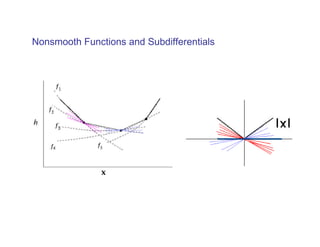
• We call the the set ∂f(x) subdifferential of f at x


• Any vector v є ∂f(x) is a subgradient.

• A proper convex function f is subdifferentiable at any point x є   , if
  ∂f(x) is non-empty, convex and compact at x.

• If the convex function f is continuously differentiable, then
Nonsmooth Functions and Subdifferentials
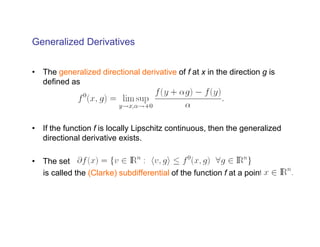
Generalized Derivatives


• The generalized directional derivative of f at x in the direction g is
  defined as


• If the function f is locally Lipschitz continuous, then the generalized
  directional derivative exists.

• The set
  is called the (Clarke) subdifferential of the function f at a point
Nonsmooth Optimization


Nonsmooth optimization

   – more general problem of minimizing functions,

   – lack some, but not all, of the favorable properties of convex functions,

   – minimizers often are again points where the function is nondifferentiable.
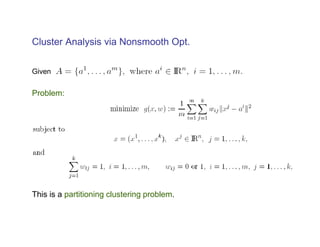
Cluster Analysis via Nonsmooth Opt.

Given


Problem:


This is a partitioning clustering problem.
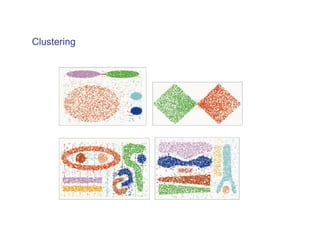
Clustering
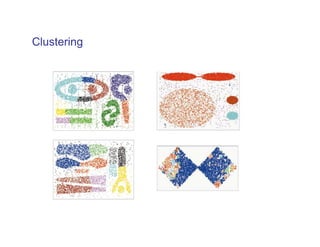
Clustering
Cluster Analysis via Nonsmooth Opt.


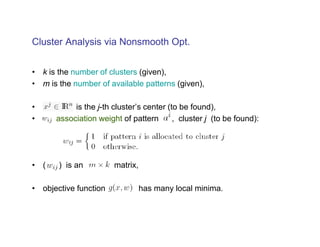
• k is the number of clusters (given),
• m is the number of available patterns (given),

•          is the j-th cluster’s center (to be found),
•     association weight of pattern       , cluster j (to be found):


• (    ) is an         matrix,

• objective function             has many local minima.
Cluster Analysis via Nonsmooth Opt.

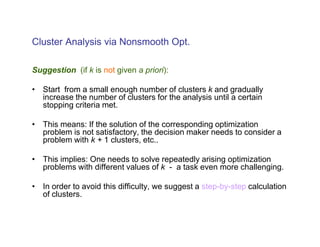
Suggestion (if k is not given a priori):

• Start from a small enough number of clusters k and gradually
  increase the number of clusters for the analysis until a certain
  stopping criteria met.

• This means: If the solution of the corresponding optimization
  problem is not satisfactory, the decision maker needs to consider a
  problem with k + 1 clusters, etc..

• This implies: One needs to solve repeatedly arising optimization
  problems with different values of k - a task even more challenging.

• In order to avoid this difficulty, we suggest a step-by-step calculation
  of clusters.
Cluster Analysis via Nonsmooth Opt.


•   k-means, h-means, j-means
•   dynamic programming
•   branch and bound
•   cutting planes
•   metaheuristics: simulated annealing, tabu search and genetic algorithms
•   an interior point method for minimum sum-of squares clustering
    problem
•   agglomerative and divisive hierarchical clustering incremental approach
Cluster Analsysis via Nonsmooth Opt.

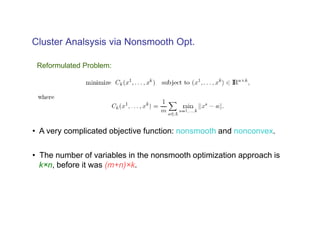
 Reformulated Problem:


• A very complicated objective function: nonsmooth and nonconvex.

• The number of variables in the nonsmooth optimization approach is
  k×n, before it was (m+n)×k.
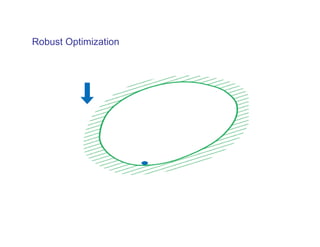
Robust Optimization


• There is uncertainty or variation in the objective and constraint
  functions, due to parameters or factors that are either
  beyond our control or unknown.

• Refers to the ability of the subject to cope well with uncertainties
  in linear, conic and semidefinite programming .

• Applications in control, engineering design and finance.

• Convex, modelled by SDP or cone quadratic programming.

• Robust solutions are computed in polynomial time, via (convex)
  semidefinite programming problem.
Robust Optimization

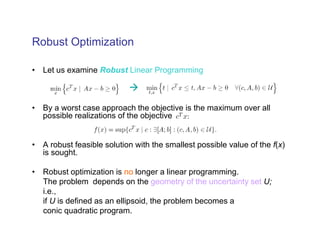
• Let us examine Robust Linear Programming


• By a worst case approach the objective is the maximum over all
  possible realizations of the objective


• A robust feasible solution with the smallest possible value of the f(x)
  is sought.

• Robust optimization is no longer a linear programming.
  The problem depends on the geometry of the uncertainty set U;
  i.e.,
  if U is defined as an ellipsoid, the problem becomes a
  conic quadratic program.
Robust Optimization
Robust Optimization

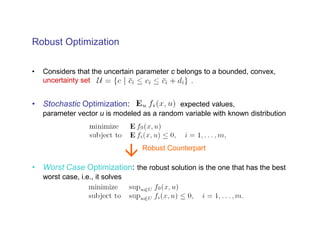
•   Considers that the uncertain parameter c belongs to a bounded, convex,
    uncertainty set


• Stochastic Optimization:                  expected values,
    parameter vector u is modeled as a random variable with known distribution


                                  Robust Counterpart

• Worst Case Optimization: the robust solution is the one that has the best
    worst case, i.e., it solves
Robust Optimization


• A complementary alternative to stochastic programming.

• Seeks a solution that will have a “good” performance under
  many/most/all possible realizations of the uncertain input
  parameters.

• Unlike stochastic programming, no distribution assumptions on
  uncertain parameters –
  each possible value equally important (this can be good or bad)

• Represents a conservative viewpoint when it is worst-case oriented.
Robust Optimization

• Especially useful when

   – some of the problem parameters are estimates and carry estimation
     risk,

   – there are constraints with uncertain parameters that must be satisfied
     regardless of the values of these parameters,

   – the objective functions / optimal solutions are particularly sensitive to
     perturbations,

   – decision-maker can not afford low-probability high-magnitude risks.
Derivative Free Optimization


The problem is to minimize a nonlinear function of several variables

•   the derivatives (sometimes even the values) of this function
    are not available,

•   arise in modern physical, chemical and econometric measurements and in
    engineering applications,

•   computer simulation is employed for the evaluation of the function values.


The methods are known as derivative free methods (DFO).
Derivative Free Optimization


Problem:


•          cannot be computed or just does not exist for every x ,
•     is an arbitrary subset of    ,
•         is called the easy constraint,
• the functions                          represent difficult constraints.
Derivative Free Optimization


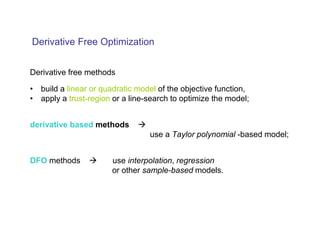
Derivative free methods

• build a linear or quadratic model of the objective function,
• apply a trust-region or a line-search to optimize the model;


derivative based methods
                                 use a Taylor polynomial -based model;


DFO methods            use interpolation, regression
                       or other sample-based models.
Derivative Free Optimization


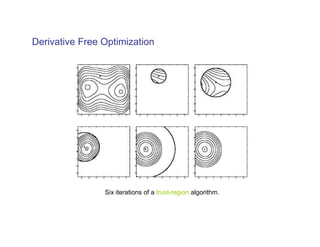
                Six iterations of a trust-region algorithm.
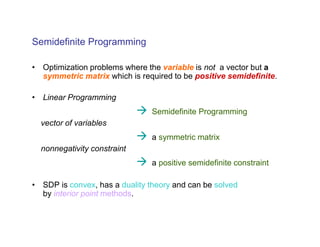
Semidefinite Programming

• Optimization problems where the variable is not a vector but a
  symmetric matrix which is required to be positive semidefinite.

• Linear Programming
                                Semidefinite Programming
  vector of variables
                                a symmetric matrix
  nonnegativity constraint
                                a positive semidefinite constraint

• SDP is convex, has a duality theory and can be solved
  by interior point methods.
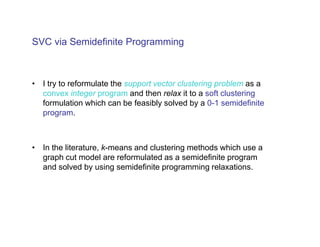
SVC via Semidefinite Programming


• I try to reformulate the support vector clustering problem as a
  convex integer program and then relax it to a soft clustering
  formulation which can be feasibly solved by a 0-1 semidefinite
  program.


• In the literature, k-means and clustering methods which use a
  graph cut model are reformulated as a semidefinite program
  and solved by using semidefinite programming relaxations.
Some References


1. Aharon Ben-Tal and Arkadi Nemirovski, Robust optimization
   methodology and applications.
2. Adil Bagirov, Nonsmooth optimization approaches in data
   Classification.
3. Adil Bagirov, Derivative-free nonsmooth optimization and its
  applications.
4. A. M. Bagirov, A. M. Rubinov, N.V. Soukhoroukova and J.
   Yearwood, Unsupervised and supervised data classification via
   nonsmooth and global optimization.
5. Laurent El Ghaoui, Robust Optimization and Applications.
6. Başak A. Öztürk, Derivative Free Optimization methods:
   Application in Stirrer Configuration and Data Clustering.
Thank you very much!

               Questions, please?

Derivative Free Optimization and Robust Optimization

  • 1.
    4th International SummerSchool Achievements and Applications of Contemporary Informatics, Mathematics and Physics National University of Technology of the Ukraine Kiev, Ukraine, August 5-16, 2009 Nonsmooth Optimization Derivative Free Optimization and Robust Optimization Gerhard-Wilhelm Weber * and Başak Akteke-Öztürk Gerhard- Akteke- Institute of Applied Mathematics Middle East Technical University, Ankara, Turkey * Faculty of Economics, Management and Law, University of Siegen, Germany Center for Research on Optimization and Control, University of Aveiro, Portugal
  • 2.
    Introduction Mathematical Models • Experimental Data Analysis • Classification problems • Identification problems treated by: • Pattern Recognition SVM, Cluster Analysis, • Assignment and Allocation Neural Systems etc. • When these methods were born, the most developed and popular optimization tools were Linear and Quadratic Programming. • Optimization parts of these methods are reduced to LP and QP Linear Discriminant Analysis
  • 3.
    Introduction • progress inOptimization • new advanced tools, • Nonsmooth Analysis and • construct a mathematical model Nondifferentiable Opt. better suited for the problem under consideration • Most cases clustering problems are reduced to solving nonsmooth optimization problems. • We are interested in new methods for solving related nonsmooth problems (e.g., Semidefinite Programming, Semi-Infinite Programming, discrete gradient method and cutting angle method).
  • 4.
    Nonsmooth Optimization Problem: minimize subject to • : is nonsmooth at many points of interest do not have a conventional derivative at these points. • A less restrictive class of assumptions for than smoothness: convexity and Lipschitzness.
  • 5.
  • 6.
    Convex Sets Aset is called convex if
  • 7.
    Convex Sets • Theconvex hull of a set : • The sets and coincide if and only if is convex. • The set is called a cone if for all , ; i.e., contains all positive multiples of its elements.
  • 8.
  • 9.
    Convex Functions • Aset is called an epigraph of function . • Let be a convex set. A function is said to be convex if its epigraph is a convex set.
  • 10.
    Convex Functions • aredifferentiable (smooth) almost everywhere, • their minimizers are points where the function need not be differentiable, • standard numerical methods do not work • Examples of convex functions: – affinely linear: – quadratic: (c>0) – exponential:
  • 11.
  • 12.
    Convex Optimization • minimizinga convex function over a convex feasible set • Many applications. • Important, because: a strong duality theory any local minimum is a global minimum includes least-squares problems and linear programs as special cases can be solved efficiently and reliably
  • 13.
    Lipschitz Continuous • Afunction is called (locally) Lipschitz continuous, if for any bounded there exist a constant such that • Lipschitzness is a more restrictive property on functions than continuity, i.e., all Lipschitz functions are continuous, but they are not guaranteed to be smooth. • They possess a generalized gradient.
  • 14.
  • 15.
    Nonsmooth Optimization • Wecall the the set ∂f(x) subdifferential of f at x • Any vector v є ∂f(x) is a subgradient. • A proper convex function f is subdifferentiable at any point x є , if ∂f(x) is non-empty, convex and compact at x. • If the convex function f is continuously differentiable, then
  • 16.
    Nonsmooth Functions andSubdifferentials
  • 17.
    Generalized Derivatives • Thegeneralized directional derivative of f at x in the direction g is defined as • If the function f is locally Lipschitz continuous, then the generalized directional derivative exists. • The set is called the (Clarke) subdifferential of the function f at a point
  • 18.
    Nonsmooth Optimization Nonsmooth optimization – more general problem of minimizing functions, – lack some, but not all, of the favorable properties of convex functions, – minimizers often are again points where the function is nondifferentiable.
  • 19.
    Cluster Analysis viaNonsmooth Opt. Given Problem: This is a partitioning clustering problem.
  • 20.
  • 21.
  • 22.
    Cluster Analysis viaNonsmooth Opt. • k is the number of clusters (given), • m is the number of available patterns (given), • is the j-th cluster’s center (to be found), • association weight of pattern , cluster j (to be found): • ( ) is an matrix, • objective function has many local minima.
  • 23.
    Cluster Analysis viaNonsmooth Opt. Suggestion (if k is not given a priori): • Start from a small enough number of clusters k and gradually increase the number of clusters for the analysis until a certain stopping criteria met. • This means: If the solution of the corresponding optimization problem is not satisfactory, the decision maker needs to consider a problem with k + 1 clusters, etc.. • This implies: One needs to solve repeatedly arising optimization problems with different values of k - a task even more challenging. • In order to avoid this difficulty, we suggest a step-by-step calculation of clusters.
  • 24.
    Cluster Analysis viaNonsmooth Opt. • k-means, h-means, j-means • dynamic programming • branch and bound • cutting planes • metaheuristics: simulated annealing, tabu search and genetic algorithms • an interior point method for minimum sum-of squares clustering problem • agglomerative and divisive hierarchical clustering incremental approach
  • 25.
    Cluster Analsysis viaNonsmooth Opt. Reformulated Problem: • A very complicated objective function: nonsmooth and nonconvex. • The number of variables in the nonsmooth optimization approach is k×n, before it was (m+n)×k.
  • 26.
    Robust Optimization • Thereis uncertainty or variation in the objective and constraint functions, due to parameters or factors that are either beyond our control or unknown. • Refers to the ability of the subject to cope well with uncertainties in linear, conic and semidefinite programming . • Applications in control, engineering design and finance. • Convex, modelled by SDP or cone quadratic programming. • Robust solutions are computed in polynomial time, via (convex) semidefinite programming problem.
  • 27.
    Robust Optimization • Letus examine Robust Linear Programming • By a worst case approach the objective is the maximum over all possible realizations of the objective • A robust feasible solution with the smallest possible value of the f(x) is sought. • Robust optimization is no longer a linear programming. The problem depends on the geometry of the uncertainty set U; i.e., if U is defined as an ellipsoid, the problem becomes a conic quadratic program.
  • 28.
  • 29.
    Robust Optimization • Considers that the uncertain parameter c belongs to a bounded, convex, uncertainty set • Stochastic Optimization: expected values, parameter vector u is modeled as a random variable with known distribution Robust Counterpart • Worst Case Optimization: the robust solution is the one that has the best worst case, i.e., it solves
  • 30.
    Robust Optimization • Acomplementary alternative to stochastic programming. • Seeks a solution that will have a “good” performance under many/most/all possible realizations of the uncertain input parameters. • Unlike stochastic programming, no distribution assumptions on uncertain parameters – each possible value equally important (this can be good or bad) • Represents a conservative viewpoint when it is worst-case oriented.
  • 31.
    Robust Optimization • Especiallyuseful when – some of the problem parameters are estimates and carry estimation risk, – there are constraints with uncertain parameters that must be satisfied regardless of the values of these parameters, – the objective functions / optimal solutions are particularly sensitive to perturbations, – decision-maker can not afford low-probability high-magnitude risks.
  • 32.
    Derivative Free Optimization Theproblem is to minimize a nonlinear function of several variables • the derivatives (sometimes even the values) of this function are not available, • arise in modern physical, chemical and econometric measurements and in engineering applications, • computer simulation is employed for the evaluation of the function values. The methods are known as derivative free methods (DFO).
  • 33.
    Derivative Free Optimization Problem: • cannot be computed or just does not exist for every x , • is an arbitrary subset of , • is called the easy constraint, • the functions represent difficult constraints.
  • 34.
    Derivative Free Optimization Derivativefree methods • build a linear or quadratic model of the objective function, • apply a trust-region or a line-search to optimize the model; derivative based methods use a Taylor polynomial -based model; DFO methods use interpolation, regression or other sample-based models.
  • 35.
    Derivative Free Optimization Six iterations of a trust-region algorithm.
  • 36.
    Semidefinite Programming • Optimizationproblems where the variable is not a vector but a symmetric matrix which is required to be positive semidefinite. • Linear Programming Semidefinite Programming vector of variables a symmetric matrix nonnegativity constraint a positive semidefinite constraint • SDP is convex, has a duality theory and can be solved by interior point methods.
  • 37.
    SVC via SemidefiniteProgramming • I try to reformulate the support vector clustering problem as a convex integer program and then relax it to a soft clustering formulation which can be feasibly solved by a 0-1 semidefinite program. • In the literature, k-means and clustering methods which use a graph cut model are reformulated as a semidefinite program and solved by using semidefinite programming relaxations.
  • 38.
    Some References 1. AharonBen-Tal and Arkadi Nemirovski, Robust optimization methodology and applications. 2. Adil Bagirov, Nonsmooth optimization approaches in data Classification. 3. Adil Bagirov, Derivative-free nonsmooth optimization and its applications. 4. A. M. Bagirov, A. M. Rubinov, N.V. Soukhoroukova and J. Yearwood, Unsupervised and supervised data classification via nonsmooth and global optimization. 5. Laurent El Ghaoui, Robust Optimization and Applications. 6. Başak A. Öztürk, Derivative Free Optimization methods: Application in Stirrer Configuration and Data Clustering.
  • 39.
    Thank you verymuch! Questions, please?