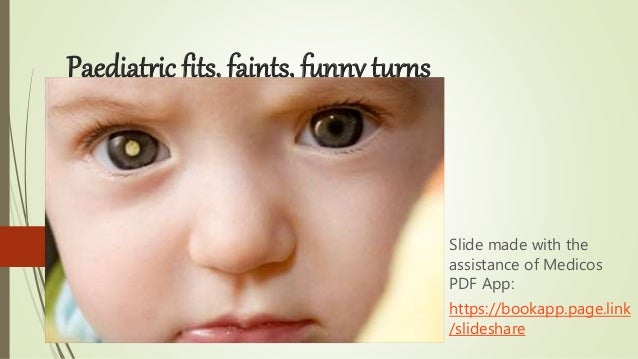
Paediatric fits, faints, funny turns
Slide made with the
assistance of Medicos
PDF App:
https://bookapp.page.link
/slideshare
Differential diagnosis
Epilepsy:
 Defined as 2 unprovoked seizures at least 24 hours apart, or
a tendency to seizures due to abnormal electrical activity.
Non-epileptic seizures:
 Febrile convulsions.
 CNS infection.
 Metabolic: ↓glucose, ↓/↑Na+, ↓Ca2+, ↓Mg2+.
 Acute trauma.
 Toxins
Other 'funny turns'
Other 'funny turns', some of which may include convulsions but
are not epilepsy:
 Syncope
 Reflex anoxic seizures: stimulus like pain, cold food, or fright
→ asystole → generalized tonic clonic seizure due to low
brain O2.
 Sleep myoclonus: a benign, random series of myoclonic
movements during or just before/after sleep. Onset is usually
in neonates and most resolve in infancy.
 Migraine
 Arrhythmia e.g. long QT.
 Tics
Psychological and
emotional episodes:
 Breath-holding attacks: crying then breath-
holding in a toddler. May become cyanosed
or have a short seizure.
 Non-epileptic attack disorder.
 Panic attacks.
Investigations
ECG in all to rule out cardiac cause.
Other tests to consider:
 Acute: rule out CNS infection, glucose, U&E.
 EEG: generally just supports clinical diagnosis when epilepsy
is strongly suspected.
 More likely to do further tests if very young.
 Worry if no obvious infections signs to cause 'febrile'
convulsions e.g. no UTI or RTI.
 MRI if focal neurology or symptoms rapidly worsening,
suggesting ↑ICP
.
Febrile convulsions
Definition and epidemiology
 Tonic-clonic seizure as temperature rises rapidly.
 By definition, not due to CNS infection or in a
child
 Affects children 6 months to 6 years old.
 Often a genetic link, so check family history.
Signs and symptoms
Signs and symptoms
 Simple febrile convulsion: one off,
 Complex febrile convulsion: recurs in 24
hours or same illness, lasts >15 minutes,
or is focal.
 Signs of underlying infection.
Management
In a confirmed febrile convulsion, explain and
reassure parents:
 30% chance it will happen again, especially if they're
younger.
 If they are ill again keep them cool – unwrap, turn
heating down, but don't make them cold e.g. by
running a cold bath.
 Give paracetamol and ibuprofen as for any fever, to
relieve discomfort. However, there is no evidence that it
reduces the risk of convulsions.
Management
 Make sure they stay well hydrated.
 If convulsions happen again, put child in recovery
position on side and clear area. Remove dummy from
mouth.
 Only call ambulance if it's >5 minutes. Of course bring
them in if they're worried, they seem very sick, or they
see a non-blanching rash.
 Only provide PR diazepam if there are repeated
seizures >5 minutes in length.
Complications
 30% recur, especially younger.
 Confers small ↑risk of later epilepsy: 2.5% vs.
1.5% in kids without febrile seizures. Bigger
increase in risk if there is a complex seizure,
a family history of epilepsy, or other
neurological abnormalities.
 No evidence of ↑risk of death.
Thank you
Happy to share this slide with Medical student .
Find hundreds of books, slides, and articles for
free from the app. To download the app just visit
:https://bookapp.page.link/slideshare

Paediatric fits, faints, funny turns

  • 1.
    Paediatric fits, faints,funny turns Slide made with the assistance of Medicos PDF App: https://bookapp.page.link /slideshare
  • 2.
    Differential diagnosis Epilepsy:  Definedas 2 unprovoked seizures at least 24 hours apart, or a tendency to seizures due to abnormal electrical activity. Non-epileptic seizures:  Febrile convulsions.  CNS infection.  Metabolic: ↓glucose, ↓/↑Na+, ↓Ca2+, ↓Mg2+.  Acute trauma.  Toxins
  • 3.
    Other 'funny turns' Other'funny turns', some of which may include convulsions but are not epilepsy:  Syncope  Reflex anoxic seizures: stimulus like pain, cold food, or fright → asystole → generalized tonic clonic seizure due to low brain O2.  Sleep myoclonus: a benign, random series of myoclonic movements during or just before/after sleep. Onset is usually in neonates and most resolve in infancy.  Migraine  Arrhythmia e.g. long QT.  Tics
  • 4.
    Psychological and emotional episodes: Breath-holding attacks: crying then breath- holding in a toddler. May become cyanosed or have a short seizure.  Non-epileptic attack disorder.  Panic attacks.
  • 5.
    Investigations ECG in allto rule out cardiac cause. Other tests to consider:  Acute: rule out CNS infection, glucose, U&E.  EEG: generally just supports clinical diagnosis when epilepsy is strongly suspected.  More likely to do further tests if very young.  Worry if no obvious infections signs to cause 'febrile' convulsions e.g. no UTI or RTI.  MRI if focal neurology or symptoms rapidly worsening, suggesting ↑ICP .
  • 6.
  • 7.
    Definition and epidemiology Tonic-clonic seizure as temperature rises rapidly.  By definition, not due to CNS infection or in a child  Affects children 6 months to 6 years old.  Often a genetic link, so check family history.
  • 8.
  • 9.
    Signs and symptoms Simple febrile convulsion: one off,  Complex febrile convulsion: recurs in 24 hours or same illness, lasts >15 minutes, or is focal.  Signs of underlying infection.
  • 10.
    Management In a confirmedfebrile convulsion, explain and reassure parents:  30% chance it will happen again, especially if they're younger.  If they are ill again keep them cool – unwrap, turn heating down, but don't make them cold e.g. by running a cold bath.  Give paracetamol and ibuprofen as for any fever, to relieve discomfort. However, there is no evidence that it reduces the risk of convulsions.
  • 11.
    Management  Make surethey stay well hydrated.  If convulsions happen again, put child in recovery position on side and clear area. Remove dummy from mouth.  Only call ambulance if it's >5 minutes. Of course bring them in if they're worried, they seem very sick, or they see a non-blanching rash.  Only provide PR diazepam if there are repeated seizures >5 minutes in length.
  • 12.
    Complications  30% recur,especially younger.  Confers small ↑risk of later epilepsy: 2.5% vs. 1.5% in kids without febrile seizures. Bigger increase in risk if there is a complex seizure, a family history of epilepsy, or other neurological abnormalities.  No evidence of ↑risk of death.
  • 13.
    Thank you Happy toshare this slide with Medical student . Find hundreds of books, slides, and articles for free from the app. To download the app just visit :https://bookapp.page.link/slideshare