Paediatric respiratory
problems
THIS INFORMATION IS TAKEN
FROM MEDICOS PDF APP:
HTTPS://BOOKAPP.PAGE.LINK/S
LIDESHARE
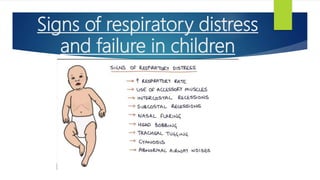
Signs of respiratory distress
and failure in children
Respiratory distress:
 ↑RR and ↑HR.
 Nasal flaring.
 Agitation
 Recession/retraction: subcostal (milder), intercostal
(moderate), sternal (severe).
 Accessory muscle use (scalene, SCM) and head bobbing
(severe).
 Grunting: expiratory noise due to an attempt to maintain
PEEP (severe).
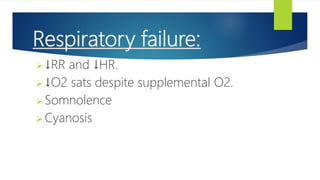
Respiratory failure:
↓RR and ↓HR.
↓O2 sats despite supplemental O2.
Somnolence
Cyanosis
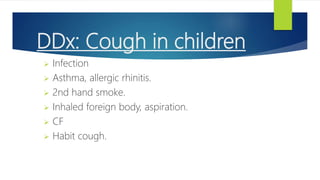
DDx: Cough in children
 Infection
 Asthma, allergic rhinitis.
 2nd hand smoke.
 Inhaled foreign body, aspiration.
 CF
 Habit cough.
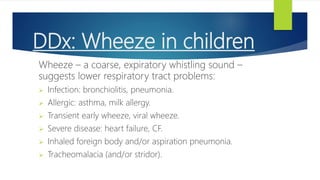
DDx: Wheeze in children
Wheeze – a coarse, expiratory whistling sound –
suggests lower respiratory tract problems:
 Infection: bronchiolitis, pneumonia.
 Allergic: asthma, milk allergy.
 Transient early wheeze, viral wheeze.
 Severe disease: heart failure, CF.
 Inhaled foreign body and/or aspiration pneumonia.
 Tracheomalacia (and/or stridor).
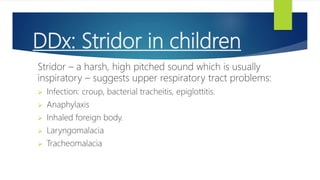
DDx: Stridor in children
Stridor – a harsh, high pitched sound which is usually
inspiratory – suggests upper respiratory tract problems:
 Infection: croup, bacterial tracheitis, epiglottitis.
 Anaphylaxis
 Inhaled foreign body.
 Laryngomalacia
 Tracheomalacia
DDx: Respiratory crackles in
children
 Fine crackles point to inflammation in the smaller airways –
bronchioles – while coarse crackles point to bronchial
involvement.
 Usually inspiratory, but they can be expiratory too if there
are voluminous secretions.
 Bronchiolitis causes bilateral, fine end inspiratory crackles.
 Pneumonia causes uni- or bilateral coarse crackles.
Investigations
Chest X-ray
Procedure and indications
 Often supine AP
, as it may be difficult to get an erect PA.
 If clinical diagnosis is clear, there is often no need for CXR
in children. More likely to be useful when there is
uncertainty e.g. younger kids with vague symptoms.
Findings
Pneumonia:
 Consolidation: lobar if Strep. pneumo.
 Cavitation if Staph. aureus or TB.
 Pleural effusion/empyema.
Severe bronchiolitis → hyperinflation:
 >6 anterior ribs.
 Flat diaphragm.
Others:
 Inhaled foreign body: requires inspiratory and
expiratory film. Hyperlucent object and collapse
distal to it.
 CF: bronchiectasis shadowing.
 HF: hyperinflation, cardiomegaly.
Other investigations
Detecting pathogens:
 Nasal swabs can pick up respiratory viruses e.g. RSV.
 Nasopharyngeal aspirate is more accurate but more
invasive.
Blood gas:
 In neonates and infants capillary blood can be used,
though the O2 readings are not very useful.
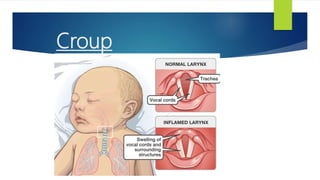
Croup
Croup
Acute laryngotracheobronchitis with subglottic
inflammation and oedema.
Epidemiology and causes
 Viral URTI due to parainfluenza 1-4 (80%), RSV, and
various rare causes.
 6 months to 6 years of age, commonest age 1-2.
 Highest prevalence in autumn.
Signs and symptoms
 Coryza 1st.
 Stridor: harsh and intermittent.
 Barking cough.
 Hoarseness
 Mild fever.
 Respiratory distress.
Management
 Dexamethasone PO.
 Adrenaline NEB if severe.
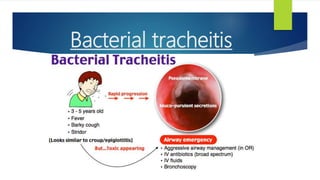
Bacterial tracheitis
Bacterial infection of trachea. Increased risk following viral
URTI due to mucosal damage and local immune changes.
Pathogens
 Staph. aureus.
 Haemophilus influenzae type b (Hib).
 Strep. pneumo.
Signs and symptoms
 Stridor
 Purulent secretions.
 Mucosal necrosis and sloughing.
 High fever.
Management
IV antibiotics.st
Epiglottitis
Epidemiology and causes
 Haemophilus influenzae type b (Hib) is traditionally the
commonest cause, but becoming less so due to the Hib
vaccine. Other causes include the usual respiratory
pathogens such as Strep. pneumo.
 Commonest in kids age 1-6 years, especially 2-3 years.
 Incidence is falling in kids, due to Hib vaccine, but rising in
adults.
Signs and symptoms
 Acute onset of high fever, sore throat, and drooling (can't
swallow secretions).
 Stridor: soft and continuous. A late sign suggesting airway
obstruction.
 Whispering
 Tripoding: sitting up and leaning forward on outstretched
arms to ease upper airway obstruction.
 In adults, onset is more gradual.
Management
 Get senior help from anaesthetics, paediatrics, and/or ENT.
 Oxygen or heliox can be given in the meantime, but do
not disturb child with oral examination or trying to gain IV
access, as it may precipitate respiratory distress. If there is
airway compromise, nebulised adrenaline can buy a small
amount of time before the airway is secured.
Management
 Definitive treatment requires intubation and IV antibiotics.
Intubation is often not needed in adults.
 Diagnosis is usually made by laryngoscopy during
intubation. In patients who are not intubated, a lateral
neck XR showing the thumb print sign can aid diagnosis.
 Investigations like blood culture and neck swabs can be
safely done once airway is secure.
Bronchiolitis
Infection of the bronchioles, usually viral.
Epidemiology and causes
 Pathogens: RSV (75%), parainfluenza, human
metapneumovirus, adenovirus (often severe).
 Commonest in kids
Signs and symptoms
Signs and symptoms
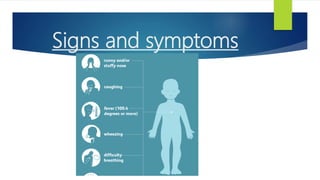
 1-3 days coryzal prodrome with clear secretions.
 Wet or dry cough.
 Respiratory distress. Apnoea may occur if
 Fever, though usually <39°C.
 Poor feeding and dehydration.
 On auscultation: wheeze, bilateral fine end-
inspiratory crackles.
Investigations
 Diagnosis usually clinical.
 O2 sats to assess severity.
 PCR of nasopharyngeal aspirate can confirm
pathogen but not routinely indicated.
 Bloods, blood gas, and CXR not routinely
recommended, unless severe disease and/or
other etiology (e.g. pneumonia) suspected.
Management
 Management is usually conservative.
 Suction secretions if causing respiratory distress or feeding
difficulties, or if there is apnoea.
 If O2 sats are low, give humidified O2 through nasal
cannula or headbox.
 If respiratory failure impending, consider CPAP or
mechanical ventilation.
 Evidence is ambiguous on benefits of nebulized
hypertonic saline. No evidence to support use of
bronchodilators, steroids, or antibiotics.
Viral-induced wheeze
 Wheeze following a viral infection such as
bronchiolitis.
 Often responds to bronchodilators.
 If it persists beyond a few weeks, child may be
more likely to go on to get an asthma diagnosis
when over 2 years old.
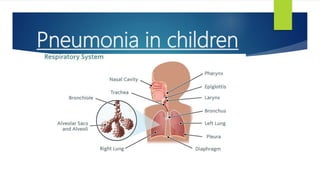
Pneumonia in children
Pathogens
 Neonates: Group B Strep.
 Strep. pneumo, Hib, Staph. aureus.
 >5 years: Mycoplasma pneumo, Strep
pneumo, Chlamydia pneumo, Group A Strep.
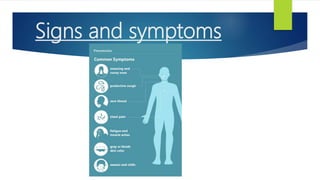
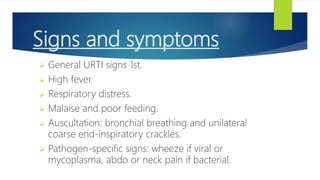
Signs and symptoms
Signs and symptoms
 General URTI signs 1st.
 High fever.
 Respiratory distress.
 Malaise and poor feeding.
 Auscultation: bronchial breathing and unilateral
coarse end-inspiratory crackles.
 Pathogen-specific signs: wheeze if viral or
mycoplasma, abdo or neck pain if bacterial.
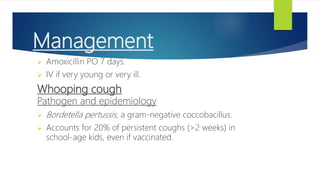
Management
 Amoxicillin PO 7 days.
 IV if very young or very ill.
Whooping cough
Pathogen and epidemiology
 Bordetella pertussis, a gram-negative coccobacillus.
 Accounts for 20% of persistent coughs (>2 weeks) in
school-age kids, even if vaccinated.
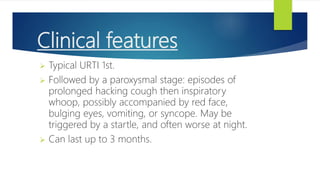
Clinical features
 Typical URTI 1st.
 Followed by a paroxysmal stage: episodes of
prolonged hacking cough then inspiratory
whoop, possibly accompanied by red face,
bulging eyes, vomiting, or syncope. May be
triggered by a startle, and often worse at night.
 Can last up to 3 months.
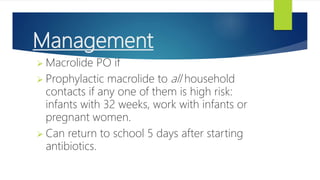
Management
 Macrolide PO if
 Prophylactic macrolide to all household
contacts if any one of them is high risk:
infants with 32 weeks, work with infants or
pregnant women.
 Can return to school 5 days after starting
antibiotics.
Inhaled foreign body
Signs and symptoms
Classic triad:
 Persistent cough following choking episode.
However, initial choking is missed in 20%, so
symptoms can last for weeks before diagnosis.
 Wheeze
 ↓Lung sounds.
Investigations and management
 CXR, though only 25% of inhaled items are
radiopaque.
 If location known, rigid bronchoscopy under general
anaesthetic (GA) to remove it.
 If location unknown, flexible bronchoscopy under
sedation to find it, then rigid bronchoscopy under
GA to remove it.
Complications
 Complete airway obstruction.
 Pneumonia. Can be recurrent and lead to
abscesses and bronchiectasis.
 Pneumothorax
 Lobar collapse.
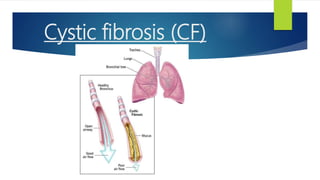
Cystic fibrosis (CF)
Genetics and pathophysiology
 Autosomal recessive mutation in CFTR gene on
chromosome 7, most commonly (70%) ΔF508. 1/25 of UK
population are carriers.
 CFTR is an apical chloride channel. Chloride movement
across cell membranes is often followed by Na+ and H2O.
 Pancreatic interlobular ducts also become clogged with
mucus, leading to impaired secretion of digestive enzymes
and eventually pancreatic destruction.
Genetics and pathophysiology
 In upper airways, CFTR dysfunction leads to
reduced fluid flow into airways and hence failure
of mucus to be cleared. This leads to recurrent
pneumonia from Staph. aureus, H.
influenzae, Strep. pneumo, and eventually
chronic Pseudomonas aeruginosa, as well as
bronchiectasis.
 In sweat glands, impaired chloride removal from
the duct (and hence Na+) leads to salty sweat.
Presentation
 Recurrent pneumonia is the commonest
presentation. Staph. aureus is the most
common dangerous pathogen in kids,
and Pseudomonas aeruginosa later.
 Neonatal meconium ileus: failure to pass the
tar-like first stools of neonates. The presenting
complaint in 10%.
 Other GI: steatorrhea, rectal prolapse, small
bowel obstruction, GORD, PUD.
Presentation
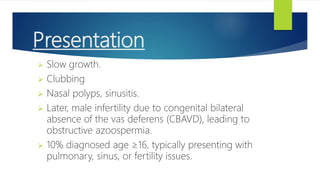
 Slow growth.
 Clubbing
 Nasal polyps, sinusitis.
 Later, male infertility due to congenital bilateral
absence of the vas deferens (CBAVD), leading to
obstructive azoospermia.
 10% diagnosed age ≥16, typically presenting with
pulmonary, sinus, or fertility issues.
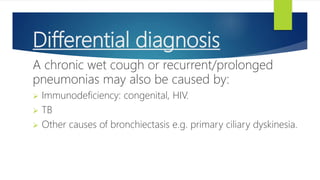
Differential diagnosis
A chronic wet cough or recurrent/prolonged
pneumonias may also be caused by:
 Immunodeficiency: congenital, HIV.
 TB
 Other causes of bronchiectasis e.g. primary ciliary dyskinesia.
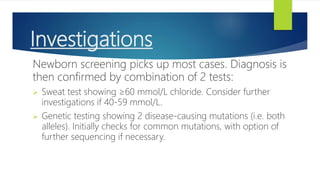
Investigations
Newborn screening picks up most cases. Diagnosis is
then confirmed by combination of 2 tests:
 Sweat test showing ≥60 mmol/L chloride. Consider further
investigations if 40-59 mmol/L.
 Genetic testing showing 2 disease-causing mutations (i.e. both
alleles). Initially checks for common mutations, with option of
further sequencing if necessary.
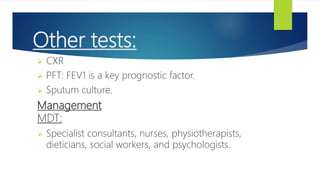
Other tests:
 CXR
 PFT: FEV1 is a key prognostic factor.
 Sputum culture.
Management
MDT:
 Specialist consultants, nurses, physiotherapists,
dieticians, social workers, and psychologists.
Respiratory:
 Mucus clearance: chest physio (postural drainage,
percussion and vibration, forced expiration) and nebulized
mucolytics (dornase alfa [a DNAse], hypertonic saline,
mannitol).
 Anti-microbials: prophylactic inhaled tobramycin (if age ≥6
with chronic P
. aeruginosa), and high-dose long-course
antibiotics when treating infections.
 Anti-inflammatories (if age ≥6): long-term azithromycin or
ibuprofen.
 Bilateral lung transplant if medical therapy fails.
Non-respiratory:
 If there is pancreatic insufficiency (>80%), give
enteric-coated pancreatic enzymes before each
meal.
 Nasal polyps may require steroids or surgery.
Targeted therapy:
 Ivacaftor and lumacaftor are novel CFTR modulators with
modest effects on lung function and exacerbation
frequency. Availability currently limited by price.
Complications
 Respiratory failure, pulmonary HTN, and cor pulmonale.
 Diabetes
 Osteoporosis
 Cirrhosis
Prognosis
Predicted median survival 40-50 years if
born today.st
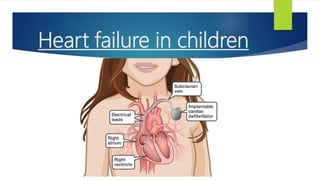
Heart failure in children
Causes and epidemiology
 A number of structural heart defects can lead to
heart failure, including VSD, PDA, coarctation of
the aorta, and valve disease. See congenital heart
disease.
 Arrhythmias and myocardial disease can also be a
cause.
 Most commonly presents in the first 3 months.
Presentation
 SOB, especially exertional.
 Poor feeding and poor weight gain.
 Cool peripheries and/or sweating.
 Recurrent chest infection.
 ↑HR, murmur.
 Cardio- and/or hepato-megaly.
THANK YOU
Thank you for visiting this slide. Keep
supporting Medicos PDF. Medical student can
download any books from Medicos PDF app
as well as we can upload our own slides for
free. Visit app from
https://bookapp.page.link/slideshare

Paediatric respiratory problems

  • 1.
    Paediatric respiratory problems THIS INFORMATIONIS TAKEN FROM MEDICOS PDF APP: HTTPS://BOOKAPP.PAGE.LINK/S LIDESHARE
  • 2.
    Signs of respiratorydistress and failure in children
  • 3.
    Respiratory distress:  ↑RRand ↑HR.  Nasal flaring.  Agitation  Recession/retraction: subcostal (milder), intercostal (moderate), sternal (severe).  Accessory muscle use (scalene, SCM) and head bobbing (severe).  Grunting: expiratory noise due to an attempt to maintain PEEP (severe).
  • 4.
    Respiratory failure: ↓RR and↓HR. ↓O2 sats despite supplemental O2. Somnolence Cyanosis
  • 5.
    DDx: Cough inchildren  Infection  Asthma, allergic rhinitis.  2nd hand smoke.  Inhaled foreign body, aspiration.  CF  Habit cough.
  • 6.
    DDx: Wheeze inchildren Wheeze – a coarse, expiratory whistling sound – suggests lower respiratory tract problems:  Infection: bronchiolitis, pneumonia.  Allergic: asthma, milk allergy.  Transient early wheeze, viral wheeze.  Severe disease: heart failure, CF.  Inhaled foreign body and/or aspiration pneumonia.  Tracheomalacia (and/or stridor).
  • 7.
    DDx: Stridor inchildren Stridor – a harsh, high pitched sound which is usually inspiratory – suggests upper respiratory tract problems:  Infection: croup, bacterial tracheitis, epiglottitis.  Anaphylaxis  Inhaled foreign body.  Laryngomalacia  Tracheomalacia
  • 8.
    DDx: Respiratory cracklesin children  Fine crackles point to inflammation in the smaller airways – bronchioles – while coarse crackles point to bronchial involvement.  Usually inspiratory, but they can be expiratory too if there are voluminous secretions.  Bronchiolitis causes bilateral, fine end inspiratory crackles.  Pneumonia causes uni- or bilateral coarse crackles.
  • 9.
    Investigations Chest X-ray Procedure andindications  Often supine AP , as it may be difficult to get an erect PA.  If clinical diagnosis is clear, there is often no need for CXR in children. More likely to be useful when there is uncertainty e.g. younger kids with vague symptoms.
  • 10.
    Findings Pneumonia:  Consolidation: lobarif Strep. pneumo.  Cavitation if Staph. aureus or TB.  Pleural effusion/empyema. Severe bronchiolitis → hyperinflation:  >6 anterior ribs.  Flat diaphragm.
  • 11.
    Others:  Inhaled foreignbody: requires inspiratory and expiratory film. Hyperlucent object and collapse distal to it.  CF: bronchiectasis shadowing.  HF: hyperinflation, cardiomegaly.
  • 12.
    Other investigations Detecting pathogens: Nasal swabs can pick up respiratory viruses e.g. RSV.  Nasopharyngeal aspirate is more accurate but more invasive. Blood gas:  In neonates and infants capillary blood can be used, though the O2 readings are not very useful.
  • 13.
  • 14.
    Croup Acute laryngotracheobronchitis withsubglottic inflammation and oedema. Epidemiology and causes  Viral URTI due to parainfluenza 1-4 (80%), RSV, and various rare causes.  6 months to 6 years of age, commonest age 1-2.  Highest prevalence in autumn.
  • 15.
    Signs and symptoms Coryza 1st.  Stridor: harsh and intermittent.  Barking cough.  Hoarseness  Mild fever.  Respiratory distress. Management  Dexamethasone PO.  Adrenaline NEB if severe.
  • 16.
  • 17.
    Bacterial tracheitis Bacterial infectionof trachea. Increased risk following viral URTI due to mucosal damage and local immune changes. Pathogens  Staph. aureus.  Haemophilus influenzae type b (Hib).  Strep. pneumo.
  • 18.
    Signs and symptoms Stridor  Purulent secretions.  Mucosal necrosis and sloughing.  High fever. Management IV antibiotics.st Epiglottitis
  • 19.
    Epidemiology and causes Haemophilus influenzae type b (Hib) is traditionally the commonest cause, but becoming less so due to the Hib vaccine. Other causes include the usual respiratory pathogens such as Strep. pneumo.  Commonest in kids age 1-6 years, especially 2-3 years.  Incidence is falling in kids, due to Hib vaccine, but rising in adults.
  • 20.
    Signs and symptoms Acute onset of high fever, sore throat, and drooling (can't swallow secretions).  Stridor: soft and continuous. A late sign suggesting airway obstruction.  Whispering  Tripoding: sitting up and leaning forward on outstretched arms to ease upper airway obstruction.  In adults, onset is more gradual.
  • 21.
    Management  Get seniorhelp from anaesthetics, paediatrics, and/or ENT.  Oxygen or heliox can be given in the meantime, but do not disturb child with oral examination or trying to gain IV access, as it may precipitate respiratory distress. If there is airway compromise, nebulised adrenaline can buy a small amount of time before the airway is secured.
  • 22.
    Management  Definitive treatmentrequires intubation and IV antibiotics. Intubation is often not needed in adults.  Diagnosis is usually made by laryngoscopy during intubation. In patients who are not intubated, a lateral neck XR showing the thumb print sign can aid diagnosis.  Investigations like blood culture and neck swabs can be safely done once airway is secure.
  • 23.
    Bronchiolitis Infection of thebronchioles, usually viral. Epidemiology and causes  Pathogens: RSV (75%), parainfluenza, human metapneumovirus, adenovirus (often severe).  Commonest in kids
  • 24.
  • 25.
    Signs and symptoms 1-3 days coryzal prodrome with clear secretions.  Wet or dry cough.  Respiratory distress. Apnoea may occur if  Fever, though usually <39°C.  Poor feeding and dehydration.  On auscultation: wheeze, bilateral fine end- inspiratory crackles.
  • 26.
    Investigations  Diagnosis usuallyclinical.  O2 sats to assess severity.  PCR of nasopharyngeal aspirate can confirm pathogen but not routinely indicated.  Bloods, blood gas, and CXR not routinely recommended, unless severe disease and/or other etiology (e.g. pneumonia) suspected.
  • 27.
    Management  Management isusually conservative.  Suction secretions if causing respiratory distress or feeding difficulties, or if there is apnoea.  If O2 sats are low, give humidified O2 through nasal cannula or headbox.  If respiratory failure impending, consider CPAP or mechanical ventilation.  Evidence is ambiguous on benefits of nebulized hypertonic saline. No evidence to support use of bronchodilators, steroids, or antibiotics.
  • 28.
    Viral-induced wheeze  Wheezefollowing a viral infection such as bronchiolitis.  Often responds to bronchodilators.  If it persists beyond a few weeks, child may be more likely to go on to get an asthma diagnosis when over 2 years old.
  • 29.
  • 30.
    Pathogens  Neonates: GroupB Strep.  Strep. pneumo, Hib, Staph. aureus.  >5 years: Mycoplasma pneumo, Strep pneumo, Chlamydia pneumo, Group A Strep.
  • 31.
  • 32.
    Signs and symptoms General URTI signs 1st.  High fever.  Respiratory distress.  Malaise and poor feeding.  Auscultation: bronchial breathing and unilateral coarse end-inspiratory crackles.  Pathogen-specific signs: wheeze if viral or mycoplasma, abdo or neck pain if bacterial.
  • 33.
    Management  Amoxicillin PO7 days.  IV if very young or very ill. Whooping cough Pathogen and epidemiology  Bordetella pertussis, a gram-negative coccobacillus.  Accounts for 20% of persistent coughs (>2 weeks) in school-age kids, even if vaccinated.
  • 34.
    Clinical features  TypicalURTI 1st.  Followed by a paroxysmal stage: episodes of prolonged hacking cough then inspiratory whoop, possibly accompanied by red face, bulging eyes, vomiting, or syncope. May be triggered by a startle, and often worse at night.  Can last up to 3 months.
  • 35.
    Management  Macrolide POif  Prophylactic macrolide to all household contacts if any one of them is high risk: infants with 32 weeks, work with infants or pregnant women.  Can return to school 5 days after starting antibiotics.
  • 36.
    Inhaled foreign body Signsand symptoms Classic triad:  Persistent cough following choking episode. However, initial choking is missed in 20%, so symptoms can last for weeks before diagnosis.  Wheeze  ↓Lung sounds.
  • 37.
    Investigations and management CXR, though only 25% of inhaled items are radiopaque.  If location known, rigid bronchoscopy under general anaesthetic (GA) to remove it.  If location unknown, flexible bronchoscopy under sedation to find it, then rigid bronchoscopy under GA to remove it.
  • 38.
    Complications  Complete airwayobstruction.  Pneumonia. Can be recurrent and lead to abscesses and bronchiectasis.  Pneumothorax  Lobar collapse.
  • 39.
  • 40.
    Genetics and pathophysiology Autosomal recessive mutation in CFTR gene on chromosome 7, most commonly (70%) ΔF508. 1/25 of UK population are carriers.  CFTR is an apical chloride channel. Chloride movement across cell membranes is often followed by Na+ and H2O.  Pancreatic interlobular ducts also become clogged with mucus, leading to impaired secretion of digestive enzymes and eventually pancreatic destruction.
  • 41.
    Genetics and pathophysiology In upper airways, CFTR dysfunction leads to reduced fluid flow into airways and hence failure of mucus to be cleared. This leads to recurrent pneumonia from Staph. aureus, H. influenzae, Strep. pneumo, and eventually chronic Pseudomonas aeruginosa, as well as bronchiectasis.  In sweat glands, impaired chloride removal from the duct (and hence Na+) leads to salty sweat.
  • 42.
    Presentation  Recurrent pneumoniais the commonest presentation. Staph. aureus is the most common dangerous pathogen in kids, and Pseudomonas aeruginosa later.  Neonatal meconium ileus: failure to pass the tar-like first stools of neonates. The presenting complaint in 10%.  Other GI: steatorrhea, rectal prolapse, small bowel obstruction, GORD, PUD.
  • 43.
    Presentation  Slow growth. Clubbing  Nasal polyps, sinusitis.  Later, male infertility due to congenital bilateral absence of the vas deferens (CBAVD), leading to obstructive azoospermia.  10% diagnosed age ≥16, typically presenting with pulmonary, sinus, or fertility issues.
  • 44.
    Differential diagnosis A chronicwet cough or recurrent/prolonged pneumonias may also be caused by:  Immunodeficiency: congenital, HIV.  TB  Other causes of bronchiectasis e.g. primary ciliary dyskinesia.
  • 45.
    Investigations Newborn screening picksup most cases. Diagnosis is then confirmed by combination of 2 tests:  Sweat test showing ≥60 mmol/L chloride. Consider further investigations if 40-59 mmol/L.  Genetic testing showing 2 disease-causing mutations (i.e. both alleles). Initially checks for common mutations, with option of further sequencing if necessary.
  • 46.
    Other tests:  CXR PFT: FEV1 is a key prognostic factor.  Sputum culture. Management MDT:  Specialist consultants, nurses, physiotherapists, dieticians, social workers, and psychologists.
  • 47.
    Respiratory:  Mucus clearance:chest physio (postural drainage, percussion and vibration, forced expiration) and nebulized mucolytics (dornase alfa [a DNAse], hypertonic saline, mannitol).  Anti-microbials: prophylactic inhaled tobramycin (if age ≥6 with chronic P . aeruginosa), and high-dose long-course antibiotics when treating infections.  Anti-inflammatories (if age ≥6): long-term azithromycin or ibuprofen.  Bilateral lung transplant if medical therapy fails.
  • 48.
    Non-respiratory:  If thereis pancreatic insufficiency (>80%), give enteric-coated pancreatic enzymes before each meal.  Nasal polyps may require steroids or surgery. Targeted therapy:  Ivacaftor and lumacaftor are novel CFTR modulators with modest effects on lung function and exacerbation frequency. Availability currently limited by price.
  • 49.
    Complications  Respiratory failure,pulmonary HTN, and cor pulmonale.  Diabetes  Osteoporosis  Cirrhosis Prognosis Predicted median survival 40-50 years if born today.st
  • 50.
  • 51.
    Causes and epidemiology A number of structural heart defects can lead to heart failure, including VSD, PDA, coarctation of the aorta, and valve disease. See congenital heart disease.  Arrhythmias and myocardial disease can also be a cause.  Most commonly presents in the first 3 months.
  • 52.
    Presentation  SOB, especiallyexertional.  Poor feeding and poor weight gain.  Cool peripheries and/or sweating.  Recurrent chest infection.  ↑HR, murmur.  Cardio- and/or hepato-megaly.
  • 53.
    THANK YOU Thank youfor visiting this slide. Keep supporting Medicos PDF. Medical student can download any books from Medicos PDF app as well as we can upload our own slides for free. Visit app from https://bookapp.page.link/slideshare