FA - Non Current Assets
• Non-Current Assets
• Ledger entries to record the Acquisition and Disposal of Non-Current Assets
• Purpose of Depreciation
Learning Objectives : Scope
1) Non-Current Assets
A Non-Current Asset is any asset, tangible or intangible, acquired for retention by an entity for the
purpose of providing a service to the business and not held for resale in the normal course of trading.
• Mostly High Value Items
• Having Long Life; More than a year
• Used to generate income directly or indirectly for a business
• Not normally Liquid Assets (i.e. not easily and quickly converted into cash without a significant loss in
value)
Non-Current Assets
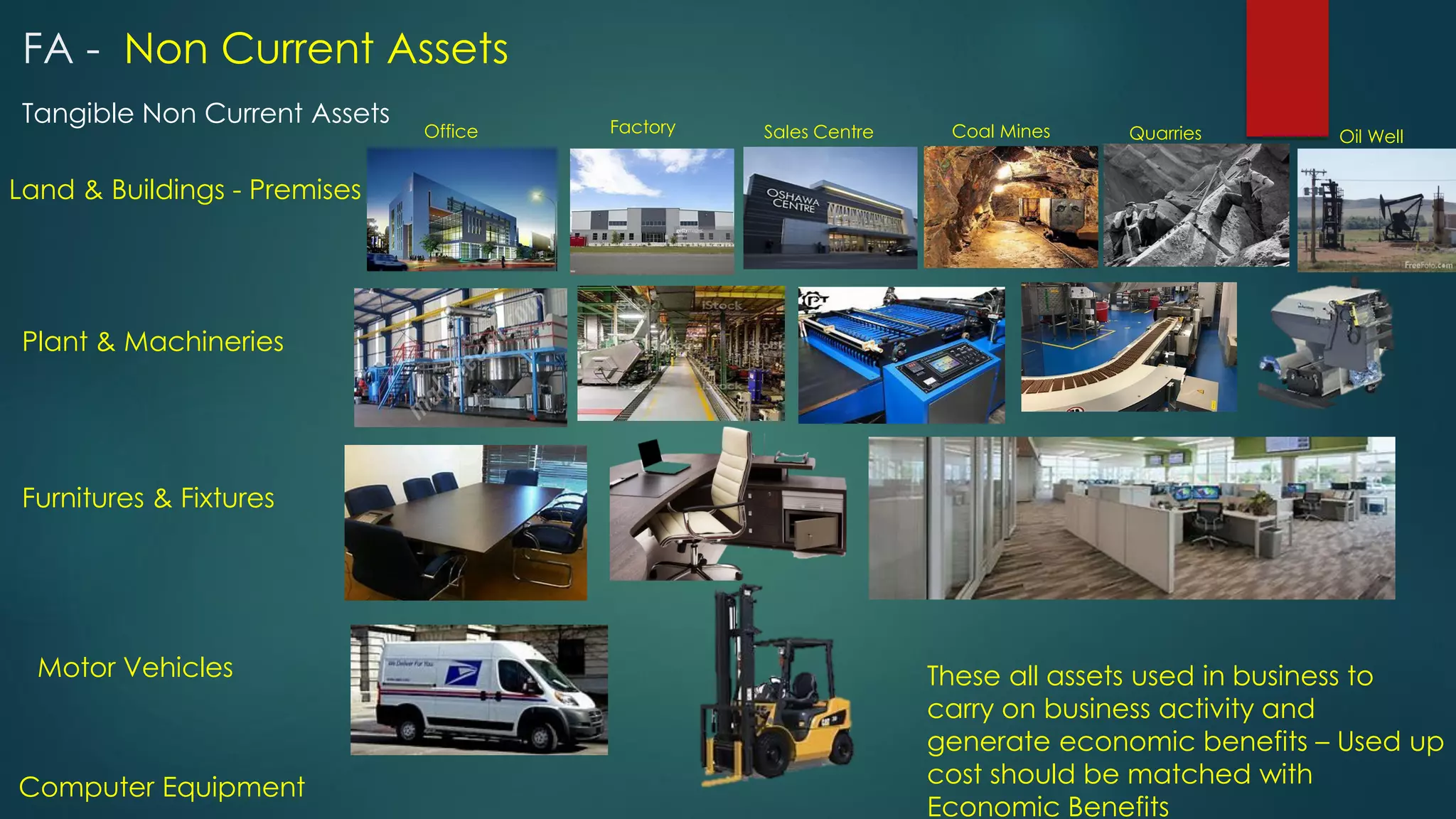
Intangible NCA
Tangible NCA
Plant & Machineries
Motor Vehicles
Computer Equipment
Tangible Non Current Assets
Furnitures & Fixtures
Office Factory Sales Centre Coal Mines Quarries Oil Well
These all assets used in business to
carry on business activity and
generate economic benefits – Used up
cost should be matched with
Economic Benefits
Land & Buildings - Premises
FA - Non Current Assets
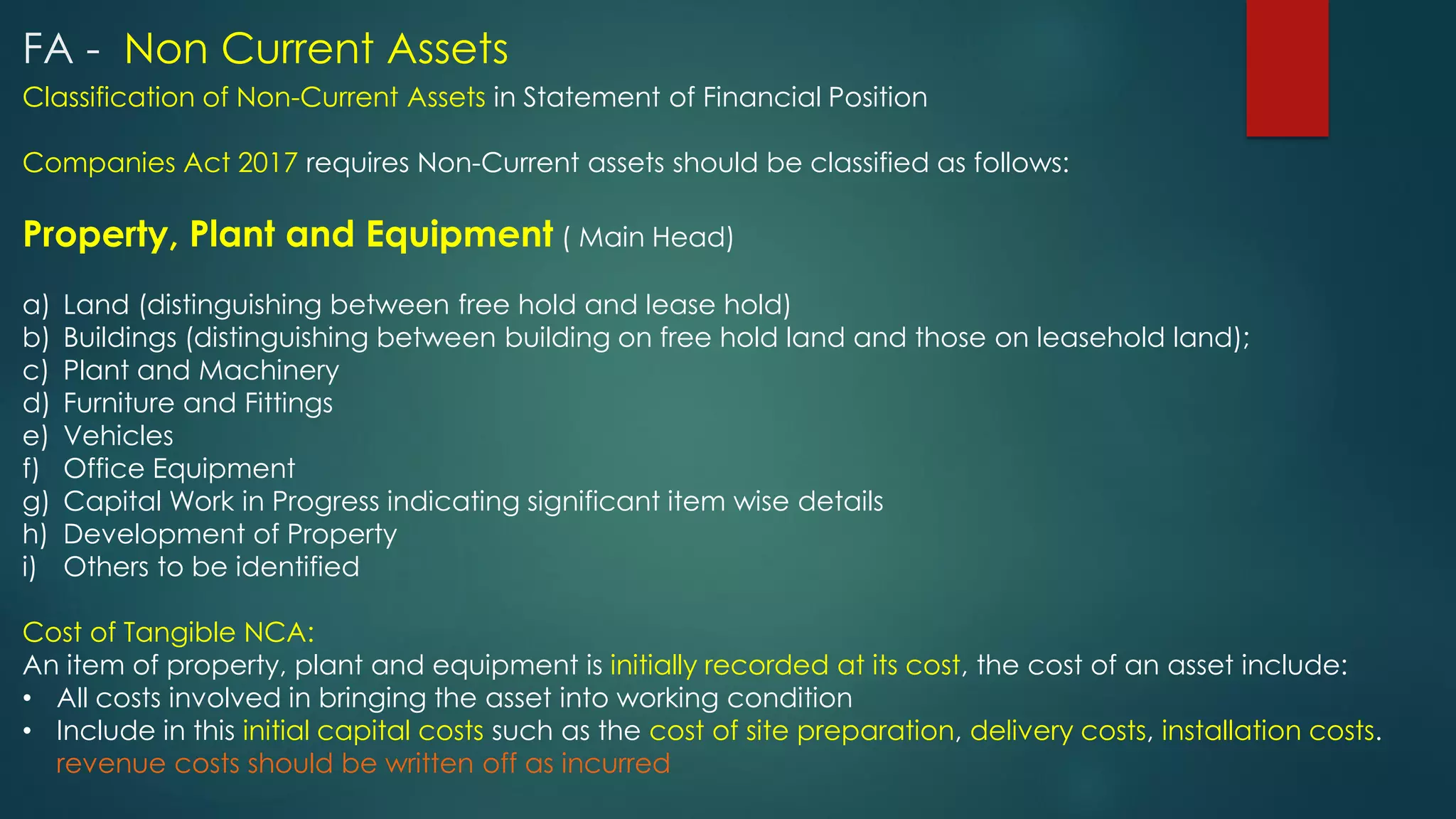
Classification of Non-Current Assets in Statement of Financial Position
Companies Act 2017 requires Non-Current assets should be classified as follows:
Property, Plant and Equipment ( Main Head)
a) Land (distinguishing between free hold and lease hold)
b) Buildings (distinguishing between building on free hold land and those on leasehold land);
c) Plant and Machinery
d) Furniture and Fittings
e) Vehicles
f) Office Equipment
g) Capital Work in Progress indicating significant item wise details
h) Development of Property
i) Others to be identified
Cost of Tangible NCA:
An item of property, plant and equipment is initially recorded at its cost, the cost of an asset include:
• All costs involved in bringing the asset into working condition
• Include in this initial capital costs such as the cost of site preparation, delivery costs, installation costs.
revenue costs should be written off as incurred
FA - Non Current Assets
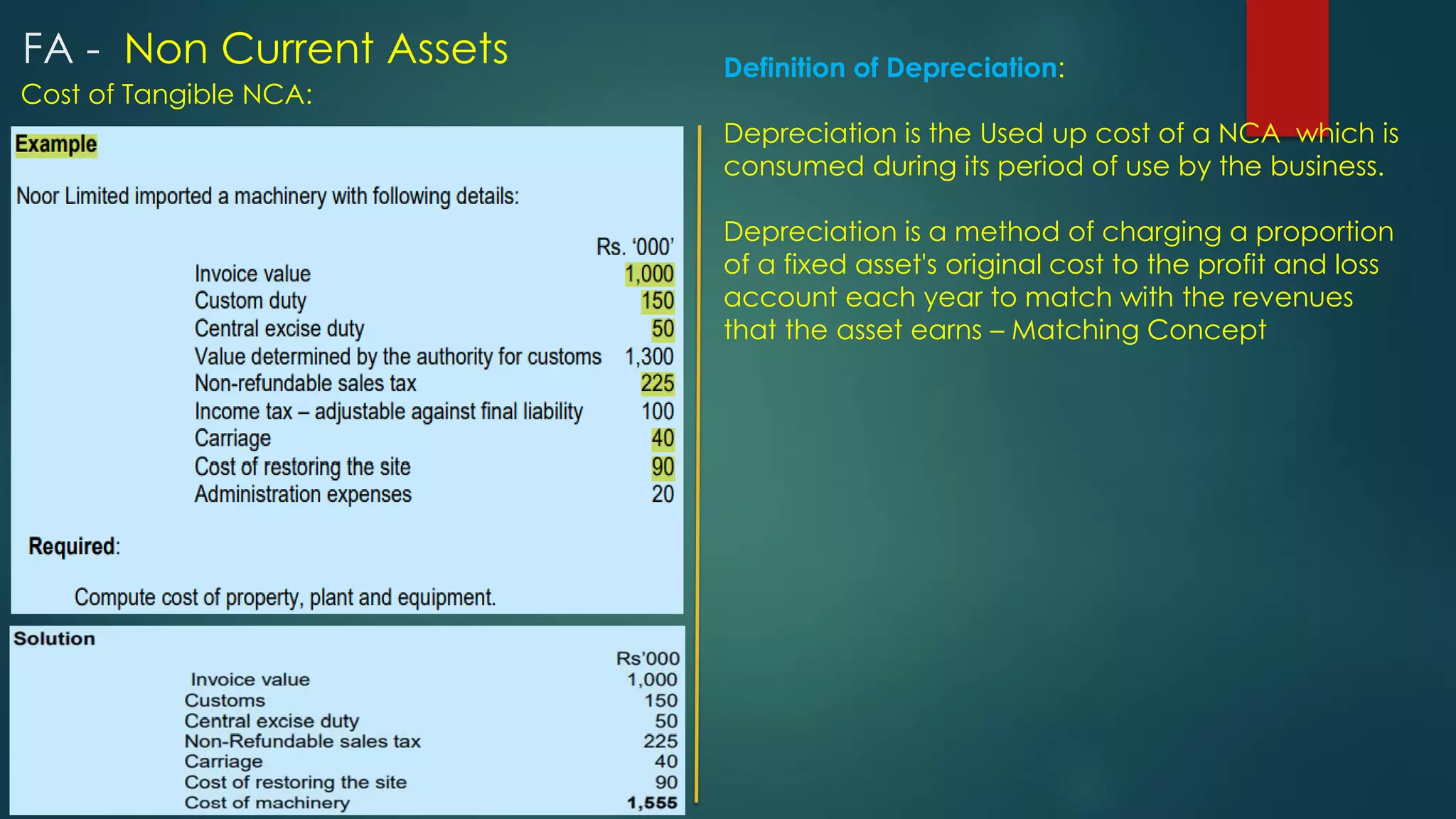
Cost of Tangible NCA:
Definition of Depreciation:
Depreciation is the Used up cost of a NCA which is
consumed during its period of use by the business.
Depreciation is a method of charging a proportion
of a fixed asset's original cost to the profit and loss
account each year to match with the revenues
that the asset earns – Matching Concept
FA - Non Current Assets
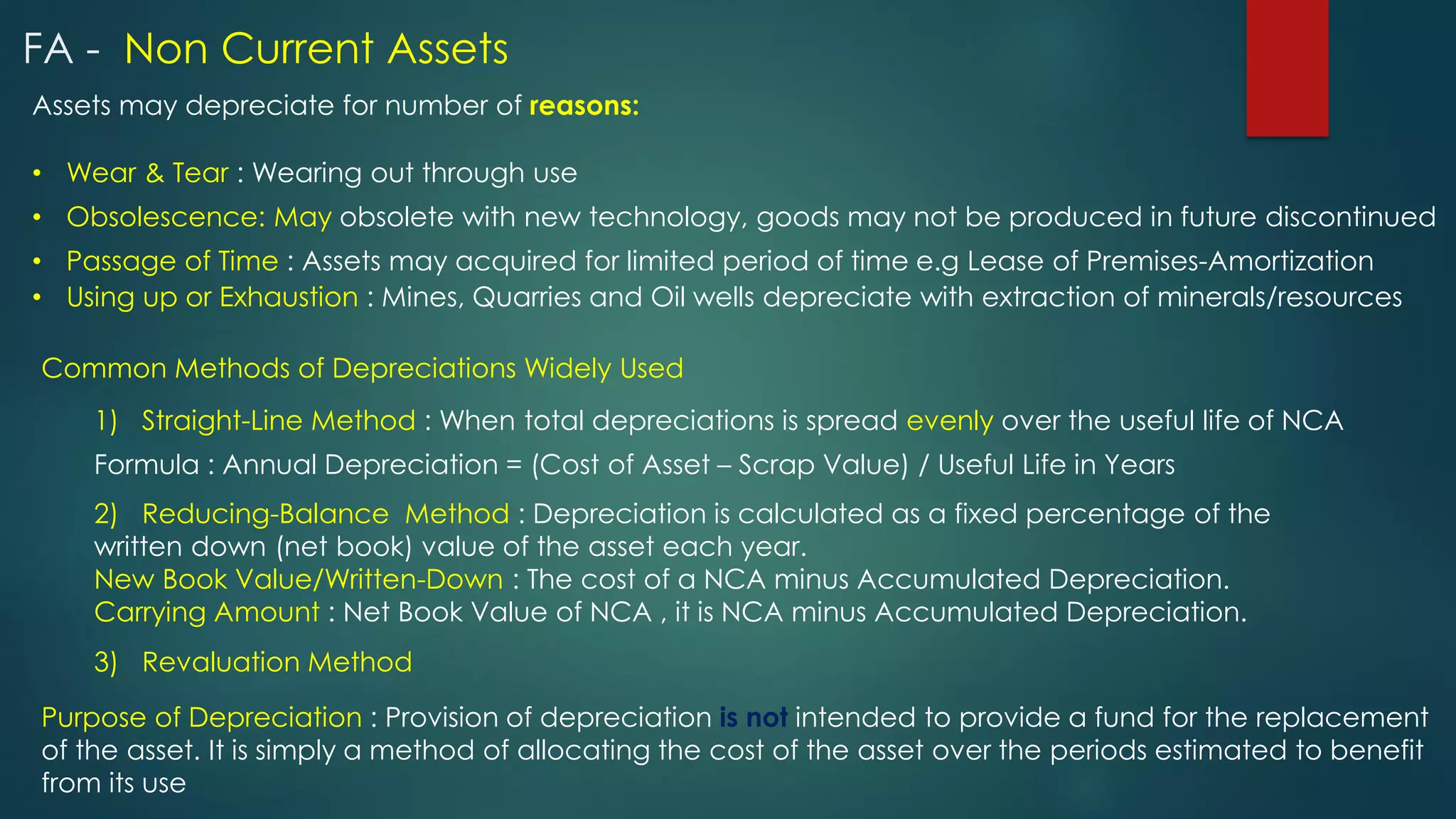
Assets may depreciate for number of reasons:
• Wear & Tear : Wearing out through use
Common Methods of Depreciations Widely Used
1) Straight-Line Method : When total depreciations is spread evenly over the useful life of NCA
• Obsolescence: May obsolete with new technology, goods may not be produced in future discontinued
• Passage of Time : Assets may acquired for limited period of time e.g Lease of Premises-Amortization
• Using up or Exhaustion : Mines, Quarries and Oil wells depreciate with extraction of minerals/resources
2) Reducing-Balance Method : Depreciation is calculated as a fixed percentage of the
written down (net book) value of the asset each year.
New Book Value/Written-Down : The cost of a NCA minus Accumulated Depreciation.
Carrying Amount : Net Book Value of NCA , it is NCA minus Accumulated Depreciation.
Formula : Annual Depreciation = (Cost of Asset – Scrap Value) / Useful Life in Years
Purpose of Depreciation : Provision of depreciation is not intended to provide a fund for the replacement
of the asset. It is simply a method of allocating the cost of the asset over the periods estimated to benefit
from its use
3) Revaluation Method
FA - Non Current Assets
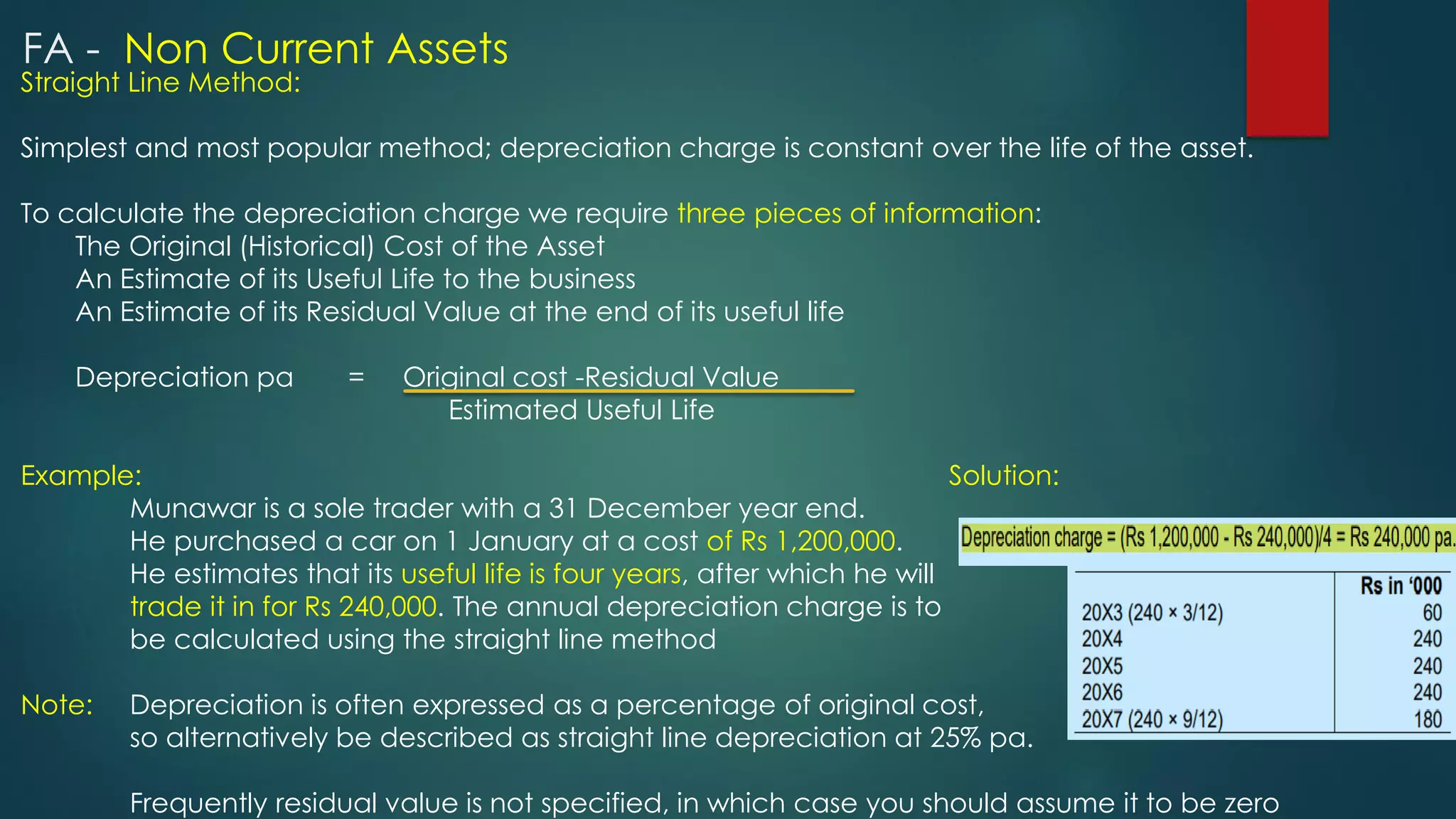
Straight Line Method:
Simplest and most popular method; depreciation charge is constant over the life of the asset.
To calculate the depreciation charge we require three pieces of information:
The Original (Historical) Cost of the Asset
An Estimate of its Useful Life to the business
An Estimate of its Residual Value at the end of its useful life
Depreciation pa = Original cost -Residual Value
Estimated Useful Life
Example: Solution:
Munawar is a sole trader with a 31 December year end.
He purchased a car on 1 January at a cost of Rs 1,200,000.
He estimates that its useful life is four years, after which he will
trade it in for Rs 240,000. The annual depreciation charge is to
be calculated using the straight line method
Note: Depreciation is often expressed as a percentage of original cost,
so alternatively be described as straight line depreciation at 25% pa.
Frequently residual value is not specified, in which case you should assume it to be zero
FA - Non Current Assets
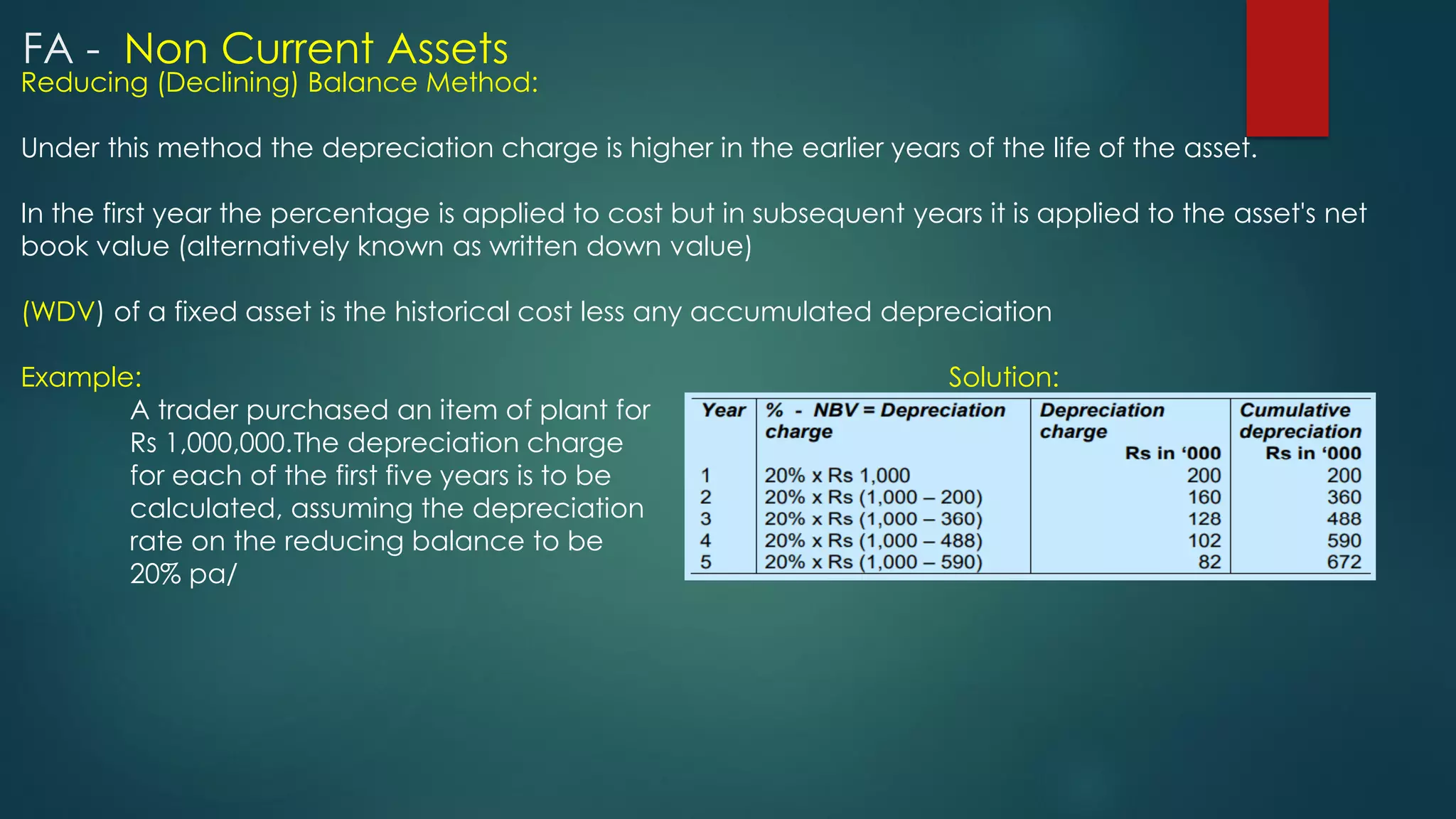
Reducing (Declining) Balance Method:
Under this method the depreciation charge is higher in the earlier years of the life of the asset.
In the first year the percentage is applied to cost but in subsequent years it is applied to the asset's net
book value (alternatively known as written down value)
(WDV) of a fixed asset is the historical cost less any accumulated depreciation
Example: Solution:
A trader purchased an item of plant for
Rs 1,000,000.The depreciation charge
for each of the first five years is to be
calculated, assuming the depreciation
rate on the reducing balance to be
20% pa/
FA - Non Current Assets
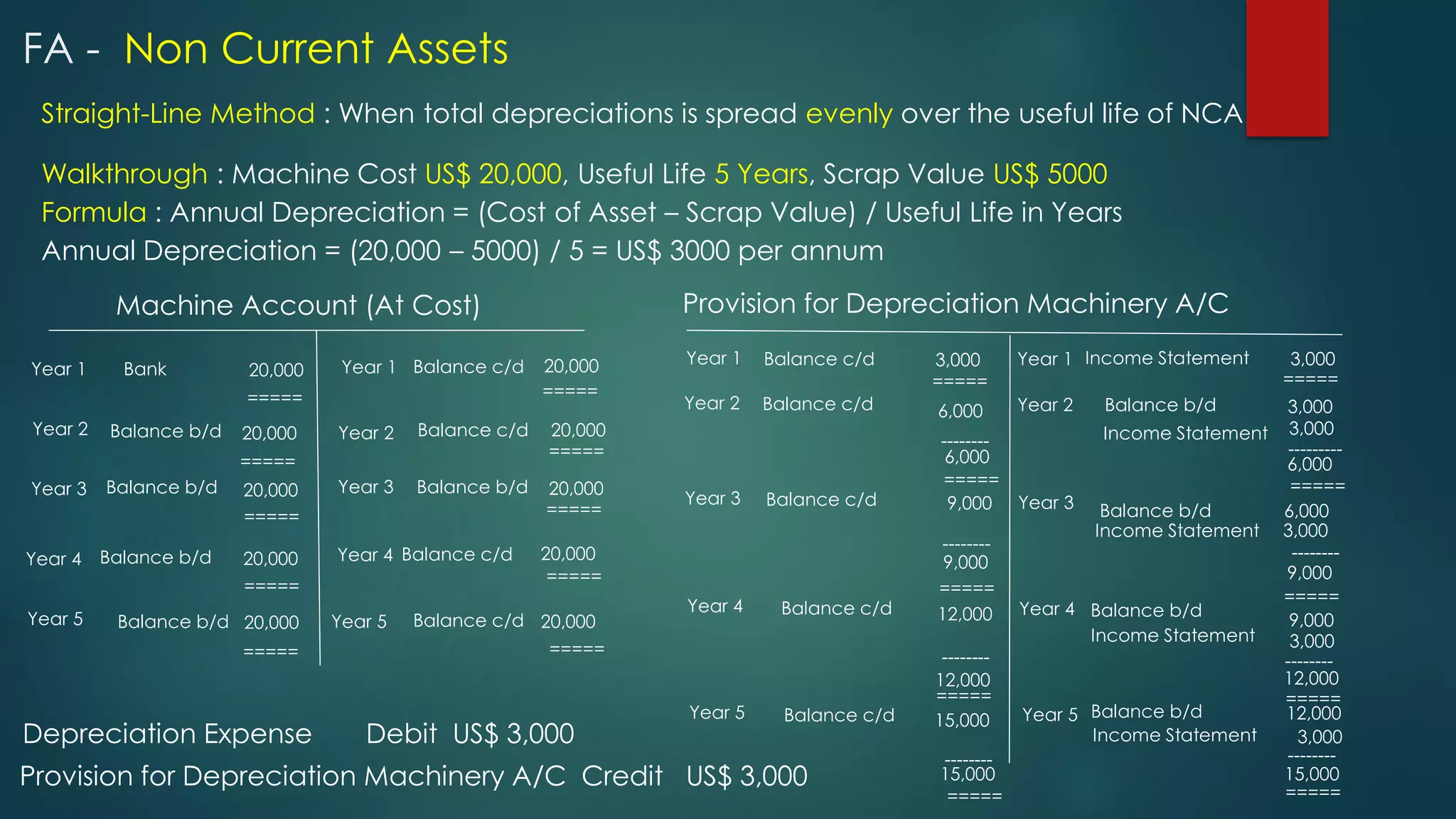
Straight-Line Method : When total depreciations is spread evenly over the useful life of NCA
Walkthrough : Machine Cost US$ 20,000, Useful Life 5 Years, Scrap Value US$ 5000
Formula : Annual Depreciation = (Cost of Asset – Scrap Value) / Useful Life in Years
Annual Depreciation = (20,000 – 5000) / 5 = US$ 3000 per annum
Machine Account (At Cost)
Year 1
Provision for Depreciation Machinery A/C
Bank 20,000
=====
Year 2
Balance c/d
Year 1 20,000
=====
Balance b/d
20,000
20,000 20,000
20,000
=====
=====
=====
Year 2 Balance c/d
Income Statement
Balance c/d
Balance c/d
Year 3 Year 3
Year 4
Year 4
Balance b/d
Balance b/d
Balance b/d
Balance b/d
=====
=====
=====
=====
20,000 20,000
20,000
Year 5 Year 5
=====
20,000
Balance b/d
Balance b/d
Balance b/d
Balance b/d
Balance c/d
Balance c/d
Balance c/d
Balance c/d
Year 1
Year 1 3,000
9,000
12,000
12,000
15,000
3,000
=====
=====
=====
=====
--------
=====
---------
Year 2
Year 2 3,000
Income Statement
Income Statement
Income Statement
Income Statement
3,000
3,000
6,000
3,000
3,000
6,000
6,000
Year 3
Year 3
6,000
--------
--------
-------- --------
-------- --------
=====
=====
=====
=====
=====
9,000
9,000
Year 4
Year 4
9,000
12,000
Balance c/d
15,000 15,000
Year 5
Year 5 12,000
Depreciation Expense Debit US$ 3,000
Provision for Depreciation Machinery A/C Credit US$ 3,000
FA - Non Current Assets
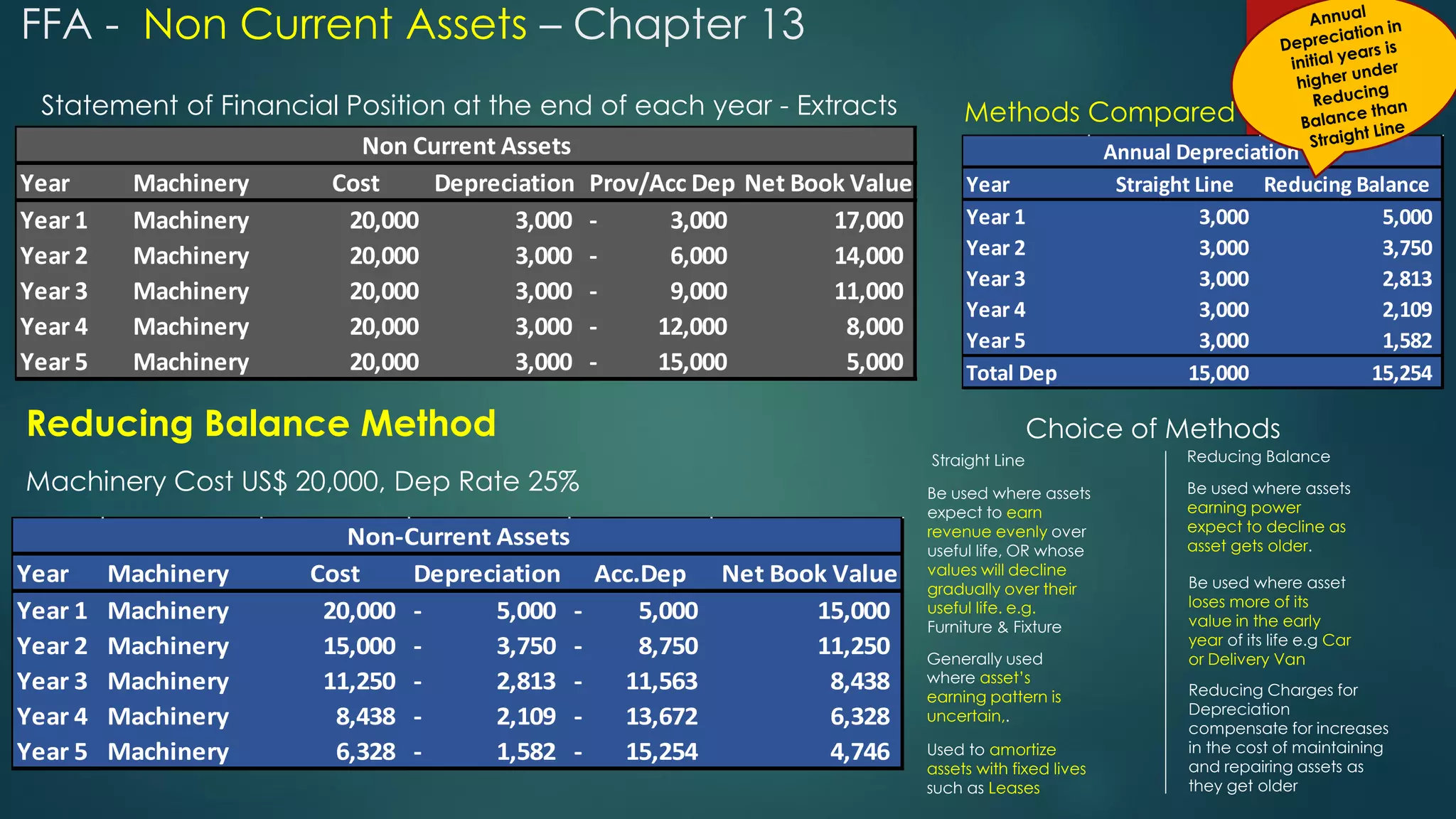
Statement of Financial Position at the end of each year - Extracts
Reducing Balance Method
Methods Compared
Choice of Methods
Year Straight Line Reducing Balance
Year 1 3,000 5,000
Year 2 3,000 3,750
Year 3 3,000 2,813
Year 4 3,000 2,109
Year 5 3,000 1,582
Total Dep 15,000 15,254
Annual Depreciation
Be used where assets
expect to earn
revenue evenly over
useful life, OR whose
values will decline
gradually over their
useful life. e.g.
Furniture & Fixture
Reducing Balance
Straight Line
Generally used
where asset’s
earning pattern is
uncertain,.
Used to amortize
assets with fixed lives
such as Leases
Be used where assets
earning power
expect to decline as
asset gets older.
Be used where asset
loses more of its
value in the early
year of its life e.g Car
or Delivery Van
Reducing Charges for
Depreciation
compensate for increases
in the cost of maintaining
and repairing assets as
they get older
Year Machinery Cost Depreciation Acc.Dep Net Book Value
Year 1 Machinery 20,000 5,000
- 5,000
- 15,000
Year 2 Machinery 15,000 3,750
- 8,750
- 11,250
Year 3 Machinery 11,250 2,813
- 11,563
- 8,438
Year 4 Machinery 8,438 2,109
- 13,672
- 6,328
Year 5 Machinery 6,328 1,582
- 15,254
- 4,746
Non-Current Assets
Machinery Cost US$ 20,000, Dep Rate 25%
Year Machinery Cost Depreciation Prov/Acc Dep Net Book Value
Year 1 Machinery 20,000 3,000 3,000
- 17,000
Year 2 Machinery 20,000 3,000 6,000
- 14,000
Year 3 Machinery 20,000 3,000 9,000
- 11,000
Year 4 Machinery 20,000 3,000 12,000
- 8,000
Year 5 Machinery 20,000 3,000 15,000
- 5,000
Non Current Assets
FFA - Non Current Assets – Chapter 13
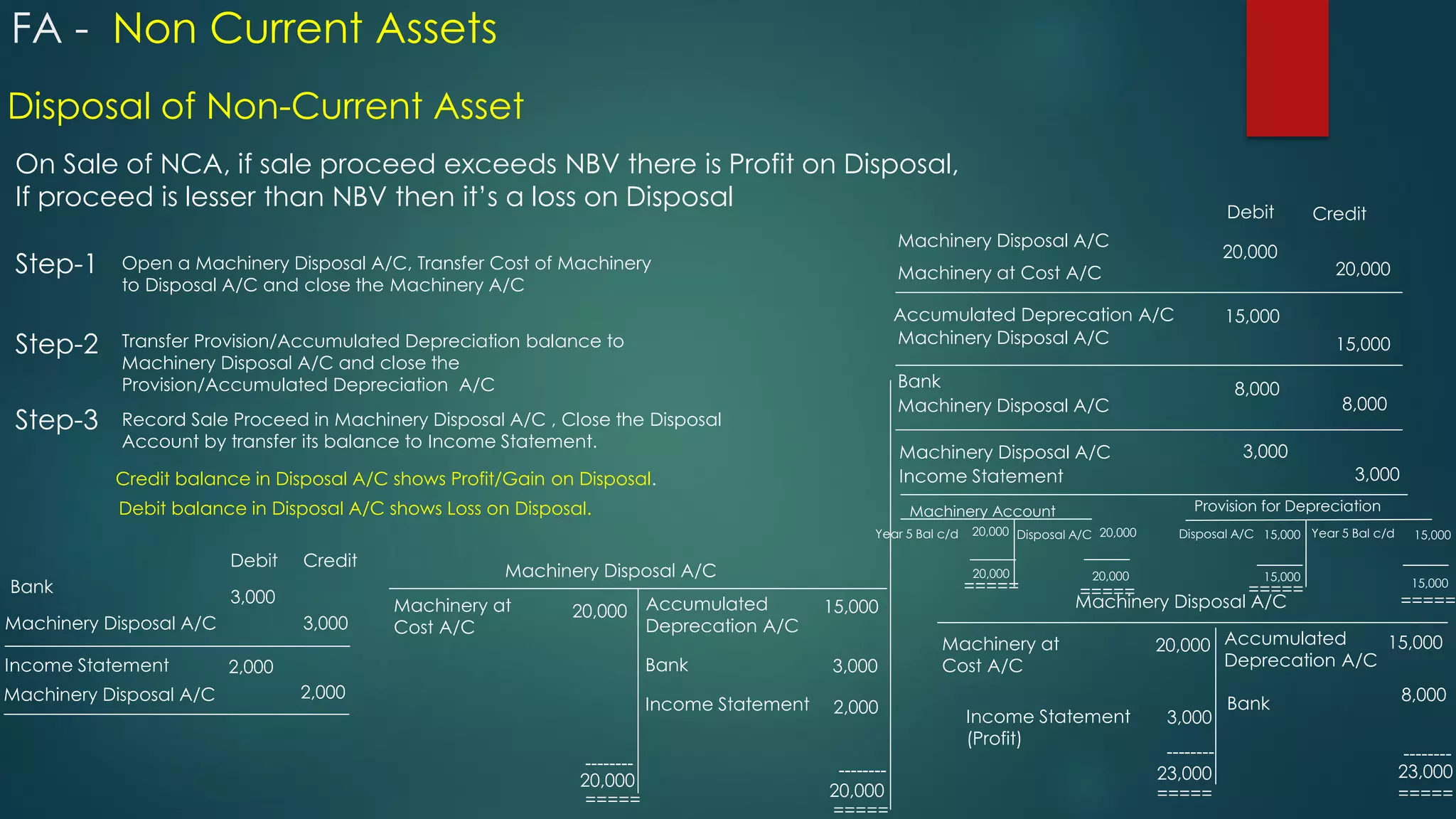
Disposal of Non-Current Asset
Step-1 Machinery at Cost A/C
Open a Machinery Disposal A/C, Transfer Cost of Machinery
to Disposal A/C and close the Machinery A/C
Debit Credit
20,000
On Sale of NCA, if sale proceed exceeds NBV there is Profit on Disposal,
If proceed is lesser than NBV then it’s a loss on Disposal
Machinery Disposal A/C
20,000
Step-2
Step-3
Transfer Provision/Accumulated Depreciation balance to
Machinery Disposal A/C and close the
Provision/Accumulated Depreciation A/C
Record Sale Proceed in Machinery Disposal A/C , Close the Disposal
Account by transfer its balance to Income Statement.
Credit balance in Disposal A/C shows Profit/Gain on Disposal.
Debit balance in Disposal A/C shows Loss on Disposal.
Machinery Disposal A/C
Accumulated Deprecation A/C
15,000
15,000
Machinery Disposal A/C
Bank
3,000
3,000
8,000
8,000
Machinery Disposal A/C
20,000
Machinery at
Cost A/C
Accumulated
Deprecation A/C
15,000
Bank 8,000
Income Statement
-------- --------
3,000
Income Statement
(Profit)
Machinery Disposal A/C
23,000
23,000
=====
=====
Debit Credit
Bank
Machinery Disposal A/C 3,000
3,000
Income Statement
Machinery Disposal A/C 2,000
2,000
Machinery Disposal A/C
Machinery at
Cost A/C
20,000 Accumulated
Deprecation A/C
15,000
Bank
Income Statement
3,000
2,000
--------
--------
=====
===== 20,000
20,000
Provision for Depreciation
Machinery Account
=====
=====
=====
=====
20,000 20,000
20,000
20,000
Year 5 Bal c/d Disposal A/C Year 5 Bal c/d 15,000
15,000
15,000
15,000
Disposal A/C
FA - Non Current Assets
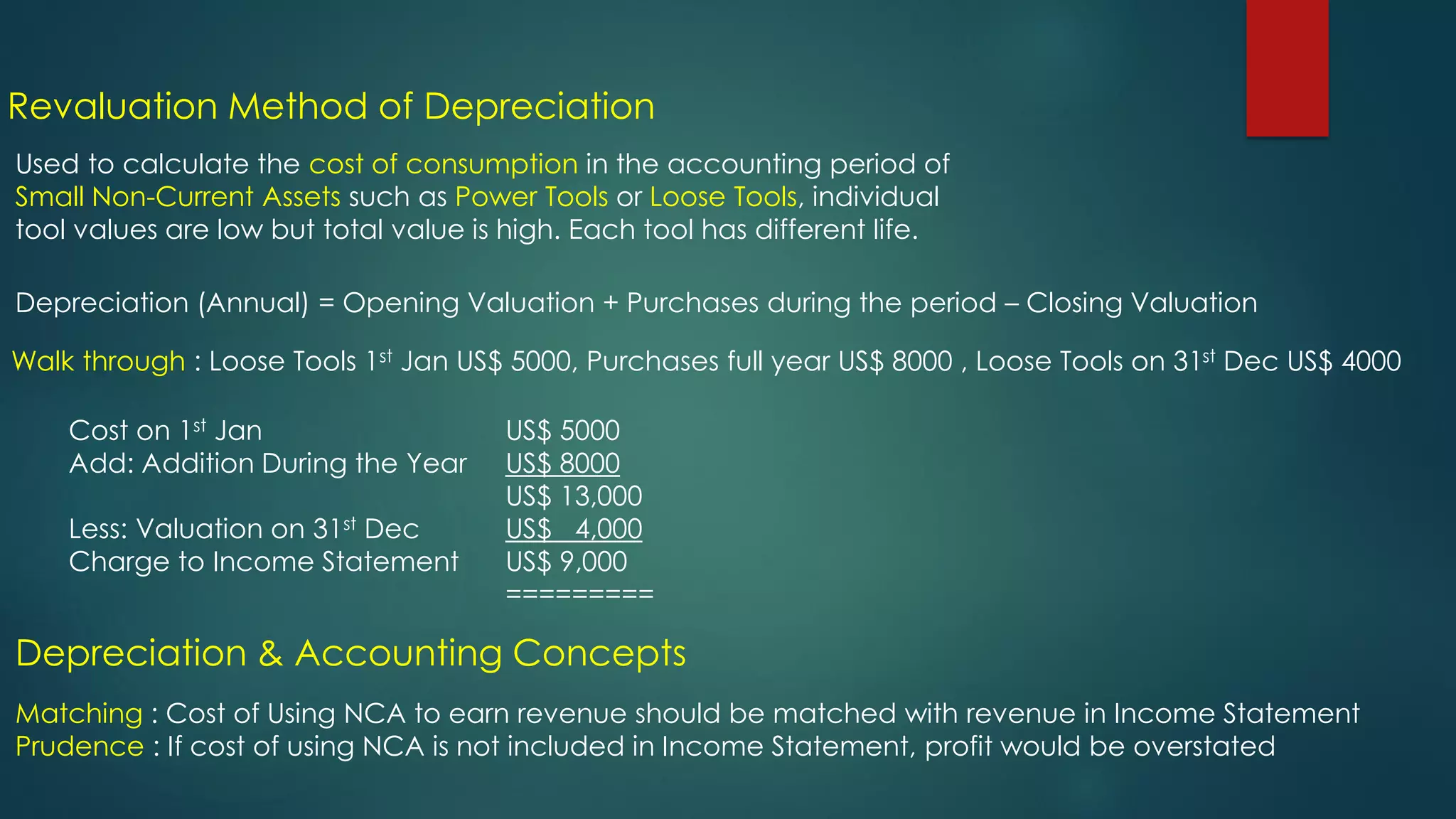
Revaluation Method of Depreciation
Used to calculate the cost of consumption in the accounting period of
Small Non-Current Assets such as Power Tools or Loose Tools, individual
tool values are low but total value is high. Each tool has different life.
Depreciation (Annual) = Opening Valuation + Purchases during the period – Closing Valuation
Walk through : Loose Tools 1st Jan US$ 5000, Purchases full year US$ 8000 , Loose Tools on 31st Dec US$ 4000
Cost on 1st Jan US$ 5000
Add: Addition During the Year US$ 8000
US$ 13,000
Less: Valuation on 31st Dec US$ 4,000
Charge to Income Statement US$ 9,000
=========
Depreciation & Accounting Concepts
Matching : Cost of Using NCA to earn revenue should be matched with revenue in Income Statement
Prudence : If cost of using NCA is not included in Income Statement, profit would be overstated
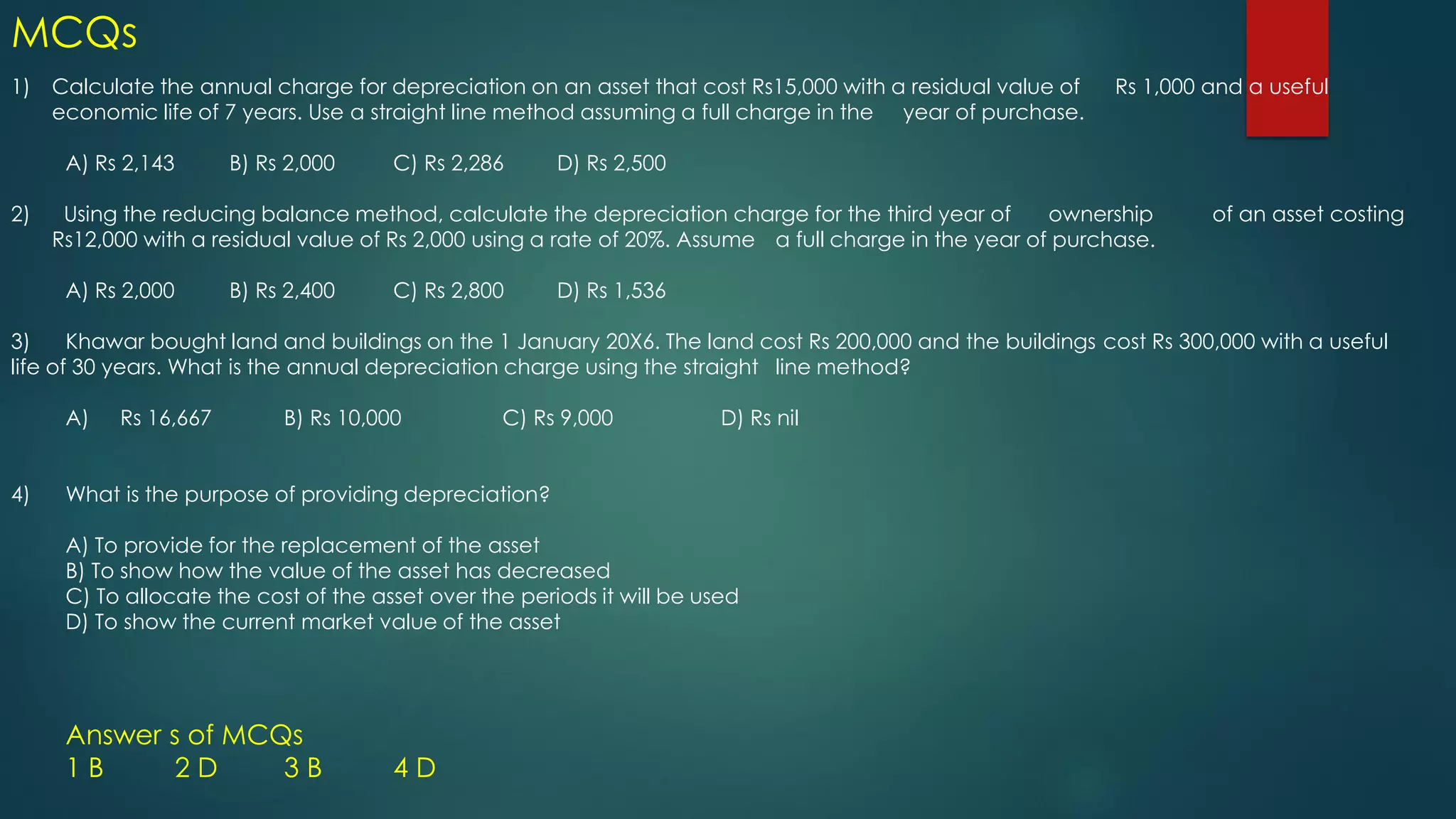
1) Calculate the annual charge for depreciation on an asset that cost Rs15,000 with a residual value of Rs 1,000 and a useful
economic life of 7 years. Use a straight line method assuming a full charge in the year of purchase.
A) Rs 2,143 B) Rs 2,000 C) Rs 2,286 D) Rs 2,500
2) Using the reducing balance method, calculate the depreciation charge for the third year of ownership of an asset costing
Rs12,000 with a residual value of Rs 2,000 using a rate of 20%. Assume a full charge in the year of purchase.
A) Rs 2,000 B) Rs 2,400 C) Rs 2,800 D) Rs 1,536
3) Khawar bought land and buildings on the 1 January 20X6. The land cost Rs 200,000 and the buildings cost Rs 300,000 with a useful
life of 30 years. What is the annual depreciation charge using the straight line method?
A) Rs 16,667 B) Rs 10,000 C) Rs 9,000 D) Rs nil
4) What is the purpose of providing depreciation?
A) To provide for the replacement of the asset
B) To show how the value of the asset has decreased
C) To allocate the cost of the asset over the periods it will be used
D) To show the current market value of the asset
Answer s of MCQs
1 B 2 D 3 B 4 D
MCQs
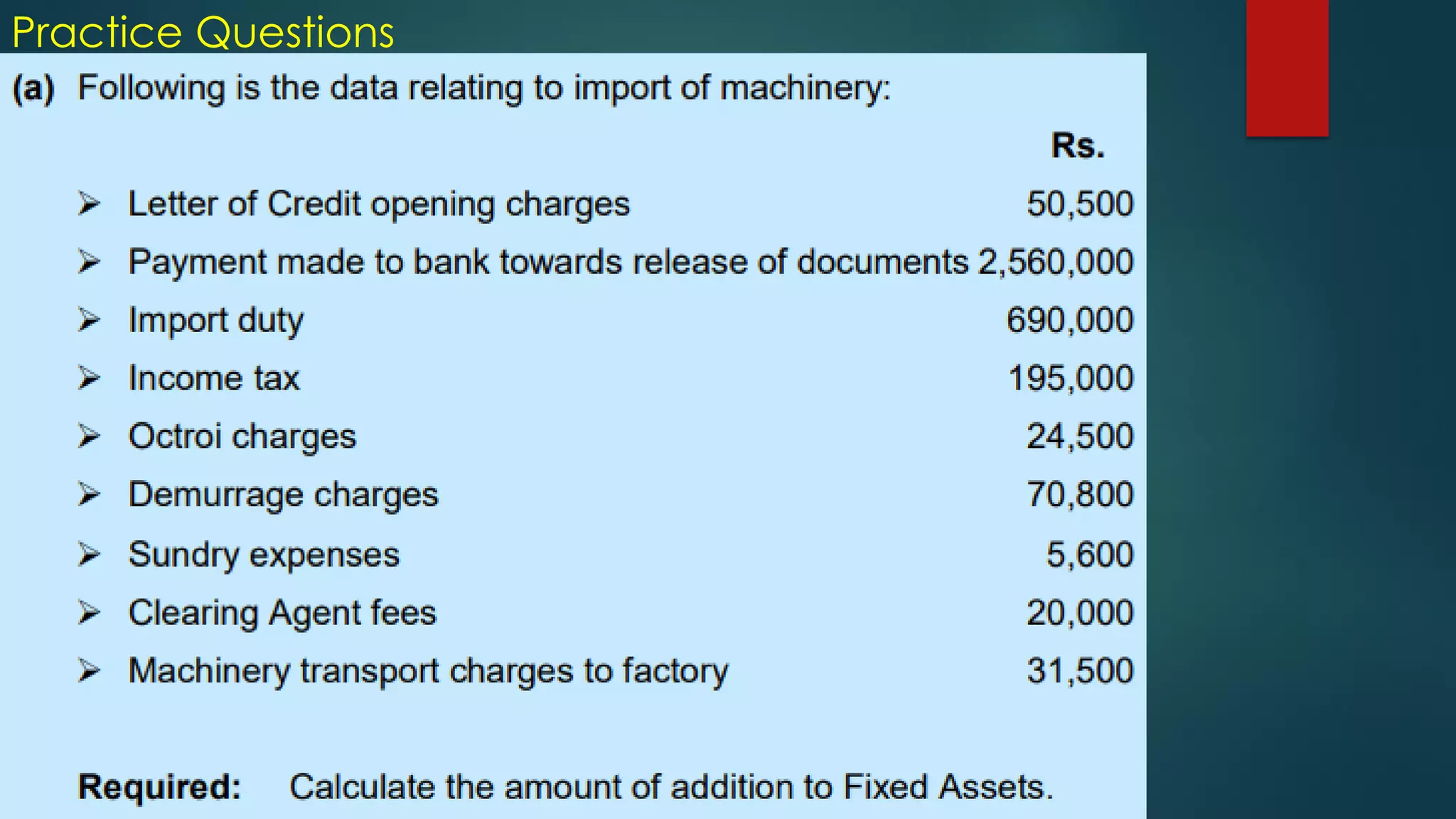
Practice Questions
Practice Questions
Practice Questions
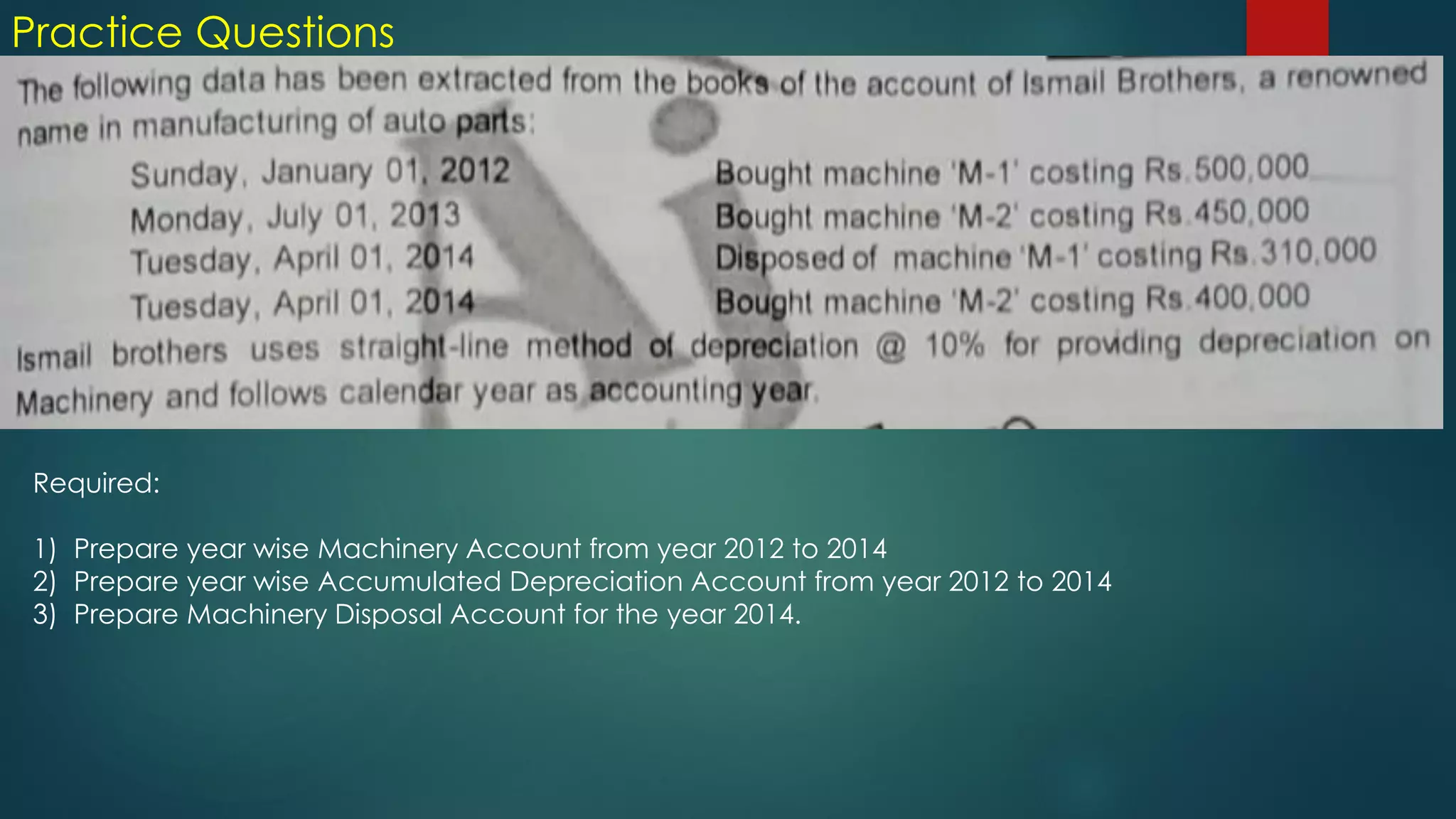
Required:
1) Prepare year wise Machinery Account from year 2012 to 2014
2) Prepare year wise Accumulated Depreciation Account from year 2012 to 2014
3) Prepare Machinery Disposal Account for the year 2014.
Practice Questions
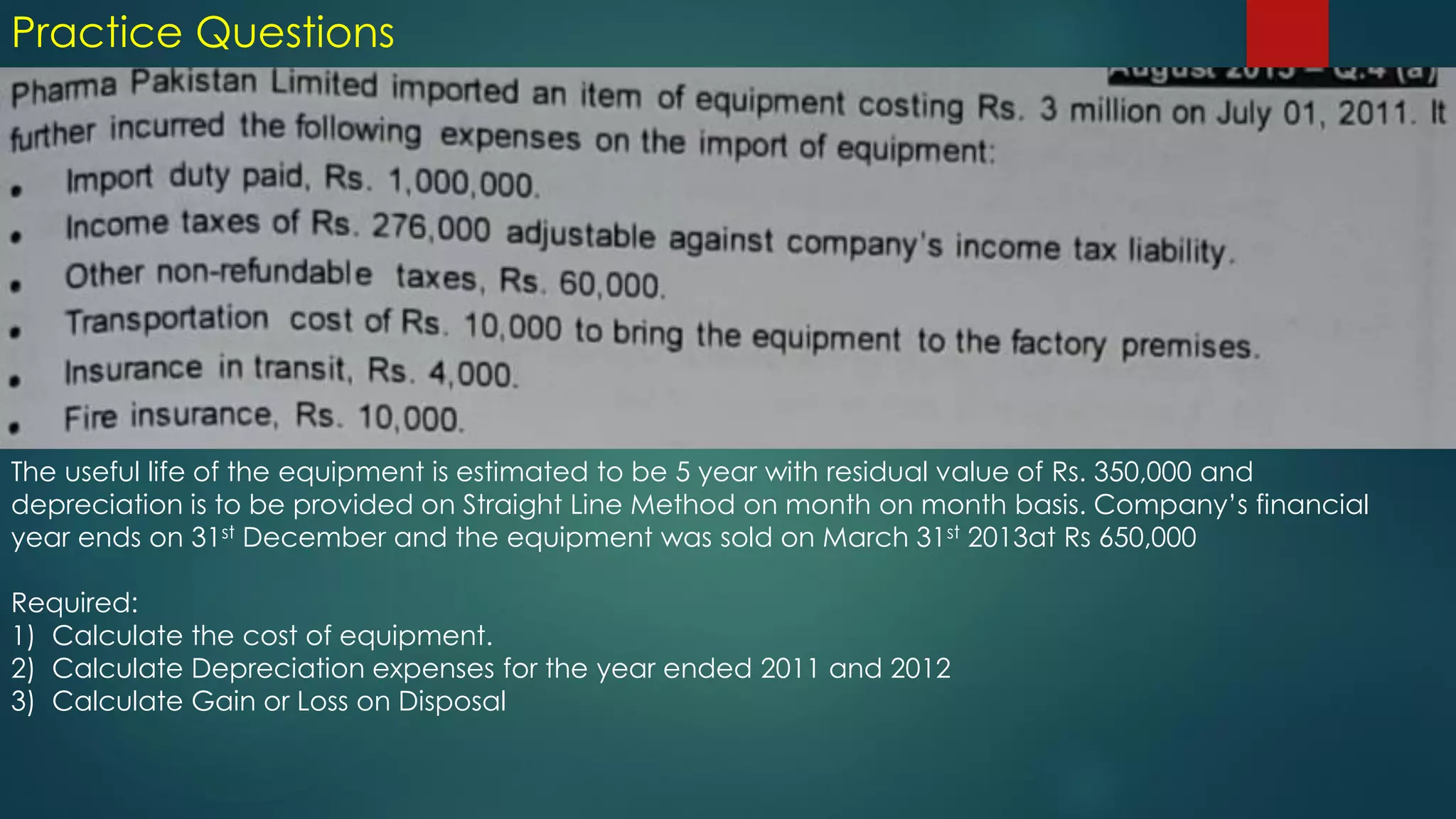
The useful life of the equipment is estimated to be 5 year with residual value of Rs. 350,000 and
depreciation is to be provided on Straight Line Method on month on month basis. Company’s financial
year ends on 31st December and the equipment was sold on March 31st 2013at Rs 650,000
Required:
1) Calculate the cost of equipment.
2) Calculate Depreciation expenses for the year ended 2011 and 2012
3) Calculate Gain or Loss on Disposal
Lecture - Non Current Assets (Depreciation).pdf

  • 1.
    FA - NonCurrent Assets • Non-Current Assets • Ledger entries to record the Acquisition and Disposal of Non-Current Assets • Purpose of Depreciation Learning Objectives : Scope 1) Non-Current Assets A Non-Current Asset is any asset, tangible or intangible, acquired for retention by an entity for the purpose of providing a service to the business and not held for resale in the normal course of trading. • Mostly High Value Items • Having Long Life; More than a year • Used to generate income directly or indirectly for a business • Not normally Liquid Assets (i.e. not easily and quickly converted into cash without a significant loss in value) Non-Current Assets Intangible NCA Tangible NCA
  • 2.
    Plant & Machineries MotorVehicles Computer Equipment Tangible Non Current Assets Furnitures & Fixtures Office Factory Sales Centre Coal Mines Quarries Oil Well These all assets used in business to carry on business activity and generate economic benefits – Used up cost should be matched with Economic Benefits Land & Buildings - Premises FA - Non Current Assets
  • 3.
    Classification of Non-CurrentAssets in Statement of Financial Position Companies Act 2017 requires Non-Current assets should be classified as follows: Property, Plant and Equipment ( Main Head) a) Land (distinguishing between free hold and lease hold) b) Buildings (distinguishing between building on free hold land and those on leasehold land); c) Plant and Machinery d) Furniture and Fittings e) Vehicles f) Office Equipment g) Capital Work in Progress indicating significant item wise details h) Development of Property i) Others to be identified Cost of Tangible NCA: An item of property, plant and equipment is initially recorded at its cost, the cost of an asset include: • All costs involved in bringing the asset into working condition • Include in this initial capital costs such as the cost of site preparation, delivery costs, installation costs. revenue costs should be written off as incurred FA - Non Current Assets
  • 4.
    Cost of TangibleNCA: Definition of Depreciation: Depreciation is the Used up cost of a NCA which is consumed during its period of use by the business. Depreciation is a method of charging a proportion of a fixed asset's original cost to the profit and loss account each year to match with the revenues that the asset earns – Matching Concept FA - Non Current Assets
  • 5.
    Assets may depreciatefor number of reasons: • Wear & Tear : Wearing out through use Common Methods of Depreciations Widely Used 1) Straight-Line Method : When total depreciations is spread evenly over the useful life of NCA • Obsolescence: May obsolete with new technology, goods may not be produced in future discontinued • Passage of Time : Assets may acquired for limited period of time e.g Lease of Premises-Amortization • Using up or Exhaustion : Mines, Quarries and Oil wells depreciate with extraction of minerals/resources 2) Reducing-Balance Method : Depreciation is calculated as a fixed percentage of the written down (net book) value of the asset each year. New Book Value/Written-Down : The cost of a NCA minus Accumulated Depreciation. Carrying Amount : Net Book Value of NCA , it is NCA minus Accumulated Depreciation. Formula : Annual Depreciation = (Cost of Asset – Scrap Value) / Useful Life in Years Purpose of Depreciation : Provision of depreciation is not intended to provide a fund for the replacement of the asset. It is simply a method of allocating the cost of the asset over the periods estimated to benefit from its use 3) Revaluation Method FA - Non Current Assets
  • 6.
    Straight Line Method: Simplestand most popular method; depreciation charge is constant over the life of the asset. To calculate the depreciation charge we require three pieces of information: The Original (Historical) Cost of the Asset An Estimate of its Useful Life to the business An Estimate of its Residual Value at the end of its useful life Depreciation pa = Original cost -Residual Value Estimated Useful Life Example: Solution: Munawar is a sole trader with a 31 December year end. He purchased a car on 1 January at a cost of Rs 1,200,000. He estimates that its useful life is four years, after which he will trade it in for Rs 240,000. The annual depreciation charge is to be calculated using the straight line method Note: Depreciation is often expressed as a percentage of original cost, so alternatively be described as straight line depreciation at 25% pa. Frequently residual value is not specified, in which case you should assume it to be zero FA - Non Current Assets
  • 7.
    Reducing (Declining) BalanceMethod: Under this method the depreciation charge is higher in the earlier years of the life of the asset. In the first year the percentage is applied to cost but in subsequent years it is applied to the asset's net book value (alternatively known as written down value) (WDV) of a fixed asset is the historical cost less any accumulated depreciation Example: Solution: A trader purchased an item of plant for Rs 1,000,000.The depreciation charge for each of the first five years is to be calculated, assuming the depreciation rate on the reducing balance to be 20% pa/ FA - Non Current Assets
  • 8.
    Straight-Line Method :When total depreciations is spread evenly over the useful life of NCA Walkthrough : Machine Cost US$ 20,000, Useful Life 5 Years, Scrap Value US$ 5000 Formula : Annual Depreciation = (Cost of Asset – Scrap Value) / Useful Life in Years Annual Depreciation = (20,000 – 5000) / 5 = US$ 3000 per annum Machine Account (At Cost) Year 1 Provision for Depreciation Machinery A/C Bank 20,000 ===== Year 2 Balance c/d Year 1 20,000 ===== Balance b/d 20,000 20,000 20,000 20,000 ===== ===== ===== Year 2 Balance c/d Income Statement Balance c/d Balance c/d Year 3 Year 3 Year 4 Year 4 Balance b/d Balance b/d Balance b/d Balance b/d ===== ===== ===== ===== 20,000 20,000 20,000 Year 5 Year 5 ===== 20,000 Balance b/d Balance b/d Balance b/d Balance b/d Balance c/d Balance c/d Balance c/d Balance c/d Year 1 Year 1 3,000 9,000 12,000 12,000 15,000 3,000 ===== ===== ===== ===== -------- ===== --------- Year 2 Year 2 3,000 Income Statement Income Statement Income Statement Income Statement 3,000 3,000 6,000 3,000 3,000 6,000 6,000 Year 3 Year 3 6,000 -------- -------- -------- -------- -------- -------- ===== ===== ===== ===== ===== 9,000 9,000 Year 4 Year 4 9,000 12,000 Balance c/d 15,000 15,000 Year 5 Year 5 12,000 Depreciation Expense Debit US$ 3,000 Provision for Depreciation Machinery A/C Credit US$ 3,000 FA - Non Current Assets
  • 9.
    Statement of FinancialPosition at the end of each year - Extracts Reducing Balance Method Methods Compared Choice of Methods Year Straight Line Reducing Balance Year 1 3,000 5,000 Year 2 3,000 3,750 Year 3 3,000 2,813 Year 4 3,000 2,109 Year 5 3,000 1,582 Total Dep 15,000 15,254 Annual Depreciation Be used where assets expect to earn revenue evenly over useful life, OR whose values will decline gradually over their useful life. e.g. Furniture & Fixture Reducing Balance Straight Line Generally used where asset’s earning pattern is uncertain,. Used to amortize assets with fixed lives such as Leases Be used where assets earning power expect to decline as asset gets older. Be used where asset loses more of its value in the early year of its life e.g Car or Delivery Van Reducing Charges for Depreciation compensate for increases in the cost of maintaining and repairing assets as they get older Year Machinery Cost Depreciation Acc.Dep Net Book Value Year 1 Machinery 20,000 5,000 - 5,000 - 15,000 Year 2 Machinery 15,000 3,750 - 8,750 - 11,250 Year 3 Machinery 11,250 2,813 - 11,563 - 8,438 Year 4 Machinery 8,438 2,109 - 13,672 - 6,328 Year 5 Machinery 6,328 1,582 - 15,254 - 4,746 Non-Current Assets Machinery Cost US$ 20,000, Dep Rate 25% Year Machinery Cost Depreciation Prov/Acc Dep Net Book Value Year 1 Machinery 20,000 3,000 3,000 - 17,000 Year 2 Machinery 20,000 3,000 6,000 - 14,000 Year 3 Machinery 20,000 3,000 9,000 - 11,000 Year 4 Machinery 20,000 3,000 12,000 - 8,000 Year 5 Machinery 20,000 3,000 15,000 - 5,000 Non Current Assets FFA - Non Current Assets – Chapter 13
  • 10.
    Disposal of Non-CurrentAsset Step-1 Machinery at Cost A/C Open a Machinery Disposal A/C, Transfer Cost of Machinery to Disposal A/C and close the Machinery A/C Debit Credit 20,000 On Sale of NCA, if sale proceed exceeds NBV there is Profit on Disposal, If proceed is lesser than NBV then it’s a loss on Disposal Machinery Disposal A/C 20,000 Step-2 Step-3 Transfer Provision/Accumulated Depreciation balance to Machinery Disposal A/C and close the Provision/Accumulated Depreciation A/C Record Sale Proceed in Machinery Disposal A/C , Close the Disposal Account by transfer its balance to Income Statement. Credit balance in Disposal A/C shows Profit/Gain on Disposal. Debit balance in Disposal A/C shows Loss on Disposal. Machinery Disposal A/C Accumulated Deprecation A/C 15,000 15,000 Machinery Disposal A/C Bank 3,000 3,000 8,000 8,000 Machinery Disposal A/C 20,000 Machinery at Cost A/C Accumulated Deprecation A/C 15,000 Bank 8,000 Income Statement -------- -------- 3,000 Income Statement (Profit) Machinery Disposal A/C 23,000 23,000 ===== ===== Debit Credit Bank Machinery Disposal A/C 3,000 3,000 Income Statement Machinery Disposal A/C 2,000 2,000 Machinery Disposal A/C Machinery at Cost A/C 20,000 Accumulated Deprecation A/C 15,000 Bank Income Statement 3,000 2,000 -------- -------- ===== ===== 20,000 20,000 Provision for Depreciation Machinery Account ===== ===== ===== ===== 20,000 20,000 20,000 20,000 Year 5 Bal c/d Disposal A/C Year 5 Bal c/d 15,000 15,000 15,000 15,000 Disposal A/C FA - Non Current Assets
  • 11.
    Revaluation Method ofDepreciation Used to calculate the cost of consumption in the accounting period of Small Non-Current Assets such as Power Tools or Loose Tools, individual tool values are low but total value is high. Each tool has different life. Depreciation (Annual) = Opening Valuation + Purchases during the period – Closing Valuation Walk through : Loose Tools 1st Jan US$ 5000, Purchases full year US$ 8000 , Loose Tools on 31st Dec US$ 4000 Cost on 1st Jan US$ 5000 Add: Addition During the Year US$ 8000 US$ 13,000 Less: Valuation on 31st Dec US$ 4,000 Charge to Income Statement US$ 9,000 ========= Depreciation & Accounting Concepts Matching : Cost of Using NCA to earn revenue should be matched with revenue in Income Statement Prudence : If cost of using NCA is not included in Income Statement, profit would be overstated
  • 12.
    1) Calculate theannual charge for depreciation on an asset that cost Rs15,000 with a residual value of Rs 1,000 and a useful economic life of 7 years. Use a straight line method assuming a full charge in the year of purchase. A) Rs 2,143 B) Rs 2,000 C) Rs 2,286 D) Rs 2,500 2) Using the reducing balance method, calculate the depreciation charge for the third year of ownership of an asset costing Rs12,000 with a residual value of Rs 2,000 using a rate of 20%. Assume a full charge in the year of purchase. A) Rs 2,000 B) Rs 2,400 C) Rs 2,800 D) Rs 1,536 3) Khawar bought land and buildings on the 1 January 20X6. The land cost Rs 200,000 and the buildings cost Rs 300,000 with a useful life of 30 years. What is the annual depreciation charge using the straight line method? A) Rs 16,667 B) Rs 10,000 C) Rs 9,000 D) Rs nil 4) What is the purpose of providing depreciation? A) To provide for the replacement of the asset B) To show how the value of the asset has decreased C) To allocate the cost of the asset over the periods it will be used D) To show the current market value of the asset Answer s of MCQs 1 B 2 D 3 B 4 D MCQs
  • 14.
  • 15.
  • 16.
    Practice Questions Required: 1) Prepareyear wise Machinery Account from year 2012 to 2014 2) Prepare year wise Accumulated Depreciation Account from year 2012 to 2014 3) Prepare Machinery Disposal Account for the year 2014.
  • 17.
    Practice Questions The usefullife of the equipment is estimated to be 5 year with residual value of Rs. 350,000 and depreciation is to be provided on Straight Line Method on month on month basis. Company’s financial year ends on 31st December and the equipment was sold on March 31st 2013at Rs 650,000 Required: 1) Calculate the cost of equipment. 2) Calculate Depreciation expenses for the year ended 2011 and 2012 3) Calculate Gain or Loss on Disposal