Dorset Coast
he Dorset Coast Land
se, Conflicts and
olutions
Aims
Describe how the physical environment creates
opportunities for economic and social land use.
Identify the land users in and around Lulworth Cove.
Identify land use conflicts between users at Lulworth Cove.
Identify how the conflicts have been resolved.
Assess their effectiveness.
The Physical Landscape
Some rocks, especially the Portland Stone, are very
resistant to erosion.
The weaker sands and clays, such as the Oxford Clay, are
easily eroded and can retreat over one metre annually.
Because of this differential erosion, the Dorset coast is
characterised by many headlands and bays, with beaches
of sand or pebbles.
The Dorset Coast geology – the endogenic factor!
Old Harry Rocks
Effects of the sea upon the the coast
are especially well illustrated at
Ballard Down.
well-developed stacks, arches and caves
have formed.
Old Harry Rocks
Opportunities for Land use
 The Dorset Coast from Lyme Regis in the west to Highcliffe in the east.
 The coastline is not only stunningly beautiful but also displays geological
sections of world importance.
 It boasts both a rich diversity of wildlife and marine archaeological finds
and a flourishing coastal economy
An ideal opportunity to study the impact of changes in the tertiary sector.
World Heritage Site Bid Document
Opportunities for Land Users
Tourism and Recreation.
Environmentalists - Area of
Outstanding Natural Beauty
(AONB)
National Trust
South West Coast Path
National Trail.
The M.O.D
Fisheries and Harbours.
Farmers.
Local Landowners.
Local residents.
Restrictions imposed by the physical environment
Landslides.
Coastal erosion puts
property at risk.
Coastal Flooding.
Portland Bill, Christmas 2002, evidence of process and landform.
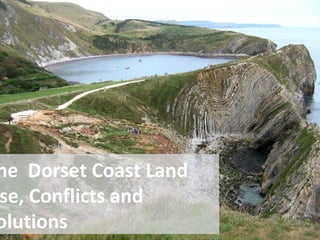
Lulworth Cove
HONEY POT
Lulworth Cove is a small bay
formed by wave action
eroding away the soft chalky
rocks that lie behind a band
of harder limestones that
form the bay mouth.
Durdle Door
South West
Coastal
Path
Pasture
for Sheep
farming.
Potential conflicts.
Tourism and Recreation.
UNESCO – World Heritage Site means restrictions on
alterations along much of the coast
Environmentalists - Area of Outstanding Natural Beauty
(AONB)
National Trust
South West Coast Path National Trail.
The M.O.D
Fisheries and Harbours.
Farmers.
Local Landowners.
Local residents.
What attracts people to Lulworth?
 It is surrounded by outstanding
scenery and wildlife habitats.
 Located on the South West
Coastal Path.
 UNESCO World Heritage status
 The nearby fossil forest is an
important SSSI.
 The classic coastal features are of
interest to students of geography
and geology.
 West Lulworth is a picturesque
village with thatched cottages and
rural ambiance.
 Lulworth Castle – partially
restored.
Lulworth Tourism Figures
About 75 000 people visit Lulworth in a year.
35% of them come in 6 weeks during July and August.
Only 10% come during the four winter months November to
February.
95% of Lulworth’s vistors are day visitors.
Over 90% of visitors come by car or coach.
The Heritage Centre is Dorsets second most visited tourist
attraction and its most visited free attraction.
The footpath between Lulworth Cove and Durdle Door is the
busiest 1 mile stretch of the whole 600 mile SW Coastal Path.
Opportunities created by Tourism
Large numbers of visitors bring significant benefits
to a rural area which traditionally relied on fishing
and farming to sustain the economy.
Tourism provides substantial full time and seasonal
employment.
Tourism brings revenue into the local economy.
This results is greater social stability for the local
population.
Funds generated by tourism provide the Lulworth
estate with capital for investment at the Cove and
general estate improvements.
Tourists may find themselves in conflict with the
following groups:-
Local people
The M.O.D
Environmentalists
Possible conflict issues that arise
 Congestion – the road to Lulworth Cove is narrow and it is a dead end so this part
of the village has to absorb all the traffic.
 Noise and Litter – The traditional character of the village is spoiled during the
summer tourist months by vehicle noise and indiscriminate litter dropping.
 Inconciderate parking create access problems.
 General access difficulties when roads are closed.
 Restrictions which the ranges impose on walkers.
 Footpath erosion – This is pariculaly obvious on the path between Durdle Door
and Lulworth.
 Litter creates a visual pollution and threat to wildlife.
 Visual Intrusion Durdle Door holiday park is unsightly and out of keeping with the
landscape.
Locals Comments
“lots of holiday makers- the queues are bigger”
“Sometimes coaches park in the wrong place and no one
can get past”
“Lots of dog poo on the beach”
“lots of people have BBQ’s which can be dangerous and
start fires”
“The army range is noisy at night when tanks are firing. I
don’t like soldiers with machine guns guarding the Army
Camp”
“The gift shops are expensive – rip off”
soultion? Car Parking….
The car park at Lulworth is surfaced in chalk rubble but
 This stands out against the green landscape and it creates huge
amounts of dust.
 Car Parking charges are high and visitors may choose to avoid being
charged by parking on sides of roads and grass verges.
solution? MOD
Permitting access to ranges at weekends and busy
holiday periods.
Keeping roads open during the busiest holiday periods.
Noise levels associated with firing are much reduced at
these times.
Solution? Footpath Erosion
Footpath maintenance – much work has been carried out
to prevent further erosion.
This has been done by re routing paths.
Building new timber steps on the path at Durdle Door.
The existing path has been reinforced with local
limestone cobbles and steps.
How effective?
Resurfacing encourages more walkers.
The whiteness of the path is an unnatural scar on the
landscape.
Steps are unnatural and walkers often choose to avoid
them by walking on the side.
Additional Environmentally friendly policies
Durdle Door beach is intentionally uncommercial.
Litter bins are not provided.
Climbing on the cliffs is banned.
Fossil collection is not permitted.
There are plans to visually screen the holiday park.
Conflict Issues
 Coastal Zone Management - Issues
 The management of the coastal zone is complicated by a number of issues,
including:
 The diverse ownership of coastal land intertidal areas;
 A ‘hostile’ marine environment;
 The number of competing activities within a relatively ‘narrow’ area;
 Conflicting issues and activities i.e. economic vs. environment;
 Over 80 Acts dealing with the regulation of activities in the coastal zone;
 No current legislation that explicitly addresses coastal management;
 The lack of an overview or lead agency ;
 Coastal issues usually transgress political boundaries.
 Coastal Zone Management in practice - Dorset:

Dorset coast

  • 1.
    Dorset Coast he DorsetCoast Land se, Conflicts and olutions
  • 2.
    Aims Describe how thephysical environment creates opportunities for economic and social land use. Identify the land users in and around Lulworth Cove. Identify land use conflicts between users at Lulworth Cove. Identify how the conflicts have been resolved. Assess their effectiveness.
  • 3.
    The Physical Landscape Somerocks, especially the Portland Stone, are very resistant to erosion. The weaker sands and clays, such as the Oxford Clay, are easily eroded and can retreat over one metre annually. Because of this differential erosion, the Dorset coast is characterised by many headlands and bays, with beaches of sand or pebbles.
  • 4.
    The Dorset Coastgeology – the endogenic factor!
  • 5.
    Old Harry Rocks Effectsof the sea upon the the coast are especially well illustrated at Ballard Down. well-developed stacks, arches and caves have formed.
  • 6.
  • 7.
    Opportunities for Landuse  The Dorset Coast from Lyme Regis in the west to Highcliffe in the east.  The coastline is not only stunningly beautiful but also displays geological sections of world importance.  It boasts both a rich diversity of wildlife and marine archaeological finds and a flourishing coastal economy An ideal opportunity to study the impact of changes in the tertiary sector. World Heritage Site Bid Document
  • 8.
    Opportunities for LandUsers Tourism and Recreation. Environmentalists - Area of Outstanding Natural Beauty (AONB) National Trust South West Coast Path National Trail. The M.O.D Fisheries and Harbours. Farmers. Local Landowners. Local residents.
  • 9.
    Restrictions imposed bythe physical environment Landslides. Coastal erosion puts property at risk. Coastal Flooding.
  • 10.
    Portland Bill, Christmas2002, evidence of process and landform.
  • 11.
    Lulworth Cove HONEY POT LulworthCove is a small bay formed by wave action eroding away the soft chalky rocks that lie behind a band of harder limestones that form the bay mouth.
  • 12.
  • 13.
    Potential conflicts. Tourism andRecreation. UNESCO – World Heritage Site means restrictions on alterations along much of the coast Environmentalists - Area of Outstanding Natural Beauty (AONB) National Trust South West Coast Path National Trail. The M.O.D Fisheries and Harbours. Farmers. Local Landowners. Local residents.
  • 14.
    What attracts peopleto Lulworth?  It is surrounded by outstanding scenery and wildlife habitats.  Located on the South West Coastal Path.  UNESCO World Heritage status  The nearby fossil forest is an important SSSI.  The classic coastal features are of interest to students of geography and geology.  West Lulworth is a picturesque village with thatched cottages and rural ambiance.  Lulworth Castle – partially restored.
  • 15.
    Lulworth Tourism Figures About75 000 people visit Lulworth in a year. 35% of them come in 6 weeks during July and August. Only 10% come during the four winter months November to February. 95% of Lulworth’s vistors are day visitors. Over 90% of visitors come by car or coach. The Heritage Centre is Dorsets second most visited tourist attraction and its most visited free attraction. The footpath between Lulworth Cove and Durdle Door is the busiest 1 mile stretch of the whole 600 mile SW Coastal Path.
  • 16.
    Opportunities created byTourism Large numbers of visitors bring significant benefits to a rural area which traditionally relied on fishing and farming to sustain the economy. Tourism provides substantial full time and seasonal employment. Tourism brings revenue into the local economy. This results is greater social stability for the local population. Funds generated by tourism provide the Lulworth estate with capital for investment at the Cove and general estate improvements.
  • 17.
    Tourists may findthemselves in conflict with the following groups:- Local people The M.O.D Environmentalists
  • 18.
    Possible conflict issuesthat arise  Congestion – the road to Lulworth Cove is narrow and it is a dead end so this part of the village has to absorb all the traffic.  Noise and Litter – The traditional character of the village is spoiled during the summer tourist months by vehicle noise and indiscriminate litter dropping.  Inconciderate parking create access problems.  General access difficulties when roads are closed.  Restrictions which the ranges impose on walkers.  Footpath erosion – This is pariculaly obvious on the path between Durdle Door and Lulworth.  Litter creates a visual pollution and threat to wildlife.  Visual Intrusion Durdle Door holiday park is unsightly and out of keeping with the landscape.
  • 19.
    Locals Comments “lots ofholiday makers- the queues are bigger” “Sometimes coaches park in the wrong place and no one can get past” “Lots of dog poo on the beach” “lots of people have BBQ’s which can be dangerous and start fires” “The army range is noisy at night when tanks are firing. I don’t like soldiers with machine guns guarding the Army Camp” “The gift shops are expensive – rip off”
  • 20.
    soultion? Car Parking…. Thecar park at Lulworth is surfaced in chalk rubble but  This stands out against the green landscape and it creates huge amounts of dust.  Car Parking charges are high and visitors may choose to avoid being charged by parking on sides of roads and grass verges.
  • 21.
    solution? MOD Permitting accessto ranges at weekends and busy holiday periods. Keeping roads open during the busiest holiday periods. Noise levels associated with firing are much reduced at these times.
  • 22.
    Solution? Footpath Erosion Footpathmaintenance – much work has been carried out to prevent further erosion. This has been done by re routing paths. Building new timber steps on the path at Durdle Door. The existing path has been reinforced with local limestone cobbles and steps.
  • 23.
    How effective? Resurfacing encouragesmore walkers. The whiteness of the path is an unnatural scar on the landscape. Steps are unnatural and walkers often choose to avoid them by walking on the side.
  • 24.
    Additional Environmentally friendlypolicies Durdle Door beach is intentionally uncommercial. Litter bins are not provided. Climbing on the cliffs is banned. Fossil collection is not permitted. There are plans to visually screen the holiday park.
  • 25.
    Conflict Issues  CoastalZone Management - Issues  The management of the coastal zone is complicated by a number of issues, including:  The diverse ownership of coastal land intertidal areas;  A ‘hostile’ marine environment;  The number of competing activities within a relatively ‘narrow’ area;  Conflicting issues and activities i.e. economic vs. environment;  Over 80 Acts dealing with the regulation of activities in the coastal zone;  No current legislation that explicitly addresses coastal management;  The lack of an overview or lead agency ;  Coastal issues usually transgress political boundaries.  Coastal Zone Management in practice - Dorset: