Welcome to the World of
Dental Technology
Jane Evans: Program & Course
Convenor
Prof Newell Johnson: Dean of
Dentistry & Oral Health
individualindividual
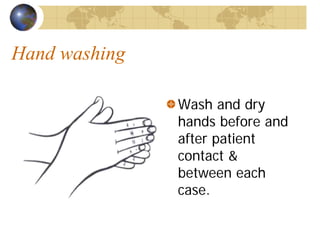
Hand washing
Wash and dry
hands before and
after patient
contact &
between each
case.Diagram courtesy Ansell Medical
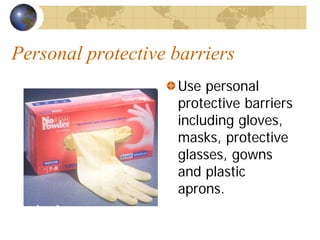
Personal protective barriers
Use personal
protective barriers
including gloves,
masks, protective
glasses, gowns
and plastic
aprons.Photo courtesy Ansell Medical
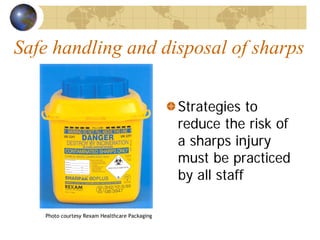
Safe handling and disposal of sharps
Strategies to
reduce the risk of
a sharps injury
must be practiced
by all staff
Photo courtesy Rexam Healthcare Packaging
Additional precautions
Applied in additionApplied in addition
to standardto standard
precautionsprecautions
Used for patients whoUsed for patients who
are known to haveare known to have
highly infectioushighly infectious
diseasesdiseases
Personal hygiene
A high standard of personal
hygiene protects you, other staff
and patients from infection
Personal hygiene includes
Fingernails kept short and clean
Hair short or tied away from face
Clean uniforms
Hand and wrist jewelry removed at start of
day
Hands washed before and after patient
contact
Hands washed before and after any activity
likely to cause contamination.
Hand washing
An important measure in preventing
the spread of infection
Hands are washed and dried…
Before starting work and after finishing
work
Before and after each patient/case
Before and after going to the toilet
Before working in a clean area
Before and after a meal break.
Hands are also washed and dried
After working in a ‘contaminated’ area
Following any incident where hands are
contaminated with blood or body fluids.
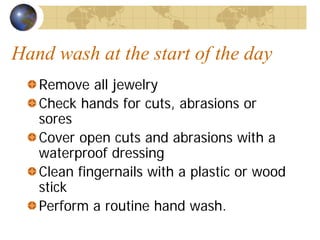
Hand wash at the start of the day
Remove all jewelry
Check hands for cuts, abrasions or
sores
Cover open cuts and abrasions with a
waterproof dressing
Clean fingernails with a plastic or wood
stick
Perform a routine hand wash.
A routine hand wash
Lather hands with liquid soap and water
for 10 to 15 seconds
Rinse with cool water
Dry hands with clean paper towels
Use paper towel to turn off hand
controlled taps.
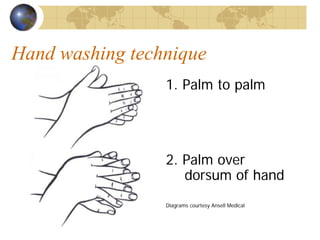
Hand washing technique
1. Palm to palm
2. Palm over
dorsum of hand
Diagrams courtesy Ansell Medical
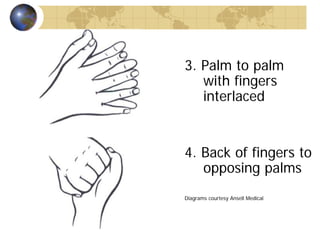
3. Palm to palm
with fingers
interlaced
4. Back of fingers to
opposing palms
Diagrams courtesy Ansell Medical
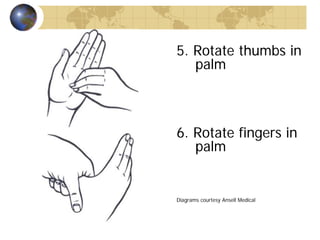
5. Rotate thumbs in
palm
6. Rotate fingers in
palm
Diagrams courtesy Ansell Medical
Hand care
The skin is a natural barrier to
invading microorganisms
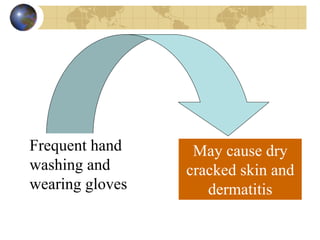
May cause dry
cracked skin and
dermatitis
Frequent hand
washing and
wearing gloves
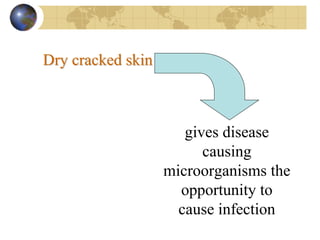
Dry cracked skinDry cracked skin
gives disease
causing
microorganisms the
opportunity to
cause infection
Preventing dermatitis
Remove all jewelry before washing
hands
Rinse hands thoroughly after washing
Avoid using hot water for hand washing
Dry hands completely after washing
Handle irritant chemicals only while
wearing gloves.
Personal protective barriers
Lab Coats, Adequate Footwear
Glasses, Gloves, &
Mask
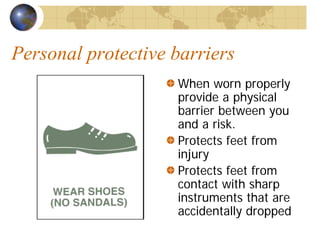
Personal protective barriers
When worn properly
provide a physical
barrier between you
and a risk.
Protects feet from
injury
Protects feet from
contact with sharp
instruments that are
accidentally dropped
Lab Coats
Protect street clothes from aerosols and
splatter contamination
Are not worn outside the laboratory
area
Are changed/washed daily or more
frequently if visibly soiled.
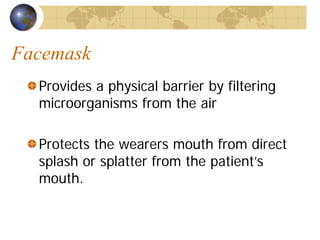
Facemask
Provides a physical barrier by filtering
microorganisms from the air
Protects the wearers mouth from direct
splash or splatter from the patient’s
mouth.
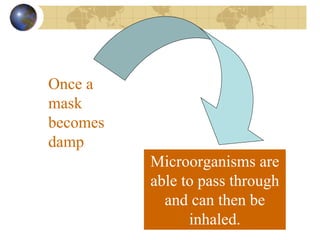
Once a
mask
becomes
damp
Microorganisms are
able to pass through
and can then be
inhaled.
Guidelines for wearing a mask
Wear a mask to protect yourself from fumes
or dust
Wear a mask while assisting with all patient
procedures
Wear a new mask for each new patient
Put on the mask before pulling on gloves
While wearing a mask do not touch it with
your hand.
Removing a mask
Remove the mask after removing
gloves by touching only the strings or
loops
Discard the mask with the general
waste.
Protective glasses
Protect eyes from sharp flying debris
Protect eyes from blood and saliva
splatter
Protect patient’s eyes from accidentally
dropped instruments
Protect patient’s eyes from chemical
splashes.
Guidelines for wearing glasses
Wear protective glasses while cutting,
trimming or polishing
Wear protective glasses while assisting with
all patient procedures
Put on protective glasses and mask before
pulling on gloves
Wash glasses between patients with water
and detergent
Rinse glasses well after washing.
Gloves
Worn whenever there is a potential for
contacting blood and saliva
Cannot protect hands from a sharps
injury.
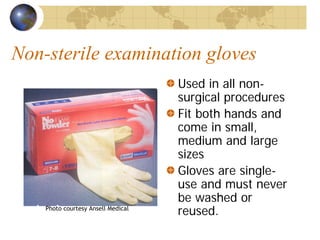
Non-sterile examination gloves
Used in all non-
surgical procedures
Fit both hands and
come in small,
medium and large
sizes
Gloves are single-
use and must never
be washed or
reused.Photo courtesy Ansell Medical
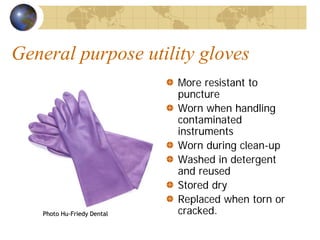
General purpose utility gloves
More resistant to
puncture
Worn when handling
contaminated
instruments
Worn during clean-up
Washed in detergent
and reused
Stored dry
Replaced when torn or
cracked.PhotoPhoto HuHu--FriedyFriedy DentalDental
Guidelines for using non-sterile
examination gloves
Remove rings and watches
Cover cuts and abrasions with waterproof
dressing
Wash, rinse and dry hands
Choose a glove size that fits well
Remove gloves that are torn, cut or
punctured
Discard gloves with general waste
Wash hands thoroughly after removing
gloves.
Aerosols A fine mist of tiny air-
borne particles that may
contain bacteria, viruses
and fungi
Splatter Larger particles of blood
and saliva contaminated
debris
Sharps injury
All dental practices should have a
written procedure for a sharps injury
that involves exposure to blood or
body fluids
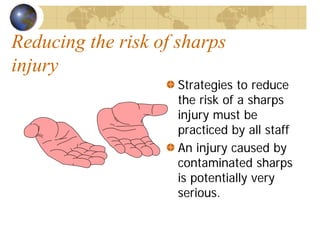
Reducing the risk of sharps
injury
Strategies to reduce
the risk of a sharps
injury must be
practiced by all staff
An injury caused by
contaminated sharps
is potentially very
serious.
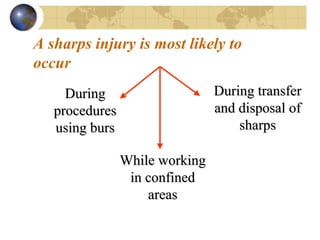
A sharps injury is most likely to
occur
DuringDuring
proceduresprocedures
using bursusing burs
During transferDuring transfer
and disposal ofand disposal of
sharpssharps
While workingWhile working
in confinedin confined
areasareas
Procedures using burs
The operator is responsible for
removing the bur from the handpiece
after use
Slow speed burs are discarded into the
sharps container
High speed burs are cleaned and
sterilized.
Managing a sharps injury
Immediately wash the injured area of
skin with soap and water
Cover the injury with waterproof tape
Report the sharps injury immediately to
the person in charge of the surgery
Complete an accident report form.
The accident report form records
The date of the injury
The time of the injury
How the injury occurred
The name of the person whose body
fluid was involved.
Dispose of
Dental Waste Safely
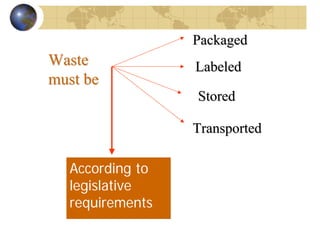
PackagedPackaged
According to
legislative
requirements
WasteWaste
must bemust be
LabeledLabeled
StoredStored
TransportedTransported
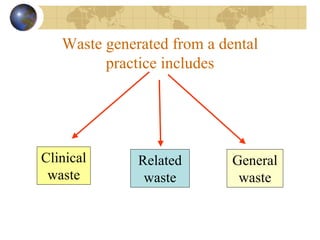
Waste generated from a dental
practice includes
Clinical
waste
Related
waste
General
waste
Clinical Waste
Waste that has the potential to
cause sharps injury, infection or
public offence
Clinical waste includes
Discarded sharps
Human tissues including materials or
solutions that contain free-flowing or
expressible blood
Laboratory and associated waste.
Discarded sharps
Wear personal protective equipment
Discard all sharps into a clearly labeled sharps
container
Keep the sharps container out of the reach of
children
Replace the container when three-quarters
full
The operator who generated the sharp is the
person responsible for their safe disposal.
Sharps include
Needles
Disposable syringes
Scalpel blades
Slow speed burs
Endodontic files
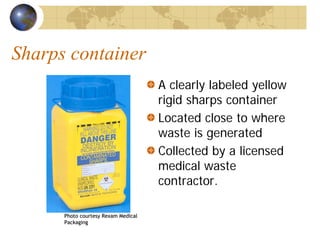
Sharps container
A clearly labeled yellow
rigid sharps container
Located close to where
waste is generated
Collected by a licensed
medical waste
contractor.
Photo courtesyPhoto courtesy RexamRexam MedicalMedical
PackagingPackaging
Human tissues
Pathological specimens
Biopsy specimens
Tissue taken during surgery
Free flowing or expressible blood
Other body fluids removed during surgery
Laboratory and associated waste
This category includes
All specimens used for laboratory testing
Cultures of microorganisms used in
biological indicators
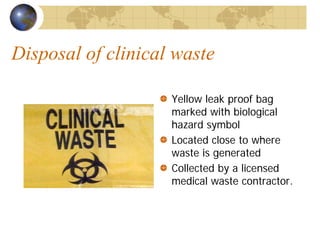
Disposal of clinical waste
Yellow leak proof bag
marked with biological
hazard symbol
Located close to where
waste is generated
Collected by a licensed
medical waste contractor.
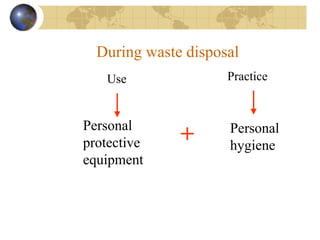
During waste disposal
PracticeUse
Personal
protective
equipment
+ Personal
hygiene
Related Waste
Wastes that are contaminated
with chemicals or pharmaceuticals
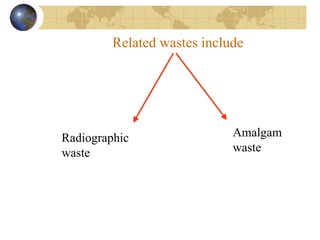
Related wastes include
Amalgam
waste
Radiographic
waste
Radiographic waste
Used fixer and developer solutions should be
stored in secure, plastic, leak proof containers
Containers must be labeled with the contents and
safety instructions
Processing chemicals are highly corrosive and
must not be tipped down the sink
Personal protective equipment must be worn
when handling chemicals
Processing chemicals should be collected by
an approved recycling company
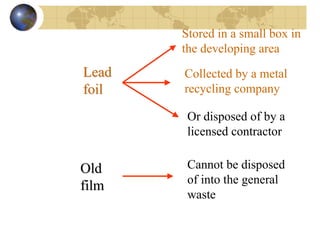
Stored in a small box in
the developing area
LeadLead
foilfoil
Collected by a metal
recycling company
Or disposed of by a
licensed contractor
Cannot be disposed
of into the general
waste
OldOld
filmfilm
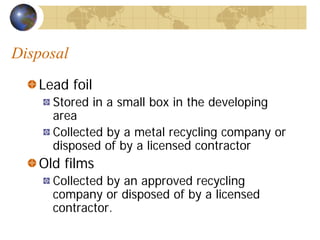
Disposal
Lead foil
Stored in a small box in the developing
area
Collected by a metal recycling company or
disposed of by a licensed contractor
Old films
Collected by an approved recycling
company or disposed of by a licensed
contractor.
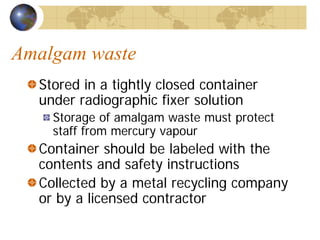
Amalgam waste
Stored in a tightly closed container
under radiographic fixer solution
Storage of amalgam waste must protect
staff from mercury vapour
Container should be labeled with the
contents and safety instructions
Collected by a metal recycling company
or by a licensed contractor
General waste
Waste that is not classified as
being within any of the categories
of the clinical and related waste
streams
General waste
General waste bag is coloured black,
buff, green or white
Collected by the community waste
contractor
Includes gloves, mask, rubber dam,
single-use cups and protective
coverings
Handled using heavy duty gloves.
Instruments
that cannot be
cleaned and
sterilized after
use
must be
discarded
Disposables include
Anaesthetic cartridges and needles
Prophylaxis cups and brushes
Mouthwash cups
Saliva ejector tips
Patient bib
Gloves and mask.
Undertake necessary measures
to ensure prevention of
transmission of infection
ContaminatedContaminated
instruments andinstruments and
equipmentequipment
Should be confined to
a well designated
zone
Limiting contamination
Clearly defines the contaminated and
clean zone in the surgery
Means that surgery clean-up is easier
and faster
Reduces the chances of cross-
contamination.
Clean zone
Must never become contaminated with
items used during patient treatment
Stores sterile instruments, equipment,
materials and medicaments
Includes the interior of drawers and
cupboards which must never become
contaminated during patient treatment.
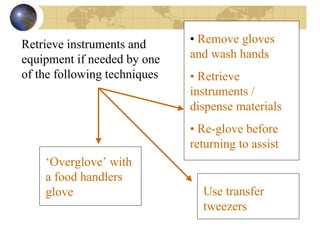
Retrieve instruments and
equipment if needed by one
of the following techniques
• Remove gloves
and wash hands
• Retrieve
instruments /
dispense materials
• Re-glove before
returning to assist
‘Overglove’ with
a food handlers
glove Use transfer
tweezers
Contaminated zone
Contains contaminated material from
the current patient
All surfaces in the contaminated zone
must be cleaned and dried between
patients
Single-use coverings are used to reduce
surface contamination.
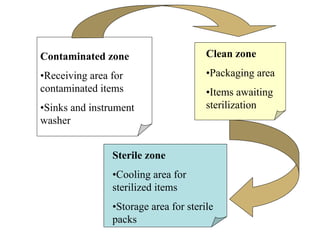
Contaminated zone
•Receiving area for
contaminated items
•Sinks and instrument
washer
Clean zone
•Packaging area
•Items awaiting
sterilization
Sterile zone
•Cooling area for
sterilized items
•Storage area for sterile
packs
Blood and/or body fluid spills
Managing a spill is always easier
when the cleaning items needed to
remove the spill are readily available
Disposable spills kit
A large reusable plastic container, with
a fitted lid, containing the following
Leak proof bags for disposal of waste
material
A disposable scraper and pan for spills
Disposable rubber gloves for cleaning
Protective glasses and a plastic apron.
Removing a small spill
Wear heavy duty gloves, mask, protective
glasses and a plastic apron
Wipe up the spill immediately using paper
towel
Discard contaminated material in to a plastic
bag for disposal
Clean the area with warm water and
detergent solution
Remove gloves and mask and wash hands
Clean and dry protective glasses before re-
use.
After
removing
the spill
Ensure the
area is clean
and dry
Replace
disposable
items in the
spill kit
Summary - it is your responsibility to collate
and maintain evidence to demonstrate
Knowledge of how infection is spread
Knowledge of infection risks in a health
environment
Compliance with NHMRC infection
control guidelines
Compliance with Australian Standards.
Summary cont….
Safe waste handling and management
procedures
Knowledge of personal hygiene practices
Knowledge of personal protection
Selection and use of appropriate cleaning
agents
Selection of the correct sterilization method.
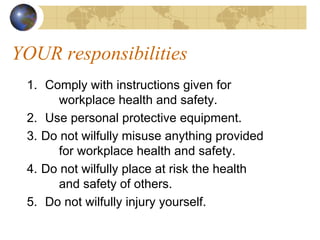
YOUR responsibilities
1. Comply with instructions given for
workplace health and safety.
2. Use personal protective equipment.
3. Do not wilfully misuse anything provided
for workplace health and safety.
4. Do not wilfully place at risk the health
and safety of others.
5. Do not wilfully injury yourself.
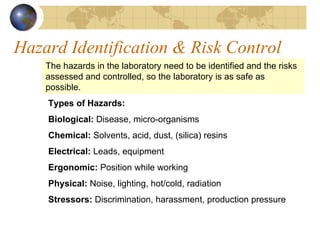
Hazard Identification & Risk Control
The hazards in the laboratory need to be identified and the risks
assessed and controlled, so the laboratory is as safe as
possible.
Types of Hazards:
Biological: Disease, micro-organisms
Chemical: Solvents, acid, dust, (silica) resins
Electrical: Leads, equipment
Ergonomic: Position while working
Physical: Noise, lighting, hot/cold, radiation
Stressors: Discrimination, harassment, production pressure
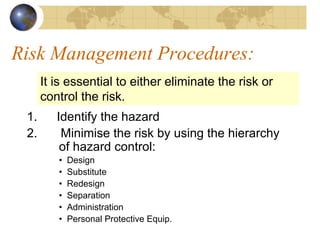
Risk Management Procedures:
It is essential to either eliminate the risk or
control the risk.
1. Identify the hazard
2. Minimise the risk by using the hierarchy
of hazard control:
• Design
• Substitute
• Redesign
• Separation
• Administration
• Personal Protective Equip.
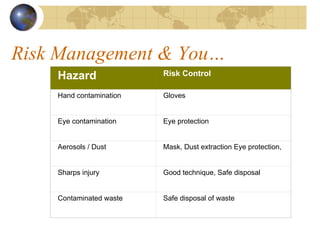
Risk Management & You…
Hazard Risk Control
Hand contamination Gloves
Eye contamination Eye protection
Aerosols / Dust Mask, Dust extraction Eye protection,
Sharps injury Good technique, Safe disposal
Contaminated waste Safe disposal of waste
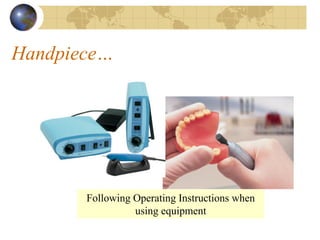
Handpiece…
Following Operating Instructions when
using equipment

Dental Lab safety

  • 1.
    Welcome to theWorld of Dental Technology Jane Evans: Program & Course Convenor Prof Newell Johnson: Dean of Dentistry & Oral Health
  • 3.
  • 4.
    Hand washing Wash anddry hands before and after patient contact & between each case.Diagram courtesy Ansell Medical
  • 5.
    Personal protective barriers Usepersonal protective barriers including gloves, masks, protective glasses, gowns and plastic aprons.Photo courtesy Ansell Medical
  • 6.
    Safe handling anddisposal of sharps Strategies to reduce the risk of a sharps injury must be practiced by all staff Photo courtesy Rexam Healthcare Packaging
  • 7.
    Additional precautions Applied inadditionApplied in addition to standardto standard precautionsprecautions Used for patients whoUsed for patients who are known to haveare known to have highly infectioushighly infectious diseasesdiseases
  • 8.
    Personal hygiene A highstandard of personal hygiene protects you, other staff and patients from infection
  • 9.
    Personal hygiene includes Fingernailskept short and clean Hair short or tied away from face Clean uniforms Hand and wrist jewelry removed at start of day Hands washed before and after patient contact Hands washed before and after any activity likely to cause contamination.
  • 10.
    Hand washing An importantmeasure in preventing the spread of infection
  • 11.
    Hands are washedand dried… Before starting work and after finishing work Before and after each patient/case Before and after going to the toilet Before working in a clean area Before and after a meal break.
  • 12.
    Hands are alsowashed and dried After working in a ‘contaminated’ area Following any incident where hands are contaminated with blood or body fluids.
  • 13.
    Hand wash atthe start of the day Remove all jewelry Check hands for cuts, abrasions or sores Cover open cuts and abrasions with a waterproof dressing Clean fingernails with a plastic or wood stick Perform a routine hand wash.
  • 14.
    A routine handwash Lather hands with liquid soap and water for 10 to 15 seconds Rinse with cool water Dry hands with clean paper towels Use paper towel to turn off hand controlled taps.
  • 15.
    Hand washing technique 1.Palm to palm 2. Palm over dorsum of hand Diagrams courtesy Ansell Medical
  • 16.
    3. Palm topalm with fingers interlaced 4. Back of fingers to opposing palms Diagrams courtesy Ansell Medical
  • 17.
    5. Rotate thumbsin palm 6. Rotate fingers in palm Diagrams courtesy Ansell Medical
  • 18.
    Hand care The skinis a natural barrier to invading microorganisms
  • 19.
    May cause dry crackedskin and dermatitis Frequent hand washing and wearing gloves
  • 20.
    Dry cracked skinDrycracked skin gives disease causing microorganisms the opportunity to cause infection
  • 21.
    Preventing dermatitis Remove alljewelry before washing hands Rinse hands thoroughly after washing Avoid using hot water for hand washing Dry hands completely after washing Handle irritant chemicals only while wearing gloves.
  • 22.
    Personal protective barriers LabCoats, Adequate Footwear Glasses, Gloves, & Mask
  • 23.
    Personal protective barriers Whenworn properly provide a physical barrier between you and a risk. Protects feet from injury Protects feet from contact with sharp instruments that are accidentally dropped
  • 24.
    Lab Coats Protect streetclothes from aerosols and splatter contamination Are not worn outside the laboratory area Are changed/washed daily or more frequently if visibly soiled.
  • 25.
    Facemask Provides a physicalbarrier by filtering microorganisms from the air Protects the wearers mouth from direct splash or splatter from the patient’s mouth.
  • 26.
    Once a mask becomes damp Microorganisms are ableto pass through and can then be inhaled.
  • 27.
    Guidelines for wearinga mask Wear a mask to protect yourself from fumes or dust Wear a mask while assisting with all patient procedures Wear a new mask for each new patient Put on the mask before pulling on gloves While wearing a mask do not touch it with your hand.
  • 28.
    Removing a mask Removethe mask after removing gloves by touching only the strings or loops Discard the mask with the general waste.
  • 29.
    Protective glasses Protect eyesfrom sharp flying debris Protect eyes from blood and saliva splatter Protect patient’s eyes from accidentally dropped instruments Protect patient’s eyes from chemical splashes.
  • 30.
    Guidelines for wearingglasses Wear protective glasses while cutting, trimming or polishing Wear protective glasses while assisting with all patient procedures Put on protective glasses and mask before pulling on gloves Wash glasses between patients with water and detergent Rinse glasses well after washing.
  • 31.
    Gloves Worn whenever thereis a potential for contacting blood and saliva Cannot protect hands from a sharps injury.
  • 32.
    Non-sterile examination gloves Usedin all non- surgical procedures Fit both hands and come in small, medium and large sizes Gloves are single- use and must never be washed or reused.Photo courtesy Ansell Medical
  • 33.
    General purpose utilitygloves More resistant to puncture Worn when handling contaminated instruments Worn during clean-up Washed in detergent and reused Stored dry Replaced when torn or cracked.PhotoPhoto HuHu--FriedyFriedy DentalDental
  • 34.
    Guidelines for usingnon-sterile examination gloves Remove rings and watches Cover cuts and abrasions with waterproof dressing Wash, rinse and dry hands Choose a glove size that fits well Remove gloves that are torn, cut or punctured Discard gloves with general waste Wash hands thoroughly after removing gloves.
  • 35.
    Aerosols A finemist of tiny air- borne particles that may contain bacteria, viruses and fungi Splatter Larger particles of blood and saliva contaminated debris
  • 36.
    Sharps injury All dentalpractices should have a written procedure for a sharps injury that involves exposure to blood or body fluids
  • 37.
    Reducing the riskof sharps injury Strategies to reduce the risk of a sharps injury must be practiced by all staff An injury caused by contaminated sharps is potentially very serious.
  • 38.
    A sharps injuryis most likely to occur DuringDuring proceduresprocedures using bursusing burs During transferDuring transfer and disposal ofand disposal of sharpssharps While workingWhile working in confinedin confined areasareas
  • 39.
    Procedures using burs Theoperator is responsible for removing the bur from the handpiece after use Slow speed burs are discarded into the sharps container High speed burs are cleaned and sterilized.
  • 40.
    Managing a sharpsinjury Immediately wash the injured area of skin with soap and water Cover the injury with waterproof tape Report the sharps injury immediately to the person in charge of the surgery Complete an accident report form.
  • 41.
    The accident reportform records The date of the injury The time of the injury How the injury occurred The name of the person whose body fluid was involved.
  • 42.
  • 43.
    PackagedPackaged According to legislative requirements WasteWaste must bemustbe LabeledLabeled StoredStored TransportedTransported
  • 44.
    Waste generated froma dental practice includes Clinical waste Related waste General waste
  • 45.
    Clinical Waste Waste thathas the potential to cause sharps injury, infection or public offence
  • 46.
    Clinical waste includes Discardedsharps Human tissues including materials or solutions that contain free-flowing or expressible blood Laboratory and associated waste.
  • 47.
    Discarded sharps Wear personalprotective equipment Discard all sharps into a clearly labeled sharps container Keep the sharps container out of the reach of children Replace the container when three-quarters full The operator who generated the sharp is the person responsible for their safe disposal.
  • 48.
    Sharps include Needles Disposable syringes Scalpelblades Slow speed burs Endodontic files
  • 49.
    Sharps container A clearlylabeled yellow rigid sharps container Located close to where waste is generated Collected by a licensed medical waste contractor. Photo courtesyPhoto courtesy RexamRexam MedicalMedical PackagingPackaging
  • 50.
    Human tissues Pathological specimens Biopsyspecimens Tissue taken during surgery Free flowing or expressible blood Other body fluids removed during surgery
  • 51.
    Laboratory and associatedwaste This category includes All specimens used for laboratory testing Cultures of microorganisms used in biological indicators
  • 52.
    Disposal of clinicalwaste Yellow leak proof bag marked with biological hazard symbol Located close to where waste is generated Collected by a licensed medical waste contractor.
  • 53.
  • 54.
    Related Waste Wastes thatare contaminated with chemicals or pharmaceuticals
  • 55.
  • 56.
    Radiographic waste Used fixerand developer solutions should be stored in secure, plastic, leak proof containers Containers must be labeled with the contents and safety instructions Processing chemicals are highly corrosive and must not be tipped down the sink Personal protective equipment must be worn when handling chemicals Processing chemicals should be collected by an approved recycling company
  • 57.
    Stored in asmall box in the developing area LeadLead foilfoil Collected by a metal recycling company Or disposed of by a licensed contractor Cannot be disposed of into the general waste OldOld filmfilm
  • 58.
    Disposal Lead foil Stored ina small box in the developing area Collected by a metal recycling company or disposed of by a licensed contractor Old films Collected by an approved recycling company or disposed of by a licensed contractor.
  • 59.
    Amalgam waste Stored ina tightly closed container under radiographic fixer solution Storage of amalgam waste must protect staff from mercury vapour Container should be labeled with the contents and safety instructions Collected by a metal recycling company or by a licensed contractor
  • 60.
    General waste Waste thatis not classified as being within any of the categories of the clinical and related waste streams
  • 61.
    General waste General wastebag is coloured black, buff, green or white Collected by the community waste contractor Includes gloves, mask, rubber dam, single-use cups and protective coverings Handled using heavy duty gloves.
  • 62.
    Instruments that cannot be cleanedand sterilized after use must be discarded
  • 63.
    Disposables include Anaesthetic cartridgesand needles Prophylaxis cups and brushes Mouthwash cups Saliva ejector tips Patient bib Gloves and mask.
  • 64.
    Undertake necessary measures toensure prevention of transmission of infection
  • 65.
  • 66.
    Limiting contamination Clearly definesthe contaminated and clean zone in the surgery Means that surgery clean-up is easier and faster Reduces the chances of cross- contamination.
  • 67.
    Clean zone Must neverbecome contaminated with items used during patient treatment Stores sterile instruments, equipment, materials and medicaments Includes the interior of drawers and cupboards which must never become contaminated during patient treatment.
  • 68.
    Retrieve instruments and equipmentif needed by one of the following techniques • Remove gloves and wash hands • Retrieve instruments / dispense materials • Re-glove before returning to assist ‘Overglove’ with a food handlers glove Use transfer tweezers
  • 69.
    Contaminated zone Contains contaminatedmaterial from the current patient All surfaces in the contaminated zone must be cleaned and dried between patients Single-use coverings are used to reduce surface contamination.
  • 70.
    Contaminated zone •Receiving areafor contaminated items •Sinks and instrument washer Clean zone •Packaging area •Items awaiting sterilization Sterile zone •Cooling area for sterilized items •Storage area for sterile packs
  • 71.
    Blood and/or bodyfluid spills Managing a spill is always easier when the cleaning items needed to remove the spill are readily available
  • 72.
    Disposable spills kit Alarge reusable plastic container, with a fitted lid, containing the following Leak proof bags for disposal of waste material A disposable scraper and pan for spills Disposable rubber gloves for cleaning Protective glasses and a plastic apron.
  • 73.
    Removing a smallspill Wear heavy duty gloves, mask, protective glasses and a plastic apron Wipe up the spill immediately using paper towel Discard contaminated material in to a plastic bag for disposal Clean the area with warm water and detergent solution Remove gloves and mask and wash hands Clean and dry protective glasses before re- use.
  • 74.
    After removing the spill Ensure the areais clean and dry Replace disposable items in the spill kit
  • 75.
    Summary - itis your responsibility to collate and maintain evidence to demonstrate Knowledge of how infection is spread Knowledge of infection risks in a health environment Compliance with NHMRC infection control guidelines Compliance with Australian Standards.
  • 76.
    Summary cont…. Safe wastehandling and management procedures Knowledge of personal hygiene practices Knowledge of personal protection Selection and use of appropriate cleaning agents Selection of the correct sterilization method.
  • 77.
    YOUR responsibilities 1. Complywith instructions given for workplace health and safety. 2. Use personal protective equipment. 3. Do not wilfully misuse anything provided for workplace health and safety. 4. Do not wilfully place at risk the health and safety of others. 5. Do not wilfully injury yourself.
  • 78.
    Hazard Identification &Risk Control The hazards in the laboratory need to be identified and the risks assessed and controlled, so the laboratory is as safe as possible. Types of Hazards: Biological: Disease, micro-organisms Chemical: Solvents, acid, dust, (silica) resins Electrical: Leads, equipment Ergonomic: Position while working Physical: Noise, lighting, hot/cold, radiation Stressors: Discrimination, harassment, production pressure
  • 79.
    Risk Management Procedures: Itis essential to either eliminate the risk or control the risk. 1. Identify the hazard 2. Minimise the risk by using the hierarchy of hazard control: • Design • Substitute • Redesign • Separation • Administration • Personal Protective Equip.
  • 80.
    Risk Management &You… Hazard Risk Control Hand contamination Gloves Eye contamination Eye protection Aerosols / Dust Mask, Dust extraction Eye protection, Sharps injury Good technique, Safe disposal Contaminated waste Safe disposal of waste
  • 81.