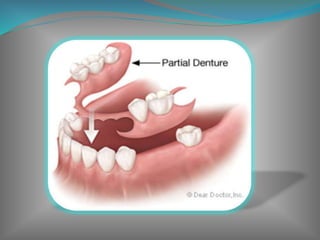
Flexible denture
 Presented by Alyaa
A.Thani
 Supervised by Dr.
Khadija sahib
Requisities
for ideal denture base material
 accuracy of adaptation to tissue
 Biologically compatible with tissue
 Thermal conductivity
 Low specific gravity _ lightness in the mouth
 Esthetic
 Dimensionally stable
 Sufficient strength _ resistance to fracture and
distortion
 Resist deformation
 Self cleansing
 Low cost
 Potential for future relining
 Valplast is generally known to be the very
first nylon denture base material. It was
developed by dental technicians, Arpad and
Tibor Nagy, in their Master-Touch Dental
Laboratory in New York, America in 1953.
1-Comfortable
2-Flexible
3- Affordable
4-No shiny metal clasps
5-Light-weight
6-Strong
7-Positive retention
8-No tooth preparation required
9-Life time guarantee against breakage of Valplast
material
10-Hypo-allergenic

 Background on flexible nylon denture
base materials
 Nylon belongs to the thermoplastic polymer
class known as polyamides (Sepúlveda-
Navarro et al., 2011). It has a high tensile
strength, high abrasion resistance, high
resiliency, high flexural strength and
excellent biocompatibility (Stern, 2007).).
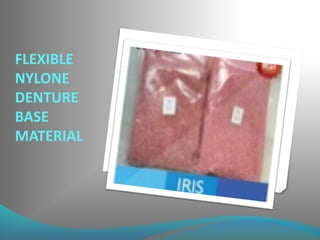
FLEXIBLE
NYLONE
DENTURE
BASE
MATERIAL
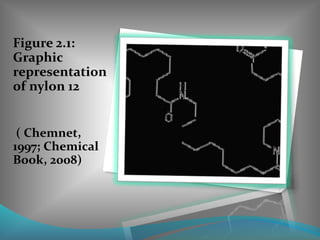
Figure 2.1:
Graphic
representation
of nylon 12
( Chemnet,
1997; Chemical
Book, 2008)
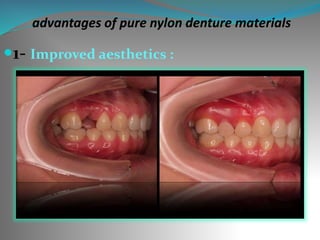
advantages of pure nylon denture materials
1- Improved aesthetics :
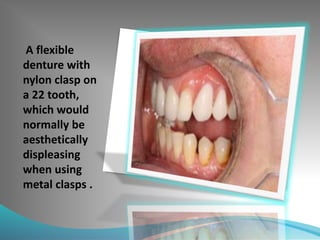
A flexible
denture with
nylon clasp on
a 22 tooth,
which would
normally be
aesthetically
displeasing
when using
metal clasps .
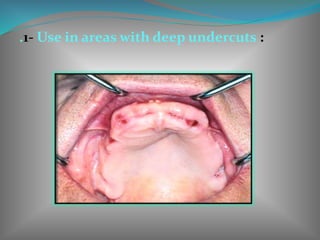
.1- Use in areas with deep undercuts :
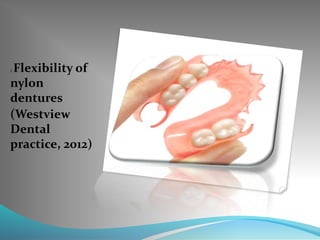
: Flexibility of
nylon
dentures
(Westview
Dental
practice, 2012)
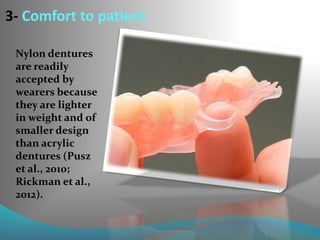
3- Comfort to patient
Nylon dentures
are readily
accepted by
wearers because
they are lighter
in weight and of
smaller design
than acrylic
dentures (Pusz
et al., 2010;
Rickman et al.,
2012).
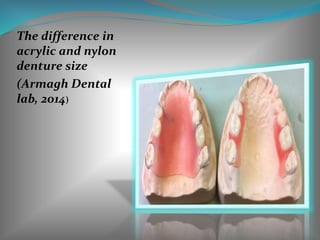
The difference in
acrylic and nylon
denture size
(Armagh Dental
lab, 2014)
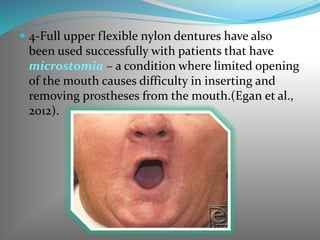
 4-Full upper flexible nylon dentures have also
been used successfully with patients that have
microstomia – a condition where limited opening
of the mouth causes difficulty in inserting and
removing prostheses from the mouth.(Egan et al.,
2012).
5-biocompatibility
 Nylon denture bases have a very
low level of porosity, making
them impervious to oral fluids
(Negrutiu et al., 2005; Pusz et al.,
2010). This reduces the amount of
stains, odours, and biological
build up on the dentures. It also
ensures the colour and
dimensional stability of the
dentures (Pusz et al., 2010).


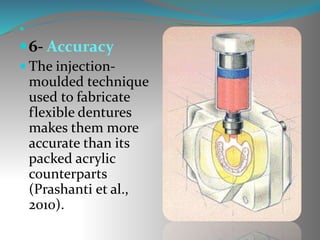
6- Accuracy
 The injection-
moulded technique
used to fabricate
flexible dentures
makes them more
accurate than its
packed acrylic
counterparts
(Prashanti et al.,
2010).
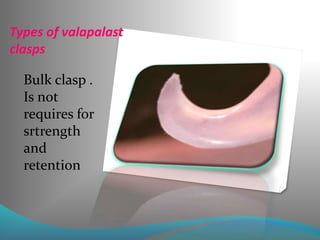
Types of valapalast
clasps
Bulk clasp .
Is not
requires for
srtrength
and
retention
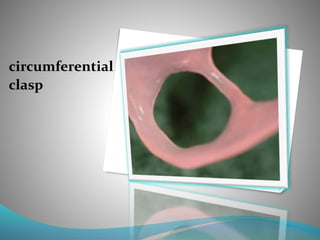
circumferential
clasp
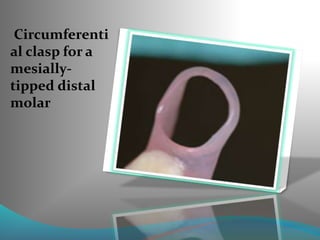
Circumferenti
al clasp for a
mesially-
tipped distal
molar
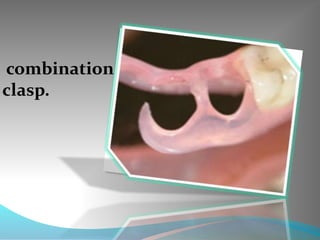
combination
clasp.
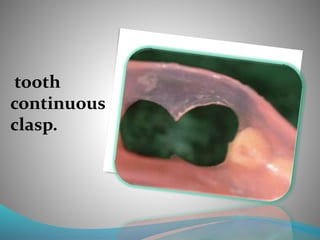
tooth
continuous
clasp.
Comparison between PMMT and nylon
denture base from physical aspect
1 Specific gravity
 Specific gravity refers to the ratio of the
density of a solid or liquid to the density of
water at 4 degrees Celsius. Water has a
specific gravity equal to one. Materials with
a specific gravity less than one will float on
pure water, while materials with a specific
gravity more than one will sink in water
because they are denser than water (WhatIs,
1999
Water absorption
Water absorption is calculated as
the percent increase in weight of
a material after exposure to
water under specified
conditions. These conditions are
usually immersion in distilled
water at room temperature for 24
hours (Prospector, 2014).
Young’s modulus
 as elastic modulus, Young’s modulus is a
measure of stiffness and is expressed in
force per unit area. It is calculated as the
ratio of stress to strain. A material with a
high elastic modulus is classified as rigid
(Phillips, 1991:33-34; Anusavice, 2003:73,80-
82).

 Tensile strength
 Tensile strength is also referred to as ultimate
strength. It is defined as the maximum stress
that a material can withstand while being
pulled or stretched before failing or breaking. It
is the highest point on a stress-stain curve and
is measured in force per unit area. Materials
that break sharply without plastic deformation
during tensile testing are called brittle.
Materials that undergo plastic deformation
during tensile testing are classified as ductile
(Phillips, 1991:38-39; Anusavice, 2003:77).
Acrylic has a lower tensile strength than nylon .
 Compressive strength
 Compressive strength is the maximum
stress that a material can withstand while
under a crushing load before failing or
breaking.
 Bonding strength
 Bonding new acrylic to an existing acrylic
denture base is achieved easily; the same
cannot be said for bonding new nylon to an
existing nylon denture base. An etch has to
be applied to the existing nylon denture
base to soften it in order for the new nylon
material to be injected onto it (Valplast
International Corporation, 2004:42-43).
 Vickers hardness
 As a micro hardness test method, Vickers
hardness Test tests the resistance of a
material to indentation. A diamond
indenter is used at a fixed force to make an
indentation in the test materials. The
indentation is measured and converted to a
hardness value. The smaller the indentation,
the harder the material (Newage, 2010).
Impact strength
 Impact strength is the capability of a
material to withstand sudden load
application. During testing the impact
energy needed to fracture a sample of
material is measured. (Phillips, 1991:40-41;
Anusavice, 2003:91-92). Acrylic has a lower
impact strength than nylon ..
Possible causes of mechanical
retention failure between acrylic teeth
and pure nylon denture bases
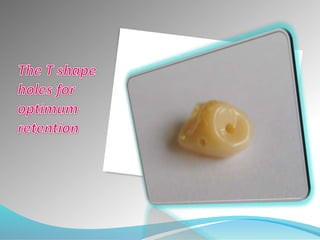
.1 Lack of intercoronal space
 Pure nylon flexible denture base materials
retain acrylic teeth by mechanical retention
only, therefore sufficient height of the
denture tooth selected is needed (Prashanti
et al., 2010).
2- Design of diatorics
 The shape of the diatorics might cause
failure in the denture base material passing
through it and this possibility should be
investigated further (Bragaglia et al., 2009;
Dhiman et al., 2009).
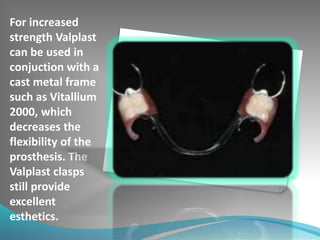
For increased
strength Valplast
can be used in
conjuction with a
cast metal frame
such as Vitallium
2000, which
decreases the
flexibility of the
prosthesis. The
Valplast clasps
still provide
excellent
esthetics.
 The combination of Valplast and Vitallium
 maximizes the physical properties of the
partial and makes it a great choice for
extended edentulous areas, especially in the
lower arch
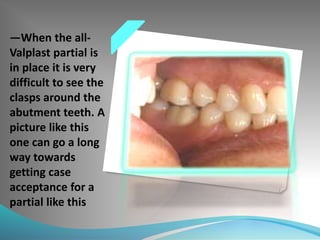
—When the all-
Valplast partial is
in place it is very
difficult to see the
clasps around the
abutment teeth. A
picture like this
one can go a long
way towards
getting case
acceptance for a
partial like this
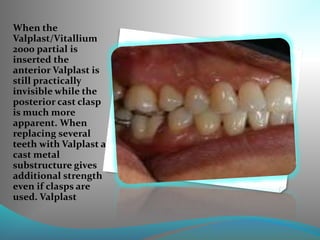
When the
Valplast/Vitallium
2000 partial is
inserted the
anterior Valplast is
still practically
invisible while the
posterior cast clasp
is much more
apparent. When
replacing several
teeth with Valplast a
cast metal
substructure gives
additional strength
even if clasps are
used. Valplast
Comparison between metal denture base and
nylon denture base from these aspects ;
 1- Comparative tissue response :
 Metal denture base has
 Inherent cleanliness of cast metal base contribute to
health of oral tissue
 Bacteriostatic ionization and oxidization of metal base
 Metal base natural cleaner
 Flexible has little tissue response
 2 -Thermal conductivity :
 Temperature changes transmiteed through metal to
underling tissue help to maintain health of tissue
 There is no thermal conductivity in nylon denture base
 3 -Whight and bulk :
 of metal denture base is more than of nylon denture base
 4- Esthetic
 Esthetic yet fully functional ulternative to traditional
cast metal Flexible denture base clasps are continuity of
nylon base and are thin has superior esthetic Vitallium
compination better support and clasp esthetic

 5 -Cost
 Metal denture base costing more than nylon denture base

 6 -Acceptance by patient :
 Flexible denture base is more accepted by patients
compared to metal denture base
 7- Skill required and Tooth preparation
 Flexible denture base require no highly skilled operator , no
tooth preparation and difficult lab procedure
 While metal base need highly skilled operator , need tooth
preparation for rests placement and difficult lab
procedures
 8 -Relining
 Relining could be done in nylon denture base material
 but it is not available in metal base material
9-biocompatibility Biocompatibility of nylon
denture base is good also of metal base material

 10- Strength Strength of valplast doesn’t require
metal framework eliminate metallic taste
 Metal base strength is good but give metallic taste
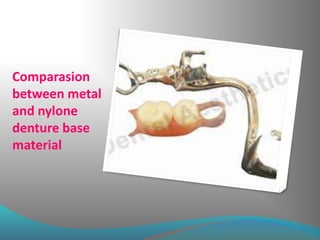
Comparasion
between metal
and nylone
denture base
material
REFRENCES
 Carr A B, MSC Giveny GB , Brown DT, Major connector
in McCarens removable partial prosthodontics 11 ed , st
louis;mosby;2008
 Stewart K L, Rudd K D , Kuebker W A ,Magior
connectorin stewarts removable partial denture
prosthodontics . 2nd Chennai;2004
 Miller E L,Grasso J E , Magior connector in removable
partial denture 2nd, blatemore:williams and wilkins
1979
References
 1. Zarb GA, Bolender CL, Carlsson GE. 11th
ed. St Louis: Mosby; 1997. Boucher's
Prosthodontic Treatment for Edentulous
Patients; pp. 337–42.
 2. Anusavice KJ. 10th ed. Philadelphia: WB
Saunders; 1996. Phillips’ Science Of Dental
Materials; p. 238.
 3. Anthony DH, Peyton FA. Dimensional
Accuracy of various Denture-Base
Materials. J Prosthet Dent. 1962;12:67–81.
Thank
you

Flexible denture

  • 1.
    Flexible denture  Presentedby Alyaa A.Thani  Supervised by Dr. Khadija sahib
  • 2.
    Requisities for ideal denturebase material  accuracy of adaptation to tissue  Biologically compatible with tissue  Thermal conductivity  Low specific gravity _ lightness in the mouth  Esthetic
  • 3.
     Dimensionally stable Sufficient strength _ resistance to fracture and distortion  Resist deformation  Self cleansing  Low cost  Potential for future relining
  • 4.
     Valplast isgenerally known to be the very first nylon denture base material. It was developed by dental technicians, Arpad and Tibor Nagy, in their Master-Touch Dental Laboratory in New York, America in 1953.
  • 5.
    1-Comfortable 2-Flexible 3- Affordable 4-No shinymetal clasps 5-Light-weight 6-Strong 7-Positive retention 8-No tooth preparation required 9-Life time guarantee against breakage of Valplast material 10-Hypo-allergenic
  • 6.
      Background onflexible nylon denture base materials  Nylon belongs to the thermoplastic polymer class known as polyamides (Sepúlveda- Navarro et al., 2011). It has a high tensile strength, high abrasion resistance, high resiliency, high flexural strength and excellent biocompatibility (Stern, 2007).).
  • 7.
  • 8.
    Figure 2.1: Graphic representation of nylon12 ( Chemnet, 1997; Chemical Book, 2008)
  • 9.
    advantages of purenylon denture materials 1- Improved aesthetics :
  • 10.
    A flexible denture with nylonclasp on a 22 tooth, which would normally be aesthetically displeasing when using metal clasps .
  • 11.
    .1- Use inareas with deep undercuts :
  • 12.
  • 13.
    3- Comfort topatient Nylon dentures are readily accepted by wearers because they are lighter in weight and of smaller design than acrylic dentures (Pusz et al., 2010; Rickman et al., 2012).
  • 14.
    The difference in acrylicand nylon denture size (Armagh Dental lab, 2014)
  • 15.
     4-Full upperflexible nylon dentures have also been used successfully with patients that have microstomia – a condition where limited opening of the mouth causes difficulty in inserting and removing prostheses from the mouth.(Egan et al., 2012).
  • 16.
    5-biocompatibility  Nylon denturebases have a very low level of porosity, making them impervious to oral fluids (Negrutiu et al., 2005; Pusz et al., 2010). This reduces the amount of stains, odours, and biological build up on the dentures. It also ensures the colour and dimensional stability of the dentures (Pusz et al., 2010). 
  • 18.
     6- Accuracy  Theinjection- moulded technique used to fabricate flexible dentures makes them more accurate than its packed acrylic counterparts (Prashanti et al., 2010).
  • 21.
    Types of valapalast clasps Bulkclasp . Is not requires for srtrength and retention
  • 22.
  • 23.
    Circumferenti al clasp fora mesially- tipped distal molar
  • 24.
  • 25.
  • 26.
    Comparison between PMMTand nylon denture base from physical aspect 1 Specific gravity  Specific gravity refers to the ratio of the density of a solid or liquid to the density of water at 4 degrees Celsius. Water has a specific gravity equal to one. Materials with a specific gravity less than one will float on pure water, while materials with a specific gravity more than one will sink in water because they are denser than water (WhatIs, 1999
  • 27.
    Water absorption Water absorptionis calculated as the percent increase in weight of a material after exposure to water under specified conditions. These conditions are usually immersion in distilled water at room temperature for 24 hours (Prospector, 2014).
  • 28.
    Young’s modulus  aselastic modulus, Young’s modulus is a measure of stiffness and is expressed in force per unit area. It is calculated as the ratio of stress to strain. A material with a high elastic modulus is classified as rigid (Phillips, 1991:33-34; Anusavice, 2003:73,80- 82).
  • 29.
      Tensile strength Tensile strength is also referred to as ultimate strength. It is defined as the maximum stress that a material can withstand while being pulled or stretched before failing or breaking. It is the highest point on a stress-stain curve and is measured in force per unit area. Materials that break sharply without plastic deformation during tensile testing are called brittle. Materials that undergo plastic deformation during tensile testing are classified as ductile (Phillips, 1991:38-39; Anusavice, 2003:77). Acrylic has a lower tensile strength than nylon .
  • 30.
     Compressive strength Compressive strength is the maximum stress that a material can withstand while under a crushing load before failing or breaking.
  • 31.
     Bonding strength Bonding new acrylic to an existing acrylic denture base is achieved easily; the same cannot be said for bonding new nylon to an existing nylon denture base. An etch has to be applied to the existing nylon denture base to soften it in order for the new nylon material to be injected onto it (Valplast International Corporation, 2004:42-43).
  • 32.
     Vickers hardness As a micro hardness test method, Vickers hardness Test tests the resistance of a material to indentation. A diamond indenter is used at a fixed force to make an indentation in the test materials. The indentation is measured and converted to a hardness value. The smaller the indentation, the harder the material (Newage, 2010).
  • 33.
    Impact strength  Impactstrength is the capability of a material to withstand sudden load application. During testing the impact energy needed to fracture a sample of material is measured. (Phillips, 1991:40-41; Anusavice, 2003:91-92). Acrylic has a lower impact strength than nylon ..
  • 34.
    Possible causes ofmechanical retention failure between acrylic teeth and pure nylon denture bases .1 Lack of intercoronal space  Pure nylon flexible denture base materials retain acrylic teeth by mechanical retention only, therefore sufficient height of the denture tooth selected is needed (Prashanti et al., 2010).
  • 35.
    2- Design ofdiatorics  The shape of the diatorics might cause failure in the denture base material passing through it and this possibility should be investigated further (Bragaglia et al., 2009; Dhiman et al., 2009).
  • 37.
    For increased strength Valplast canbe used in conjuction with a cast metal frame such as Vitallium 2000, which decreases the flexibility of the prosthesis. The Valplast clasps still provide excellent esthetics.
  • 38.
     The combinationof Valplast and Vitallium  maximizes the physical properties of the partial and makes it a great choice for extended edentulous areas, especially in the lower arch
  • 39.
    —When the all- Valplastpartial is in place it is very difficult to see the clasps around the abutment teeth. A picture like this one can go a long way towards getting case acceptance for a partial like this
  • 40.
    When the Valplast/Vitallium 2000 partialis inserted the anterior Valplast is still practically invisible while the posterior cast clasp is much more apparent. When replacing several teeth with Valplast a cast metal substructure gives additional strength even if clasps are used. Valplast
  • 41.
    Comparison between metaldenture base and nylon denture base from these aspects ;  1- Comparative tissue response :  Metal denture base has  Inherent cleanliness of cast metal base contribute to health of oral tissue  Bacteriostatic ionization and oxidization of metal base  Metal base natural cleaner  Flexible has little tissue response
  • 42.
     2 -Thermalconductivity :  Temperature changes transmiteed through metal to underling tissue help to maintain health of tissue  There is no thermal conductivity in nylon denture base  3 -Whight and bulk :  of metal denture base is more than of nylon denture base  4- Esthetic  Esthetic yet fully functional ulternative to traditional cast metal Flexible denture base clasps are continuity of nylon base and are thin has superior esthetic Vitallium compination better support and clasp esthetic
  • 43.
      5 -Cost Metal denture base costing more than nylon denture base   6 -Acceptance by patient :  Flexible denture base is more accepted by patients compared to metal denture base  7- Skill required and Tooth preparation  Flexible denture base require no highly skilled operator , no tooth preparation and difficult lab procedure  While metal base need highly skilled operator , need tooth preparation for rests placement and difficult lab procedures
  • 44.
     8 -Relining Relining could be done in nylon denture base material  but it is not available in metal base material 9-biocompatibility Biocompatibility of nylon denture base is good also of metal base material   10- Strength Strength of valplast doesn’t require metal framework eliminate metallic taste  Metal base strength is good but give metallic taste
  • 45.
  • 46.
    REFRENCES  Carr AB, MSC Giveny GB , Brown DT, Major connector in McCarens removable partial prosthodontics 11 ed , st louis;mosby;2008  Stewart K L, Rudd K D , Kuebker W A ,Magior connectorin stewarts removable partial denture prosthodontics . 2nd Chennai;2004  Miller E L,Grasso J E , Magior connector in removable partial denture 2nd, blatemore:williams and wilkins 1979
  • 47.
    References  1. ZarbGA, Bolender CL, Carlsson GE. 11th ed. St Louis: Mosby; 1997. Boucher's Prosthodontic Treatment for Edentulous Patients; pp. 337–42.  2. Anusavice KJ. 10th ed. Philadelphia: WB Saunders; 1996. Phillips’ Science Of Dental Materials; p. 238.  3. Anthony DH, Peyton FA. Dimensional Accuracy of various Denture-Base Materials. J Prosthet Dent. 1962;12:67–81.
  • 48.