Dental Waxes
Presented by: Dr. Shruti Potdukhe
Lecturer, Department of Prosthodontics and Crown & Bridge
Contents
• Introduction
• Definition
• History
• Characteristic
• Classification of waxes
• Composition
• Uses of waxes
• Properties
• Conclusion
• References
Introduction
• One of several esters of fatty acids with higher alcohols,
usually monohydric alcohols.
• Dental waxes are combinations of various types of waxes
compounded to provide desired physical properties.
Definition
 Dental wax can be defined as a
low molecular weight ester of fatty acids
derived from natural and synthetic components
such as petroleum derivatives that
soften to a plastic state
at a relatively low temperature.
-Kenneth J Anusavice, Phillip’s science of dental materials; eleventh edition; 2004.
History
 Wax Models used in connection with Prosthetic work were
first mentioned by Mathhaeus Gottfried Purmann in 1700
 In 1905, Dr William.H.Taggart of Chicago formulated a wax
pattern compound of excellent properties.
 He also described the lost wax technique and even
invented an centrifugal casting machine.
General Characteristics of Waxes
• Should be tough & rigid at room temperature but not brittle
• Should have a low softening temperature
• Should flow easily
• Should be dimensionally stable
• Should have a melting point well below boiling point of water,
so that wax can be removed under boiling water
• Should have pleasant color & posses a color contrast to help
during carving
General composition of Waxes
1. Natural waxes
2. Synthetic waxes
3. Natural resins ( dammar)
4. Oils
5. Fats (stearic acid)
6. Gums ( gum arabic)
7. Coloring agents
General Characteristic Properties
I .Thermal Properties:
1) Melting range
2) Softening temperature
3) Thermal conductivity
4) Coefficient of Thermal expansion
5) Mechanical properties
6) Flow
7) Residual stress
8) Ductility
1) Melting Range
• Waxes have melting range rather than specific melting point
• Solid at lower temperature
• Fluid at high temperature
Eg. Paraffin wax : 44-62o C
Carnauba wax : 50-90oC
• By varying compositions, it is possible to change melting
ranges suitable according to use
2) Softening temperature:
• should be just above mouth temperature.
3) Thermal conductivity:
• Poor thermal conductor.
• suitable kneading & time is required to heat them uniformly &
cool them to room temperature
4) Thermal Expansion:
• Largest values of coefficient of thermal expansion (150-
400x10-6/oC)
• Contraction of wax pattern by 0.3-0.8% when cooled from
37oC to room temperature leading to inaccuracy of finished
restoration
• Higher the temperature heated greater is the shrinkage as it
cools.
Mechanical Properties
1)Brittleness:
• Denture waxes need to be tough so can be removed from a
slight undercut.
• Inlay wax need to be brittle so get fracture on removal.
2) Modulus of elasticity, proportional limit, flexibility &
compressive strength are low & decreases with rise in
temperature
3) Ductility :
• Increases with an increase in temperature
• Waxes with low melting temperatures have greater ductility
than those with higher melting temperature
4) Flow:
• Flow increases as melting range of wax is approached
• Depends upon temperature of the wax, external deforming
force & the time the force is applied
5) Residual Stress:
• Elastic memory.
• Under compression during cooling, atoms & molecules are
forced closer together & are under no external stress.
• After it is cooled on room temp & load is removed, motion of
molecules is restricted, & this restriction results in residual
stresses in it.
Classification of Dental Waxes
III. ACCORDING TO USE
A. Pattern wax
a) Inlay wax
a) Casting wax
c) Base plate
B. Processing wax
a) Boxing wax
b) Utility wax
c) Sticky wax
C. Impression wax
a) Corrective wax
b) Bite registration wax
I. ACCORDING TO
ORIGIN
A. Natural wax
a) Mineral
b) Plant
c) Insect
d) Animal
B. Synthetic waxes
C. Additives
II. ACCORDING TO
COMPOSITION
A. Hydrocarbon
B. Esters
I. According to source/origin :
A) Natural waxes:
a) Mineral waxes : 1.Paraffin
2.Microcrystalline
3.Ceresin
4.Ozocerite
5.Monton
Classification of Dental Waxes
1. Paraffin Waxes:
• Melting range 40-71o C. increases with increasing molecular
weight.
• Likely to flake when trimmed.
• Does not present smooth, glossy surface
2.Microcrystalline:
• Similar to paraffin waxes but are obtained from heavier oil
fraction.
• More tougher than paraffin wax.
• Lower the softening temperature.
Classification of Dental Waxes
b) Plant waxes : 1.Carnauba
2.Candelilla
3.Ouricury
4.Japanese wax
5.Cocoa butter
Classification of Dental Waxes
1. Carnauba wax (plant wax):
• Derived from tropical palms
• It is quite hard, melting range 84-910C
• Combined with paraffin to- Decrease flow at mouth
temperature increase the hardness
• It contributes to glossiness of the wax surface, even more
than dammar resin.
• (Addition of 10 % carnauba wax to paraffin wax with a melting
range of 200C will increase the melting range to 460C.)
Classification of Dental Waxes
c) Insect waxes : Beeswax
• Obtained from honeycomb.
• Melting range 63-700C.
• Brittle at room temperature,
becomes plastic at body
temperature.
• Used to modify the properties of paraffin wax.
• The main component of sticky wax.
d) Animal waxes : spermaceti
B) Synthetic Waxes :
1. Polyethylene waxes
2. Polyoxyethylene glycol waxes
3. Hydrogenated waxes
4. Halogenated waxes
5. Halogenated hydrocarbon waxes
6. Wax esters
Classification of Dental Waxes
3) Additives
i) Fats : Stearic acid
Glyceryl-tristearate
Oils : terpentine
ii) Natural Resins : dammar rosin
iii) Synthetic Resins : polyethylene
polystyrene
Classification of Dental Waxes
III. According to Uses :
A) Pattern B) Processing C) Impression
1. Inlay
2. Casting
3. Base
plate
1. Beading & Boxing
2. Utility
3. Sticky
4. Block out
5. Carving
6. Carding
1. Corrective
2. Bite registration
Classification of Dental Waxes
A) Pattern Waxes
• Used to prepare predetermined size & contour of an artificial
dental restoration
• which is to be constructed of a more durable material such as
cast gold alloys, Co-Cr-Ni alloys or poly methyl methacrylate
resin.
• Types : 1. Inlay waxes
2.Casting waxes
3.Base plate waxes
Classification of Dental Waxes
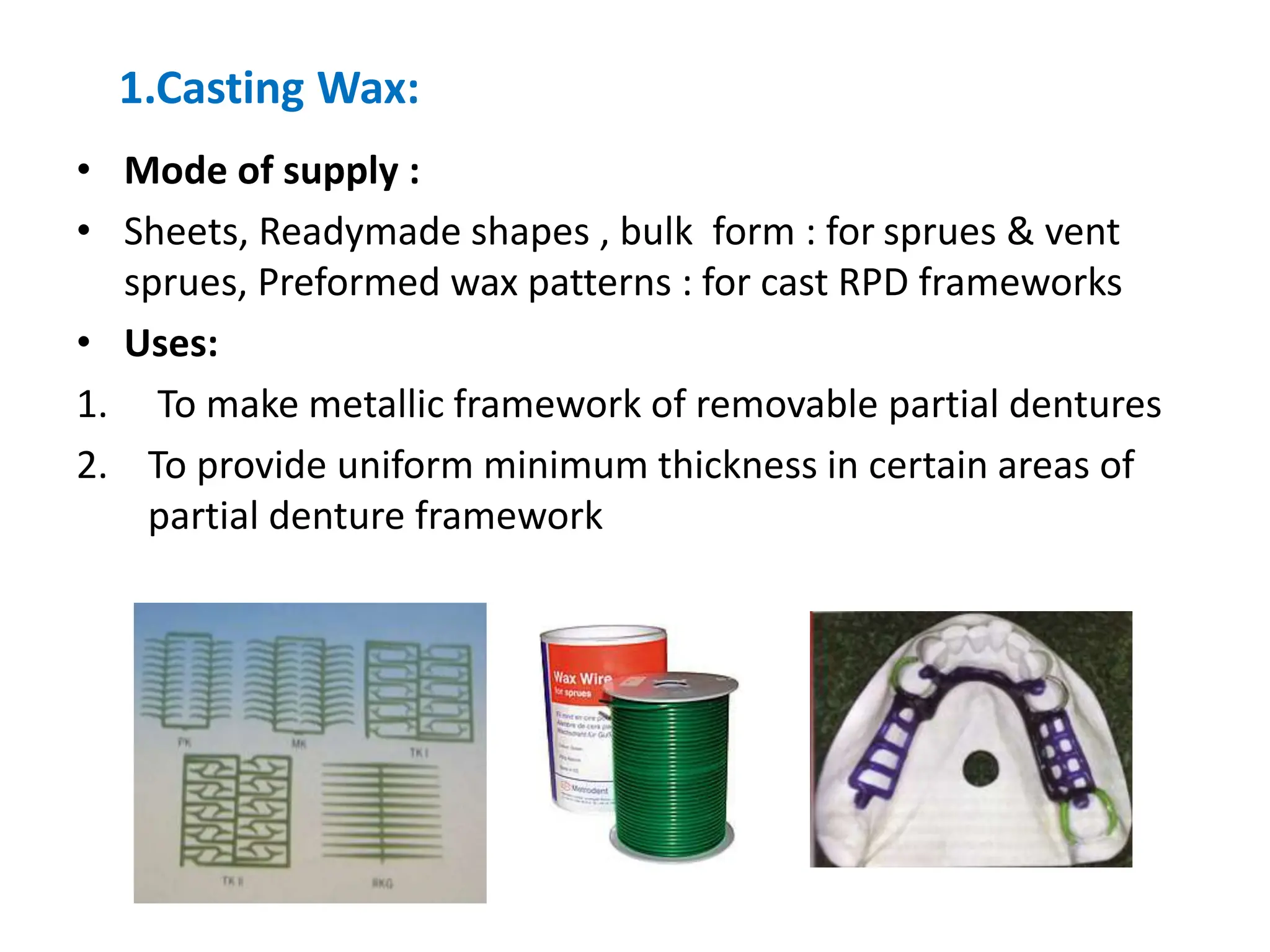
1.Casting Wax:
• Mode of supply :
• Sheets, Readymade shapes , bulk form : for sprues & vent
sprues, Preformed wax patterns : for cast RPD frameworks
• Uses:
1. To make metallic framework of removable partial dentures
2. To provide uniform minimum thickness in certain areas of
partial denture framework
Composition
Ingredients Functions
1. Paraffin wax To establish melting point
2. Ceresin wax Improves carving
characteristics
3. Bees wax Reduces flow at mouth temp
& reduces brittleness
4. Natural resins Gives suitable flow properties
to wax
2. Base plate wax
• Also known as Modelling wax
• Mode of supply : sheets of pink/red color
• Classification :
According to ADA specification No.24, they are classified as :
1. Type I Soft - for building veneers
2. Type II Medium – tried in mouths in temperate climatic
conditions
3. Type III Hard – for trial fitting in the mouth in tropical
climates
Composition of Base plate wax
Ingredients Weight % Functions
1. Ceresin wax 80 % Improves carving
characteristics
2. Bees wax 12 % Reduces brittleness &
reduces flow at mouth temp
& gives glossy surface
3. Natural or synthetic
resin
3 % Gives stable flow properties
4. Microcrystalline wax 25 % To establish required melting
point
Uses of Base plate wax
1. To make occlusion rims, which is used on base plate to
establish vertical dimensions, plane of occlusion & initial
arch form in complete denture fabrication
2. To produce desired contour of denture after teeth are set in
position
3. To make patterns for orthodontic appliances & prosthesis
other than complete dentures
4. To check various articulating relations in the mouth & to
transfer them to mechanical articulators
3.Inlay Waxes
• Mode of supply : supplied as deep blue or purple rods or
sticks,small pellets & cones.
• Uses:
to prepare wax patterns of inlays, crowns, & bridges for the lost
wax casting technique.
• Classification of Inlay Waxes :
According to ADA specification No. 4
Type I : medium wax, used in direct technique
Type II : soft wax, used in indirect technique
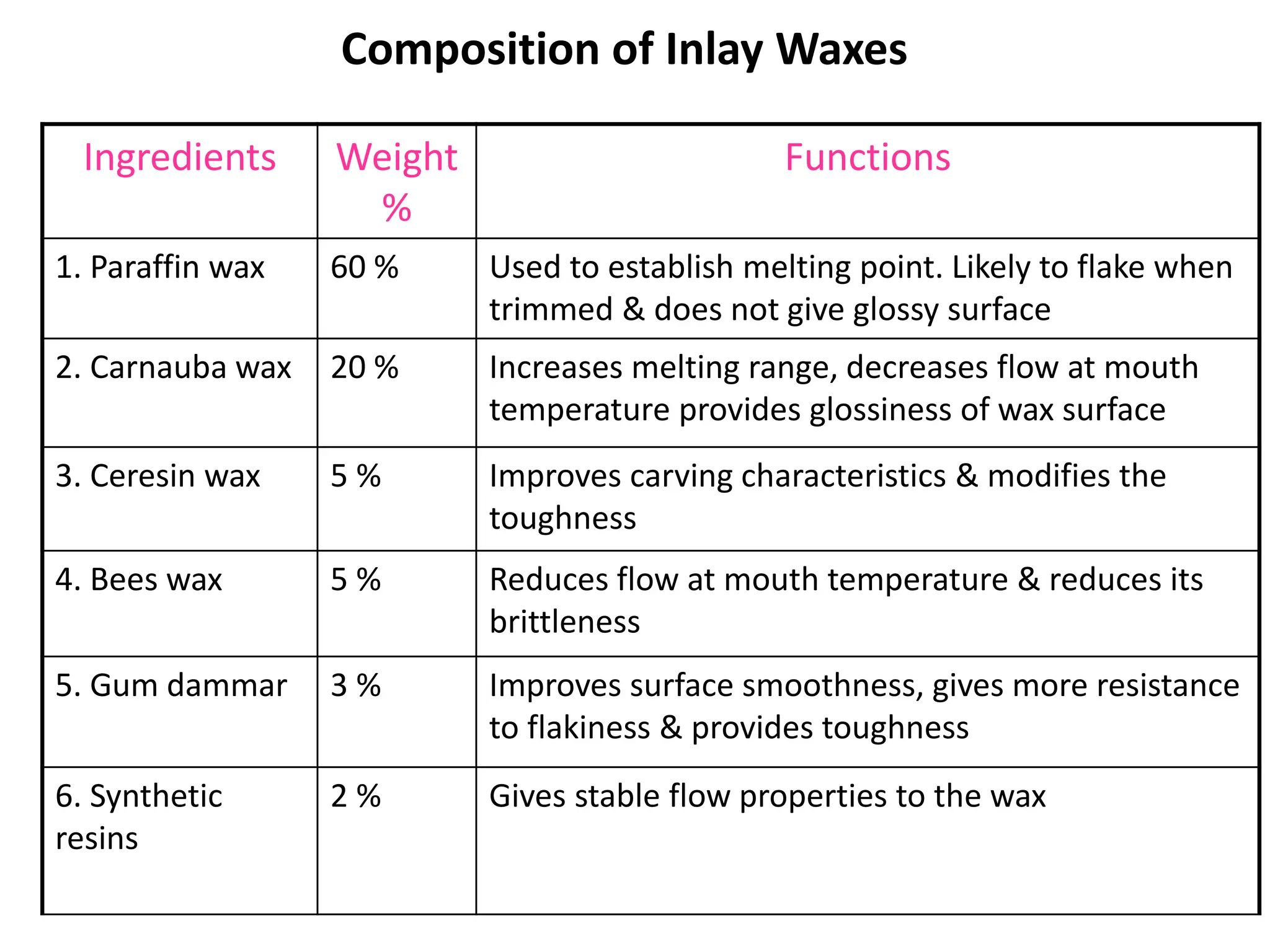
Composition of Inlay Waxes
Ingredients Weight
%
Functions
1. Paraffin wax 60 % Used to establish melting point. Likely to flake when
trimmed & does not give glossy surface
2. Carnauba wax 20 % Increases melting range, decreases flow at mouth
temperature provides glossiness of wax surface
3. Ceresin wax 5 % Improves carving characteristics & modifies the
toughness
4. Bees wax 5 % Reduces flow at mouth temperature & reduces its
brittleness
5. Gum dammar 3 % Improves surface smoothness, gives more resistance
to flakiness & provides toughness
6. Synthetic
resins
2 % Gives stable flow properties to the wax
Desirable Properties of Inlay Waxes
1. When softened, wax should be uniform
2. Color should contrast with die material or prepared tooth
3. There should be no flakiness or surface roughening when wax is
molded for softening
4. In Type I waxes, it should be sufficiently plastic at a temperature
slightly above mouth temperature & become rigid at mouth
temperature
5. It should have a flow not less than 70% at 45oC & not more than
1% at 37oC
6. Wax should not pull or chip with the carving instrument when it is
carved
7. No residue in excess of 0.10%
8. Wax pattern should be completely rigid & dimensionally stable at
all times until it is eliminated.
Properties of Inlay Wax
1. Flow
2. Thermal conductivity
3. Coefficient of thermal expansion
4. Wax distortion
1. Flow
• The flow of wax is a measure of its potential to deform under
a small static load, even that associated with its own mass
• Type I inlay wax exhibits marked plasticity or flow at a
temperature slightly above mouth temperature
• Maximum flow for Type I waxes at 37oC is 1%
• Both Type I & Type II waxes must have flow between 70% &
90% at 45oC, i.e., when waxes are inserted into the prepared
cavity
2.Thermal Conductivity:
• Thermal conductivity of waxes is low, sufficient time is
required both to heat them uniformly throughout & to cool
them to body or room temperature
3. Coefficient of Thermal Expansion
• Inlay waxes have a high coefficient of thermal expansion
4. Wax Distortion
• Results from thermal changes & release of stresses that arise
from :
1. Non-uniform contraction on cooling if wax is not held under
uniform pressure
2. Occluded gas bubbles
3. Non-uniform heating during insertion in the cavity
4. change of shape during molding, carving, & removal
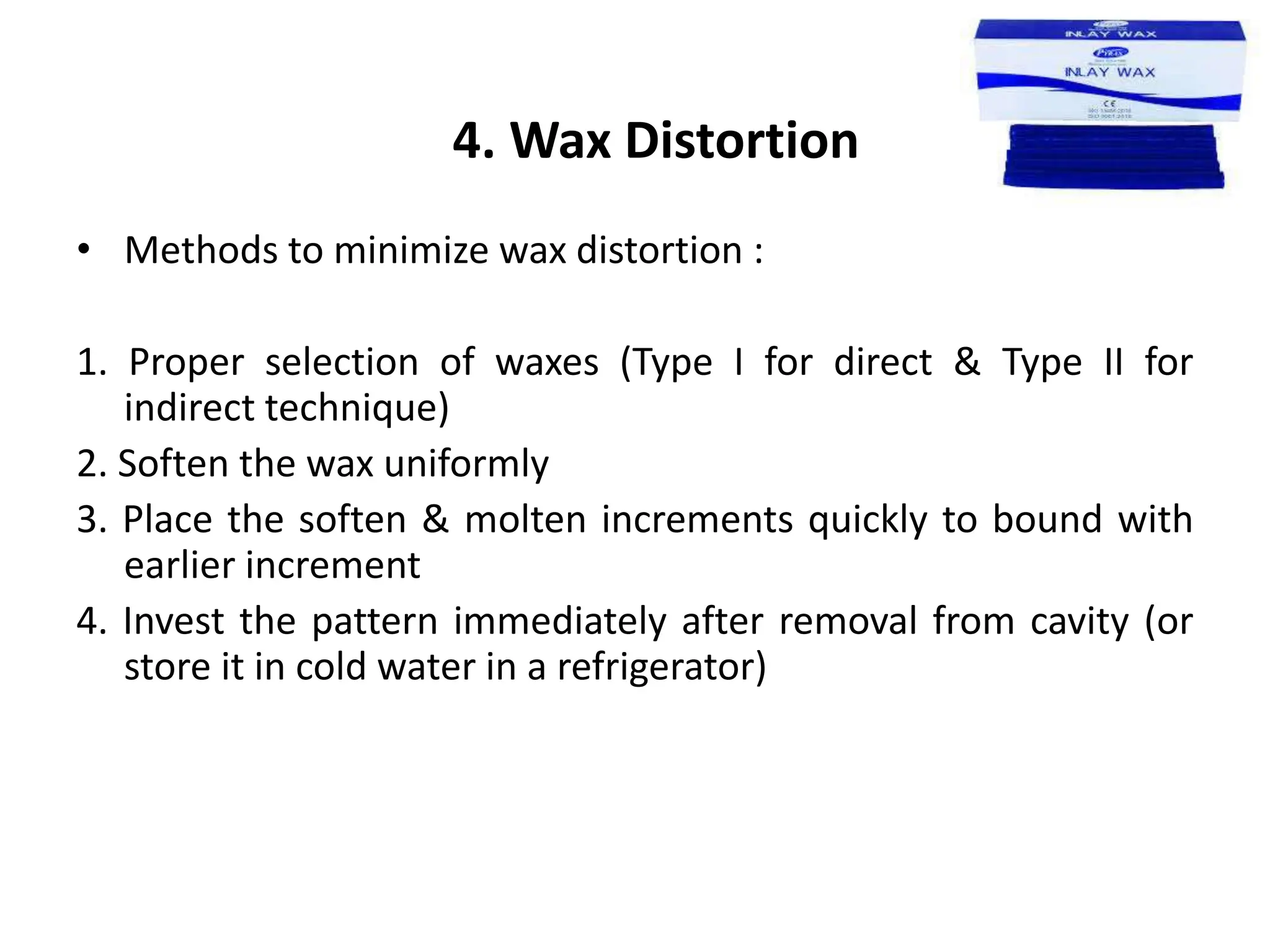
• Methods to minimize wax distortion :
1. Proper selection of waxes (Type I for direct & Type II for
indirect technique)
2. Soften the wax uniformly
3. Place the soften & molten increments quickly to bound with
earlier increment
4. Invest the pattern immediately after removal from cavity (or
store it in cold water in a refrigerator)
4. Wax Distortion
B) Processing Waxes
• Used mainly as accessory aids in construction of a variety of
restorations & appliances either in the clinic or in the
laboratory
• These are :
1. Beading & Boxing wax
2. Utility wax
3. Sticky wax
4. Carding wax
5. Blockout wax
6. Carving wax
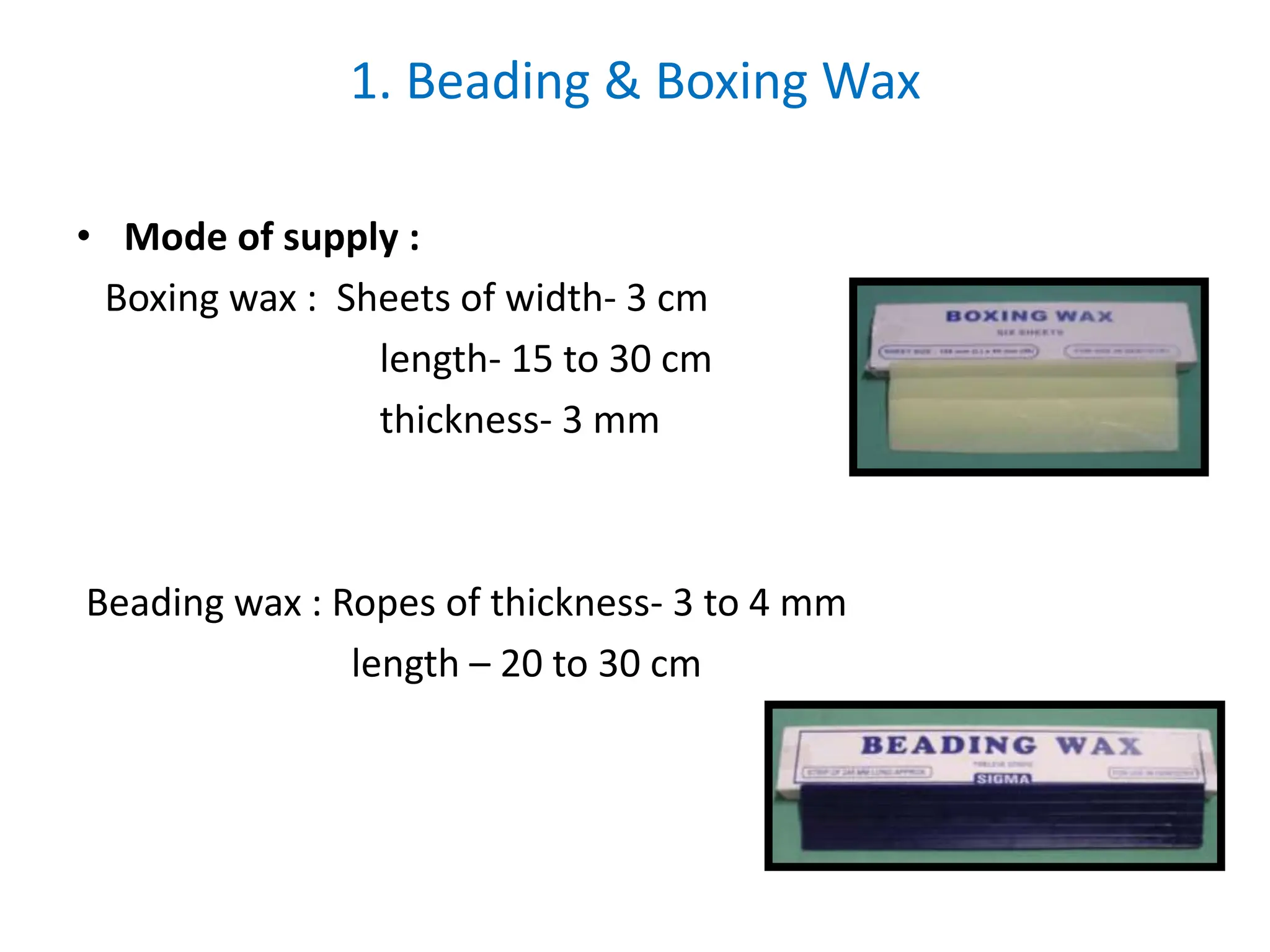
• Mode of supply :
Boxing wax : Sheets of width- 3 cm
length- 15 to 30 cm
thickness- 3 mm
Beading wax : Ropes of thickness- 3 to 4 mm
length – 20 to 30 cm
1. Beading & Boxing Wax
USES:
1. To build up vertical walls around the impression
2. To produce desired size & form of the base of the cast
3. To preserve certain landmarks of the impression
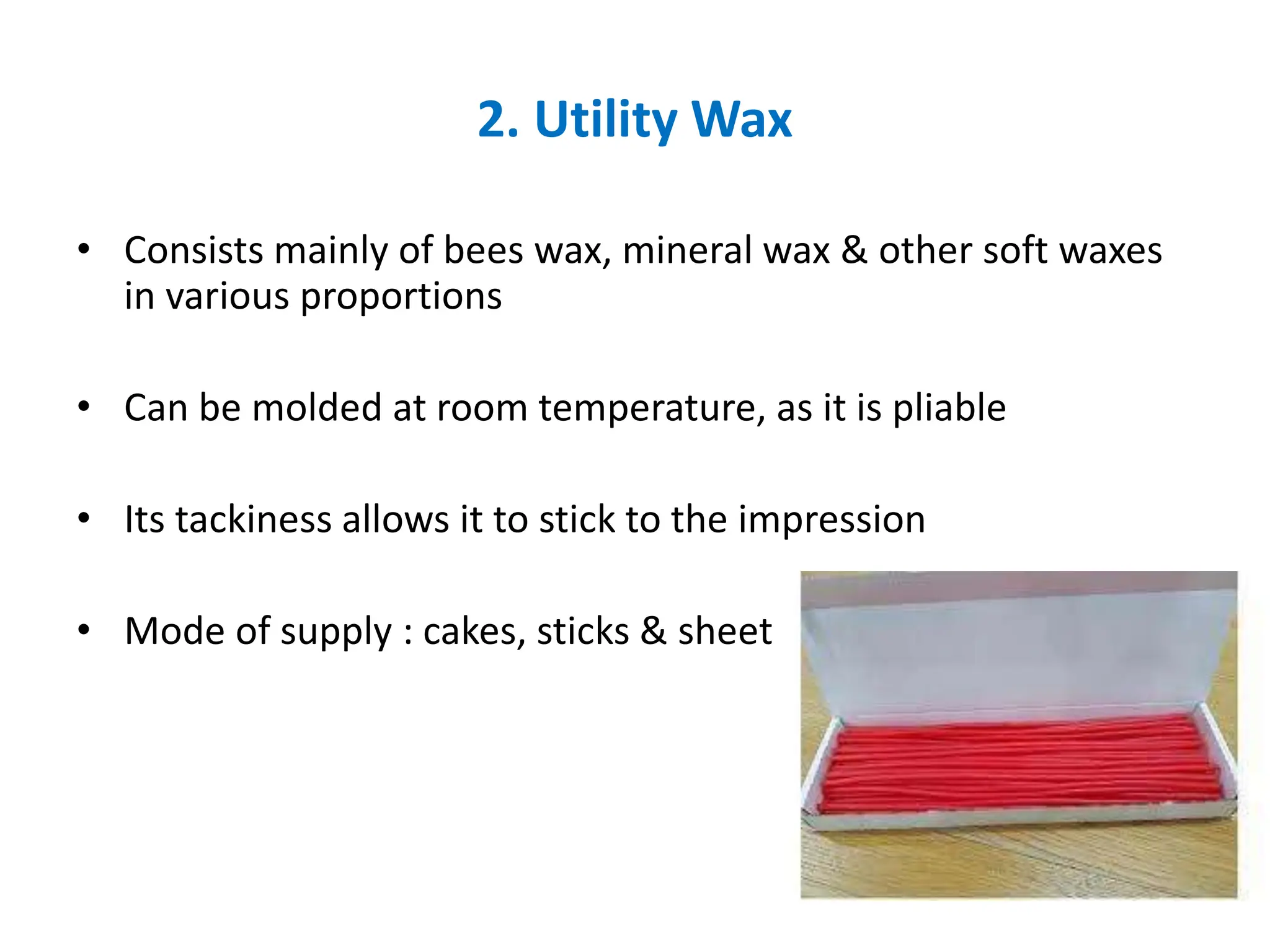
2. Utility Wax
• Consists mainly of bees wax, mineral wax & other soft waxes
in various proportions
• Can be molded at room temperature, as it is pliable
• Its tackiness allows it to stick to the impression
• Mode of supply : cakes, sticks & sheets
Uses of Utility Wax
• To provide desirable contour to a perforated tray for use with
hydrocolloids
• To build up flange of tray & raise the palatal portion of the
tray posteriorly in recording impression of patients with deep
palate
3. Sticky Wax
• Also known as adhesive wax or model cement
• Consists of yellow bees wax, rosin & natural resins such as
gum dammar
• It is sticky when melted & adheres closely to the surface upon
which it is applied
• At room temperature, it is free from tackiness & is brittle
Uses
1. To assemble metallic pieces temporarily in position or to seal
a plaster splint to stone cast in the process of forming
porcelain facings
2. To join fragments of broken denture before repair
4. Carding Wax
• Used for attaching broken parts of the denture before denture
repair procedure
• Used to join metal pieces in soldering procedures
• Used to attach artificial teeth
5.Block out Wax
• Used to fill voids & undercuts during
fabrication of removable partial denture
6. Carving Wax
• Used for tooth carving procedures
in dental anatomy, laboratory
procedures
C. Impression Waxes
• Used to record non-undercut edentulous portions of the oral
cavity & are generally used in combination with other
impression materials like polysulfide, ZOE impression paste or
impression compound
• Important impression waxes are :
1. Corrective impression waxes
2. Bite registration waxes
1. Corrective Impression Waxes
• Used as a wax veneer over an original impression to contact &
register the details of the soft tissues
• Consists of paraffin, ceresin & bees wax
• Flow at 37oC is 100 % (can get distorted while removing from
the mouth)
• These waxes are designed to flow at mouth temperature
• Four types of waxes can be used for this technique
1) IOWA Wax , white , by Dr. Smith
2) Korecta Wax No.4 , Orange , by Dr, O.C. Apllegate
3) H-L physiologic paste , yellow-white, by Dr.C.S.Harkins
4) Adaptol , green , by Dr. N.G.Kaye
1. Corrective Impression Waxes
1. Functional impression of distal extension partial dentures
2. To record posterior palatal seal
3. Functional impression for obturators
Uses of Corrective Impression Waxes
2. Bite Registration Wax
• Used to record the occlusal relationship of opposing
quadrants
• Consists of beeswax, paraffin wax & ceresin wax
• Flow at 37oC ranges from 2.5 % to 22 %
• Mode of supply : U-shaped thin sheets, which are sometimes
matallised or foil laminated
eg. Aluwax
• Bite Registration Wax is interposed between the teeth &
patient is asked to bite in the position of jaw relation
recording
• The indentations thus formed on the wax are used to place
the cast in position & then transfer it to the articulator.
2. Bite Registration Wax
Conclusion
• Waxes find great utility in dentistry from blocking undercuts,
making rims, impressions, wax patterns to casting
• Wide variety available for different uses
• Handling of wax is an art
• Its not only removing of unwanted but also building-up of
what is wanted
References
• Anusavice : Philips’ Science of Dental Materials Xth & XIth Edn.
• Craig : Dental Materials : Properties & Manipulation VIth, VIIth
& VIIIth Edn.
• S. Winkler : Essentials of Complete Denture Prosthodontics
IInd Edn.
Questions asked?????
1. MCQ Based questions
2. Short answer questions
3. Long answer questions
Ex: Define Waxes, Classify Waxes,
Properties of Waxes, Uses of Different
Waxes.
THANK YOU

Dental Waxes

  • 1.
    Dental Waxes Presented by:Dr. Shruti Potdukhe Lecturer, Department of Prosthodontics and Crown & Bridge
  • 2.
    Contents • Introduction • Definition •History • Characteristic • Classification of waxes • Composition • Uses of waxes • Properties • Conclusion • References
  • 3.
    Introduction • One ofseveral esters of fatty acids with higher alcohols, usually monohydric alcohols. • Dental waxes are combinations of various types of waxes compounded to provide desired physical properties.
  • 4.
    Definition  Dental waxcan be defined as a low molecular weight ester of fatty acids derived from natural and synthetic components such as petroleum derivatives that soften to a plastic state at a relatively low temperature. -Kenneth J Anusavice, Phillip’s science of dental materials; eleventh edition; 2004.
  • 5.
    History  Wax Modelsused in connection with Prosthetic work were first mentioned by Mathhaeus Gottfried Purmann in 1700  In 1905, Dr William.H.Taggart of Chicago formulated a wax pattern compound of excellent properties.  He also described the lost wax technique and even invented an centrifugal casting machine.
  • 6.
    General Characteristics ofWaxes • Should be tough & rigid at room temperature but not brittle • Should have a low softening temperature • Should flow easily • Should be dimensionally stable • Should have a melting point well below boiling point of water, so that wax can be removed under boiling water • Should have pleasant color & posses a color contrast to help during carving
  • 7.
    General composition ofWaxes 1. Natural waxes 2. Synthetic waxes 3. Natural resins ( dammar) 4. Oils 5. Fats (stearic acid) 6. Gums ( gum arabic) 7. Coloring agents
  • 8.
    General Characteristic Properties I.Thermal Properties: 1) Melting range 2) Softening temperature 3) Thermal conductivity 4) Coefficient of Thermal expansion 5) Mechanical properties 6) Flow 7) Residual stress 8) Ductility
  • 9.
    1) Melting Range •Waxes have melting range rather than specific melting point • Solid at lower temperature • Fluid at high temperature Eg. Paraffin wax : 44-62o C Carnauba wax : 50-90oC • By varying compositions, it is possible to change melting ranges suitable according to use
  • 10.
    2) Softening temperature: •should be just above mouth temperature. 3) Thermal conductivity: • Poor thermal conductor. • suitable kneading & time is required to heat them uniformly & cool them to room temperature
  • 11.
    4) Thermal Expansion: •Largest values of coefficient of thermal expansion (150- 400x10-6/oC) • Contraction of wax pattern by 0.3-0.8% when cooled from 37oC to room temperature leading to inaccuracy of finished restoration • Higher the temperature heated greater is the shrinkage as it cools.
  • 12.
    Mechanical Properties 1)Brittleness: • Denturewaxes need to be tough so can be removed from a slight undercut. • Inlay wax need to be brittle so get fracture on removal. 2) Modulus of elasticity, proportional limit, flexibility & compressive strength are low & decreases with rise in temperature
  • 13.
    3) Ductility : •Increases with an increase in temperature • Waxes with low melting temperatures have greater ductility than those with higher melting temperature 4) Flow: • Flow increases as melting range of wax is approached • Depends upon temperature of the wax, external deforming force & the time the force is applied
  • 14.
    5) Residual Stress: •Elastic memory. • Under compression during cooling, atoms & molecules are forced closer together & are under no external stress. • After it is cooled on room temp & load is removed, motion of molecules is restricted, & this restriction results in residual stresses in it.
  • 15.
    Classification of DentalWaxes III. ACCORDING TO USE A. Pattern wax a) Inlay wax a) Casting wax c) Base plate B. Processing wax a) Boxing wax b) Utility wax c) Sticky wax C. Impression wax a) Corrective wax b) Bite registration wax I. ACCORDING TO ORIGIN A. Natural wax a) Mineral b) Plant c) Insect d) Animal B. Synthetic waxes C. Additives II. ACCORDING TO COMPOSITION A. Hydrocarbon B. Esters
  • 16.
    I. According tosource/origin : A) Natural waxes: a) Mineral waxes : 1.Paraffin 2.Microcrystalline 3.Ceresin 4.Ozocerite 5.Monton Classification of Dental Waxes
  • 17.
    1. Paraffin Waxes: •Melting range 40-71o C. increases with increasing molecular weight. • Likely to flake when trimmed. • Does not present smooth, glossy surface 2.Microcrystalline: • Similar to paraffin waxes but are obtained from heavier oil fraction. • More tougher than paraffin wax. • Lower the softening temperature. Classification of Dental Waxes
  • 18.
    b) Plant waxes: 1.Carnauba 2.Candelilla 3.Ouricury 4.Japanese wax 5.Cocoa butter Classification of Dental Waxes
  • 19.
    1. Carnauba wax(plant wax): • Derived from tropical palms • It is quite hard, melting range 84-910C • Combined with paraffin to- Decrease flow at mouth temperature increase the hardness • It contributes to glossiness of the wax surface, even more than dammar resin. • (Addition of 10 % carnauba wax to paraffin wax with a melting range of 200C will increase the melting range to 460C.) Classification of Dental Waxes
  • 20.
    c) Insect waxes: Beeswax • Obtained from honeycomb. • Melting range 63-700C. • Brittle at room temperature, becomes plastic at body temperature. • Used to modify the properties of paraffin wax. • The main component of sticky wax. d) Animal waxes : spermaceti
  • 21.
    B) Synthetic Waxes: 1. Polyethylene waxes 2. Polyoxyethylene glycol waxes 3. Hydrogenated waxes 4. Halogenated waxes 5. Halogenated hydrocarbon waxes 6. Wax esters Classification of Dental Waxes
  • 22.
    3) Additives i) Fats: Stearic acid Glyceryl-tristearate Oils : terpentine ii) Natural Resins : dammar rosin iii) Synthetic Resins : polyethylene polystyrene Classification of Dental Waxes
  • 23.
    III. According toUses : A) Pattern B) Processing C) Impression 1. Inlay 2. Casting 3. Base plate 1. Beading & Boxing 2. Utility 3. Sticky 4. Block out 5. Carving 6. Carding 1. Corrective 2. Bite registration Classification of Dental Waxes
  • 24.
    A) Pattern Waxes •Used to prepare predetermined size & contour of an artificial dental restoration • which is to be constructed of a more durable material such as cast gold alloys, Co-Cr-Ni alloys or poly methyl methacrylate resin. • Types : 1. Inlay waxes 2.Casting waxes 3.Base plate waxes Classification of Dental Waxes
  • 25.
    1.Casting Wax: • Modeof supply : • Sheets, Readymade shapes , bulk form : for sprues & vent sprues, Preformed wax patterns : for cast RPD frameworks • Uses: 1. To make metallic framework of removable partial dentures 2. To provide uniform minimum thickness in certain areas of partial denture framework
  • 26.
    Composition Ingredients Functions 1. Paraffinwax To establish melting point 2. Ceresin wax Improves carving characteristics 3. Bees wax Reduces flow at mouth temp & reduces brittleness 4. Natural resins Gives suitable flow properties to wax
  • 27.
    2. Base platewax • Also known as Modelling wax • Mode of supply : sheets of pink/red color • Classification : According to ADA specification No.24, they are classified as : 1. Type I Soft - for building veneers 2. Type II Medium – tried in mouths in temperate climatic conditions 3. Type III Hard – for trial fitting in the mouth in tropical climates
  • 28.
    Composition of Baseplate wax Ingredients Weight % Functions 1. Ceresin wax 80 % Improves carving characteristics 2. Bees wax 12 % Reduces brittleness & reduces flow at mouth temp & gives glossy surface 3. Natural or synthetic resin 3 % Gives stable flow properties 4. Microcrystalline wax 25 % To establish required melting point
  • 29.
    Uses of Baseplate wax 1. To make occlusion rims, which is used on base plate to establish vertical dimensions, plane of occlusion & initial arch form in complete denture fabrication 2. To produce desired contour of denture after teeth are set in position 3. To make patterns for orthodontic appliances & prosthesis other than complete dentures 4. To check various articulating relations in the mouth & to transfer them to mechanical articulators
  • 30.
    3.Inlay Waxes • Modeof supply : supplied as deep blue or purple rods or sticks,small pellets & cones. • Uses: to prepare wax patterns of inlays, crowns, & bridges for the lost wax casting technique. • Classification of Inlay Waxes : According to ADA specification No. 4 Type I : medium wax, used in direct technique Type II : soft wax, used in indirect technique
  • 31.
    Composition of InlayWaxes Ingredients Weight % Functions 1. Paraffin wax 60 % Used to establish melting point. Likely to flake when trimmed & does not give glossy surface 2. Carnauba wax 20 % Increases melting range, decreases flow at mouth temperature provides glossiness of wax surface 3. Ceresin wax 5 % Improves carving characteristics & modifies the toughness 4. Bees wax 5 % Reduces flow at mouth temperature & reduces its brittleness 5. Gum dammar 3 % Improves surface smoothness, gives more resistance to flakiness & provides toughness 6. Synthetic resins 2 % Gives stable flow properties to the wax
  • 32.
    Desirable Properties ofInlay Waxes 1. When softened, wax should be uniform 2. Color should contrast with die material or prepared tooth 3. There should be no flakiness or surface roughening when wax is molded for softening 4. In Type I waxes, it should be sufficiently plastic at a temperature slightly above mouth temperature & become rigid at mouth temperature 5. It should have a flow not less than 70% at 45oC & not more than 1% at 37oC 6. Wax should not pull or chip with the carving instrument when it is carved 7. No residue in excess of 0.10% 8. Wax pattern should be completely rigid & dimensionally stable at all times until it is eliminated.
  • 33.
    Properties of InlayWax 1. Flow 2. Thermal conductivity 3. Coefficient of thermal expansion 4. Wax distortion
  • 34.
    1. Flow • Theflow of wax is a measure of its potential to deform under a small static load, even that associated with its own mass • Type I inlay wax exhibits marked plasticity or flow at a temperature slightly above mouth temperature • Maximum flow for Type I waxes at 37oC is 1% • Both Type I & Type II waxes must have flow between 70% & 90% at 45oC, i.e., when waxes are inserted into the prepared cavity
  • 35.
    2.Thermal Conductivity: • Thermalconductivity of waxes is low, sufficient time is required both to heat them uniformly throughout & to cool them to body or room temperature 3. Coefficient of Thermal Expansion • Inlay waxes have a high coefficient of thermal expansion
  • 36.
    4. Wax Distortion •Results from thermal changes & release of stresses that arise from : 1. Non-uniform contraction on cooling if wax is not held under uniform pressure 2. Occluded gas bubbles 3. Non-uniform heating during insertion in the cavity 4. change of shape during molding, carving, & removal
  • 37.
    • Methods tominimize wax distortion : 1. Proper selection of waxes (Type I for direct & Type II for indirect technique) 2. Soften the wax uniformly 3. Place the soften & molten increments quickly to bound with earlier increment 4. Invest the pattern immediately after removal from cavity (or store it in cold water in a refrigerator) 4. Wax Distortion
  • 38.
    B) Processing Waxes •Used mainly as accessory aids in construction of a variety of restorations & appliances either in the clinic or in the laboratory • These are : 1. Beading & Boxing wax 2. Utility wax 3. Sticky wax 4. Carding wax 5. Blockout wax 6. Carving wax
  • 39.
    • Mode ofsupply : Boxing wax : Sheets of width- 3 cm length- 15 to 30 cm thickness- 3 mm Beading wax : Ropes of thickness- 3 to 4 mm length – 20 to 30 cm 1. Beading & Boxing Wax
  • 40.
    1. Beading &Boxing Wax USES: 1. To build up vertical walls around the impression 2. To produce desired size & form of the base of the cast 3. To preserve certain landmarks of the impression
  • 41.
    2. Utility Wax •Consists mainly of bees wax, mineral wax & other soft waxes in various proportions • Can be molded at room temperature, as it is pliable • Its tackiness allows it to stick to the impression • Mode of supply : cakes, sticks & sheets
  • 42.
    Uses of UtilityWax • To provide desirable contour to a perforated tray for use with hydrocolloids • To build up flange of tray & raise the palatal portion of the tray posteriorly in recording impression of patients with deep palate
  • 43.
    3. Sticky Wax •Also known as adhesive wax or model cement • Consists of yellow bees wax, rosin & natural resins such as gum dammar • It is sticky when melted & adheres closely to the surface upon which it is applied • At room temperature, it is free from tackiness & is brittle
  • 44.
    Uses 1. To assemblemetallic pieces temporarily in position or to seal a plaster splint to stone cast in the process of forming porcelain facings 2. To join fragments of broken denture before repair
  • 45.
    4. Carding Wax •Used for attaching broken parts of the denture before denture repair procedure • Used to join metal pieces in soldering procedures • Used to attach artificial teeth
  • 46.
    5.Block out Wax •Used to fill voids & undercuts during fabrication of removable partial denture 6. Carving Wax • Used for tooth carving procedures in dental anatomy, laboratory procedures
  • 47.
    C. Impression Waxes •Used to record non-undercut edentulous portions of the oral cavity & are generally used in combination with other impression materials like polysulfide, ZOE impression paste or impression compound • Important impression waxes are : 1. Corrective impression waxes 2. Bite registration waxes
  • 48.
    1. Corrective ImpressionWaxes • Used as a wax veneer over an original impression to contact & register the details of the soft tissues • Consists of paraffin, ceresin & bees wax • Flow at 37oC is 100 % (can get distorted while removing from the mouth)
  • 49.
    • These waxesare designed to flow at mouth temperature • Four types of waxes can be used for this technique 1) IOWA Wax , white , by Dr. Smith 2) Korecta Wax No.4 , Orange , by Dr, O.C. Apllegate 3) H-L physiologic paste , yellow-white, by Dr.C.S.Harkins 4) Adaptol , green , by Dr. N.G.Kaye 1. Corrective Impression Waxes
  • 50.
    1. Functional impressionof distal extension partial dentures 2. To record posterior palatal seal 3. Functional impression for obturators Uses of Corrective Impression Waxes
  • 51.
    2. Bite RegistrationWax • Used to record the occlusal relationship of opposing quadrants • Consists of beeswax, paraffin wax & ceresin wax • Flow at 37oC ranges from 2.5 % to 22 % • Mode of supply : U-shaped thin sheets, which are sometimes matallised or foil laminated eg. Aluwax
  • 52.
    • Bite RegistrationWax is interposed between the teeth & patient is asked to bite in the position of jaw relation recording • The indentations thus formed on the wax are used to place the cast in position & then transfer it to the articulator. 2. Bite Registration Wax
  • 53.
    Conclusion • Waxes findgreat utility in dentistry from blocking undercuts, making rims, impressions, wax patterns to casting • Wide variety available for different uses • Handling of wax is an art • Its not only removing of unwanted but also building-up of what is wanted
  • 54.
    References • Anusavice :Philips’ Science of Dental Materials Xth & XIth Edn. • Craig : Dental Materials : Properties & Manipulation VIth, VIIth & VIIIth Edn. • S. Winkler : Essentials of Complete Denture Prosthodontics IInd Edn.
  • 55.
    Questions asked????? 1. MCQBased questions 2. Short answer questions 3. Long answer questions Ex: Define Waxes, Classify Waxes, Properties of Waxes, Uses of Different Waxes.
  • 56.