 Health [WHO] : Is a state of complete physical, mental
and social well-being and not a mere absence of disease or
disability .
 Public Health :The art and science of preventing
disease , prolonging life and promoting physical and
mental efficiency through organized community efforts.
 Dental Public Health [ADA] : The science and art
of preventing and controlling dental disease and
promoting dental health through organized community
efforts.
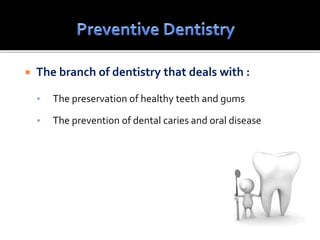
 The branch of dentistry that deals with :
• The preservation of healthy teeth and gums
• The prevention of dental caries and oral disease
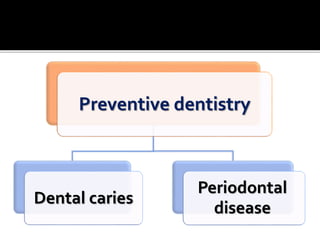
Preventive dentistry
Dental caries
Periodontal
disease
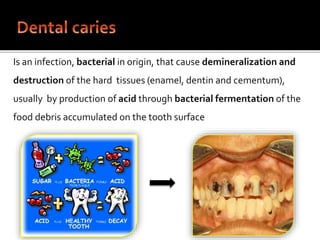
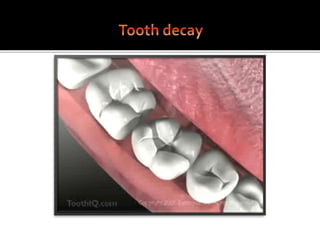
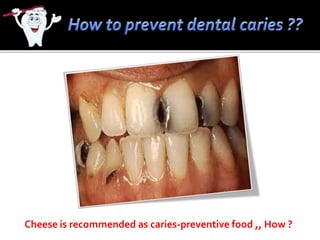
Is an infection, bacterial in origin, that cause demineralization and
destruction of the hard tissues (enamel, dentin and cementum),
usually by production of acid through bacterial fermentation of the
food debris accumulated on the tooth surface
Cheese is recommended as caries-preventive food ,, How ?
1) Fluoride .
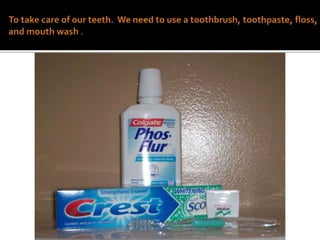
2) Inorganic and organic phosphate.
3) Dextranase.
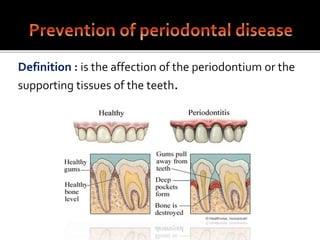
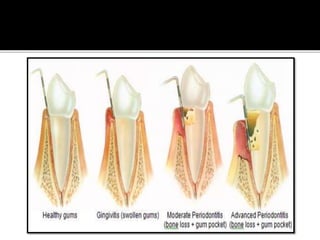
Definition : is the affection of the periodontium or the
supporting tissues of the teeth.
 These may be conveniently divided into local and
systemic predisposing though naturally.
 Any particular patient may be affected by more
than one etiological factor.
I. Local factors
II. Systemic factors
1. The consistency of the diet.
2. Calculus.
3. The process of shedding of deciduous teeth and eruption of
permanent teeth.
4. Untreated caries.
5. Occlausal abnormalities.
6. Prosthetic and orthodontic appliances.
1. Endocrinal disorders.
2. Drugs.
3. During acute fevers.
4. Blood dyscrasias.
5. Avitaminosis.
 Dental prophylaxis
 Good oral hygiene
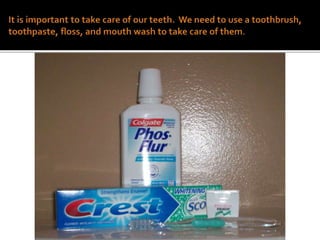
 Tooth brushing
 Devices for entering individual crevices
 Oral irrigation
 Early treatment of carious cavities
 Disorder of occlusion
 Mouth breathing
 Systematic diseases
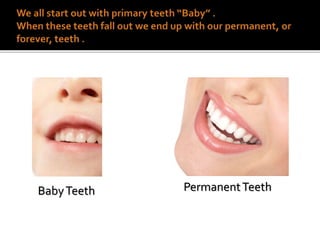
BabyTeeth PermanentTeeth
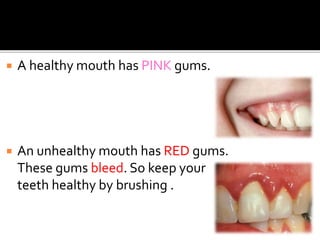
 A healthy mouth has PINK gums.
 An unhealthy mouth has RED gums.
These gums bleed. So keep your
teeth healthy by brushing .
• Many different designs have been manufactured .
• Patients usually uses brushes selected on the basis of cost,
availability, advertising claims, family tradition, or habit .
• Because of the variety in shapes, sizes, textures, and other
characteristics .
• Dental professionals must become familiar with the many
available products to advise patients appropriately
• Conforms to individual patient requirements
• Easily and efficiently manipulated
• Is readily cleaned
• Is durable and inexpensive
• Flexible, soft, and of strength, rigidity and lightness
of the handle
• Has end rounded filaments or bristles
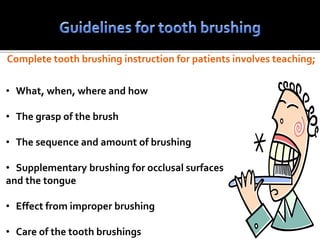
Complete tooth brushing instruction for patients involves teaching;
• What, when, where and how
• The grasp of the brush
• The sequence and amount of brushing
• Supplementary brushing for occlusal surfaces
and the tongue
• Effect from improper brushing
• Care of the tooth brushings
• The emphasis in patient education should be placed on
complete plaque control rather than on number of brushing .
• At least two brushing with interdental cleaning is
recommended for control of bacterial plaque and halitosis
prevention .
• A night brushing before bed time should be encouraged .
1. Manmade bristles of about 0.4mm thick x 12mm long.
2. Firm and resilient bristles with rounded and polished
ends.
3. Short head (about 2.5cm) with flat brushing surface
(2.5x0.5cm) to permit access to all surfaces of the teeth.
4. Multitufted, 2 or 3 rows of separate bundles of bristles.
This allows the bristles to enter easily in the embrasures
and in the depth of the fissures.
5. Able to remove plaque from teeth.
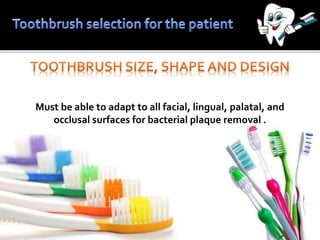
Must be able to adapt to all facial, lingual, palatal, and
occlusal surfaces for bacterial plaque removal .
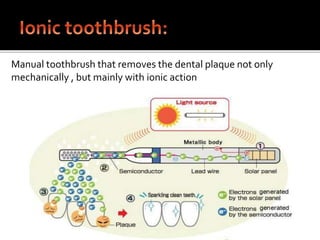
Manual toothbrush that removes the dental plaque not only
mechanically , but mainly with ionic action
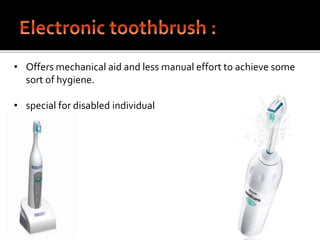
• Offers mechanical aid and less manual effort to achieve some
sort of hygiene.
• special for disabled individual
 There are several different acceptable tooth
brushing methods because each patient has
different needs.
 Not one method is perfect for all patients.
Some patients may use more than one
method.
 The important thing is to brush thoroughly
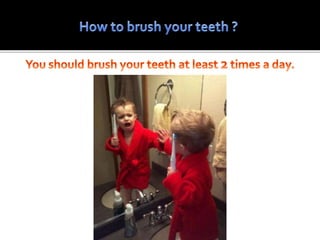
for at least two minutes each time and two
times a day ….
 The Bass Method
 The Rolling Stroke
 The Stillman’s Method
 The Charters Method
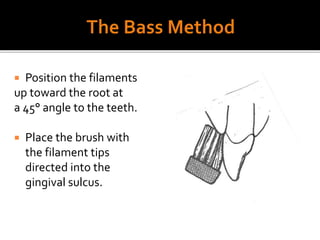
 Position the filaments
up toward the root at
a 45° angle to the teeth.
 Place the brush with
the filament tips
directed into the
gingival sulcus.
Bass Method
 Using a vibratory stroke brush back and forth
with very short strokes for the count of ten.
 Reposition the brush to the next group of
teeth.
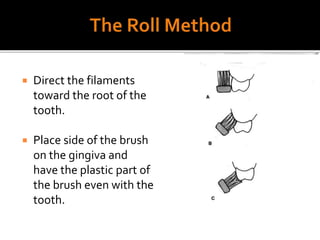
 Direct the filaments
toward the root of the
tooth.
 Place side of the brush
on the gingiva and
have the plastic part of
the brush even with the
tooth.
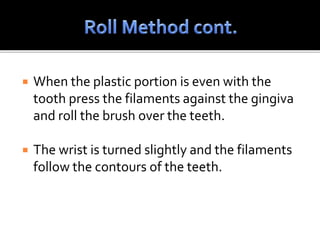
 When the plastic portion is even with the
tooth press the filaments against the gingiva
and roll the brush over the teeth.
 The wrist is turned slightly and the filaments
follow the contours of the teeth.
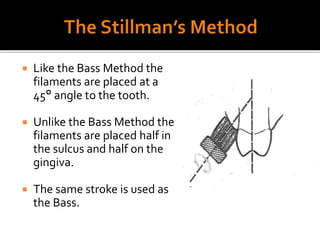
 Like the Bass Method the
filaments are placed at a
45° angle to the tooth.
 Unlike the Bass Method the
filaments are placed half in
the sulcus and half on the
gingiva.
 The same stroke is used as
the Bass.
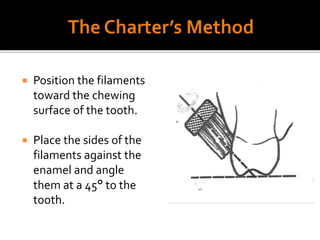
 Position the filaments
toward the chewing
surface of the tooth.
 Place the sides of the
filaments against the
enamel and angle
them at a 45° to the
tooth.
 Vibrate the filaments gently but firmly,
keeping the filaments against the tooth.
 Reposition on the next set of teeth.
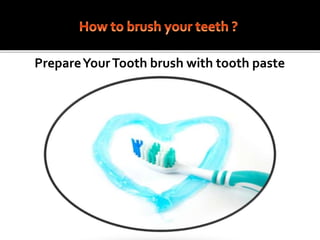
PrepareYourTooth brush with tooth paste
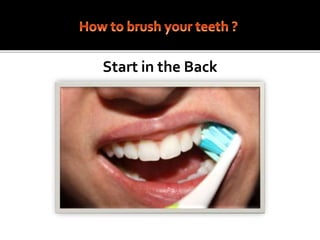
Start in the Back
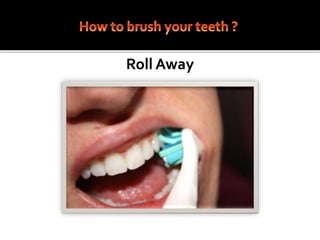
Roll Away
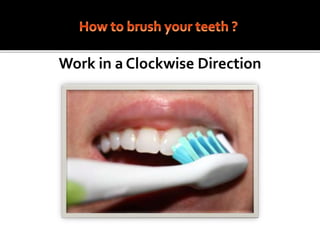
Work in a Clockwise Direction
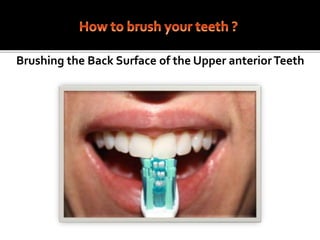
Brushing the Back Surface of the Upper anteriorTeeth
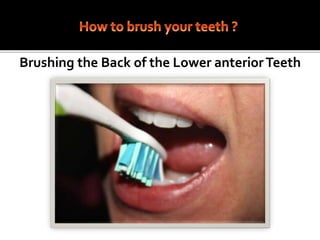
Brushing the Back of the Lower anteriorTeeth
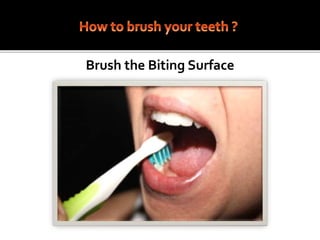
Brush the Biting Surface
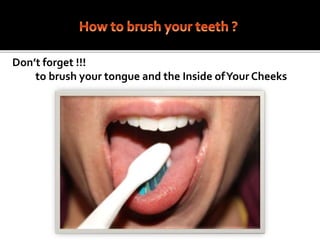
Don’t forget !!!
to brush your tongue and the Inside ofYour Cheeks
• Two brushes for home use and a third in a portable container
for use at work
• Frequent replacement recommended
• Brushes should be replaced before filaments become splayed,
frayed or lose resiliency
• Clean thoroughly after each use
• Brushes should be kept in open air with head in an upright
position, apart from contact with other brushes.
“ Be true to your teeth or they will be false to you ”

Preventive Dentistry

  • 2.
     Health [WHO]: Is a state of complete physical, mental and social well-being and not a mere absence of disease or disability .  Public Health :The art and science of preventing disease , prolonging life and promoting physical and mental efficiency through organized community efforts.  Dental Public Health [ADA] : The science and art of preventing and controlling dental disease and promoting dental health through organized community efforts.
  • 3.
     The branchof dentistry that deals with : • The preservation of healthy teeth and gums • The prevention of dental caries and oral disease
  • 4.
  • 5.
    Is an infection,bacterial in origin, that cause demineralization and destruction of the hard tissues (enamel, dentin and cementum), usually by production of acid through bacterial fermentation of the food debris accumulated on the tooth surface
  • 7.
    Cheese is recommendedas caries-preventive food ,, How ?
  • 8.
    1) Fluoride . 2)Inorganic and organic phosphate. 3) Dextranase.
  • 9.
    Definition : isthe affection of the periodontium or the supporting tissues of the teeth.
  • 10.
     These maybe conveniently divided into local and systemic predisposing though naturally.  Any particular patient may be affected by more than one etiological factor. I. Local factors II. Systemic factors
  • 11.
    1. The consistencyof the diet. 2. Calculus. 3. The process of shedding of deciduous teeth and eruption of permanent teeth. 4. Untreated caries. 5. Occlausal abnormalities. 6. Prosthetic and orthodontic appliances.
  • 13.
    1. Endocrinal disorders. 2.Drugs. 3. During acute fevers. 4. Blood dyscrasias. 5. Avitaminosis.
  • 15.
     Dental prophylaxis Good oral hygiene  Tooth brushing  Devices for entering individual crevices  Oral irrigation  Early treatment of carious cavities  Disorder of occlusion  Mouth breathing  Systematic diseases
  • 19.
  • 20.
     A healthymouth has PINK gums.  An unhealthy mouth has RED gums. These gums bleed. So keep your teeth healthy by brushing .
  • 22.
    • Many differentdesigns have been manufactured . • Patients usually uses brushes selected on the basis of cost, availability, advertising claims, family tradition, or habit . • Because of the variety in shapes, sizes, textures, and other characteristics . • Dental professionals must become familiar with the many available products to advise patients appropriately
  • 23.
    • Conforms toindividual patient requirements • Easily and efficiently manipulated • Is readily cleaned • Is durable and inexpensive • Flexible, soft, and of strength, rigidity and lightness of the handle • Has end rounded filaments or bristles
  • 24.
    Complete tooth brushinginstruction for patients involves teaching; • What, when, where and how • The grasp of the brush • The sequence and amount of brushing • Supplementary brushing for occlusal surfaces and the tongue • Effect from improper brushing • Care of the tooth brushings
  • 25.
    • The emphasisin patient education should be placed on complete plaque control rather than on number of brushing . • At least two brushing with interdental cleaning is recommended for control of bacterial plaque and halitosis prevention . • A night brushing before bed time should be encouraged .
  • 26.
    1. Manmade bristlesof about 0.4mm thick x 12mm long. 2. Firm and resilient bristles with rounded and polished ends. 3. Short head (about 2.5cm) with flat brushing surface (2.5x0.5cm) to permit access to all surfaces of the teeth. 4. Multitufted, 2 or 3 rows of separate bundles of bristles. This allows the bristles to enter easily in the embrasures and in the depth of the fissures. 5. Able to remove plaque from teeth.
  • 27.
    Must be ableto adapt to all facial, lingual, palatal, and occlusal surfaces for bacterial plaque removal .
  • 28.
    Manual toothbrush thatremoves the dental plaque not only mechanically , but mainly with ionic action
  • 29.
    • Offers mechanicalaid and less manual effort to achieve some sort of hygiene. • special for disabled individual
  • 30.
     There areseveral different acceptable tooth brushing methods because each patient has different needs.  Not one method is perfect for all patients. Some patients may use more than one method.
  • 31.
     The importantthing is to brush thoroughly for at least two minutes each time and two times a day ….
  • 32.
     The BassMethod  The Rolling Stroke  The Stillman’s Method  The Charters Method
  • 33.
     Position thefilaments up toward the root at a 45° angle to the teeth.  Place the brush with the filament tips directed into the gingival sulcus. Bass Method
  • 34.
     Using avibratory stroke brush back and forth with very short strokes for the count of ten.  Reposition the brush to the next group of teeth.
  • 35.
     Direct thefilaments toward the root of the tooth.  Place side of the brush on the gingiva and have the plastic part of the brush even with the tooth.
  • 36.
     When theplastic portion is even with the tooth press the filaments against the gingiva and roll the brush over the teeth.  The wrist is turned slightly and the filaments follow the contours of the teeth.
  • 37.
     Like theBass Method the filaments are placed at a 45° angle to the tooth.  Unlike the Bass Method the filaments are placed half in the sulcus and half on the gingiva.  The same stroke is used as the Bass.
  • 38.
     Position thefilaments toward the chewing surface of the tooth.  Place the sides of the filaments against the enamel and angle them at a 45° to the tooth.
  • 39.
     Vibrate thefilaments gently but firmly, keeping the filaments against the tooth.  Reposition on the next set of teeth.
  • 43.
  • 44.
  • 45.
  • 46.
    Work in aClockwise Direction
  • 47.
    Brushing the BackSurface of the Upper anteriorTeeth
  • 48.
    Brushing the Backof the Lower anteriorTeeth
  • 49.
  • 50.
    Don’t forget !!! tobrush your tongue and the Inside ofYour Cheeks
  • 55.
    • Two brushesfor home use and a third in a portable container for use at work • Frequent replacement recommended • Brushes should be replaced before filaments become splayed, frayed or lose resiliency • Clean thoroughly after each use • Brushes should be kept in open air with head in an upright position, apart from contact with other brushes.
  • 56.
    “ Be trueto your teeth or they will be false to you ”