DENGUE
SYNDROME
(DENGUE &
DENGUE
HEMORRHAGIC
FEVER)
DR. VISHAL BATHMA [MBBS,
MBA(HA),MD]
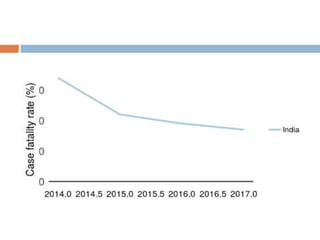
Epidemiology
 In India first outbreak of dengue was
recorded in 1812
 A double peak hemorrhagic fever epidemic
occurred in India for the first time in Calcutta
between July 1963 & March 1964
 In New Delhi, outbreaks of dengue fever
reported in 1967,1970,1982, &1996
Average number of dengue and severe dengue
cases reported to WHO annually
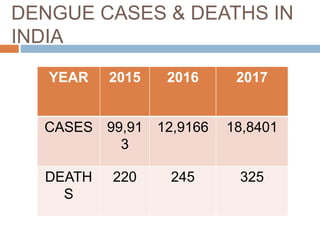
DENGUE CASES & DEATHS IN
INDIA
YEAR 2015 2016 2017
CASES 99,91
3
12,9166 18,8401
DEATH
S
220 245 325
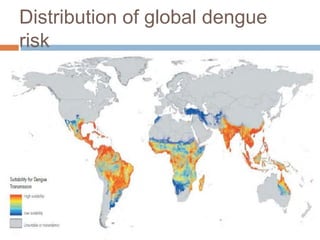
Distribution of global dengue
risk
BURDEN OF DISEASE IN S.E. ASIA
 CATEGORY-A
(INDONESIA,MYANMAR,AND THAILAND)
 CATEGORY-B
(INDIA,BANGALADESH,MALDIVES,AND
SRILANKA)
 CATEGORY-C (BHUTAN, NEPAL)
 CTEGORY-D (DPR KOREA)
Dengue Virus
Causes dengue and dengue hemorrhagic
fever
• It is an arbovirus
• Transmitted by mosquitoes
• Composed of single-stranded RNA
• Has 4 serotypes (DEN-1, 2, 3, 4)
Dengue Virus
•Each serotype provides specific lifetime
immunity, and short-term cross-immunity
•All serotypes can cause severe and fatal
disease
•Genetic variation within serotypes
•Some genetic variants within each serotype
appear to be more virulent or have greater
epidemic potential
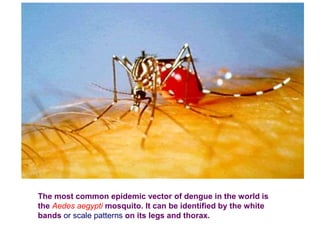
The most common epidemic vector of dengue in the world is
the Aedes aegypti mosquito. It can be identified by the white
bands or scale patterns on its legs and thorax.
Aedes aegypti
•Dengue transmitted by infected female mosquito
•Primarily a daytime feeder
•Lives around human habitation
•Lays eggs and produces larvae preferentially in
artificial containers
Clinical Characteristics of Dengue Fever
•Fever
•Headache
•Muscle and joint pain
•Nausea/vomiting
•Rash
•Hemorrhagic manifestations
Patients may also report other symptoms, such as
itching and aberrations in the sense of taste,
particularly a metallic taste. In addition, there have
been reports of severe depression after the acute
phase of the illness.
1.The virus is inoculated into humans with the
mosquito saliva.
2.The virus localizes and replicates in various
target organs, for example, local lymph nodes
and the liver.
3.The virus is then released from these tissues
and spreads through the blood to infect white
blood cells and other lymphatic tissues.
4.The virus is then released from these tissues
and circulates in the blood.
5.The mosquito ingests blood containing the virus.
6.The virus replicates in the mosquito midgut, the ovaries, nerve tissue and
fat body. It then escapes into the body cavity, and later infects the salivary
glands.
7.The virus replicates in the salivary glands and when the mosquito bites
another human, the cycle continues.
There are actually four dengue
clinical syndromes:
1.Undifferentiated fever;
2.Classic dengue fever;
3.Dengue hemorrhagic fever, or
DHF; and
4.Dengue shock syndrome, or
DSS.
Dengue shock syndrome is
actually a severe form of DHF.
Clinical Case Definition for Dengue Fever
Classical Dengue fever or Break bone fever is an acute
febrile viral disease frequently presenting with
headaches, bone or joint pain, muscular pains, rash and
leucopenia
Clinical Case Definition for Dengue Hemorrhagic Fever
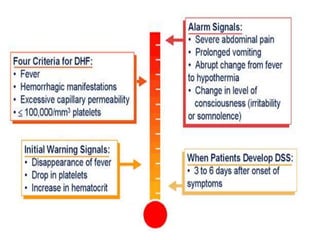
4 Necessary Criteria:
1. Fever, or recent history of acute fever
2. Hemorrhagic manifestations
3. Low platelet count (100,000/mm3 or less)
4. Positive tourniquet test : >20 petechiae/sq. inch
5. Objective evidence of “leaky capillaries:”
• elevated hematocrit (20% or more over baseline)
• low albumin
• pleural or other effusions
Clinical Case Definition for Dengue Shock
Syndrome
•4 criteria for DHF
+
•Evidence of circulatory failure manifested indirectly
by all of the following:
•Rapid and weak pulse
•Narrow pulse pressure (< 20 mm Hg) OR
hypotension for age
•Cold, clammy skin and altered mental status
• Frank shock is direct evidence of circulatory failure
Hemorrhagic Manifestations of Dengue
Skin hemorrhages:
petechiae, purpura, ecchymoses
Bleeding:
•Gingival bleeding
•Nasal bleeding
•Gastrointestinal
Hematemesis, melena, hematochezia
•Hematuria
•Increased menstrual flow
Signs and Symptoms of
Encephalitis/Encephalopathy Associated
with Acute Dengue Infection
•Decreased level of consciousness:
lethargy, confusion, coma
•Seizures
•Nuchal rigidity
•Paresis
Manifestations Of The Dengue
Syndrome
Four Grades of DHF
Grade 1
Fever and nonspecific constitutional symptoms
Positive tourniquet test is only hemorrhagic
manifestation
Grade 2
Grade 1 manifestations + spontaneous bleeding
Grade 3
Signs of circulatory failure (rapid/weak pulse, narrow
pulse pressure, hypotension, cold/clammy skin)
Grade 4
Profound shock (undetectable pulse and BP)
Danger Signs in Dengue Hemorrhagic Fever
•Abdominal pain - intense and sustained
•Persistent vomiting
•Abrupt change from fever to hypothermia, with
sweating and prostration
•Restlessness or somnolence
*All of these are signs of impending shock and
should alert clinicians that the patient needs close
observation and fluids.
What to do if you think you have
dengue
 Bed rest- acute phase
 Cold sponging for reducing fever
X Avoid aspirin, brufen etc – these can cause gastritis,
vomiting, platelet dysfunction
 Paracetamol is preferable for fever management.
 Oral electrolyte therapy: for excessive sweating, vomiting
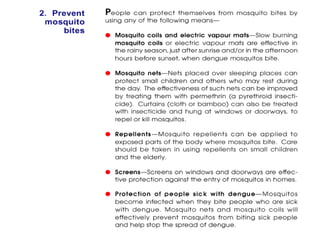
•Avoid mosquito bites
wear full sleeves; Place patient under bed net or use insect
repellent on the patient while they have a fever, Put screens
on windows and doors to prevent mosquitoes from coming
into house.
•Consult a physician.
TAKE PLENTY OF FLUIDS
What does the treating doctor
need to do in such cases?
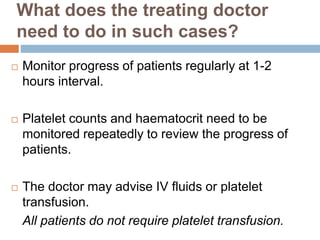
 Monitor progress of patients regularly at 1-2
hours interval.
 Platelet counts and haematocrit need to be
monitored repeatedly to review the progress of
patients.
 The doctor may advise IV fluids or platelet
transfusion.
All patients do not require platelet transfusion.
Purpose of Control
•Reduce female vector density to a level below which
epidemic vector transmission will not occur
•Based on the assumption that eliminating or reducing the
number of larval habitats in the domestic environment will
control the vector
•The minimum vector density to prevent epidemic
transmission
LABORATORY CRITERIA
 ISOLATION OF DENQUE VIRUS
 INCREASED IgM OR IgG ANTIBODIES TITRES
 DENQUE ANTIGEN DETECTION BY
IMMUNOHISTOCHEMISTRY,IMMUNOFLUROSCEN
CE,ELISA
 PCR
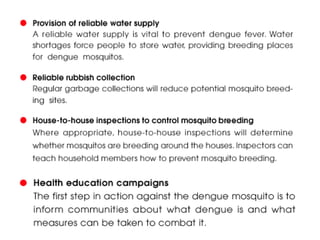
Programs to Minimize the Impact of Epidemics
•Education of the medical community
•Implementation of emergency contingency plan
•Education of the general population
THE GLOBAL STRATEGY
FOR DENGUE
PREVENTION AND
CONTROL
GOAL
 TO REDUCE THE BURDEN OF DENGUE
OBJECTIVES
 To reduce dengue mortality by at least 50% by 2020*
 To reduce dengue morbidity by at least 25% by 2020*
 To estimate the true burden of the disease by 2015
*The year 2010 used as the baseline.
Technical elements
Possible levels of dengue diagnostic tests and
other functions in health centres
ENABLING FACTORS FOR EFFECTIVE
IMPLEMENTATION OF THE GLOBAL STRATEGY
 Advocacy and resource mobilization
 Partnership, coordination and collaboration
 Communication to achieve behavioral outcomes
 Capacity building
 Monitoring and evaluation
THANK YOU

Dengue2

  • 1.
  • 2.
    Epidemiology  In Indiafirst outbreak of dengue was recorded in 1812  A double peak hemorrhagic fever epidemic occurred in India for the first time in Calcutta between July 1963 & March 1964  In New Delhi, outbreaks of dengue fever reported in 1967,1970,1982, &1996
  • 3.
    Average number ofdengue and severe dengue cases reported to WHO annually
  • 5.
    DENGUE CASES &DEATHS IN INDIA YEAR 2015 2016 2017 CASES 99,91 3 12,9166 18,8401 DEATH S 220 245 325
  • 6.
  • 7.
    BURDEN OF DISEASEIN S.E. ASIA  CATEGORY-A (INDONESIA,MYANMAR,AND THAILAND)  CATEGORY-B (INDIA,BANGALADESH,MALDIVES,AND SRILANKA)  CATEGORY-C (BHUTAN, NEPAL)  CTEGORY-D (DPR KOREA)
  • 8.
    Dengue Virus Causes dengueand dengue hemorrhagic fever • It is an arbovirus • Transmitted by mosquitoes • Composed of single-stranded RNA • Has 4 serotypes (DEN-1, 2, 3, 4)
  • 9.
    Dengue Virus •Each serotypeprovides specific lifetime immunity, and short-term cross-immunity •All serotypes can cause severe and fatal disease •Genetic variation within serotypes •Some genetic variants within each serotype appear to be more virulent or have greater epidemic potential
  • 10.
    The most commonepidemic vector of dengue in the world is the Aedes aegypti mosquito. It can be identified by the white bands or scale patterns on its legs and thorax.
  • 12.
    Aedes aegypti •Dengue transmittedby infected female mosquito •Primarily a daytime feeder •Lives around human habitation •Lays eggs and produces larvae preferentially in artificial containers
  • 13.
    Clinical Characteristics ofDengue Fever •Fever •Headache •Muscle and joint pain •Nausea/vomiting •Rash •Hemorrhagic manifestations Patients may also report other symptoms, such as itching and aberrations in the sense of taste, particularly a metallic taste. In addition, there have been reports of severe depression after the acute phase of the illness.
  • 14.
    1.The virus isinoculated into humans with the mosquito saliva. 2.The virus localizes and replicates in various target organs, for example, local lymph nodes and the liver. 3.The virus is then released from these tissues and spreads through the blood to infect white blood cells and other lymphatic tissues. 4.The virus is then released from these tissues and circulates in the blood.
  • 15.
    5.The mosquito ingestsblood containing the virus. 6.The virus replicates in the mosquito midgut, the ovaries, nerve tissue and fat body. It then escapes into the body cavity, and later infects the salivary glands. 7.The virus replicates in the salivary glands and when the mosquito bites another human, the cycle continues.
  • 17.
    There are actuallyfour dengue clinical syndromes: 1.Undifferentiated fever; 2.Classic dengue fever; 3.Dengue hemorrhagic fever, or DHF; and 4.Dengue shock syndrome, or DSS. Dengue shock syndrome is actually a severe form of DHF.
  • 18.
    Clinical Case Definitionfor Dengue Fever Classical Dengue fever or Break bone fever is an acute febrile viral disease frequently presenting with headaches, bone or joint pain, muscular pains, rash and leucopenia Clinical Case Definition for Dengue Hemorrhagic Fever 4 Necessary Criteria: 1. Fever, or recent history of acute fever 2. Hemorrhagic manifestations 3. Low platelet count (100,000/mm3 or less) 4. Positive tourniquet test : >20 petechiae/sq. inch 5. Objective evidence of “leaky capillaries:” • elevated hematocrit (20% or more over baseline) • low albumin • pleural or other effusions
  • 19.
    Clinical Case Definitionfor Dengue Shock Syndrome •4 criteria for DHF + •Evidence of circulatory failure manifested indirectly by all of the following: •Rapid and weak pulse •Narrow pulse pressure (< 20 mm Hg) OR hypotension for age •Cold, clammy skin and altered mental status • Frank shock is direct evidence of circulatory failure
  • 20.
    Hemorrhagic Manifestations ofDengue Skin hemorrhages: petechiae, purpura, ecchymoses Bleeding: •Gingival bleeding •Nasal bleeding •Gastrointestinal Hematemesis, melena, hematochezia •Hematuria •Increased menstrual flow
  • 21.
    Signs and Symptomsof Encephalitis/Encephalopathy Associated with Acute Dengue Infection •Decreased level of consciousness: lethargy, confusion, coma •Seizures •Nuchal rigidity •Paresis
  • 22.
    Manifestations Of TheDengue Syndrome
  • 23.
    Four Grades ofDHF Grade 1 Fever and nonspecific constitutional symptoms Positive tourniquet test is only hemorrhagic manifestation Grade 2 Grade 1 manifestations + spontaneous bleeding Grade 3 Signs of circulatory failure (rapid/weak pulse, narrow pulse pressure, hypotension, cold/clammy skin) Grade 4 Profound shock (undetectable pulse and BP)
  • 24.
    Danger Signs inDengue Hemorrhagic Fever •Abdominal pain - intense and sustained •Persistent vomiting •Abrupt change from fever to hypothermia, with sweating and prostration •Restlessness or somnolence *All of these are signs of impending shock and should alert clinicians that the patient needs close observation and fluids.
  • 27.
    What to doif you think you have dengue  Bed rest- acute phase  Cold sponging for reducing fever X Avoid aspirin, brufen etc – these can cause gastritis, vomiting, platelet dysfunction  Paracetamol is preferable for fever management.  Oral electrolyte therapy: for excessive sweating, vomiting •Avoid mosquito bites wear full sleeves; Place patient under bed net or use insect repellent on the patient while they have a fever, Put screens on windows and doors to prevent mosquitoes from coming into house. •Consult a physician. TAKE PLENTY OF FLUIDS
  • 28.
    What does thetreating doctor need to do in such cases?  Monitor progress of patients regularly at 1-2 hours interval.  Platelet counts and haematocrit need to be monitored repeatedly to review the progress of patients.  The doctor may advise IV fluids or platelet transfusion. All patients do not require platelet transfusion.
  • 29.
    Purpose of Control •Reducefemale vector density to a level below which epidemic vector transmission will not occur •Based on the assumption that eliminating or reducing the number of larval habitats in the domestic environment will control the vector •The minimum vector density to prevent epidemic transmission
  • 33.
    LABORATORY CRITERIA  ISOLATIONOF DENQUE VIRUS  INCREASED IgM OR IgG ANTIBODIES TITRES  DENQUE ANTIGEN DETECTION BY IMMUNOHISTOCHEMISTRY,IMMUNOFLUROSCEN CE,ELISA  PCR
  • 35.
    Programs to Minimizethe Impact of Epidemics •Education of the medical community •Implementation of emergency contingency plan •Education of the general population
  • 37.
    THE GLOBAL STRATEGY FORDENGUE PREVENTION AND CONTROL
  • 38.
    GOAL  TO REDUCETHE BURDEN OF DENGUE OBJECTIVES  To reduce dengue mortality by at least 50% by 2020*  To reduce dengue morbidity by at least 25% by 2020*  To estimate the true burden of the disease by 2015 *The year 2010 used as the baseline.
  • 39.
  • 41.
    Possible levels ofdengue diagnostic tests and other functions in health centres
  • 42.
    ENABLING FACTORS FOREFFECTIVE IMPLEMENTATION OF THE GLOBAL STRATEGY  Advocacy and resource mobilization  Partnership, coordination and collaboration  Communication to achieve behavioral outcomes  Capacity building  Monitoring and evaluation
  • 44.