DEMENTIA
Dr. Rahul Sharma
Associate Professor
H.O.D. of Mental Health Nursing
Ph. D Coordinator
Seedling School of Nursing,
Jaipur National University, Jaipur
INTRODUCTION
 The word ‘Dementia’ is derived from 2 latin words
i.e. ‘de’ means ‘away’ and ‘mentia’ means
‘mind’. IN latin dementia means ‘ irritationality’.
It is a late life disease as it tends to develop
mostly in elderly people.
Definition
A syndrome characterized by multiple
cognitive defects including disturbing
memory without disturbance of
consciousness.
CAUSES
 Degenerative diseases
 Vascular causes
 Toxic reaction
 Huntingtons disease
 Parkinsons disease
 Head trauma
 Brain tumor
TYPES
 CORTICAL DEMENTIA
 SUBCORTICAL DEMENTIA
 PROGRESSIVE DEMENTIA
 PRIMARY DEMENTIA
 SECONDARY DEMENTIA
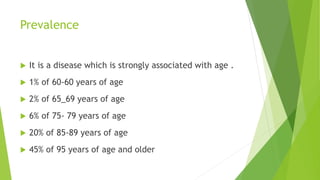
Prevalence
 It is a disease which is strongly associated with age .
 1% of 60-60 years of age
 2% of 65_69 years of age
 6% of 75- 79 years of age
 20% of 85-89 years of age
 45% of 95 years of age and older
CLINICAL MANIFESTATION
 Forgetfulness
 Difficulties with activity
 Language difficulty
 Impaired judgment
 Problem r/t to thinking
 No interest in their work and hobbies
 Confusion
 Drowsiness
DIAGNOSTIC EVALUATION
 History taking
 Physical examination
 M.S.E
 CT SCAN
 MRI & MRA
 Neuro psychological test
 Assesment of activities of daily living
Treatment
ANTIPSYCHOTIC DRUGS
ANTI DEPRESSANTS
ANTI ANXIETY DRUGS
COGNITIVE THERAPY
Dementia disorder
Dementia disorder

Dementia disorder