1
DEMENTIA

CENTRAL AMERICA HEALTH SCIENCE UNIVERSITY,
BELIZE
18TH NOV 2013
INSTRUCTOR : DR. SURYA SUDARSHAN
PRESENTER : MAHESH SUNDARAM
: SYED ABDUL SAMIE
: GIA K.SHARMA
WHAT IS IT :
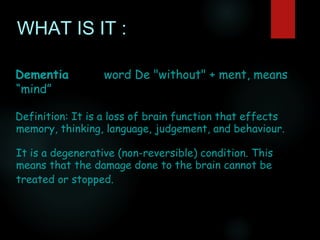
Dementia Latin word De "without" + ment, means
“mind”
Definition: It is a loss of brain function that effects
memory, thinking, language, judgement, and behaviour. 
It is a degenerative (non-reversible) condition. This
means that the damage done to the brain cannot be
treated or stopped.
4
GOALS IN DEMENTIA


Evaluation and Diagnosis



Current Therapy for Dementia



Complications



Resources for the Caregivers
Early Symptoms and Warning Signs
As we get older, many of us become more forgetful – for example we
might misplace our keys occasionally or find it difficult to find the
right word to describe something. This is normal and isn’t a cause
for concern.
It is important to be able to differentiate between these changes
and the early warning signs of a more serious condition. These early
signs can start to develop as much as twenty years before a
diagnosis is made.
Research carried out at Stanford University in the USA suggests
that a newly developed blood test can identify people most at risk
from developing DEMENTIA disease up to six years before the
symptoms become apparent.
The test measures the levels of a number of proteins in the blood
associated with Alzheimer’s.
7
Diagnosis



Based on memory loss (both short and long-term),
plus one or more of the following:



Aphasia – language problems



Apraxia – organisational problems



Agnosia – unable to recognise objects or tell their
purpose



Disturbed executive function – personality and
inhibition
Is it JUST “Old Age?”
Signs of Dementia

Typical Age
Related Changes



Poor judgment and decision making



Inability to manage a budget



Making a bad decision once in a while



Losing track of the date or the
season



Missing a monthly payment



Forgetting which day it is and
remembering later



Sometimes forgetting which word to use



Losing things from time to time.



Difficulty having a conversation



Misplacing things and being unable
to retrace steps to find them
Types of Dementia



Alzheimer’s – Most common , Memory, Language,
Visuospatial, Indifferent to Loss



Lewy Body – second most common (vivid
hallucinations), Visual hallucinations, delusions,
flucutating mental status



Fronto-temporal – shrinking frontal and temporal
lobes, Memory, Marked Personality changes,
Preserved visuospatial
TYPES OF DEMENTIA
cont…


Vascular Dementia– aka multi-infarct dementia,1530% develop dementia



Progressive Supranuclear Palsy



The Rare Birds : Late onset Metabolic Disease



Other causes: Alcoholism, AIDS, Pick’s disease, etc…
Disease
EVALUATION


HISTORY
HPI,

Medical, Medications, Psychiatric, Functional,
Caregiver



EXAM
Physical,

Neurologic, Psychiatric, Cognitive Testing
EVALUATION


LABORATORY



Blood Work





CBC, TSH, Chem 7, Ca 2+, B12, Folate
RPR

Imaging




CT or MRI

Other Studies


LP, neuropsychiatric testing, EEG,



SPECT, PET
DIFFERENTIAL DIAGNOSIS


DEPRESSION Pseudodementia



CNS: Neoplasm, NPH, stroke



Vascular: subdural, vasculitis,



Endocrine: Thyroid, Calcium,



Nutritional: B12, Thiamine,ETOH



Infections: HIV, Cryptococcus
CURRENT THERAPY
CHOLINESTERASE INHIBITORS





For mild to moderate disease, slow progression,
stabilize ADL and MMSE

1st Generation





Tacrine hepatotoxic, last choice

2nd Generation




Donepezil 5-10 mg qd

$113/mp



Rivastigmine 3-6 mg bid $153/mo



Galantamine 16-32

$298/mo
CURRENT THERAPY cont…


VITAMIN E




GINKGO BILOBA




Antioxident, anti-inflammatory

ESTROGENS




Antioxident, inexpensive

neuroprotective?

NSAIDS


Epidemiologic suggestions
COMPLICATIONS





Depression
Suspicion
Disinhibition
Agitation
 Verbal,

Vocal,

Anxiety
 Aggression
 Withdrawal
 Vegetative






Psychosis
 Hallucinations
 Delusions

sleep



Motor

appetite

Wandering
 Apathy

APPROACHES TO
BEHAVIOUR PROBLEMS

1.
 2.
 3.
 4.




5.

6.
 7.
 8.
 9.


Define target symptoms
Revisit medical diagnoses
Establish neuropsychiatric diagnoses
Assess and remove provoking factors:
environmental, psychosocial, other
Adapt environment and treatments to specific
cognitive deficits
Educate caregivers
Employ behavior management principles
Treat specific psychiatric disease specifically
For remaining behavior problems consider
symptomatic pharmacotherapy
PHARMACOTHERAPY


DEPRESSION



TCADS Nortriptyline




SSRI’S Paroxetine, Sertraline, Others
ECT if life threatening

ANXIETY




Buspirone,Lorazepam, Propanolol

PSYCHOSIS


Rispiridone, Olanzepine, Haloperidol
PHARMACOTHERAPY


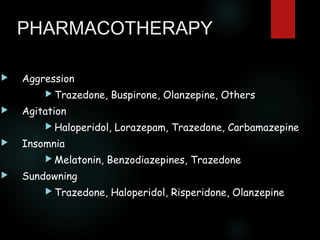
Aggression
 Trazedone,



Buspirone, Olanzepine, Others

Agitation
 Haloperidol,



Insomnia
 Melatonin,



Lorazepam, Trazedone, Carbamazepine

Benzodiazepines, Trazedone

Sundowning
 Trazedone,

Haloperidol, Risperidone, Olanzepine






PROGRESSION
Forgetfulness
 complains

of memory deficits, misplace objects, trouble
word finding, functional

Confusional
 getting

lost, job trouble, language problems, lost objects
denial, anxiety, lost current events, can’t handle finance
other executive functions, withdrawal

Early Dementia
 Need

assistance, can’t use phone reliably, disorientation
to time, place, know family, can feed and toilet with
reminders
PROGRESSION


Middle Dementia




Late Dementia




Unaware of surroundings, forget spouse’s name,
loss of recent events of life, personality and
behavior changes, needs help with most ADL
Loss of all verbal abilities, complete incontinence,
no thirst or hunger responses

TIME COURSE
DAY TO DAY CARE


Be Firm, Don’t Rush or Argue
 Now



it time to….., don’t rush or argue

Minimize Distractions
 Decrease



Keep It Simple, Keep It Safe
 Cannot



follow multi-step commands

Lower Your Standards
 Expect



noise, remove visual clutter

less from the patient

Establish Routines
 Reassuring,

reduce agitation
CARE FOR CAREGIVERS


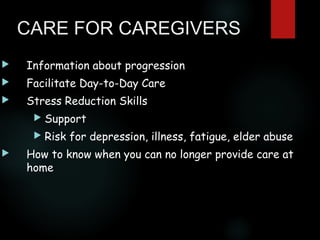
Information about progression



Facilitate Day-to-Day Care



Stress Reduction Skills





Support
Risk for depression, illness, fatigue, elder abuse

How to know when you can no longer provide care at
home
Economics of Dementia


2-5 million affected
With



current demographics 10 million by 2030

Expenses

TOTAL $100 Billion

Ranks
 Per

third (Heart disease and Cancer)

Capita

Direct

$10-25K home, $40-50k NH

Indirect
Unpaid
Paid

$60k

Care

$10-50k

Out of Pocket 65%
Consider Hospice/Palliative
Care


Dementia is a terminal disease. Consider palliative care
referrals and/or referrals to support agencies early on.



Once patient has progressed and is in the late stages of
the disease, consider a hospice referral to help keep
the patient comfortable and provide ongoing support for
the family.
Research
In

2013, multiple AD biomarkers are receiving research attention,
including structural and metabolic brain alterations as well as
amyloid and tau protein levels in both the brain and cerebrospinal
fluid (CSF). Lilly’s experimental Alzheimer’s drug (Solanezumab):

Created

to attach to protein fragments in the brain before those
fragments clump together to become plaques.

DIAN

studies – Alzheimer’s Association has funded 4.2 million for
this study. DIAN is a network of investigators recruiting families
with dominantly inherited AD. These families have rare, inherited
gene mutations that cause young onset, familiar AD.
Thank you

Dementia

  • 1.
  • 2.
    DEMENTIA CENTRAL AMERICA HEALTHSCIENCE UNIVERSITY, BELIZE 18TH NOV 2013 INSTRUCTOR : DR. SURYA SUDARSHAN PRESENTER : MAHESH SUNDARAM : SYED ABDUL SAMIE : GIA K.SHARMA
  • 3.
    WHAT IS IT: Dementia Latin word De "without" + ment, means “mind” Definition: It is a loss of brain function that effects memory, thinking, language, judgement, and behaviour.  It is a degenerative (non-reversible) condition. This means that the damage done to the brain cannot be treated or stopped.
  • 4.
  • 5.
    GOALS IN DEMENTIA  Evaluationand Diagnosis  Current Therapy for Dementia  Complications  Resources for the Caregivers
  • 6.
    Early Symptoms andWarning Signs As we get older, many of us become more forgetful – for example we might misplace our keys occasionally or find it difficult to find the right word to describe something. This is normal and isn’t a cause for concern. It is important to be able to differentiate between these changes and the early warning signs of a more serious condition. These early signs can start to develop as much as twenty years before a diagnosis is made. Research carried out at Stanford University in the USA suggests that a newly developed blood test can identify people most at risk from developing DEMENTIA disease up to six years before the symptoms become apparent. The test measures the levels of a number of proteins in the blood associated with Alzheimer’s.
  • 7.
  • 8.
    Diagnosis  Based on memoryloss (both short and long-term), plus one or more of the following:  Aphasia – language problems  Apraxia – organisational problems  Agnosia – unable to recognise objects or tell their purpose  Disturbed executive function – personality and inhibition
  • 9.
    Is it JUST“Old Age?” Signs of Dementia Typical Age Related Changes  Poor judgment and decision making  Inability to manage a budget  Making a bad decision once in a while  Losing track of the date or the season  Missing a monthly payment  Forgetting which day it is and remembering later  Sometimes forgetting which word to use  Losing things from time to time.  Difficulty having a conversation  Misplacing things and being unable to retrace steps to find them
  • 10.
    Types of Dementia  Alzheimer’s– Most common , Memory, Language, Visuospatial, Indifferent to Loss  Lewy Body – second most common (vivid hallucinations), Visual hallucinations, delusions, flucutating mental status  Fronto-temporal – shrinking frontal and temporal lobes, Memory, Marked Personality changes, Preserved visuospatial
  • 11.
    TYPES OF DEMENTIA cont…  VascularDementia– aka multi-infarct dementia,1530% develop dementia  Progressive Supranuclear Palsy  The Rare Birds : Late onset Metabolic Disease  Other causes: Alcoholism, AIDS, Pick’s disease, etc… Disease
  • 12.
    EVALUATION  HISTORY HPI, Medical, Medications, Psychiatric,Functional, Caregiver  EXAM Physical, Neurologic, Psychiatric, Cognitive Testing
  • 13.
    EVALUATION  LABORATORY  Blood Work    CBC, TSH,Chem 7, Ca 2+, B12, Folate RPR Imaging   CT or MRI Other Studies  LP, neuropsychiatric testing, EEG,  SPECT, PET
  • 14.
    DIFFERENTIAL DIAGNOSIS  DEPRESSION Pseudodementia  CNS:Neoplasm, NPH, stroke  Vascular: subdural, vasculitis,  Endocrine: Thyroid, Calcium,  Nutritional: B12, Thiamine,ETOH  Infections: HIV, Cryptococcus
  • 15.
    CURRENT THERAPY CHOLINESTERASE INHIBITORS   Formild to moderate disease, slow progression, stabilize ADL and MMSE 1st Generation   Tacrine hepatotoxic, last choice 2nd Generation   Donepezil 5-10 mg qd $113/mp  Rivastigmine 3-6 mg bid $153/mo  Galantamine 16-32 $298/mo
  • 16.
    CURRENT THERAPY cont…  VITAMINE   GINKGO BILOBA   Antioxident, anti-inflammatory ESTROGENS   Antioxident, inexpensive neuroprotective? NSAIDS  Epidemiologic suggestions
  • 17.
    COMPLICATIONS     Depression Suspicion Disinhibition Agitation  Verbal, Vocal, Anxiety  Aggression Withdrawal  Vegetative    Psychosis  Hallucinations  Delusions sleep  Motor appetite Wandering  Apathy 
  • 18.
    APPROACHES TO BEHAVIOUR PROBLEMS 1. 2.  3.  4.   5. 6.  7.  8.  9.  Define target symptoms Revisit medical diagnoses Establish neuropsychiatric diagnoses Assess and remove provoking factors: environmental, psychosocial, other Adapt environment and treatments to specific cognitive deficits Educate caregivers Employ behavior management principles Treat specific psychiatric disease specifically For remaining behavior problems consider symptomatic pharmacotherapy
  • 19.
    PHARMACOTHERAPY  DEPRESSION   TCADS Nortriptyline   SSRI’S Paroxetine,Sertraline, Others ECT if life threatening ANXIETY   Buspirone,Lorazepam, Propanolol PSYCHOSIS  Rispiridone, Olanzepine, Haloperidol
  • 20.
    PHARMACOTHERAPY  Aggression  Trazedone,  Buspirone, Olanzepine,Others Agitation  Haloperidol,  Insomnia  Melatonin,  Lorazepam, Trazedone, Carbamazepine Benzodiazepines, Trazedone Sundowning  Trazedone, Haloperidol, Risperidone, Olanzepine
  • 21.
       PROGRESSION Forgetfulness  complains of memorydeficits, misplace objects, trouble word finding, functional Confusional  getting lost, job trouble, language problems, lost objects denial, anxiety, lost current events, can’t handle finance other executive functions, withdrawal Early Dementia  Need assistance, can’t use phone reliably, disorientation to time, place, know family, can feed and toilet with reminders
  • 22.
    PROGRESSION  Middle Dementia   Late Dementia   Unawareof surroundings, forget spouse’s name, loss of recent events of life, personality and behavior changes, needs help with most ADL Loss of all verbal abilities, complete incontinence, no thirst or hunger responses TIME COURSE
  • 23.
    DAY TO DAYCARE  Be Firm, Don’t Rush or Argue  Now  it time to….., don’t rush or argue Minimize Distractions  Decrease  Keep It Simple, Keep It Safe  Cannot  follow multi-step commands Lower Your Standards  Expect  noise, remove visual clutter less from the patient Establish Routines  Reassuring, reduce agitation
  • 24.
    CARE FOR CAREGIVERS  Informationabout progression  Facilitate Day-to-Day Care  Stress Reduction Skills    Support Risk for depression, illness, fatigue, elder abuse How to know when you can no longer provide care at home
  • 25.
    Economics of Dementia  2-5million affected With  current demographics 10 million by 2030 Expenses TOTAL $100 Billion Ranks  Per third (Heart disease and Cancer) Capita Direct $10-25K home, $40-50k NH Indirect Unpaid Paid $60k Care $10-50k Out of Pocket 65%
  • 26.
    Consider Hospice/Palliative Care  Dementia isa terminal disease. Consider palliative care referrals and/or referrals to support agencies early on.  Once patient has progressed and is in the late stages of the disease, consider a hospice referral to help keep the patient comfortable and provide ongoing support for the family.
  • 27.
    Research In 2013, multiple ADbiomarkers are receiving research attention, including structural and metabolic brain alterations as well as amyloid and tau protein levels in both the brain and cerebrospinal fluid (CSF). Lilly’s experimental Alzheimer’s drug (Solanezumab): Created to attach to protein fragments in the brain before those fragments clump together to become plaques. DIAN studies – Alzheimer’s Association has funded 4.2 million for this study. DIAN is a network of investigators recruiting families with dominantly inherited AD. These families have rare, inherited gene mutations that cause young onset, familiar AD.
  • 28.