Internet markets and online advertising
Marco Delmastro
Agcom
Head of Media Market Analysis
Summer School for Journalists and Media Practitioners: “Freedom and
Pluralism of Traditional and New Media”
European University Institute
3 June 2014
2
Outline
• Media markets
– Two-sided markets (or multi-sided markets)
– Network externalities (direct, indirect, and cross-side)
– Other characteristics: multi-homing, switching costs, sunk costs and
economies of scale, users’ preferences
• The Internet
– The value chain
– Web markets (upstream and downstream): device (smartphone, tablet,
desktop,..) & software (app, OS,..), horizontal (search, social networks,…)
and vertical (information,…) web services, online advertising
– Competitive structures (the winner takes all?)
• Information
– Traditional sources (TV, radio, newspapers,…)
– New digital sources and services
– Business models
Media markets: two-sided markets
3
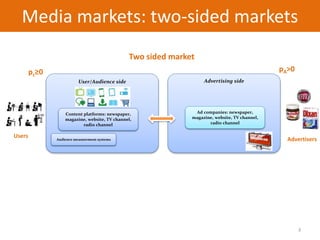
User/Audience side Advertising side
Ad companies: newspaper,
magazine, website, TV channel,
radio channel
Content platforms: newspaper,
magazine, website, TV channel,
radio channel
Audience measurement systems
Users
Advertisers
Two sided market
pc≥0 pA>0
4
Media markets: two-sided markets
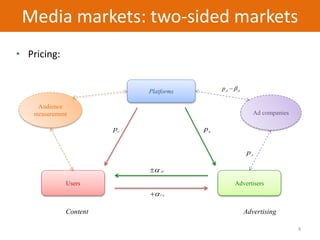
Platforms
Users Advertisers
Ad companies
Audience
measurement
AAp 
pA
pC
pA
 CA
 AC
Content Advertising
• Pricing:
5
Media markets: two-sided markets
• Pricing:
– Feedback loop between the two sides
– Increase in price on one side causes a decrease in demand on
the first side (traditional direct effect) and on both sides
(indirect effect due to externalities)
– Optimal price depend on the price sensitivity of demand on
both sides, the nature and intensity of indirect network effects,
and marginal costs
– Possible zero (or even negative) prices on one sides
6
Media markets: newspapers
• Example: The price war in the UK newspaper market in the
1990s
Price of
newspapers:
Guardian,
Independent,
Times, Daily
Telegraph
7
Media markets: newspapers
• Example: The price war in the UK newspaper market in the
1990s
Circulation of
newspapers:
Guardian,
Independent,
Times, Daily
Telegraph
8
Media markets: newspapers
• Example: The price war in the UK newspaper market in the
1990s
Price of ads:
Guardian,
Independent,
Times, Daily
Telegraph
9
Media markets: newspapers
• Example: The price war in the UK newspaper market in the
1990s
Profits:
Times
10
Media markets: newspapers
• Example: The price war in the UK newspaper market in the
1990s
% circulation
revenues:
Guardian,
Independent,
Times, Daily
Telegrap
Media markets: the Internet
11
Networks (mobile and fixed)
Device and software (for surfing the web)
Web services: horizontal and vertical Online advertising
Access
Backhaul/
switching
Backbone
Software
(OS, browser)
Device
((pc, tablet, console, connected TV,
smarthphone)
Search
Ad exchanges, ad
networks, web
analytics
Information
Social media
Users AdvertisersAd companies
p=0 free content
p>0 pay
Two sided market pA>0
Integration
Vertical
integration
12
The Internet: market structure
• Winner-Take-All (WTA) in web markets (?)
– WTA: market share of the leader >80-90%
– Dominant position
• Predicting platform market structure
• Factors:
– Strength of network effects
• Direct
• Cross-side
• Indirect
– Economies of scale (natural monopoly)
– Multi-homing costs (and switching-costs)
– Users’ preferences for differentiated platform functionality
13
The Internet: network externalities
• Network externalities
– direct: within one side of the market
– cross-side: two-side network effects
– Indirect: between two different markets (in vertical relationship in the
value chain)
“Early on, [Microsoft] recognized that consumers would benefit greatly if a wide range
of hardware and software products could interoperate with one another. Among other
things, (i) the products would be more useful if information could be exchanged among
them, and (ii) development costs would fall and a broader array of products would
become available if they could be developed for larger customer segments without the
need to rewrite software to target narrow platforms. As more products became
available and more information could be exchanged, more consumers would be
attracted to the platform, which would in turn attract more investment in product
development for the platform. Economists call this a "network effect," but at the time
we called it the "positive feedback loop” (Bill Gates, 1998)
“Bitcoin is a classic network effect, a positive feedback loop. The more people who use
Bitcoin, the more valuable Bitcoin is for everyone who uses it, and the higher the
incentive for the next user to start using the technology. Bitcoin shares this network
effect property with the telephone system, the web, and popular Internet services like
eBay and Facebook…For this reason alone, new challengers to Bitcoin face a hard uphill
battle. If something is to displace Bitcoin now, it will have to have sizable
improvements and it will have to happen quickly. Otherwise, this network effect will
carry Bitcoin to dominance.” (Marc Andreesen, 2014)
The Internet: direct network externalities
14
Networks (mobile and fixed)
Device and software (for surfing the web)
Web services Online advertising
Access
Backhaul/
switching
Backbone
Software
(OS, browser)
Device
((pc, tablet, console, connected TV,
smarthphone)
Ad exchanges, ad
networks, web
analyticsSocial
networks
Users Advertisers
Ad companies
15
The Internet: direct network externalities
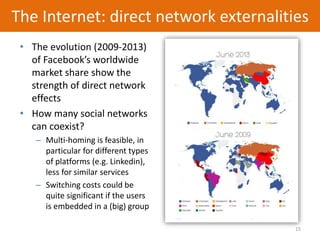
• The evolution (2009-2013)
of Facebook’s worldwide
market share show the
strength of direct network
effects
• How many social networks
can coexist?
– Multi-homing is feasible, in
particular for different types
of platforms (e.g. Linkedin),
less for similar services
– Switching costs could be
quite significant if the users
is embedded in a (big) group
16
The Internet: direct network externalities
• If the number of users exceeds a threshold network size
than “bandwagon effect”
• Corner solution with one winner and many losers
Mondo0
20
40
60
80
100
Mondo Europa Italia
The Internet: cross-side network extern.
17
Networks (mobile and fixed)
Device and software (for surfing the web)
Web services Online advertising
Access
Backhaul/
switching
Backbone
Software
(OS, browser)
Device
((pc, tablet, console, connected TV,
smarthphone)
Users Advertisers
Search
Ad exchanges, ad
networks, web
analytics
18
The Internet: cross-side network extern.
• When network externalities across the two sides of the
market are strong a platform will emerge as a leader
• Search:
– Advertisers claim for more users to be reached by their commercials
– Users ask for more advertisers within a search platform
0
10
20
30
40
50
60
70
80
90
100
mar-01
set-01
mar-02
set-02
mar-03
set-03
mar-04
set-04
mar-05
set-05
mar-06
set-06
mar-07
set-07
mar-08
set-08
mar-09
set-09
mar-10
set-10
mar-11
set-11
mar-12
set-12
mar-13
Google Yahoo! Microsoft (MSN/Bing) Altri
The Internet: indirect network externalities
19
Networks (mobile and fixed)
Device and software (for surfing the web)
Web services Online advertising
Access
Backhaul/
switching
Backbone
Software
(OS, browser)
Device
((pc, tablet, console, connected TV,
smarthphone)
Users Advertisers
Search
Ad exchanges, ad
networks, web
analytics
20
The Internet: indirect network externalities
• Indirect network externalities relates to a complementary
positive feedback between different markets
– Software-hardware: operating system (Microsoft
Windows) and software/web applications (Microsoft
Office/Internet Explorer)
– Software-web ad services: operating system (Android) and
web ad services (Google AdSense platform) (ongoing
antitrust case in EU)
21
The Internet: platform envelopment
• Strategy: through envelopment, a provider in one platform
market can enter another platform market, combining its own
functionality with the target’s in a multi-platform bundle that
leverages shared user relationships
• Ingredients: bundling of services/products, economies of
scope, network effects
• Example: Google has entered many platform markets by
linking (bundle) new products to its search platform (Google
Search), including audiovisual content (YouTube), maps
(Google Maps), email (Gmail), social network (Google +), web
browser software (Chrome), and mobile phone operating
system (Android)
• Result: leverage effect
22
The Internet: platform envelopment
• Network of servers:
“there really are almost no companies in the world, just a handful, that
are really investing in scaled public cloud infrastructure. We [Microsoft]
have something over a million servers in our datacenter infrastructure.
Google is bigger than we are. Amazon is a little bit smaller. You get
Yahoo! and Facebook, and then everybody else is 100,000 units
probably or less. So the number of companies that really understand
the network topology, the datacenter construction, the server
requirements to build this public cloud infrastructure is very, very small,
very small.” (Steve Ballmer, 2013)
• Estimated value (rough):
– Google: $4.0 - 6.5 B
– Microsoft: $3.0 - 5.5 B
– Amazon: $3.0 - 5.0 B
The Internet: platform envelopment
23
The Internet: platform envelopment
Device&Software Horizontal web services
Online ad
OS
(desktop)
OS
(mobile)
Browser
(desktop)
Browser
(mobile)
Search
Social
network
Portals
-
Leader
(37%)
Leader
(40%)
Leader
(43%)
Leader
(90%)
Minor
(<1%)
-
Leader
(32%)
Leader
(91%)
Minor
(1%)
Second
(29%)
Minor
(3%)
Second
(7%)
Minor
(<1%)
Third
(12%)
Minor
(3%)
Second
(7%)
Second
(25%)
Fourth
(8%)
Second
(39%)
-
Minor
(<1%)
- -
- - - - -
Leader
(79%)
-
Second
(4%)
- - - - -
Minor
(<1%)
Leader
(26%)
Minor
(3%)
24
The Internet: online advertising
• Online advertising: worldwide = $117 bn (+12% in one year, +
35% in 2 years)
• Online advertising = search, display (& video), classified &
directory, other
0%
10%
20%
30%
40%
50%
60%
70%
80%
90%
100%
2008 2009 2010 2011 2012 2013
Search Display & Video Classified/Directory Other
25
The Internet: online advertising
• Market structure:
– a leader (Google)
– a small number of international competitors (Facebook, Yahoo!,
Microsoft,…), but nearly 30 points behind
– a huge amount of marginal operators
26
The Internet: online advertising
• Mobile advertising: increasing part of the market (10% in
2013, i.e. $17 bn)
• A more concentrated market structure
– Google: ~ 50% (Android…)
– Facebook: 13%
– Others: < 3%
27
Sources of information
• International benchmark (2013): Pew, Ofcom, Agcom
• For citizens the Internet is a key source of information
• But TV is still the main media
Italy (Acgom)
USA (PEW)(*)
UK (Ofcom/Kantar)
0%
10%
20%
30%
40%
50%
60%
70%
80%
90%
TV Internet Radio Newspapers
28
Online information
Websites used by Italian citizens as the main source of
information
Category % web users
Traditional sources:
Online Newspapers (Repubblica, Corriere,…) 36.1%
Online magazines (L’Espresso, Panorama,…) 0.8%
Press (ANSA,…) 9.0%
Broadcasters (TGCom, RAI,…) 5.2%
New sources:
(only) Digital sites (Huffington, IlPost,…) 2.4%
Portals (Yahoo!, Libero,…) 6.7%
Search (Google, Google Search,…) 21.6%
Social networks (Facebook, Twitter,…) 8.1%
Blogs (Beppe Grillo,…) 0.1%
Other sites (Wikipedia,…), 1.7%
No source 8.2%
Political information
% population
(≥ 18 years)
% voters
TV 51.8% 56.3%
Newspapers 20.9% 22.7%
Internet 19.1% 20.7%
- Online newspapers and magazines 3.1% 3.4%
- New digital sites 1.9% 2.0%
- Aggregators: search&portals 4.8% 5.2%
- Social networks 6.7% 7.3%
- Blogs 7.0% 7.6%
Radio 7.1% 7.7%
Magazines 13.7% 14.9%
Other 4.0% 5.2%
Nothing 16.5% 17.9%
29
Online information
Websites as the main source of information
Operatore % utenti web
Google 21,5%
Repubblica 17,3%
Corriere della sera 9,5%
ANSA 8,9%
Facebook 7,1%
TGCom 5,1%
Libero 4,0%
Il Sole 24 Ore 2,4%
Wikipedia 1,6%
La Stampa 1,4%
Yahoo! 1,4%
Il Fatto quotidiano 1,3%
Twitter 1,0%
Tiscali 0,7%
Il Mattino 0,7%
Il Giornale 0,6%
Leggo 0,6%
Il Messagero 0,5%
Huffington post 0,5%
30
Business models
Italian newspapers (2012)
0.37
0.31
0
0.1
0.2
0.3
0.4
0.5
0.6
0.7
0.8
0.9
1
Circulation Advertising
98%
89%
2%
11%
0% 20% 40% 60% 80% 100%
Circulation revenue
Advertising revenue
Paper Digital
• Source of revenues:
digital still lacking
• Average per unit
revenue: web vs.
paper
31
Business models
• Paywall:
– Success for someone: Wall Street Journal/Financial Times/New York
Times
– But not for all: The Sun
0
5
10
15
20
25
30
35
0
5,000
10,000
15,000
20,000
25,000
Jul-12
Aug-12
Sep-12
Oct-12
Nov-12
Dec-12
Jan-13
Feb-13
Mar-13
Apr-13
May-13
Jun-13
Jul-13
Aug-13
Sep-13
Oct-13
Unique visitors Visits Pages viewed
paywall
32
Informazione online
Business models
Pierre Omidyar, First Look Media (The Intercept)
«How does a company support itself given such
ambition? We’re figuring that out. We’ll
experiment with new and old revenue sources
and create entirely ones. We don’t have all of the
answers. But we’re really good at asking
questions, and learning from our mistakes»
33
Thank you!
Marco Delmastro
m.delmastro@agcom.it

Internet markets and online advertising

  • 1.
    Internet markets andonline advertising Marco Delmastro Agcom Head of Media Market Analysis Summer School for Journalists and Media Practitioners: “Freedom and Pluralism of Traditional and New Media” European University Institute 3 June 2014
  • 2.
    2 Outline • Media markets –Two-sided markets (or multi-sided markets) – Network externalities (direct, indirect, and cross-side) – Other characteristics: multi-homing, switching costs, sunk costs and economies of scale, users’ preferences • The Internet – The value chain – Web markets (upstream and downstream): device (smartphone, tablet, desktop,..) & software (app, OS,..), horizontal (search, social networks,…) and vertical (information,…) web services, online advertising – Competitive structures (the winner takes all?) • Information – Traditional sources (TV, radio, newspapers,…) – New digital sources and services – Business models
  • 3.
    Media markets: two-sidedmarkets 3 User/Audience side Advertising side Ad companies: newspaper, magazine, website, TV channel, radio channel Content platforms: newspaper, magazine, website, TV channel, radio channel Audience measurement systems Users Advertisers Two sided market pc≥0 pA>0
  • 4.
    4 Media markets: two-sidedmarkets Platforms Users Advertisers Ad companies Audience measurement AAp  pA pC pA  CA  AC Content Advertising • Pricing:
  • 5.
    5 Media markets: two-sidedmarkets • Pricing: – Feedback loop between the two sides – Increase in price on one side causes a decrease in demand on the first side (traditional direct effect) and on both sides (indirect effect due to externalities) – Optimal price depend on the price sensitivity of demand on both sides, the nature and intensity of indirect network effects, and marginal costs – Possible zero (or even negative) prices on one sides
  • 6.
    6 Media markets: newspapers •Example: The price war in the UK newspaper market in the 1990s Price of newspapers: Guardian, Independent, Times, Daily Telegraph
  • 7.
    7 Media markets: newspapers •Example: The price war in the UK newspaper market in the 1990s Circulation of newspapers: Guardian, Independent, Times, Daily Telegraph
  • 8.
    8 Media markets: newspapers •Example: The price war in the UK newspaper market in the 1990s Price of ads: Guardian, Independent, Times, Daily Telegraph
  • 9.
    9 Media markets: newspapers •Example: The price war in the UK newspaper market in the 1990s Profits: Times
  • 10.
    10 Media markets: newspapers •Example: The price war in the UK newspaper market in the 1990s % circulation revenues: Guardian, Independent, Times, Daily Telegrap
  • 11.
    Media markets: theInternet 11 Networks (mobile and fixed) Device and software (for surfing the web) Web services: horizontal and vertical Online advertising Access Backhaul/ switching Backbone Software (OS, browser) Device ((pc, tablet, console, connected TV, smarthphone) Search Ad exchanges, ad networks, web analytics Information Social media Users AdvertisersAd companies p=0 free content p>0 pay Two sided market pA>0 Integration Vertical integration
  • 12.
    12 The Internet: marketstructure • Winner-Take-All (WTA) in web markets (?) – WTA: market share of the leader >80-90% – Dominant position • Predicting platform market structure • Factors: – Strength of network effects • Direct • Cross-side • Indirect – Economies of scale (natural monopoly) – Multi-homing costs (and switching-costs) – Users’ preferences for differentiated platform functionality
  • 13.
    13 The Internet: networkexternalities • Network externalities – direct: within one side of the market – cross-side: two-side network effects – Indirect: between two different markets (in vertical relationship in the value chain) “Early on, [Microsoft] recognized that consumers would benefit greatly if a wide range of hardware and software products could interoperate with one another. Among other things, (i) the products would be more useful if information could be exchanged among them, and (ii) development costs would fall and a broader array of products would become available if they could be developed for larger customer segments without the need to rewrite software to target narrow platforms. As more products became available and more information could be exchanged, more consumers would be attracted to the platform, which would in turn attract more investment in product development for the platform. Economists call this a "network effect," but at the time we called it the "positive feedback loop” (Bill Gates, 1998) “Bitcoin is a classic network effect, a positive feedback loop. The more people who use Bitcoin, the more valuable Bitcoin is for everyone who uses it, and the higher the incentive for the next user to start using the technology. Bitcoin shares this network effect property with the telephone system, the web, and popular Internet services like eBay and Facebook…For this reason alone, new challengers to Bitcoin face a hard uphill battle. If something is to displace Bitcoin now, it will have to have sizable improvements and it will have to happen quickly. Otherwise, this network effect will carry Bitcoin to dominance.” (Marc Andreesen, 2014)
  • 14.
    The Internet: directnetwork externalities 14 Networks (mobile and fixed) Device and software (for surfing the web) Web services Online advertising Access Backhaul/ switching Backbone Software (OS, browser) Device ((pc, tablet, console, connected TV, smarthphone) Ad exchanges, ad networks, web analyticsSocial networks Users Advertisers Ad companies
  • 15.
    15 The Internet: directnetwork externalities • The evolution (2009-2013) of Facebook’s worldwide market share show the strength of direct network effects • How many social networks can coexist? – Multi-homing is feasible, in particular for different types of platforms (e.g. Linkedin), less for similar services – Switching costs could be quite significant if the users is embedded in a (big) group
  • 16.
    16 The Internet: directnetwork externalities • If the number of users exceeds a threshold network size than “bandwagon effect” • Corner solution with one winner and many losers Mondo0 20 40 60 80 100 Mondo Europa Italia
  • 17.
    The Internet: cross-sidenetwork extern. 17 Networks (mobile and fixed) Device and software (for surfing the web) Web services Online advertising Access Backhaul/ switching Backbone Software (OS, browser) Device ((pc, tablet, console, connected TV, smarthphone) Users Advertisers Search Ad exchanges, ad networks, web analytics
  • 18.
    18 The Internet: cross-sidenetwork extern. • When network externalities across the two sides of the market are strong a platform will emerge as a leader • Search: – Advertisers claim for more users to be reached by their commercials – Users ask for more advertisers within a search platform 0 10 20 30 40 50 60 70 80 90 100 mar-01 set-01 mar-02 set-02 mar-03 set-03 mar-04 set-04 mar-05 set-05 mar-06 set-06 mar-07 set-07 mar-08 set-08 mar-09 set-09 mar-10 set-10 mar-11 set-11 mar-12 set-12 mar-13 Google Yahoo! Microsoft (MSN/Bing) Altri
  • 19.
    The Internet: indirectnetwork externalities 19 Networks (mobile and fixed) Device and software (for surfing the web) Web services Online advertising Access Backhaul/ switching Backbone Software (OS, browser) Device ((pc, tablet, console, connected TV, smarthphone) Users Advertisers Search Ad exchanges, ad networks, web analytics
  • 20.
    20 The Internet: indirectnetwork externalities • Indirect network externalities relates to a complementary positive feedback between different markets – Software-hardware: operating system (Microsoft Windows) and software/web applications (Microsoft Office/Internet Explorer) – Software-web ad services: operating system (Android) and web ad services (Google AdSense platform) (ongoing antitrust case in EU)
  • 21.
    21 The Internet: platformenvelopment • Strategy: through envelopment, a provider in one platform market can enter another platform market, combining its own functionality with the target’s in a multi-platform bundle that leverages shared user relationships • Ingredients: bundling of services/products, economies of scope, network effects • Example: Google has entered many platform markets by linking (bundle) new products to its search platform (Google Search), including audiovisual content (YouTube), maps (Google Maps), email (Gmail), social network (Google +), web browser software (Chrome), and mobile phone operating system (Android) • Result: leverage effect
  • 22.
    22 The Internet: platformenvelopment • Network of servers: “there really are almost no companies in the world, just a handful, that are really investing in scaled public cloud infrastructure. We [Microsoft] have something over a million servers in our datacenter infrastructure. Google is bigger than we are. Amazon is a little bit smaller. You get Yahoo! and Facebook, and then everybody else is 100,000 units probably or less. So the number of companies that really understand the network topology, the datacenter construction, the server requirements to build this public cloud infrastructure is very, very small, very small.” (Steve Ballmer, 2013) • Estimated value (rough): – Google: $4.0 - 6.5 B – Microsoft: $3.0 - 5.5 B – Amazon: $3.0 - 5.0 B
  • 23.
    The Internet: platformenvelopment 23 The Internet: platform envelopment Device&Software Horizontal web services Online ad OS (desktop) OS (mobile) Browser (desktop) Browser (mobile) Search Social network Portals - Leader (37%) Leader (40%) Leader (43%) Leader (90%) Minor (<1%) - Leader (32%) Leader (91%) Minor (1%) Second (29%) Minor (3%) Second (7%) Minor (<1%) Third (12%) Minor (3%) Second (7%) Second (25%) Fourth (8%) Second (39%) - Minor (<1%) - - - - - - - Leader (79%) - Second (4%) - - - - - Minor (<1%) Leader (26%) Minor (3%)
  • 24.
    24 The Internet: onlineadvertising • Online advertising: worldwide = $117 bn (+12% in one year, + 35% in 2 years) • Online advertising = search, display (& video), classified & directory, other 0% 10% 20% 30% 40% 50% 60% 70% 80% 90% 100% 2008 2009 2010 2011 2012 2013 Search Display & Video Classified/Directory Other
  • 25.
    25 The Internet: onlineadvertising • Market structure: – a leader (Google) – a small number of international competitors (Facebook, Yahoo!, Microsoft,…), but nearly 30 points behind – a huge amount of marginal operators
  • 26.
    26 The Internet: onlineadvertising • Mobile advertising: increasing part of the market (10% in 2013, i.e. $17 bn) • A more concentrated market structure – Google: ~ 50% (Android…) – Facebook: 13% – Others: < 3%
  • 27.
    27 Sources of information •International benchmark (2013): Pew, Ofcom, Agcom • For citizens the Internet is a key source of information • But TV is still the main media Italy (Acgom) USA (PEW)(*) UK (Ofcom/Kantar) 0% 10% 20% 30% 40% 50% 60% 70% 80% 90% TV Internet Radio Newspapers
  • 28.
    28 Online information Websites usedby Italian citizens as the main source of information Category % web users Traditional sources: Online Newspapers (Repubblica, Corriere,…) 36.1% Online magazines (L’Espresso, Panorama,…) 0.8% Press (ANSA,…) 9.0% Broadcasters (TGCom, RAI,…) 5.2% New sources: (only) Digital sites (Huffington, IlPost,…) 2.4% Portals (Yahoo!, Libero,…) 6.7% Search (Google, Google Search,…) 21.6% Social networks (Facebook, Twitter,…) 8.1% Blogs (Beppe Grillo,…) 0.1% Other sites (Wikipedia,…), 1.7% No source 8.2% Political information % population (≥ 18 years) % voters TV 51.8% 56.3% Newspapers 20.9% 22.7% Internet 19.1% 20.7% - Online newspapers and magazines 3.1% 3.4% - New digital sites 1.9% 2.0% - Aggregators: search&portals 4.8% 5.2% - Social networks 6.7% 7.3% - Blogs 7.0% 7.6% Radio 7.1% 7.7% Magazines 13.7% 14.9% Other 4.0% 5.2% Nothing 16.5% 17.9%
  • 29.
    29 Online information Websites asthe main source of information Operatore % utenti web Google 21,5% Repubblica 17,3% Corriere della sera 9,5% ANSA 8,9% Facebook 7,1% TGCom 5,1% Libero 4,0% Il Sole 24 Ore 2,4% Wikipedia 1,6% La Stampa 1,4% Yahoo! 1,4% Il Fatto quotidiano 1,3% Twitter 1,0% Tiscali 0,7% Il Mattino 0,7% Il Giornale 0,6% Leggo 0,6% Il Messagero 0,5% Huffington post 0,5%
  • 30.
    30 Business models Italian newspapers(2012) 0.37 0.31 0 0.1 0.2 0.3 0.4 0.5 0.6 0.7 0.8 0.9 1 Circulation Advertising 98% 89% 2% 11% 0% 20% 40% 60% 80% 100% Circulation revenue Advertising revenue Paper Digital • Source of revenues: digital still lacking • Average per unit revenue: web vs. paper
  • 31.
    31 Business models • Paywall: –Success for someone: Wall Street Journal/Financial Times/New York Times – But not for all: The Sun 0 5 10 15 20 25 30 35 0 5,000 10,000 15,000 20,000 25,000 Jul-12 Aug-12 Sep-12 Oct-12 Nov-12 Dec-12 Jan-13 Feb-13 Mar-13 Apr-13 May-13 Jun-13 Jul-13 Aug-13 Sep-13 Oct-13 Unique visitors Visits Pages viewed paywall
  • 32.
    32 Informazione online Business models PierreOmidyar, First Look Media (The Intercept) «How does a company support itself given such ambition? We’re figuring that out. We’ll experiment with new and old revenue sources and create entirely ones. We don’t have all of the answers. But we’re really good at asking questions, and learning from our mistakes»
  • 33.