Empowerment Technologies
Quarter 3 – Module 1:
The Power of Information and
Communication Technologies
After going through this module, you are
expected to:
 a. compare and contrast the nuances of varied online platforms, sites,
and content to best achieve specific class objectives or address
situational challenges (CS_ICT11/12-ICTPT-Ia-b-1);
 b. share plans on how to use your knowledge on the different trends
in ICT; and
 c. independently compose an insightful reflection on the nature of
ICT in the context of your life, society, and professional tracks (Arts,
TechVoc, Sports, Academic).
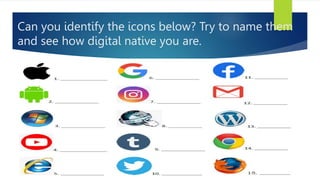
Can you identify the icons below? Try to name them
and see how digital native you are.
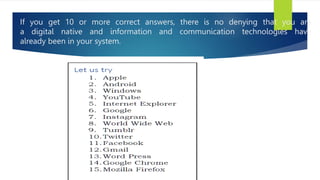
If you get 10 or more correct answers, there is no denying that you are
a digital native and information and communication technologies have
already been in your system.
As countries around the world put up their best fight against
the coronavirus pandemic, the Information and
Communication Technology (ICT) industry is playing a key
role in this journey. In the article of Mint (2020) entitled ―The
power of ICT: Using technology to combat the pandemic‖,
several examples to showcase the role and contribution of
ICT were mentioned —from keeping in touch with friends,
family members, and acquaintances to fulfilling basic needs
such as health and education. Others are as follows.
1. 5G telemedicine is proving especially instrumental in the
protection of medical personnel and quarantine ward
automation, among others. For instance, remote gene
sequencing, which is a 5G application, is helping improve the
detection rates of Covid-19.
2. Unmanned or self-driving vehicles that spray disinfectants on
their own are helping reduce the risk of infection of those
working in quarantined areas.
3. Infrared temperature measurement tools and mobile trolleys
for quarantine ward consultations are other examples of how
the healthcare sector is currently benefitting from using ICT.
4. The advent of 5G is also making it possible to provide
telemedicine facilities in rural areas, with lesser transmission
lag. Patients can communicate with their family members or
counselors, and receive 24/7 medical interventions.
5. Governments across the world, meanwhile, are using ICT to
collect information about the epidemic and facilitate
collaboration among different stakeholders.
6. When it comes to the online education space, 5G
technology is proving to be of paramount importance.
Students can enjoy better download and upload speeds, and
can connect with educators seamlessly from the comfort of
their homes.
The listed examples give us a picture of the current state of
ICTs and how these help in times of global crises and needs.
These may sound so high-tech but we cannot deny the fact
that even in our homes and in our everyday lives, ICT also
play important roles in our coping of the different
challenges.
What is ICT?
Stands for "Information and Communication Technologies."
ICT, in a very simplified sense, refers to technologies associated
with the transmission and exchange of data in the form of
sound, text, visual images, signals or any other form or any
combination of those forms through the use of digital
technology
According to Christensson (2010), information and
communication technologies have provided society with a vast
array of new communication capabilities in the past few decades.
For example, people can communicate in real-time with others in
different countries using technologies such as instant messaging,
voice over IP (VoIP), and video-conferencing. Social networking
websites like Facebook allow users from all over the world to
remain in contact and communicate on a regular basis.
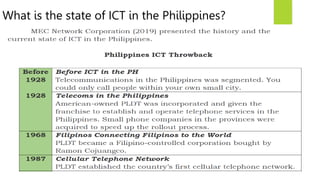
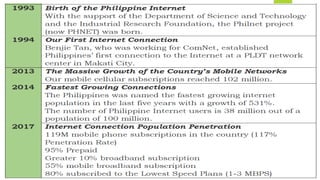
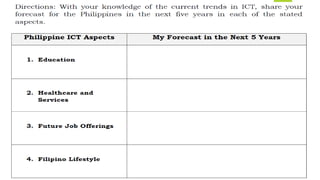
What is the state of ICT in the Philippines?
World Wide Web Internet
- web for short, are the pages
you see when
you're at a device and you're
online
- are the
things you see on the roads
like houses and shops
- the network of
connected computers that the
web works on, as well as what
emails and
files travel across (BBC, 2019).
- The internet could be likened
to the roads
that connect towns and cities
together
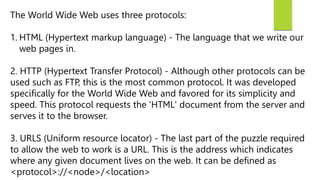
The World Wide Web uses three protocols:
1. HTML (Hypertext markup language) - The language that we write our
web pages in.
2. HTTP (Hypertext Transfer Protocol) - Although other protocols can be
used such as FTP, this is the most common protocol. It was developed
specifically for the World Wide Web and favored for its simplicity and
speed. This protocol requests the 'HTML' document from the server and
serves it to the browser.
3. URLS (Uniform resource locator) - The last part of the puzzle required
to allow the web to work is a URL. This is the address which indicates
where any given document lives on the web. It can be defined as
<protocol>://<node>/<location>
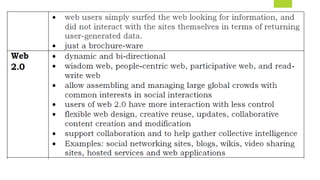
Features of Web 2.0
o Folksonomy - It allows users to categorize and classify/arrange
information using freely chosen keywords (e.g., tagging). Popular
social networking sites such as Twitter, Instagram, Facebook, etc.
use tags that start with the pound sign (#). This is also referred to
as hashtag.
o Rich User Experience - Content is dynamic and is responsive
to user’s input. An example would be a website that shows local
content. In the case of social networking sites, when logged on,
your account is used to modify what you see in their website.
o User Participation - The owner of the website is not the only one who is
able to put content. Others are able to place a content of their own by
means of comment, reviews, and evaluation. Some websites allow readers
to comment on an article, participate in a poll, or review a specific product
(e.g.,Amazon.com, online stores).
o Software as a Service - Users will subscribe to a software only when
needed rather than purchasing them. This is a cheaper option if you do
not always need to use a software. For instance, Google Docs is a free
web-based application that allows the user to create and edit word
processing and spreadsheet documents online. When you need a software,
like a Word Processor, you can purchase it for a one-time huge amount
and install it in your computer and it is yours forever. Software as a service
allows you to ―rent a software for a minimal fee.
o Mass Participation - It is a diverse information
sharing through universal web access. Since most users
can use the Internet, Web 2.0’s content is based on
people from various cultures.
What is the difference between webpage, website, web
browser, web server, and search engine?
Webpage A web page or webpage is a document, commonly
written in HTML, that is viewed in an Internet browser. This can be
accessed by entering a URL address into a browser's address bar.
Also, it may contain text, graphics, and hyperlinks to other web
pages and files. A web page is often used to provide information to
viewers, including pictures or videos to help illustrate important
topics. It may also be used as a method to sell products or services
to viewers. Multiple web pages make up a website (Computer Hope,
2020).
Website
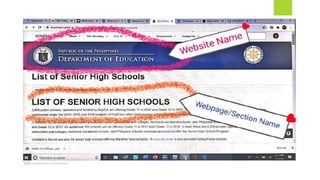
A website is a collection of linked web pages (plus their associated
resources) that share a unique domain name. Each web page of a
given website provides explicit links—most of the time in the form
of clickable portion of text—that allow the user to move from one
page of the website to another (Mozilla Developer Network, 2020).
Illustration below shows examples of webpage and website.
Web Server
A web server stores and delivers the content for a website – such
as text, images, video, and application data – to clients that
request it. The most common type of client is a web browser
program, which requests data from your website when a user
clicks on a link or downloads a document on a page displayed in
the browser. A web server communicates with a web browser
using the HTTP. The content of most web pages is encoded in
HTML. The content can be static, for example, text and images, or
dynamic, for example, a computed price or the list of items a
customer has marked for purchase (NGINX).
The difference between the web browser and web server is that
web browser requests the server for the web documents and
services while the web server accepts, approve and respond to the
request made by the web browser for a web document or services.
Search Engine Search engines are answer machines. They are
used to discover, understand, and organize the internet's content in
order to offer the most relevant results to the questions searchers
are asking. They work through three primary functions. One is
crawling or scouring the Internet for content, looking over the
code/content for each URL they find. Another is indexing. They
store and organize the content found during the crawling process.
Once a page is in the index, it’s in the running to be displayed as a
result to relevant queries. And lastly, ranking as they provide the
pieces of content that will best answer a searcher's query, which
means that results are ordered by most relevant to least relevant
(Muller & Moz Staff, 2021).
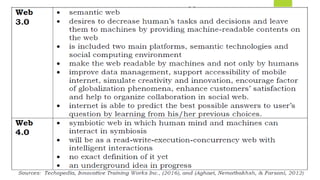
What are the current trends in ICT?
As the world of ICT continues to grow, the industry has focused
on several innovations. These innovations cater to the needs of the
people that benefit most out of ICT. Whether it is for business or
personal use, these trends are the current front runners in the
innovation of ICT (Innovative Training Works Inc., 2016).
Convergence
Technological convergence is the synergy of technological
advancements to work on a similar goal or task. For example,
besides using your personal computer to create word documents,
you can now use your smartphone. It can also use cloud
technologies to sync files from one device to another while also
using LTE technology which means you can access your files
anytime, anywhere. Convergence is using several technologies to
accomplish a task conveniently.
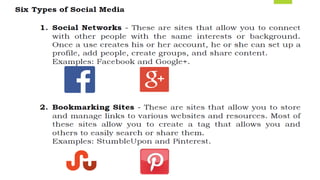
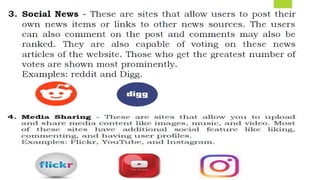
Social Media
Social media is a website, application, or online channel
that enables web users to create, co-create, discuss, modify,
and exchange SM.jpguser-generated content. According to
Nielsen, a global information and measurement company,
Internet users spend more time in social media sites than in
any other type of site. With this, more and more advertisers
use social media to promote their product.
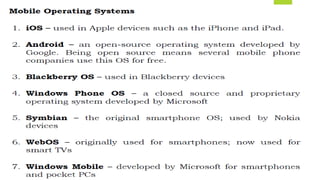
Mobile Technologies
The popularity of smartphones and tablets has taken
a major rise over the years. This is largely because of the
devices capability to do tasks that were originally found in
personal computers. Several of these devices are capable
of using high-speed internet. Today, the latest mobile
devices use 5G Networking (LTE). Also, mobile devices use
different operating systems:
Assistive Media
Assistive media is a nonprofit service designed to assist
people who have visual and reading impairments. A database
of audio recordings is used to read to the user. You may visit
http://www.assistivemedia.org/ for several of their audio
recordings.
Empowerment Technologies Quarter 3 Module 1

Empowerment Technologies Quarter 3 Module 1

  • 1.
    Empowerment Technologies Quarter 3– Module 1: The Power of Information and Communication Technologies
  • 2.
    After going throughthis module, you are expected to:  a. compare and contrast the nuances of varied online platforms, sites, and content to best achieve specific class objectives or address situational challenges (CS_ICT11/12-ICTPT-Ia-b-1);  b. share plans on how to use your knowledge on the different trends in ICT; and  c. independently compose an insightful reflection on the nature of ICT in the context of your life, society, and professional tracks (Arts, TechVoc, Sports, Academic).
  • 3.
    Can you identifythe icons below? Try to name them and see how digital native you are.
  • 4.
    If you get10 or more correct answers, there is no denying that you are a digital native and information and communication technologies have already been in your system.
  • 5.
    As countries aroundthe world put up their best fight against the coronavirus pandemic, the Information and Communication Technology (ICT) industry is playing a key role in this journey. In the article of Mint (2020) entitled ―The power of ICT: Using technology to combat the pandemic‖, several examples to showcase the role and contribution of ICT were mentioned —from keeping in touch with friends, family members, and acquaintances to fulfilling basic needs such as health and education. Others are as follows.
  • 6.
    1. 5G telemedicineis proving especially instrumental in the protection of medical personnel and quarantine ward automation, among others. For instance, remote gene sequencing, which is a 5G application, is helping improve the detection rates of Covid-19. 2. Unmanned or self-driving vehicles that spray disinfectants on their own are helping reduce the risk of infection of those working in quarantined areas.
  • 7.
    3. Infrared temperaturemeasurement tools and mobile trolleys for quarantine ward consultations are other examples of how the healthcare sector is currently benefitting from using ICT. 4. The advent of 5G is also making it possible to provide telemedicine facilities in rural areas, with lesser transmission lag. Patients can communicate with their family members or counselors, and receive 24/7 medical interventions.
  • 8.
    5. Governments acrossthe world, meanwhile, are using ICT to collect information about the epidemic and facilitate collaboration among different stakeholders. 6. When it comes to the online education space, 5G technology is proving to be of paramount importance. Students can enjoy better download and upload speeds, and can connect with educators seamlessly from the comfort of their homes.
  • 9.
    The listed examplesgive us a picture of the current state of ICTs and how these help in times of global crises and needs. These may sound so high-tech but we cannot deny the fact that even in our homes and in our everyday lives, ICT also play important roles in our coping of the different challenges.
  • 11.
    What is ICT? Standsfor "Information and Communication Technologies." ICT, in a very simplified sense, refers to technologies associated with the transmission and exchange of data in the form of sound, text, visual images, signals or any other form or any combination of those forms through the use of digital technology
  • 12.
    According to Christensson(2010), information and communication technologies have provided society with a vast array of new communication capabilities in the past few decades. For example, people can communicate in real-time with others in different countries using technologies such as instant messaging, voice over IP (VoIP), and video-conferencing. Social networking websites like Facebook allow users from all over the world to remain in contact and communicate on a regular basis.
  • 13.
    What is thestate of ICT in the Philippines?
  • 16.
    World Wide WebInternet - web for short, are the pages you see when you're at a device and you're online - are the things you see on the roads like houses and shops - the network of connected computers that the web works on, as well as what emails and files travel across (BBC, 2019). - The internet could be likened to the roads that connect towns and cities together
  • 17.
    The World WideWeb uses three protocols: 1. HTML (Hypertext markup language) - The language that we write our web pages in. 2. HTTP (Hypertext Transfer Protocol) - Although other protocols can be used such as FTP, this is the most common protocol. It was developed specifically for the World Wide Web and favored for its simplicity and speed. This protocol requests the 'HTML' document from the server and serves it to the browser. 3. URLS (Uniform resource locator) - The last part of the puzzle required to allow the web to work is a URL. This is the address which indicates where any given document lives on the web. It can be defined as <protocol>://<node>/<location>
  • 21.
    Features of Web2.0 o Folksonomy - It allows users to categorize and classify/arrange information using freely chosen keywords (e.g., tagging). Popular social networking sites such as Twitter, Instagram, Facebook, etc. use tags that start with the pound sign (#). This is also referred to as hashtag. o Rich User Experience - Content is dynamic and is responsive to user’s input. An example would be a website that shows local content. In the case of social networking sites, when logged on, your account is used to modify what you see in their website.
  • 22.
    o User Participation- The owner of the website is not the only one who is able to put content. Others are able to place a content of their own by means of comment, reviews, and evaluation. Some websites allow readers to comment on an article, participate in a poll, or review a specific product (e.g.,Amazon.com, online stores). o Software as a Service - Users will subscribe to a software only when needed rather than purchasing them. This is a cheaper option if you do not always need to use a software. For instance, Google Docs is a free web-based application that allows the user to create and edit word processing and spreadsheet documents online. When you need a software, like a Word Processor, you can purchase it for a one-time huge amount and install it in your computer and it is yours forever. Software as a service allows you to ―rent a software for a minimal fee.
  • 23.
    o Mass Participation- It is a diverse information sharing through universal web access. Since most users can use the Internet, Web 2.0’s content is based on people from various cultures.
  • 24.
    What is thedifference between webpage, website, web browser, web server, and search engine? Webpage A web page or webpage is a document, commonly written in HTML, that is viewed in an Internet browser. This can be accessed by entering a URL address into a browser's address bar. Also, it may contain text, graphics, and hyperlinks to other web pages and files. A web page is often used to provide information to viewers, including pictures or videos to help illustrate important topics. It may also be used as a method to sell products or services to viewers. Multiple web pages make up a website (Computer Hope, 2020).
  • 25.
    Website A website isa collection of linked web pages (plus their associated resources) that share a unique domain name. Each web page of a given website provides explicit links—most of the time in the form of clickable portion of text—that allow the user to move from one page of the website to another (Mozilla Developer Network, 2020). Illustration below shows examples of webpage and website.
  • 28.
    Web Server A webserver stores and delivers the content for a website – such as text, images, video, and application data – to clients that request it. The most common type of client is a web browser program, which requests data from your website when a user clicks on a link or downloads a document on a page displayed in the browser. A web server communicates with a web browser using the HTTP. The content of most web pages is encoded in HTML. The content can be static, for example, text and images, or dynamic, for example, a computed price or the list of items a customer has marked for purchase (NGINX).
  • 29.
    The difference betweenthe web browser and web server is that web browser requests the server for the web documents and services while the web server accepts, approve and respond to the request made by the web browser for a web document or services.
  • 30.
    Search Engine Searchengines are answer machines. They are used to discover, understand, and organize the internet's content in order to offer the most relevant results to the questions searchers are asking. They work through three primary functions. One is crawling or scouring the Internet for content, looking over the code/content for each URL they find. Another is indexing. They store and organize the content found during the crawling process. Once a page is in the index, it’s in the running to be displayed as a result to relevant queries. And lastly, ranking as they provide the pieces of content that will best answer a searcher's query, which means that results are ordered by most relevant to least relevant (Muller & Moz Staff, 2021).
  • 32.
    What are thecurrent trends in ICT? As the world of ICT continues to grow, the industry has focused on several innovations. These innovations cater to the needs of the people that benefit most out of ICT. Whether it is for business or personal use, these trends are the current front runners in the innovation of ICT (Innovative Training Works Inc., 2016).
  • 33.
    Convergence Technological convergence isthe synergy of technological advancements to work on a similar goal or task. For example, besides using your personal computer to create word documents, you can now use your smartphone. It can also use cloud technologies to sync files from one device to another while also using LTE technology which means you can access your files anytime, anywhere. Convergence is using several technologies to accomplish a task conveniently.
  • 34.
    Social Media Social mediais a website, application, or online channel that enables web users to create, co-create, discuss, modify, and exchange SM.jpguser-generated content. According to Nielsen, a global information and measurement company, Internet users spend more time in social media sites than in any other type of site. With this, more and more advertisers use social media to promote their product.
  • 38.
    Mobile Technologies The popularityof smartphones and tablets has taken a major rise over the years. This is largely because of the devices capability to do tasks that were originally found in personal computers. Several of these devices are capable of using high-speed internet. Today, the latest mobile devices use 5G Networking (LTE). Also, mobile devices use different operating systems:
  • 40.
    Assistive Media Assistive mediais a nonprofit service designed to assist people who have visual and reading impairments. A database of audio recordings is used to read to the user. You may visit http://www.assistivemedia.org/ for several of their audio recordings.