GLOBAL MANUFACTURING
STRATEGY:
1994
CASE FACT
 ITT Automotive is in the process of developing a new generation
antilock brake system (ABS) designated as the MK 20.
 The case focuses on the level of automation to be used in the
production of this new system and whether all plants should use the
same process technology.
 Due to intensifying cost pressure and rapidly growing demand for
lower cost ABS the development team and senior management
(based in Frankfurt Germany) strongly favor using a single highly
automated production process in the four plants scheduled to
produce the MK 20 (located in Germany, Belgium and the United
States).
 Managers at the company's two plants in the United States favor
using less automation technology in order to allow greater flexibility
for improving process technology over time.
QUESTION 1
What are the implications for both cost and
flexibility of automation?
Do you agree with the assertion made by one of
the managers in the case : "If you automate, you
stagnate?"
 The MK20 was predicted to be enormously popular, since it
would be the lightest, lowest-cost, and most sophisticated
automotive anti-lock brake system available in the world.
• COST IMPLICATIONS OF AUTOMATION:
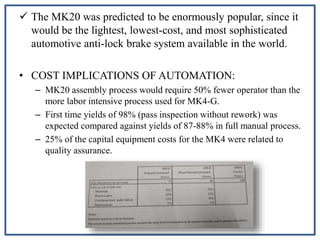
– MK20 assembly process would require 50% fewer operator than the
more labor intensive process used for MK4-G.
– First time yields of 98% (pass inspection without rework) was
expected compared against yields of 87-88% in full manual process.
– 25% of the capital equipment costs for the MK4 were related to
quality assurance.
FLEXIBILITY IMPLICATION OF
AUTOMATION
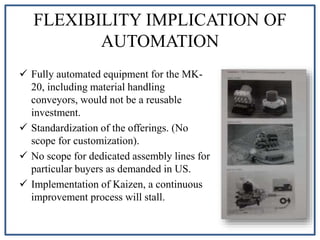
 Fully automated equipment for the MK-
20, including material handling
conveyors, would not be a reusable
investment.
 Standardization of the offerings. (No
scope for customization).
 No scope for dedicated assembly lines for
particular buyers as demanded in US.
 Implementation of Kaizen, a continuous
improvement process will stall.
"If you automate, you stagnate?"
 For products requiring constant upgrading and change in
design should refrain from complete automation unless the
cost of setup hugely outweigh the sales generated in limited
time frame. It also hampers scope for customization and
minor changes in short run.
 For products like Coke etc where the product is
standardized, the production processes should be automated
which will bring reduction in operation time and work
handling time, Higher consistency and quality, and have
direct economic impact.
QUESTION 2
What are your recommendations regarding the
issue of standardizing process technology across
all the plants?
Are there motives behind the proposal, other
than those stated in the case?
 The MK20 was predicted to be enormously popular, since it
would be the lightest, lowest-cost, and most sophisticated
automotive anti-lock brake system available in the world.
 It was a highly competitive market, so given the high volumes
and intense cost pressures in anti-lock brakes it is
understandable that ITT Automotive was eager to automate
their production lines.
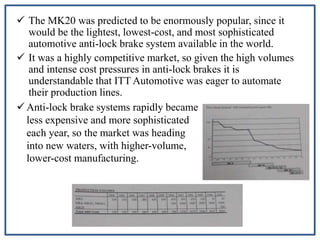
 Anti-lock brake systems rapidly became
less expensive and more sophisticated
each year, so the market was heading
into new waters, with higher-volume,
lower-cost manufacturing.
RECOMMENDATIONS
 Considering the high volume and low cost requirements and
the timelines associated with MK20, the Frankfurt plant in
Germany should continue their process standardization.
 Although most of the requirements across other plants
remains the same, difference in labor cost, quality
considerations and variation in customer preference should
be considered important factor before process
standardization.
OTHER MOTIVE
 Moving towards more standardized offerings for
increased efficiency in wake of reducing margins and
demand for cheaper products.
 Market consolidation through MK-20.
 Standardized performance and process offering across all
plants of ITT.
QUESTION 3
As Juergen Geissinger, how would you go about
implementing your recommendations? How
would you overcome resistance from the plants?
As Dickerson, the plant manager at Asheville,
North Carolina, what line of reasoning would
you use to convince senior management that full
automation is the less desirable alternative?
QUESTION 4
As Klaus Lederer, what options would you like
to see pursued?
How do various options fit into the broader
corporate strategy of ITT Automotive?
THANK YOU

Itt global manufacturing strategy os

  • 1.
  • 2.
    CASE FACT  ITTAutomotive is in the process of developing a new generation antilock brake system (ABS) designated as the MK 20.  The case focuses on the level of automation to be used in the production of this new system and whether all plants should use the same process technology.  Due to intensifying cost pressure and rapidly growing demand for lower cost ABS the development team and senior management (based in Frankfurt Germany) strongly favor using a single highly automated production process in the four plants scheduled to produce the MK 20 (located in Germany, Belgium and the United States).  Managers at the company's two plants in the United States favor using less automation technology in order to allow greater flexibility for improving process technology over time.
  • 3.
    QUESTION 1 What arethe implications for both cost and flexibility of automation? Do you agree with the assertion made by one of the managers in the case : "If you automate, you stagnate?"
  • 4.
     The MK20was predicted to be enormously popular, since it would be the lightest, lowest-cost, and most sophisticated automotive anti-lock brake system available in the world. • COST IMPLICATIONS OF AUTOMATION: – MK20 assembly process would require 50% fewer operator than the more labor intensive process used for MK4-G. – First time yields of 98% (pass inspection without rework) was expected compared against yields of 87-88% in full manual process. – 25% of the capital equipment costs for the MK4 were related to quality assurance.
  • 5.
    FLEXIBILITY IMPLICATION OF AUTOMATION Fully automated equipment for the MK- 20, including material handling conveyors, would not be a reusable investment.  Standardization of the offerings. (No scope for customization).  No scope for dedicated assembly lines for particular buyers as demanded in US.  Implementation of Kaizen, a continuous improvement process will stall.
  • 6.
    "If you automate,you stagnate?"  For products requiring constant upgrading and change in design should refrain from complete automation unless the cost of setup hugely outweigh the sales generated in limited time frame. It also hampers scope for customization and minor changes in short run.  For products like Coke etc where the product is standardized, the production processes should be automated which will bring reduction in operation time and work handling time, Higher consistency and quality, and have direct economic impact.
  • 7.
    QUESTION 2 What areyour recommendations regarding the issue of standardizing process technology across all the plants? Are there motives behind the proposal, other than those stated in the case?
  • 8.
     The MK20was predicted to be enormously popular, since it would be the lightest, lowest-cost, and most sophisticated automotive anti-lock brake system available in the world.  It was a highly competitive market, so given the high volumes and intense cost pressures in anti-lock brakes it is understandable that ITT Automotive was eager to automate their production lines.  Anti-lock brake systems rapidly became less expensive and more sophisticated each year, so the market was heading into new waters, with higher-volume, lower-cost manufacturing.
  • 9.
    RECOMMENDATIONS  Considering thehigh volume and low cost requirements and the timelines associated with MK20, the Frankfurt plant in Germany should continue their process standardization.  Although most of the requirements across other plants remains the same, difference in labor cost, quality considerations and variation in customer preference should be considered important factor before process standardization.
  • 10.
    OTHER MOTIVE  Movingtowards more standardized offerings for increased efficiency in wake of reducing margins and demand for cheaper products.  Market consolidation through MK-20.  Standardized performance and process offering across all plants of ITT.
  • 11.
    QUESTION 3 As JuergenGeissinger, how would you go about implementing your recommendations? How would you overcome resistance from the plants? As Dickerson, the plant manager at Asheville, North Carolina, what line of reasoning would you use to convince senior management that full automation is the less desirable alternative?
  • 12.
    QUESTION 4 As KlausLederer, what options would you like to see pursued? How do various options fit into the broader corporate strategy of ITT Automotive?
  • 13.