COMPUTER-BASED SUPPLY CHAIN
MANAGEMENT AND INFORMATION
SYSTEMS INTEGRATION
                                                                                                                      10
        CHAPTER PREVIEW

       The success of many organizations, private, public, and military, depends on their
       ability to manage the flow of materials, information, and money into, within, and
       out of the organization. Such a flow is referred to as a supply chain. Because sup-
       ply chains may be long and complex and may involve many different business
       partners, we frequently see problems in the operation of the supply chains. These
       problems may result in delays, in customers’ dissatisfaction, in lost sales, and in
       high expenses of fixing the problems once they occur. World-class companies,
       such as Dell Computer, attribute much of their success to effective supply chain
       management (SCM), which is largely supported by IT.
            In this chapter we describe the nature and types of supply chains and explain
       why problems occur there. Then we outline the IT-based solutions, most of which
       are provided by integrated software such as MRP and ERP. Next we show you
       how EC can cure problems along the supply chain. Finally we describe the prob-
       lems of fulfilling orders in e-commerce systems and some of the solutions used.


 CHAPTER OUTLINE                                           LEARNING OBJECTIVES
10.1    Supply Chains and Their Management                1. Understand the concept of the supply chain, its
10.2    Supply Chain Problems And Solutions                  importance, and its management.
10.3    IT Supply Chain Support and Systems Integration   2. Describe the various types of supply chains.
10.4    Enterprise Resource Planning (ERP)                3. Describe the problems in managing supply chains.
10.5    E-Commerce And Supply Chain Management            4. Describe the major categories of supply chain
10.6    Order Fulfillment in E-Commerce                       solutions.
                                                          5. Explain the need for software integration and describe
                                                             the available software.
                                                          6. Explain how EC improves supply chain management.
                                                          7. Describe EC order-fulfillment problems and solutions.
HOW DELL MANAGES ITS SUPPLY CHAIN

www.dell.com    The Business Problem
               Michael Dell started his business as a student, from his university dorm, by using a
               mail-order approach for selling PCs. This changed the manner by which PCs were
               sold. The customer did not have to come to a store to buy a computer, and Dell was
               able to customize the computer to the customer’s specifications. The direct-mail ap-
               proach enabled Dell to underprice his rivals, who were using distributors and retail-
               ers, by about 10 percent. For several years the business grew, and Dell constantly
               captured market share. In 1993, Compaq, the PC market leader at that time, decided
               to drastically cut prices in order to drive Dell out of the market. As a result of the
               price war, Dell Computer Corporation had a $65 million loss from reduced sales and
               inventory writedowns in the first six months of 1993 alone. The company was on the
               verge of bankruptcy.
                The IT Solution
               Dell realized that the only way to win the marketing war was to introduce fundamen-
               tal changes along the supply chain, from its suppliers all the way to its customers.
               Among the innovations used to restructure the business were the following.
               • Most orders from customers and to suppliers were moved to the Web. Customers
                 configure what they want, and find the cost and the deliverability in seconds, all on-
                 line.
               • Dell builds most computers only after they are ordered. This is done by using just-
                 in-time manufacturing, which also enables quick deliveries, low inventories, little or
                 no obsolescence, and lower marketing and administrative costs. This is an example
                 of mass customization cited previously in the text.
               • Component warehouses, which are maintained by Dell’s major suppliers, are lo-
                 cated within 15 minutes of Dell factories. Not only does Dell get components
                 quickly, but those components are up to 60 days newer than the ones acquired by
                 major competitors.
               • Shipments, which are done by UPS and other carriers, are all arranged electroni-
                 cally.
               • Dell collaborates electronically with its buyers to pick their brains for new product
                 ideas.
               • Dell’s new PC models are tested at the same time as the networks that they are on
                 are tested. This collaboration reduces the testing period from 60 or 90 days to 15.
                    In addition to competing on price and quality, Dell started competing on speed.
               Since 2000, if you order a customized PC on any working day in the United States, the
               computer will be on the delivery truck the next day. A complex custom-made PC will
               be delivered in no more than 5 days.
                    In 2001, Dell was selling more than $4 million worth of computers each day on its
               Web site, and this amount was growing by 6 percent per month! In 1999, Dell added
               electronic auctions (dellauction.com) as a marketing channel. Eventually, Dell is aim-
               ing to sell most of its computers and servers from its Web site (dell.com).
                    In addition, Dell created customized home pages for its biggest corporate cus-
               tomers, such as Eastman Chemical, Monsanto, and Wells Fargo. At these sites, cus-
               tomers’ employees use configuration tools and work-flow software to design
               computers, get the order approved inside the client organization, and place the order
               quickly and easily. The electronic ordering by both larger and smaller customers
enables Dell to collect payments very quickly, even before it starts to assemble the
computers.
    Once orders are received they are transferred electronically to the production
floor. Intelligent systems prepare the required parts and component list for each com-
puter, and check availability. If not in stock, components and parts are automatically
and electronically ordered directly from suppliers, who sometimes deliver in less than
60 minutes. Computerized manufacturing systems tightly link the entire demand and
supply chains from suppliers to buyers. This system is the foundation on which the
build-to-order strategy rests.
    Dell also electronically passes along to its suppliers data about its defect rates, en-
gineering changes, and product enhancements. Since Dell and its suppliers are in con-
stant communication, the margin for error is reduced. Dell employees collaborate
electronically with business partners in real time on product designs and enhance-
ments. Also, suppliers are required to share sensitive information with Dell, such as
their own quality problems. Suppliers follow Dell’s lead because they also reap the
benefits of faster cycle times, reduced inventory, and improved forecasts.
    Dell is using several other information technologies, including e-mail, EDI,
videoteleconferencing, electronic procurement, computerized faxes, an intranet, DSS,
a Web-based call center, and more. Dell also uses the Internet to create a community
around its supply chain. Dell’s corporate portal has links to bulletin boards where
partners from around the world can exchange information about their experiences
with Dell’s products, logistics, and customer service.
  The Results
By 1999, Dell had become the world’s number-two PC seller, and in 2001 it became
number one. It is considered one of the world’s best-managed and most profitable
companies.
Sources: Compiled from articles in Business Week (1997–2001), Information Week (1998–2001), cio.com
(2001), and us.dell.com/dell/media.

 What We Learned from This Case
The Dell case demonstrates that the new build-to-order business model changed the
manner in which business is done in the PC industry (and later, in the server industry).
To implement such a model on a large scale (mass customization), Dell built superb
supply chain management that includes both suppliers and customers. A major success
factor in Dell’s operation was the improvements made by using IT along the entire sup-
ply chain. Dell created flexible and responsive IT-based manufacturing systems that are
integrated with the supply chain. In addition, Dell is able to collect payment before it
starts to assemble computers, thus shortening the corporate cash flow. Dell successfully
implemented the concepts of supply chain management, enterprise resource planning,
supply chain intelligence, and customer-relationship management. The first three topics
are the subject of this chapter. (CRM is described in Chapter 8.)


10.1       SUPPLY CHAINS AND THEIR MANAGEMENT

Definitions and Benefits
Initially, the concept of a supply chain referred to the flow of materials from their
sources (suppliers) to the company, and then inside the company for processing. Then,
finished products were moved to customers. Today the concept is much broader.
320   Chapter 10          Computer-Based Supply Chain Management and Information Systems Integration

                                 Definitions. A supply chain refers to the flow of materials, information, payments,
                                 and services, from raw material suppliers, through factories and warehouses, to end
                                 customers. A supply chain also includes the organizations and processes that create
                                 and deliver products, information, and services to the end customers. It includes many
                                 tasks such as purchasing, payment flow, materials handling, production planning and
                                 control, logistics and warehousing inventory control, and distribution and delivery.
                                 The function of supply chain management (SCM) is to plan, organize, coordinate, and
                                 control all the supply chain’s activities.

                                 Benefits. The goals of modern SCM are to reduce uncertainty and risks in the supply
                                 chain, thereby positively affecting inventory levels, cycle time, business processes, and
                                 customer service. All these benefits contribute to increased profitability and competi-
                                 tiveness. The benefits of supply chain management have long been recognized both in
                                 business and in the military. As early as 401 B.C., Clerchus of Sparta said, that the sur-
                                 vival of the Greek army depended not only upon its discipline, training, and morale,
                                 but also upon its supply chain. The same idea was later echoed by famous generals
                                 such as Napoleon and Eisenhower.

                                 The Components of Supply Chains
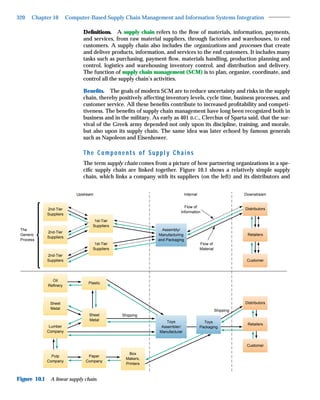
                                 The term supply chain comes from a picture of how partnering organizations in a spe-
                                 cific supply chain are linked together. Figure 10.1 shows a relatively simple supply
                                 chain, which links a company with its suppliers (on the left) and its distributors and


                              Upstream                                           Internal                         Downstream


                                                                               Flow of
              2nd-Tier                                                                                            Distributors
                                                                             Information
              Suppliers
                                      1st-Tier
                                     Suppliers
 The                                                               Assembly/
              2nd-Tier
 Generic                                                         Manufacturing                                     Retailers
              Suppliers
 Process                                                         and Packaging
                                      1st-Tier                                              Flow of
                                     Suppliers                                              Material
              2nd-Tier
              Suppliers                                                                                            Customer


                Oil
                                   Plastic
              Refinery


               Sheet                                                                                              Distributors
               Metal
                                                                                                       Shipping
                                    Sheet        Shipping
                                    Metal                             Toys                    Toys
                                                                                                                   Retailers
               Lumber                                              Assembler/               Packaging
              Company                                             Manufacturer


                                                                                                                   Customer

                                                     Box
                Pulp               Paper
                                                   Makers,
              Company             Company
                                                   Printers


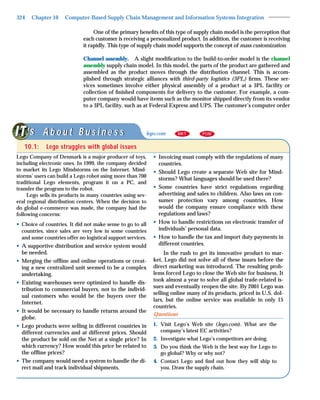
Figure 10.1    A linear supply chain.
Section 10.1    Supply Chains and Their Management   321

customers (on the right). The upper part of the figure shows a generic supply chain;
the lower part shows the chain of a toy manufacturer. Notice that suppliers may have
their own (second-tier) suppliers. In addition to flow of material there is a flow of in-
formation (shown only in the upper part of the figure) and money as well. The flow of
money usually goes in the direction opposite to the flow of materials.
    Note that the supply chain is linear and it involves three basic parts:
1. Upstream supply chain. This part includes the organization’s first-tier suppliers
   (which themselves can be manufacturers and/or assemblers) and their suppliers.
   Such a relationship can be extended, to the left, in several tiers, all the way to the
   origin of the material (e.g., mining ores, growing crops). Here the major activities
   are purchasing and shipping.
2. Internal supply chain. This part includes all the processes used by an organization
   in transforming the inputs shipped by the suppliers into outputs, from the time ma-
   terials enter the organization to the time that the finished product goes to distribu-
   tion, outside the organization. Activities here include materials handling, inventory
   management, manufacturing, and quality control.
3. Downstream supply chain. This part includes all the processes involved in distrib-
   uting and delivering the products to final customers. Looked at very broadly, the
   supply chain actually ends when the product reaches its after-use disposal—pre-
   sumably back to “Mother Earth” somewhere. Activities here include packaging,
   warehousing, and shipping. These activities may be done by using several tiers of
   distributors (e.g., wholesalers and retailers).
    Supply chains come in all shapes and sizes and may be fairly complex, as shown in
Figure 10.2. As can be seen in the figure, the supply chain for a car manufacturer in-
cludes hundreds of suppliers, dozens of manufacturing plants (for parts) and assembly
plants (assembling cars), warehouses, dealers, direct business customers (buying
fleets), wholesalers (some of which are virtual), customers, and support functions such
as product engineering, purchasing agents, banks, and transportation companies.
    Notice that in this case the chain is not strictly linear as it was in Figure 10.1. Here
we see some loops in the process. In addition, sometimes the flow of information and
even goods can be bidirectional, as it would be, for example, for the return of products
(known as reverse logistics). For an automaker, that would be cars returned to the
dealers in cases of defects or recalls by the manufacturer. Also notice that the supply
chain is much more than just physical. It includes both information and financial
flows. As a matter of fact, the supply chain of a service such as obtaining a mortgage
or a digitizable product may not include any physical materials. (See Problem-Solving
Activity 4 for an example.)

Types of Supply Chains
The supply chain shown in Figure 10.1 is typical for a manufacturing company. If the
company is a traditional one, it will produce items that will be stored in warehouses
and other locations, making the supply chain more complex. If the company uses a
make-to-order business model, there will be no need for storing finished products, but
there will be need to store raw materials and components. Therefore, it is clear that
supply chains depend on the nature of the company. The following four types are very
common.

Integrated make-to-stock. The integrated make-to-stock supply chain model focuses
on tracking customer demand in real time, so that the production process can restock
the finished-goods inventory efficiently. This integration is often achieved through use
322    Chapter 10     Computer-Based Supply Chain Management and Information Systems Integration


                                       Wholesalers

                                               Organizational
                                                  Fleets
                                                        CARS                                                    CARS
                                                                          Car Dealers


                                                                                                             Assembly Material
                                          Customers                                   Allocated
                                                                                                            Planning (19 plants)
                                                                                      buildable
                                                                      Sales
                                                                                       orders
                                                                    Operations                                    Vehicle scheduling              Shipping


                                                                                    New products                Preproduction planning         Assembly Line
                                                                                   and engineering
                                                        Product
                                                                                      changes
                                                      Engineering                                               Components scheduling           Warehousing

                                                                  Ship                                           Planning/sequencing
                                                                release                                                                           Receiving


                                                                                                                                PARTS
                                                                                                                                                       PARTS
                                                  Manufacturing
                                                                                 Stampings
                                                   (57 plants)
                                                                                                          Request
                                                                                                                                          Ship releases
                                  Engines              Transmissions                Castings               to buy
                                                                                                                                         and engineering
                                                                                                                                            changes
                                   Electrical/Fuel        Components
                                                                                 Electronics                             PURCHASING
                                  Handling Devices          Group                                     Request
                                                                                                       to buy
Figure 10.2     An automo-        Glass
                                                         Plastics/                  Climate
                                                      Trim Products                 Controls
tive supply chain. (Source:
Modified from R. B. Hand-                                                                             MATERIALS                                 Suppliers
field and E. L. Nichols, Jr.,                                                                                                                  (hundreds)

Introduction to Supply
                                                                                           Advance ship notice
Chain Management, Upper
Saddle River, NJ: Prentice-                                                  Engineering changes and
Hall, 1999.)                                                                      ship releases


                               of an information system that is fully integrated (an enterprise system, described in
                               Section 10.4). Through application of such a system, the organization can receive real-
                               time demand information that can be used to develop and modify production plans
                               and schedules. This information is also integrated further down the supply chain to
                               the procurement function, so that the modified production plans and schedules can be
                               supported by input materials.

                                EXAMPLE
                               Starbucks matches supply and demand using IT. Starbucks Coffee (starbucks.com)
                               uses several distribution channels, not only selling coffee drinks to consumers, but
                               also selling beans and ground coffee to businesses such as airlines, supermarkets, de-
                               partment stores, and ice-cream makers. Sales are also done through direct mail, in-
                               cluding the Internet. Starbucks is successfully integrating all sources of demand and
                               matching it with the supply by using Oracle’s automated information system for man-
                               ufacturing (called GEMMS). The system does distribution planning, manufacturing
                               scheduling, and inventory control (using MRP). The coordination of supply with mul-
                               tiple distribution channels requires timely and accurate information flow about de-
                               mand, inventories, storage capacity, transportation scheduling, and more. The
                               information systems are critical in doing all the above with maximum effectiveness
                               and reasonable cost. Finally, Starbucks must work closely with hundreds of business
                               partners.      ●
Section 10.1                                           Supply Chains and Their Management        323

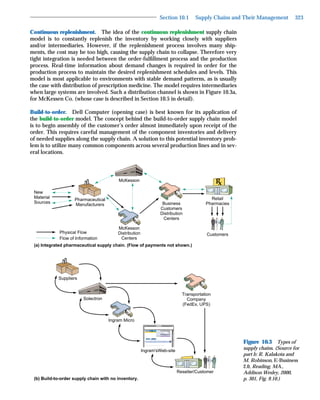
Continuous replenishment. The idea of the continuous replenishment supply chain
model is to constantly replenish the inventory by working closely with suppliers
and/or intermediaries. However, if the replenishment process involves many ship-
ments, the cost may be too high, causing the supply chain to collapse. Therefore very
tight integration is needed between the order-fulfillment process and the production
process. Real-time information about demand changes is required in order for the
production process to maintain the desired replenishment schedules and levels. This
model is most applicable to environments with stable demand patterns, as is usually
the case with distribution of prescription medicine. The model requires intermediaries
when large systems are involved. Such a distribution channel is shown in Figure 10.3a,
for McKessen Co. (whose case is described in Section 10.5 in detail).

Build-to-order. Dell Computer (opening case) is best known for its application of
the build-to-order model. The concept behind the build-to-order supply chain model
is to begin assembly of the customer’s order almost immediately upon receipt of the
order. This requires careful management of the component inventories and delivery
of needed supplies along the supply chain. A solution to this potential inventory prob-
lem is to utilize many common components across several production lines and in sev-
eral locations.


                                         McKesson

 New
 Material                                                                                                                                                                   Retail
                    Pharmaceutical
 Sources                                                                                                         Business                                                 Pharmacies
                    Manufacturers
                                                                                                                Customers
                                                                                                                Distribution
                                                                                                                 Centers

                                         McKesson
             Physical Flow               Distribution                                                                                                                      Customers
             Flow of Information          Centers
 (a) Integrated pharmaceutical supply chain. (Flow of payments not shown.)


            Suppliers


                                                                                                                                                               Transportation
                        Solectron                                                                                                                                Company
                                                                                                                                                               (FedEx, UPS)


                                     Ingram Micro

                                                                                                                                   Top of Form

                                                         Ingram           MICRO
                                                                                                                   Front Section

                                                                                                                                                    Go

                                                                                                                Product List
                                                                                                                              Bottom of Form


                                                                                                                  NEWS      FAVORITES        SETUP CENTER


                                                             Production           Create New


                                                          EDIT PORTFOLIO
                                                         HELP
                                                                               CUSTOMIZE       REARRANGE PORTFOLIOS


                                                         NOW IS THE TIME FOR ALL GOOD MEN TO COME TO THE AIDE OF THEIR COUNTRY
                                                                                                                                    QUOTE SEARCH         ?

                                                                                                                                                                                       Figure 10.3      Types of
                                                        Ingram'sWeb-site
                                                                                                                                                                                       supply chains. (Source for
                                                                                                                                                                                       part b: R. Kalakota and
                                                                                                                                                                                       M. Robinson, E-Business
                                                                                                                                                                                       2.0, Reading, MA.,
                                                                                                                                                             Reseller/Customer         Addison Wesley, 2000,
 (b) Build-to-order supply chain with no inventory.                                                                                                                                    p. 301, Fig. 9.10.)
324    Chapter 10    Computer-Based Supply Chain Management and Information Systems Integration

                                  One of the primary benefits of this type of supply chain model is the perception that
                             each customer is receiving a personalized product. In addition, the customer is receiving
                             it rapidly. This type of supply chain model supports the concept of mass customization.

                             Channel assembly. A slight modification to the build-to-order model is the channel
                             assembly supply chain model. In this model, the parts of the product are gathered and
                             assembled as the product moves through the distribution channel. This is accom-
                             plished through strategic alliances with third-party logistics (3PL) firms. These ser-
                             vices sometimes involve either physical assembly of a product at a 3PL facility or
                             collection of finished components for delivery to the customer. For example, a com-
                             puter company would have items such as the monitor shipped directly from its vendor
                             to a 3PL facility, such as at Federal Express and UPS. The customer’s computer order


      ‘s A b o u t B u s i n e s s                       lego.com      MKT        POM


   10.1:     Lego struggles with global issues
Lego Company of Denmark is a major producer of toys,         • Invoicing must comply with the regulations of many
including electronic ones. In 1999, the company decided        countries.
to market its Lego Mindstorms on the Internet. Mind-         • Should Lego create a separate Web site for Mind-
storms’ users can build a Lego robot using more than 700
                                                               storms? What languages should be used there?
traditional Lego elements, program it on a PC, and
transfer the program to the robot.                           • Some countries have strict regulations regarding
     Lego sells its products in many countries using sev-      advertising and sales to children. Also laws on con-
eral regional distribution centers. When the decision to       sumer protection vary among countries. How
do global e-commerce was made, the company had the             would the company ensure compliance with these
following concerns:                                            regulations and laws?
• Choice of countries. It did not make sense to go to all    • How to handle restrictions on electronic transfer of
  countries, since sales are very low in some countries        individuals’ personal data.
  and some countries offer no logistical support services.   • How to handle the tax and import duty payments in
• A supportive distribution and service system would           different countries.
  be needed.                                                      In the rush to get its innovative product to mar-
• Merging the offline and online operations or creat-         ket, Lego did not solve all of these issues before the
  ing a new centralized unit seemed to be a complex          direct marketing was introduced. The resulting prob-
  undertaking.                                               lems forced Lego to close the Web site for business. It
                                                             took almost a year to solve all global trade-related is-
• Existing warehouses were optimized to handle dis-
                                                             sues and eventually reopen the site. By 2001 Lego was
  tribution to commercial buyers, not to the individ-
                                                             selling online many of its products, priced in U.S. dol-
  ual customers who would be the buyers over the
                                                             lars, but the online service was available in only 15
  Internet.
                                                             countries.
• It would be necessary to handle returns around the
                                                             Questions
  globe.
• Lego products were selling in different countries in       1. Visit Lego’s Web site (lego.com). What are the
  different currencies and at different prices. Should          company’s latest EC activities?
  the product be sold on the Net at a single price? In       2. Investigate what Lego’s competitors are doing.
  which currency? How would this price be related to         3. Do you think the Web is the best way for Lego to
  the offline prices?                                            go global? Why or why not?
• The company would need a system to handle the di-          4. Contact Lego and find out how they will ship to
  rect mail and track individual shipments.                     you. Draw the supply chain.
Section 10.2   Supply Chain Problems and Solutions   325

would therefore only come together once all items were placed on a vehicle for deliv-
ery. A channel assembly may have low or zero inventories, and it is popular in the
computer technology industry. An example is shown in Figure 10.3b with a large dis-
tributor, Ingram Micro, at the center of the supply chain.


Global Supply Chains
Supply chains that involve suppliers and/or customers in other countries are referred
to as global supply chains. The major reasons why companies go global in their supply
chains are: lower prices of materials, services, and labor; availability of products or
technology that are unavailable domestically; high quality of products available in
global markets; the firm’s global sales strategy; intensification of global competition,
which drives companies to cut costs; the need to develop a foreign presence; and ful-
fillment of counter trade. The introduction of e-commerce has made it much easier
and cheaper to find suppliers in other countries (e.g., by using electronic bidding) and
to reach many customers.
     Global supply chains are usually longer than domestic ones, and they may be com-
plex. Therefore, additional uncertainties and problems are likely. Information tech-
nologies are extremely useful in supporting global supply chains. For example,
TradeNet in Singapore connects sellers, buyers, and government agencies via elec-
tronic data interchange (EDI). (TradeNet’s case is described in detail on the Web site
of this book.) A similar network, TradeLink, operates in Hong Kong, using both EDI
and EDI/Internet to connect thousands of trading partners. Some of the issues that
may create difficulties in global supply chains are legal issues, customs fees and taxes,
language and cultural differences, fast changes in currency exchange rates, and political
instabilities. An example of such difficulties can be seen in IT’s About Business 10.1.


 Before you go on . . .

 1. Define a supply chain and its management and benefits.
 2. Describe the components of a supply chain.
 3. Define reverse logistics.
 4. Describe the major types of supply chains.
 5. Describe a global supply chain and its difficulties.


10.2      SUPPLY CHAIN PROBLEMS AND SOLUTIONS
A large number of problems may develop along supply chains. Here we demonstrate
the most recurrent ones.


Background
Supply chain problems have been recognized both in the military and in business op-
erations for generations. Some even caused armies to lose wars or companies to go
out of business. The problems are most evident in complex or long supply chains and
in cases where many business partners are involved. In the business world there are
numerous examples of companies that were unable to meet demand, had too large
326   Chapter 10   Computer-Based Supply Chain Management and Information Systems Integration

                         and expensive inventories, and so on. On the other hand, some world-class companies
                         such as Wal-Mart, Federal Express, and Dell have superb supply chains with many in-
                         novative features.

                           EXAMPLE
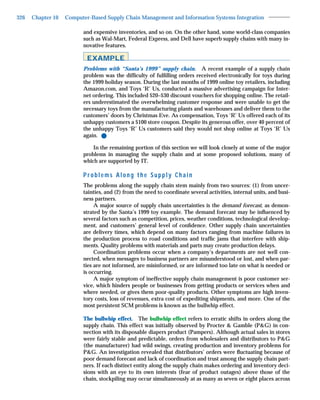
                         Problems with “Santa’s 1999” supply chain. A recent example of a supply chain
                         problem was the difficulty of fulfilling orders received electronically for toys during
                         the 1999 holiday season. During the last months of 1999 online toy retailers, including
                         Amazon.com, and Toys ‘R’ Us, conducted a massive advertising campaign for Inter-
                         net ordering. This included $20–$30 discount vouchers for shopping online. The retail-
                         ers underestimated the overwhelming customer response and were unable to get the
                         necessary toys from the manufacturing plants and warehouses and deliver them to the
                         customers’ doors by Christmas Eve. As compensation, Toys ‘R’ Us offered each of its
                         unhappy customers a $100 store coupon. Despite its generous offer, over 40 percent of
                         the unhappy Toys ‘R’ Us customers said they would not shop online at Toys ‘R’ Us
                         again. ●
                             In the remaining portion of this section we will look closely at some of the major
                         problems in managing the supply chain and at some proposed solutions, many of
                         which are supported by IT.

                         Problems Along the Supply Chain
                         The problems along the supply chain stem mainly from two sources: (1) from uncer-
                         tainties, and (2) from the need to coordinate several activities, internal units, and busi-
                         ness partners.
                              A major source of supply chain uncertainties is the demand forecast, as demon-
                         strated by the Santa’s 1999 toy example. The demand forecast may be influenced by
                         several factors such as competition, prices, weather conditions, technological develop-
                         ment, and customers’ general level of confidence. Other supply chain uncertainties
                         are delivery times, which depend on many factors ranging from machine failures in
                         the production process to road conditions and traffic jams that interfere with ship-
                         ments. Quality problems with materials and parts may create production delays.
                              Coordination problems occur when a company’s departments are not well con-
                         nected, when messages to business partners are misunderstood or lost, and when par-
                         ties are not informed, are misinformed, or are informed too late on what is needed or
                         is occurring.
                              A major symptom of ineffective supply chain management is poor customer ser-
                         vice, which hinders people or businesses from getting products or services when and
                         where needed, or gives them poor-quality products. Other symptoms are high inven-
                         tory costs, loss of revenues, extra cost of expediting shipments, and more. One of the
                         most persistent SCM problems is known as the bullwhip effect.

                         The bullwhip effect. The bullwhip effect refers to erratic shifts in orders along the
                         supply chain. This effect was initially observed by Procter & Gamble (P&G) in con-
                         nection with its disposable diapers product (Pampers). Although actual sales in stores
                         were fairly stable and predictable, orders from wholesalers and distributors to P&G
                         (the manufacturer) had wild swings, creating production and inventory problems for
                         P&G. An investigation revealed that distributors’ orders were fluctuating because of
                         poor demand forecast and lack of coordination and trust among the supply chain part-
                         ners. If each distinct entity along the supply chain makes ordering and inventory deci-
                         sions with an eye to its own interests (fear of product outages) above those of the
                         chain, stockpiling may occur simultaneously at as many as seven or eight places across
Section 10.2   Supply Chain Problems and Solutions   327

the supply chain. Such stockpiling can lead in some cases to as many as 100 days of in-
ventory (instead of the usual 10 to 15 days)—inventory that is waiting, “just in case.”
Keeping such large inventory can be very expensive for supply chain partners, costing
as much as 24 percent of the value of the items stocked, each year.
     The bullwhip effect is not unique to P&G. Firms ranging from Hewlett-Packard
in the computer industry to Bristol-Myers Squibb in the pharmaceutical field have ex-
perienced a similar phenomenon. A 1998 grocery industry study projected that simply
by sharing information, $30 billion in savings could materialize in the grocery industry
supply chains alone. To avoid the “sting of the bullwhip,” companies must share infor-
mation. Such sharing is facilitated by EDI, extranets, and groupware technologies,
and it is now part of collaborative commerce as it is done by P&G with its major cus-
tomers, as the following example shows.

 EXAMPLE
Information sharing between two giants. One of the most notable examples of in-
formation sharing is between Procter and Gamble (P&G) and Wal-Mart. Wal-Mart
provides P&G access to sales information about every P&G product that Wal-Mart
sells. The information is collected electronically by P&G on a daily basis, from every
Wal-Mart store. By monitoring the inventory level of each P&G item in every store,
P&G knows when the inventories fall below the threshold that requires a shipment.
This way, P&G is able to manage the inventory replenishment for Wal-Mart. All this
is done electronically. The benefit for P&G is accurate demand information. P&G has
similar agreements with other major retailers. Thus, P&G can plan production more
accurately, avoiding some of the problem of the bullwhip effect. In fact, P&G imple-
mented a Web-based “Ultimate-Supply System,” which replaced 4,000 different EDI
links to suppliers and retailers in a more cost-effective way. ●
Other problems along the supply chain. Many other supply chain problems exist.
One major problem is known as phantom stockouts. Such a problem occurs when cus-
tomers are told that a product they want is not available, though in fact the product is
available (e.g., when the product is misplaced, or the count of in-stock is inaccurate).
According to Harvard Business Review (May 2001), phantom stockouts cut one com-
pany’s profitability by 25 percent.

Solutions to Supply Chain Problems
Over the years organizations have developed many solutions to supply chain problems.
One of the earliest solutions was vertical integration. For example, Henry Ford pur-
chased rubber plantations in South America in order to control tire production for his
cars. Today, many companies whose success depends on tight coordination of all the
parts use vertical integration. For example, Starbucks Coffee owns coffee-processing
plants, warehouses, and distribution systems, all tied together by software programs.
     Undoubtedly, the most common solution used by companies is building invento-
ries as insurance against supply chain uncertainties. This way products and parts flow
smoothly through the production processes. The main problem with this approach is
that it is very difficult to correctly determine inventory levels for each product and
part. If inventory levels are set too high, the cost of keeping the inventory will be very
large. If the inventory is too low, there is no insurance against high demand or slow
delivery times, and revenues (and customers) may be lost. In either event the total
cost, including inventory holding cost and the cost of sales opportunities lost and bad
reputation, can be very high. Thus, companies make major attempts to control inven-
tory, usually with the aid of inventory control software or supply chain software that
includes inventory modules.
328     Chapter 10         Computer-Based Supply Chain Management and Information Systems Integration

       Manager’s Checklist 10.1

IT Solutions to Supply Chain Problems     • Use outsourcing rather than do-it-yourself during demand peaks.
                                          • Similarly, “buy” rather than “make” production inputs whenever
                                            appropriate.
                                          • Configure optimal shipping plans.
                                          • Create strategic partnerships with suppliers.
                                          • Use the just-in-time approach to purchasing, in which suppliers deliver small
                                            quantities whenever supplies, materials, and parts are needed. (See the Dell
                                            opening case.)
                                          • Reduce the lead time for buying and selling.
                                          • Use fewer suppliers.
                                          • Improve supplier-buyer relationships.
                                          • Manufacture only after orders are in, as Dell does with its custom-made
                                            computers.
                                          • Achieve accurate demand by working closely with suppliers to forecast
                                            demand.


                                             Effective supply chain and inventory management requires coordination of all ac-
                                        tivities and links of the supply chain. Successful coordination enables materials and
                                        goods to move smoothly and on time from suppliers to manufacturers to customers,
                                        which enables firms to keep inventories low and costs down. For example, computer-
                                        ized point-of-sale (POS) information can be transmitted once a day, or even in real
                                        time, to distribution centers, suppliers, and shippers. This enables firms to achieve op-
                                        timal inventory levels. Other solutions for solving SCM problems are provided in
                                        Manager’s Checklist 10.1.
                                             In conclusion, in today’s competitive business environment, the efficiency and ef-
                                        fectiveness of supply chains in most organizations are critical for the organization’s
                                        survival and are greatly dependent upon the supporting information systems. In the
                                        next section, we will show you how IT is used to support supply chains.


                                         Before you go on . . .
                                         1. Describe typical problems along the supply chain.
                                         2. Define the bullwhip effect.
                                         3. Describe some solutions to supply chain problems.


10.3         IT SUPPLY CHAIN SUPPORT AND SYSTEMS INTEGRATION

                                        Effective solutions to supply chain problems have been provided by IT for decades.
                                        Indeed, the concept of the supply chain is interrelated with the computerization of its
                                        activities, which has evolved over 50 years. Some examples of how IT solves recurrent
                                        supply chain problems are provided in Table 10.1. (Some of the supporting technolo-
                                        gies mentioned in this table are described in Chapters 11 and 12.)
Section 10.3   IT Supply Chain Support and Systems Integration              329


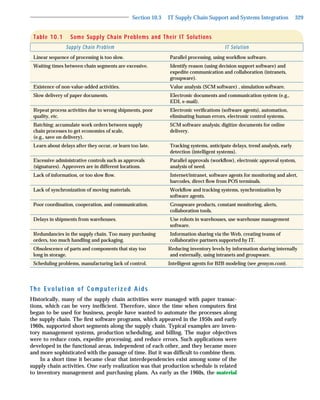
 Table 10.1       Some Supply Chain Problems and Their IT Solutions
                Supply Chain Problem                                                     IT Solution
 Linear sequence of processing is too slow.                    Parallel processing, using workflow software.
 Waiting times between chain segments are excessive.           Identify reason (using decision support software) and
                                                               expedite communication and collaboration (intranets,
                                                               groupware).
 Existence of non-value-added activities.                      Value analysis (SCM software) , simulation software.
 Slow delivery of paper documents.                             Electronic documents and communication system (e.g.,
                                                               EDI, e-mail).
 Repeat process activities due to wrong shipments, poor        Electronic verifications (software agents), automation,
 quality, etc.                                                 eliminating human errors, electronic control systems.
 Batching; accumulate work orders between supply               SCM software analysis; digitize documents for online
 chain processes to get economies of scale,                    delivery.
 (e.g., save on delivery).
 Learn about delays after they occur, or learn too late.       Tracking systems, anticipate delays, trend analysis, early
                                                               detection (intelligent systems).
 Excessive administrative controls such as approvals           Parallel approvals (workflow), electronic approval system,
 (signatures). Approvers are in different locations.           analysis of need.
 Lack of information, or too slow flow.                         Internet/intranet, software agents for monitoring and alert,
                                                               barcodes, direct flow from POS terminals.
 Lack of synchronization of moving materials.                  Workflow and tracking systems, synchronization by
                                                               software agents.
 Poor coordination, cooperation, and communication.            Groupware products, constant monitoring, alerts,
                                                               collaboration tools.
 Delays in shipments from warehouses.                          Use robots in warehouses, use warehouse management
                                                               software.
 Redundancies in the supply chain. Too many purchasing         Information sharing via the Web, creating teams of
 orders, too much handling and packaging.                      collaborative partners supported by IT.
 Obsolescence of parts and components that stay too            Reducing inventory levels by information sharing internally
 long in storage.                                              and externally, using intranets and groupware.
 Scheduling problems, manufacturing lack of control.           Intelligent agents for B2B modeling (see gensym.com).


The Evolution of Computerized Aids
Historically, many of the supply chain activities were managed with paper transac-
tions, which can be very inefficient. Therefore, since the time when computers first
began to be used for business, people have wanted to automate the processes along
the supply chain. The first software programs, which appeared in the 1950s and early
1960s, supported short segments along the supply chain. Typical examples are inven-
tory management systems, production scheduling, and billing. The major objectives
were to reduce costs, expedite processing, and reduce errors. Such applications were
developed in the functional areas, independent of each other, and they became more
and more sophisticated with the passage of time. But it was difficult to combine them.
     In a short time it became clear that interdependencies exist among some of the
supply chain activities. One early realization was that production schedule is related
to inventory management and purchasing plans. As early as the 1960s, the material
330    Chapter 10      Computer-Based Supply Chain Management and Information Systems Integration

                              requirements planning (MRP) model was devised. This model essentially integrates
                              production, purchasing, and inventory management of interrelated products (see
                              Chapter 8). It became clear that computer support could greatly enhance the use of
                              this model, which may require daily updating. This resulted in commercial MRP soft-
                              ware packages coming on the market.
                                   MRP packages were useful in many cases, and they are still in use today, helping
                              to drive inventory levels down and streamlining portions of the supply chain. How-
                              ever, some of the MRP applications failed. One of the major reasons for such failure
                              was that schedule-inventory-purchasing operations are closely related to both finan-
                              cial and labor resources, but were not included in the MRP packages. The realization
                              of this failure resulted in an enhanced MRP methodology and software called manu-
                              facturing resource planning (MRP II), which adds labor and financial planning to the
                              simpler MRP model.
                                   This evolution continued, leading to the enterprise resource planning (ERP) con-
                              cept, which expanded MRP II to other activities in the entire enterprise. ERP was
                              confined initially to include internal suppliers and customers, but later it incorporated
                              external suppliers and customers in what is known as extended ERP software. (We
                              look at ERP again in more detail in Section 10.4.)
                                   The above evolution of computerized integrated systems is shown in Figure 10.4.
                              The next step in this evolution, which is just beginning to make its way into business
                              use, is the inclusion of markets and communities. (See mySAP.com for details.)
                                   Notice that throughout this evolution there have been more and more integra-
                              tions along several dimensions (more functional areas, combining transaction process-
                              ing and decision support, inclusion of business partners). The question is—why?


                              Why Systems Integration?
                              Creating the twenty-first century enterprise cannot be done effectively with twentieth-
                              century computer technology, which is functionally oriented. Functional systems may
                              not let different departments communicate with each other in the same language.
                              Worse yet, crucial sales, inventory, and production data often have to be painstak-
                              ingly entered manually into separate computer systems every time they need to be


                                                  Inventory
                                                                      Production                       Production
                                    1960                       +                           MRP
                                                                      Scheduling                       Managment
                                                  Purchasing


                                                                                                       Major
                                                                       Finance,
                                    1970            MRP        +                          MRP II       Manufacturing
                                                                        Labor
                                                                                                       Resources

                                                                                                       Coordinated
                                                               +      All Internal                     Manufacturing
                                    1980            MRPII                                  ERP
                                                                      Resources                        and Service
                                                                                                       Transactions


                                                                   Internal Customers                  Internal
                                    1990            ERP        +                        Internal SCM
                                                                      and Suppliers                    ERP/SCM


                                                   Internal        External Suppliers    Extended      Extended
                                    2000                       +
                                                  ERP/SCM           and Customers          SCM         ERP/SCM


Figure 10.4      The evolu-
tion of integrated systems.                Time
Section 10.3   IT Supply Chain Support and Systems Integration   331

processed together. In many cases employees simply do not get the information they
need, or they get it too late.
    The following are the major tangible and intangible benefits of systems integra-
tion (in order of importance):
• Tangible benefits: Inventory reduction, personnel reduction, productivity improve-
  ment, order management improvement, financial-close cycle improvements, IT cost
  reduction, procurement cost reduction, cash management improvements,
  revenue/profit increases, transportation and logistics cost reduction, maintenance
  reduction, and on-time delivery improvement.
• Intangible benefits: Information visibility, new/improved processes, customer re-
  sponsiveness, standardization, flexibility, globalization, and business performance
Notice that in both types of benefits many items are directly related to improved sup-
ply chain management.

Supply Chain and Value Chain Integration
The integration of the links in the supply chain has been facilitated by the need to
streamline operations in order to meet customer demands in the areas of product and
service cost, quality, delivery, technology, and cycle time brought by increased global
competition. This requires flexibility of the integrated systems.

Types of integration: from supply to value and system chains. The most obvious in-
tegration is of the segments of the supply chain and/or of the information that flows
among the segments. But there is another type of integration, related to what are
called value chains. The term value chain (Chapter 13) describes the primary activities
of an organization (inboard logistics, operations, etc.), along with its support activities
(infrastructure, human resources, technology, etc.), and the net value that is added to
the organization’s product or service by each primary activity, sequentially.
     Traditionally, we thought of the value chain in terms of one organization’s pri-
mary activities such as purchasing, transportation, warehousing, and logistics. How-
ever, when the value chain is extended to include suppliers, customers, and so forth, it
becomes a value system, or integrated value chain (Chapter 13). The integrated value
chain is a more encompassing concept. It is the process by which multiple enterprises
within a shared market channel collaboratively plan, implement, and manage (elec-
tronically as well as physically) the flow of goods, services, and information along
their entire joint chain in a manner that increases customer-perceived value (value
proposition). This process optimizes the efficiency of the chain, creating competitive
advantage for all stakeholders in their own value chains.
     Another way of defining value chain integration is as a process of collaboration
that optimizes all internal and external activities involved in delivering greater per-
ceived value to the ultimate customer. A supply chain is transformed into an inte-
grated value chain when it:
• Extends the chain all the way from subsuppliers (tier 2, 3, etc.) to customers
• Integrates back-office operations with those of the front office
• Becomes highly customer-centric, focusing on demand generation and customer
  service as well as demand fulfillment and logistics
• Is proactively designed by chain members to compete as an extended enterprise,
  creating and enhancing customer-perceived value by means of cross-enterprise col-
  laboration
• Seeks to optimize the value added by information and utility-enhancing services
‘s A b o u t B u s i n e s s                                                POM      MKT


      10.2:      How Warner-Lambert applies an integrated supply chain
  One of Warner-Lambert’s major products is Listerine                       shared strategic plans, performance data, and market in-
  antiseptic mouthwash (now a division of Pfizer). The ma-                   sight with Wal-Mart over private networks (see the fig-
  terials for making Listerine come from eucalyptus trees in                ure). The company realized that it could benefit from
  Australia and are shipped to the Warner-Lambert (W-L)                     Wal-Mart’s market knowledge, just as Wal-Mart could
  manufacturing plant in New Jersey, USA. The Listerine is                  benefit from W-L’s product knowledge. In CPFR, trad-
  distributed by wholesalers and by thousands of retail                     ing partners collaborate on demand forecast. The project
  stores, some of which are giants such as Wal-Mart. The                    includes major SCM and ERP vendors such as SAP and
  problem that W-L faces is to forecast the overall demand                  Manugistics. During the CPFR pilot, W-L increased its
  in order to determine how much Listerine to produce. A                    products’ shelf-fill rate—the extent to which a store’s
  wrong forecast will result either in high inventories, or in              shelves are fully stocked—from 87 percent to 98 percent,
  shortages. Inventories are expensive to keep, and short-                  earning the company about $8 million a year in addi-
  ages may result in loss of revenue and reputation.                        tional sales for much less investment. W-L is now using
       Warner-Lambert forecasts demand with the help of                     the Internet to expand the CPFR program to all its sup-
  Manugistic Inc.’s Demand Planning Information System.                     pliers and retail partners.
  (Manugistic is a vendor of IT software for SCM.) Then                          Warner-Lambert is involved in another collabora-
  the system analyzes manufacturing, distribution, and                      tive retail-industry project, the Supply-Chain Operations
  sales data against expected demand and business climate                   Reference (SCOR), an initiative of the Supply-Chain
  information. Its goal is to help W-L decide how much                      Council in the United States. SCOR divides supply chain
  Listerine (and other products) to make and distribute                     operations into parts, giving manufacturers, suppliers,
  and how much of each raw ingredient is needed, and                        distributors, and retailers a framework with which to
  when. The sales and marketing group of W-L enters the                     evaluate the effectiveness of their processes along the
  expected demand for Listerine into another SCM soft-                      same supply chains.
  ware) which schedules the production of Listerine in the
  amounts needed and generates electronic purchase or-
                                                                            Questions
  ders for W-L’s suppliers.                                                 1. Can you identify other industries, besides retailing,
       W-L’s supply chain excellence stems from the Col-                       for which a similar collaboration would be benefi-
  laborative Planning, Forecasting, and Replenishment                          cial?
  (CPFR) program. This is a retailing-industry project for                  2. Why was Listerine a target for the pilot SCM col-
  which piloting was done at W-L. In the pilot project W-L                     laboration?
A CPFR                                        Wal-Mart                                                          Warner-Lambert (W-L)
project. In a pilot
project, Wal-Mart
has used the
CPFR to link up                              Operational                                                                ERP
                                              System
with one of its
key suppliers,
                                                             Intranet


Warner-Lambert,
manufacturer of                                                                      EDI
consumer prod-
ucts like Lister-                                                                                        Intranet
                                          Data warehouse
ine. Through
CPFR work-                                                                                                              SCM
benches (spread-                                                                                                    Manufacturing
sheet-like                                                                                                            Planning
                                                                        Wal-Mart            W-L
documents with                               RetailLink                  CPFR              CPFR
ample space for                                                          Server            Server
collaborative
comments), Wal-                           Sales data about
                                           W-L Products
Mart buyers and
Warner-Lambert                        ?                                                                                    ?
                      Inventory                                                Internet               Review and
planners are able       Plan                 Forecast                                                 Comments
to jointly develop
product forecasts.                Planner                                                                              Planner
Section 10.4    Enterprise Resource Planning (ERP)   333

     Presently only a few large companies are successfully involved in a comprehen-
sive collaboration to reengineer the value system. One such effort is described in IT’s
About Business 10.2, a case about Warner-Lambert, manufacturer of consumer prod-
ucts like Listerine.
     Through CPFR workbenches (spreadsheet-like documents with ample space for
collaborative comments), Warner-Lambert (W-L) planners and buyers from Wal-
Mart, a giant buyer of W-L products, are able to jointly develop forecasts of overall
product demand. Such forecasts help guide W-L’s production planning for its manu-
facturing plants. This kind of collaboration is referred to as collaborative commerce
networks, a type of collaborative commerce (see Chapter 9).
     Another example of supply chain integration is product development systems that
allow suppliers to dial into a client’s intranet, pull product specifications, and view illus-
trations and videos of a manufacturing process. Finally, one should distinguish between
integration inside a company (integrating the information systems of departments, con-
necting to database, connecting the ordering system to the back-end production activi-
ties), and interorganizational system integration (connecting systems of different
organizations).


 Before you go on . . .
 1. Trace the evolution from MRP to ERP.
 2. Describe the need for software integration.
 3. Define value chain and value system.


10.4      ENTERPRISE RESOURCE PLANNING (ERP)
With the advance of enterprisewide client server computing comes a new challenge:
how to control all major business processes with a single software architecture in real
time. The integrated solution known as enterprise resource planning (ERP) is a
process of managing all resources and their use in the entire enterprise in a coordi-
nated manner. ERP’s major objective is to integrate all departments and functions
across a company onto a single information system that can serve all of the enter-
prise’s needs. For example, improved order entry allows immediate access to inven-
tory, product data, customer credit history, and prior order information. This
availability of information raises productivity, quality, and profitability, and it in-
creases customer satisfaction. The implementation of ERP is done by commercial
software available from companies such as SAP, Oracle, and PeopleSoft. An ERP im-
plementation is illustrated in IT’s About Business 10.3.
     ERP software crosses functional department lines. It includes dozens of inte-
grated modules such as sales, procurement, inventory control, manufacturing schedul-
ing, accounts payable, accounts receivable, payroll, monthly financial statements, and
systems management. An ERP suite provides a single interface for managing all the
routine activities performed in manufacturing—from entering sales orders to coordi-
nating shipping and after-sales customer service. As of the late 1990s, ERP systems
have begun to be extended along the supply chain to suppliers and customers, incor-
porating functionality for customer interaction and for managing relationships with
suppliers and vendors.
334     Chapter 10   Computer-Based Supply Chain Management and Information Systems Integration


      ‘s A b o u t B u s i n e s s                      colgate.com

      10.3:   Colgate-Palmolive uses ERP to smooth its supply chain
Colgate-Palmolive is the world leader in oral-care prod-    pany to access more timely and accurate data, and re-
ucts (mouthwashes, toothpaste, and toothbrushes) and a      duce costs (see figure at our Web site).
major supplier of personal-care products (baby care, de-         An important factor for Colgate was whether it
odorants, shampoos, and soaps). In addition, the com-       could use the ERP software across the entire spectrum
pany’s Hill’s Health Science Diet is a leading pet-food     of the business. Colgate needed the ability to coordinate
brand worldwide. Foreign sales account for about 70         globally and act locally. Colgate’s U.S. division installed
percent of Colgate’s total revenues.                        SAP R/3 for this purpose (see description of SAP R/3 on
     To stay competitive, Colgate continuously seeks to     the book’s Web site).
streamline its supply chain, where thousands of suppliers
and customers interact with the company. At the same
time, Colgate faces the challenges of new-product accel-    Questions
eration, which has been a factor in driving faster sales
                                                            1. Draw the supply chain of Colgate’s toothpaste.
growth and improved market share. Also, Colgate is de-
                                                               (To do so, you need to find how the product is
vising ways to offer consumers a greater choice of better
                                                               made and distributed.)
products at a lower cost to the company, which creates
complexities in the manufacturing and the supply chains.    2. What role does the ERP software play?
To better manage and coordinate its business, Colgate       3. What benefits can customers, like yourself, derive
embarked on an ERP implementation to allow the com-            from the ERP?


                                  But ERP was never meant to fully support supply chains. ERP solutions are cen-
                             tered around business transactions. As such, they do not provide the computerized de-
                             cision support needed to respond rapidly to real-time changes in supply, demand,
                             labor, or capacity. This deficiency has been overcome by the second generation of
                             ERP.


                             Second-Generation ERP
                             ERP has traditionally excelled in the ability to manage administrative activities like
                             payroll, inventory, and order processing. For example, an ERP system has the func-
                             tionality of electronic ordering or the best way to bill the customer—but all it does
                             is automate the transactions. The reports generated by ERP systems gave planners
                             statistics about what happened in the company, costs, and financial performance.
                             However, the planning systems with ERP were rudimentary. Reports from first-
                             generation ERP systems provided a snapshot of the business at a point in time. But
                             they did not support the continuous planning that is central to supply chain plan-
                             ning—planning that continues to refine and enhance the plan as changes and events
                             occur, up to the very last minute before executing the plan. First-generation ERP
                             systems did not support decision making either. To get such support for segments of
                             the supply chain, companies used standalone (unintegrated) supply chain manage-
                             ment (SCM) software.

                             SCM software. Planning systems oriented toward decision making were provided
                             by SCM software. To illustrate, consider how ERP and SCM approach an order-
                             processing problem. There is a fundamental difference: The question in SCM be-
                             comes “Should I take your order?” instead of the ERP approach of “How can I best
                             take or fulfill your order?” The following example demonstrates how SCM software
                             works.
Section 10.4    Enterprise Resource Planning (ERP)   335


 EXAMPLE

IBM links its global supply chain with SCM software. IBM reengineered its global
supply chain in order to achieve quick responsiveness to customers and to do so with
minimal inventory. To support this effort, it developed a supply chain analysis tool
called the Asset Management Tool (AMT). AMT integrates analytical performance
optimization, simulation, activity-based costing, graphical process modeling, and en-
terprise database connectivity into a system that allows quantitative analysis of ex-
tended supply chains. IBM has used AMT to study such issues as inventory budgets,
customer-service targets, and new-product introductions. The system was imple-
mented at a number of IBM business units and their supply chain partners. AMT ben-
efits include savings of over $750 million in material costs and reductions in
administrative expenses each year.       ●
    However, SCM solutions need to be coordinated, and they sometimes require in-
formation provided by ERP software. Therefore, it makes sense to integrate ERP and
SCM.

Integrating ERP and SCM. How is ERP/SCM integration done? One approach is to
work with different software products from different vendors. For example, a com-
pany might use SAP R/3 as an ERP and add to it Manugistics’ manufacturing-
oriented SCM software (as shown in the Warner-Lambert case). Such an approach,
which is known as the “best of breed” approach, requires fitting different softwares,
from different vendors, which may be a complex task unless special interfaces exist.


 Table 10.2        Comparing SCM and SCI
   Supply Chain Management (SCM)                        Supply Chain Intelligence (SCI)
 Largely about managing the procurement           Provides a broad view of an entire supply
 and production links of the supply chain.        chain to reveal full product and component
 life cycle.
 Transactional.                                   Analytical.
 Tactical decision making.                        Strategic decision making.
 Helps reduce costs through improved              Reveals opportunities for cost reduction,
 operational efficiency.                           but also stimulates revenue growth.
 Usually just the SCM application’s data          Integrates supplier, manufacturing, and
 (as a vertical stovepipe).                       product data (horizontal).
 Records one state of data, representing          Keeps a historic record.
 “now”.
 Assists in material and production planning.     Does what-if forecasting based on historic
 data.
 Quantifies cost of some materials.                Enables an understanding of total cost.
 Shows today’s yield but cannot explain           Drills into yield figures to reveal what
 influences on it; thus provides no help for       caused the performance level, so it can be
 improvements.                                    improved.
 Simple reporting.                                Collaborative environment with personalized
                                                  monitoring of metrics.
Source: P. Russom, “Increasing Manufacturing Performance Through Supply Chain Intelligence,” DM Re-
view, (September 2000).
336   Chapter 10   Computer-Based Supply Chain Management and Information Systems Integration

                              The second approach is for the ERP vendors to add SCM functionalities, such as
                         decision support and business intelligence capabilities. Business intelligence refers to
                         analysis performed by DSS, EIS, data mining, and intelligent systems (see Chapters
                         11 and 12). These added capabilities solve the integration problem. But as is the case
                         with integration of database management systems and spreadsheets in Excel, the re-
                         sult can be a product with some not-so-strong functionalities. However, most ERP
                         vendors are adding such functionalities for another reason: It is cheaper for the cus-
                         tomers. Packages with these added functionalities represent the second-generation
                         ERP, which includes not only decision support but also customer relationship man-
                         agement (CRM) (Chapter 8), e-commerce (Section 10.5), and data warehousing and
                         mining (Chapter 11). Some second-generation systems include a knowledge manage-
                         ment (Chapter 11) component as well.

                         Supply chain intelligence. The inclusion of business intelligence in supply chain
                         software solutions is referred to by some as supply chain intelligence (CSI). CSI ap-
                         plications enable strategic decision making by analyzing data along the entire supply
                         chain. To better understand CSI, it is worthwhile to compare it with SCM, as shown
                         in Table 10.2.


                           Before you go on . . .

                           1. Define ERP and its functionalities.
                           2. Describe SCM software.
                           3. Describe the second-generation ERP (integrated ERP/SCM).
                           4. What is supply chain intelligence?


10.5     E-COMMERCE AND SUPPLY CHAIN MANAGEMENT
                         E-commerce is emerging as a superb approach for providing solutions to problems
                         along the supply chain. As seen in the Dell example at the beginning of the chapter,
                         many supply chain activities, from taking customers’ orders to parts procurement, can
                         be conducted as EC initiatives.

                         EC Activities Along the Supply Chain
                         A major role of EC is to facilitate buying, selling, and collaborating along the supply
                         chain. Here we describe the types of EC activities along the supply chain.

                         Upstream activities. Several innovative EC models can improve the upstream sup-
                         ply chain activities. These models are described generally as e-procurement. Three are
                         presented in Chapter 9: reverse auctions, aggregation of vendors’ catalogs at the
                         buyer’s site, and procurement via consortia and group purchasing.

                         Internal SCM activities. Internal SCM activities include different intrabusiness EC
                         activities. These activities range from entering orders of materials, to streamlining
                         production, to recording sales, to tracking shipments. They are usually conducted over
                         a corporate intranet. Details and examples are provided in Chapters 8 and 9.
Section 10.5     E-Commerce and Supply Chain Management        337

Downstream activities. Typical EC downstream activities are related to online selling
as described in Chapters 8 and 9. Two popular models of downstream activities follow.

Selling on your own Web site. Large companies such as Intel, Cisco, and IBM use this
model. At the company’s own Web site, buyers review electronic catalogs from which
they buy. Large buyers are provided with their own Web pages and customized catalogs.

Auctions. Large companies such as Dell conduct auctions of products or obsolete
equipment on their Web sites. Electronic auctions can shorten cycle time and the sup-
ply chain and save on logistics and administrative expenses. One online auctioneer,
for example, is Autodaq (autodaq.com). The buyers are car dealers who then resell
the used cars (the transaction is B2B2C). Traditional car auctions are done on large
lots, where the cars are displayed and physically auctioned. In the electronic auction,
the autos do not need to be transported to a physical auction site, nor do buyers have
to travel to an auction site. Savings of $500 per car can be realized.

Exchanges. Considerable support to B2B supply chains can be provided by elec-
tronic exchanges (Chapter 9). Such exchanges are shown in Figure 10.5. Notice that in
this example there are three separate exchanges. In other cases there may be only one
exchange for the entire industry.

Restructuring the Supply Chain
E-commerce can introduce structural changes in the supply chain. For example, the
creation of electronic markets drastically changes order processing and fulfillment. In
many cases, linear supply chains are changed to hubs, as shown in the case of ORBIS
Corp. in IT’s About Business 10.4.


                       Finanacial
                         Market
                          Plan                 Banks
                                                                     Wholesale
                                                                     Distributors
                                                                                          Retailers

               Suppliers
                                          Manufacturers


                               Supplier                                                   Customer
                                                                          Logistics
                               Oriented                                                    Oriented
                                                                         Exchanges
                              Exchanges                                                   Exchanges


                                                                                                             Customers
                                                  Virtual
                                               Manufacturers
                Contract                                                                    Returned Items
              Manufacturers
                                                                           Logistics
                                                                           Providers

                           Information Flows
                           Goods Flow

Figure 10.5    Web-based supply chain involving exchanges.
338     Chapter 10      Computer-Based Supply Chain Management and Information Systems Integration


      ‘s A b o u t B u s i n e s s                            productbank.com.au

      10.4   Orbis changes a linear physical supply chain to an electronic hub

                            Supplier                          Ad            Scanning      Digital
             Retailer                     Courier                                                      Catalog
                             (Sony)                         Agency           House        Image
ORBIS.


Orbis Corp. is a small Australian company that provides                With the new system, manufacturers send digitized
Internet and EC services. One of its services is called           photos to Orbis, and Orbis enters and organizes the pho-
ProductBank (productbank.com.au). This service revo-              tos in a database. When retailers need pictures, they can
lutionized the flow of information and products in the             view online the images in the database and decide which
B2B advertising field. In order to understand how the              they want to include in their catalog. The retailers com-
service works, let’s look at how a retail catalog or              municate electronically with their ad agency about what
brochure is put together. A catalog shows pictures of             images they want to include in their catalogs. The ad
many products. These pictures are obtained from manu-             agency makes suggestions and works on the design of
facturers such as Sony or Nokia. The traditional process          the catalog. Once the design is complete, the catalog can
is linear, as shown in the figure.                                 be downloaded by the printer. The transaction cost per
      The traditional process works like this: When retail-       picture (usually paid by the manufacturer) is 30 to 40
ers need a photo of a product they contact the manufac-           percent lower, and the cycle time is 50 to 70 percent
turers, who send the photos via a courier to an ad                shorter than in the traditional catalog production
agency. The ad agency decides, in cooperation with the            method.
retailer, which photos to use and how to present them.
The ad agency then rushes the photos to be scanned and
converted into digital images, which are transferred to           Questions
the printer. The cycle time for each photo is 4 to 6 weeks,       1. Identify the benefits to the supply chain partici-
and the total transaction cost of preparing one picture              pants.
for the catalog is about $150 AU.
                                                                  2. Where does the cost reduction come from?
      ProductBank simplifies this lengthy process. It has
centralized the entire process by changing the linear flow         3. Where does the cycle time reduction come from?
of products and information to a digitized hub as shown           4. Explain the benefits of electronic collaboration be-
in the figure.                                                        tween the catalog owners and the ad agency.


                                                Printer

                             Sony

                                                                                         Retailer 1

                             Nokia
                                                             Product-
                                                            bank.com                     Retailer 2
                                                               Hub
                             Other

                                                                                           Other

                             Other

                                              Ad Agency 1            Ad Agency 2
Section 10.5    E-Commerce and Supply Chain Management                339

Integration of EC with ERP
Since many middle-sized and large companies already have an ERP system, and since
e-commerce needs to interface with ERP, it makes sense to integrate the two. For ex-
ample, SAP started building some EC interfaces in 1997, and in 1999 introduced
mySAP.com as a major initiative. The mySAP initiative is a multifaceted Internet
product that includes EC, online trading sites, an information portal, application host-
ing, and user-friendly graphical interfaces.
     The logic behind integrating EC and ERP is that by extending the existing ERP
system to support e-commerce, organizations not only leverage their investment in
the ERP solution, but also speed up the development of EC applications. The prob-
lem with this approach is that the ERP software is very complex and inflexible (diffi-
cult to change), so it is difficult to achieve easy, smooth, and effective integration. One
other potential problem is that ERP systems tend to focus on back-office (administra-
tive) applications, whereas EC focuses on front-office applications such as sales and
order taking, customer service, and other customer relationship management (CRM)
activities. Ideally, one should attempt to achieve tight integration along the entire sup-
ply chain as done by McKesson, described in IT’s About Business 10.5.


    ‘s A b o u t B u s i n e s s                           mckesson.com

   10.5:     How McKesson integrates the pharmaceutical supply chain
McKesson Drug Company is the largest U.S. distributor          tion of the bullwhip effect discussed earlier. On the up-
of pharmaceuticals, healthcare products, medical sup-          stream side, McKesson uses e-procurement with its
plies, and related products (mckesson.com). It is posi-        major suppliers. It also collaborates with them electroni-
tioned between manufacturers and retailers and other           cally on demand forecasts by product. Finally, McKesson
business customers, such as hospitals. Its supply chain is     uses an eleborate intrabusiness e-commerce system be-
shown in Figure 10.3a.                                         tween its headquarters, the distribution centers, and the
      With annual sales of over $22 billion and close to       transportation units (company owned and outsourced).
40,000 business customers, who generate over 2,000,000         All documentation flows electronically in the system.
purchasing orders every month, for thousands of products,      Also, warehouse management and order pick-ups are
the supply chain and its management are rather complex.        computerized to minimize pickers’ efforts.
      Effectiveness and efficiency, which are needed for             The benefits to McKesson of its integration of the
survival, can be achieved only with a tight integration with   supply chain include rapid, reliable, and cost-effective
both the major customers and the suppliers. To enable          customer order processing. Sales personnel are no
such integration with its major customers (such as CVS         longer primarily order takers; they can do proactive mar-
drug chain and Rite Aid), McKesson assumed the respon-         keting. Purchasing from suppliers has been reorganized
sibility of monitoring and replenishing the inventory of its   to tightly match actual sales, and productivity of the
major products at the store level. In other cases, virtually   warehouse staff has been significantly increased. Finally,
all purchasing orders are submitted to McKesson elec-          customers are more loyal to McKesson because of the
tronically. Once submitted, orders are organized by re-        benefits they enjoy.
gion and stored on a mainframe. Regional distribution
centers pull the orders daily and make the necessary deliv-    Questions
eries. In addition, all payments are made online.
                                                               1. Enter mckesson.com and identify any new supply-
      McKesson provides its business customers with
                                                                  chain related initiatives.
Web-based up-to-date sales data, by product and by
store, enabling the customers to make better marketing,        2. Identify the B2B2C activities used by McKesson.
promotions, inventory, and pricing decisions. The tight        3. In theory, manufacturers can sell direct to retail-
software integration with the customers on the down-              ers, eliminating McKesson. Explain McKesson’s
stream side of the supply chain enables better demand             strategy to protect itself. Is the company likely to
forecast, which results in lower inventories and elimina-         be successful? Why or why not?
340    Chapter 10         Computer-Based Supply Chain Management and Information Systems Integration

      Manager’s Checklist 10.2

How E-Commerce Activities Can       • Digitized products (such as software) are much cheaper and faster to create
Improve SCM                           and move than are physical products.
                                    • Replacing paper documents with electronic documents improves speed and
                                      accuracy, and the cost of document transmission is much cheaper.
                                    • Replacing faxes, telephone calls, and telegrams with an electronic messaging
                                      system streamlines communications and cuts communications costs.
                                    • Restructuring the supply chain from linear to a hub (as shown in the Orbis
                                      case, in IT’s About Business 10.4) enables faster, cheaper, and better
                                      communication, collaboration, and discovery of information.
                                    • Enhancing collaboration and information sharing among the partners in the
                                      supply chain can improve cooperation, coordination, and demand forecasts.
                                    • EC can shorten supply chains and minimize inventories. As a result of the
                                      build-to-order model provided by EC, the auto industry, for example, is
                                      expected to save billions of dollars annually in inventory reduction alone.
                                    • Innovations such as FAQs and the self-tracking of shipments can reduce the
                                      need for information flow between companies and customers.
                                    • E-marketplaces bring efficiencies into buying and selling, as shown in
                                      Chapter 9.

                                    Other e-commerce activities can make significant contributions to SCM improve-
                                 ment, as suggested in Manager’s Checklist 10.2.


                                  Before you go on . . .

                                  1. Describe how EC improves activities along the major segments of the supply
                                     chain.
                                  2. Explain how EC changes the linear supply chain to a hub.
                                  3. Describe the need of integrating EC with ERP.


10.6        ORDER FULFILLMENT IN E-COMMERCE
                                 In the previous section we described how e-commerce tools can solve problems along
                                 the supply chain. However, some applications of EC, especially B2C and sometimes
                                 B2B, may have problems with their own supply chains. These problems usually occur
                                 in order fulfillment. Let’s explain.

                                 Order Fulfillment and Logistics: An Overview
                                 Order fulfillment refers not only to providing the customers with what they ordered
                                 and doing it on time, but also to providing all related customer service. To do so in e-
                                 tailing one must send small packages to a large number of customers. In contrast, in
                                 traditional retailing you ship large quantities to a small number of retail stores. There-
                                 fore, e-tailers face several problems in order fulfillment, especially during the holiday
                                 season. The problems occur in storage, picking up items, packaging, and shipping, all of
                                 which must be done effectively at a minimum cost. These problems result in inability to
Section 10.6    Order Fulfillment in E-Commerce   341

deliver on time, delivery of wrong items, paying too much for deliveries, and costly
compensation of unhappy customers. Taking orders over the Internet could well be the
easy part of B2C electronic commerce. Fulfillment to customers’ door is the tricky part.
     Several factors can be responsible for delays in deliveries. They range from inability
to accurately forecast demand, to ineffective supply chains of the e-tailers. One factor
that is typical of EC is that it is based on the concept of pull operations, which begin with
an order, frequently a customized one. This is in contrast with traditional retailing that
begins with production to inventory, which is then pushed to customers. In the pull case it
is more difficult to forecast demand, due to the unique nature of customized orders.

Innovative Solutions to the Order Fulfillment Problem
During the last few years companies have developed innovative solutions to both B2C
and B2B order fulfillment. Here are some examples.

Same-day, even same-hour delivery. In the digital age, next-morning delivery may
not be fast enough. Today we talk about same-day delivery, and even delivery within
an hour. Delivering groceries is an example where speed is important. Quick deliver-
ies of pizzas have been practiced for a long time using telephone ordering. Many
restaurants use the same approach, which is known as “dine online.” Online ordering
can be much more efficient.

 EXAMPLE
Dialing for dinners. Some dine online companies offer aggregating services, which
process orders for several restaurants (e.g., Campusfood.com and Dialadinner.com.hk)
and also make the deliveries. Here is how it works in Hong Kong: Customers click on
the online menu at dialadinner.com.hk, select the dishes they want, then submit their
order electronically. Sometimes customers can even mix and match orders from two
restaurants. For first-time customers, a Dialadinner staff member phones to check de-
livery details and to confirm that the order is genuine. The orders are forwarded elec-
tronically from Dialadinner to the participating restaurants. Delivery staff receives a
copy of the order by e-mail (SMS) on their mobile phones, telling them which restau-
rant to go to. There, they are handed the food and delivery details. Delivery is made in
small cars or on motorcycles (see photo). Customers receive their meals and pay cash
on delivery. Average time from order to delivery is 30 to 40 minutes. For other exam-
ples of quick delivery, see 4sameday.com and Xmessenger.com.        ●
Automated warehouses. Traditional warehouses are built to deliver large quantities
to a small number of stores or manufacturing plants. In B2C EC, companies need to
send small quantities to a large number of individual customers. The picking and pack-
ing process therefore is different, and usually more labor intensive. Therefore, large-
volume EC fulfillment requires special, possibly automated, warehouses, which may
include robots and other devices that expedite the pickup of products. Several large e-
tailers, such as Amazon.com, operate their own warehouses. However, most order ful-
fillment is probably shipped via outsourcers. For a description of how a typical
automated warehouse would work, see the book’s Web site.

Dealing with Returns
Returning unwanted merchandise and providing for exchanges are necessary for
maintaining customers’ trust and loyalty. The Boston Consulting Group found that
“absence of good return mechanism” was the second biggest reason that U.S. shop-
pers cited for refusing to buy on the Web. For their part, merchants face the major
problem of how to deal with returns. Several options exist:
342   Chapter 10   Computer-Based Supply Chain Management and Information Systems Integration

                         1. Return an item to the place where it was purchased. This is easy to do in a brick-
                            and-mortar store, but not in a virtual one. To return an item to a virtual store, you
                            need to get authorization, pack everything up, pay to ship it back, insure it, and
                            wait up to two billing cycles for a credit to show up on your statement. The buyer is
                            not happy. Neither is the seller, who must unpack the item, check the paperwork,
                            and resell the item, usually at a loss. This solution is good only if the number of re-
                            turns is small.
                         2. Separate the logistics of returns from the logistics of delivery. Returns are shipped
                            to an independent unit and handled separately inside the company. This solution
                            may be more efficient from the seller’s point of view, but the buyer is still unhappy.
                         3. Allow the customer to physically drop the returned items at collection stations
                            (such as at 7-Eleven stores or Mail Boxes Etc.), from which the returns can be
                            picked up. For example, BP Australia Ltd. (operator of gasoline service stations)
                            teamed up with Wishlist.com.au, to accept returns. Caltex Oil of Australia also
                            provides such service at their convenience stores.
                         4. Completely outsource the logistics of returns. Several outsourcers, including
                            United Postal Service (UPS), provide such services. The services they offer deal
                            not only with returns, but also with the entire logistics process of deliveries.


                           Before you go on . . .

                           1. Describe the order fulfillment process.
                           2. Explain the same-day delivery process.
                           3. Describe the role of automated warehouses in the logistics of e-commerce.
                           4. List the difficulties of handling returns and describe the solutions.


                              WHAT’S IN                  FOR ME ?

                   ACC    FOR THE ACCOUNTING MAJOR
                          The accounting information systems (part of the back-end systems) are a central com-
                          ponent in any ERP package. As a matter of fact, all large CPA firms actively consult
                          clients on ERP implementation, using thousands of specially trained accounting ma-
                          jors. Also, many supply chain issues ranging from inventory management and valua-
                          tion to risk analysis are in the realm of accountants. Finally, many SCM software
                          packages are available to support your job.

                   FIN    FOR THE FINANCE MAJOR
                          Starting with MRP II and continuing with ERP, finance activities and modeling are
                          integral portions of all such commercial software packages. Flows of funds (pay-
                          ments) are at the core of most supply chains, and they must be done efficiently and ef-
                          fectively. Financial arrangements are especially important along global supply chains
                          where currency convention and financial regulations must be considered.

                   MKT    FOR THE MARKETING MAJOR
                          The downstream part of supply chains is where marketing, distribution channels, and
                          customer service are conducted. An understanding of how this portion of the supply
                          chain is related to the other portions in critical. Supply chain problems hurt customer
Summary   343


satisfaction and marketing efforts, so you need to understand the nature of such prob-
lems and their solutions.

FOR THE PRODUCTION/OPERATIONS MANAGEMENT MAJOR
Supply chain management is usually the responsibility of the POM departments since          POM
it involves material handling, inventory control, logistics, and other activities done by
that department. The POM department started the trend of software integration with
MRP. Many of the SCM innovations are in the realm of the POM department. As a
matter of fact, almost all POM majors will deal with supply chain issues and its soft-
ware support once they are employed.

FOR THE HUMAN RESOURCES MANAGEMENT MAJOR
Interactions among employees along the supply chain, especially between business            HRM
partners from different countries, are important for supply chain effectiveness. It is a
necessity, therefore, for the HRM expert to understand the flows of information and
the collaboration issues in SCM. (For example, more than 10,000 employees lost their
jobs in eight industries when fewer people needed food on airlines after the Septem-
ber 11, 2001 terrorist attack—see Team Activities and Role Playing 3.)

FOR THE MIS MAJOR                                                                           MIS

FOR THE NONBUSINESS MAJOR
Everyone should understand the nature of supply chains and their problems. Supply
chains are everywhere, from the supermarket to your application for a loan. You, as a
customer, may be the victim of a poor supply chain. It will help if you have answers to
these questions: What are the problems of supply chains? What are the solutions?
And what role does IT play?


 SUMMARY
ⅷ Understand the concept of the supply chain, its importance, and its management.
1
  Supply chains connect suppliers to a manufacturing company, departments inside a
  company, and a company to its customers. To properly manage the supply chain, it is
  necessary to assure superb customer service, low cost, and short cycle time. The sup-
  ply chain must be completely managed, from the raw material to the end customers.
ⅷ
2 Describe the various types of supply chains.
  The major types are: manufacture to inventory, build-to-order, and continuous re-
  plenishment. Either type can be global or local.
ⅷ Describe the problems in managing supply chains.
3
  It is difficult to manage the supply chain due to the uncertainties in demand and
  supply and the need to coordinate several business partners’ activities. One of the
  major problems is known as the bullwhip problem, where lack of coordination re-
  sults in large, unnecessary inventories.
ⅷ Describe the major categories of supply chain solutions.
4
   Solutions to SCM problems are provided via SCM functional software, ERP inte-
   grated software, and e-commerce applications. Innovative solutions also require
   cooperation and coordination with business partners, which is facilitated by IT in-
   novations such as extranets that allow suppliers to view a company’s inventories in
   real time.
344   Chapter 10     Computer-Based Supply Chain Management and Information Systems Integration

                             ⅷ Explain the need for software integration and describe the available software.
                             5
                               Functional software is designed for departments, and it is difficult to integrate it for
                               enterprisewide applications. Therefore, during the last 50 years, software integration
                               has increased both in coverage and scope, from MRP to MRP II, to ERP, to en-
                               hanced ERP. Today, ERP software, which is designed to improve standard business
                               transactions, is enhanced with decision-support capabilities as well as Web interfaces.
                             ⅷ Explain how EC improves supply chain management.
                             6
                               Electronic commerce is able to provide new solutions to problems along the supply
                               chain by automating processes and integrating the company’s major business activ-
                               ities with both upstream and downstream entities via an electronic infrastructure.
                             ⅷ
                             7 Describe EC order-fulfillment problems and solutions.
                               Order fulfillment in EC is difficult due to the need to ship small packages to many
                               customers’ doors. Outsourcing the logistics and delivery jobs is common, especially
                               when same-day delivery is needed. Special large and automated warehouses also
                               help in improving EC order fulfillment.


   INTERACTIVE LEARNING SESSION


 DISCUSSION QUESTIONS
1. What is the role of inventories in SCM, and why it is     4. Find examples of how organizations improve their
   difficult to manage them?                                     supply chains in two of the following: manufactur-
2. Discuss what it would be like if the registration            ing, hospitals, retailing, education, construction, or
   process and class scheduling process at your college or      transportation.
   university were reengineered to an online, real-time,     5. Discuss the problem of reverse logistics in EC. What
   seamless basis with good connectivity and good em-           kind of companies may suffer the most?
   powerment in the organization. (If your registration is   6. Discuss the meaning of intelligence in “supply chain
   already online, find another manual process to reengi-        intelligence.”
   neer.) Describe the supply chain in this situation.
                                                             7. Explain the bullwhip effect. In which type of busi-
3. Discuss how cooperation between a company that               ness it is likely to occur most? How can the effect be
   you are familiar with and its suppliers can reduce in-       controlled?
   ventory costs.

 PROBLEM-SOLVING ACTIVITIES
1. Draw the supply chain of Dell and a supply chain of          tion, until the ultimate end user.” Explain. Use of a
   a competitor that sells in retail stores. Comment on         diagram is recommended.
   the differences.                                          4. Go to a bank and find out the process and steps of
2. Review the Warner-Lambert Listerine case and                 obtaining a mortgage for a house. Draw the supply
   draw W-L’s supply chain. How was W-L’s supply                chain. Now assume that some of the needed infor-
   chain improved with IT?                                      mation, such as the value of the house and the finan-
3. It is said that supply chains are essentially “a series      cial status of the applicant, is found in a publicly
   of linked suppliers and customers; every customer is         available database (such a database exists in Hong
   in turn a supplier to the next downstream organiza-          Kong, for example). Draw the supply chain in this
                                                                case. By how much can the cycle time be reduced?
Real-World Case     345


 INTERNET ACTIVITIES
1.   Enter ups.com. Examine some of the IT-supported             uspsprioritymail.com. What are the potential
     customer services and tools provided by the com-            advantages for EC shippers?
     pany. Write a report on how UPS contributes to          7. Enter brio.com and identify Brio’s solution to SCM
     supply chain improvements.                                  integration as it relates to decision making for EC.
2.   Enter supply-chain.org and cio.com, and identify            View the demo.
     recent issues in supply chain management. Also          8. Enter mySap.com. Identify its major components.
     find information about SCOR and CPFR (try                    Also review the Advanced Planning and Optimiza-
     cpfr.org).                                                  tion tool. How can each benefit the management of
3.   Enter isourceonline.com, supplychaintoday.com,              a supply chain?
     and tilion.com. Find information on the bullwhip        9. Enter kewill.com. Examine the various products
     effect and on the strategies and tools used to lessen       offered there, including Commander WMS. Relate
     the effect.                                                 this to SCM.
4.   Enter coca-colastore.com. Examine the delivery          10. Enter frictionless.com and find how Frictionless
     and return options available there.                         Sourcing eliminates supply chain inefficiencies.
5.   Enter oracle.com and identify the solutions offered         Follow the demo. Submit a report.
     there for supply chain problems.                        11. Enter i2.com and review its SCM products that go
6.   The U.S. post office is entering EC logistics.               beyond ERP. Examine the OCN Network and
     Examine its services and tracking systems at                Rhythm. Write a report.

 TEAM ACTIVITIES AND ROLE PLAYING
1. Each team will be assigned to a major ERP vendor          2. Assign each team to one type of supply chain, such
   such as SAP, PeopleSoft, Oracle, J.D. Edwards,               as build-to-order or continuous replenishment. The
   etc. Members of the groups will investigate topics           team should find two examples of the assigned type,
   such as:                                                     draw the supply chains, and explain the IT and EC
   a. Web connections.                                          solutions used.
   b. Use of business intelligence tools.                    3. Assign teams to investigate the impact of the Sep-
                                                                tember 11, 2001 terrorist attacks on the following
   c. Relationship to CRM and to EC.
                                                                supply chains:
   d. Major capabilities.
                                                                a. Food served on airlines
   e. Availability of ASP services.
                                                                b. Manufacturers of security devices in airports
   Each group will prepare a presentation for the class,
                                                                c. Security checkpoints in airports
   trying to convince the class why its software is best
   for a local company known to the students (e.g., a           d. Airline flights
   supermarket chain).

 REAL-WORLD CASE
Quantum Corporation Streamlines Its Supply Chain

The Business Problem Quantum Corporation                     would not be interrupted, the process required high
(quantum.com) is a major U.S. manufacturer of hard-          levels of inventory. Quantum needed a solution that
disk drives and other high-technology storage compo-         would automate the ordering process to increase accu-
nents. Quantum faced two key challenges in its               racy and efficiency, reduce needed inventory to 3 days,
manufacturing process.                                       and provide the company’s purchasing agents with
    The first challenge was streamlining Quantum’s            more time for nontransactional tasks.
component supply process in order to lower on-hand               Quantum’s second challenge was to improve the
inventory. Quantum’s traditional ordering process was        quality of the component data in its material require-
labor intensive, involving numerous phone calls and          ments planning (MRP) system. Incomplete and inaccu-
manual inventory checks. To ensure that production           rate data caused delays in production. Quantum’s
346   Chapter 10     Computer-Based Supply Chain Management and Information Systems Integration

solution of manually reviewing reports to identify er-       ordering process using the new system is millions of
rors was labor-intensive and occurred too late; prob-        dollars in inventory reductions each year. The buyers
lems in production were experienced before the reports       have reduced transaction tasks and costs, and both
were even reviewed. Quantum needed a technology so-          Quantum and its buyers get a lot more information
lution that would enable it to operate proactively to        with a lot less work. Before the implementation of
catch problems before they caused production delays.         Xalerts, Quantum’s analysts would search massive re-
                                                             ports for MRP data errors. Now that the new system is
The IT Solution The solution that Quantum chose to
                                                             implemented, exceptions are identified as they occur.
automate its component supply process was an inter-
                                                             This new process has freed the analysts from the
enterprise system that automatically e-mails reorders
                                                             drudgery of scanning reports and has greatly increased
to suppliers. Initiated in 1999, the system uses an innov-
                                                             employee satisfaction.
ative event detection and notification solution from
                                                                 Data integrity of the MRP increased from 10 per-
Categoric Software (categoric.com). It scans Quan-
                                                             cent to almost 100 percent, and Quantum is now able
tum’s databases twice daily, assessing material require-
                                                             to quickly respond to changing customer demand. The
ments from one application module against inventory
                                                             system paid for itself in the first year.
levels tracked in another. Orders are automatically
                                                             Sources: Compiled from an advertising supplement in CIO Magazine
generated and sent to suppliers as needed, allowing
                                                             (October 1, 1999), and from information at categoric.com (November
suppliers to make regular deliveries that match Quan-        2001).
tum’s production schedule.
     The system also provided other improvements. It
enabled Quantum to tap into multiple data sources to         Questions
identify critical business events. To elevate data qual-
                                                             1. Identify the internal and external parts of the supply
ity, Quantum implemented Xalerts to proactively catch
                                                                chain that were enhanced with the system.
any data errors or omissions in its MRP database. The
                                                             2. Enter categoric.com and find information about sup-
systems’ notifications are now sent whenever any criti-
                                                                ply-chain products, especially on Xalerts. Describe
cal MRP data fall outside the existing operational para-
                                                                the capability of the product (review the screen).
meters (see the attached screen).
                                                             3. Explain how purchasing was improved.
The Results The system has produced the desired re-          4. Describe how Quantum’s customers are now being
sults. For example, the estimated value of the improved         better served.


                Catatonic Alert Software.
Virtual Company Assignment   347


VIRTUAL COMPANY ASSIGNMENT

Ch10

  • 1.
    COMPUTER-BASED SUPPLY CHAIN MANAGEMENTAND INFORMATION SYSTEMS INTEGRATION 10 CHAPTER PREVIEW The success of many organizations, private, public, and military, depends on their ability to manage the flow of materials, information, and money into, within, and out of the organization. Such a flow is referred to as a supply chain. Because sup- ply chains may be long and complex and may involve many different business partners, we frequently see problems in the operation of the supply chains. These problems may result in delays, in customers’ dissatisfaction, in lost sales, and in high expenses of fixing the problems once they occur. World-class companies, such as Dell Computer, attribute much of their success to effective supply chain management (SCM), which is largely supported by IT. In this chapter we describe the nature and types of supply chains and explain why problems occur there. Then we outline the IT-based solutions, most of which are provided by integrated software such as MRP and ERP. Next we show you how EC can cure problems along the supply chain. Finally we describe the prob- lems of fulfilling orders in e-commerce systems and some of the solutions used. CHAPTER OUTLINE LEARNING OBJECTIVES 10.1 Supply Chains and Their Management 1. Understand the concept of the supply chain, its 10.2 Supply Chain Problems And Solutions importance, and its management. 10.3 IT Supply Chain Support and Systems Integration 2. Describe the various types of supply chains. 10.4 Enterprise Resource Planning (ERP) 3. Describe the problems in managing supply chains. 10.5 E-Commerce And Supply Chain Management 4. Describe the major categories of supply chain 10.6 Order Fulfillment in E-Commerce solutions. 5. Explain the need for software integration and describe the available software. 6. Explain how EC improves supply chain management. 7. Describe EC order-fulfillment problems and solutions.
  • 2.
    HOW DELL MANAGESITS SUPPLY CHAIN www.dell.com The Business Problem Michael Dell started his business as a student, from his university dorm, by using a mail-order approach for selling PCs. This changed the manner by which PCs were sold. The customer did not have to come to a store to buy a computer, and Dell was able to customize the computer to the customer’s specifications. The direct-mail ap- proach enabled Dell to underprice his rivals, who were using distributors and retail- ers, by about 10 percent. For several years the business grew, and Dell constantly captured market share. In 1993, Compaq, the PC market leader at that time, decided to drastically cut prices in order to drive Dell out of the market. As a result of the price war, Dell Computer Corporation had a $65 million loss from reduced sales and inventory writedowns in the first six months of 1993 alone. The company was on the verge of bankruptcy. The IT Solution Dell realized that the only way to win the marketing war was to introduce fundamen- tal changes along the supply chain, from its suppliers all the way to its customers. Among the innovations used to restructure the business were the following. • Most orders from customers and to suppliers were moved to the Web. Customers configure what they want, and find the cost and the deliverability in seconds, all on- line. • Dell builds most computers only after they are ordered. This is done by using just- in-time manufacturing, which also enables quick deliveries, low inventories, little or no obsolescence, and lower marketing and administrative costs. This is an example of mass customization cited previously in the text. • Component warehouses, which are maintained by Dell’s major suppliers, are lo- cated within 15 minutes of Dell factories. Not only does Dell get components quickly, but those components are up to 60 days newer than the ones acquired by major competitors. • Shipments, which are done by UPS and other carriers, are all arranged electroni- cally. • Dell collaborates electronically with its buyers to pick their brains for new product ideas. • Dell’s new PC models are tested at the same time as the networks that they are on are tested. This collaboration reduces the testing period from 60 or 90 days to 15. In addition to competing on price and quality, Dell started competing on speed. Since 2000, if you order a customized PC on any working day in the United States, the computer will be on the delivery truck the next day. A complex custom-made PC will be delivered in no more than 5 days. In 2001, Dell was selling more than $4 million worth of computers each day on its Web site, and this amount was growing by 6 percent per month! In 1999, Dell added electronic auctions (dellauction.com) as a marketing channel. Eventually, Dell is aim- ing to sell most of its computers and servers from its Web site (dell.com). In addition, Dell created customized home pages for its biggest corporate cus- tomers, such as Eastman Chemical, Monsanto, and Wells Fargo. At these sites, cus- tomers’ employees use configuration tools and work-flow software to design computers, get the order approved inside the client organization, and place the order quickly and easily. The electronic ordering by both larger and smaller customers
  • 3.
    enables Dell tocollect payments very quickly, even before it starts to assemble the computers. Once orders are received they are transferred electronically to the production floor. Intelligent systems prepare the required parts and component list for each com- puter, and check availability. If not in stock, components and parts are automatically and electronically ordered directly from suppliers, who sometimes deliver in less than 60 minutes. Computerized manufacturing systems tightly link the entire demand and supply chains from suppliers to buyers. This system is the foundation on which the build-to-order strategy rests. Dell also electronically passes along to its suppliers data about its defect rates, en- gineering changes, and product enhancements. Since Dell and its suppliers are in con- stant communication, the margin for error is reduced. Dell employees collaborate electronically with business partners in real time on product designs and enhance- ments. Also, suppliers are required to share sensitive information with Dell, such as their own quality problems. Suppliers follow Dell’s lead because they also reap the benefits of faster cycle times, reduced inventory, and improved forecasts. Dell is using several other information technologies, including e-mail, EDI, videoteleconferencing, electronic procurement, computerized faxes, an intranet, DSS, a Web-based call center, and more. Dell also uses the Internet to create a community around its supply chain. Dell’s corporate portal has links to bulletin boards where partners from around the world can exchange information about their experiences with Dell’s products, logistics, and customer service. The Results By 1999, Dell had become the world’s number-two PC seller, and in 2001 it became number one. It is considered one of the world’s best-managed and most profitable companies. Sources: Compiled from articles in Business Week (1997–2001), Information Week (1998–2001), cio.com (2001), and us.dell.com/dell/media. What We Learned from This Case The Dell case demonstrates that the new build-to-order business model changed the manner in which business is done in the PC industry (and later, in the server industry). To implement such a model on a large scale (mass customization), Dell built superb supply chain management that includes both suppliers and customers. A major success factor in Dell’s operation was the improvements made by using IT along the entire sup- ply chain. Dell created flexible and responsive IT-based manufacturing systems that are integrated with the supply chain. In addition, Dell is able to collect payment before it starts to assemble computers, thus shortening the corporate cash flow. Dell successfully implemented the concepts of supply chain management, enterprise resource planning, supply chain intelligence, and customer-relationship management. The first three topics are the subject of this chapter. (CRM is described in Chapter 8.) 10.1 SUPPLY CHAINS AND THEIR MANAGEMENT Definitions and Benefits Initially, the concept of a supply chain referred to the flow of materials from their sources (suppliers) to the company, and then inside the company for processing. Then, finished products were moved to customers. Today the concept is much broader.
  • 4.
    320 Chapter 10 Computer-Based Supply Chain Management and Information Systems Integration Definitions. A supply chain refers to the flow of materials, information, payments, and services, from raw material suppliers, through factories and warehouses, to end customers. A supply chain also includes the organizations and processes that create and deliver products, information, and services to the end customers. It includes many tasks such as purchasing, payment flow, materials handling, production planning and control, logistics and warehousing inventory control, and distribution and delivery. The function of supply chain management (SCM) is to plan, organize, coordinate, and control all the supply chain’s activities. Benefits. The goals of modern SCM are to reduce uncertainty and risks in the supply chain, thereby positively affecting inventory levels, cycle time, business processes, and customer service. All these benefits contribute to increased profitability and competi- tiveness. The benefits of supply chain management have long been recognized both in business and in the military. As early as 401 B.C., Clerchus of Sparta said, that the sur- vival of the Greek army depended not only upon its discipline, training, and morale, but also upon its supply chain. The same idea was later echoed by famous generals such as Napoleon and Eisenhower. The Components of Supply Chains The term supply chain comes from a picture of how partnering organizations in a spe- cific supply chain are linked together. Figure 10.1 shows a relatively simple supply chain, which links a company with its suppliers (on the left) and its distributors and Upstream Internal Downstream Flow of 2nd-Tier Distributors Information Suppliers 1st-Tier Suppliers The Assembly/ 2nd-Tier Generic Manufacturing Retailers Suppliers Process and Packaging 1st-Tier Flow of Suppliers Material 2nd-Tier Suppliers Customer Oil Plastic Refinery Sheet Distributors Metal Shipping Sheet Shipping Metal Toys Toys Retailers Lumber Assembler/ Packaging Company Manufacturer Customer Box Pulp Paper Makers, Company Company Printers Figure 10.1 A linear supply chain.
  • 5.
    Section 10.1 Supply Chains and Their Management 321 customers (on the right). The upper part of the figure shows a generic supply chain; the lower part shows the chain of a toy manufacturer. Notice that suppliers may have their own (second-tier) suppliers. In addition to flow of material there is a flow of in- formation (shown only in the upper part of the figure) and money as well. The flow of money usually goes in the direction opposite to the flow of materials. Note that the supply chain is linear and it involves three basic parts: 1. Upstream supply chain. This part includes the organization’s first-tier suppliers (which themselves can be manufacturers and/or assemblers) and their suppliers. Such a relationship can be extended, to the left, in several tiers, all the way to the origin of the material (e.g., mining ores, growing crops). Here the major activities are purchasing and shipping. 2. Internal supply chain. This part includes all the processes used by an organization in transforming the inputs shipped by the suppliers into outputs, from the time ma- terials enter the organization to the time that the finished product goes to distribu- tion, outside the organization. Activities here include materials handling, inventory management, manufacturing, and quality control. 3. Downstream supply chain. This part includes all the processes involved in distrib- uting and delivering the products to final customers. Looked at very broadly, the supply chain actually ends when the product reaches its after-use disposal—pre- sumably back to “Mother Earth” somewhere. Activities here include packaging, warehousing, and shipping. These activities may be done by using several tiers of distributors (e.g., wholesalers and retailers). Supply chains come in all shapes and sizes and may be fairly complex, as shown in Figure 10.2. As can be seen in the figure, the supply chain for a car manufacturer in- cludes hundreds of suppliers, dozens of manufacturing plants (for parts) and assembly plants (assembling cars), warehouses, dealers, direct business customers (buying fleets), wholesalers (some of which are virtual), customers, and support functions such as product engineering, purchasing agents, banks, and transportation companies. Notice that in this case the chain is not strictly linear as it was in Figure 10.1. Here we see some loops in the process. In addition, sometimes the flow of information and even goods can be bidirectional, as it would be, for example, for the return of products (known as reverse logistics). For an automaker, that would be cars returned to the dealers in cases of defects or recalls by the manufacturer. Also notice that the supply chain is much more than just physical. It includes both information and financial flows. As a matter of fact, the supply chain of a service such as obtaining a mortgage or a digitizable product may not include any physical materials. (See Problem-Solving Activity 4 for an example.) Types of Supply Chains The supply chain shown in Figure 10.1 is typical for a manufacturing company. If the company is a traditional one, it will produce items that will be stored in warehouses and other locations, making the supply chain more complex. If the company uses a make-to-order business model, there will be no need for storing finished products, but there will be need to store raw materials and components. Therefore, it is clear that supply chains depend on the nature of the company. The following four types are very common. Integrated make-to-stock. The integrated make-to-stock supply chain model focuses on tracking customer demand in real time, so that the production process can restock the finished-goods inventory efficiently. This integration is often achieved through use
  • 6.
    322 Chapter 10 Computer-Based Supply Chain Management and Information Systems Integration Wholesalers Organizational Fleets CARS CARS Car Dealers Assembly Material Customers Allocated Planning (19 plants) buildable Sales orders Operations Vehicle scheduling Shipping New products Preproduction planning Assembly Line and engineering Product changes Engineering Components scheduling Warehousing Ship Planning/sequencing release Receiving PARTS PARTS Manufacturing Stampings (57 plants) Request Ship releases Engines Transmissions Castings to buy and engineering changes Electrical/Fuel Components Electronics PURCHASING Handling Devices Group Request to buy Figure 10.2 An automo- Glass Plastics/ Climate Trim Products Controls tive supply chain. (Source: Modified from R. B. Hand- MATERIALS Suppliers field and E. L. Nichols, Jr., (hundreds) Introduction to Supply Advance ship notice Chain Management, Upper Saddle River, NJ: Prentice- Engineering changes and Hall, 1999.) ship releases of an information system that is fully integrated (an enterprise system, described in Section 10.4). Through application of such a system, the organization can receive real- time demand information that can be used to develop and modify production plans and schedules. This information is also integrated further down the supply chain to the procurement function, so that the modified production plans and schedules can be supported by input materials. EXAMPLE Starbucks matches supply and demand using IT. Starbucks Coffee (starbucks.com) uses several distribution channels, not only selling coffee drinks to consumers, but also selling beans and ground coffee to businesses such as airlines, supermarkets, de- partment stores, and ice-cream makers. Sales are also done through direct mail, in- cluding the Internet. Starbucks is successfully integrating all sources of demand and matching it with the supply by using Oracle’s automated information system for man- ufacturing (called GEMMS). The system does distribution planning, manufacturing scheduling, and inventory control (using MRP). The coordination of supply with mul- tiple distribution channels requires timely and accurate information flow about de- mand, inventories, storage capacity, transportation scheduling, and more. The information systems are critical in doing all the above with maximum effectiveness and reasonable cost. Finally, Starbucks must work closely with hundreds of business partners. ●
  • 7.
    Section 10.1 Supply Chains and Their Management 323 Continuous replenishment. The idea of the continuous replenishment supply chain model is to constantly replenish the inventory by working closely with suppliers and/or intermediaries. However, if the replenishment process involves many ship- ments, the cost may be too high, causing the supply chain to collapse. Therefore very tight integration is needed between the order-fulfillment process and the production process. Real-time information about demand changes is required in order for the production process to maintain the desired replenishment schedules and levels. This model is most applicable to environments with stable demand patterns, as is usually the case with distribution of prescription medicine. The model requires intermediaries when large systems are involved. Such a distribution channel is shown in Figure 10.3a, for McKessen Co. (whose case is described in Section 10.5 in detail). Build-to-order. Dell Computer (opening case) is best known for its application of the build-to-order model. The concept behind the build-to-order supply chain model is to begin assembly of the customer’s order almost immediately upon receipt of the order. This requires careful management of the component inventories and delivery of needed supplies along the supply chain. A solution to this potential inventory prob- lem is to utilize many common components across several production lines and in sev- eral locations. McKesson New Material Retail Pharmaceutical Sources Business Pharmacies Manufacturers Customers Distribution Centers McKesson Physical Flow Distribution Customers Flow of Information Centers (a) Integrated pharmaceutical supply chain. (Flow of payments not shown.) Suppliers Transportation Solectron Company (FedEx, UPS) Ingram Micro Top of Form Ingram MICRO Front Section Go Product List Bottom of Form NEWS FAVORITES SETUP CENTER Production Create New EDIT PORTFOLIO HELP CUSTOMIZE REARRANGE PORTFOLIOS NOW IS THE TIME FOR ALL GOOD MEN TO COME TO THE AIDE OF THEIR COUNTRY QUOTE SEARCH ? Figure 10.3 Types of Ingram'sWeb-site supply chains. (Source for part b: R. Kalakota and M. Robinson, E-Business 2.0, Reading, MA., Reseller/Customer Addison Wesley, 2000, (b) Build-to-order supply chain with no inventory. p. 301, Fig. 9.10.)
  • 8.
    324 Chapter 10 Computer-Based Supply Chain Management and Information Systems Integration One of the primary benefits of this type of supply chain model is the perception that each customer is receiving a personalized product. In addition, the customer is receiving it rapidly. This type of supply chain model supports the concept of mass customization. Channel assembly. A slight modification to the build-to-order model is the channel assembly supply chain model. In this model, the parts of the product are gathered and assembled as the product moves through the distribution channel. This is accom- plished through strategic alliances with third-party logistics (3PL) firms. These ser- vices sometimes involve either physical assembly of a product at a 3PL facility or collection of finished components for delivery to the customer. For example, a com- puter company would have items such as the monitor shipped directly from its vendor to a 3PL facility, such as at Federal Express and UPS. The customer’s computer order ‘s A b o u t B u s i n e s s lego.com MKT POM 10.1: Lego struggles with global issues Lego Company of Denmark is a major producer of toys, • Invoicing must comply with the regulations of many including electronic ones. In 1999, the company decided countries. to market its Lego Mindstorms on the Internet. Mind- • Should Lego create a separate Web site for Mind- storms’ users can build a Lego robot using more than 700 storms? What languages should be used there? traditional Lego elements, program it on a PC, and transfer the program to the robot. • Some countries have strict regulations regarding Lego sells its products in many countries using sev- advertising and sales to children. Also laws on con- eral regional distribution centers. When the decision to sumer protection vary among countries. How do global e-commerce was made, the company had the would the company ensure compliance with these following concerns: regulations and laws? • Choice of countries. It did not make sense to go to all • How to handle restrictions on electronic transfer of countries, since sales are very low in some countries individuals’ personal data. and some countries offer no logistical support services. • How to handle the tax and import duty payments in • A supportive distribution and service system would different countries. be needed. In the rush to get its innovative product to mar- • Merging the offline and online operations or creat- ket, Lego did not solve all of these issues before the ing a new centralized unit seemed to be a complex direct marketing was introduced. The resulting prob- undertaking. lems forced Lego to close the Web site for business. It took almost a year to solve all global trade-related is- • Existing warehouses were optimized to handle dis- sues and eventually reopen the site. By 2001 Lego was tribution to commercial buyers, not to the individ- selling online many of its products, priced in U.S. dol- ual customers who would be the buyers over the lars, but the online service was available in only 15 Internet. countries. • It would be necessary to handle returns around the Questions globe. • Lego products were selling in different countries in 1. Visit Lego’s Web site (lego.com). What are the different currencies and at different prices. Should company’s latest EC activities? the product be sold on the Net at a single price? In 2. Investigate what Lego’s competitors are doing. which currency? How would this price be related to 3. Do you think the Web is the best way for Lego to the offline prices? go global? Why or why not? • The company would need a system to handle the di- 4. Contact Lego and find out how they will ship to rect mail and track individual shipments. you. Draw the supply chain.
  • 9.
    Section 10.2 Supply Chain Problems and Solutions 325 would therefore only come together once all items were placed on a vehicle for deliv- ery. A channel assembly may have low or zero inventories, and it is popular in the computer technology industry. An example is shown in Figure 10.3b with a large dis- tributor, Ingram Micro, at the center of the supply chain. Global Supply Chains Supply chains that involve suppliers and/or customers in other countries are referred to as global supply chains. The major reasons why companies go global in their supply chains are: lower prices of materials, services, and labor; availability of products or technology that are unavailable domestically; high quality of products available in global markets; the firm’s global sales strategy; intensification of global competition, which drives companies to cut costs; the need to develop a foreign presence; and ful- fillment of counter trade. The introduction of e-commerce has made it much easier and cheaper to find suppliers in other countries (e.g., by using electronic bidding) and to reach many customers. Global supply chains are usually longer than domestic ones, and they may be com- plex. Therefore, additional uncertainties and problems are likely. Information tech- nologies are extremely useful in supporting global supply chains. For example, TradeNet in Singapore connects sellers, buyers, and government agencies via elec- tronic data interchange (EDI). (TradeNet’s case is described in detail on the Web site of this book.) A similar network, TradeLink, operates in Hong Kong, using both EDI and EDI/Internet to connect thousands of trading partners. Some of the issues that may create difficulties in global supply chains are legal issues, customs fees and taxes, language and cultural differences, fast changes in currency exchange rates, and political instabilities. An example of such difficulties can be seen in IT’s About Business 10.1. Before you go on . . . 1. Define a supply chain and its management and benefits. 2. Describe the components of a supply chain. 3. Define reverse logistics. 4. Describe the major types of supply chains. 5. Describe a global supply chain and its difficulties. 10.2 SUPPLY CHAIN PROBLEMS AND SOLUTIONS A large number of problems may develop along supply chains. Here we demonstrate the most recurrent ones. Background Supply chain problems have been recognized both in the military and in business op- erations for generations. Some even caused armies to lose wars or companies to go out of business. The problems are most evident in complex or long supply chains and in cases where many business partners are involved. In the business world there are numerous examples of companies that were unable to meet demand, had too large
  • 10.
    326 Chapter 10 Computer-Based Supply Chain Management and Information Systems Integration and expensive inventories, and so on. On the other hand, some world-class companies such as Wal-Mart, Federal Express, and Dell have superb supply chains with many in- novative features. EXAMPLE Problems with “Santa’s 1999” supply chain. A recent example of a supply chain problem was the difficulty of fulfilling orders received electronically for toys during the 1999 holiday season. During the last months of 1999 online toy retailers, including Amazon.com, and Toys ‘R’ Us, conducted a massive advertising campaign for Inter- net ordering. This included $20–$30 discount vouchers for shopping online. The retail- ers underestimated the overwhelming customer response and were unable to get the necessary toys from the manufacturing plants and warehouses and deliver them to the customers’ doors by Christmas Eve. As compensation, Toys ‘R’ Us offered each of its unhappy customers a $100 store coupon. Despite its generous offer, over 40 percent of the unhappy Toys ‘R’ Us customers said they would not shop online at Toys ‘R’ Us again. ● In the remaining portion of this section we will look closely at some of the major problems in managing the supply chain and at some proposed solutions, many of which are supported by IT. Problems Along the Supply Chain The problems along the supply chain stem mainly from two sources: (1) from uncer- tainties, and (2) from the need to coordinate several activities, internal units, and busi- ness partners. A major source of supply chain uncertainties is the demand forecast, as demon- strated by the Santa’s 1999 toy example. The demand forecast may be influenced by several factors such as competition, prices, weather conditions, technological develop- ment, and customers’ general level of confidence. Other supply chain uncertainties are delivery times, which depend on many factors ranging from machine failures in the production process to road conditions and traffic jams that interfere with ship- ments. Quality problems with materials and parts may create production delays. Coordination problems occur when a company’s departments are not well con- nected, when messages to business partners are misunderstood or lost, and when par- ties are not informed, are misinformed, or are informed too late on what is needed or is occurring. A major symptom of ineffective supply chain management is poor customer ser- vice, which hinders people or businesses from getting products or services when and where needed, or gives them poor-quality products. Other symptoms are high inven- tory costs, loss of revenues, extra cost of expediting shipments, and more. One of the most persistent SCM problems is known as the bullwhip effect. The bullwhip effect. The bullwhip effect refers to erratic shifts in orders along the supply chain. This effect was initially observed by Procter & Gamble (P&G) in con- nection with its disposable diapers product (Pampers). Although actual sales in stores were fairly stable and predictable, orders from wholesalers and distributors to P&G (the manufacturer) had wild swings, creating production and inventory problems for P&G. An investigation revealed that distributors’ orders were fluctuating because of poor demand forecast and lack of coordination and trust among the supply chain part- ners. If each distinct entity along the supply chain makes ordering and inventory deci- sions with an eye to its own interests (fear of product outages) above those of the chain, stockpiling may occur simultaneously at as many as seven or eight places across
  • 11.
    Section 10.2 Supply Chain Problems and Solutions 327 the supply chain. Such stockpiling can lead in some cases to as many as 100 days of in- ventory (instead of the usual 10 to 15 days)—inventory that is waiting, “just in case.” Keeping such large inventory can be very expensive for supply chain partners, costing as much as 24 percent of the value of the items stocked, each year. The bullwhip effect is not unique to P&G. Firms ranging from Hewlett-Packard in the computer industry to Bristol-Myers Squibb in the pharmaceutical field have ex- perienced a similar phenomenon. A 1998 grocery industry study projected that simply by sharing information, $30 billion in savings could materialize in the grocery industry supply chains alone. To avoid the “sting of the bullwhip,” companies must share infor- mation. Such sharing is facilitated by EDI, extranets, and groupware technologies, and it is now part of collaborative commerce as it is done by P&G with its major cus- tomers, as the following example shows. EXAMPLE Information sharing between two giants. One of the most notable examples of in- formation sharing is between Procter and Gamble (P&G) and Wal-Mart. Wal-Mart provides P&G access to sales information about every P&G product that Wal-Mart sells. The information is collected electronically by P&G on a daily basis, from every Wal-Mart store. By monitoring the inventory level of each P&G item in every store, P&G knows when the inventories fall below the threshold that requires a shipment. This way, P&G is able to manage the inventory replenishment for Wal-Mart. All this is done electronically. The benefit for P&G is accurate demand information. P&G has similar agreements with other major retailers. Thus, P&G can plan production more accurately, avoiding some of the problem of the bullwhip effect. In fact, P&G imple- mented a Web-based “Ultimate-Supply System,” which replaced 4,000 different EDI links to suppliers and retailers in a more cost-effective way. ● Other problems along the supply chain. Many other supply chain problems exist. One major problem is known as phantom stockouts. Such a problem occurs when cus- tomers are told that a product they want is not available, though in fact the product is available (e.g., when the product is misplaced, or the count of in-stock is inaccurate). According to Harvard Business Review (May 2001), phantom stockouts cut one com- pany’s profitability by 25 percent. Solutions to Supply Chain Problems Over the years organizations have developed many solutions to supply chain problems. One of the earliest solutions was vertical integration. For example, Henry Ford pur- chased rubber plantations in South America in order to control tire production for his cars. Today, many companies whose success depends on tight coordination of all the parts use vertical integration. For example, Starbucks Coffee owns coffee-processing plants, warehouses, and distribution systems, all tied together by software programs. Undoubtedly, the most common solution used by companies is building invento- ries as insurance against supply chain uncertainties. This way products and parts flow smoothly through the production processes. The main problem with this approach is that it is very difficult to correctly determine inventory levels for each product and part. If inventory levels are set too high, the cost of keeping the inventory will be very large. If the inventory is too low, there is no insurance against high demand or slow delivery times, and revenues (and customers) may be lost. In either event the total cost, including inventory holding cost and the cost of sales opportunities lost and bad reputation, can be very high. Thus, companies make major attempts to control inven- tory, usually with the aid of inventory control software or supply chain software that includes inventory modules.
  • 12.
    328 Chapter 10 Computer-Based Supply Chain Management and Information Systems Integration Manager’s Checklist 10.1 IT Solutions to Supply Chain Problems • Use outsourcing rather than do-it-yourself during demand peaks. • Similarly, “buy” rather than “make” production inputs whenever appropriate. • Configure optimal shipping plans. • Create strategic partnerships with suppliers. • Use the just-in-time approach to purchasing, in which suppliers deliver small quantities whenever supplies, materials, and parts are needed. (See the Dell opening case.) • Reduce the lead time for buying and selling. • Use fewer suppliers. • Improve supplier-buyer relationships. • Manufacture only after orders are in, as Dell does with its custom-made computers. • Achieve accurate demand by working closely with suppliers to forecast demand. Effective supply chain and inventory management requires coordination of all ac- tivities and links of the supply chain. Successful coordination enables materials and goods to move smoothly and on time from suppliers to manufacturers to customers, which enables firms to keep inventories low and costs down. For example, computer- ized point-of-sale (POS) information can be transmitted once a day, or even in real time, to distribution centers, suppliers, and shippers. This enables firms to achieve op- timal inventory levels. Other solutions for solving SCM problems are provided in Manager’s Checklist 10.1. In conclusion, in today’s competitive business environment, the efficiency and ef- fectiveness of supply chains in most organizations are critical for the organization’s survival and are greatly dependent upon the supporting information systems. In the next section, we will show you how IT is used to support supply chains. Before you go on . . . 1. Describe typical problems along the supply chain. 2. Define the bullwhip effect. 3. Describe some solutions to supply chain problems. 10.3 IT SUPPLY CHAIN SUPPORT AND SYSTEMS INTEGRATION Effective solutions to supply chain problems have been provided by IT for decades. Indeed, the concept of the supply chain is interrelated with the computerization of its activities, which has evolved over 50 years. Some examples of how IT solves recurrent supply chain problems are provided in Table 10.1. (Some of the supporting technolo- gies mentioned in this table are described in Chapters 11 and 12.)
  • 13.
    Section 10.3 IT Supply Chain Support and Systems Integration 329 Table 10.1 Some Supply Chain Problems and Their IT Solutions Supply Chain Problem IT Solution Linear sequence of processing is too slow. Parallel processing, using workflow software. Waiting times between chain segments are excessive. Identify reason (using decision support software) and expedite communication and collaboration (intranets, groupware). Existence of non-value-added activities. Value analysis (SCM software) , simulation software. Slow delivery of paper documents. Electronic documents and communication system (e.g., EDI, e-mail). Repeat process activities due to wrong shipments, poor Electronic verifications (software agents), automation, quality, etc. eliminating human errors, electronic control systems. Batching; accumulate work orders between supply SCM software analysis; digitize documents for online chain processes to get economies of scale, delivery. (e.g., save on delivery). Learn about delays after they occur, or learn too late. Tracking systems, anticipate delays, trend analysis, early detection (intelligent systems). Excessive administrative controls such as approvals Parallel approvals (workflow), electronic approval system, (signatures). Approvers are in different locations. analysis of need. Lack of information, or too slow flow. Internet/intranet, software agents for monitoring and alert, barcodes, direct flow from POS terminals. Lack of synchronization of moving materials. Workflow and tracking systems, synchronization by software agents. Poor coordination, cooperation, and communication. Groupware products, constant monitoring, alerts, collaboration tools. Delays in shipments from warehouses. Use robots in warehouses, use warehouse management software. Redundancies in the supply chain. Too many purchasing Information sharing via the Web, creating teams of orders, too much handling and packaging. collaborative partners supported by IT. Obsolescence of parts and components that stay too Reducing inventory levels by information sharing internally long in storage. and externally, using intranets and groupware. Scheduling problems, manufacturing lack of control. Intelligent agents for B2B modeling (see gensym.com). The Evolution of Computerized Aids Historically, many of the supply chain activities were managed with paper transac- tions, which can be very inefficient. Therefore, since the time when computers first began to be used for business, people have wanted to automate the processes along the supply chain. The first software programs, which appeared in the 1950s and early 1960s, supported short segments along the supply chain. Typical examples are inven- tory management systems, production scheduling, and billing. The major objectives were to reduce costs, expedite processing, and reduce errors. Such applications were developed in the functional areas, independent of each other, and they became more and more sophisticated with the passage of time. But it was difficult to combine them. In a short time it became clear that interdependencies exist among some of the supply chain activities. One early realization was that production schedule is related to inventory management and purchasing plans. As early as the 1960s, the material
  • 14.
    330 Chapter 10 Computer-Based Supply Chain Management and Information Systems Integration requirements planning (MRP) model was devised. This model essentially integrates production, purchasing, and inventory management of interrelated products (see Chapter 8). It became clear that computer support could greatly enhance the use of this model, which may require daily updating. This resulted in commercial MRP soft- ware packages coming on the market. MRP packages were useful in many cases, and they are still in use today, helping to drive inventory levels down and streamlining portions of the supply chain. How- ever, some of the MRP applications failed. One of the major reasons for such failure was that schedule-inventory-purchasing operations are closely related to both finan- cial and labor resources, but were not included in the MRP packages. The realization of this failure resulted in an enhanced MRP methodology and software called manu- facturing resource planning (MRP II), which adds labor and financial planning to the simpler MRP model. This evolution continued, leading to the enterprise resource planning (ERP) con- cept, which expanded MRP II to other activities in the entire enterprise. ERP was confined initially to include internal suppliers and customers, but later it incorporated external suppliers and customers in what is known as extended ERP software. (We look at ERP again in more detail in Section 10.4.) The above evolution of computerized integrated systems is shown in Figure 10.4. The next step in this evolution, which is just beginning to make its way into business use, is the inclusion of markets and communities. (See mySAP.com for details.) Notice that throughout this evolution there have been more and more integra- tions along several dimensions (more functional areas, combining transaction process- ing and decision support, inclusion of business partners). The question is—why? Why Systems Integration? Creating the twenty-first century enterprise cannot be done effectively with twentieth- century computer technology, which is functionally oriented. Functional systems may not let different departments communicate with each other in the same language. Worse yet, crucial sales, inventory, and production data often have to be painstak- ingly entered manually into separate computer systems every time they need to be Inventory Production Production 1960 + MRP Scheduling Managment Purchasing Major Finance, 1970 MRP + MRP II Manufacturing Labor Resources Coordinated + All Internal Manufacturing 1980 MRPII ERP Resources and Service Transactions Internal Customers Internal 1990 ERP + Internal SCM and Suppliers ERP/SCM Internal External Suppliers Extended Extended 2000 + ERP/SCM and Customers SCM ERP/SCM Figure 10.4 The evolu- tion of integrated systems. Time
  • 15.
    Section 10.3 IT Supply Chain Support and Systems Integration 331 processed together. In many cases employees simply do not get the information they need, or they get it too late. The following are the major tangible and intangible benefits of systems integra- tion (in order of importance): • Tangible benefits: Inventory reduction, personnel reduction, productivity improve- ment, order management improvement, financial-close cycle improvements, IT cost reduction, procurement cost reduction, cash management improvements, revenue/profit increases, transportation and logistics cost reduction, maintenance reduction, and on-time delivery improvement. • Intangible benefits: Information visibility, new/improved processes, customer re- sponsiveness, standardization, flexibility, globalization, and business performance Notice that in both types of benefits many items are directly related to improved sup- ply chain management. Supply Chain and Value Chain Integration The integration of the links in the supply chain has been facilitated by the need to streamline operations in order to meet customer demands in the areas of product and service cost, quality, delivery, technology, and cycle time brought by increased global competition. This requires flexibility of the integrated systems. Types of integration: from supply to value and system chains. The most obvious in- tegration is of the segments of the supply chain and/or of the information that flows among the segments. But there is another type of integration, related to what are called value chains. The term value chain (Chapter 13) describes the primary activities of an organization (inboard logistics, operations, etc.), along with its support activities (infrastructure, human resources, technology, etc.), and the net value that is added to the organization’s product or service by each primary activity, sequentially. Traditionally, we thought of the value chain in terms of one organization’s pri- mary activities such as purchasing, transportation, warehousing, and logistics. How- ever, when the value chain is extended to include suppliers, customers, and so forth, it becomes a value system, or integrated value chain (Chapter 13). The integrated value chain is a more encompassing concept. It is the process by which multiple enterprises within a shared market channel collaboratively plan, implement, and manage (elec- tronically as well as physically) the flow of goods, services, and information along their entire joint chain in a manner that increases customer-perceived value (value proposition). This process optimizes the efficiency of the chain, creating competitive advantage for all stakeholders in their own value chains. Another way of defining value chain integration is as a process of collaboration that optimizes all internal and external activities involved in delivering greater per- ceived value to the ultimate customer. A supply chain is transformed into an inte- grated value chain when it: • Extends the chain all the way from subsuppliers (tier 2, 3, etc.) to customers • Integrates back-office operations with those of the front office • Becomes highly customer-centric, focusing on demand generation and customer service as well as demand fulfillment and logistics • Is proactively designed by chain members to compete as an extended enterprise, creating and enhancing customer-perceived value by means of cross-enterprise col- laboration • Seeks to optimize the value added by information and utility-enhancing services
  • 16.
    ‘s A bo u t B u s i n e s s POM MKT 10.2: How Warner-Lambert applies an integrated supply chain One of Warner-Lambert’s major products is Listerine shared strategic plans, performance data, and market in- antiseptic mouthwash (now a division of Pfizer). The ma- sight with Wal-Mart over private networks (see the fig- terials for making Listerine come from eucalyptus trees in ure). The company realized that it could benefit from Australia and are shipped to the Warner-Lambert (W-L) Wal-Mart’s market knowledge, just as Wal-Mart could manufacturing plant in New Jersey, USA. The Listerine is benefit from W-L’s product knowledge. In CPFR, trad- distributed by wholesalers and by thousands of retail ing partners collaborate on demand forecast. The project stores, some of which are giants such as Wal-Mart. The includes major SCM and ERP vendors such as SAP and problem that W-L faces is to forecast the overall demand Manugistics. During the CPFR pilot, W-L increased its in order to determine how much Listerine to produce. A products’ shelf-fill rate—the extent to which a store’s wrong forecast will result either in high inventories, or in shelves are fully stocked—from 87 percent to 98 percent, shortages. Inventories are expensive to keep, and short- earning the company about $8 million a year in addi- ages may result in loss of revenue and reputation. tional sales for much less investment. W-L is now using Warner-Lambert forecasts demand with the help of the Internet to expand the CPFR program to all its sup- Manugistic Inc.’s Demand Planning Information System. pliers and retail partners. (Manugistic is a vendor of IT software for SCM.) Then Warner-Lambert is involved in another collabora- the system analyzes manufacturing, distribution, and tive retail-industry project, the Supply-Chain Operations sales data against expected demand and business climate Reference (SCOR), an initiative of the Supply-Chain information. Its goal is to help W-L decide how much Council in the United States. SCOR divides supply chain Listerine (and other products) to make and distribute operations into parts, giving manufacturers, suppliers, and how much of each raw ingredient is needed, and distributors, and retailers a framework with which to when. The sales and marketing group of W-L enters the evaluate the effectiveness of their processes along the expected demand for Listerine into another SCM soft- same supply chains. ware) which schedules the production of Listerine in the amounts needed and generates electronic purchase or- Questions ders for W-L’s suppliers. 1. Can you identify other industries, besides retailing, W-L’s supply chain excellence stems from the Col- for which a similar collaboration would be benefi- laborative Planning, Forecasting, and Replenishment cial? (CPFR) program. This is a retailing-industry project for 2. Why was Listerine a target for the pilot SCM col- which piloting was done at W-L. In the pilot project W-L laboration? A CPFR Wal-Mart Warner-Lambert (W-L) project. In a pilot project, Wal-Mart has used the CPFR to link up Operational ERP System with one of its key suppliers, Intranet Warner-Lambert, manufacturer of EDI consumer prod- ucts like Lister- Intranet Data warehouse ine. Through CPFR work- SCM benches (spread- Manufacturing sheet-like Planning Wal-Mart W-L documents with RetailLink CPFR CPFR ample space for Server Server collaborative comments), Wal- Sales data about W-L Products Mart buyers and Warner-Lambert ? ? Inventory Internet Review and planners are able Plan Forecast Comments to jointly develop product forecasts. Planner Planner
  • 17.
    Section 10.4 Enterprise Resource Planning (ERP) 333 Presently only a few large companies are successfully involved in a comprehen- sive collaboration to reengineer the value system. One such effort is described in IT’s About Business 10.2, a case about Warner-Lambert, manufacturer of consumer prod- ucts like Listerine. Through CPFR workbenches (spreadsheet-like documents with ample space for collaborative comments), Warner-Lambert (W-L) planners and buyers from Wal- Mart, a giant buyer of W-L products, are able to jointly develop forecasts of overall product demand. Such forecasts help guide W-L’s production planning for its manu- facturing plants. This kind of collaboration is referred to as collaborative commerce networks, a type of collaborative commerce (see Chapter 9). Another example of supply chain integration is product development systems that allow suppliers to dial into a client’s intranet, pull product specifications, and view illus- trations and videos of a manufacturing process. Finally, one should distinguish between integration inside a company (integrating the information systems of departments, con- necting to database, connecting the ordering system to the back-end production activi- ties), and interorganizational system integration (connecting systems of different organizations). Before you go on . . . 1. Trace the evolution from MRP to ERP. 2. Describe the need for software integration. 3. Define value chain and value system. 10.4 ENTERPRISE RESOURCE PLANNING (ERP) With the advance of enterprisewide client server computing comes a new challenge: how to control all major business processes with a single software architecture in real time. The integrated solution known as enterprise resource planning (ERP) is a process of managing all resources and their use in the entire enterprise in a coordi- nated manner. ERP’s major objective is to integrate all departments and functions across a company onto a single information system that can serve all of the enter- prise’s needs. For example, improved order entry allows immediate access to inven- tory, product data, customer credit history, and prior order information. This availability of information raises productivity, quality, and profitability, and it in- creases customer satisfaction. The implementation of ERP is done by commercial software available from companies such as SAP, Oracle, and PeopleSoft. An ERP im- plementation is illustrated in IT’s About Business 10.3. ERP software crosses functional department lines. It includes dozens of inte- grated modules such as sales, procurement, inventory control, manufacturing schedul- ing, accounts payable, accounts receivable, payroll, monthly financial statements, and systems management. An ERP suite provides a single interface for managing all the routine activities performed in manufacturing—from entering sales orders to coordi- nating shipping and after-sales customer service. As of the late 1990s, ERP systems have begun to be extended along the supply chain to suppliers and customers, incor- porating functionality for customer interaction and for managing relationships with suppliers and vendors.
  • 18.
    334 Chapter 10 Computer-Based Supply Chain Management and Information Systems Integration ‘s A b o u t B u s i n e s s colgate.com 10.3: Colgate-Palmolive uses ERP to smooth its supply chain Colgate-Palmolive is the world leader in oral-care prod- pany to access more timely and accurate data, and re- ucts (mouthwashes, toothpaste, and toothbrushes) and a duce costs (see figure at our Web site). major supplier of personal-care products (baby care, de- An important factor for Colgate was whether it odorants, shampoos, and soaps). In addition, the com- could use the ERP software across the entire spectrum pany’s Hill’s Health Science Diet is a leading pet-food of the business. Colgate needed the ability to coordinate brand worldwide. Foreign sales account for about 70 globally and act locally. Colgate’s U.S. division installed percent of Colgate’s total revenues. SAP R/3 for this purpose (see description of SAP R/3 on To stay competitive, Colgate continuously seeks to the book’s Web site). streamline its supply chain, where thousands of suppliers and customers interact with the company. At the same time, Colgate faces the challenges of new-product accel- Questions eration, which has been a factor in driving faster sales 1. Draw the supply chain of Colgate’s toothpaste. growth and improved market share. Also, Colgate is de- (To do so, you need to find how the product is vising ways to offer consumers a greater choice of better made and distributed.) products at a lower cost to the company, which creates complexities in the manufacturing and the supply chains. 2. What role does the ERP software play? To better manage and coordinate its business, Colgate 3. What benefits can customers, like yourself, derive embarked on an ERP implementation to allow the com- from the ERP? But ERP was never meant to fully support supply chains. ERP solutions are cen- tered around business transactions. As such, they do not provide the computerized de- cision support needed to respond rapidly to real-time changes in supply, demand, labor, or capacity. This deficiency has been overcome by the second generation of ERP. Second-Generation ERP ERP has traditionally excelled in the ability to manage administrative activities like payroll, inventory, and order processing. For example, an ERP system has the func- tionality of electronic ordering or the best way to bill the customer—but all it does is automate the transactions. The reports generated by ERP systems gave planners statistics about what happened in the company, costs, and financial performance. However, the planning systems with ERP were rudimentary. Reports from first- generation ERP systems provided a snapshot of the business at a point in time. But they did not support the continuous planning that is central to supply chain plan- ning—planning that continues to refine and enhance the plan as changes and events occur, up to the very last minute before executing the plan. First-generation ERP systems did not support decision making either. To get such support for segments of the supply chain, companies used standalone (unintegrated) supply chain manage- ment (SCM) software. SCM software. Planning systems oriented toward decision making were provided by SCM software. To illustrate, consider how ERP and SCM approach an order- processing problem. There is a fundamental difference: The question in SCM be- comes “Should I take your order?” instead of the ERP approach of “How can I best take or fulfill your order?” The following example demonstrates how SCM software works.
  • 19.
    Section 10.4 Enterprise Resource Planning (ERP) 335 EXAMPLE IBM links its global supply chain with SCM software. IBM reengineered its global supply chain in order to achieve quick responsiveness to customers and to do so with minimal inventory. To support this effort, it developed a supply chain analysis tool called the Asset Management Tool (AMT). AMT integrates analytical performance optimization, simulation, activity-based costing, graphical process modeling, and en- terprise database connectivity into a system that allows quantitative analysis of ex- tended supply chains. IBM has used AMT to study such issues as inventory budgets, customer-service targets, and new-product introductions. The system was imple- mented at a number of IBM business units and their supply chain partners. AMT ben- efits include savings of over $750 million in material costs and reductions in administrative expenses each year. ● However, SCM solutions need to be coordinated, and they sometimes require in- formation provided by ERP software. Therefore, it makes sense to integrate ERP and SCM. Integrating ERP and SCM. How is ERP/SCM integration done? One approach is to work with different software products from different vendors. For example, a com- pany might use SAP R/3 as an ERP and add to it Manugistics’ manufacturing- oriented SCM software (as shown in the Warner-Lambert case). Such an approach, which is known as the “best of breed” approach, requires fitting different softwares, from different vendors, which may be a complex task unless special interfaces exist. Table 10.2 Comparing SCM and SCI Supply Chain Management (SCM) Supply Chain Intelligence (SCI) Largely about managing the procurement Provides a broad view of an entire supply and production links of the supply chain. chain to reveal full product and component life cycle. Transactional. Analytical. Tactical decision making. Strategic decision making. Helps reduce costs through improved Reveals opportunities for cost reduction, operational efficiency. but also stimulates revenue growth. Usually just the SCM application’s data Integrates supplier, manufacturing, and (as a vertical stovepipe). product data (horizontal). Records one state of data, representing Keeps a historic record. “now”. Assists in material and production planning. Does what-if forecasting based on historic data. Quantifies cost of some materials. Enables an understanding of total cost. Shows today’s yield but cannot explain Drills into yield figures to reveal what influences on it; thus provides no help for caused the performance level, so it can be improvements. improved. Simple reporting. Collaborative environment with personalized monitoring of metrics. Source: P. Russom, “Increasing Manufacturing Performance Through Supply Chain Intelligence,” DM Re- view, (September 2000).
  • 20.
    336 Chapter 10 Computer-Based Supply Chain Management and Information Systems Integration The second approach is for the ERP vendors to add SCM functionalities, such as decision support and business intelligence capabilities. Business intelligence refers to analysis performed by DSS, EIS, data mining, and intelligent systems (see Chapters 11 and 12). These added capabilities solve the integration problem. But as is the case with integration of database management systems and spreadsheets in Excel, the re- sult can be a product with some not-so-strong functionalities. However, most ERP vendors are adding such functionalities for another reason: It is cheaper for the cus- tomers. Packages with these added functionalities represent the second-generation ERP, which includes not only decision support but also customer relationship man- agement (CRM) (Chapter 8), e-commerce (Section 10.5), and data warehousing and mining (Chapter 11). Some second-generation systems include a knowledge manage- ment (Chapter 11) component as well. Supply chain intelligence. The inclusion of business intelligence in supply chain software solutions is referred to by some as supply chain intelligence (CSI). CSI ap- plications enable strategic decision making by analyzing data along the entire supply chain. To better understand CSI, it is worthwhile to compare it with SCM, as shown in Table 10.2. Before you go on . . . 1. Define ERP and its functionalities. 2. Describe SCM software. 3. Describe the second-generation ERP (integrated ERP/SCM). 4. What is supply chain intelligence? 10.5 E-COMMERCE AND SUPPLY CHAIN MANAGEMENT E-commerce is emerging as a superb approach for providing solutions to problems along the supply chain. As seen in the Dell example at the beginning of the chapter, many supply chain activities, from taking customers’ orders to parts procurement, can be conducted as EC initiatives. EC Activities Along the Supply Chain A major role of EC is to facilitate buying, selling, and collaborating along the supply chain. Here we describe the types of EC activities along the supply chain. Upstream activities. Several innovative EC models can improve the upstream sup- ply chain activities. These models are described generally as e-procurement. Three are presented in Chapter 9: reverse auctions, aggregation of vendors’ catalogs at the buyer’s site, and procurement via consortia and group purchasing. Internal SCM activities. Internal SCM activities include different intrabusiness EC activities. These activities range from entering orders of materials, to streamlining production, to recording sales, to tracking shipments. They are usually conducted over a corporate intranet. Details and examples are provided in Chapters 8 and 9.
  • 21.
    Section 10.5 E-Commerce and Supply Chain Management 337 Downstream activities. Typical EC downstream activities are related to online selling as described in Chapters 8 and 9. Two popular models of downstream activities follow. Selling on your own Web site. Large companies such as Intel, Cisco, and IBM use this model. At the company’s own Web site, buyers review electronic catalogs from which they buy. Large buyers are provided with their own Web pages and customized catalogs. Auctions. Large companies such as Dell conduct auctions of products or obsolete equipment on their Web sites. Electronic auctions can shorten cycle time and the sup- ply chain and save on logistics and administrative expenses. One online auctioneer, for example, is Autodaq (autodaq.com). The buyers are car dealers who then resell the used cars (the transaction is B2B2C). Traditional car auctions are done on large lots, where the cars are displayed and physically auctioned. In the electronic auction, the autos do not need to be transported to a physical auction site, nor do buyers have to travel to an auction site. Savings of $500 per car can be realized. Exchanges. Considerable support to B2B supply chains can be provided by elec- tronic exchanges (Chapter 9). Such exchanges are shown in Figure 10.5. Notice that in this example there are three separate exchanges. In other cases there may be only one exchange for the entire industry. Restructuring the Supply Chain E-commerce can introduce structural changes in the supply chain. For example, the creation of electronic markets drastically changes order processing and fulfillment. In many cases, linear supply chains are changed to hubs, as shown in the case of ORBIS Corp. in IT’s About Business 10.4. Finanacial Market Plan Banks Wholesale Distributors Retailers Suppliers Manufacturers Supplier Customer Logistics Oriented Oriented Exchanges Exchanges Exchanges Customers Virtual Manufacturers Contract Returned Items Manufacturers Logistics Providers Information Flows Goods Flow Figure 10.5 Web-based supply chain involving exchanges.
  • 22.
    338 Chapter 10 Computer-Based Supply Chain Management and Information Systems Integration ‘s A b o u t B u s i n e s s productbank.com.au 10.4 Orbis changes a linear physical supply chain to an electronic hub Supplier Ad Scanning Digital Retailer Courier Catalog (Sony) Agency House Image ORBIS. Orbis Corp. is a small Australian company that provides With the new system, manufacturers send digitized Internet and EC services. One of its services is called photos to Orbis, and Orbis enters and organizes the pho- ProductBank (productbank.com.au). This service revo- tos in a database. When retailers need pictures, they can lutionized the flow of information and products in the view online the images in the database and decide which B2B advertising field. In order to understand how the they want to include in their catalog. The retailers com- service works, let’s look at how a retail catalog or municate electronically with their ad agency about what brochure is put together. A catalog shows pictures of images they want to include in their catalogs. The ad many products. These pictures are obtained from manu- agency makes suggestions and works on the design of facturers such as Sony or Nokia. The traditional process the catalog. Once the design is complete, the catalog can is linear, as shown in the figure. be downloaded by the printer. The transaction cost per The traditional process works like this: When retail- picture (usually paid by the manufacturer) is 30 to 40 ers need a photo of a product they contact the manufac- percent lower, and the cycle time is 50 to 70 percent turers, who send the photos via a courier to an ad shorter than in the traditional catalog production agency. The ad agency decides, in cooperation with the method. retailer, which photos to use and how to present them. The ad agency then rushes the photos to be scanned and converted into digital images, which are transferred to Questions the printer. The cycle time for each photo is 4 to 6 weeks, 1. Identify the benefits to the supply chain partici- and the total transaction cost of preparing one picture pants. for the catalog is about $150 AU. 2. Where does the cost reduction come from? ProductBank simplifies this lengthy process. It has centralized the entire process by changing the linear flow 3. Where does the cycle time reduction come from? of products and information to a digitized hub as shown 4. Explain the benefits of electronic collaboration be- in the figure. tween the catalog owners and the ad agency. Printer Sony Retailer 1 Nokia Product- bank.com Retailer 2 Hub Other Other Other Ad Agency 1 Ad Agency 2
  • 23.
    Section 10.5 E-Commerce and Supply Chain Management 339 Integration of EC with ERP Since many middle-sized and large companies already have an ERP system, and since e-commerce needs to interface with ERP, it makes sense to integrate the two. For ex- ample, SAP started building some EC interfaces in 1997, and in 1999 introduced mySAP.com as a major initiative. The mySAP initiative is a multifaceted Internet product that includes EC, online trading sites, an information portal, application host- ing, and user-friendly graphical interfaces. The logic behind integrating EC and ERP is that by extending the existing ERP system to support e-commerce, organizations not only leverage their investment in the ERP solution, but also speed up the development of EC applications. The prob- lem with this approach is that the ERP software is very complex and inflexible (diffi- cult to change), so it is difficult to achieve easy, smooth, and effective integration. One other potential problem is that ERP systems tend to focus on back-office (administra- tive) applications, whereas EC focuses on front-office applications such as sales and order taking, customer service, and other customer relationship management (CRM) activities. Ideally, one should attempt to achieve tight integration along the entire sup- ply chain as done by McKesson, described in IT’s About Business 10.5. ‘s A b o u t B u s i n e s s mckesson.com 10.5: How McKesson integrates the pharmaceutical supply chain McKesson Drug Company is the largest U.S. distributor tion of the bullwhip effect discussed earlier. On the up- of pharmaceuticals, healthcare products, medical sup- stream side, McKesson uses e-procurement with its plies, and related products (mckesson.com). It is posi- major suppliers. It also collaborates with them electroni- tioned between manufacturers and retailers and other cally on demand forecasts by product. Finally, McKesson business customers, such as hospitals. Its supply chain is uses an eleborate intrabusiness e-commerce system be- shown in Figure 10.3a. tween its headquarters, the distribution centers, and the With annual sales of over $22 billion and close to transportation units (company owned and outsourced). 40,000 business customers, who generate over 2,000,000 All documentation flows electronically in the system. purchasing orders every month, for thousands of products, Also, warehouse management and order pick-ups are the supply chain and its management are rather complex. computerized to minimize pickers’ efforts. Effectiveness and efficiency, which are needed for The benefits to McKesson of its integration of the survival, can be achieved only with a tight integration with supply chain include rapid, reliable, and cost-effective both the major customers and the suppliers. To enable customer order processing. Sales personnel are no such integration with its major customers (such as CVS longer primarily order takers; they can do proactive mar- drug chain and Rite Aid), McKesson assumed the respon- keting. Purchasing from suppliers has been reorganized sibility of monitoring and replenishing the inventory of its to tightly match actual sales, and productivity of the major products at the store level. In other cases, virtually warehouse staff has been significantly increased. Finally, all purchasing orders are submitted to McKesson elec- customers are more loyal to McKesson because of the tronically. Once submitted, orders are organized by re- benefits they enjoy. gion and stored on a mainframe. Regional distribution centers pull the orders daily and make the necessary deliv- Questions eries. In addition, all payments are made online. 1. Enter mckesson.com and identify any new supply- McKesson provides its business customers with chain related initiatives. Web-based up-to-date sales data, by product and by store, enabling the customers to make better marketing, 2. Identify the B2B2C activities used by McKesson. promotions, inventory, and pricing decisions. The tight 3. In theory, manufacturers can sell direct to retail- software integration with the customers on the down- ers, eliminating McKesson. Explain McKesson’s stream side of the supply chain enables better demand strategy to protect itself. Is the company likely to forecast, which results in lower inventories and elimina- be successful? Why or why not?
  • 24.
    340 Chapter 10 Computer-Based Supply Chain Management and Information Systems Integration Manager’s Checklist 10.2 How E-Commerce Activities Can • Digitized products (such as software) are much cheaper and faster to create Improve SCM and move than are physical products. • Replacing paper documents with electronic documents improves speed and accuracy, and the cost of document transmission is much cheaper. • Replacing faxes, telephone calls, and telegrams with an electronic messaging system streamlines communications and cuts communications costs. • Restructuring the supply chain from linear to a hub (as shown in the Orbis case, in IT’s About Business 10.4) enables faster, cheaper, and better communication, collaboration, and discovery of information. • Enhancing collaboration and information sharing among the partners in the supply chain can improve cooperation, coordination, and demand forecasts. • EC can shorten supply chains and minimize inventories. As a result of the build-to-order model provided by EC, the auto industry, for example, is expected to save billions of dollars annually in inventory reduction alone. • Innovations such as FAQs and the self-tracking of shipments can reduce the need for information flow between companies and customers. • E-marketplaces bring efficiencies into buying and selling, as shown in Chapter 9. Other e-commerce activities can make significant contributions to SCM improve- ment, as suggested in Manager’s Checklist 10.2. Before you go on . . . 1. Describe how EC improves activities along the major segments of the supply chain. 2. Explain how EC changes the linear supply chain to a hub. 3. Describe the need of integrating EC with ERP. 10.6 ORDER FULFILLMENT IN E-COMMERCE In the previous section we described how e-commerce tools can solve problems along the supply chain. However, some applications of EC, especially B2C and sometimes B2B, may have problems with their own supply chains. These problems usually occur in order fulfillment. Let’s explain. Order Fulfillment and Logistics: An Overview Order fulfillment refers not only to providing the customers with what they ordered and doing it on time, but also to providing all related customer service. To do so in e- tailing one must send small packages to a large number of customers. In contrast, in traditional retailing you ship large quantities to a small number of retail stores. There- fore, e-tailers face several problems in order fulfillment, especially during the holiday season. The problems occur in storage, picking up items, packaging, and shipping, all of which must be done effectively at a minimum cost. These problems result in inability to
  • 25.
    Section 10.6 Order Fulfillment in E-Commerce 341 deliver on time, delivery of wrong items, paying too much for deliveries, and costly compensation of unhappy customers. Taking orders over the Internet could well be the easy part of B2C electronic commerce. Fulfillment to customers’ door is the tricky part. Several factors can be responsible for delays in deliveries. They range from inability to accurately forecast demand, to ineffective supply chains of the e-tailers. One factor that is typical of EC is that it is based on the concept of pull operations, which begin with an order, frequently a customized one. This is in contrast with traditional retailing that begins with production to inventory, which is then pushed to customers. In the pull case it is more difficult to forecast demand, due to the unique nature of customized orders. Innovative Solutions to the Order Fulfillment Problem During the last few years companies have developed innovative solutions to both B2C and B2B order fulfillment. Here are some examples. Same-day, even same-hour delivery. In the digital age, next-morning delivery may not be fast enough. Today we talk about same-day delivery, and even delivery within an hour. Delivering groceries is an example where speed is important. Quick deliver- ies of pizzas have been practiced for a long time using telephone ordering. Many restaurants use the same approach, which is known as “dine online.” Online ordering can be much more efficient. EXAMPLE Dialing for dinners. Some dine online companies offer aggregating services, which process orders for several restaurants (e.g., Campusfood.com and Dialadinner.com.hk) and also make the deliveries. Here is how it works in Hong Kong: Customers click on the online menu at dialadinner.com.hk, select the dishes they want, then submit their order electronically. Sometimes customers can even mix and match orders from two restaurants. For first-time customers, a Dialadinner staff member phones to check de- livery details and to confirm that the order is genuine. The orders are forwarded elec- tronically from Dialadinner to the participating restaurants. Delivery staff receives a copy of the order by e-mail (SMS) on their mobile phones, telling them which restau- rant to go to. There, they are handed the food and delivery details. Delivery is made in small cars or on motorcycles (see photo). Customers receive their meals and pay cash on delivery. Average time from order to delivery is 30 to 40 minutes. For other exam- ples of quick delivery, see 4sameday.com and Xmessenger.com. ● Automated warehouses. Traditional warehouses are built to deliver large quantities to a small number of stores or manufacturing plants. In B2C EC, companies need to send small quantities to a large number of individual customers. The picking and pack- ing process therefore is different, and usually more labor intensive. Therefore, large- volume EC fulfillment requires special, possibly automated, warehouses, which may include robots and other devices that expedite the pickup of products. Several large e- tailers, such as Amazon.com, operate their own warehouses. However, most order ful- fillment is probably shipped via outsourcers. For a description of how a typical automated warehouse would work, see the book’s Web site. Dealing with Returns Returning unwanted merchandise and providing for exchanges are necessary for maintaining customers’ trust and loyalty. The Boston Consulting Group found that “absence of good return mechanism” was the second biggest reason that U.S. shop- pers cited for refusing to buy on the Web. For their part, merchants face the major problem of how to deal with returns. Several options exist:
  • 26.
    342 Chapter 10 Computer-Based Supply Chain Management and Information Systems Integration 1. Return an item to the place where it was purchased. This is easy to do in a brick- and-mortar store, but not in a virtual one. To return an item to a virtual store, you need to get authorization, pack everything up, pay to ship it back, insure it, and wait up to two billing cycles for a credit to show up on your statement. The buyer is not happy. Neither is the seller, who must unpack the item, check the paperwork, and resell the item, usually at a loss. This solution is good only if the number of re- turns is small. 2. Separate the logistics of returns from the logistics of delivery. Returns are shipped to an independent unit and handled separately inside the company. This solution may be more efficient from the seller’s point of view, but the buyer is still unhappy. 3. Allow the customer to physically drop the returned items at collection stations (such as at 7-Eleven stores or Mail Boxes Etc.), from which the returns can be picked up. For example, BP Australia Ltd. (operator of gasoline service stations) teamed up with Wishlist.com.au, to accept returns. Caltex Oil of Australia also provides such service at their convenience stores. 4. Completely outsource the logistics of returns. Several outsourcers, including United Postal Service (UPS), provide such services. The services they offer deal not only with returns, but also with the entire logistics process of deliveries. Before you go on . . . 1. Describe the order fulfillment process. 2. Explain the same-day delivery process. 3. Describe the role of automated warehouses in the logistics of e-commerce. 4. List the difficulties of handling returns and describe the solutions. WHAT’S IN FOR ME ? ACC FOR THE ACCOUNTING MAJOR The accounting information systems (part of the back-end systems) are a central com- ponent in any ERP package. As a matter of fact, all large CPA firms actively consult clients on ERP implementation, using thousands of specially trained accounting ma- jors. Also, many supply chain issues ranging from inventory management and valua- tion to risk analysis are in the realm of accountants. Finally, many SCM software packages are available to support your job. FIN FOR THE FINANCE MAJOR Starting with MRP II and continuing with ERP, finance activities and modeling are integral portions of all such commercial software packages. Flows of funds (pay- ments) are at the core of most supply chains, and they must be done efficiently and ef- fectively. Financial arrangements are especially important along global supply chains where currency convention and financial regulations must be considered. MKT FOR THE MARKETING MAJOR The downstream part of supply chains is where marketing, distribution channels, and customer service are conducted. An understanding of how this portion of the supply chain is related to the other portions in critical. Supply chain problems hurt customer
  • 27.
    Summary 343 satisfaction and marketing efforts, so you need to understand the nature of such prob- lems and their solutions. FOR THE PRODUCTION/OPERATIONS MANAGEMENT MAJOR Supply chain management is usually the responsibility of the POM departments since POM it involves material handling, inventory control, logistics, and other activities done by that department. The POM department started the trend of software integration with MRP. Many of the SCM innovations are in the realm of the POM department. As a matter of fact, almost all POM majors will deal with supply chain issues and its soft- ware support once they are employed. FOR THE HUMAN RESOURCES MANAGEMENT MAJOR Interactions among employees along the supply chain, especially between business HRM partners from different countries, are important for supply chain effectiveness. It is a necessity, therefore, for the HRM expert to understand the flows of information and the collaboration issues in SCM. (For example, more than 10,000 employees lost their jobs in eight industries when fewer people needed food on airlines after the Septem- ber 11, 2001 terrorist attack—see Team Activities and Role Playing 3.) FOR THE MIS MAJOR MIS FOR THE NONBUSINESS MAJOR Everyone should understand the nature of supply chains and their problems. Supply chains are everywhere, from the supermarket to your application for a loan. You, as a customer, may be the victim of a poor supply chain. It will help if you have answers to these questions: What are the problems of supply chains? What are the solutions? And what role does IT play? SUMMARY ⅷ Understand the concept of the supply chain, its importance, and its management. 1 Supply chains connect suppliers to a manufacturing company, departments inside a company, and a company to its customers. To properly manage the supply chain, it is necessary to assure superb customer service, low cost, and short cycle time. The sup- ply chain must be completely managed, from the raw material to the end customers. ⅷ 2 Describe the various types of supply chains. The major types are: manufacture to inventory, build-to-order, and continuous re- plenishment. Either type can be global or local. ⅷ Describe the problems in managing supply chains. 3 It is difficult to manage the supply chain due to the uncertainties in demand and supply and the need to coordinate several business partners’ activities. One of the major problems is known as the bullwhip problem, where lack of coordination re- sults in large, unnecessary inventories. ⅷ Describe the major categories of supply chain solutions. 4 Solutions to SCM problems are provided via SCM functional software, ERP inte- grated software, and e-commerce applications. Innovative solutions also require cooperation and coordination with business partners, which is facilitated by IT in- novations such as extranets that allow suppliers to view a company’s inventories in real time.
  • 28.
    344 Chapter 10 Computer-Based Supply Chain Management and Information Systems Integration ⅷ Explain the need for software integration and describe the available software. 5 Functional software is designed for departments, and it is difficult to integrate it for enterprisewide applications. Therefore, during the last 50 years, software integration has increased both in coverage and scope, from MRP to MRP II, to ERP, to en- hanced ERP. Today, ERP software, which is designed to improve standard business transactions, is enhanced with decision-support capabilities as well as Web interfaces. ⅷ Explain how EC improves supply chain management. 6 Electronic commerce is able to provide new solutions to problems along the supply chain by automating processes and integrating the company’s major business activ- ities with both upstream and downstream entities via an electronic infrastructure. ⅷ 7 Describe EC order-fulfillment problems and solutions. Order fulfillment in EC is difficult due to the need to ship small packages to many customers’ doors. Outsourcing the logistics and delivery jobs is common, especially when same-day delivery is needed. Special large and automated warehouses also help in improving EC order fulfillment. INTERACTIVE LEARNING SESSION DISCUSSION QUESTIONS 1. What is the role of inventories in SCM, and why it is 4. Find examples of how organizations improve their difficult to manage them? supply chains in two of the following: manufactur- 2. Discuss what it would be like if the registration ing, hospitals, retailing, education, construction, or process and class scheduling process at your college or transportation. university were reengineered to an online, real-time, 5. Discuss the problem of reverse logistics in EC. What seamless basis with good connectivity and good em- kind of companies may suffer the most? powerment in the organization. (If your registration is 6. Discuss the meaning of intelligence in “supply chain already online, find another manual process to reengi- intelligence.” neer.) Describe the supply chain in this situation. 7. Explain the bullwhip effect. In which type of busi- 3. Discuss how cooperation between a company that ness it is likely to occur most? How can the effect be you are familiar with and its suppliers can reduce in- controlled? ventory costs. PROBLEM-SOLVING ACTIVITIES 1. Draw the supply chain of Dell and a supply chain of tion, until the ultimate end user.” Explain. Use of a a competitor that sells in retail stores. Comment on diagram is recommended. the differences. 4. Go to a bank and find out the process and steps of 2. Review the Warner-Lambert Listerine case and obtaining a mortgage for a house. Draw the supply draw W-L’s supply chain. How was W-L’s supply chain. Now assume that some of the needed infor- chain improved with IT? mation, such as the value of the house and the finan- 3. It is said that supply chains are essentially “a series cial status of the applicant, is found in a publicly of linked suppliers and customers; every customer is available database (such a database exists in Hong in turn a supplier to the next downstream organiza- Kong, for example). Draw the supply chain in this case. By how much can the cycle time be reduced?
  • 29.
    Real-World Case 345 INTERNET ACTIVITIES 1. Enter ups.com. Examine some of the IT-supported uspsprioritymail.com. What are the potential customer services and tools provided by the com- advantages for EC shippers? pany. Write a report on how UPS contributes to 7. Enter brio.com and identify Brio’s solution to SCM supply chain improvements. integration as it relates to decision making for EC. 2. Enter supply-chain.org and cio.com, and identify View the demo. recent issues in supply chain management. Also 8. Enter mySap.com. Identify its major components. find information about SCOR and CPFR (try Also review the Advanced Planning and Optimiza- cpfr.org). tion tool. How can each benefit the management of 3. Enter isourceonline.com, supplychaintoday.com, a supply chain? and tilion.com. Find information on the bullwhip 9. Enter kewill.com. Examine the various products effect and on the strategies and tools used to lessen offered there, including Commander WMS. Relate the effect. this to SCM. 4. Enter coca-colastore.com. Examine the delivery 10. Enter frictionless.com and find how Frictionless and return options available there. Sourcing eliminates supply chain inefficiencies. 5. Enter oracle.com and identify the solutions offered Follow the demo. Submit a report. there for supply chain problems. 11. Enter i2.com and review its SCM products that go 6. The U.S. post office is entering EC logistics. beyond ERP. Examine the OCN Network and Examine its services and tracking systems at Rhythm. Write a report. TEAM ACTIVITIES AND ROLE PLAYING 1. Each team will be assigned to a major ERP vendor 2. Assign each team to one type of supply chain, such such as SAP, PeopleSoft, Oracle, J.D. Edwards, as build-to-order or continuous replenishment. The etc. Members of the groups will investigate topics team should find two examples of the assigned type, such as: draw the supply chains, and explain the IT and EC a. Web connections. solutions used. b. Use of business intelligence tools. 3. Assign teams to investigate the impact of the Sep- tember 11, 2001 terrorist attacks on the following c. Relationship to CRM and to EC. supply chains: d. Major capabilities. a. Food served on airlines e. Availability of ASP services. b. Manufacturers of security devices in airports Each group will prepare a presentation for the class, c. Security checkpoints in airports trying to convince the class why its software is best for a local company known to the students (e.g., a d. Airline flights supermarket chain). REAL-WORLD CASE Quantum Corporation Streamlines Its Supply Chain The Business Problem Quantum Corporation would not be interrupted, the process required high (quantum.com) is a major U.S. manufacturer of hard- levels of inventory. Quantum needed a solution that disk drives and other high-technology storage compo- would automate the ordering process to increase accu- nents. Quantum faced two key challenges in its racy and efficiency, reduce needed inventory to 3 days, manufacturing process. and provide the company’s purchasing agents with The first challenge was streamlining Quantum’s more time for nontransactional tasks. component supply process in order to lower on-hand Quantum’s second challenge was to improve the inventory. Quantum’s traditional ordering process was quality of the component data in its material require- labor intensive, involving numerous phone calls and ments planning (MRP) system. Incomplete and inaccu- manual inventory checks. To ensure that production rate data caused delays in production. Quantum’s
  • 30.
    346 Chapter 10 Computer-Based Supply Chain Management and Information Systems Integration solution of manually reviewing reports to identify er- ordering process using the new system is millions of rors was labor-intensive and occurred too late; prob- dollars in inventory reductions each year. The buyers lems in production were experienced before the reports have reduced transaction tasks and costs, and both were even reviewed. Quantum needed a technology so- Quantum and its buyers get a lot more information lution that would enable it to operate proactively to with a lot less work. Before the implementation of catch problems before they caused production delays. Xalerts, Quantum’s analysts would search massive re- ports for MRP data errors. Now that the new system is The IT Solution The solution that Quantum chose to implemented, exceptions are identified as they occur. automate its component supply process was an inter- This new process has freed the analysts from the enterprise system that automatically e-mails reorders drudgery of scanning reports and has greatly increased to suppliers. Initiated in 1999, the system uses an innov- employee satisfaction. ative event detection and notification solution from Data integrity of the MRP increased from 10 per- Categoric Software (categoric.com). It scans Quan- cent to almost 100 percent, and Quantum is now able tum’s databases twice daily, assessing material require- to quickly respond to changing customer demand. The ments from one application module against inventory system paid for itself in the first year. levels tracked in another. Orders are automatically Sources: Compiled from an advertising supplement in CIO Magazine generated and sent to suppliers as needed, allowing (October 1, 1999), and from information at categoric.com (November suppliers to make regular deliveries that match Quan- 2001). tum’s production schedule. The system also provided other improvements. It enabled Quantum to tap into multiple data sources to Questions identify critical business events. To elevate data qual- 1. Identify the internal and external parts of the supply ity, Quantum implemented Xalerts to proactively catch chain that were enhanced with the system. any data errors or omissions in its MRP database. The 2. Enter categoric.com and find information about sup- systems’ notifications are now sent whenever any criti- ply-chain products, especially on Xalerts. Describe cal MRP data fall outside the existing operational para- the capability of the product (review the screen). meters (see the attached screen). 3. Explain how purchasing was improved. The Results The system has produced the desired re- 4. Describe how Quantum’s customers are now being sults. For example, the estimated value of the improved better served. Catatonic Alert Software.
  • 31.
    Virtual Company Assignment 347 VIRTUAL COMPANY ASSIGNMENT