SUBSTRUCTURE
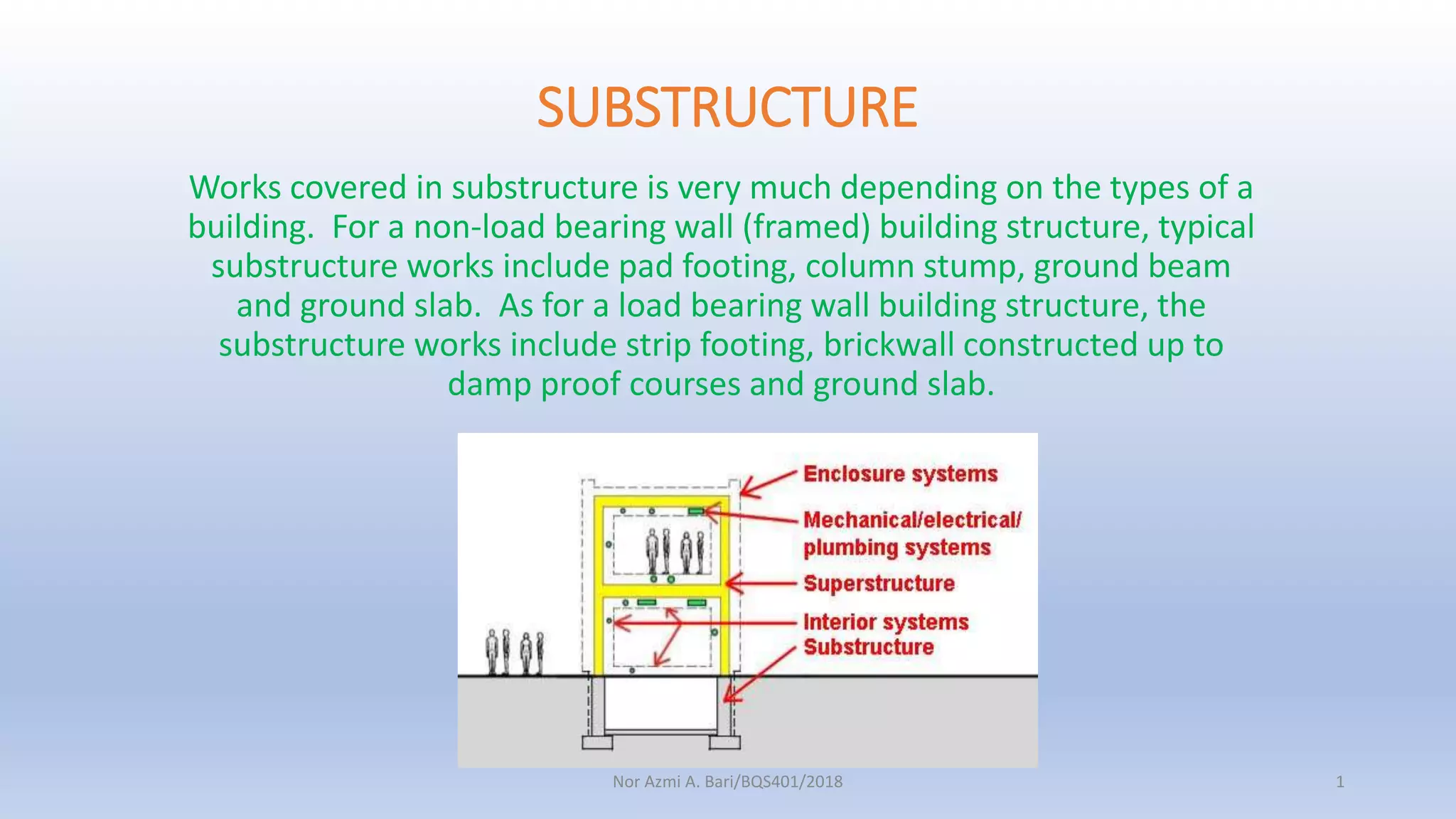
Works covered in substructure is very much depending on the types of a
building. For a non-load bearing wall (framed) building structure, typical
substructure works include pad footing, column stump, ground beam
and ground slab. As for a load bearing wall building structure, the
substructure works include strip footing, brickwall constructed up to
damp proof courses and ground slab.
Nor Azmi A. Bari/BQS401/2018 1
SUBSTRUCTURE
The rules of standard method of measurement in SMM2 for
substructure works shall include the following sections:
1) Section D: Excavation and Earthwork
2) Section F: Concrete Work
3) Section G: Brickwork and Blockwork
4) Section K: Waterproofing and Asphalt work
The following slides will highlight the salient points involved in the
measurement of a simple substructure works.
Nor Azmi A. Bari/BQS401/2018 2
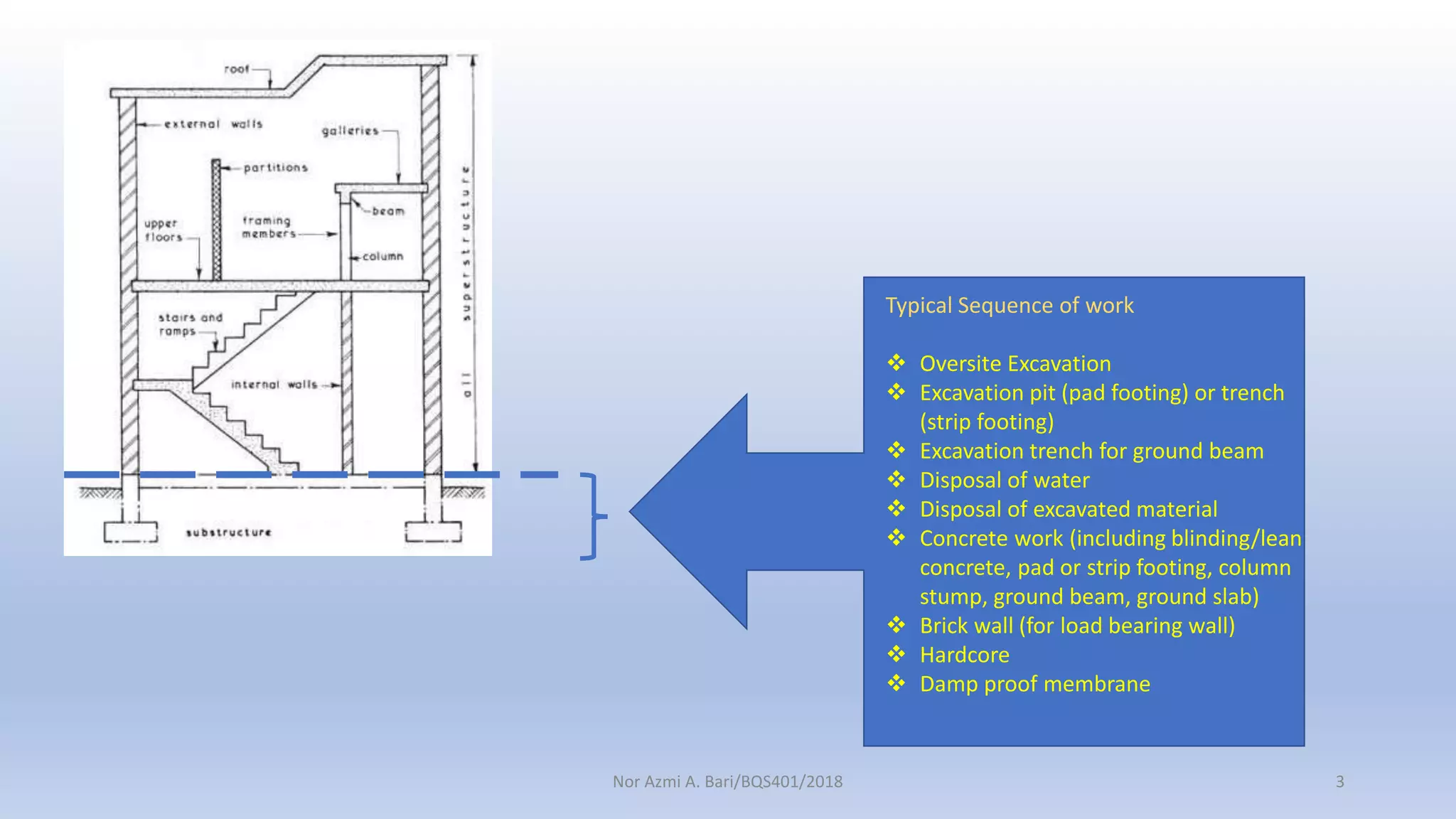
Typical Sequence of work
 Oversite Excavation
 Excavation pit (pad footing) or trench
(strip footing)
 Excavation trench for ground beam
 Disposal of water
 Disposal of excavated material
 Concrete work (including blinding/lean
concrete, pad or strip footing, column
stump, ground beam, ground slab)
 Brick wall (for load bearing wall)
 Hardcore
 Damp proof membrane
Nor Azmi A. Bari/BQS401/2018 3
SECTION D:
EXCAVATION AND EARTHWORK
Nor Azmi A. Bari/BQS401/2018 4
SECTION D: EXCAVATION
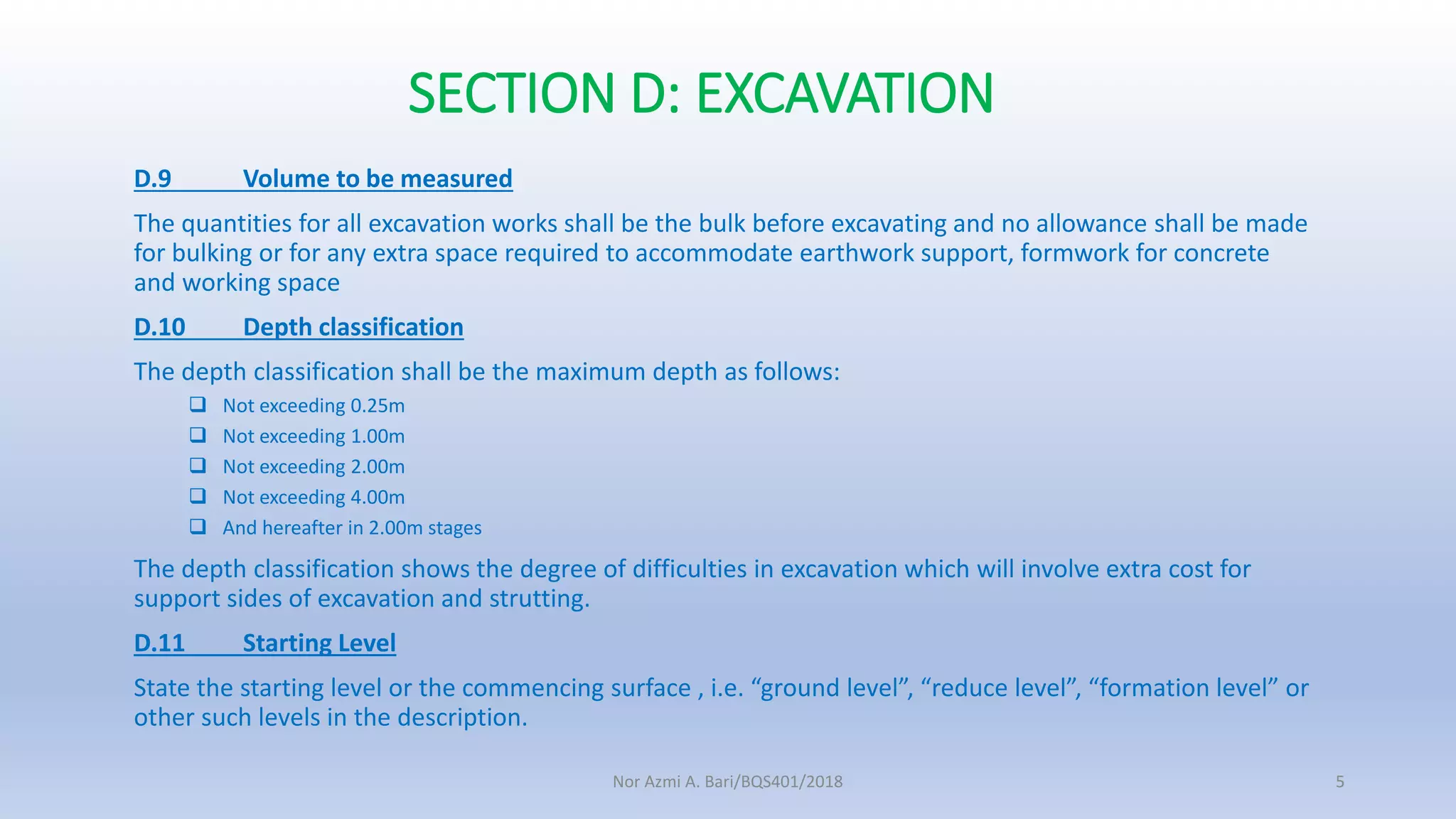
D.9 Volume to be measured
The quantities for all excavation works shall be the bulk before excavating and no allowance shall be made
for bulking or for any extra space required to accommodate earthwork support, formwork for concrete
and working space
D.10 Depth classification
The depth classification shall be the maximum depth as follows:
 Not exceeding 0.25m
 Not exceeding 1.00m
 Not exceeding 2.00m
 Not exceeding 4.00m
 And hereafter in 2.00m stages
The depth classification shows the degree of difficulties in excavation which will involve extra cost for
support sides of excavation and strutting.
D.11 Starting Level
State the starting level or the commencing surface , i.e. “ground level”, “reduce level”, “formation level” or
other such levels in the description.
Nor Azmi A. Bari/BQS401/2018 5
SECTION D: EXCAVATION
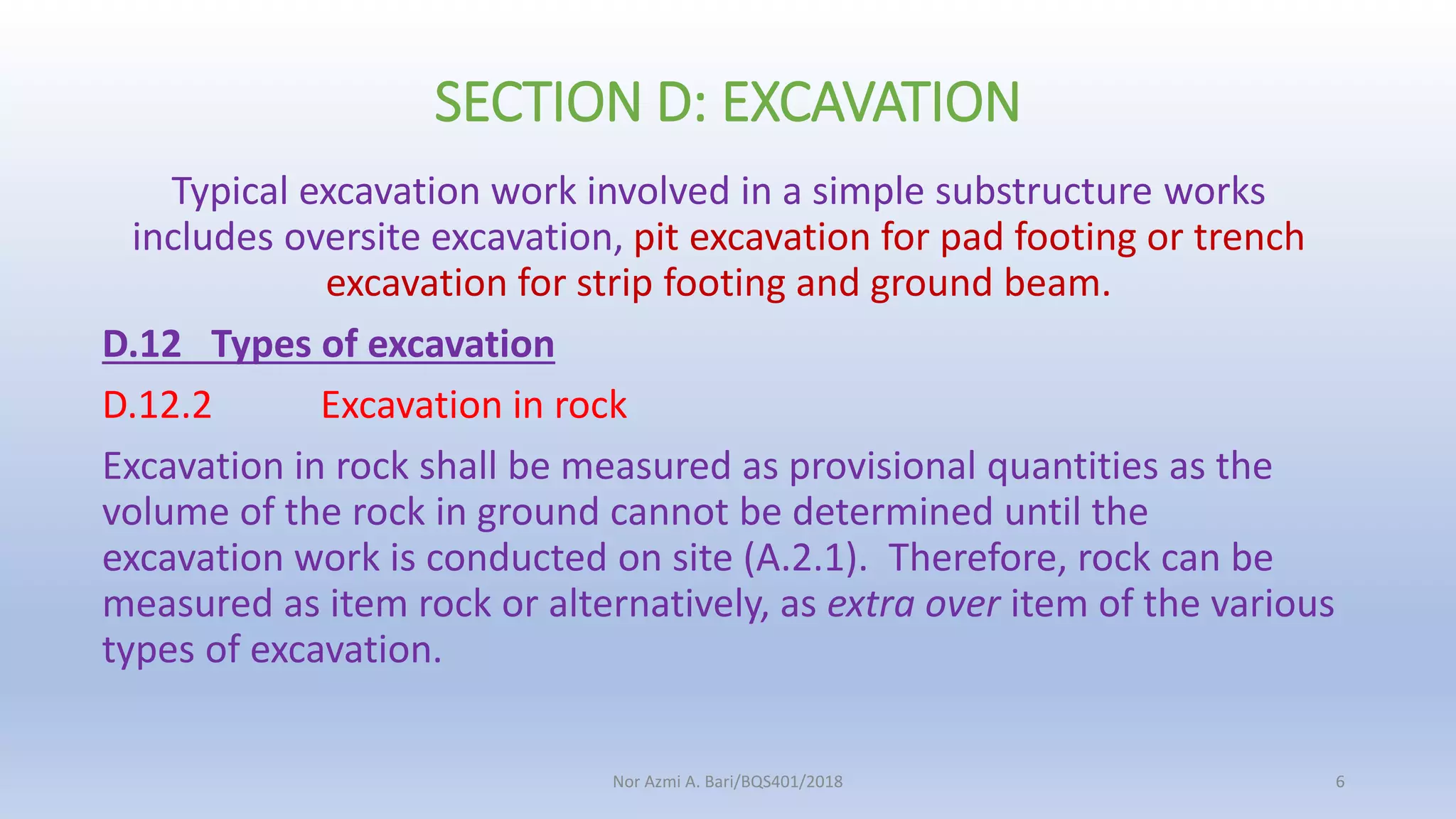
Typical excavation work involved in a simple substructure works
includes oversite excavation, pit excavation for pad footing or trench
excavation for strip footing and ground beam.
D.12 Types of excavation
D.12.2 Excavation in rock
Excavation in rock shall be measured as provisional quantities as the
volume of the rock in ground cannot be determined until the
excavation work is conducted on site (A.2.1). Therefore, rock can be
measured as item rock or alternatively, as extra over item of the various
types of excavation.
Nor Azmi A. Bari/BQS401/2018 6
SECTION D: EXCAVATION
Types Of Excavation (cont’d)
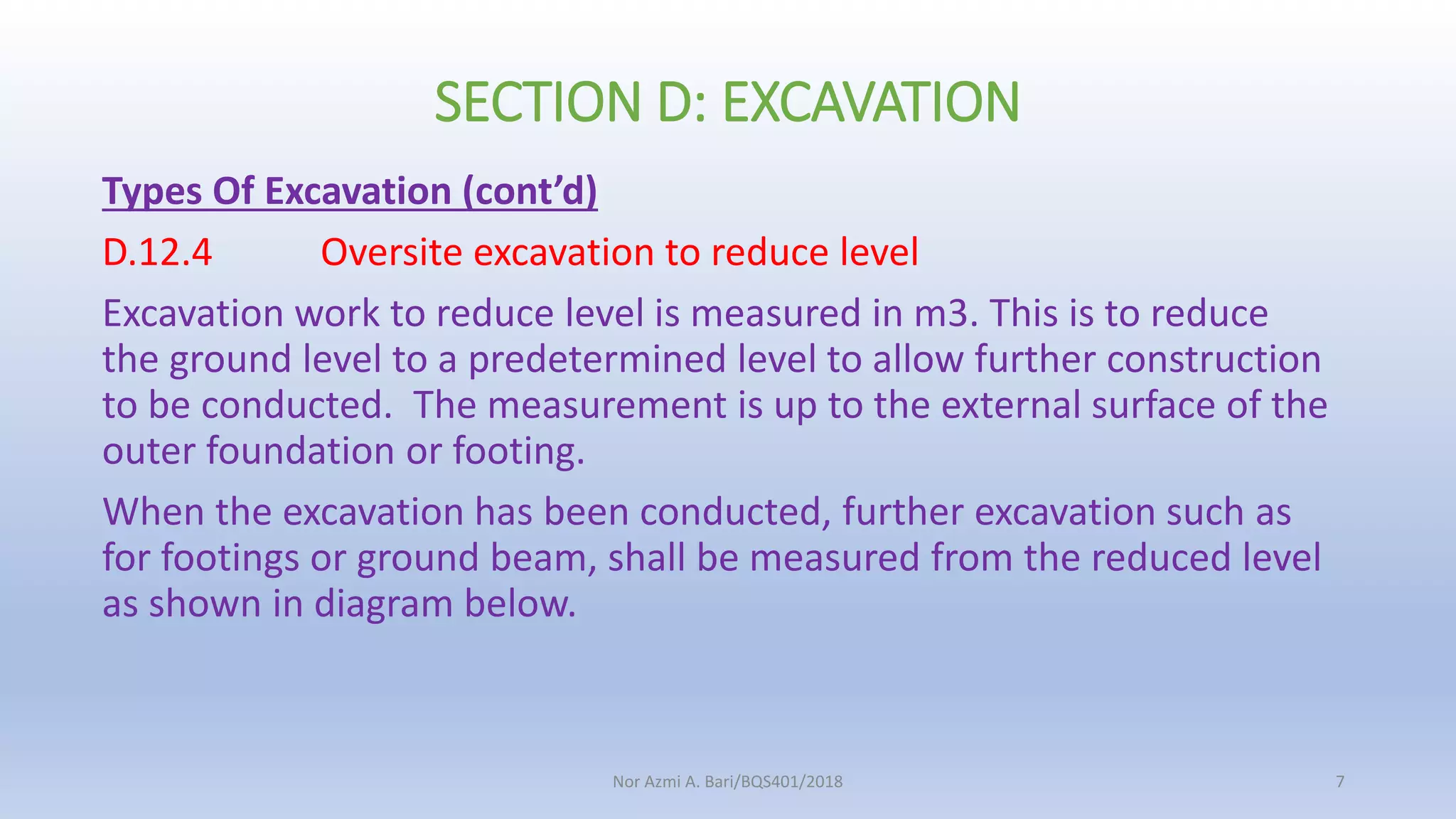
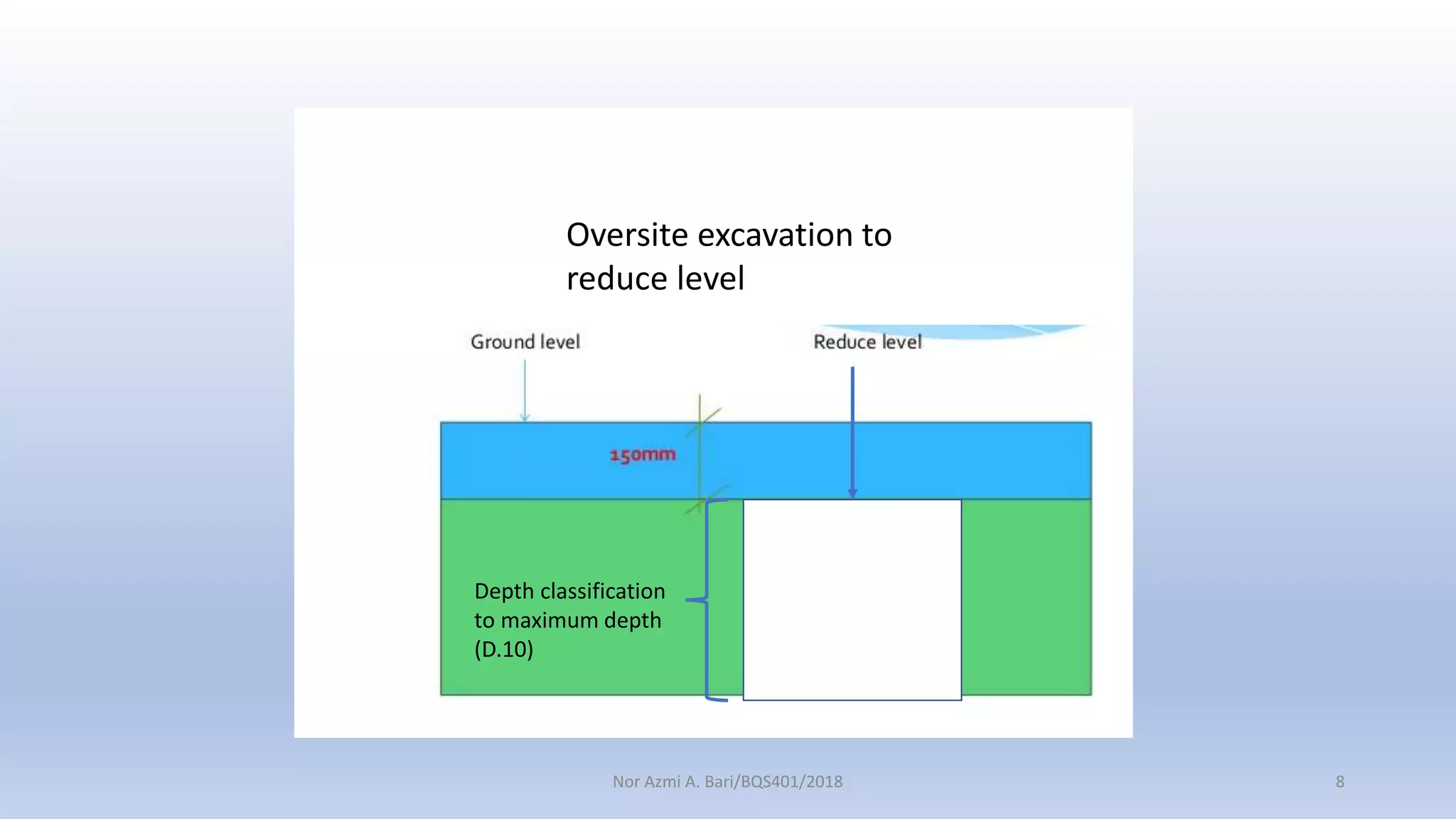
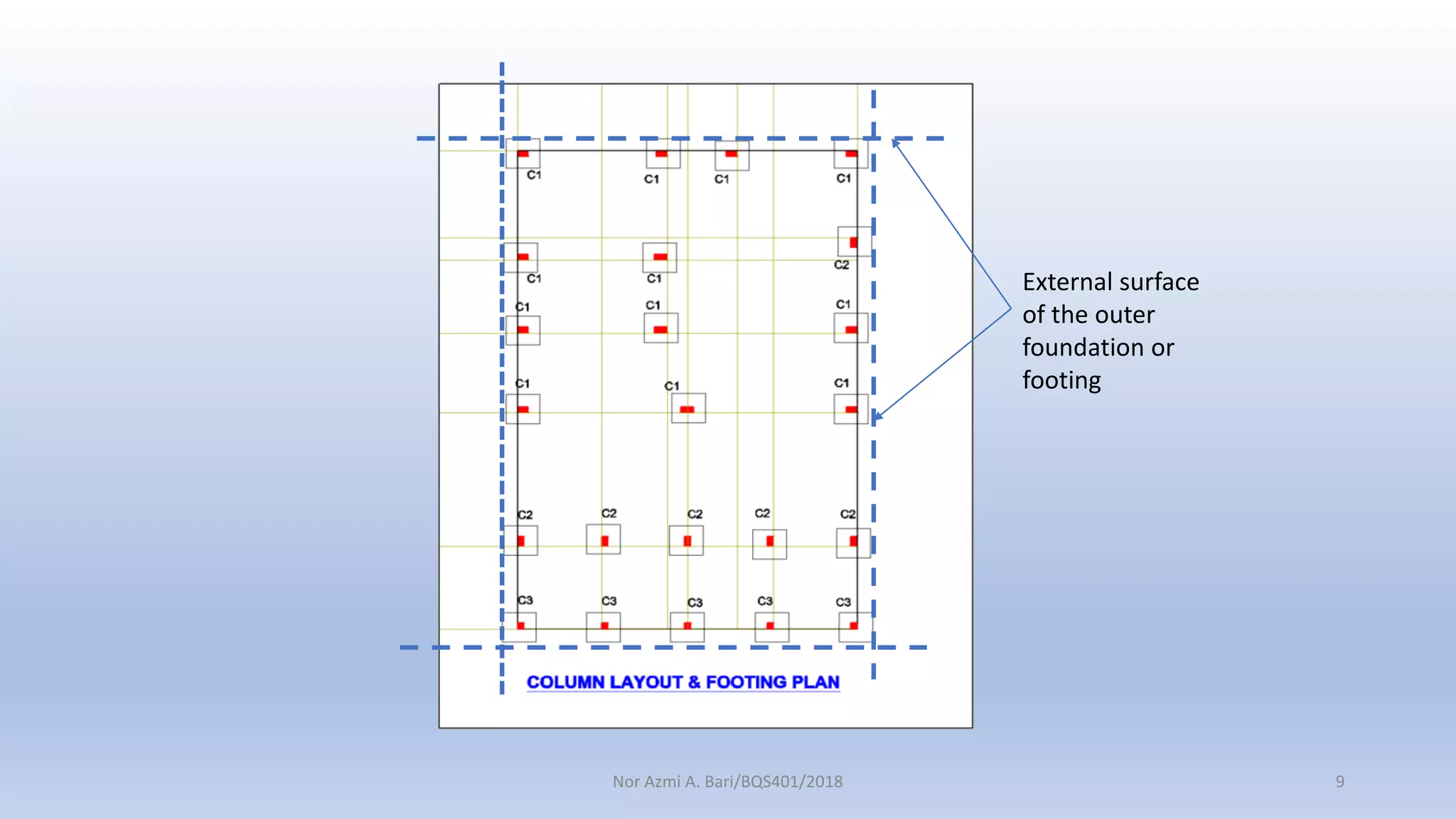
D.12.4 Oversite excavation to reduce level
Excavation work to reduce level is measured in m3. This is to reduce
the ground level to a predetermined level to allow further construction
to be conducted. The measurement is up to the external surface of the
outer foundation or footing.
When the excavation has been conducted, further excavation such as
for footings or ground beam, shall be measured from the reduced level
as shown in diagram below.
Nor Azmi A. Bari/BQS401/2018 7
Oversite excavation to
reduce level
Nor Azmi A. Bari/BQS401/2018 8
Depth classification
to maximum depth
(D.10)
Nor Azmi A. Bari/BQS401/2018 9
External surface
of the outer
foundation or
footing
SECTION D: EXCAVATION
Types Of Excavation (cont’d)
D.12.6 Pit excavation
Excavation pit for pad footing is measured in m3 and stating the
number and starting level in the description. If the excavating pits
having both dimensions less than 1.25m, shall be measured separately.
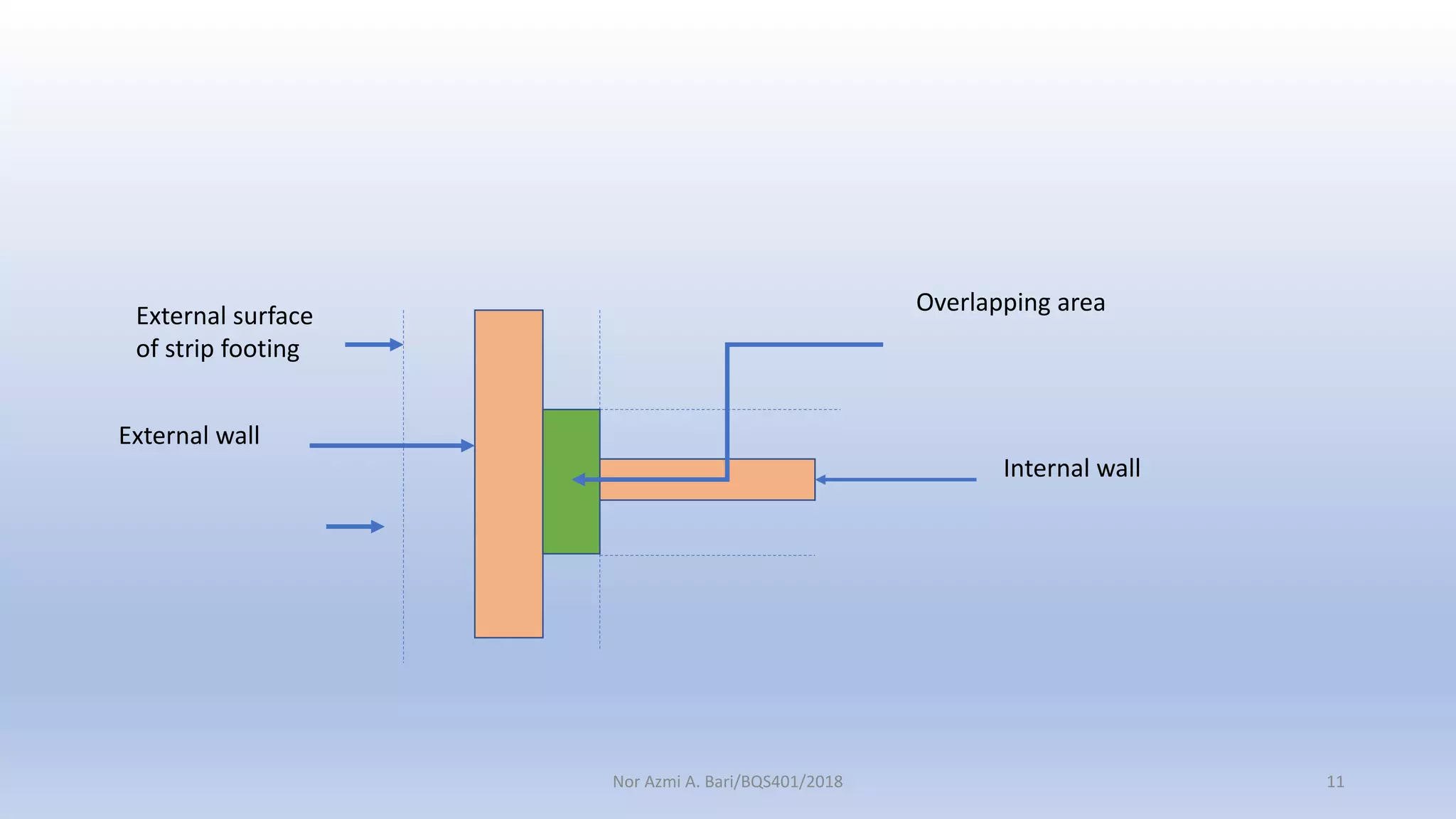
D.12.7 Trench excavation
Trench excavation for strip footing is measured in m3 and the starting
level in stated in the description. The overlapping area at internal and
external wall junction shall be deducted for the measurement.
Nor Azmi A. Bari/BQS401/2018 10
External surface
of strip footing
External wall
Overlapping area
Internal wall
Nor Azmi A. Bari/BQS401/2018 11
SECTION D: EXCAVATION
Types Of Excavation (cont’d)
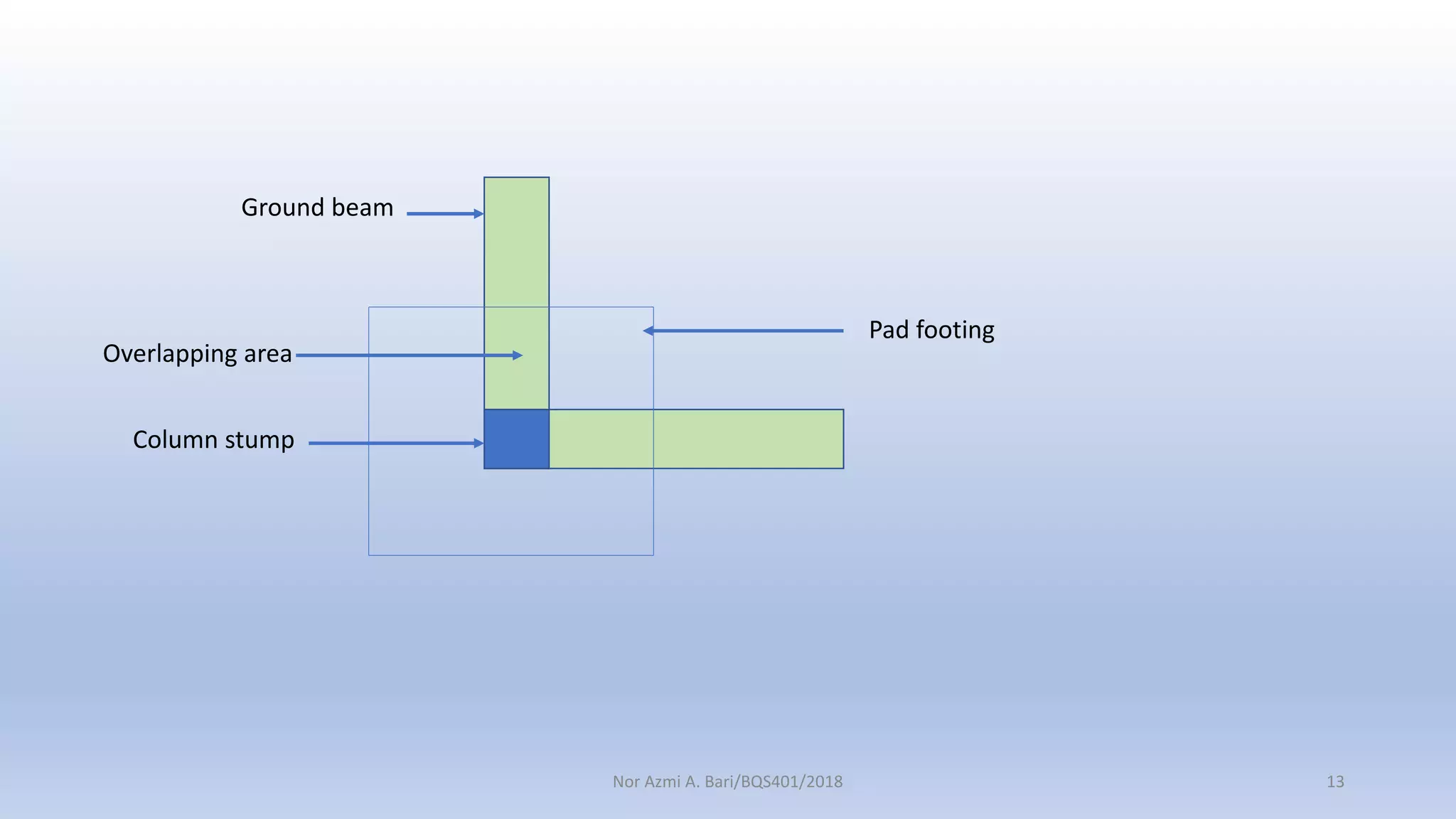
D.12.7 Ground beam
Trench excavation for ground beam is measured in m3 and the starting
level shall be stated in the description. The measurement for ground
beam shall be taken from the outer side of column. The overlapping
area at every junction between ground beam and pad footing shall not
be deducted for trench excavation of ground beam as filling to pad
footing will be done up to the starting level.
Nor Azmi A. Bari/BQS401/2018 12
Pad footing
Ground beam
Overlapping area
Column stump
Nor Azmi A. Bari/BQS401/2018 13
SECTION D: EXCAVATION
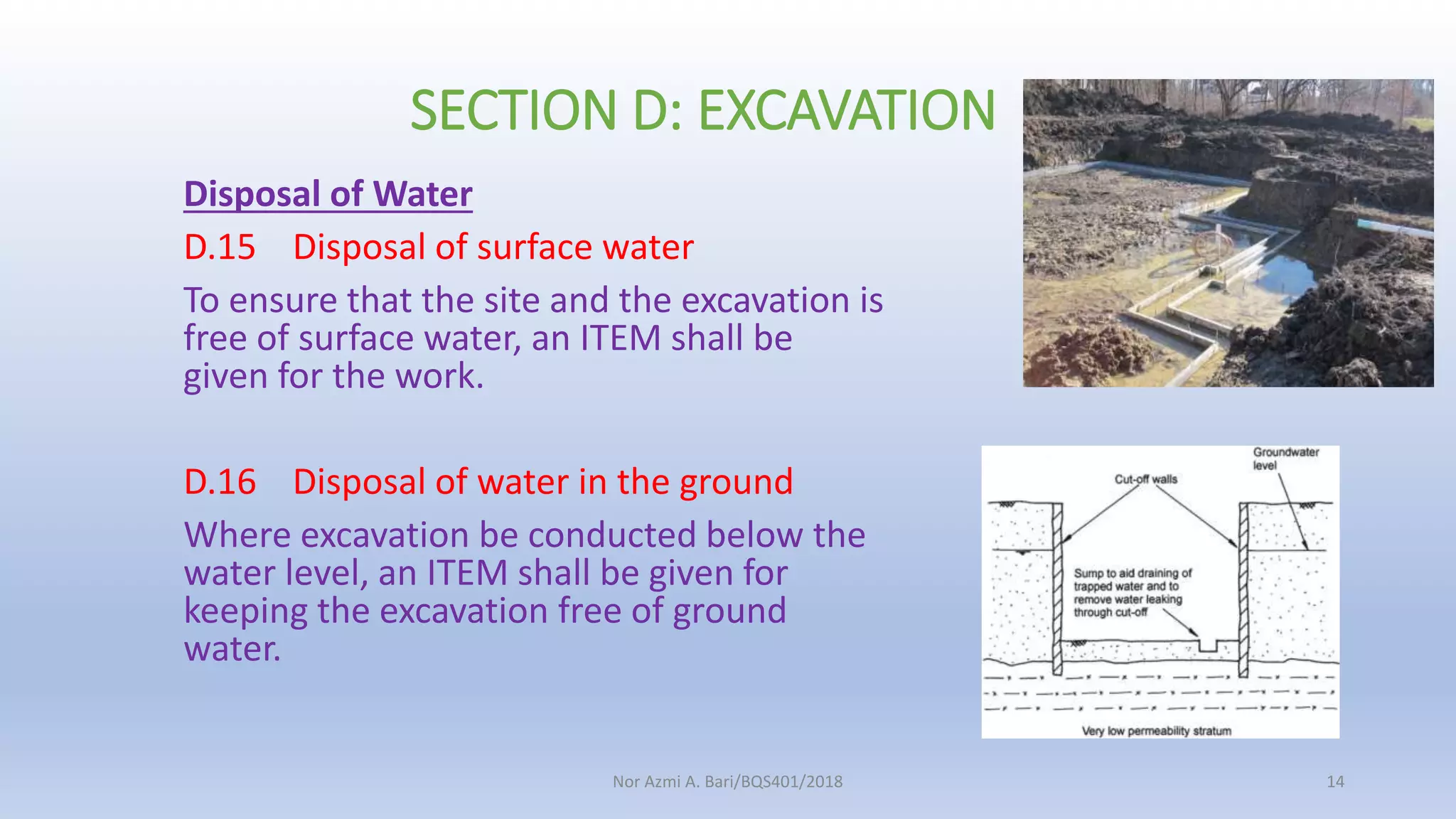
Disposal of Water
D.15 Disposal of surface water
To ensure that the site and the excavation is
free of surface water, an ITEM shall be
given for the work.
D.16 Disposal of water in the ground
Where excavation be conducted below the
water level, an ITEM shall be given for
keeping the excavation free of ground
water.
Nor Azmi A. Bari/BQS401/2018 14
SECTION D: EXCAVATION
Disposal of Excavated Materials
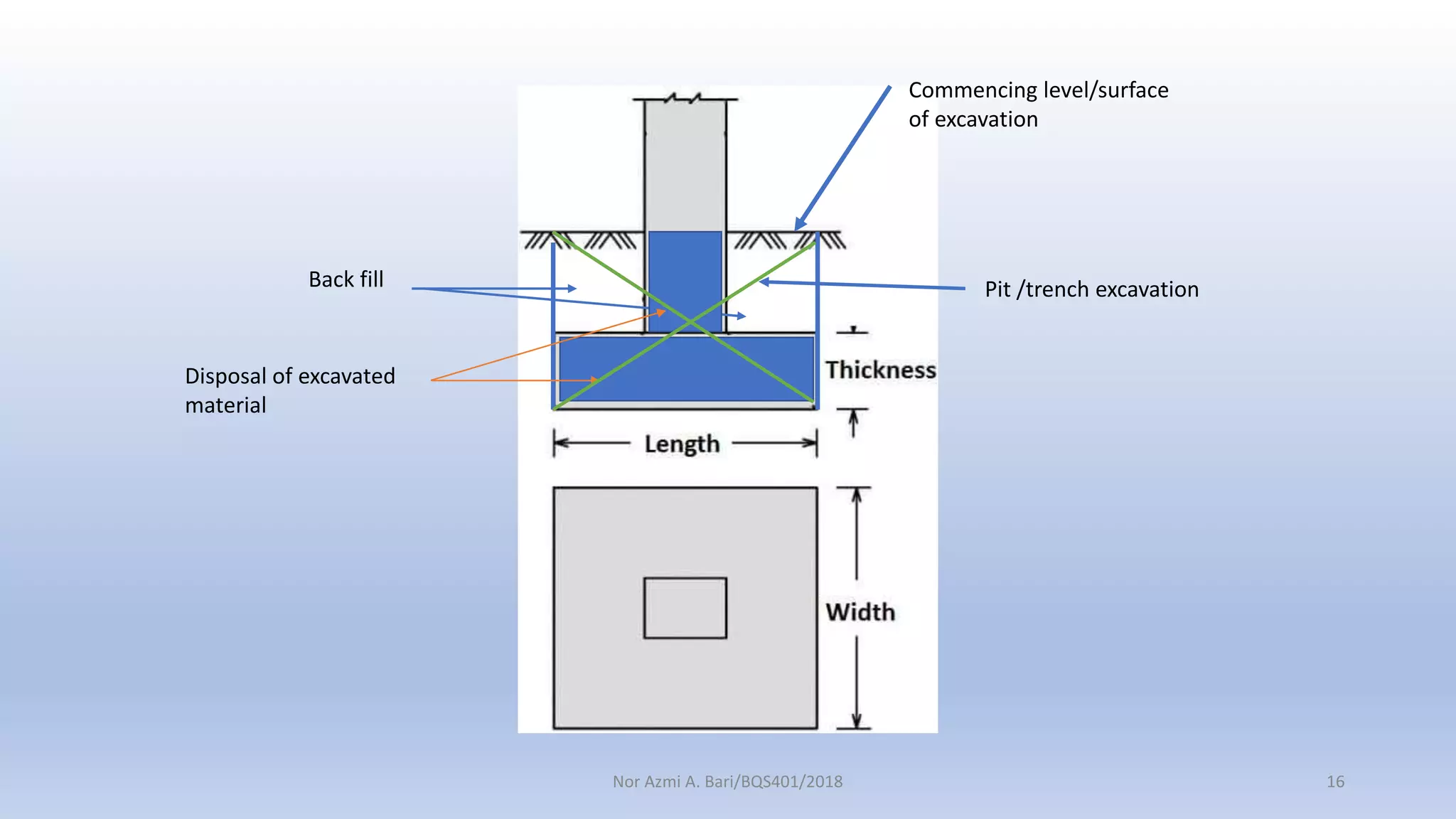
In excavation works, disposal of excavated material shall be given in m3 and shall be stated in the description
whether to be spread on site or to be disposed offsite.
D.18 Disposal on site
Excavated material to be deposited on site in permanent spoil heaps or spread on site shall be measured
stating the requirements for the location or the average distance from the excavation in the description.
D.19 Disposal offsite
Excavated material to be removed from site shall also be described.
D.20 Topsoil Spread on site
Topsoil spread on site shall be measure separately from preserved and imported topsoil. Topsoil not exceeding
250 mm thick shall be measured in m2 and the average thickness be stated in the description. If the thickness
is exceeding 250 mm thick, it shall be given in m3 (D.26). Topsoil to be reused and deposited in temporary
spoil heaps shall be given in m3 and the description shall state any requirement for the location of deposits or
the average distance (D.21).
Nor Azmi A. Bari/BQS401/2018 15
Nor Azmi A. Bari/BQS401/2018 16
Commencing level/surface
of excavation
Pit /trench excavationBack fill
Disposal of excavated
material
SECTION D: EXCAVATION
Hardcore
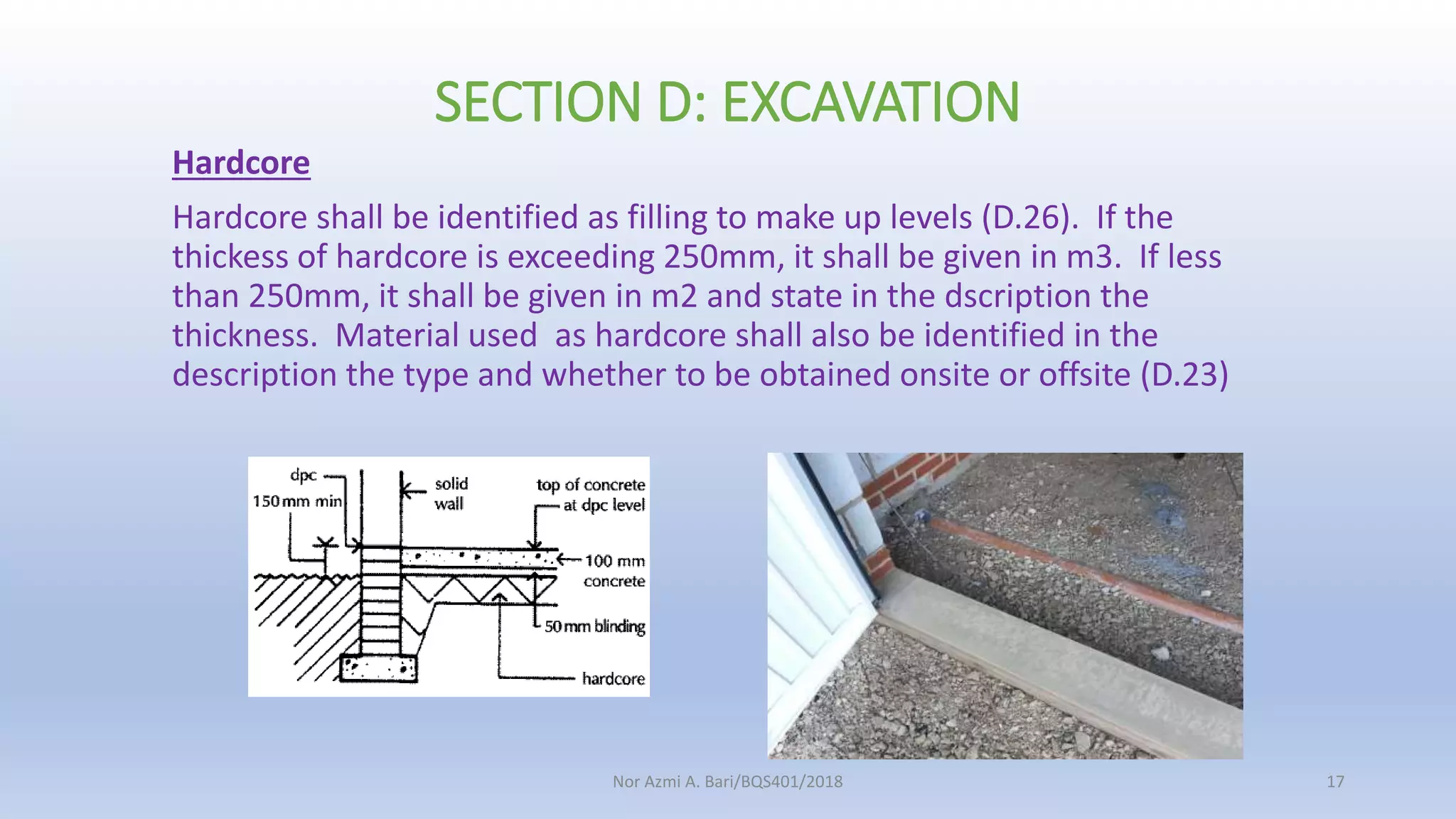
Hardcore shall be identified as filling to make up levels (D.26). If the
thickess of hardcore is exceeding 250mm, it shall be given in m3. If less
than 250mm, it shall be given in m2 and state in the dscription the
thickness. Material used as hardcore shall also be identified in the
description the type and whether to be obtained onsite or offsite (D.23)
Nor Azmi A. Bari/BQS401/2018 17
SECTION F:
CONCRETE WORK
Nor Azmi A. Bari/BQS401/2018 18
SECTION F: CONCRETE WORK
Insitu concrete
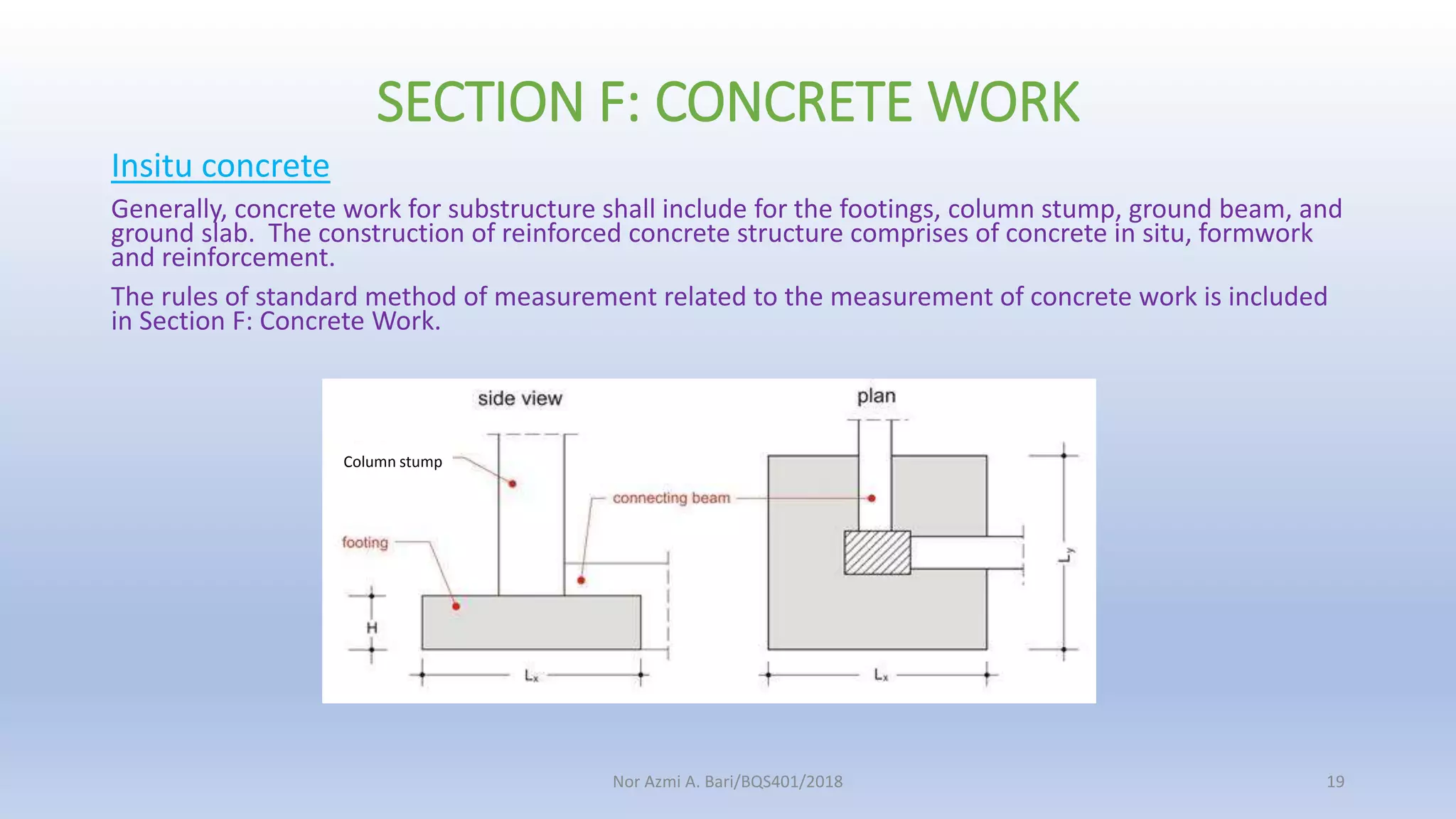
Generally, concrete work for substructure shall include for the footings, column stump, ground beam, and
ground slab. The construction of reinforced concrete structure comprises of concrete in situ, formwork
and reinforcement.
The rules of standard method of measurement related to the measurement of concrete work is included
in Section F: Concrete Work.
Nor Azmi A. Bari/BQS401/2018 19
Column stump
SECTION F: CONCRETE WORK
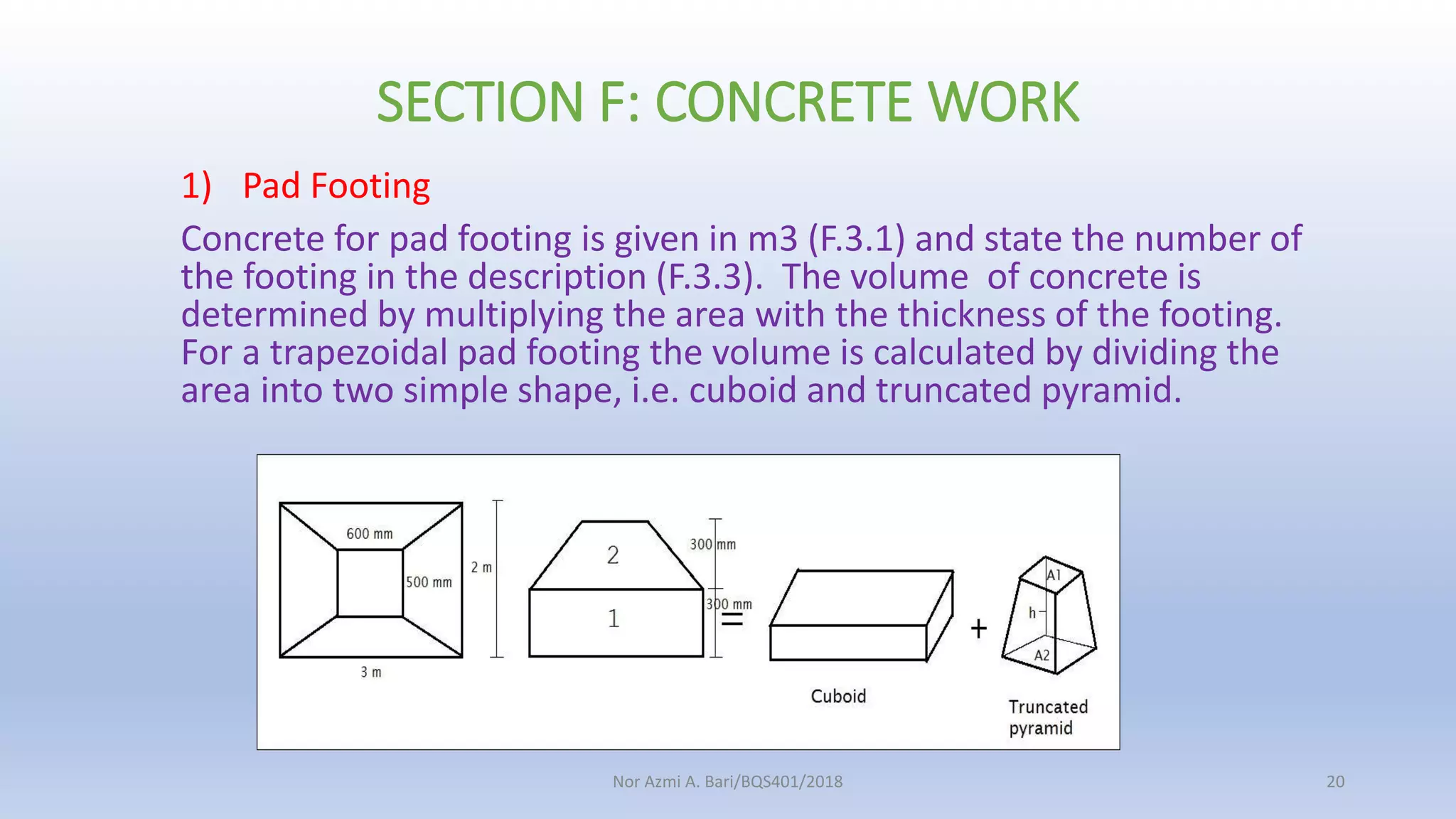
1) Pad Footing
Concrete for pad footing is given in m3 (F.3.1) and state the number of
the footing in the description (F.3.3). The volume of concrete is
determined by multiplying the area with the thickness of the footing.
For a trapezoidal pad footing the volume is calculated by dividing the
area into two simple shape, i.e. cuboid and truncated pyramid.
Nor Azmi A. Bari/BQS401/2018 20
SECTION F: CONCRETE WORK
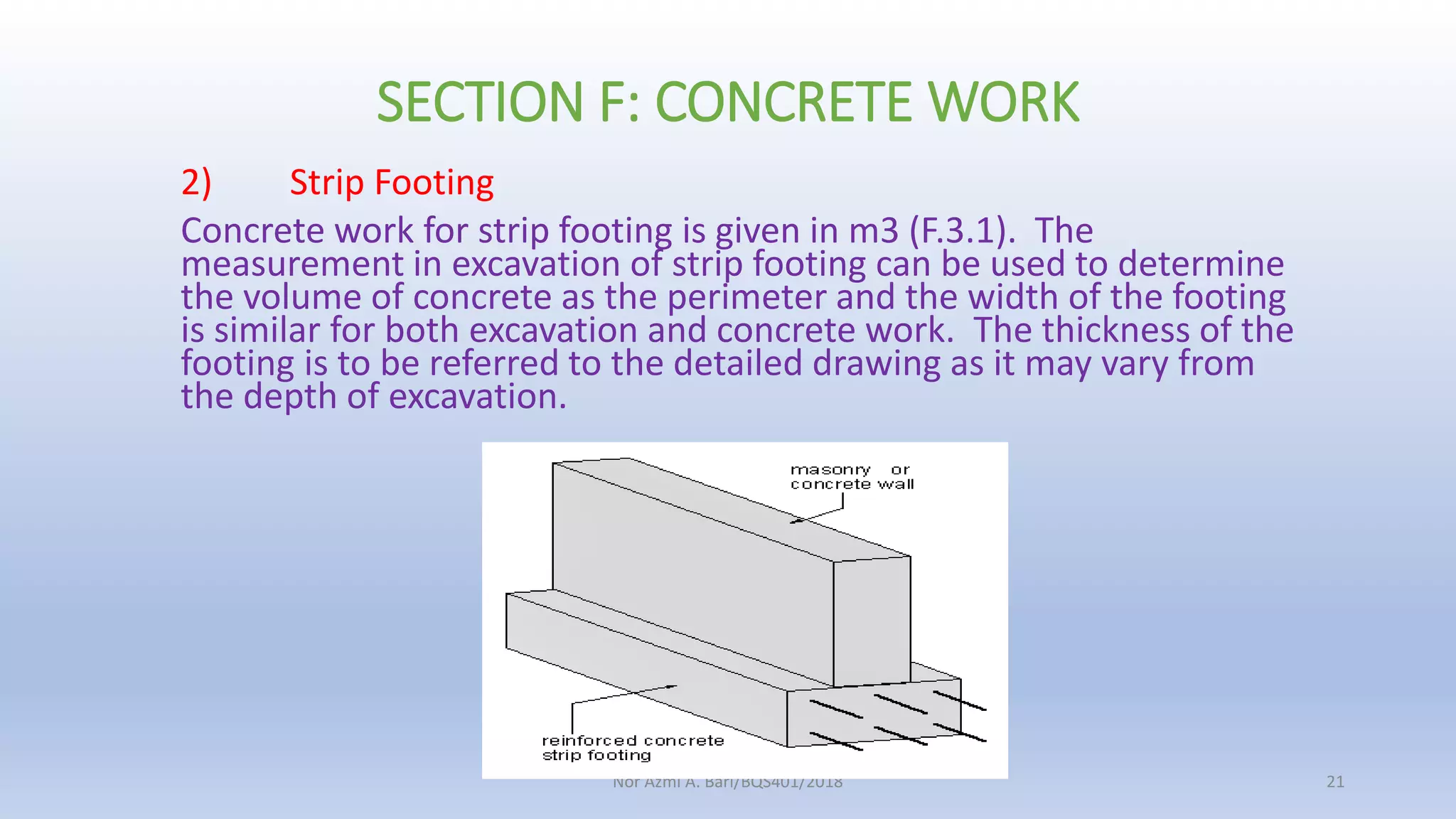
2) Strip Footing
Concrete work for strip footing is given in m3 (F.3.1). The
measurement in excavation of strip footing can be used to determine
the volume of concrete as the perimeter and the width of the footing
is similar for both excavation and concrete work. The thickness of the
footing is to be referred to the detailed drawing as it may vary from
the depth of excavation.
Nor Azmi A. Bari/BQS401/2018 21
SECTION F: CONCRETE WORK
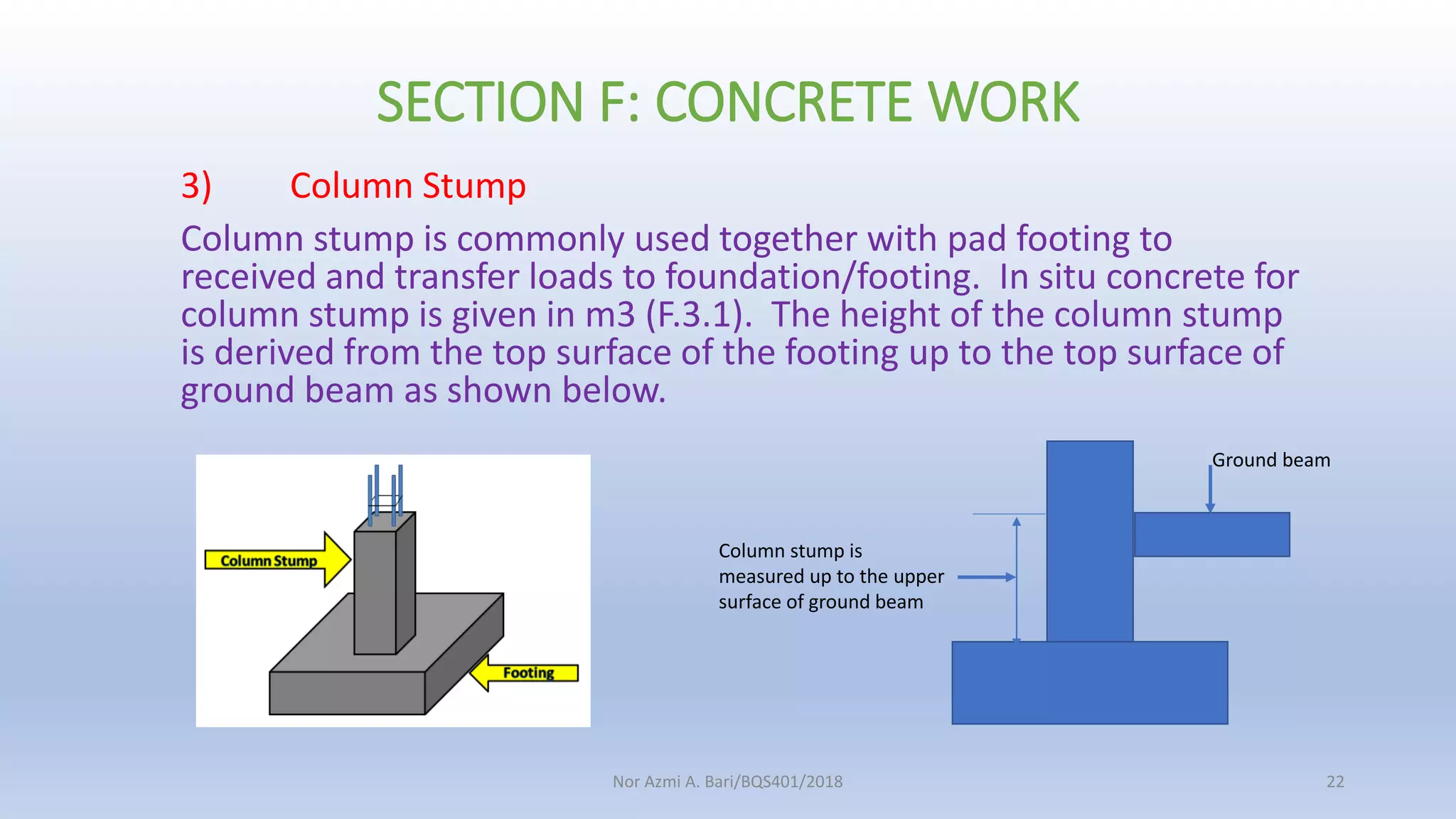
3) Column Stump
Column stump is commonly used together with pad footing to
received and transfer loads to foundation/footing. In situ concrete for
column stump is given in m3 (F.3.1). The height of the column stump
is derived from the top surface of the footing up to the top surface of
ground beam as shown below.
Nor Azmi A. Bari/BQS401/2018 22
Ground beam
Column stump is
measured up to the upper
surface of ground beam
SECTION F: CONCRETE WORK
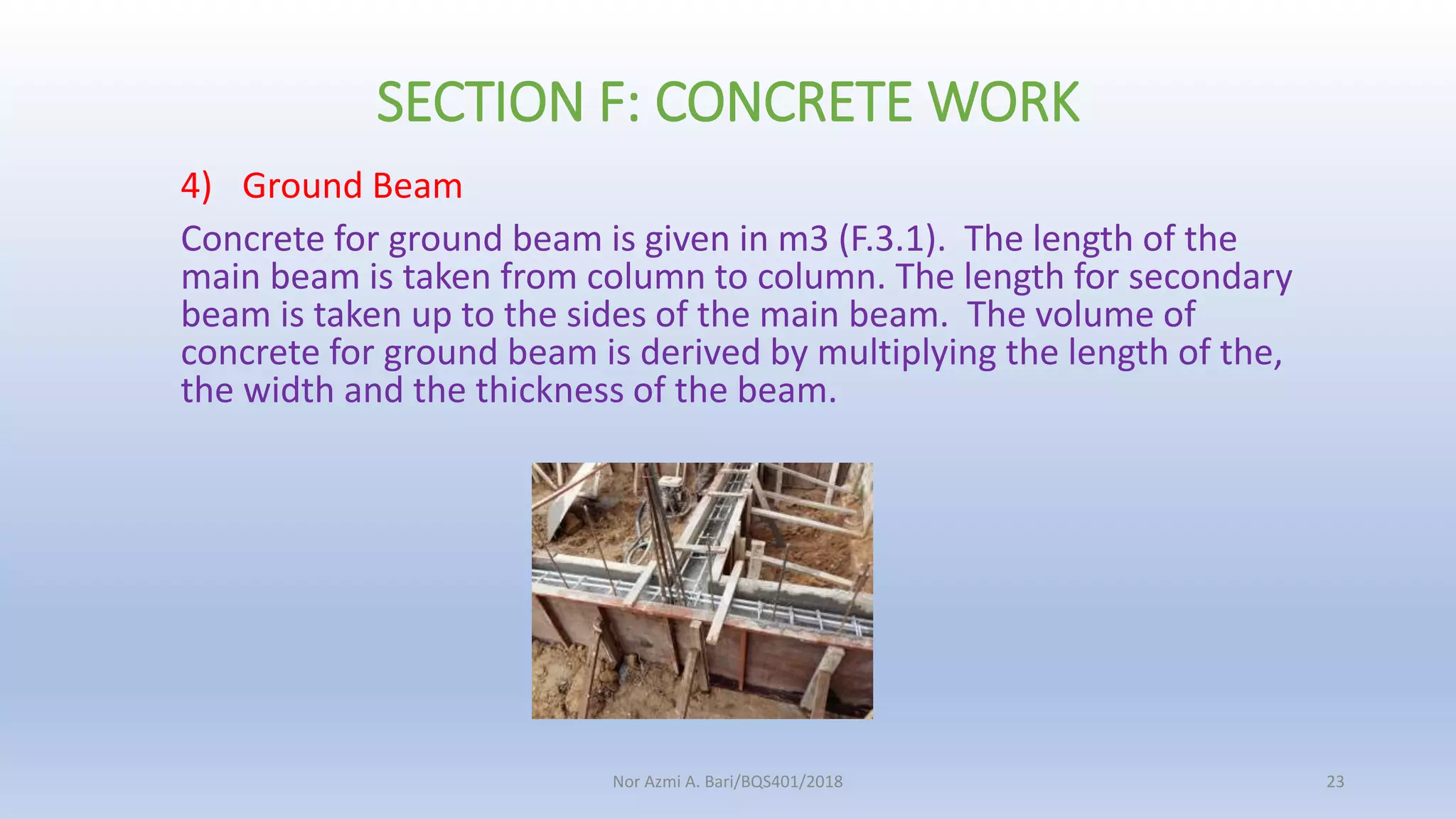
4) Ground Beam
Concrete for ground beam is given in m3 (F.3.1). The length of the
main beam is taken from column to column. The length for secondary
beam is taken up to the sides of the main beam. The volume of
concrete for ground beam is derived by multiplying the length of the,
the width and the thickness of the beam.
Nor Azmi A. Bari/BQS401/2018 23
SECTION F: CONCRETE WORK
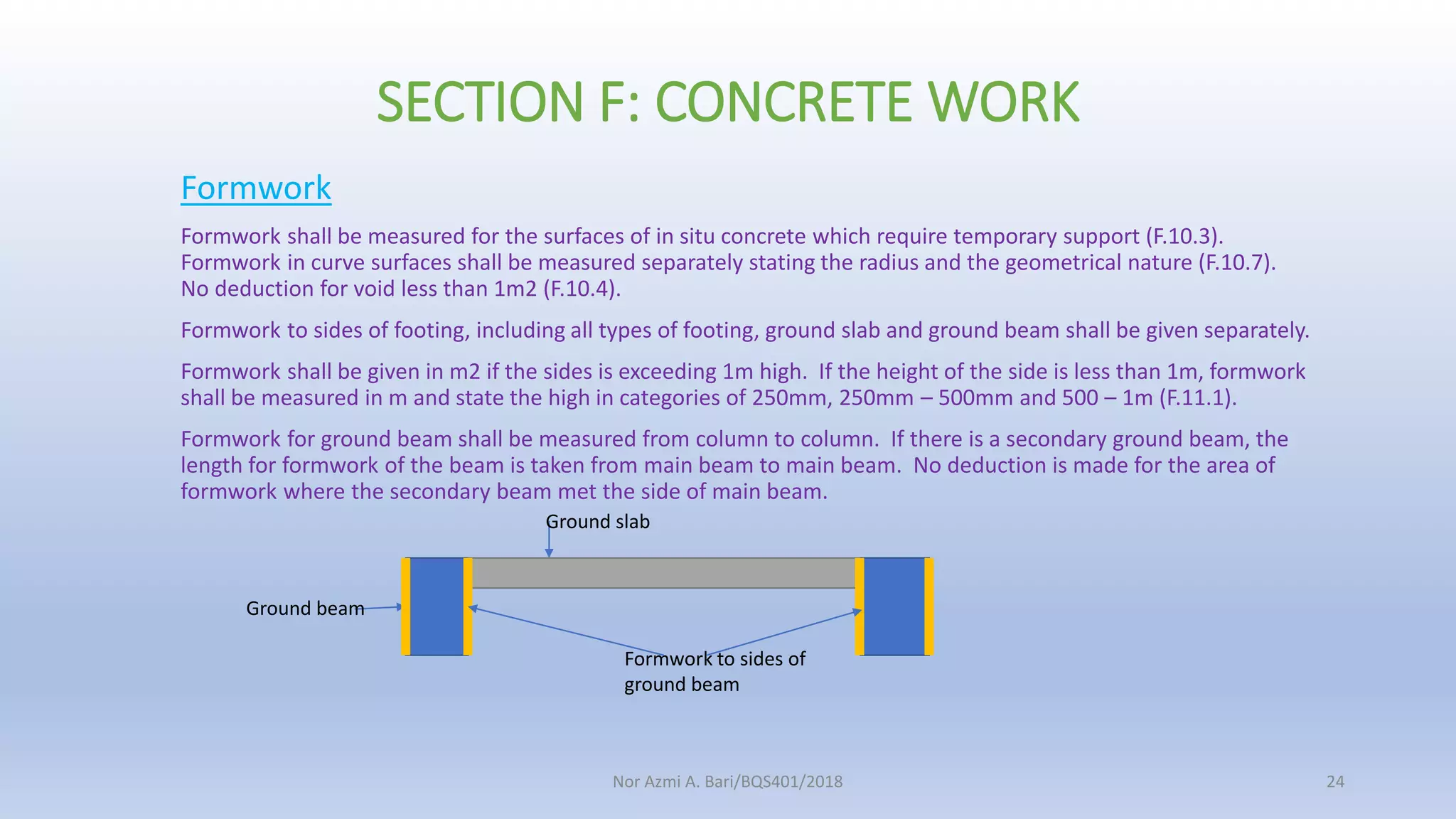
Formwork
Formwork shall be measured for the surfaces of in situ concrete which require temporary support (F.10.3).
Formwork in curve surfaces shall be measured separately stating the radius and the geometrical nature (F.10.7).
No deduction for void less than 1m2 (F.10.4).
Formwork to sides of footing, including all types of footing, ground slab and ground beam shall be given separately.
Formwork shall be given in m2 if the sides is exceeding 1m high. If the height of the side is less than 1m, formwork
shall be measured in m and state the high in categories of 250mm, 250mm – 500mm and 500 – 1m (F.11.1).
Formwork for ground beam shall be measured from column to column. If there is a secondary ground beam, the
length for formwork of the beam is taken from main beam to main beam. No deduction is made for the area of
formwork where the secondary beam met the side of main beam.
Nor Azmi A. Bari/BQS401/2018 24
Ground beam
Ground slab
Formwork to sides of
ground beam
SECTION F: CONCRETE WORK
Formwork (cont’d)
Formwork to sides of column stump shall be grouped as measurement for column and
given in m2 (F.15.1). No deduction for formwork at the intersection between ground beam
and column stump (F.15.4)
Nor Azmi A. Bari/BQS401/2018 25
No ded
No deduction for
formwork at
intersection
beam
SECTION F: CONCRETE WORK
Bar Reinforcement
Bar reinforcement shall be given in m and the unit of billing is the kg or tonne
to the nearest two places of decimals (F.8.2). Particulars of the kind and
quality, section of bars (if other than plain circular), tests of bar and restrictions
of bending (F.8.1).
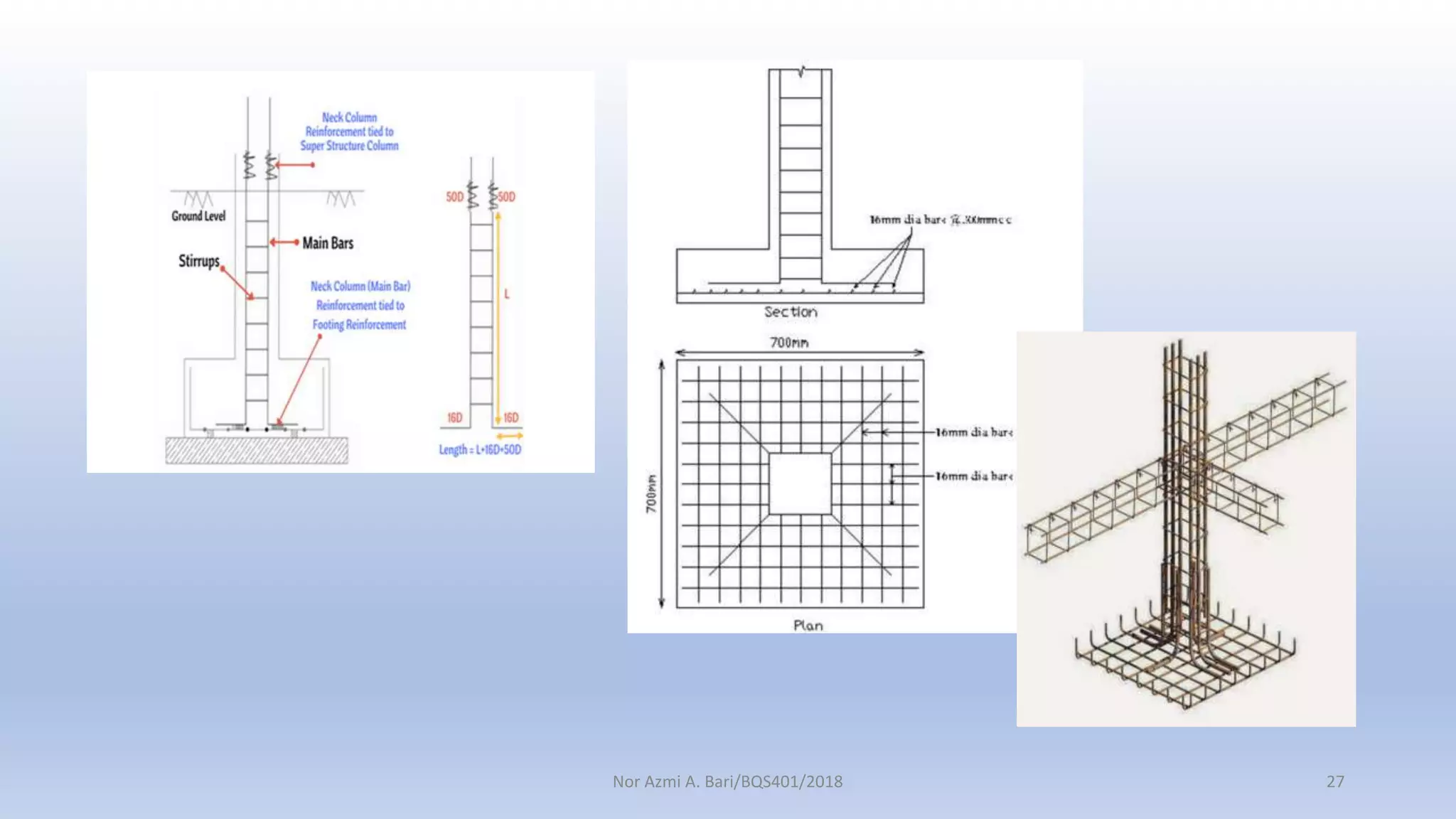
Bari reinforcement for pad footing, strip footing and ground beam grouped
together in one item and classified as foundation (F.8.4a).
Bar reinforcement for column stump shall be classified as bar reinforcement in
column, beam and lintels (F.8.4j).
Bar reinforcement for ground slab shall be classified as bar reinforcement in
ground slab (F.8.4b).
The length for bar reinforcement of column stump shall include the length
extended in column and footing.
Nor Azmi A. Bari/BQS401/2018 26
Nor Azmi A. Bari/BQS401/2018 27
SECTION F: CONCRETE WORK
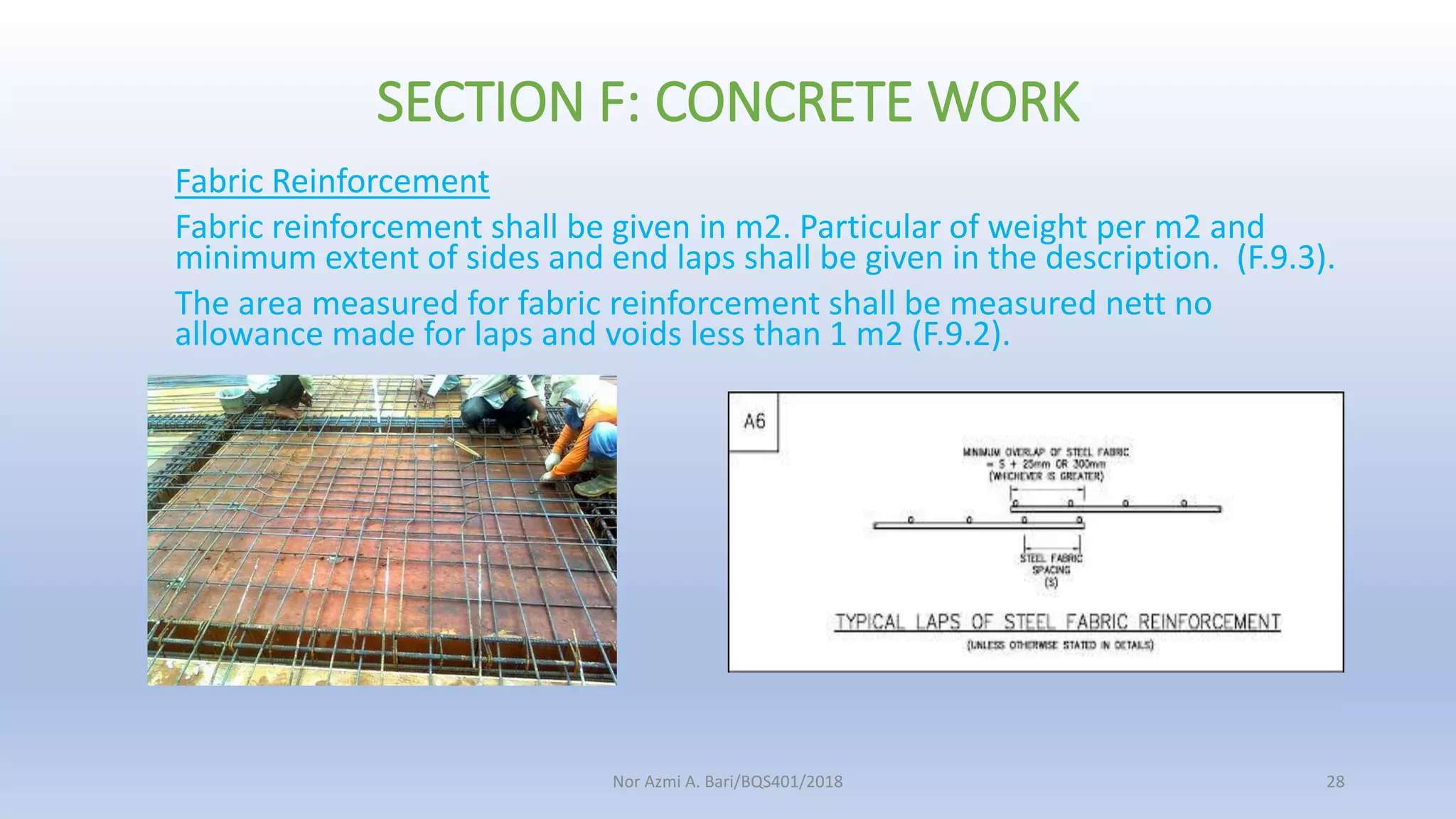
Fabric Reinforcement
Fabric reinforcement shall be given in m2. Particular of weight per m2 and
minimum extent of sides and end laps shall be given in the description. (F.9.3).
The area measured for fabric reinforcement shall be measured nett no
allowance made for laps and voids less than 1 m2 (F.9.2).
Nor Azmi A. Bari/BQS401/2018 28
SECTION G:
BRICK WORK AND
BLOCK WORK
Nor Azmi A. Bari/BQS401/2018 29
SECTION G: BRICKWORK AND BLOCKWORK
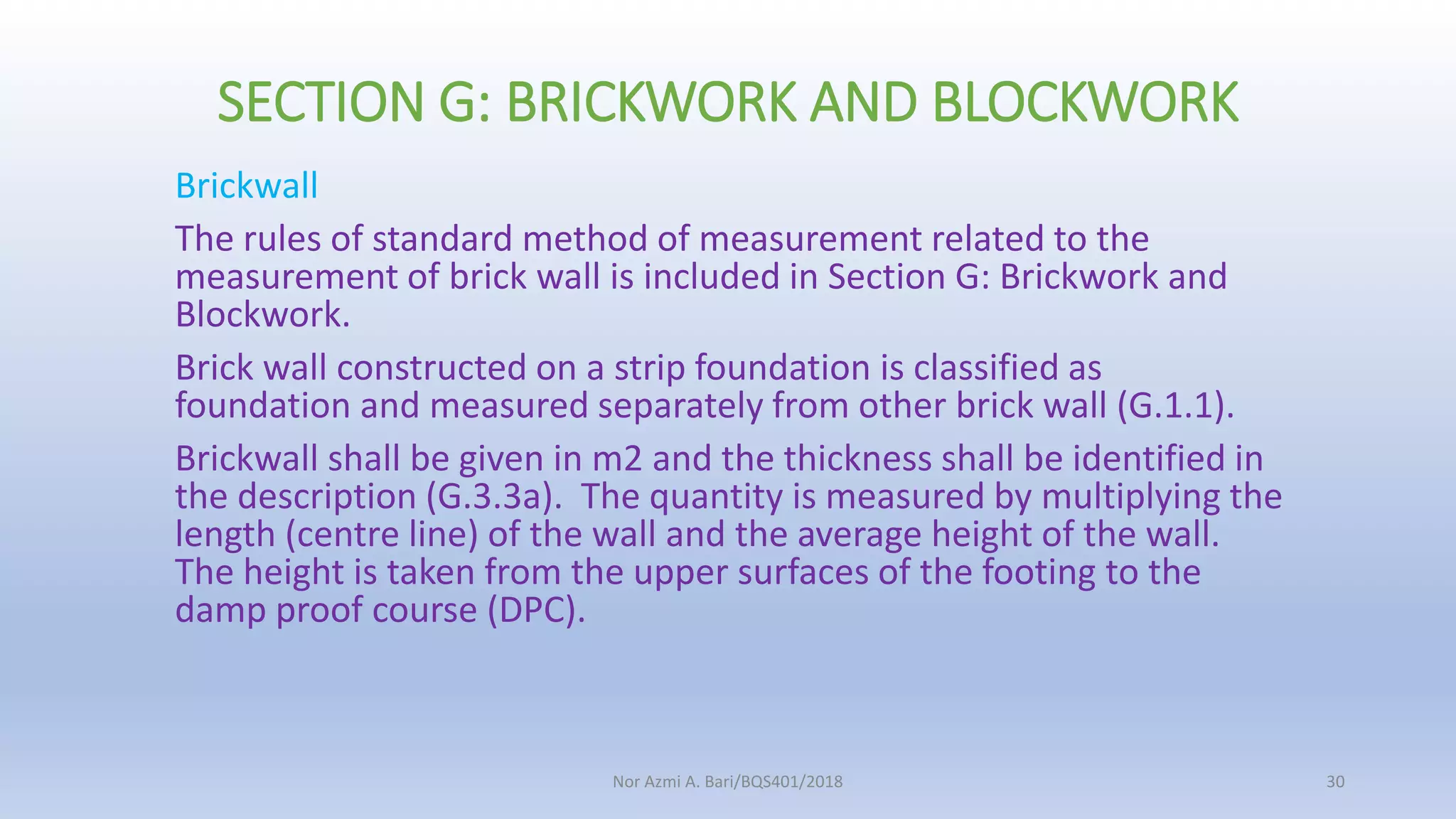
Brickwall
The rules of standard method of measurement related to the
measurement of brick wall is included in Section G: Brickwork and
Blockwork.
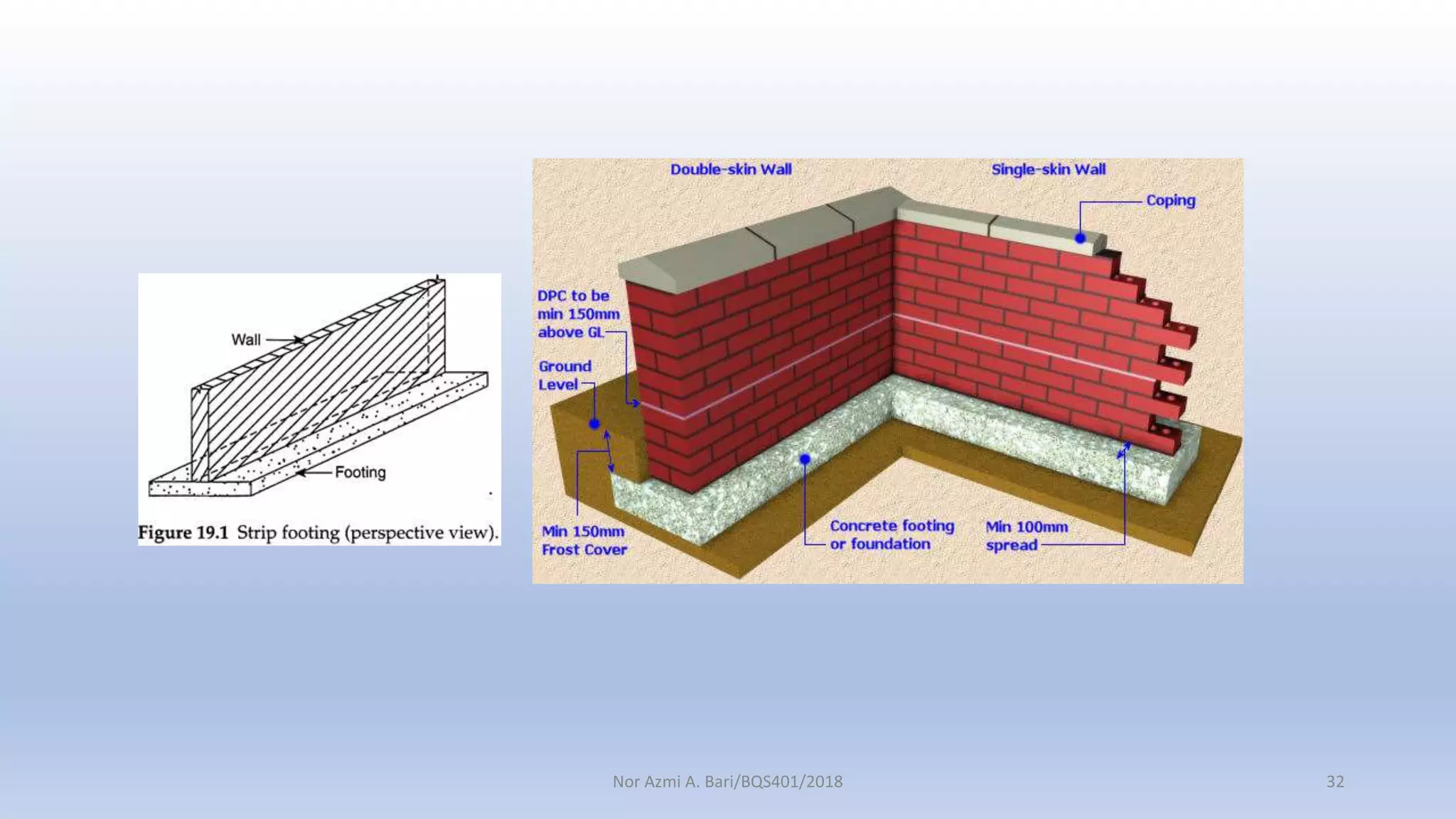
Brick wall constructed on a strip foundation is classified as
foundation and measured separately from other brick wall (G.1.1).
Brickwall shall be given in m2 and the thickness shall be identified in
the description (G.3.3a). The quantity is measured by multiplying the
length (centre line) of the wall and the average height of the wall.
The height is taken from the upper surfaces of the footing to the
damp proof course (DPC).
Nor Azmi A. Bari/BQS401/2018 30
Nor Azmi A. Bari/BQS401/2018 31
Height of brick wall
Ground level
Strip footing
Brick wall
Nor Azmi A. Bari/BQS401/2018 32
SECTION K:
WATER PROOFING AND
ASPHALT WORK
Nor Azmi A. Bari/BQS401/2018 33
SECTION K: WATERPROOFING AND ASPHALT WORK
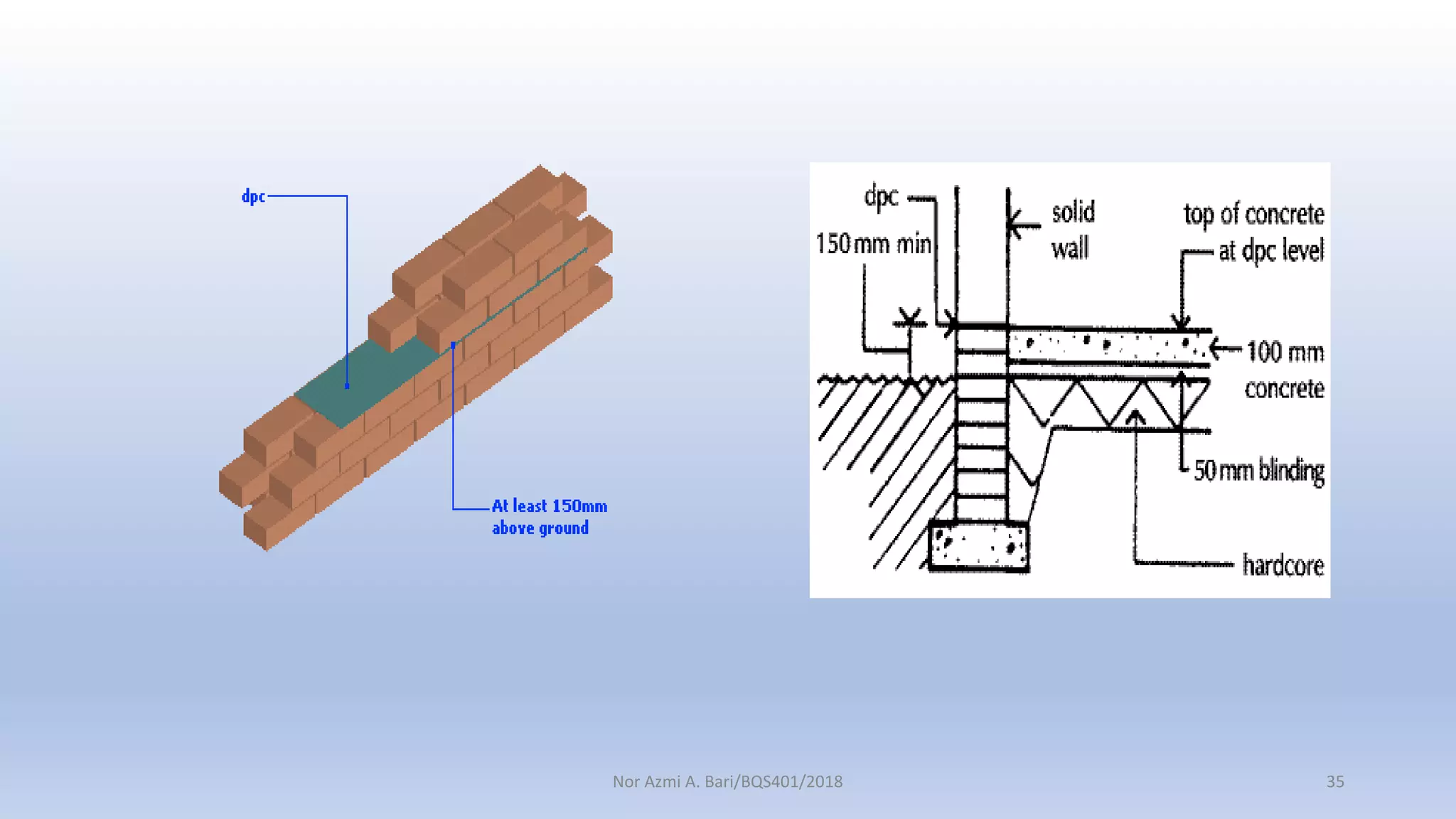
Damp proof course (DPC)/membrane
The rules of standard method of measurement related to the
measurement of DPC is included in Section K: Waterproofing and
Asphalt Work.
DPC shall be given in m2 if the width covering exceeding 300mm. If
the width covering is less than 300mm, it shall be given in m and
state the width in stages of 150mm. The work shall be classified as
flat covering, sloping covering 10° - 45° from the horizontal or sloping
covering over 45° from the horizontal (K.2.3).
The description shall identified the type and quality material,
thickness and numbers of coats and layers, nature of base and
surface treatment.
Nor Azmi A. Bari/BQS401/2018 34
Nor Azmi A. Bari/BQS401/2018 35
END OF SUBSTRUCTURE
THANK YOU
Nor Azmi A. Bari/BQS401/2018 36

Mooc smm substructure_2

  • 1.
    SUBSTRUCTURE Works covered insubstructure is very much depending on the types of a building. For a non-load bearing wall (framed) building structure, typical substructure works include pad footing, column stump, ground beam and ground slab. As for a load bearing wall building structure, the substructure works include strip footing, brickwall constructed up to damp proof courses and ground slab. Nor Azmi A. Bari/BQS401/2018 1
  • 2.
    SUBSTRUCTURE The rules ofstandard method of measurement in SMM2 for substructure works shall include the following sections: 1) Section D: Excavation and Earthwork 2) Section F: Concrete Work 3) Section G: Brickwork and Blockwork 4) Section K: Waterproofing and Asphalt work The following slides will highlight the salient points involved in the measurement of a simple substructure works. Nor Azmi A. Bari/BQS401/2018 2
  • 3.
    Typical Sequence ofwork  Oversite Excavation  Excavation pit (pad footing) or trench (strip footing)  Excavation trench for ground beam  Disposal of water  Disposal of excavated material  Concrete work (including blinding/lean concrete, pad or strip footing, column stump, ground beam, ground slab)  Brick wall (for load bearing wall)  Hardcore  Damp proof membrane Nor Azmi A. Bari/BQS401/2018 3
  • 4.
    SECTION D: EXCAVATION ANDEARTHWORK Nor Azmi A. Bari/BQS401/2018 4
  • 5.
    SECTION D: EXCAVATION D.9Volume to be measured The quantities for all excavation works shall be the bulk before excavating and no allowance shall be made for bulking or for any extra space required to accommodate earthwork support, formwork for concrete and working space D.10 Depth classification The depth classification shall be the maximum depth as follows:  Not exceeding 0.25m  Not exceeding 1.00m  Not exceeding 2.00m  Not exceeding 4.00m  And hereafter in 2.00m stages The depth classification shows the degree of difficulties in excavation which will involve extra cost for support sides of excavation and strutting. D.11 Starting Level State the starting level or the commencing surface , i.e. “ground level”, “reduce level”, “formation level” or other such levels in the description. Nor Azmi A. Bari/BQS401/2018 5
  • 6.
    SECTION D: EXCAVATION Typicalexcavation work involved in a simple substructure works includes oversite excavation, pit excavation for pad footing or trench excavation for strip footing and ground beam. D.12 Types of excavation D.12.2 Excavation in rock Excavation in rock shall be measured as provisional quantities as the volume of the rock in ground cannot be determined until the excavation work is conducted on site (A.2.1). Therefore, rock can be measured as item rock or alternatively, as extra over item of the various types of excavation. Nor Azmi A. Bari/BQS401/2018 6
  • 7.
    SECTION D: EXCAVATION TypesOf Excavation (cont’d) D.12.4 Oversite excavation to reduce level Excavation work to reduce level is measured in m3. This is to reduce the ground level to a predetermined level to allow further construction to be conducted. The measurement is up to the external surface of the outer foundation or footing. When the excavation has been conducted, further excavation such as for footings or ground beam, shall be measured from the reduced level as shown in diagram below. Nor Azmi A. Bari/BQS401/2018 7
  • 8.
    Oversite excavation to reducelevel Nor Azmi A. Bari/BQS401/2018 8 Depth classification to maximum depth (D.10)
  • 9.
    Nor Azmi A.Bari/BQS401/2018 9 External surface of the outer foundation or footing
  • 10.
    SECTION D: EXCAVATION TypesOf Excavation (cont’d) D.12.6 Pit excavation Excavation pit for pad footing is measured in m3 and stating the number and starting level in the description. If the excavating pits having both dimensions less than 1.25m, shall be measured separately. D.12.7 Trench excavation Trench excavation for strip footing is measured in m3 and the starting level in stated in the description. The overlapping area at internal and external wall junction shall be deducted for the measurement. Nor Azmi A. Bari/BQS401/2018 10
  • 11.
    External surface of stripfooting External wall Overlapping area Internal wall Nor Azmi A. Bari/BQS401/2018 11
  • 12.
    SECTION D: EXCAVATION TypesOf Excavation (cont’d) D.12.7 Ground beam Trench excavation for ground beam is measured in m3 and the starting level shall be stated in the description. The measurement for ground beam shall be taken from the outer side of column. The overlapping area at every junction between ground beam and pad footing shall not be deducted for trench excavation of ground beam as filling to pad footing will be done up to the starting level. Nor Azmi A. Bari/BQS401/2018 12
  • 13.
    Pad footing Ground beam Overlappingarea Column stump Nor Azmi A. Bari/BQS401/2018 13
  • 14.
    SECTION D: EXCAVATION Disposalof Water D.15 Disposal of surface water To ensure that the site and the excavation is free of surface water, an ITEM shall be given for the work. D.16 Disposal of water in the ground Where excavation be conducted below the water level, an ITEM shall be given for keeping the excavation free of ground water. Nor Azmi A. Bari/BQS401/2018 14
  • 15.
    SECTION D: EXCAVATION Disposalof Excavated Materials In excavation works, disposal of excavated material shall be given in m3 and shall be stated in the description whether to be spread on site or to be disposed offsite. D.18 Disposal on site Excavated material to be deposited on site in permanent spoil heaps or spread on site shall be measured stating the requirements for the location or the average distance from the excavation in the description. D.19 Disposal offsite Excavated material to be removed from site shall also be described. D.20 Topsoil Spread on site Topsoil spread on site shall be measure separately from preserved and imported topsoil. Topsoil not exceeding 250 mm thick shall be measured in m2 and the average thickness be stated in the description. If the thickness is exceeding 250 mm thick, it shall be given in m3 (D.26). Topsoil to be reused and deposited in temporary spoil heaps shall be given in m3 and the description shall state any requirement for the location of deposits or the average distance (D.21). Nor Azmi A. Bari/BQS401/2018 15
  • 16.
    Nor Azmi A.Bari/BQS401/2018 16 Commencing level/surface of excavation Pit /trench excavationBack fill Disposal of excavated material
  • 17.
    SECTION D: EXCAVATION Hardcore Hardcoreshall be identified as filling to make up levels (D.26). If the thickess of hardcore is exceeding 250mm, it shall be given in m3. If less than 250mm, it shall be given in m2 and state in the dscription the thickness. Material used as hardcore shall also be identified in the description the type and whether to be obtained onsite or offsite (D.23) Nor Azmi A. Bari/BQS401/2018 17
  • 18.
    SECTION F: CONCRETE WORK NorAzmi A. Bari/BQS401/2018 18
  • 19.
    SECTION F: CONCRETEWORK Insitu concrete Generally, concrete work for substructure shall include for the footings, column stump, ground beam, and ground slab. The construction of reinforced concrete structure comprises of concrete in situ, formwork and reinforcement. The rules of standard method of measurement related to the measurement of concrete work is included in Section F: Concrete Work. Nor Azmi A. Bari/BQS401/2018 19 Column stump
  • 20.
    SECTION F: CONCRETEWORK 1) Pad Footing Concrete for pad footing is given in m3 (F.3.1) and state the number of the footing in the description (F.3.3). The volume of concrete is determined by multiplying the area with the thickness of the footing. For a trapezoidal pad footing the volume is calculated by dividing the area into two simple shape, i.e. cuboid and truncated pyramid. Nor Azmi A. Bari/BQS401/2018 20
  • 21.
    SECTION F: CONCRETEWORK 2) Strip Footing Concrete work for strip footing is given in m3 (F.3.1). The measurement in excavation of strip footing can be used to determine the volume of concrete as the perimeter and the width of the footing is similar for both excavation and concrete work. The thickness of the footing is to be referred to the detailed drawing as it may vary from the depth of excavation. Nor Azmi A. Bari/BQS401/2018 21
  • 22.
    SECTION F: CONCRETEWORK 3) Column Stump Column stump is commonly used together with pad footing to received and transfer loads to foundation/footing. In situ concrete for column stump is given in m3 (F.3.1). The height of the column stump is derived from the top surface of the footing up to the top surface of ground beam as shown below. Nor Azmi A. Bari/BQS401/2018 22 Ground beam Column stump is measured up to the upper surface of ground beam
  • 23.
    SECTION F: CONCRETEWORK 4) Ground Beam Concrete for ground beam is given in m3 (F.3.1). The length of the main beam is taken from column to column. The length for secondary beam is taken up to the sides of the main beam. The volume of concrete for ground beam is derived by multiplying the length of the, the width and the thickness of the beam. Nor Azmi A. Bari/BQS401/2018 23
  • 24.
    SECTION F: CONCRETEWORK Formwork Formwork shall be measured for the surfaces of in situ concrete which require temporary support (F.10.3). Formwork in curve surfaces shall be measured separately stating the radius and the geometrical nature (F.10.7). No deduction for void less than 1m2 (F.10.4). Formwork to sides of footing, including all types of footing, ground slab and ground beam shall be given separately. Formwork shall be given in m2 if the sides is exceeding 1m high. If the height of the side is less than 1m, formwork shall be measured in m and state the high in categories of 250mm, 250mm – 500mm and 500 – 1m (F.11.1). Formwork for ground beam shall be measured from column to column. If there is a secondary ground beam, the length for formwork of the beam is taken from main beam to main beam. No deduction is made for the area of formwork where the secondary beam met the side of main beam. Nor Azmi A. Bari/BQS401/2018 24 Ground beam Ground slab Formwork to sides of ground beam
  • 25.
    SECTION F: CONCRETEWORK Formwork (cont’d) Formwork to sides of column stump shall be grouped as measurement for column and given in m2 (F.15.1). No deduction for formwork at the intersection between ground beam and column stump (F.15.4) Nor Azmi A. Bari/BQS401/2018 25 No ded No deduction for formwork at intersection beam
  • 26.
    SECTION F: CONCRETEWORK Bar Reinforcement Bar reinforcement shall be given in m and the unit of billing is the kg or tonne to the nearest two places of decimals (F.8.2). Particulars of the kind and quality, section of bars (if other than plain circular), tests of bar and restrictions of bending (F.8.1). Bari reinforcement for pad footing, strip footing and ground beam grouped together in one item and classified as foundation (F.8.4a). Bar reinforcement for column stump shall be classified as bar reinforcement in column, beam and lintels (F.8.4j). Bar reinforcement for ground slab shall be classified as bar reinforcement in ground slab (F.8.4b). The length for bar reinforcement of column stump shall include the length extended in column and footing. Nor Azmi A. Bari/BQS401/2018 26
  • 27.
    Nor Azmi A.Bari/BQS401/2018 27
  • 28.
    SECTION F: CONCRETEWORK Fabric Reinforcement Fabric reinforcement shall be given in m2. Particular of weight per m2 and minimum extent of sides and end laps shall be given in the description. (F.9.3). The area measured for fabric reinforcement shall be measured nett no allowance made for laps and voids less than 1 m2 (F.9.2). Nor Azmi A. Bari/BQS401/2018 28
  • 29.
    SECTION G: BRICK WORKAND BLOCK WORK Nor Azmi A. Bari/BQS401/2018 29
  • 30.
    SECTION G: BRICKWORKAND BLOCKWORK Brickwall The rules of standard method of measurement related to the measurement of brick wall is included in Section G: Brickwork and Blockwork. Brick wall constructed on a strip foundation is classified as foundation and measured separately from other brick wall (G.1.1). Brickwall shall be given in m2 and the thickness shall be identified in the description (G.3.3a). The quantity is measured by multiplying the length (centre line) of the wall and the average height of the wall. The height is taken from the upper surfaces of the footing to the damp proof course (DPC). Nor Azmi A. Bari/BQS401/2018 30
  • 31.
    Nor Azmi A.Bari/BQS401/2018 31 Height of brick wall Ground level Strip footing Brick wall
  • 32.
    Nor Azmi A.Bari/BQS401/2018 32
  • 33.
    SECTION K: WATER PROOFINGAND ASPHALT WORK Nor Azmi A. Bari/BQS401/2018 33
  • 34.
    SECTION K: WATERPROOFINGAND ASPHALT WORK Damp proof course (DPC)/membrane The rules of standard method of measurement related to the measurement of DPC is included in Section K: Waterproofing and Asphalt Work. DPC shall be given in m2 if the width covering exceeding 300mm. If the width covering is less than 300mm, it shall be given in m and state the width in stages of 150mm. The work shall be classified as flat covering, sloping covering 10° - 45° from the horizontal or sloping covering over 45° from the horizontal (K.2.3). The description shall identified the type and quality material, thickness and numbers of coats and layers, nature of base and surface treatment. Nor Azmi A. Bari/BQS401/2018 34
  • 35.
    Nor Azmi A.Bari/BQS401/2018 35
  • 36.
    END OF SUBSTRUCTURE THANKYOU Nor Azmi A. Bari/BQS401/2018 36