NA
NARA
RAS
S
HI
HIN
ND
DU
U
BA
UNIVERSITY
Centre of Food Science &
Technology
MILK
PROCESSIN
G
SUBMITTED TO:
Dr. R. C. Pradhan
Asst. Professor
Dept. of
Agricultural
Farm Engineering
SUBMITTED BY:
Sukhveer Singh
Prabal Pratap Singh
Uday Pratap Singh
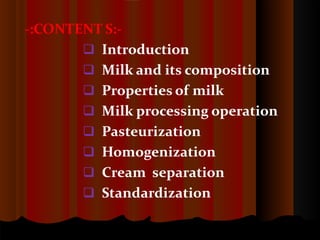
-:INTRODUCTION:-
Milk is a unique in that it is both consumed,
as fluid milk with minimal processing and it is the raw
material used to manufacture a wide variety of
product.
Definition
Milk may be defined as the whole, fresh, clean, lacteal
secretion obtained by the complete milking of one or
more healthy milch animals, excluding that obtained
within 15 day before or 15 days after calving or such
periods as may be necessary to render the milk
practically colostrums-free and containing the
minimum prescribed percentages of milk fat and
milk-solid-not-fat.
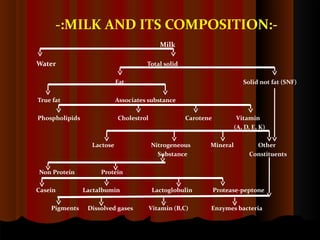
-:MILK AND ITS COMPOSITION:-
Milk
Water Total solid
Fat Solid not fat (SNF)
True fat Associates substance
Phospholipids Cholestrol Carotene Vitamin
(A, D, E, K)
Lactose Nitrogeneous Mineral Other
Substance Constituents
Non Protein Protein
Casein Lactalbumin Lactoglobulin Protease-peptone
Pigments Dissolved gases Vitamin (B,C) Enzymes bacteria
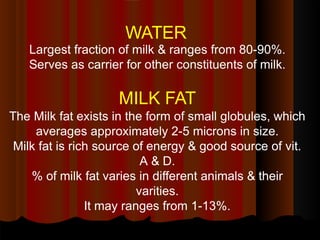
WATER
Largest fraction of milk & ranges from 80-90%.
Serves as carrier for other constituents of milk.
MILK FAT
The Milk fat exists in the form of small globules, which
averages approximately 2-5 microns in size.
Milk fat is rich source of energy & good source of vit.
A & D.
% of milk fat varies in different animals & their
varities.
It may ranges from 1-13%.
MILK PROTIEN
Milk normally contains about 0.5% of nitrogen of
which 95% constituents milk protein & 5% non
protein nitrogen.
Casein is phosphoprotien, accounts for 80% of
total protein content.
The viscosity & white colour of milk are largely
because of casein.
MILK SUGAR OR LACTOSE
It occurs exclusively in mammalian milk.
The average lactose content of cow & buffalo milk
is 4.5 & 4.8% respectively.
ENZYMES
A number of enzymes present in milk. More than
25 enzymes have been identified in cow milk.
The milk enzymes are of considerable importance
in certain aspects of milk technology. For example
lipase is responsible for the development of rancid
flavours in milk.
VITAMINS
Milk is good source of fat soluble (Vitamins A,D,E
& K) & water soluble vitamins (B).
Milk is good source of Vitamin A but it is poor
source of Vitamin C.
MINELRALS
Milk is an important source of calcium, potassium,
Properties of Milk
1. Physical state of Milk: The Milk constituents
exists partially as a solution & partially in colloidal
state.
2.Acidity of Milk: The titratable acidity of milk is usually
expressed as lactic acid equivalent per 100 ml. of milk & it
may range from 0.13 – 0.21%.
3. pH of Milk: Milk is slightly acidic in
nature & its ph value varies from 6.5 –
6.7.
4.Colour of Milk: Milk ranges in colour from yellowish
creamy to creamy white. The larger the fat globules & the
higher the fat percentage , the greater intensity of the yellow
colour.
5. Flavour: This is composed of smell (odour) & taste.
Milk is sweet in taste. The chlorides & lactose are
mainly responsible for taste.
6.Specific gravity: The specific gravity of milk is
determined by using a plunger of special shape &
volume called lactometer.
7.Viscosity: The viscosity of milk is always higher
than viscosity of water due to presence of dissolved
solids in milk. At normal temperature viscosity from 1.5– 2.
8.Boiling point of milk: The Boiling point of milk
varies from 100.17 - 101°c. This is slightly higher than
that of water due to dissolved substances in milk.
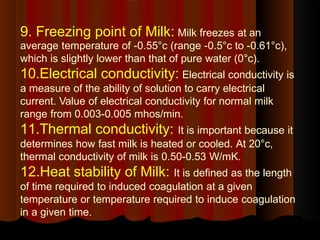
9. Freezing point of Milk: Milk freezes at an
average temperature of -0.55°c (range -0.5°c to -0.61°c),
which is slightly lower than that of pure water (0°c).
10.Electrical conductivity: Electrical conductivity is
a measure of the ability of solution to carry electrical
current. Value of electrical conductivity for normal milk
range from 0.003-0.005 mhos/min.
11.Thermal conductivity: It is important because it
determines how fast milk is heated or cooled. At 20°c,
thermal conductivity of milk is 0.50-0.53 W/mK.
12.Heat stability of Milk: It is defined as the length
of time required to induced coagulation at a given
temperature or temperature required to induce coagulation
in a given time.
Milk Processing Operations:
Once th milk has been received at the milk
processing centre, or dairy, it should be
immediately strained, cooled & processed so as to
prevent any bacteriall growth.
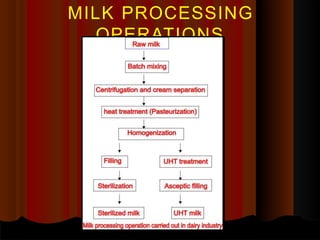
MILK PROCESSING
OPERATIONS
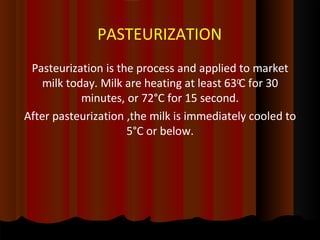
PASTEURIZATION
Pasteurization is the process and applied to market
milk today. Milk are heating at least 630
C for 30
minutes, or 72°C for 15 second.
After pasteurization ,the milk is immediately cooled to
5°C or below.
History of pasteurization
1. Pasteurization term is first time used
by Louis Pasteur in 20 April 1862.and
eliminate bacteria in wines
2. The pasteurization of
milk was adopted in
1895.
Method of Pasteurization
1. Low temperature long time (LTLT)
2. High temperature short time (HTST)
3. Ultra high temperature (UHT)
1. LTLT: Low temperature long time
this method commonly know as Batch or Holding
method of pasteurization and ideal temperature is
63C for 30 minute(Milk)
2.HTST: High temperature short time.
This method is know as continuous
process of pasteurization and is 72C for 15
second.
3.UHT: Ultra high temperature. This
process was developed in 1950.and
temperature are provide 135C to 150 C for
one second
HOMOGENIZATION
Breakdown of milk fat globules is called
Homogenization and fat globules
subdivision to 2 microns or less in diameter.
Effect of
homogenization on milk
1. Increased the viscosity of Milk.
2. Reduced the milk curd tension.
3. More creamier structure, bland flavor.
Merits & Demerits of Homogenization
Merits:
1. No formation of cream
layer
2. Produces soft curd and better digested
3. More palatable to
brighter appearance
Demerits:
1. Increased cost of production
2. Greater tendency for milk
CREAM SEPRATION
The basic principle of cream sepration is
based on the fact that density of fat (930
kg/m3) is lower than milk average 1036
kg/m3
). Hence when mlik which may be
considered to be a mixture of fat (as
cream) & skim milk, is subjected to either
gravity or a centrifugal force the two
components, viz. cream & skim milk by
virtue of their differing densities, stratify
from one another.
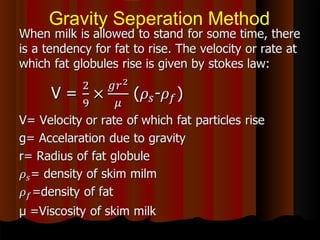
Gravity Seperation Method
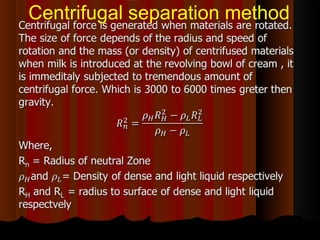
Centrifugal separation method
STANDARDIZATION
Standrdization refers to the adujestment
( i.e. raising or lowerin the fat and/ or solid –
not-fat %). Of milk to desired value, So as to
confirm to some lefgal or others
requirement.
MIXING OF INSGREDIENTS
Ice cream contains numbers of ingredients
obtained from various source. The
ingredients used in the manufacture of ice
cream include dairy (like whole milk, skim
milk, cream, frozen cream, butter, butter oil
condensed milk products,dried milk product,
and non dairy product like sugar, stabilizer
and emulsifiers.
dairyprocessing-180708173002 (1).pptx

dairyprocessing-180708173002 (1).pptx

  • 2.
  • 3.
    MILK PROCESSIN G SUBMITTED TO: Dr. R.C. Pradhan Asst. Professor Dept. of Agricultural Farm Engineering SUBMITTED BY: Sukhveer Singh Prabal Pratap Singh Uday Pratap Singh
  • 5.
    -:INTRODUCTION:- Milk is aunique in that it is both consumed, as fluid milk with minimal processing and it is the raw material used to manufacture a wide variety of product. Definition Milk may be defined as the whole, fresh, clean, lacteal secretion obtained by the complete milking of one or more healthy milch animals, excluding that obtained within 15 day before or 15 days after calving or such periods as may be necessary to render the milk practically colostrums-free and containing the minimum prescribed percentages of milk fat and milk-solid-not-fat.
  • 6.
    -:MILK AND ITSCOMPOSITION:- Milk Water Total solid Fat Solid not fat (SNF) True fat Associates substance Phospholipids Cholestrol Carotene Vitamin (A, D, E, K) Lactose Nitrogeneous Mineral Other Substance Constituents Non Protein Protein Casein Lactalbumin Lactoglobulin Protease-peptone Pigments Dissolved gases Vitamin (B,C) Enzymes bacteria
  • 7.
    WATER Largest fraction ofmilk & ranges from 80-90%. Serves as carrier for other constituents of milk. MILK FAT The Milk fat exists in the form of small globules, which averages approximately 2-5 microns in size. Milk fat is rich source of energy & good source of vit. A & D. % of milk fat varies in different animals & their varities. It may ranges from 1-13%.
  • 8.
    MILK PROTIEN Milk normallycontains about 0.5% of nitrogen of which 95% constituents milk protein & 5% non protein nitrogen. Casein is phosphoprotien, accounts for 80% of total protein content. The viscosity & white colour of milk are largely because of casein. MILK SUGAR OR LACTOSE It occurs exclusively in mammalian milk. The average lactose content of cow & buffalo milk is 4.5 & 4.8% respectively.
  • 9.
    ENZYMES A number ofenzymes present in milk. More than 25 enzymes have been identified in cow milk. The milk enzymes are of considerable importance in certain aspects of milk technology. For example lipase is responsible for the development of rancid flavours in milk. VITAMINS Milk is good source of fat soluble (Vitamins A,D,E & K) & water soluble vitamins (B). Milk is good source of Vitamin A but it is poor source of Vitamin C. MINELRALS Milk is an important source of calcium, potassium,
  • 10.
    Properties of Milk 1.Physical state of Milk: The Milk constituents exists partially as a solution & partially in colloidal state. 2.Acidity of Milk: The titratable acidity of milk is usually expressed as lactic acid equivalent per 100 ml. of milk & it may range from 0.13 – 0.21%. 3. pH of Milk: Milk is slightly acidic in nature & its ph value varies from 6.5 – 6.7. 4.Colour of Milk: Milk ranges in colour from yellowish creamy to creamy white. The larger the fat globules & the higher the fat percentage , the greater intensity of the yellow colour.
  • 11.
    5. Flavour: Thisis composed of smell (odour) & taste. Milk is sweet in taste. The chlorides & lactose are mainly responsible for taste. 6.Specific gravity: The specific gravity of milk is determined by using a plunger of special shape & volume called lactometer. 7.Viscosity: The viscosity of milk is always higher than viscosity of water due to presence of dissolved solids in milk. At normal temperature viscosity from 1.5– 2. 8.Boiling point of milk: The Boiling point of milk varies from 100.17 - 101°c. This is slightly higher than that of water due to dissolved substances in milk.
  • 12.
    9. Freezing pointof Milk: Milk freezes at an average temperature of -0.55°c (range -0.5°c to -0.61°c), which is slightly lower than that of pure water (0°c). 10.Electrical conductivity: Electrical conductivity is a measure of the ability of solution to carry electrical current. Value of electrical conductivity for normal milk range from 0.003-0.005 mhos/min. 11.Thermal conductivity: It is important because it determines how fast milk is heated or cooled. At 20°c, thermal conductivity of milk is 0.50-0.53 W/mK. 12.Heat stability of Milk: It is defined as the length of time required to induced coagulation at a given temperature or temperature required to induce coagulation in a given time.
  • 13.
    Milk Processing Operations: Onceth milk has been received at the milk processing centre, or dairy, it should be immediately strained, cooled & processed so as to prevent any bacteriall growth.
  • 14.
  • 15.
    PASTEURIZATION Pasteurization is theprocess and applied to market milk today. Milk are heating at least 630 C for 30 minutes, or 72°C for 15 second. After pasteurization ,the milk is immediately cooled to 5°C or below.
  • 16.
    History of pasteurization 1.Pasteurization term is first time used by Louis Pasteur in 20 April 1862.and eliminate bacteria in wines 2. The pasteurization of milk was adopted in 1895.
  • 17.
    Method of Pasteurization 1.Low temperature long time (LTLT) 2. High temperature short time (HTST) 3. Ultra high temperature (UHT)
  • 18.
    1. LTLT: Lowtemperature long time this method commonly know as Batch or Holding method of pasteurization and ideal temperature is 63C for 30 minute(Milk) 2.HTST: High temperature short time. This method is know as continuous process of pasteurization and is 72C for 15 second. 3.UHT: Ultra high temperature. This process was developed in 1950.and temperature are provide 135C to 150 C for one second
  • 19.
    HOMOGENIZATION Breakdown of milkfat globules is called Homogenization and fat globules subdivision to 2 microns or less in diameter.
  • 20.
    Effect of homogenization onmilk 1. Increased the viscosity of Milk. 2. Reduced the milk curd tension. 3. More creamier structure, bland flavor.
  • 21.
    Merits & Demeritsof Homogenization Merits: 1. No formation of cream layer 2. Produces soft curd and better digested 3. More palatable to brighter appearance Demerits: 1. Increased cost of production 2. Greater tendency for milk
  • 22.
    CREAM SEPRATION The basicprinciple of cream sepration is based on the fact that density of fat (930 kg/m3) is lower than milk average 1036 kg/m3 ). Hence when mlik which may be considered to be a mixture of fat (as cream) & skim milk, is subjected to either gravity or a centrifugal force the two components, viz. cream & skim milk by virtue of their differing densities, stratify from one another.
  • 23.
  • 24.
  • 25.
    STANDARDIZATION Standrdization refers tothe adujestment ( i.e. raising or lowerin the fat and/ or solid – not-fat %). Of milk to desired value, So as to confirm to some lefgal or others requirement.
  • 26.
    MIXING OF INSGREDIENTS Icecream contains numbers of ingredients obtained from various source. The ingredients used in the manufacture of ice cream include dairy (like whole milk, skim milk, cream, frozen cream, butter, butter oil condensed milk products,dried milk product, and non dairy product like sugar, stabilizer and emulsifiers.