MILK PROCESSING PLANT
Submitted by:
Varnit Chauhan
17/IBT/042
INTRODUCTION
 Milk is widely considered as one of the most valuable
and well-known Food.
 Milk is used as food by all age group.
 In industry has standard capacity of Milk processing and
milk handling 1,000 –5 Lac liters per day.
 Milk Processing plant can operate 20 hours in a day.
 Fat content Whole or full-fat milk contains about 3.5%
fat Semi-skimmed contains about 1.7% fat Skimmed
milk contains 0.1 to 0.3% fat Some supermarkets sell
milk with a 1% fat content which has almost half the fat
of semi-skimmed milk but retains a more creamy flavor.
SITE
 The plant should be located as centrally as possible
within a given milk producing area, near a source of
water, or in a place where water is available.
 The transportation facility must be nearer to the
plant i.e. Road, Market connectivity.
 The site should be cool and well-ventilated. It
always influenced by their environment. The most
important factor is availability of water.
 It should be remembered that on average five liters
of water are required to process one liters of milk.
 Electricity and workers availability.
OPERATIONS AND PRODUCTION
 Milk processing operations will take place far from urban
consumption centers. In these areas the quantities of milk
hardly exceed an average of 500 liters per day.
 The products made must be able to withstand long
periods of transportation, often under difficult climatic
conditions.
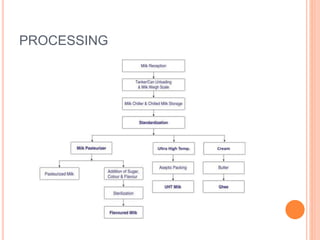
 Standardization: Standardization is an operation
producing milk with a constant butterfat content through
partial, manual skimming. The operation makes it possible
to standardize the composition of the finished product and
to set aside part of the cream for butter.
OPERATIONS AND PRODUCTION
 Heat treatment: Pathogenic germs in milk are
destroyed by heating the milk to a minimum temperature
of 63°C for 30 minutes.
 Inoculation: Due to heat treatment, which destroys a
large number of lactic bacteria, cheese or yoghurt-
making requires the addition of lactic bacteria to the
milk. These bacteria are selected according to the type
of finished product required.
 Clotting: Milk changes from a liquid to a solid state
through the use of a coagulant: rennet.
 Curd-Separation: In cheese-making, the milk after
coagulation is cut and separated into a liquid whey, and
cheese curd.
OPERATIONS AND PRODUCTION
 Ripening: This phase of cheese-making allows
cheese texture to become homogeneous and the
aroma to develop
 Churning: In this operation, cream is churned to
produce a semi-solid product which becomes
butter.
 Melting and emulsification: Defective cheeses are
melted and emulsified with salts to obtain a solid
consistency and, after cooling forms processed
cheese.
COLLECTION
 Stainless steal milking pails are often an
improvement on the utensils commonly used.
 The producer should use small aluminum milk
 Cans of 5–10 liter capacity for transporting the milk,
while the collector should use 30–50 liter cans.
 If the milk needs to be collected, the following will
be needed: the use of a bicycle, a 50 liter milk can,
a graduated cylinder lacto-densitometer and a
measuring pail.
PROCESSING
 Reception: the following equipment is needed for the
reception of milk brought in by producers themselves
and by the collector: a milk scale and a pail.
 Storage: a milk funnel and 50 liter milk cans.
 Standardization/Cream separation: a manual cream
separator has to be used to skim a portion of the milk
received.
 Heat treatment: there are several possibilities for heat
treatment, depending on the available power source.
Under the least favorable circumstances, the sole
available energy source is wood or peat. The best thing
to use in this case is a “boiler/water bath”
 Cooling: the milk is cooled with the help of milk chillers.
PROCESSING
 Clotting: The cheese vat can be of aluminum with
a tap for draining the whey
 Pressing: different kinds of cheese (curd) presses
can be made. The simplest press is made by
placing weights or cement block on the molded
cheese (curd) as shown in the following diagram:
PROCESSING
 Milk Collection Centre :
 Milk Collection from Farm Level to Milk Collection
Centers.
 Transfer of Milk from Farmer to Milk Centers
 Measuring and Buying of Milk at Small Collection Center
Measuring
 Pouring of Milk in Milk Silo Front View of Milk Silo.
PROCESSING
PRODUCTS
 Types of Milk : Pasteurized, Homogenized, Whole,
Skimmed, Single Toned, Double Toned, Full Cream
milk contain.
 Pasteurized-Heated at high temperatures in order to the
kill the harmful bacteria without losing out on the flavor
or nutritional content of Milk.
 Homogenized-Process where the fat globules in it are
broken, which spreads the fat evenly, preventing the
formation of the creamy layer on top. However, the fat
content and other factors remain the same.
 Skimmed-All the nutrients found in whole milk like the
vitamins and minerals.
PRODUCT
 Whole –full cream milk is usually consumed by children,
teenagers and body builders. Whole milk is called so
because it contains all the milk fat found them. One
glass of whole milk contains 3.5% milk fat, which
provides about 150 calories. Whole milk is also creamier
and full of flavor
 Single Toned -obtained by adding skimmed milk powder
and water to whole milk. It contains about 3.0% fat and
toned milk restricts the body from absorbing cholesterol
from the milk to minimum
 Double Toned-obtained by adding skimmed milk power
to whole milk and has about 1.5% fat content. Double
toned milk is ideal for those trying to maintain weight as
it keeps the calorie intake under check and aids weight
loss
PRODUCT
 Paneer –The curds are drained in muslin or
cheesecloth and the excess water is pressed out
 Shrikhand- Shrikhand, yogurt is tied in a cotton
cloth and left under pressure to drain
 Ghee-Ghee is the pure butterfat left over after the
milk solids and water are removed from butter.
 Khoa-Made of either dried whole milk or milk
thickened by heating in an open iron pan.
 Lassi - Lassi is a blend of yogurt, water, spices.
Sweet Lassi, Mango Lassi & Bhang Lassi

Milk processing plant

  • 1.
    MILK PROCESSING PLANT Submittedby: Varnit Chauhan 17/IBT/042
  • 2.
    INTRODUCTION  Milk iswidely considered as one of the most valuable and well-known Food.  Milk is used as food by all age group.  In industry has standard capacity of Milk processing and milk handling 1,000 –5 Lac liters per day.  Milk Processing plant can operate 20 hours in a day.  Fat content Whole or full-fat milk contains about 3.5% fat Semi-skimmed contains about 1.7% fat Skimmed milk contains 0.1 to 0.3% fat Some supermarkets sell milk with a 1% fat content which has almost half the fat of semi-skimmed milk but retains a more creamy flavor.
  • 3.
    SITE  The plantshould be located as centrally as possible within a given milk producing area, near a source of water, or in a place where water is available.  The transportation facility must be nearer to the plant i.e. Road, Market connectivity.  The site should be cool and well-ventilated. It always influenced by their environment. The most important factor is availability of water.  It should be remembered that on average five liters of water are required to process one liters of milk.  Electricity and workers availability.
  • 4.
    OPERATIONS AND PRODUCTION Milk processing operations will take place far from urban consumption centers. In these areas the quantities of milk hardly exceed an average of 500 liters per day.  The products made must be able to withstand long periods of transportation, often under difficult climatic conditions.  Standardization: Standardization is an operation producing milk with a constant butterfat content through partial, manual skimming. The operation makes it possible to standardize the composition of the finished product and to set aside part of the cream for butter.
  • 5.
    OPERATIONS AND PRODUCTION Heat treatment: Pathogenic germs in milk are destroyed by heating the milk to a minimum temperature of 63°C for 30 minutes.  Inoculation: Due to heat treatment, which destroys a large number of lactic bacteria, cheese or yoghurt- making requires the addition of lactic bacteria to the milk. These bacteria are selected according to the type of finished product required.  Clotting: Milk changes from a liquid to a solid state through the use of a coagulant: rennet.  Curd-Separation: In cheese-making, the milk after coagulation is cut and separated into a liquid whey, and cheese curd.
  • 6.
    OPERATIONS AND PRODUCTION Ripening: This phase of cheese-making allows cheese texture to become homogeneous and the aroma to develop  Churning: In this operation, cream is churned to produce a semi-solid product which becomes butter.  Melting and emulsification: Defective cheeses are melted and emulsified with salts to obtain a solid consistency and, after cooling forms processed cheese.
  • 7.
    COLLECTION  Stainless stealmilking pails are often an improvement on the utensils commonly used.  The producer should use small aluminum milk  Cans of 5–10 liter capacity for transporting the milk, while the collector should use 30–50 liter cans.  If the milk needs to be collected, the following will be needed: the use of a bicycle, a 50 liter milk can, a graduated cylinder lacto-densitometer and a measuring pail.
  • 8.
    PROCESSING  Reception: thefollowing equipment is needed for the reception of milk brought in by producers themselves and by the collector: a milk scale and a pail.  Storage: a milk funnel and 50 liter milk cans.  Standardization/Cream separation: a manual cream separator has to be used to skim a portion of the milk received.  Heat treatment: there are several possibilities for heat treatment, depending on the available power source. Under the least favorable circumstances, the sole available energy source is wood or peat. The best thing to use in this case is a “boiler/water bath”  Cooling: the milk is cooled with the help of milk chillers.
  • 9.
    PROCESSING  Clotting: Thecheese vat can be of aluminum with a tap for draining the whey  Pressing: different kinds of cheese (curd) presses can be made. The simplest press is made by placing weights or cement block on the molded cheese (curd) as shown in the following diagram:
  • 10.
    PROCESSING  Milk CollectionCentre :  Milk Collection from Farm Level to Milk Collection Centers.  Transfer of Milk from Farmer to Milk Centers  Measuring and Buying of Milk at Small Collection Center Measuring  Pouring of Milk in Milk Silo Front View of Milk Silo.
  • 11.
  • 12.
    PRODUCTS  Types ofMilk : Pasteurized, Homogenized, Whole, Skimmed, Single Toned, Double Toned, Full Cream milk contain.  Pasteurized-Heated at high temperatures in order to the kill the harmful bacteria without losing out on the flavor or nutritional content of Milk.  Homogenized-Process where the fat globules in it are broken, which spreads the fat evenly, preventing the formation of the creamy layer on top. However, the fat content and other factors remain the same.  Skimmed-All the nutrients found in whole milk like the vitamins and minerals.
  • 13.
    PRODUCT  Whole –fullcream milk is usually consumed by children, teenagers and body builders. Whole milk is called so because it contains all the milk fat found them. One glass of whole milk contains 3.5% milk fat, which provides about 150 calories. Whole milk is also creamier and full of flavor  Single Toned -obtained by adding skimmed milk powder and water to whole milk. It contains about 3.0% fat and toned milk restricts the body from absorbing cholesterol from the milk to minimum  Double Toned-obtained by adding skimmed milk power to whole milk and has about 1.5% fat content. Double toned milk is ideal for those trying to maintain weight as it keeps the calorie intake under check and aids weight loss
  • 14.
    PRODUCT  Paneer –Thecurds are drained in muslin or cheesecloth and the excess water is pressed out  Shrikhand- Shrikhand, yogurt is tied in a cotton cloth and left under pressure to drain  Ghee-Ghee is the pure butterfat left over after the milk solids and water are removed from butter.  Khoa-Made of either dried whole milk or milk thickened by heating in an open iron pan.  Lassi - Lassi is a blend of yogurt, water, spices. Sweet Lassi, Mango Lassi & Bhang Lassi