1
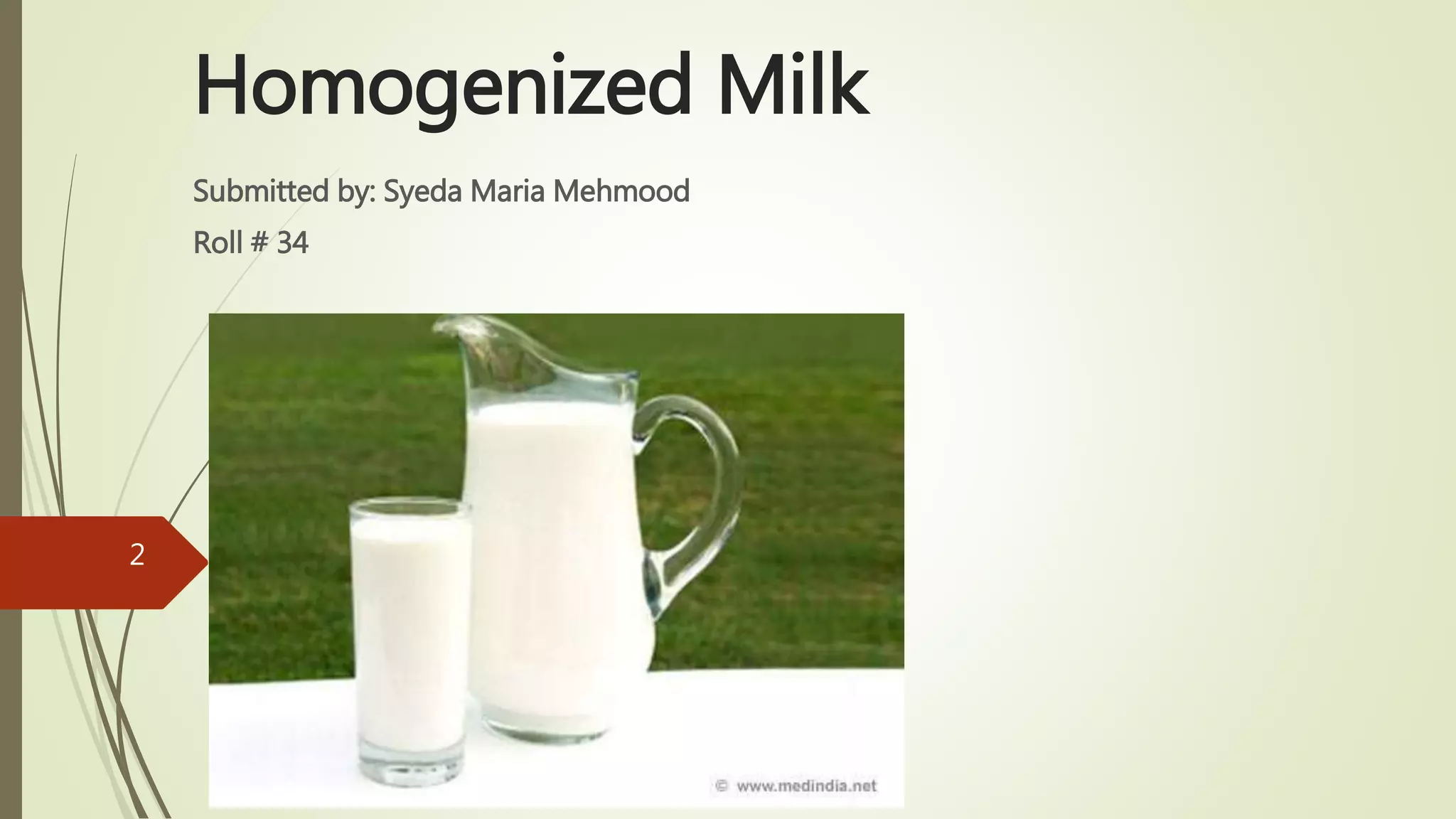
Homogenized Milk
Submitted by: Syeda Maria Mehmood
Roll # 34
2
Contents
Milk
 Composition of milk
Homogenization
Homogenized milk
Advantages of homogenized milk
Disadvantages of homogenized milk
3
Milk
 Whole, clean, fresh lacteal secretion, free from colostrum.
 Obtained by complete milking of mammals.
 Milk a complete food for the new born.
 Milk valuable nutritious food.
 Milk used as food by all age group.
 Milk contains more utilizable calcium and good quality protein.
4
Composition of Milk
87.7% Water
4.9% Lactose
3.4% Fat
3.3% Protein
0.7% Minerals
5
Water
Lactose
Fat
Protein
Minerals
 Basic composition of milk regardless of source remains same:
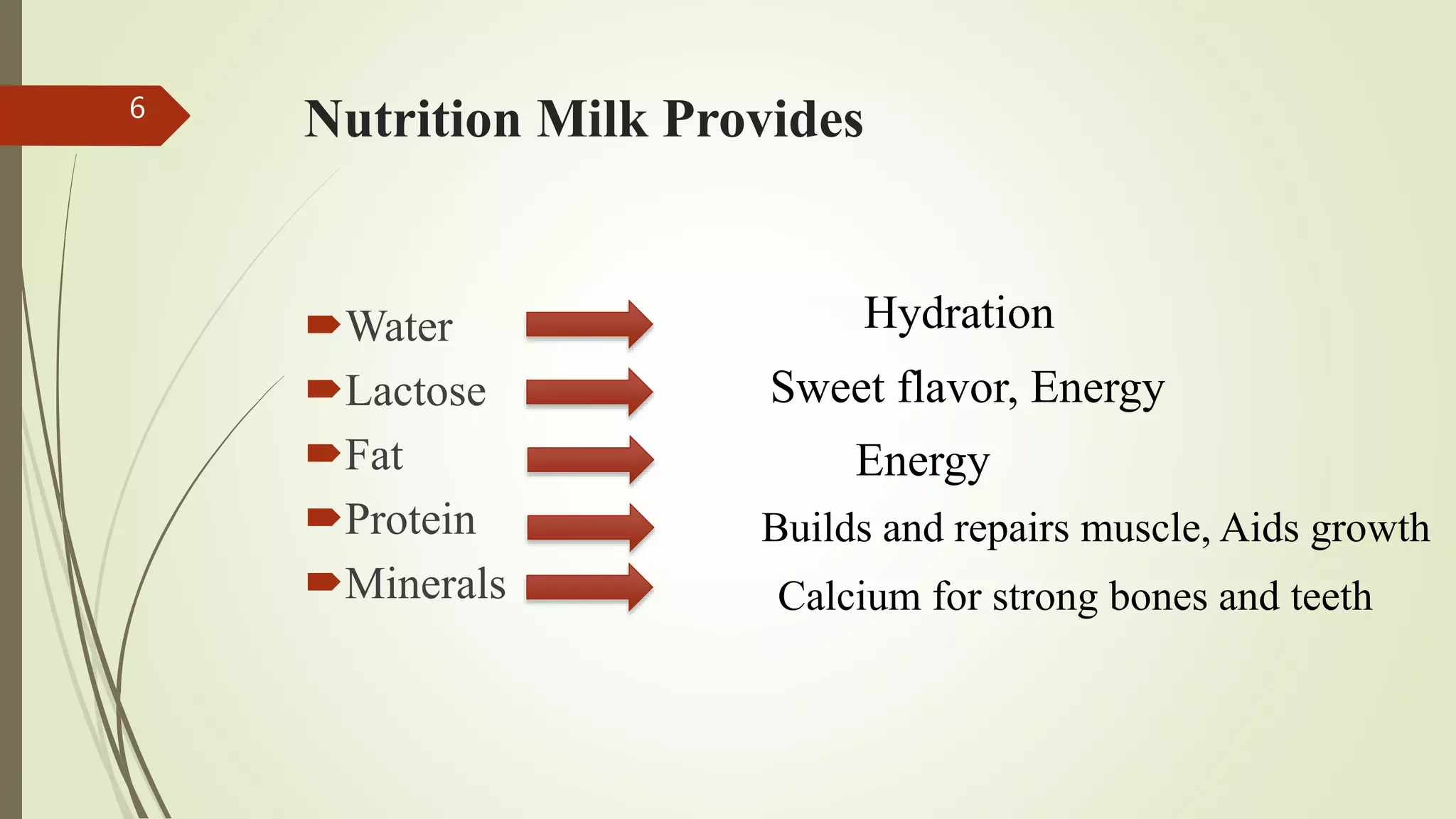
Nutrition Milk Provides
Water
Lactose
Fat
Protein
Minerals
6
Hydration
Sweet flavor, Energy
Energy
Builds and repairs muscle, Aids growth
Calcium for strong bones and teeth
Mil Processing benefits
 Done to make milk:
Safe and healthy
More appealing
Improves quality
More nutritious
 Provides regular income
 Generates employment
7
Homogenization
 Mechanical treatment of fat globules in milk.
 Brought about by passing milk under high pressure through a tiny orifice.
 Decrease in the average diameter.
 Reduced tendency for creaming of fat globules.
 Enhanced stability of homogenized milk.
 Nothing is added or removed.
Purpose of Homogenization
 No formation of cream layer.
 Whiter and more appetizing colour..
 More full-bodied flavour, and better mouth feel.
 Better stability of cultured milk products.
 Produces soft curd and is better digested.
9
Effect of Homogenization10
Homogenized Milk
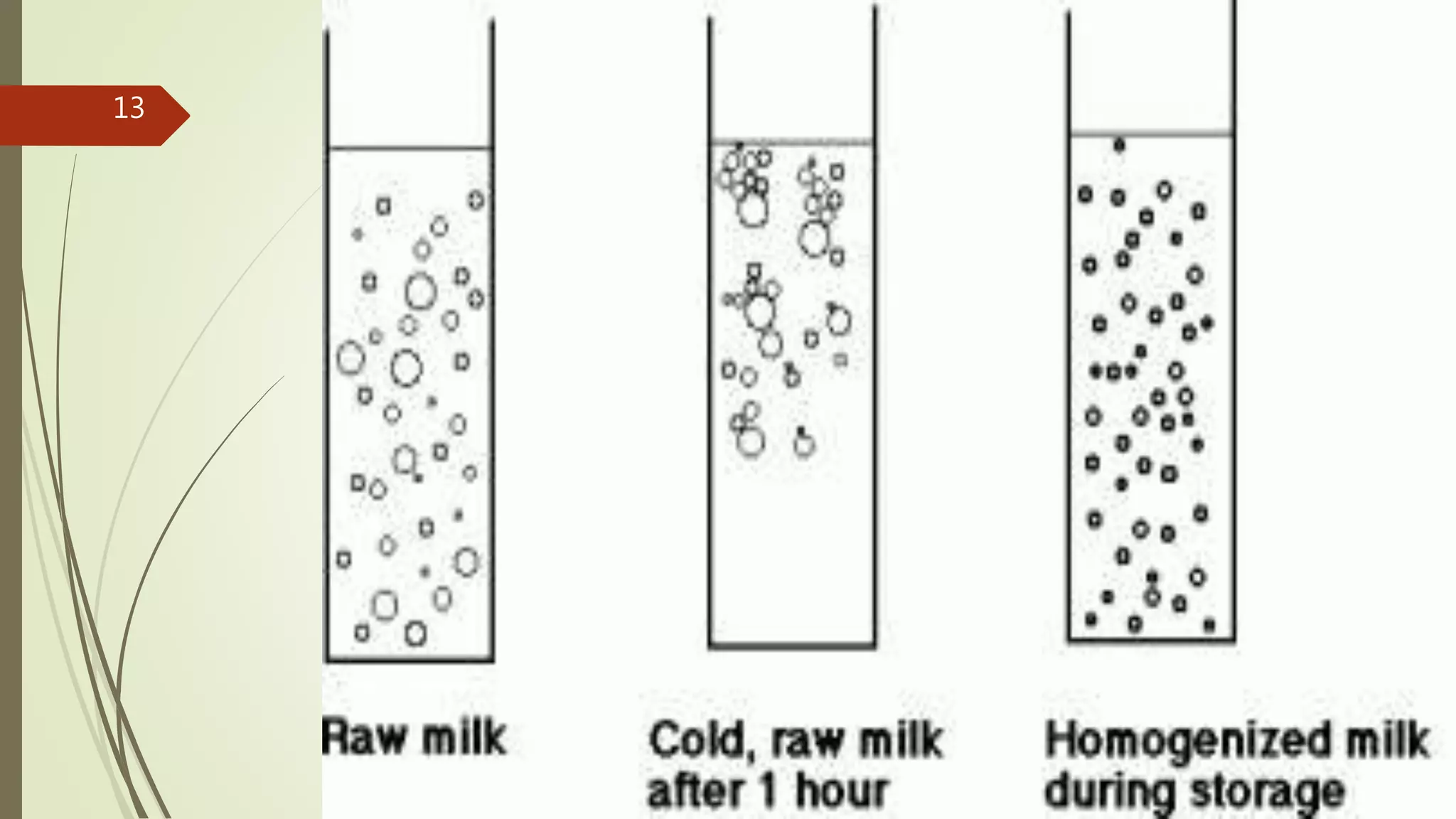
 Milk has treated to insure breakup of fat globules that after 48 hours of storage no
visible cream separation occurs on the milk at 4ºC.
 Fat globules subdivided to 2 microns or less in diameter.
 First invented by Auguste Gaulin, a Frenchman.
11
Characteristics of Homogenized Milk
 No creaming or separation of cream to the top of the container.
 Whiter milk due to a finer dispersions of fat.
 An increase in absorption and reflection of light due to smaller fat particles.
 More viscous and creamy milk due to a greater number of fat particles.
 Improved shelf life.
 Less susceptible to oxidized flavor.
12
13
Process of Homogenization
1. Process allows milk manufacturers to combine cream and milk so not be separate.
2. Process is purely mechanical, and involves no additives or chemical treatments.
3. The process typically starts with agitation.
4. Milk is placed in a large drum or barrel that is spun at high speeds.
14
Conti…
5. Warm fat molecules disintegrate more easily than cold ones, so heat is often
applied.
6. The turbulence caused by the agitation starts breaking down the fat.
7. Next, the milk is pressed through narrow sieves or filters.
8. This forces the fats to break apart even more to fit through the microscopic
holes.
15
16
Homogenization Theories
 Involves two theories, turbulence and cavitation.
 Explains reduction in size of fat globules during homogenization process.
A. Turbulence
 A lot of small eddies created in a liquid travelling at a high velocity.
 Higher velocity gives smaller eddies.
 Eddy hits oil droplet of same size, droplet deformed and finally break up.
17
Conti…
B. Cavitation
 Shock waves creates when steam bubbles implode, disrupt the fat droplets.
 Homogenization takes place when the liquid is leaving the gap.
 Back pressure important to control the cavitation and homogenization.
18
Advantages of Homogenized Milk
 Prevents removal of fat/cream from milk surface.
 Results in softer curd ,easily digested by infants.
 Churning of fat does not occur during bulk transportation.
 Fat is uniformly distributed and therefore gives uniform consistency.
 Resistant to development of oxidized flavor defect.
 Ease of digestion helps increases absorbance of nutrients.
19
Disadvantages of Homogenized Milk
 Proteins in milk absorbed into the bloodstream, not digested.
 Homogenized milk cannot be efficiently separated.
 Interacts within body’s hormones, leads to cancer.
 Also destroy many nutrients and other valuable organisms in the milk.
 Homogenized milk concerns heart disease and arterial plaque buildup.
20
21
22
References
 http://dairyknowledge.in/sites/default/files/homogenization.pdf
 http://www.slideshare.net/dhanupriya/milk-chemistry-composition
 http://milk.polybum.com/equipment_dairy_industry/homogenisers/the_technology
_behind_disruption_of_fat_globules/flow_characteristics/homogenisation_theories
 http://www.wellwise.org/blogs/kantha-shelke/homogenized-milk-better-or-worse-
you
 http://dairy-technology.blogspot.com/2014/01/homogenization-theories-and-
process.html
23
24

Homogenized milk

  • 1.
  • 2.
    Homogenized Milk Submitted by:Syeda Maria Mehmood Roll # 34 2
  • 3.
    Contents Milk  Composition ofmilk Homogenization Homogenized milk Advantages of homogenized milk Disadvantages of homogenized milk 3
  • 4.
    Milk  Whole, clean,fresh lacteal secretion, free from colostrum.  Obtained by complete milking of mammals.  Milk a complete food for the new born.  Milk valuable nutritious food.  Milk used as food by all age group.  Milk contains more utilizable calcium and good quality protein. 4
  • 5.
    Composition of Milk 87.7%Water 4.9% Lactose 3.4% Fat 3.3% Protein 0.7% Minerals 5 Water Lactose Fat Protein Minerals  Basic composition of milk regardless of source remains same:
  • 6.
    Nutrition Milk Provides Water Lactose Fat Protein Minerals 6 Hydration Sweetflavor, Energy Energy Builds and repairs muscle, Aids growth Calcium for strong bones and teeth
  • 7.
    Mil Processing benefits Done to make milk: Safe and healthy More appealing Improves quality More nutritious  Provides regular income  Generates employment 7
  • 8.
    Homogenization  Mechanical treatmentof fat globules in milk.  Brought about by passing milk under high pressure through a tiny orifice.  Decrease in the average diameter.  Reduced tendency for creaming of fat globules.  Enhanced stability of homogenized milk.  Nothing is added or removed.
  • 9.
    Purpose of Homogenization No formation of cream layer.  Whiter and more appetizing colour..  More full-bodied flavour, and better mouth feel.  Better stability of cultured milk products.  Produces soft curd and is better digested. 9
  • 10.
  • 11.
    Homogenized Milk  Milkhas treated to insure breakup of fat globules that after 48 hours of storage no visible cream separation occurs on the milk at 4ºC.  Fat globules subdivided to 2 microns or less in diameter.  First invented by Auguste Gaulin, a Frenchman. 11
  • 12.
    Characteristics of HomogenizedMilk  No creaming or separation of cream to the top of the container.  Whiter milk due to a finer dispersions of fat.  An increase in absorption and reflection of light due to smaller fat particles.  More viscous and creamy milk due to a greater number of fat particles.  Improved shelf life.  Less susceptible to oxidized flavor. 12
  • 13.
  • 14.
    Process of Homogenization 1.Process allows milk manufacturers to combine cream and milk so not be separate. 2. Process is purely mechanical, and involves no additives or chemical treatments. 3. The process typically starts with agitation. 4. Milk is placed in a large drum or barrel that is spun at high speeds. 14
  • 15.
    Conti… 5. Warm fatmolecules disintegrate more easily than cold ones, so heat is often applied. 6. The turbulence caused by the agitation starts breaking down the fat. 7. Next, the milk is pressed through narrow sieves or filters. 8. This forces the fats to break apart even more to fit through the microscopic holes. 15
  • 16.
  • 17.
    Homogenization Theories  Involvestwo theories, turbulence and cavitation.  Explains reduction in size of fat globules during homogenization process. A. Turbulence  A lot of small eddies created in a liquid travelling at a high velocity.  Higher velocity gives smaller eddies.  Eddy hits oil droplet of same size, droplet deformed and finally break up. 17
  • 18.
    Conti… B. Cavitation  Shockwaves creates when steam bubbles implode, disrupt the fat droplets.  Homogenization takes place when the liquid is leaving the gap.  Back pressure important to control the cavitation and homogenization. 18
  • 19.
    Advantages of HomogenizedMilk  Prevents removal of fat/cream from milk surface.  Results in softer curd ,easily digested by infants.  Churning of fat does not occur during bulk transportation.  Fat is uniformly distributed and therefore gives uniform consistency.  Resistant to development of oxidized flavor defect.  Ease of digestion helps increases absorbance of nutrients. 19
  • 20.
    Disadvantages of HomogenizedMilk  Proteins in milk absorbed into the bloodstream, not digested.  Homogenized milk cannot be efficiently separated.  Interacts within body’s hormones, leads to cancer.  Also destroy many nutrients and other valuable organisms in the milk.  Homogenized milk concerns heart disease and arterial plaque buildup. 20
  • 21.
  • 22.
  • 23.
    References  http://dairyknowledge.in/sites/default/files/homogenization.pdf  http://www.slideshare.net/dhanupriya/milk-chemistry-composition http://milk.polybum.com/equipment_dairy_industry/homogenisers/the_technology _behind_disruption_of_fat_globules/flow_characteristics/homogenisation_theories  http://www.wellwise.org/blogs/kantha-shelke/homogenized-milk-better-or-worse- you  http://dairy-technology.blogspot.com/2014/01/homogenization-theories-and- process.html 23
  • 24.

Editor's Notes

  • #13 The process of homogenization shrinks milk fat globules, leaving the milk smoother. The process also prevents cream from separating from the milk. The types of homogenized milk available in most grocery stores include whole milk, reduced-fat milk, low-fat milk and fat-free milk. The cholesterol in the milk also changes, depending on the fat percentage, while protein, carbohydrates, vitamins and minerals remain about the same.
  • #21 Xanthine Oxidase (XO)