DRIVING - AN ART
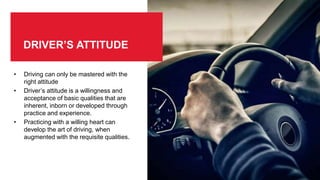
DRIVER’S ATTITUDE
• Driving can only be mastered with the
right attitude
• Driver’s attitude is a willingness and
acceptance of basic qualities that are
inherent, inborn or developed through
practice and experience.
• Practicing with a willing heart can
develop the art of driving, when
augmented with the requisite qualities.
Requisite Qualities that define the correct attitude:
a. RESPONSIBILITY: Showing proper concern not only for your passengers but also for the safety of
all road users and safety of the vehicle.
b. CONCENTRATION: Staying focused on driving. If you let your mind wander, the risk of making a
mistake increases enormously.
c. ANTICIPATION: Thinking ahead so that you can act promptly as per the behaviour of other drivers
on the road.
d. PATIENCE: Tolerating other road users. Do not drive with a spirit of competition or retaliation.
Impatience and bad temper must not override your good sense.
e. CONFIDENCE: Being sure of what you are doing and acting positively. Confidence grows with
experience but never let it be excessive to become over - confident.
f. MECHANICAL KNOWLEDGE: A driver must know the mechanical functioning of engines and all
systems of his vehicle.
DEFENSIVE DRIVING
WHAT IS
DEFENSIVE
DRIVING?
DEFENSIVE
DRIVING
CODE?
RIGHT
OF WAY
STOPPING
DISTANCE
1 2 3 4
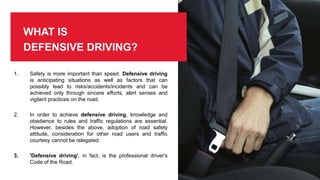
WHAT IS
DEFENSIVE DRIVING?
1. Safety is more important than speed. Defensive driving
is anticipating situations as well as factors that can
possibly lead to risks/accidents/incidents and can be
achieved only through sincere efforts, alert senses and
vigilant practices on the road.
2. In order to achieve defensive driving, knowledge and
obedience to rules and traffic regulations are essential.
However, besides the above, adoption of road safety
attitude, consideration for other road users and traffic
courtesy cannot be relegated.
3. 'Defensive driving', in fact, is the professional driver's
Code of the Road.
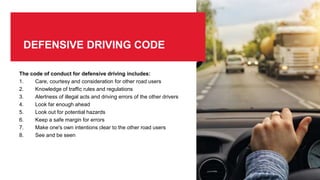
DEFENSIVE DRIVING CODE
The code of conduct for defensive driving includes:
1. Care, courtesy and consideration for other road users
2. Knowledge of traffic rules and regulations
3. Alertness of illegal acts and driving errors of the other drivers
4. Look far enough ahead
5. Look out for potential hazards
6. Keep a safe margin for errors
7. Make one's own intentions clear to the other road users
8. See and be seen
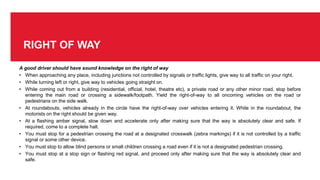
RIGHT OF WAY
A good driver should have sound knowledge on the right of way
• When approaching any place, including junctions not controlled by signals or traffic lights, give way to all traffic on your right.
• While turning left or right, give way to vehicles going straight on.
• While coming out from a building (residential, official, hotel, theatre etc), a private road or any other minor road, stop before
entering the main road or crossing a sidewalk/footpath. Yield the right-of-way to all oncoming vehicles on the road or
pedestrians on the side walk.
• At roundabouts, vehicles already in the circle have the right-of-way over vehicles entering it. While in the roundabout, the
motorists on the right should be given way.
• At a flashing amber signal, slow down and accelerate only after making sure that the way is absolutely clear and safe. If
required, come to a complete halt.
• You must stop for a pedestrian crossing the road at a designated crosswalk (zebra markings) if it is not controlled by a traffic
signal or some other device.
• You must stop to allow blind persons or small children crossing a road even if it is not a designated pedestrian crossing.
• You must stop at a stop sign or flashing red signal, and proceed only after making sure that the way is absolutely clear and
safe.
STOPPING DISTANCE
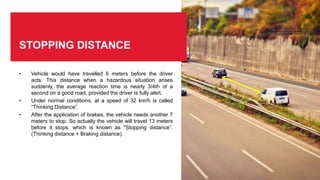
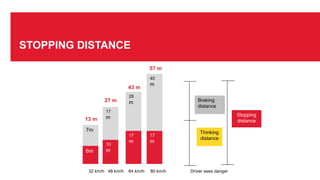
• Vehicle would have travelled 6 meters before the driver
acts. This distance when a hazardous situation arises
suddenly, the average reaction time is nearly 3/4th of a
second on a good road, provided the driver is fully alert.
• Under normal conditions, at a speed of 32 km/h is called
“Thinking Distance”.
• After the application of brakes, the vehicle needs another 7
meters to stop. So actually the vehicle will travel 13 meters
before it stops, which is known as "Stopping distance”.
(Thinking distance + Braking distance).
Braking
distance
Thinking
distance
Stopping
distance
7m
6m
10
m
17
m
17
m
26
m
17
m
40
m
27 m
43 m
57 m
13 m
32 km/h 48 km/h 64 km/h 80 km/h Driver sees danger
STOPPING DISTANCE
ALCOHOL & DRIVING
Alcohol (liquor) goes directly from the stomach into blood stream. As the level of alcohol in the blood increases, the
brain is affected and following symptoms develop in the individual:
• Reduced Alertness
• Poor Judgment
• Loss of Decision Making Capability
• Lack of Muscular co-ordination
• Prolonged Reaction Time
• Visual Distortion
• Poor Depth Perception
A drunken driver should not drive vehicle under the influence of alcohol as it may lead to accident resulting in loss of
precious lives and property. If a driver is drunk, he should take rest so as to enable him to recover as the body can get
rid of alcohol at a rate of about one drink per hour.
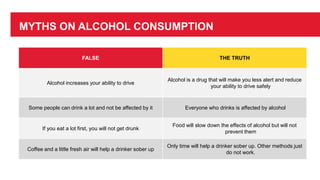
MYTHS ON ALCOHOL CONSUMPTION
FALSE THE TRUTH
Alcohol increases your ability to drive
Alcohol is a drug that will make you less alert and reduce
your ability to drive safely
Some people can drink a lot and not be affected by it Everyone who drinks is affected by alcohol
If you eat a lot first, you will not get drunk
Food will slow down the effects of alcohol but will not
prevent them
Coffee and a little fresh air will help a drinker sober up
Only time will help a drinker sober up. Other methods just
do not work.
DRIVING UNDER SPECIAL CONDITIONS
Certain conditions warrant special skills and techniques, especially in adverse weather conditions, on
bad roads, in extremely hot terrains, at night, in flooded areas etc., A good driver must recognize the
potential hazards these present and acquire superior skills by following the correct procedures and
gaining experience to become a truly mature driver. These conditions include:
• Driving in fog
• Driving at Night
• Driving in Rain
• Driving through a flood
• Driving in very hot weather
• City Driving
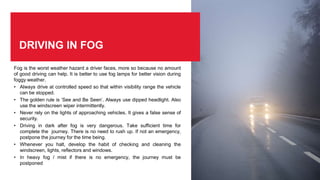
DRIVING IN FOG
Fog is the worst weather hazard a driver faces, more so because no amount
of good driving can help. It is better to use fog lamps for better vision during
foggy weather.
• Always drive at controlled speed so that within visibility range the vehicle
can be stopped.
• The golden rule is ‘See and Be Seen’. Always use dipped headlight. Also
use the windscreen wiper intermittently.
• Never rely on the lights of approaching vehicles. It gives a false sense of
security.
• Driving in dark after fog is very dangerous. Take sufficient time for
complete the journey. There is no need to rush up. If not an emergency,
postpone the journey for the time being.
• Whenever you halt, develop the habit of checking and cleaning the
windscreen, lights, reflectors and windows.
• In heavy fog / mist if there is no emergency, the journey must be
postponed
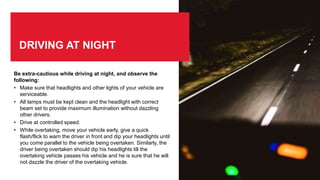
DRIVING AT NIGHT
Be extra-cautious while driving at night, and observe the
following:
• Make sure that headlights and other lights of your vehicle are
serviceable.
• All lamps must be kept clean and the headlight with correct
beam set to provide maximum illumination without dazzling
other drivers.
• Drive at controlled speed.
• While overtaking, move your vehicle early, give a quick
flash/flick to warn the driver in front and dip your headlights until
you come parallel to the vehicle being overtaken. Similarly, the
driver being overtaken should dip his headlights till the
overtaking vehicle passes his vehicle and he is sure that he will
not dazzle the driver of the overtaking vehicle.
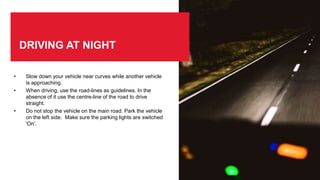
DRIVING AT NIGHT
• Slow down your vehicle near curves while another vehicle
is approaching.
• When driving, use the road-lines as guidelines. In the
absence of it use the centre-line of the road to drive
straight.
• Do not stop the vehicle on the main road. Park the vehicle
on the left side. Make sure the parking lights are switched
'On'.
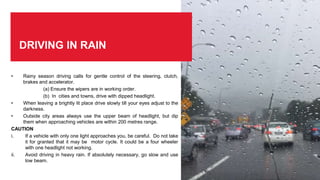
DRIVING IN RAIN
• Rainy season driving calls for gentle control of the steering, clutch,
brakes and accelerator.
(a) Ensure the wipers are in working order.
(b) In cities and towns, drive with dipped headlight.
• When leaving a brightly lit place drive slowly till your eyes adjust to the
darkness.
• Outside city areas always use the upper beam of headlight, but dip
them when approaching vehicles are within 200 metres range.
CAUTION
i. If a vehicle with only one light approaches you, be careful. Do not take
it for granted that it may be motor cycle. It could be a four wheeler
with one headlight not working.
ii. Avoid driving in heavy rain. If absolutely necessary, go slow and use
low beam.
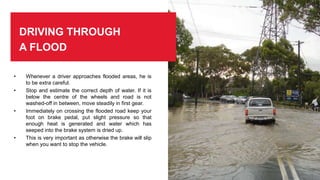
DRIVING THROUGH
A FLOOD
• Whenever a driver approaches flooded areas, he is
to be extra careful.
• Stop and estimate the correct depth of water. If it is
below the centre of the wheels and road is not
washed-off in between, move steadily in first gear.
• Immediately on crossing the flooded road keep your
foot on brake pedal, put slight pressure so that
enough heat is generated and water which has
seeped into the brake system is dried up.
• This is very important as otherwise the brake will slip
when you want to stop the vehicle.
DRIVING IN VERY HOT WEATHER
• Inspect the tyres for overheating and tread separation at every 100 km. If a tyre is too hot to
touch stop for some time and allow it to cool off.
• Under high temperature, tread may come off the retreaded tyres and result in a tyre burst.
• Air pressure increases with temperature. Do not try to remove air as the tyre pressure will be
too low when the tyre cools off.
• Ensure enough engine oil in the engine sump and water in the radiator to help keep the
engine cool.
• Make sure the engine fan belts are properly tightened. Loose belt will not turn the water
pump or fan properly which can result in overheating.
• Watch for those road sections where tar melts in heat. Drive slowly in these areas as they
are very slippery.
• In desert areas, high speed generates more heat from the tyre and engine, increasing the
chances of tyre burst, tyre fire and engine failure. The vehicle should be equipped with a fire
extinguisher.
• The driver must use a wet cloth or handkerchief to keep himself cool. He should neither
overeat nor should he remain in an empty stomach. It is advisable to drink water every one
and a half hours. This will ensure that he does not get heat stroke or become unconscious.
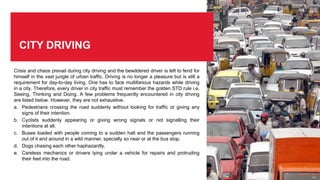
CITY DRIVING
Crisis and chaos prevail during city driving and the bewildered driver is left to fend for
himself in the vast jungle of urban traffic. Driving is no longer a pleasure but is still a
requirement for day-to-day living. One has to face multifarious hazards while driving
in a city. Therefore, every driver in city traffic must remember the golden STD rule i.e,
Seeing, Thinking and Doing. A few problems frequently encountered in city driving
are listed below. However, they are not exhaustive.
a. Pedestrians crossing the road suddenly without looking for traffic or giving any
signs of their intention.
b. Cyclists suddenly appearing or giving wrong signals or not signalling their
intentions at all.
c. Buses loaded with people coming to a sudden halt and the passengers running
out of it and around in a wild manner, specially so near or at the bus stop.
d. Dogs chasing each other haphazardly.
e. Careless mechanics or drivers lying under a vehicle for repairs and protruding
their feet into the road.
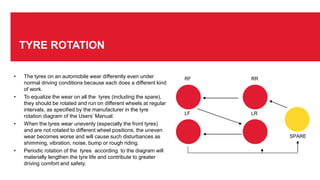
TYRE ROTATION
• The tyres on an automobile wear differently even under
normal driving conditions because each does a different kind
of work.
• To equalize the wear on all the tyres (including the spare),
they should be rotated and run on different wheels at regular
intervals, as specified by the manufacturer in the tyre
rotation diagram of the Users’ Manual.
• When the tyres wear unevenly (especially the front tyres)
and are not rotated to different wheel positions, the uneven
wear becomes worse and will cause such disturbances as
shimming, vibration, noise, bump or rough riding.
• Periodic rotation of the tyres according to the diagram will
materially lengthen the tyre life and contribute to greater
driving comfort and safety.
RF RR
LF LR
SPARE
•October 17, 2019

Tips to Become a Better Driver

  • 1.
  • 2.
    DRIVER’S ATTITUDE • Drivingcan only be mastered with the right attitude • Driver’s attitude is a willingness and acceptance of basic qualities that are inherent, inborn or developed through practice and experience. • Practicing with a willing heart can develop the art of driving, when augmented with the requisite qualities.
  • 3.
    Requisite Qualities thatdefine the correct attitude: a. RESPONSIBILITY: Showing proper concern not only for your passengers but also for the safety of all road users and safety of the vehicle. b. CONCENTRATION: Staying focused on driving. If you let your mind wander, the risk of making a mistake increases enormously. c. ANTICIPATION: Thinking ahead so that you can act promptly as per the behaviour of other drivers on the road. d. PATIENCE: Tolerating other road users. Do not drive with a spirit of competition or retaliation. Impatience and bad temper must not override your good sense. e. CONFIDENCE: Being sure of what you are doing and acting positively. Confidence grows with experience but never let it be excessive to become over - confident. f. MECHANICAL KNOWLEDGE: A driver must know the mechanical functioning of engines and all systems of his vehicle.
  • 4.
  • 5.
    WHAT IS DEFENSIVE DRIVING? 1.Safety is more important than speed. Defensive driving is anticipating situations as well as factors that can possibly lead to risks/accidents/incidents and can be achieved only through sincere efforts, alert senses and vigilant practices on the road. 2. In order to achieve defensive driving, knowledge and obedience to rules and traffic regulations are essential. However, besides the above, adoption of road safety attitude, consideration for other road users and traffic courtesy cannot be relegated. 3. 'Defensive driving', in fact, is the professional driver's Code of the Road.
  • 6.
    DEFENSIVE DRIVING CODE Thecode of conduct for defensive driving includes: 1. Care, courtesy and consideration for other road users 2. Knowledge of traffic rules and regulations 3. Alertness of illegal acts and driving errors of the other drivers 4. Look far enough ahead 5. Look out for potential hazards 6. Keep a safe margin for errors 7. Make one's own intentions clear to the other road users 8. See and be seen
  • 7.
    RIGHT OF WAY Agood driver should have sound knowledge on the right of way • When approaching any place, including junctions not controlled by signals or traffic lights, give way to all traffic on your right. • While turning left or right, give way to vehicles going straight on. • While coming out from a building (residential, official, hotel, theatre etc), a private road or any other minor road, stop before entering the main road or crossing a sidewalk/footpath. Yield the right-of-way to all oncoming vehicles on the road or pedestrians on the side walk. • At roundabouts, vehicles already in the circle have the right-of-way over vehicles entering it. While in the roundabout, the motorists on the right should be given way. • At a flashing amber signal, slow down and accelerate only after making sure that the way is absolutely clear and safe. If required, come to a complete halt. • You must stop for a pedestrian crossing the road at a designated crosswalk (zebra markings) if it is not controlled by a traffic signal or some other device. • You must stop to allow blind persons or small children crossing a road even if it is not a designated pedestrian crossing. • You must stop at a stop sign or flashing red signal, and proceed only after making sure that the way is absolutely clear and safe.
  • 8.
    STOPPING DISTANCE • Vehiclewould have travelled 6 meters before the driver acts. This distance when a hazardous situation arises suddenly, the average reaction time is nearly 3/4th of a second on a good road, provided the driver is fully alert. • Under normal conditions, at a speed of 32 km/h is called “Thinking Distance”. • After the application of brakes, the vehicle needs another 7 meters to stop. So actually the vehicle will travel 13 meters before it stops, which is known as "Stopping distance”. (Thinking distance + Braking distance).
  • 9.
    Braking distance Thinking distance Stopping distance 7m 6m 10 m 17 m 17 m 26 m 17 m 40 m 27 m 43 m 57m 13 m 32 km/h 48 km/h 64 km/h 80 km/h Driver sees danger STOPPING DISTANCE
  • 10.
    ALCOHOL & DRIVING Alcohol(liquor) goes directly from the stomach into blood stream. As the level of alcohol in the blood increases, the brain is affected and following symptoms develop in the individual: • Reduced Alertness • Poor Judgment • Loss of Decision Making Capability • Lack of Muscular co-ordination • Prolonged Reaction Time • Visual Distortion • Poor Depth Perception A drunken driver should not drive vehicle under the influence of alcohol as it may lead to accident resulting in loss of precious lives and property. If a driver is drunk, he should take rest so as to enable him to recover as the body can get rid of alcohol at a rate of about one drink per hour.
  • 11.
    MYTHS ON ALCOHOLCONSUMPTION FALSE THE TRUTH Alcohol increases your ability to drive Alcohol is a drug that will make you less alert and reduce your ability to drive safely Some people can drink a lot and not be affected by it Everyone who drinks is affected by alcohol If you eat a lot first, you will not get drunk Food will slow down the effects of alcohol but will not prevent them Coffee and a little fresh air will help a drinker sober up Only time will help a drinker sober up. Other methods just do not work.
  • 12.
    DRIVING UNDER SPECIALCONDITIONS Certain conditions warrant special skills and techniques, especially in adverse weather conditions, on bad roads, in extremely hot terrains, at night, in flooded areas etc., A good driver must recognize the potential hazards these present and acquire superior skills by following the correct procedures and gaining experience to become a truly mature driver. These conditions include: • Driving in fog • Driving at Night • Driving in Rain • Driving through a flood • Driving in very hot weather • City Driving
  • 13.
    DRIVING IN FOG Fogis the worst weather hazard a driver faces, more so because no amount of good driving can help. It is better to use fog lamps for better vision during foggy weather. • Always drive at controlled speed so that within visibility range the vehicle can be stopped. • The golden rule is ‘See and Be Seen’. Always use dipped headlight. Also use the windscreen wiper intermittently. • Never rely on the lights of approaching vehicles. It gives a false sense of security. • Driving in dark after fog is very dangerous. Take sufficient time for complete the journey. There is no need to rush up. If not an emergency, postpone the journey for the time being. • Whenever you halt, develop the habit of checking and cleaning the windscreen, lights, reflectors and windows. • In heavy fog / mist if there is no emergency, the journey must be postponed
  • 14.
    DRIVING AT NIGHT Beextra-cautious while driving at night, and observe the following: • Make sure that headlights and other lights of your vehicle are serviceable. • All lamps must be kept clean and the headlight with correct beam set to provide maximum illumination without dazzling other drivers. • Drive at controlled speed. • While overtaking, move your vehicle early, give a quick flash/flick to warn the driver in front and dip your headlights until you come parallel to the vehicle being overtaken. Similarly, the driver being overtaken should dip his headlights till the overtaking vehicle passes his vehicle and he is sure that he will not dazzle the driver of the overtaking vehicle.
  • 15.
    DRIVING AT NIGHT •Slow down your vehicle near curves while another vehicle is approaching. • When driving, use the road-lines as guidelines. In the absence of it use the centre-line of the road to drive straight. • Do not stop the vehicle on the main road. Park the vehicle on the left side. Make sure the parking lights are switched 'On'.
  • 16.
    DRIVING IN RAIN •Rainy season driving calls for gentle control of the steering, clutch, brakes and accelerator. (a) Ensure the wipers are in working order. (b) In cities and towns, drive with dipped headlight. • When leaving a brightly lit place drive slowly till your eyes adjust to the darkness. • Outside city areas always use the upper beam of headlight, but dip them when approaching vehicles are within 200 metres range. CAUTION i. If a vehicle with only one light approaches you, be careful. Do not take it for granted that it may be motor cycle. It could be a four wheeler with one headlight not working. ii. Avoid driving in heavy rain. If absolutely necessary, go slow and use low beam.
  • 17.
    DRIVING THROUGH A FLOOD •Whenever a driver approaches flooded areas, he is to be extra careful. • Stop and estimate the correct depth of water. If it is below the centre of the wheels and road is not washed-off in between, move steadily in first gear. • Immediately on crossing the flooded road keep your foot on brake pedal, put slight pressure so that enough heat is generated and water which has seeped into the brake system is dried up. • This is very important as otherwise the brake will slip when you want to stop the vehicle.
  • 18.
    DRIVING IN VERYHOT WEATHER • Inspect the tyres for overheating and tread separation at every 100 km. If a tyre is too hot to touch stop for some time and allow it to cool off. • Under high temperature, tread may come off the retreaded tyres and result in a tyre burst. • Air pressure increases with temperature. Do not try to remove air as the tyre pressure will be too low when the tyre cools off. • Ensure enough engine oil in the engine sump and water in the radiator to help keep the engine cool. • Make sure the engine fan belts are properly tightened. Loose belt will not turn the water pump or fan properly which can result in overheating. • Watch for those road sections where tar melts in heat. Drive slowly in these areas as they are very slippery. • In desert areas, high speed generates more heat from the tyre and engine, increasing the chances of tyre burst, tyre fire and engine failure. The vehicle should be equipped with a fire extinguisher. • The driver must use a wet cloth or handkerchief to keep himself cool. He should neither overeat nor should he remain in an empty stomach. It is advisable to drink water every one and a half hours. This will ensure that he does not get heat stroke or become unconscious.
  • 19.
    CITY DRIVING Crisis andchaos prevail during city driving and the bewildered driver is left to fend for himself in the vast jungle of urban traffic. Driving is no longer a pleasure but is still a requirement for day-to-day living. One has to face multifarious hazards while driving in a city. Therefore, every driver in city traffic must remember the golden STD rule i.e, Seeing, Thinking and Doing. A few problems frequently encountered in city driving are listed below. However, they are not exhaustive. a. Pedestrians crossing the road suddenly without looking for traffic or giving any signs of their intention. b. Cyclists suddenly appearing or giving wrong signals or not signalling their intentions at all. c. Buses loaded with people coming to a sudden halt and the passengers running out of it and around in a wild manner, specially so near or at the bus stop. d. Dogs chasing each other haphazardly. e. Careless mechanics or drivers lying under a vehicle for repairs and protruding their feet into the road.
  • 20.
    TYRE ROTATION • Thetyres on an automobile wear differently even under normal driving conditions because each does a different kind of work. • To equalize the wear on all the tyres (including the spare), they should be rotated and run on different wheels at regular intervals, as specified by the manufacturer in the tyre rotation diagram of the Users’ Manual. • When the tyres wear unevenly (especially the front tyres) and are not rotated to different wheel positions, the uneven wear becomes worse and will cause such disturbances as shimming, vibration, noise, bump or rough riding. • Periodic rotation of the tyres according to the diagram will materially lengthen the tyre life and contribute to greater driving comfort and safety. RF RR LF LR SPARE
  • 21.